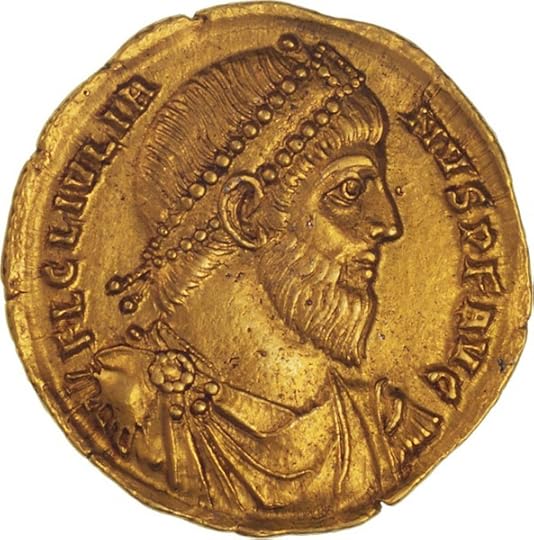
This portrayal of one of antiquity’s most enigmatic figures offers a vivid and compact assessment of the Apostate’s life and reign. Proceeding directly from an evaluation of the ancient sources―the testimony of friends and enemies of Julian as well as the writings of the emperor himself―the author traces Julian’s youth, his years as the commander of the Roman forces in Gaul, and his emergence as sole ruler in the course of a dramatic march to Constantinople. In G. W. Bowersock’s analysis of Julian’s religious revolution, the emperor’s ardent espousal of a lost cause is seen to have made intolerable demands upon pagans, Jews, and Christians alike.
Glen Warren Bowersock is a contemporary American scholar of the ancient world. He is the author of over a dozen books and has published over 300 articles on Greek, Roman, and Near Eastern history and culture as well as the classical tradition.
Julian (330/1-363), last of the Constantinian line Julian, Seeing Indifference "Seeing, then, that there is great indifference among us toward the gods" - he says with that solemn affect. Indifference. But what then did he expect? Let him organize religion as much as he pleased, let him write the high priest of Galatia as much as he pleased, or to others like him, exhorting, giving directions. His friends weren't Christians: that much is certain. But even so they weren't able to play the way that he did (brought up as a Christian) with the system of a new religion, ridiculous in theory and in practice. In the end they were Greeks. Nothing in excess, Augustus.
- C.P. Cavafy (trans. by Daniel Mendelsohn)
One of the most interesting and controversial figures of the later Roman Empire is Emperor Julian, called "the Apostate" in Christian tradition, the (half) nephew of Constantine the "Great" and the last of his line, all others having been killed off either by Constantine himself(*) or by his son and second in the Constantinian line, Constantius. Raised as a Christian whose mother tongue was Greek, Julian's love for Hellenistic culture became increasingly tightly bound to the old Greek religion, so that when he was acclaimed Augustus by his soldiers in Lutetia (Paris) and started moving his army to meet Constantius in battle he openly declared his religious fealty and announced his resolution to undo the suppression of the old religion initiated by Constantine and eagerly continued by Constantius. And he did what he could to carry out his resolution during his brief reign (approximately 18 months) as Emperor, so Julian was demonized by Christians and deified by "pagans" after his early death. Thus very quickly the facts of his life became swamped by a tsunami of propaganda from both sides. These mutually contradictory legends have provided a gold mine for later polemicists, poets and novelists who have taken what they wanted from this swirling mass and invented the rest.
In Julian the Apostate (1978) the noted classical historian G.W. Bowersock has made a careful analysis and evaluation of the sources(**) and brought together the most reliable to present a picture of Julian the man, the ruler and the reformer. Though Julian was an ascetic and a learned man like one of his heroes, Marcus Aurelius, I learned to my discomfiture that not only was he a disciple of the burgeoning school of Neo-Platonism, but he followed the branch of that mystical "philosophy" which stemmed from Iamblichus, the branch in which reason was held in the most disdain as a means to penetrate the mysteries of the world. A highly intelligent man, he was also irascible and vindictive whenever he was thwarted, which was not seldom since he was swimming against the tide. While preparing for his fatal campaign against the Persians (which was to be the beginning of an effort to extend the Roman Empire far to the East in imitation of his other great hero, Alexander the Great), he made Antioch his capital and forged grand plans for its transformation into the hub of the Empire. But not only was Antioch overwhelmingly Christian and unreceptive to his religious reforms, in just a few months he managed to alienate nearly its entire populace with his well-meaning but unworldly administrative and economic policies, policies that misapprehended the degree to which ordinary people have no desire to be abstemious zealots.
In 363 Julian, who had been an undefeated commander of the Roman armies in Gaul, led 90,000 men against the Persians. For a gripping account of that doomed campaign, in which Julian was killed by a spear thrown by an Arab in Persian service (according to Bowersock, that is the most reliable of the many stories that have entered into the legend) and in which the Persians reduced the proud Roman army to desperation during their long retreat back to Roman territory, I recommend the version in Ammianus Marcellinus' history, written shortly after the events and based upon eyewitness reports.
(*) Among many others, Constantine had his own son, Crispus, and his own wife, Fausta, killed.
(**) These include many texts from Julian's own hand, some of which I've read in the past week. Indeed, we have so many of his texts - edicts, letters, orations, and various more unusual texts that cannot be so simply characterized - that Bowersock asserts that we know the man better than any classical Roman with the exception of Cicero.
I feel like any book about Julian that perpetuates the label "apostate" must have a pro-Christian bias, and this one is no exception. It's a short and decent intro to the emperor Julian (though originally written in 1978, there is certainly newer scholarship about Julian out there). It's well-researched, but the authors bias against Julian definitely shows at some points. For example, it seems the author thinks that Julian's questions of consience when he went against Constantius were a bad thing. What about Constantius' consience when he murdered his family members (including Julian's relatives)? I suppose we all must look at the ancient world through the lens of our own experience and beliefs.
This was an entertaining and well-researched biography of the last pagan emperor of Rome. It is an academic work and not a piece of pop-history, but the material is so damned interesting even a scientist can enjoy (and has enjoyed) it.
It traces the unlikely rise of a humble scholar and academic philosopher to the imperial purple. Along the way he becomes a great war hero and also parts ways with his family's Christian religion. His Quixotic efforts to restore pagan religion, learning and culture to a world slipping into the dark ages, make him a most tragic and heroic character.
Some of his edicts meant to reign in Christians are very funny. He did not hurt anyone or persecute them, but rather he tried to help Christians in living up to their ideals (e.g. taking wealth from rich Bishops to distribute to the poor, etc.). When Christians attacked him he published a series of academic works to support the philosophical basis of his program (rather than tossing them all to the lions). Pretty good show!
A fair assessment, Bowestock seems to be very fair to Julian in the earlier stages of his life and his great successes in Gaul, but does not sugar-coat the complete failure of his religious policy (if his incoherent effort to make paganism the Roman state religion can be called that) or his disastrous campaign against the Persians which led to his own death. Julian should've stayed in Gaul.
The book is set out more or less as a chronological biography from Julian's birth to his accession to the throne as sole Augustus in 361. From there, it takes on a more thematic aspect as it describes his policies and movements throughout his time in Naissus, Constantinople and then on to Antioch, where the narrative picks up again and swiftly carries the emperor to his greatest triumph - against the Sassanid Persians at their own capital of Ctesiphon - and his final end on the return journey.
The major downside to this work is Bowersock's clear, at times vitriolic disdain for the Emperor Julian and many of his policies. In the early part of the book, he writes seemingly as an apologist for Constantius II, portraying him in a far more favourable light than most other historians of the period. He castes Julian in the mold of a zealot and a bigot, and eventually as a persecutor of Christians, something which most historians stop short of. This is not the book one should read first on Julian, as I can imagine it would colour one's views irrevocably against the man.
Despite this, however, Bowersock's writing is clear, his style engaging, and his research clearly meticulous. If one is able to see beyond the surface layer of strongly opinionated commentary, an incredible amount of knowledge in a short run of pages (only 119 for the main section) is revealed. For that reason, this is a must-read for anyone with a solid background knowledge of Julian, looking to learn more.
A good concise biography. This is a second reading of this for me - I finished a biography of Valens, who came after him, and Constantine, who came before, and thought that I would get more out of another reading. I did - the first time I read it was an introduction for me to the era, so I got a lot more out of it this time. My only complaint is that some of it is too brief - the author mentions that Julian was traumatized by the murder of his brother, but the book gives little information about him. However, I noticed the lack only on a second reading - when I was first reading it, I was found it really informative. So a good book on the subject, that makes me want to research more.
I think this is as far as I know the definitive biography and I'll be rereading it again. It's pretty dense but features some interesting dissections of where Julian's account of his life and elevation to the height of power differs from the facts in the historical record. He's also good at analyzing the few firsthand sources we have on this troubling figure in history.
I can't help but have a sneaking admiration for Julian. He tried . . . it was a lost cause, but he tried. Can't help but feel fond for an underdog, sometimes.