

What do you think?

Creepy Archives #1
Creepy Archives Volume 1
Gather up your wooden stakes, your blood-covered hatchets, and all the skeletons in the darkest depths of your closet, and prepare for a horrifying adventure into the darkest corners of comics history. Dark Horse Comics further corners the market on high-quality horror storytelling with one of the most anticipated releases of the decade - a hardcover archive collection of the legendary Creepy Magazine! This groundbreaking material turned the world of graphic storytelling on its head in the early 1960s, as phenomenal young artists like Bernie Wrightson and Neal Adams reached new artistic heights with their fascinating explorations of classic and modern horror stories.
248 pages, Paperback
First published September 3, 2008
About the author
Archie Goodwin
990 books73 followersArchie Goodwin was an American comic book writer, editor, and artist. He worked on a number of comic strips in addition to comic books, and is best known for his Warren and Marvel Comics work. For Warren he was chief writer and editor of landmark horror anthology titles Creepy and Eerie, and for Marvel he set up the creator-owned Epic Comics as well as adapting Star Wars into both comics and newspaper strips. He is regularly cited as the "best-loved comic book editor, ever."
Ratings & Reviews
Friends & Following
Create a free account to discover what your friends think of this book!
Community Reviews
Displaying 1 - 30 of 117 reviews
April 3, 2016
Year of the Goat: The CCA, EC Comics & Creepy
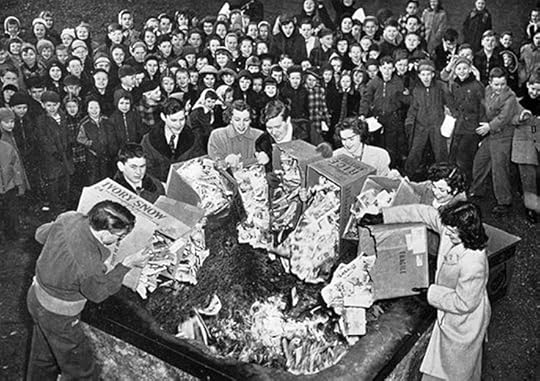
In 1954 a book was published about comics. It’s not recommended… for anyone, by anyone; but the over-the-top alarmist bullshit provides a modicum of entertainment, if you’re down for squeezing it from all the logic-leaping exposition and bad science. When it first hit the shelves it began getting press for its claims, and it was the kind of sensationalistic craziness the papers loved. So once the national controversy surrounding this book -- Dr. Fredric Wertham's 'Seduction of the Innocents' -- got loud enough, and frantic enough, the Kefauver 'Senate Sub-committee on Juvenile Delinquency' investigated Wertham's allegations concerning… comic-books. Evil comic books. His 'studies' are long debunked, now viewed solely as a historical and cultural footnote, a symptom of the paranoia and oppression that defined the earliest days of the Cold War. When the Soviets tested 'Joe 1' in 1949, it created a psychological climate that was a humid, dripping mess of anxiety. Every church was declaring the end to be fucking nigh. After the news in 1950 that it was American citizens -- most prominently, Julius and Ethel Rosenberg -- that were responsible for providing the USSR with the information they needed to build their own atomic bombs, the vibe was truly apocalyptic. Mistrust and conformity became the new national past-times.
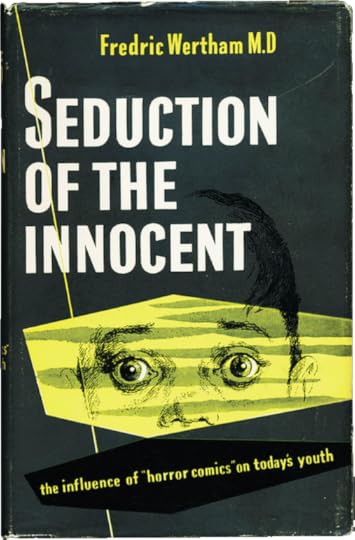
Seduction of the Innocent, by Dr. Fredric Wertham, the innocuous-looking CCA Seal of Approval, and a classic Johnny Craig E.C. cover that was used as evidence of ‘mind-warping’ imagery supposedly turning little Opie Taylor-looking motherfuckers into Anton Chigurh:


When the Rosenberg's were executed as traitors in 1953, the Red Scare had essentially scared America Red. Nobody was 'vive'-ing 'la difference'. Normalcy was an obsession. So when Sen. Joseph McCarthy found he could exploit national anxieties to his own advantage, he soon mastered the fine art of scapegoating and fear-mongering. His career as demagogue and Commie-hunter began with a drunken 1950 speech to the Republican Women's Club of Wheeling, West Virginia. After dramatically showing off a piece of paper like it meant something, he dropped a bomb of his own… claiming it was a list of 205 names, all of them working for the State Department, all of them known Communists. Given his complete irrelevance at the time, and his penchant for drunken bloviating, I don't think he realized what an effect his little stunt might have. His bullshit was front-page news around the country. Over the next couple years McCarthy surfed the wave of bullshit his dumb remarks had generated, fine-tuning his lies and accusations for maximum impact. The number of names included on this 'List of the Traitorous and Damned' changed inexplicably; McCarthy used it as a weapon to intimidate, threaten and blackmail his political adversaries. No one knew if it was truly a loaded gun in his pocket or just his greasy finger, but no one called his bluff. After a while, just being accused meant your life was over. Proof was an unnecessary hassle. He was a powerful and influential person for the years that McCarthyism was working its way through the digestive tract of American politics. But the definition of McCarthyism in 2016 is "the practice of making accusations of subversion or treason without proper regard for evidence". It also means "the practice of making unfair allegations or using unfair investigative techniques, especially in order to restrict dissent or political criticism". It also means ‘douchebag’.
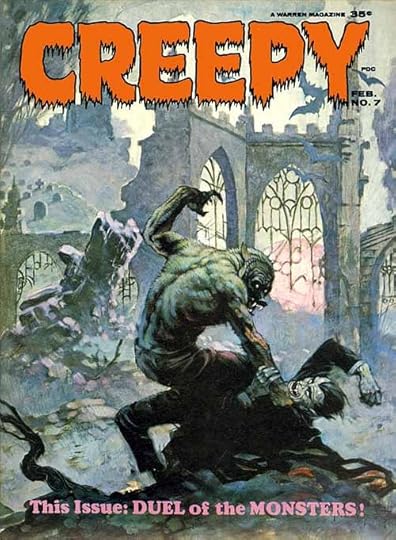
Frank Frazetta covers, from the Creepy and Eerie Archives:

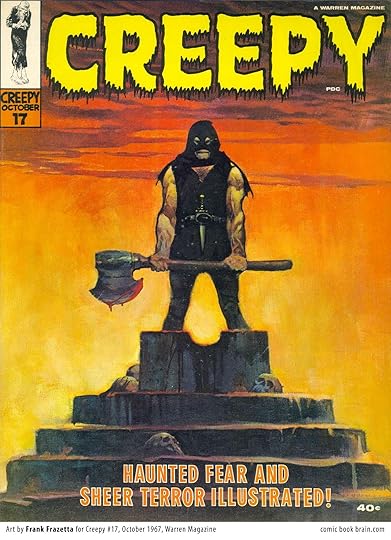
Wertham's book came at the perfect time. The Rosenberg's had been executed the year before, the US was deep into the Cold War, and deeper into a real war against freshly-minted Korean and Chinese Communists. Hollywood was having 'commie problems' of its own. 1955 would be the year of the Goat... and McCarthy-style scapegoating and fear-mongering proved doubly effective in Wertham's white fucking labcoat. According to 'Seduction of the Innocents', Batman was a pedophile and The Boy Wonder was his victim, and horror comics were creating an epidemic of psychopathic pre-teen perverts who would destroy America. You'd think people might've scoffed at Wertham's crazy-ass claims... but instead, comic-book bonfires -- eerily reminiscent of Nazi book-burnings -- were organized across the US. 1955 saw the big companies toning down the gore after the public vilification of William Gaines and EC, but the entire comics medium had been successfully demonized, and sales dropped accordingly.
Alex Toth, from the Creepy and Eerie Archives:


EC Comics was responsible for many of the best-selling and best-loved titles in the spinner rack, and for spear-heading the horror trend; they also took the biggest hits during the hearings. Competing publishers, including Stan Lee at Timely, were suddenly eager to give young EC publisher William Gaines all the credit: they claimed EC kept pushing deeper into gruesome and bloody subject matter, and they were just trying to keep up, even though they were disgusted by EC's tactics. So EC became the enemy, the scapegoat offered up to appease the beast. In order to escape government censorship, the industry would be in charge of regulating itself, with strict guidelines drafted and enforced by the 'Comics Code Authority'. Technically, they had little true authority. Comic publishers didn't have to submit issues for approval before printing, and all the CCA could do to books that didn't pass inspection was withhold the CCA 'Seal of Approval' until the suggested changes were made. That, however, was a much bigger obstacle to doing business than it initially appeared.
Gene Colan, from the Creepy and Eerie Archives:

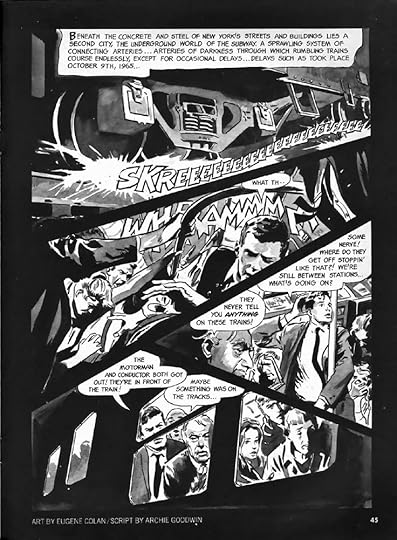

In fact, without the seal, a comic-book publisher was fucked. The national distributors in charge of getting newspapers, magazines and comics to the thousands of stores and news-stands across the country wouldn't ship a comic without the seal. The CCA was run by EC's biggest competitors, upstanding and self-righteous pricks like the owner and creator of Archie Comics. Because the CCA was made up of industry big-shots, and the Government had made its wishes clear to the national distributors that any comics not bearing the seal should be refused, the CCA became an oligarchy. The commission had handed an arbitrary few some badges, swore them in as sherifficutioners, & gave them the weapons to shoot down the black hats themselves... and EC was public enemy No. 1. The first moves they made specifically targeted and killed EC's most popular titles. Certain words were no longer permissible for comic-book titles: crypt, horror, terror, weird, crime, combat, shock... there was no pretense of logic or impartiality. 'Tales from the Crypt', 'Vault of Horror', 'Crime Suspenstories', 'Weird Science' and 'Frontline Combat' were gone. The 'New Trend' books were dead. Gaines and Feldstein replaced them with the post-CCA 'New Direction' books, which were actually great. 'Valor' continued with historical adventure similar to the 'Two Fisted Tales' and 'Frontline Combat' model Harvey Kurtzman has established, and 'Extra' followed a team of fictional reporters investigating strange stories from around the world, a ground-breaking idea for the time. Some of the best stories EC published came from this oppressive environment, like Bernie Krigstein's 'Master Race' and 'The Flying Machine'. But trying to rebuild their entire line from scratch had the financially devastating effect the CCA was hoping for. In order to protect 'Mad', the irreverent humor comic created by Harvey Kurtzman, Gaines made a tough decision. It had no chance of escaping the scrutiny and censorship of the CCA, so 'Mad' went from being a four-color comic-book to a black-and-white magazine. By changing format, it no longer required CCA approval for distribution, and was able to get away with the satirical silliness and Kurtzman-style shenanigans that have made it an anti-establishment establishment for over 60 years. For fans of the crazy and endlessly inventive crime, science fiction and horror comics that EC did better than anyone, it was a grim fucking scene.
Steve Ditko, from the Creepy and Eerie Archives:


A few years later, however, things were starting to relax, as the American public grew a little more comfortable with the prospect of nuclear annihilation. The US and USSR were the world’s first nuclear super powers, after all, and the price of their plutonium thrones and an uneasy peace would be living with a radioactive Sword of Damocles hanging over every American head. So be it. Religious types were still doing what they always do, twisting scriptures into prophecy-in-hindsight, and claiming the bible spelled it out clearly that the apocalypse was still extremely fucking nigh. Even though their understanding of Book-of-Revelations-type imagery only worked after shit had already gone down – making it absolutely useless and not really prophetic – they still found plenty of frightened lemmings to follow them over the edge of logic and take the long drop into the pit of religious bullshit. Ignorance and fear are like gasoline in the religious engine. As the sixties began, more people were deciding that the culture of fear and conformity had caused more harm than good. God was an anachronism. Life and our short time on Earth was precious. Carpe Diem, blah, blah. Kennedy’s presidency was an expression of newly empowered youth and optimism, and people bought into the Camelot thing. The Summer of Love was a few years away, but the Beat Generation of poets and novelists were writing strange and dangerous shit about pot and heroin and jazz, and Elvis Presley, the Beatles and the Rolling Stones were freaking out the squares. The reactionary conservatives were still doing the Helen Lovejoy thing and begging ‘someone to think of the children’, but now they had better shit to bitch about than comics. So… a kid named Archie Goodwin decided the time was right to bring the kind of horror, science fiction and war comics that E.C. had done so well back from the dead.
Gray Morrow, from the Creepy and Eerie Archives:
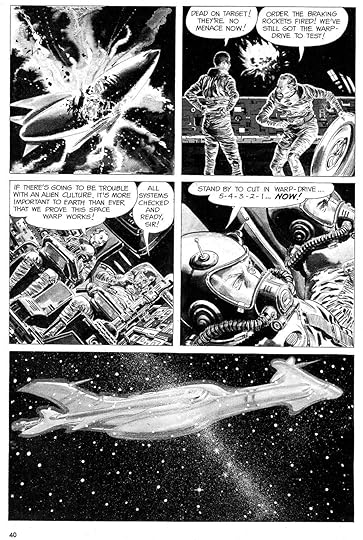

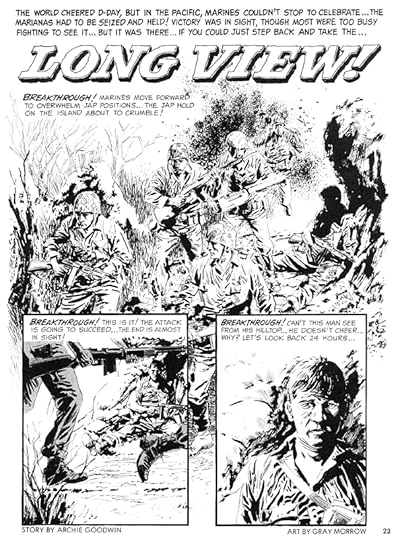
Working first as a writer, Goodwin did most of the stories in the first couple issues, bringing his favorite artists on board by tailoring the material to their strengths and preferences. His skills as writer and talent-wrangler quickly established him as the obvious pick for editor on Creepy and Eerie. Publisher Al Warren was a far fucking cry from E.C. head Bill Gaines, who genuinely believed in making the best comics he possibly could, promoting his artists publicly and giving them the credit they deserved. He also paid better than other publishers, which goes a long way in inspiring artist loyalty. Warren Publishing did not have that sort of reputation. What they did have was Archie Goodwin, whose skills as a writer and passion for the material was hard to deny; by re-uniting the E.C. ‘New Trend’ stars, the best of the other pre-code horror artists, and some of the most promising young artists of the time, he made his first important entry in the annals of the comic medium. Maybe Goodwin was just remarkably convincing, or perhaps times really were that tough, in the comic-book dead-zone of the mid-fifties and early sixties. Either way, the first couple years of ‘Creepy’ had some of the most impressive comic art of the period, selling well enough for Warren to greenlight a second horror anthology, named ‘Eerie’. Each book had their own Feldstein-style host – Uncle Creepy and Cousin Eerie – designed by the legendary Jack Davis, who also provided the first fully-painted covers. While the repressive Eisenhower-era societal attitudes were relaxing slightly, a standard 4-color comic like ‘Tales from the Crypt’ was out of the question. Instead, they followed the example of ‘Mad’, which was still pushing boundaries in the 60’s with Al Feldstein as editor… shit they could get away with as a black & white magazine.
John Severin, from the Creepy and Eerie Archives:
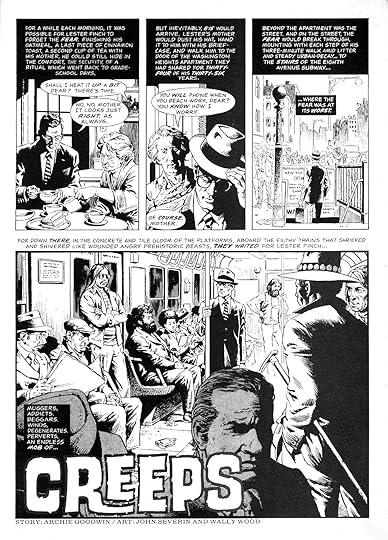
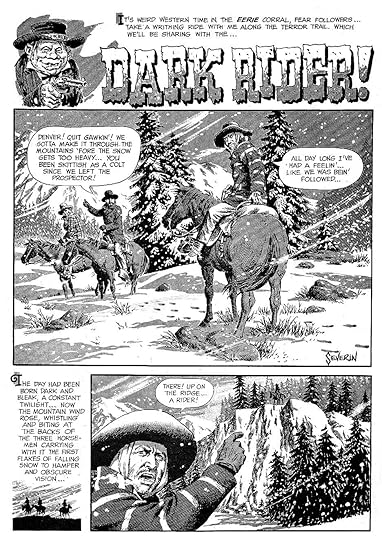
The ‘Creepy Archives’ and ‘Eerie Archives’, published by Dark Horse as beautifully designed 8 x 11-inch hardcovers with coated art-book paper-stock, reproduce each issue exactly, including the covers, ads and letter pages. The Creepy and Eerie Archives are now well past Volume 20 for both titles, but the material collected in the first four volumes of Creepy and the first three volumes of Eerie is light years beyond the later issues. Artists like Richard Corben and Bernie Wrightson would provide some stellar work in the 70’s, but the volumes collecting the ‘Archie Goodwin period’ are essential. The painted covers by Frank Frazetta are some of his best, and the stories illustrated by Frazetta are amongst the last examples. The way each artist embraces the black and white format is spectacular. Steve Ditko is one of several to use ink-wash grey-tones with superb results; Ditko is at his peak. Gene Colan use of washes gives his stories a painterly brilliance that is absolutely stunning. Colan’s artwork was a revelation, matched only by Alex Toth. Toth’s status as one of the masters of the medium is best exemplified in these volumes. Toth is one of those artists who doesn’t have a big, famous title in his resume, but is still widely acknowledged to be one of the greats. Dark Horse borrowed an idea Heavy Metal Magazine came up with, and put together some ‘Creepy Presents…’ collections in a format that matches the Archives. The first one was similar to the original Heavy Metal volume that collected material from Richard Corben’s Creepy and Eerie contributions, followed by volumes devoted to Bernie Wrightson, Alex Toth, and Steve Ditko. The list of contributors for the first few volumes worth of issues is fucking crazy, a super-dense convocation of comic-book-legends-under-construction; Goodwin wanted an E.C. revival, and managed to gather the most impressive group of artists to work under one banner: Frank Frazetta, Jack Davis, Wally Wood, Johnny Craig, Al Williamson, John Severin, Reed Crandall, George Evans, Dan Adkins, Steve Ditko, Gray Morrow, Gil Kane, Joe Orlando, Neal Adams, Alex Toth, Gene Colan, Angelo Torres, Jeff Jones… the list gets longer after Volumes 4 and 3 of Creepy and Eerie, respectively, but the ‘stars’ become harder to find after the mid-sixties; Timely Comics was now Marvel comics, and Stan Lee’s vision of the Marvel Universe was ambitious… luring away many of the best and Creepiest artists from Warren. Goodwin was no longer editor, and without him, Warren’s terrible page-rates didn’t cut it.
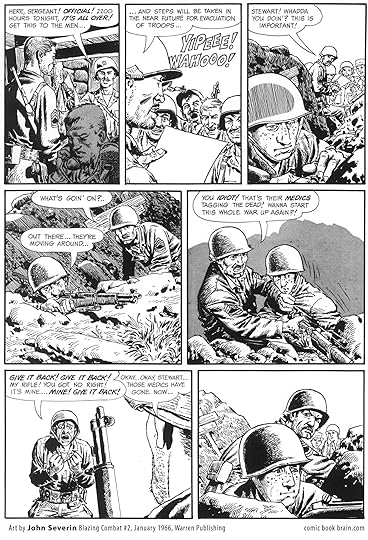
Blazing Combat! The first of the four classic Frazetta covers, Gene Colan, Wally Wood doing aviation combat with his typical perfection, and a spectacular example of Russ Heath’s talents:


With Creepy and Eerie doing horror, SF and fantasy, Goodwin was determined to do an anthology that would continue the seminal ‘anti-war’ comics pioneered brilliantly by Harvey Kurtzman’s ‘Two-Fisted Tales’ and ‘Frontline Combat’. Like Kurtzman, Goodwin’s scripts for issues 1-4 of ‘Blazing Combat’ never did any of the obvious moralizing you’d find in a ‘Chick Tract’. It didn’t have to. Instead, he told stories that were grittily realistic for the time, illustrating the horror, futility and indignity of war, when other comics were essentially war-hawk propaganda. Goodwin’s stories were critically well-received and a commercial success. The artwork is perhaps the best of any 4 issues published by Warren or E.C., with ‘Frontline Combat’ and ‘Two-Fisted Tales’ veterans John Severin, Alex Toth and Wally Wood giving virtuoso pen-and-ink performances; but it’s a newcomer at the time, Russ Heath, who turns in the most impressive pages. With the Vietnam War starting to heat up, and the voice of dissent struggling to make itself heard, ‘Blazing Combat’ was just controversial enough to get the wrong kind of attention… and history repeated itself, sort of. A veterans group complained, the distributors refused to ship it, and the best war comic of the sixties was dead after four issues. Fantagraphics has an excellent collection available.
In 1954 a book was published about comics. It’s not recommended… for anyone, by anyone; but the over-the-top alarmist bullshit provides a modicum of entertainment, if you’re down for squeezing it from all the logic-leaping exposition and bad science. When it first hit the shelves it began getting press for its claims, and it was the kind of sensationalistic craziness the papers loved. So once the national controversy surrounding this book -- Dr. Fredric Wertham's 'Seduction of the Innocents' -- got loud enough, and frantic enough, the Kefauver 'Senate Sub-committee on Juvenile Delinquency' investigated Wertham's allegations concerning… comic-books. Evil comic books. His 'studies' are long debunked, now viewed solely as a historical and cultural footnote, a symptom of the paranoia and oppression that defined the earliest days of the Cold War. When the Soviets tested 'Joe 1' in 1949, it created a psychological climate that was a humid, dripping mess of anxiety. Every church was declaring the end to be fucking nigh. After the news in 1950 that it was American citizens -- most prominently, Julius and Ethel Rosenberg -- that were responsible for providing the USSR with the information they needed to build their own atomic bombs, the vibe was truly apocalyptic. Mistrust and conformity became the new national past-times.
Seduction of the Innocent, by Dr. Fredric Wertham, the innocuous-looking CCA Seal of Approval, and a classic Johnny Craig E.C. cover that was used as evidence of ‘mind-warping’ imagery supposedly turning little Opie Taylor-looking motherfuckers into Anton Chigurh:
When the Rosenberg's were executed as traitors in 1953, the Red Scare had essentially scared America Red. Nobody was 'vive'-ing 'la difference'. Normalcy was an obsession. So when Sen. Joseph McCarthy found he could exploit national anxieties to his own advantage, he soon mastered the fine art of scapegoating and fear-mongering. His career as demagogue and Commie-hunter began with a drunken 1950 speech to the Republican Women's Club of Wheeling, West Virginia. After dramatically showing off a piece of paper like it meant something, he dropped a bomb of his own… claiming it was a list of 205 names, all of them working for the State Department, all of them known Communists. Given his complete irrelevance at the time, and his penchant for drunken bloviating, I don't think he realized what an effect his little stunt might have. His bullshit was front-page news around the country. Over the next couple years McCarthy surfed the wave of bullshit his dumb remarks had generated, fine-tuning his lies and accusations for maximum impact. The number of names included on this 'List of the Traitorous and Damned' changed inexplicably; McCarthy used it as a weapon to intimidate, threaten and blackmail his political adversaries. No one knew if it was truly a loaded gun in his pocket or just his greasy finger, but no one called his bluff. After a while, just being accused meant your life was over. Proof was an unnecessary hassle. He was a powerful and influential person for the years that McCarthyism was working its way through the digestive tract of American politics. But the definition of McCarthyism in 2016 is "the practice of making accusations of subversion or treason without proper regard for evidence". It also means "the practice of making unfair allegations or using unfair investigative techniques, especially in order to restrict dissent or political criticism". It also means ‘douchebag’.
Frank Frazetta covers, from the Creepy and Eerie Archives:
Wertham's book came at the perfect time. The Rosenberg's had been executed the year before, the US was deep into the Cold War, and deeper into a real war against freshly-minted Korean and Chinese Communists. Hollywood was having 'commie problems' of its own. 1955 would be the year of the Goat... and McCarthy-style scapegoating and fear-mongering proved doubly effective in Wertham's white fucking labcoat. According to 'Seduction of the Innocents', Batman was a pedophile and The Boy Wonder was his victim, and horror comics were creating an epidemic of psychopathic pre-teen perverts who would destroy America. You'd think people might've scoffed at Wertham's crazy-ass claims... but instead, comic-book bonfires -- eerily reminiscent of Nazi book-burnings -- were organized across the US. 1955 saw the big companies toning down the gore after the public vilification of William Gaines and EC, but the entire comics medium had been successfully demonized, and sales dropped accordingly.
Alex Toth, from the Creepy and Eerie Archives:
EC Comics was responsible for many of the best-selling and best-loved titles in the spinner rack, and for spear-heading the horror trend; they also took the biggest hits during the hearings. Competing publishers, including Stan Lee at Timely, were suddenly eager to give young EC publisher William Gaines all the credit: they claimed EC kept pushing deeper into gruesome and bloody subject matter, and they were just trying to keep up, even though they were disgusted by EC's tactics. So EC became the enemy, the scapegoat offered up to appease the beast. In order to escape government censorship, the industry would be in charge of regulating itself, with strict guidelines drafted and enforced by the 'Comics Code Authority'. Technically, they had little true authority. Comic publishers didn't have to submit issues for approval before printing, and all the CCA could do to books that didn't pass inspection was withhold the CCA 'Seal of Approval' until the suggested changes were made. That, however, was a much bigger obstacle to doing business than it initially appeared.
Gene Colan, from the Creepy and Eerie Archives:
In fact, without the seal, a comic-book publisher was fucked. The national distributors in charge of getting newspapers, magazines and comics to the thousands of stores and news-stands across the country wouldn't ship a comic without the seal. The CCA was run by EC's biggest competitors, upstanding and self-righteous pricks like the owner and creator of Archie Comics. Because the CCA was made up of industry big-shots, and the Government had made its wishes clear to the national distributors that any comics not bearing the seal should be refused, the CCA became an oligarchy. The commission had handed an arbitrary few some badges, swore them in as sherifficutioners, & gave them the weapons to shoot down the black hats themselves... and EC was public enemy No. 1. The first moves they made specifically targeted and killed EC's most popular titles. Certain words were no longer permissible for comic-book titles: crypt, horror, terror, weird, crime, combat, shock... there was no pretense of logic or impartiality. 'Tales from the Crypt', 'Vault of Horror', 'Crime Suspenstories', 'Weird Science' and 'Frontline Combat' were gone. The 'New Trend' books were dead. Gaines and Feldstein replaced them with the post-CCA 'New Direction' books, which were actually great. 'Valor' continued with historical adventure similar to the 'Two Fisted Tales' and 'Frontline Combat' model Harvey Kurtzman has established, and 'Extra' followed a team of fictional reporters investigating strange stories from around the world, a ground-breaking idea for the time. Some of the best stories EC published came from this oppressive environment, like Bernie Krigstein's 'Master Race' and 'The Flying Machine'. But trying to rebuild their entire line from scratch had the financially devastating effect the CCA was hoping for. In order to protect 'Mad', the irreverent humor comic created by Harvey Kurtzman, Gaines made a tough decision. It had no chance of escaping the scrutiny and censorship of the CCA, so 'Mad' went from being a four-color comic-book to a black-and-white magazine. By changing format, it no longer required CCA approval for distribution, and was able to get away with the satirical silliness and Kurtzman-style shenanigans that have made it an anti-establishment establishment for over 60 years. For fans of the crazy and endlessly inventive crime, science fiction and horror comics that EC did better than anyone, it was a grim fucking scene.
Steve Ditko, from the Creepy and Eerie Archives:
A few years later, however, things were starting to relax, as the American public grew a little more comfortable with the prospect of nuclear annihilation. The US and USSR were the world’s first nuclear super powers, after all, and the price of their plutonium thrones and an uneasy peace would be living with a radioactive Sword of Damocles hanging over every American head. So be it. Religious types were still doing what they always do, twisting scriptures into prophecy-in-hindsight, and claiming the bible spelled it out clearly that the apocalypse was still extremely fucking nigh. Even though their understanding of Book-of-Revelations-type imagery only worked after shit had already gone down – making it absolutely useless and not really prophetic – they still found plenty of frightened lemmings to follow them over the edge of logic and take the long drop into the pit of religious bullshit. Ignorance and fear are like gasoline in the religious engine. As the sixties began, more people were deciding that the culture of fear and conformity had caused more harm than good. God was an anachronism. Life and our short time on Earth was precious. Carpe Diem, blah, blah. Kennedy’s presidency was an expression of newly empowered youth and optimism, and people bought into the Camelot thing. The Summer of Love was a few years away, but the Beat Generation of poets and novelists were writing strange and dangerous shit about pot and heroin and jazz, and Elvis Presley, the Beatles and the Rolling Stones were freaking out the squares. The reactionary conservatives were still doing the Helen Lovejoy thing and begging ‘someone to think of the children’, but now they had better shit to bitch about than comics. So… a kid named Archie Goodwin decided the time was right to bring the kind of horror, science fiction and war comics that E.C. had done so well back from the dead.
Gray Morrow, from the Creepy and Eerie Archives:
Working first as a writer, Goodwin did most of the stories in the first couple issues, bringing his favorite artists on board by tailoring the material to their strengths and preferences. His skills as writer and talent-wrangler quickly established him as the obvious pick for editor on Creepy and Eerie. Publisher Al Warren was a far fucking cry from E.C. head Bill Gaines, who genuinely believed in making the best comics he possibly could, promoting his artists publicly and giving them the credit they deserved. He also paid better than other publishers, which goes a long way in inspiring artist loyalty. Warren Publishing did not have that sort of reputation. What they did have was Archie Goodwin, whose skills as a writer and passion for the material was hard to deny; by re-uniting the E.C. ‘New Trend’ stars, the best of the other pre-code horror artists, and some of the most promising young artists of the time, he made his first important entry in the annals of the comic medium. Maybe Goodwin was just remarkably convincing, or perhaps times really were that tough, in the comic-book dead-zone of the mid-fifties and early sixties. Either way, the first couple years of ‘Creepy’ had some of the most impressive comic art of the period, selling well enough for Warren to greenlight a second horror anthology, named ‘Eerie’. Each book had their own Feldstein-style host – Uncle Creepy and Cousin Eerie – designed by the legendary Jack Davis, who also provided the first fully-painted covers. While the repressive Eisenhower-era societal attitudes were relaxing slightly, a standard 4-color comic like ‘Tales from the Crypt’ was out of the question. Instead, they followed the example of ‘Mad’, which was still pushing boundaries in the 60’s with Al Feldstein as editor… shit they could get away with as a black & white magazine.
John Severin, from the Creepy and Eerie Archives:
The ‘Creepy Archives’ and ‘Eerie Archives’, published by Dark Horse as beautifully designed 8 x 11-inch hardcovers with coated art-book paper-stock, reproduce each issue exactly, including the covers, ads and letter pages. The Creepy and Eerie Archives are now well past Volume 20 for both titles, but the material collected in the first four volumes of Creepy and the first three volumes of Eerie is light years beyond the later issues. Artists like Richard Corben and Bernie Wrightson would provide some stellar work in the 70’s, but the volumes collecting the ‘Archie Goodwin period’ are essential. The painted covers by Frank Frazetta are some of his best, and the stories illustrated by Frazetta are amongst the last examples. The way each artist embraces the black and white format is spectacular. Steve Ditko is one of several to use ink-wash grey-tones with superb results; Ditko is at his peak. Gene Colan use of washes gives his stories a painterly brilliance that is absolutely stunning. Colan’s artwork was a revelation, matched only by Alex Toth. Toth’s status as one of the masters of the medium is best exemplified in these volumes. Toth is one of those artists who doesn’t have a big, famous title in his resume, but is still widely acknowledged to be one of the greats. Dark Horse borrowed an idea Heavy Metal Magazine came up with, and put together some ‘Creepy Presents…’ collections in a format that matches the Archives. The first one was similar to the original Heavy Metal volume that collected material from Richard Corben’s Creepy and Eerie contributions, followed by volumes devoted to Bernie Wrightson, Alex Toth, and Steve Ditko. The list of contributors for the first few volumes worth of issues is fucking crazy, a super-dense convocation of comic-book-legends-under-construction; Goodwin wanted an E.C. revival, and managed to gather the most impressive group of artists to work under one banner: Frank Frazetta, Jack Davis, Wally Wood, Johnny Craig, Al Williamson, John Severin, Reed Crandall, George Evans, Dan Adkins, Steve Ditko, Gray Morrow, Gil Kane, Joe Orlando, Neal Adams, Alex Toth, Gene Colan, Angelo Torres, Jeff Jones… the list gets longer after Volumes 4 and 3 of Creepy and Eerie, respectively, but the ‘stars’ become harder to find after the mid-sixties; Timely Comics was now Marvel comics, and Stan Lee’s vision of the Marvel Universe was ambitious… luring away many of the best and Creepiest artists from Warren. Goodwin was no longer editor, and without him, Warren’s terrible page-rates didn’t cut it.
Blazing Combat! The first of the four classic Frazetta covers, Gene Colan, Wally Wood doing aviation combat with his typical perfection, and a spectacular example of Russ Heath’s talents:
With Creepy and Eerie doing horror, SF and fantasy, Goodwin was determined to do an anthology that would continue the seminal ‘anti-war’ comics pioneered brilliantly by Harvey Kurtzman’s ‘Two-Fisted Tales’ and ‘Frontline Combat’. Like Kurtzman, Goodwin’s scripts for issues 1-4 of ‘Blazing Combat’ never did any of the obvious moralizing you’d find in a ‘Chick Tract’. It didn’t have to. Instead, he told stories that were grittily realistic for the time, illustrating the horror, futility and indignity of war, when other comics were essentially war-hawk propaganda. Goodwin’s stories were critically well-received and a commercial success. The artwork is perhaps the best of any 4 issues published by Warren or E.C., with ‘Frontline Combat’ and ‘Two-Fisted Tales’ veterans John Severin, Alex Toth and Wally Wood giving virtuoso pen-and-ink performances; but it’s a newcomer at the time, Russ Heath, who turns in the most impressive pages. With the Vietnam War starting to heat up, and the voice of dissent struggling to make itself heard, ‘Blazing Combat’ was just controversial enough to get the wrong kind of attention… and history repeated itself, sort of. A veterans group complained, the distributors refused to ship it, and the best war comic of the sixties was dead after four issues. Fantagraphics has an excellent collection available.

March 18, 2021
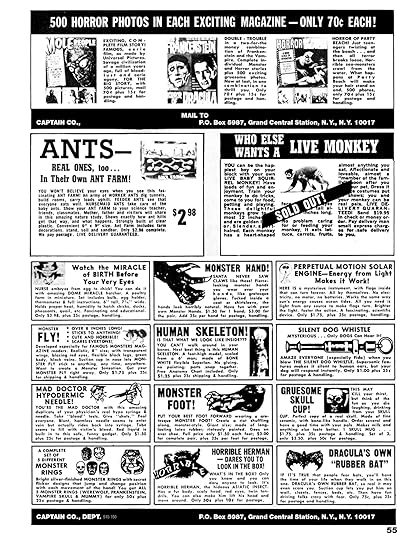
I love these little horror vignettes of old. The art's great too and the lack of color just adds to the atmosphere. There's some industry heavyweights of the time contributing to these stories too. Archie Goodwin, Al Williamson, Alex Toth, Gray Morrow. Frank Frazetta's last paneled comic book art is in this collection too. After this it's covers only. I also dig that Dark Horse reprinted the advertisements for all the goofy gadgets they used to sell in Creepy too.


March 29, 2013
When I was growing up, anything that smacked of horror was forbidden in my family. The only comic books allowed were Illustrated Classics and Disney. However my lifelong obsession with horror fiction began at the age of 6 when a babysitter allowed me to watch the movie Frankenstein while my parents were out. I was hooked. I was an avid reader even then and I devoured anything I could as I got older including classic horror like Poe and those great paperback Alfred Hitchcock Presents story collections that I could buy for 50 cents and hide under the mattress. As for comic books, I would read my friends' collections although Spiderman was the only one I really got into.
One day on a boy scout camping tip, one of the scouts brought along a couple issues of Creepy. We pored over them by flashlight in our tent. We never saw anything like it. Here were really scary stories perfect for the 14 year old male mentality. The gore was not as excessive as the earlier EC Comics, which we were then unaware of, but certainly more than kids in the mid 60s were familiar with. But what really stood out was the art. This was not Blondie and Dagwood. This was intricate lines and shadows all in black-and-white, perfect to illustrate horror. These magazines, not called comic books in order to get past the strict comic book codes, were not that easy to come by even then. So I have only seen 4 or 5 of them...until now.
Creepy Archives, Vol. 1 features the first five issues. The full run is slowly being republished by Dark Horse. They are not cheap. The Kindle edition goes for a ridiculous $29.95! Fortunately for me, they are currently on sale at Amazon for a much better $3.99. That probably won't last by the time you read this. The color covers, mostly by Frank Frazzeta, and the intricate black and white drawings show up beautifully on my Kindle Fire. They are definitely a blast from the past. As for the writing, it was perfect for a teenage boy in the 60s but seem very dated and a bit campy now. At their worse, the stories are hokey but at their best, when coupled with those great drawings, they are wonderfully...well...creepy. Most are original tales written by Archie Goodwin but there are a few renditions of classic tales including Poe's "Tell-Tale Heart" and Ambrose Pierce's "The Damned Thing". The tales can get a little formulaic. After all, they had to be delivered in 6 to 7 pages of drawings. Usually the monster twist was very obvious and the bad guy always got his just dessert if usually in a gory way. Yet these were part of the 60s coming-of-age for many of us and no doubt for later writers, artists and film makers. This is a must for any horror fan.
One day on a boy scout camping tip, one of the scouts brought along a couple issues of Creepy. We pored over them by flashlight in our tent. We never saw anything like it. Here were really scary stories perfect for the 14 year old male mentality. The gore was not as excessive as the earlier EC Comics, which we were then unaware of, but certainly more than kids in the mid 60s were familiar with. But what really stood out was the art. This was not Blondie and Dagwood. This was intricate lines and shadows all in black-and-white, perfect to illustrate horror. These magazines, not called comic books in order to get past the strict comic book codes, were not that easy to come by even then. So I have only seen 4 or 5 of them...until now.
Creepy Archives, Vol. 1 features the first five issues. The full run is slowly being republished by Dark Horse. They are not cheap. The Kindle edition goes for a ridiculous $29.95! Fortunately for me, they are currently on sale at Amazon for a much better $3.99. That probably won't last by the time you read this. The color covers, mostly by Frank Frazzeta, and the intricate black and white drawings show up beautifully on my Kindle Fire. They are definitely a blast from the past. As for the writing, it was perfect for a teenage boy in the 60s but seem very dated and a bit campy now. At their worse, the stories are hokey but at their best, when coupled with those great drawings, they are wonderfully...well...creepy. Most are original tales written by Archie Goodwin but there are a few renditions of classic tales including Poe's "Tell-Tale Heart" and Ambrose Pierce's "The Damned Thing". The tales can get a little formulaic. After all, they had to be delivered in 6 to 7 pages of drawings. Usually the monster twist was very obvious and the bad guy always got his just dessert if usually in a gory way. Yet these were part of the 60s coming-of-age for many of us and no doubt for later writers, artists and film makers. This is a must for any horror fan.

August 24, 2023
Creepy was the spiritual successor to the EC comics of the fifties. Spawned by Jim Warren in the early 1970s, Creepy was host to EC veterans like Reed Crandall and Al Williamson as well as talented newcomers and future legends like Bernie Wrightson. This collects issues 1-5 of Creepy.
With Archie Goodwin writing the bulk of the tales, these stories are far easier reading than Al Feldstein's EC work. Aside from Otto Binder's Adam Link, there are no recurring characters. The stories are good but some of the variety EC had was missing. Five issues in and there are already too many vampire and werewolf stories for my tastes. Where are the double dealing husbands and wives?
Anyway, this is fun stuff with exquisite artwork. Now that they're putting these archives out in softcover, I'm all-in.
With Archie Goodwin writing the bulk of the tales, these stories are far easier reading than Al Feldstein's EC work. Aside from Otto Binder's Adam Link, there are no recurring characters. The stories are good but some of the variety EC had was missing. Five issues in and there are already too many vampire and werewolf stories for my tastes. Where are the double dealing husbands and wives?
Anyway, this is fun stuff with exquisite artwork. Now that they're putting these archives out in softcover, I'm all-in.
November 6, 2016
The art is quite good in this collection of issues 1-5 of Creepy magazine from the 1960's. However, the stories were formulaic. Each story is only a few pages long. Basically, someone acts like a jerk and on the final page some sort of horror twist occurs. The stories are all predictable, and the horror is pretty tame. Also, there is an over-reliance on vampires and other classic Hollywood monsters.

May 3, 2014
"Creepy" was a black and white horror anthology comic book series that began in 1964. It is clearly heavily influenced by "The Twilight Zone" which had just begun in 1959 and was still a big cultural force. The stories locales ranged from deep in the Bayou to the outer reaches of space. These stories frequently had classic monsters (vampires, werewolves, and zombies being the most popular). However, the one thing that all of the stories had was the big twist ending (duh, duh, duuuuuuuhhhhhhhh!) I'm a sucker for these and grew up loving them on "The Twilight Zone."
Because these comics were meant for kids you can see most of them coming a mile away but that didn't really take away from my enjoyment at all. The artistry is amazing! That's part of what makes "Creepy" so great: Art gallery level art with juvenile delinquent sensibilities.
If you've never read this, do yourself a favor and pick this collection up.
Because these comics were meant for kids you can see most of them coming a mile away but that didn't really take away from my enjoyment at all. The artistry is amazing! That's part of what makes "Creepy" so great: Art gallery level art with juvenile delinquent sensibilities.
If you've never read this, do yourself a favor and pick this collection up.

January 16, 2016
I was lucky and collected a full set of these magazines and got a chance to read the fantastic stories and enjoy the incredible art from many of the greats, many of who got their start here, from the comic world. If you like offbeat horror, supernatural, SiFi and just plan different stories then these are the magazines for you. Very recommended
September 27, 2014
I absolutely love horror anthology comics, and other than EC Comics, which I consider the best of all time in the genre, Warren was my favorite. This volume includes the first 5 issues and it's great. You do have some predictable stuff, some may be a little cheesy, but thats horror comics in general and part of the appeal.
The talent that worked on this series was also amazing. Frank Frazetta, Neal Adams, Berni Wrightson, and many more. The late Archie Goodwin did much of the writing, and he was really writing well at this time. The Warren books also used some of the old EC talent, going back to there roots to honor the masters of the craft.
As far as each story goes, it's the usual mix of Vampires, Werewolves, Witches, Ax Murderers and other various creatures of the night. I recommend this volume to anyone who likes horror comics, you just can't go wrong with this one.
The talent that worked on this series was also amazing. Frank Frazetta, Neal Adams, Berni Wrightson, and many more. The late Archie Goodwin did much of the writing, and he was really writing well at this time. The Warren books also used some of the old EC talent, going back to there roots to honor the masters of the craft.
As far as each story goes, it's the usual mix of Vampires, Werewolves, Witches, Ax Murderers and other various creatures of the night. I recommend this volume to anyone who likes horror comics, you just can't go wrong with this one.

October 31, 2018
This was a very nostalgic read, and the art was great, overall, but the writing was often pretty bad. Like other people are saying, the dialogue is flat and often overly explanatory. Why spoon feed us everything when there are drawings in every frame too? The blatant sexism and racism contributed to my distaste for the writing. I’d imagine it’s a product of its time, and that in 2018 I have a dramatically different worldview. I won’t be rushing to read volume two, but I’m not upset to have checked this out. Maybe I’ll revisit Tales from the Crypt and/or The Twilight Zone soon.

August 11, 2024
Chock full of the most splendid art in comics history !
Click here for a quick flick through the first issue:
https://youtu.be/61FjhtNxNzk

August 11, 2008
This hardcover compilation of the first six issues of the legendary horror magazine features amazing work from Frank Frazetta, Jack Davis, Joe Orlando, Al Williamson, Alex Toth, Gray Morrow, Angelo Torres, and Roy Krenkel. The volume, produced in the same oversized dimensions of the original magazine, includes the original color covers, advertisements, letters pages, and an interesting historical introduction by noted Warren magazine historian Jon B. Cooke. The Creepy Archives Volume 1 provides tantalizing insight into some of the finest horror ever produced.

April 2, 2017
Great!!! I had heard about these comics in fanzines and in forwards by Stephen King but they weren't really out there for my generation. If you liked Stephen King's Creep Show movies and Tales From The Crypt then these will feel like a slice of heaven from page 1; I can't wait to read the whole archived series. Thank you Hoopla!!!

July 15, 2010
Nice to see the earliest CREEPY magazines collected here. I have twenty-some battered copies of Creepy and EERIE magazines in my collection that I managed to save. Terrific covers. The stories are okay, sometimes corny, sometimes rushed, but always fun. I'll probably be getting future archives.

May 9, 2022
Such fun reading these short horror stories with a twist! The art is excellent and I can see hints of MAD Magazine in Uncle Creepy’s character.

April 9, 2023
2023 - 365 Days of Horror
Day 99 - Issue #1: ⭐️⭐️⭐️
When the Comics Code Authority cracked down on the comic book industry in 1955, horror comics all but faded from the scene. Enter Creepy magazine, publisher James Warren's tribute (after a fashion) to EC's vaunted horror comics line, which couldn't survive the Code's strong arm censorship tactics. Magazines weren't subject to the same rules, giving Warren the freedom to publish more mature content. Eerie, Vampirella, and other Warren publications followed. Stories in this first issue of Creepy include: Voodoo by Bill Pearson and Joe Orlando; H2O World! by Larry Ivie, Al Williamson, and Roy G. Krenkel; Vampires fly at Dusk! by Archie Goodwin and Reed Crandall; Werewolf! by Larry Ivie and Frank Frazetta; Bewitched! by Larry Ivie and Gray Morrow; The Success Story by Archie Goodwin and Al Williamson; and Pursuit of the Vampire! by Archie Goodwin and Angelo Torres. Features the first appearance of Uncle Creepy. Cover art by Jack Davis.
Day 100 - Issue #2: ⭐️⭐️⭐️
Issue #2. April 1965. Stories in this issue include: Fun and Games! by Archie Goodwin and Joe Orlando; Spawn of the Cat People by Archie Goodwin and Reed Crandall; Wardrobe of Monsters! by Otto Binder, Gray Morrow, and Angelo Torres; Welcome Stranger by Archie Goodwin and Al Williamson; I, Robot by Otto Binder and Joe Orlando; and Ogre's Castle by Archie Goodwin and Angelo Torres. Cover art by Frank Frazetta. 8.25" x 10.75". 48 pages. Black and white.
Day 101 - Issue #3: ⭐️⭐️⭐️⭐️
Issue #3. June 1965. Stories in this issue include: Swamped! by Archie Goodwin and Angelo Torres; Tell-Tale Heart by Archie Goodwin and Reed Crandall (from the story by Edgar Allan Poe); Howling Success! by Archie Goodwin and Angelo Torres; Haunted! by Archie Goodwin and Gray Morrow; Incident in the Beyond by Archie Goodwin and Gray Morrow; and Return Trip by Arthur Porges and Joe Orlando. Cover by Frank Frazetta. 8.25" x 10.75". 48 pages. Black and white.
Day 102 - Issue #4: ⭐️⭐️⭐️
Issue #4. August 1965. Stories in this issue include: Monster Rally! by Archie Goodwin and Al McWilliams; Blood and Orchids! by Archie Goodwin and Al McWilliams; The Damned Thing! by Archie Goodwin and Gray Morrow; Moon City! by Larry Englehart and Al McWilliams; Curse of the Full Moon! by Archie Goodwin and Reed Crandall; and The Trial of Adam Link! by Otto Binder and Joe Orlando. Cover art by Frank Frazetta. 8.25" x 10.75". 56 pages. Black and white.
Day 103 - Issue #5: ⭐️⭐️⭐️⭐️
Issue #5. October 1965. Stories in this issue include: Family Reunion! by Archie Goodwin and Joe Orlando; Untimely Tomb! by Archie Goodwin and Angelo Torres; Sand Doom by Archie Goodwin and Al Williamson; The Judge's House! by Archie Goodwin and Al Williamson (from the story by Bram Stoker); Grave Undertaking by Archie Goodwin and Al Williamson; and Revenge of the Beast! By Archie Goodwin and Gray Morrow. Cover art by Frank Frazetta. 8.25" x 10.75". 56 pages. Black and white.
Day 99 - Issue #1: ⭐️⭐️⭐️
When the Comics Code Authority cracked down on the comic book industry in 1955, horror comics all but faded from the scene. Enter Creepy magazine, publisher James Warren's tribute (after a fashion) to EC's vaunted horror comics line, which couldn't survive the Code's strong arm censorship tactics. Magazines weren't subject to the same rules, giving Warren the freedom to publish more mature content. Eerie, Vampirella, and other Warren publications followed. Stories in this first issue of Creepy include: Voodoo by Bill Pearson and Joe Orlando; H2O World! by Larry Ivie, Al Williamson, and Roy G. Krenkel; Vampires fly at Dusk! by Archie Goodwin and Reed Crandall; Werewolf! by Larry Ivie and Frank Frazetta; Bewitched! by Larry Ivie and Gray Morrow; The Success Story by Archie Goodwin and Al Williamson; and Pursuit of the Vampire! by Archie Goodwin and Angelo Torres. Features the first appearance of Uncle Creepy. Cover art by Jack Davis.
Day 100 - Issue #2: ⭐️⭐️⭐️
Issue #2. April 1965. Stories in this issue include: Fun and Games! by Archie Goodwin and Joe Orlando; Spawn of the Cat People by Archie Goodwin and Reed Crandall; Wardrobe of Monsters! by Otto Binder, Gray Morrow, and Angelo Torres; Welcome Stranger by Archie Goodwin and Al Williamson; I, Robot by Otto Binder and Joe Orlando; and Ogre's Castle by Archie Goodwin and Angelo Torres. Cover art by Frank Frazetta. 8.25" x 10.75". 48 pages. Black and white.
Day 101 - Issue #3: ⭐️⭐️⭐️⭐️
Issue #3. June 1965. Stories in this issue include: Swamped! by Archie Goodwin and Angelo Torres; Tell-Tale Heart by Archie Goodwin and Reed Crandall (from the story by Edgar Allan Poe); Howling Success! by Archie Goodwin and Angelo Torres; Haunted! by Archie Goodwin and Gray Morrow; Incident in the Beyond by Archie Goodwin and Gray Morrow; and Return Trip by Arthur Porges and Joe Orlando. Cover by Frank Frazetta. 8.25" x 10.75". 48 pages. Black and white.
Day 102 - Issue #4: ⭐️⭐️⭐️
Issue #4. August 1965. Stories in this issue include: Monster Rally! by Archie Goodwin and Al McWilliams; Blood and Orchids! by Archie Goodwin and Al McWilliams; The Damned Thing! by Archie Goodwin and Gray Morrow; Moon City! by Larry Englehart and Al McWilliams; Curse of the Full Moon! by Archie Goodwin and Reed Crandall; and The Trial of Adam Link! by Otto Binder and Joe Orlando. Cover art by Frank Frazetta. 8.25" x 10.75". 56 pages. Black and white.
Day 103 - Issue #5: ⭐️⭐️⭐️⭐️
Issue #5. October 1965. Stories in this issue include: Family Reunion! by Archie Goodwin and Joe Orlando; Untimely Tomb! by Archie Goodwin and Angelo Torres; Sand Doom by Archie Goodwin and Al Williamson; The Judge's House! by Archie Goodwin and Al Williamson (from the story by Bram Stoker); Grave Undertaking by Archie Goodwin and Al Williamson; and Revenge of the Beast! By Archie Goodwin and Gray Morrow. Cover art by Frank Frazetta. 8.25" x 10.75". 56 pages. Black and white.

November 23, 2011
This was absolutely my favorite comic book when I was growing up. Too bad that Dark Horse finally put out these archival volumes only AFTER I had spent several years and major money collecting ALL the original comic books, mostly on eBay. I never would have done it if high-quality reprints like these had been available back then.
As it turns out, my youthful tastes were not simply arbitrary: Creepy featured some of the greatest comic book artists ever, like Wallace Wood, Steve Ditko, Jerry Grandenetti, Dan Adkins, Gene Colan, Alex Toth, Bernie Wrightson, Richard Corben, Neal Adams . . . the list goes on and on.
What's more, Creepy was a black & white comic book. None of that crappy looking, blotchy four-color stuff that you saw in the old Marvel or DC comics. Black & white gives the reader a clear view of the artist's lines and shading. What's more, drawing and coloring are usually separate steps, executed by separate people in the comic book production process. The original artist would often have no idea how his work would ultimately look.
Another interesting feature of Creepy is that it was printed in full magazine size and displayed on magazine racks -- not comic book spinners -- to avoid the necessity of compliance with the Comics Code Authority. (So look out: there's plenty of gore and nudity, especially in the issues that were published during the 1970's.) The covers were usually masterful, full-color oil paintings by the likes of Frank Frazetta, Enrich, or Sanjulian. The full magazine size also helped showcase the incredible art work on the inside.
Dark Horse is now (at the time of this writing)up to Volume Eleven of the Creepy Archives. (Less than half way through, I'd guess: there were 145 issues of Creepy, in all, before the publisher's bankruptcy, circa 1983.) Creepy started out in 1964 as a gothic, traditional horror magazine, but slowly evolved into a more ground-breaking, occasionally post-modern, and often disturbing periodical. These reprints allow the reader to review that evolution in a convenient, hardbound format.
Not that you should have particularly high hopes for the writing. It's very difficult to do much in a stand-alone six or nine page comic book story that is targeted at 12 year old boys. Yet I think Creepy did remarkably well, given these limitations. (Beware: there are lots of bad puns and "trick" endings that will be sure to make your eyes roll.)
But that's what Creepy was all about: stand-alone short stories. There were no continuing characters to identify with, as in the typical superhero comic book. Which was great, because each magazine could feature several different artists and writers. And different genres could be mixed in for variety: typically horror, science fiction, or fantasy, with an occasional crime noir story.
If you love high-quality comic book art, you will love these volumes.
As it turns out, my youthful tastes were not simply arbitrary: Creepy featured some of the greatest comic book artists ever, like Wallace Wood, Steve Ditko, Jerry Grandenetti, Dan Adkins, Gene Colan, Alex Toth, Bernie Wrightson, Richard Corben, Neal Adams . . . the list goes on and on.
What's more, Creepy was a black & white comic book. None of that crappy looking, blotchy four-color stuff that you saw in the old Marvel or DC comics. Black & white gives the reader a clear view of the artist's lines and shading. What's more, drawing and coloring are usually separate steps, executed by separate people in the comic book production process. The original artist would often have no idea how his work would ultimately look.
Another interesting feature of Creepy is that it was printed in full magazine size and displayed on magazine racks -- not comic book spinners -- to avoid the necessity of compliance with the Comics Code Authority. (So look out: there's plenty of gore and nudity, especially in the issues that were published during the 1970's.) The covers were usually masterful, full-color oil paintings by the likes of Frank Frazetta, Enrich, or Sanjulian. The full magazine size also helped showcase the incredible art work on the inside.
Dark Horse is now (at the time of this writing)up to Volume Eleven of the Creepy Archives. (Less than half way through, I'd guess: there were 145 issues of Creepy, in all, before the publisher's bankruptcy, circa 1983.) Creepy started out in 1964 as a gothic, traditional horror magazine, but slowly evolved into a more ground-breaking, occasionally post-modern, and often disturbing periodical. These reprints allow the reader to review that evolution in a convenient, hardbound format.
Not that you should have particularly high hopes for the writing. It's very difficult to do much in a stand-alone six or nine page comic book story that is targeted at 12 year old boys. Yet I think Creepy did remarkably well, given these limitations. (Beware: there are lots of bad puns and "trick" endings that will be sure to make your eyes roll.)
But that's what Creepy was all about: stand-alone short stories. There were no continuing characters to identify with, as in the typical superhero comic book. Which was great, because each magazine could feature several different artists and writers. And different genres could be mixed in for variety: typically horror, science fiction, or fantasy, with an occasional crime noir story.
If you love high-quality comic book art, you will love these volumes.

June 2, 2012
Those of us who were around in the mid-1960s when "Creepy" magazine could be found at the newsstand for a paltry 35 cents (for the industrious among us, that was 18 discarded pop bottles scavenged from the streets and alleys and turned in at the grocery store) are rejoicing that these pages are back in print. "Creepy" came from the same publisher as "Famous Monsters of Filmland," and it eventually spawned sibling publications "Eerie" and "Vampirella." It was unlike any other comic book of its time in that it was oversized (magazine sized) and the pages were in black-and-white. But those black-and-white pages boasted of some of the finest comic artwork to be found, created by the likes of Frank Frazetta, Alex Toth, Reed Crandall, Al Williamson, Steve Ditko and a host of others. Even today, much of the artwork is amazing. The problem with "Creepy" was the stories themselves, which were often simplistic and hugely repetitive. Editor Archie Goodwin was responsible for the vast majority of the writing, but all too often he stole a plot from a movie or else relied on "surprise" endings in which one character or another ends up as either a vampire or a werewolf. The creative parent of "Creepy" was obviously the E.C. horror comics of the 1950s, such as "Tales From the Crypt" and "The Vault of Horror," but those tended to be far, far more inventive in their storytelling than "Creepy," or "Eerie," for that matter. So anyone wanting to seem some spectacular comic art should relish this book, but don't expect a lot from the writing.

June 24, 2014
Despite being a long-time EC fan, had not yet delved into Creepy or Eerie until this past week. And now I'm glad that I have a new series of reprints to catch up on.
The art ranges from good to amazing, with many panels being right up at the top of any horror comic I have ever seen. Gorgeous and stark. The writing (in the sense of dialogue and pacing) has many bright spots. It blends humor and horror fairly well, with a few stories trying to mix-up some old standard yarns. The addition of science fiction and a serial story—Adam Link—adds some new and interesting flavor.
The only drawback is a tendency to rely so heavily on the old-favorites—I have never seen so many werewolf tales outside of Storyteller RPG fanfiction—that many stories come across as more the comfort food of horror comics. On the upside, much of the moralizing structure of EC's stories have been replaced with a tad more bleak worldview: occasionally characters just die as opposed to always dying because they wronged someone. Still, with a few exceptions, buy this issue for the great art with some fair to good stories attached.
As a note, one of the letters sent in decries the tendency to evoke Poe and Lovecraft. Since pretty much none of the stories had been particularly Lovecraftian, seems interesting to hear the name misused as far back as the mid 60's.
The art ranges from good to amazing, with many panels being right up at the top of any horror comic I have ever seen. Gorgeous and stark. The writing (in the sense of dialogue and pacing) has many bright spots. It blends humor and horror fairly well, with a few stories trying to mix-up some old standard yarns. The addition of science fiction and a serial story—Adam Link—adds some new and interesting flavor.
The only drawback is a tendency to rely so heavily on the old-favorites—I have never seen so many werewolf tales outside of Storyteller RPG fanfiction—that many stories come across as more the comfort food of horror comics. On the upside, much of the moralizing structure of EC's stories have been replaced with a tad more bleak worldview: occasionally characters just die as opposed to always dying because they wronged someone. Still, with a few exceptions, buy this issue for the great art with some fair to good stories attached.
As a note, one of the letters sent in decries the tendency to evoke Poe and Lovecraft. Since pretty much none of the stories had been particularly Lovecraftian, seems interesting to hear the name misused as far back as the mid 60's.
September 16, 2009
The earliest issues of the legendary Creepy Magazine are at long last collected in a lavish hardcover edition...and what a collection it is! The original magazine-page proportions are maintained, as is the original publication order and format, right down to the inclusion of the famous Warren magazine in-house ads. No fan of great comic book art should be without this volume, because what the early Warren stories lacked in literary innovation (herein you'll encounter the to-be-expected retinue of vampires, werewolves, and zombies, most of them players in the style of simplistic morality play previously defined by the EC horror comics of the 1950s) was outweighed by the spectacular black-and-white artwork turned in by artistic greats such as Reed Crandall, Frank Frazetta, Al Williamson, and Alex Toth. Never mind the admittedly obscene cover price: even at $50 a book, any hint of buyer's remorse will fade into distant memory once you've beheld these gorgeous pages. This is a series I fully intend to collect in its entirety, and yes, I'll be buying these collected editions even after they reach the point at which my collection of the original magazines begins. The reprints look that good.

July 29, 2011
I remembered seeing Creepy kicking around the stands as a kid, and the few issues of it and it's horrid cousin EERIE that I got my hands on left an impression. After devouring the EC COMIC reprints, it's great to finally be able to get these, and from the start of the run!
The books are top quality, and with many of the EC artists working on these stories, the art is amazing! That said, this volume content wise is a little weak. The first couple issues that are reprinted read like EC knock offs and are a little weak. By issue 3 though, they abandon the "4 pages" per story count and allow for longer stories to be told. It makes all the difference and the quality goes way up. There's nice surprises too. The Adam Link stories that began in the short run EC title "Weird Science & Fantasy" continue on here with amazing B&W art by Joe Orlando. The addition of reprinting the letters pages is cool too, as you get to see a fan letter to Frazzetta by Bernie Wrightson!
So yeah, a great start, but I bet the future books are even better!
The books are top quality, and with many of the EC artists working on these stories, the art is amazing! That said, this volume content wise is a little weak. The first couple issues that are reprinted read like EC knock offs and are a little weak. By issue 3 though, they abandon the "4 pages" per story count and allow for longer stories to be told. It makes all the difference and the quality goes way up. There's nice surprises too. The Adam Link stories that began in the short run EC title "Weird Science & Fantasy" continue on here with amazing B&W art by Joe Orlando. The addition of reprinting the letters pages is cool too, as you get to see a fan letter to Frazzetta by Bernie Wrightson!
So yeah, a great start, but I bet the future books are even better!

May 15, 2022
I was actually blown away by this anthology. Lost of really neat stories with an incredible roster of artists. Sure some of the plot twists attempting to make the stories 'creepy' can be a bit silly but the majority of the stories here are creative and satisfying for how short (6 pages) they are.

May 21, 2021
When I was just a kid (a long time ago!) I couldn't wait to get my hands on the latest issue of Creepy magazine.
The archive editions of this awesome magazine are really something special, showcasing some of the most fantastic artists and writers ever featured in "comics".
Loved this one from cover to cover!
The archive editions of this awesome magazine are really something special, showcasing some of the most fantastic artists and writers ever featured in "comics".
Loved this one from cover to cover!
September 18, 2022
A really fun throwback to old horror comics. The stories are all to varying degrees of effectiveness and quality, but as a whole its a great read and has some pulpy thrills that I love. The art style is endearingly old school and some of the stories are truly witty and spooky.

May 2, 2024
Racconti un po' datati e forse un po' troppo brevi. Il format però è questo, ma non mi hanno entusiasmato.

May 19, 2025
Picking up where Tales from the Crypt left off, after 1950's hysteria, led by a Doctor of dubious conclusions, came the magazines Creepy and Eerie. Some ten years after the death of EC, and all of their horror books.
Presented in black and white, the art is fantastic! Frank Frazetta, Alex Toth, Joe Orlando, Angelo Torres, and many, many more.
The stories are similar to EC's. With people that often get what they deserve in the story. Some Sci-fi horror and classics from the likes of Poe, Bierce, and Stoker are also mixed in for some variety.
Presented in black and white, the art is fantastic! Frank Frazetta, Alex Toth, Joe Orlando, Angelo Torres, and many, many more.
The stories are similar to EC's. With people that often get what they deserve in the story. Some Sci-fi horror and classics from the likes of Poe, Bierce, and Stoker are also mixed in for some variety.
February 13, 2025
Shadows on the Page: A Review of Creepy Archives, Volume 1
It is one of life’s small but enduring pleasures to discover, tucked away in the forgotten corners of a bookstore or a back-issue bin, a work of art that should not have been lost, yet somehow was.
For some, it is an obscure jazz LP, a black-and-white film noir, a dog-eared paperback of Lovecraft or Bradbury. But for those of a certain persuasion—those who appreciate their fiction dripping with shadow, slathered in dread, and accompanied by the musty scent of yellowing newsprint—there is no more electrifying rediscovery than Creepy Magazine.
And so we come to Creepy Archives, Volume 1, the first in Dark Horse’s immaculately restored collection of Warren Publishing’s legendary horror magazine, a series that emerged in 1964 like a specter from the crypt, clad in stark black-and-white ink, whispering grim and ghoulish tales to any reader brave enough to turn the page.
For those who first encountered the original magazines in dimly lit comic shops, as you did in the mid-1980s, and felt an immediate, spectral connection to their macabre genius, these archive editions are nothing short of a dark miracle.
They are, quite simply, essential reading—for fans of horror, for devotees of comic book artistry, for anyone who appreciates the sheer, delicious thrill of a well-told terror tale.
And if you have not yet raced out to buy them, what exactly are you waiting for?
The Birth of Creepy: A Revolution in Horror Storytelling
To understand why Creepy was, and remains, one of the greatest horror comic anthologies ever created, one must first consider the state of horror comics in the early 1960s.
The EC Comics era was dead.
The Comics Code Authority had neutered an entire genre.
Mainstream horror comics had become tame, toothless, and devoid of menace.
By 1954, the draconian restrictions of the Comics Code had exorcised horror from the pages of mainstream comics, suffocating the lurid brilliance of EC’s Tales from the Crypt, The Haunt of Fear, and The Vault of Horror. The industry had become timid, sanitized, and utterly without bite.
And then came James Warren, a publisher who understood what had been lost—and was determined to resurrect it.
His solution?
Bypassing the Comics Code altogether.
Creepy was not a comic book. It was a magazine—published in black and white, printed at a larger size, and marketed to an older audience. It answered to no censorship board, no moral watchdogs, no arbitrary rules about what could and could not be depicted on the page.
And because of that, it was gloriously, unapologetically horrifying.
The Art: A Gallery of Macabre Masters
If Creepy had simply been an EC imitation, it would have been forgotten.
Instead, it was a work of profound artistic ambition, featuring some of the most stunningly illustrated horror comics ever produced.
In Creepy Archives, Volume 1, which collects the first five issues of the magazine, we are treated to a murderer’s row of talent, each artist bringing their own unique flavor of terror to the page.
Frank Frazetta, the undisputed master of pulp illustration, contributes some of the most exquisite painted covers ever to grace a horror magazine. His work on Creepy is not merely illustration—it is visual seduction, luring the reader in with images that feel simultaneously nightmarish and hypnotic.
Gray Morrow infuses his work with a sense of cinematic realism, his shadows crawling across the panels like something alive, his characters rendered with a stark humanity that makes their inevitable suffering all the more chilling.
Reed Crandall, whose meticulous linework had defined EC’s Shock SuspenStories, brings classical elegance to the grotesque, crafting horror tales that feel as if they belong in the pages of an illuminated manuscript—if said manuscript were written by the damned.
Angelo Torres and Al Williamson, both proteges of EC’s golden era, contribute stories that shimmer with detail, atmosphere, and a palpable sense of creeping doom.
And anchoring it all is the unmistakable presence of Uncle Creepy himself—the magazine’s ghoulish, ever-smirking host, whose gruesome puns and ghastly introductions serve as a loving nod to EC’s Crypt-Keeper, while still maintaining their own uniquely sardonic personality.
To read Creepy Archives, Volume 1 is to experience a masterclass in horror illustration. It is to see artists who were not just drawing horror, but crafting it—layering each panel with dread, shaping the darkness itself into something that slithers off the page and into your imagination.
The Stories: Tales of Terror, Twisted Morality, and Darkly Comic Irony
What makes Creepy so enduring is that its stories are not just gruesome—they are smart.
They are morality plays with a razor’s edge, cautionary tales in which the wicked are punished, the foolish are devoured, and fate itself seems to delight in toying with human frailty.
In “Bewitched”, a man falls for a mysterious woman only to discover the sinister truth behind her hypnotic beauty—a tale that unfolds with the cruel inevitability of a Greek tragedy.
In “Pursuit of the Vampire”, a hunter tracks an undead monster across the centuries, leading to a twist ending that is as darkly ironic as it is satisfying.
In “Voodoo”, the classic horror trope of a vengeful undead servant is executed with such atmospheric brilliance that it feels fresh, despite its familiar beats.
These are not simple horror stories—they are literary horror in comic form, tales that could easily sit alongside Poe, Bierce, or Machen in their deft construction and sense of eerie fatalism.
Why Creepy Still Matters
Horror is, at its core, a reflection of our fears, and Creepy understood this better than any horror comic of its time.
Its stories are not just about monsters and ghosts—they are about human folly, the dangers of arrogance, the terrifying unpredictability of fate.
This is why, even decades after their original publication, they still haunt us.
And this is why, when Dark Horse began publishing the Creepy Archives, those of us who had once discovered the original magazines in the back of comic shops in the 1980s raced to buy them.
Because Creepy was never just another horror comic.
It was an act of resurrection.
It was the revival of true, uncensored, artistically daring horror storytelling.
And it remains, even now, one of the greatest horror comics of all time.
If you love horror—if you appreciate the mastery of mood, the art of unease, the sheer joy of a well-told terror tale—then you owe it to yourself to experience Creepy Archives, Volume 1.
Because some stories never die.
They simply wait in the shadows—patient, watching, waiting to be rediscovered.
And when you find them, they will never let you go.
As well they shouldn’t.
It is one of life’s small but enduring pleasures to discover, tucked away in the forgotten corners of a bookstore or a back-issue bin, a work of art that should not have been lost, yet somehow was.
For some, it is an obscure jazz LP, a black-and-white film noir, a dog-eared paperback of Lovecraft or Bradbury. But for those of a certain persuasion—those who appreciate their fiction dripping with shadow, slathered in dread, and accompanied by the musty scent of yellowing newsprint—there is no more electrifying rediscovery than Creepy Magazine.
And so we come to Creepy Archives, Volume 1, the first in Dark Horse’s immaculately restored collection of Warren Publishing’s legendary horror magazine, a series that emerged in 1964 like a specter from the crypt, clad in stark black-and-white ink, whispering grim and ghoulish tales to any reader brave enough to turn the page.
For those who first encountered the original magazines in dimly lit comic shops, as you did in the mid-1980s, and felt an immediate, spectral connection to their macabre genius, these archive editions are nothing short of a dark miracle.
They are, quite simply, essential reading—for fans of horror, for devotees of comic book artistry, for anyone who appreciates the sheer, delicious thrill of a well-told terror tale.
And if you have not yet raced out to buy them, what exactly are you waiting for?
The Birth of Creepy: A Revolution in Horror Storytelling
To understand why Creepy was, and remains, one of the greatest horror comic anthologies ever created, one must first consider the state of horror comics in the early 1960s.
The EC Comics era was dead.
The Comics Code Authority had neutered an entire genre.
Mainstream horror comics had become tame, toothless, and devoid of menace.
By 1954, the draconian restrictions of the Comics Code had exorcised horror from the pages of mainstream comics, suffocating the lurid brilliance of EC’s Tales from the Crypt, The Haunt of Fear, and The Vault of Horror. The industry had become timid, sanitized, and utterly without bite.
And then came James Warren, a publisher who understood what had been lost—and was determined to resurrect it.
His solution?
Bypassing the Comics Code altogether.
Creepy was not a comic book. It was a magazine—published in black and white, printed at a larger size, and marketed to an older audience. It answered to no censorship board, no moral watchdogs, no arbitrary rules about what could and could not be depicted on the page.
And because of that, it was gloriously, unapologetically horrifying.
The Art: A Gallery of Macabre Masters
If Creepy had simply been an EC imitation, it would have been forgotten.
Instead, it was a work of profound artistic ambition, featuring some of the most stunningly illustrated horror comics ever produced.
In Creepy Archives, Volume 1, which collects the first five issues of the magazine, we are treated to a murderer’s row of talent, each artist bringing their own unique flavor of terror to the page.
Frank Frazetta, the undisputed master of pulp illustration, contributes some of the most exquisite painted covers ever to grace a horror magazine. His work on Creepy is not merely illustration—it is visual seduction, luring the reader in with images that feel simultaneously nightmarish and hypnotic.
Gray Morrow infuses his work with a sense of cinematic realism, his shadows crawling across the panels like something alive, his characters rendered with a stark humanity that makes their inevitable suffering all the more chilling.
Reed Crandall, whose meticulous linework had defined EC’s Shock SuspenStories, brings classical elegance to the grotesque, crafting horror tales that feel as if they belong in the pages of an illuminated manuscript—if said manuscript were written by the damned.
Angelo Torres and Al Williamson, both proteges of EC’s golden era, contribute stories that shimmer with detail, atmosphere, and a palpable sense of creeping doom.
And anchoring it all is the unmistakable presence of Uncle Creepy himself—the magazine’s ghoulish, ever-smirking host, whose gruesome puns and ghastly introductions serve as a loving nod to EC’s Crypt-Keeper, while still maintaining their own uniquely sardonic personality.
To read Creepy Archives, Volume 1 is to experience a masterclass in horror illustration. It is to see artists who were not just drawing horror, but crafting it—layering each panel with dread, shaping the darkness itself into something that slithers off the page and into your imagination.
The Stories: Tales of Terror, Twisted Morality, and Darkly Comic Irony
What makes Creepy so enduring is that its stories are not just gruesome—they are smart.
They are morality plays with a razor’s edge, cautionary tales in which the wicked are punished, the foolish are devoured, and fate itself seems to delight in toying with human frailty.
In “Bewitched”, a man falls for a mysterious woman only to discover the sinister truth behind her hypnotic beauty—a tale that unfolds with the cruel inevitability of a Greek tragedy.
In “Pursuit of the Vampire”, a hunter tracks an undead monster across the centuries, leading to a twist ending that is as darkly ironic as it is satisfying.
In “Voodoo”, the classic horror trope of a vengeful undead servant is executed with such atmospheric brilliance that it feels fresh, despite its familiar beats.
These are not simple horror stories—they are literary horror in comic form, tales that could easily sit alongside Poe, Bierce, or Machen in their deft construction and sense of eerie fatalism.
Why Creepy Still Matters
Horror is, at its core, a reflection of our fears, and Creepy understood this better than any horror comic of its time.
Its stories are not just about monsters and ghosts—they are about human folly, the dangers of arrogance, the terrifying unpredictability of fate.
This is why, even decades after their original publication, they still haunt us.
And this is why, when Dark Horse began publishing the Creepy Archives, those of us who had once discovered the original magazines in the back of comic shops in the 1980s raced to buy them.
Because Creepy was never just another horror comic.
It was an act of resurrection.
It was the revival of true, uncensored, artistically daring horror storytelling.
And it remains, even now, one of the greatest horror comics of all time.
If you love horror—if you appreciate the mastery of mood, the art of unease, the sheer joy of a well-told terror tale—then you owe it to yourself to experience Creepy Archives, Volume 1.
Because some stories never die.
They simply wait in the shadows—patient, watching, waiting to be rediscovered.
And when you find them, they will never let you go.
As well they shouldn’t.

July 1, 2009
The stories are about what you'd expect from an EC-style horror anthology comic, but where the issues of Creepy (and its brother publication Eerie) really shine is in the art. It varies in quality from artist to artist and even from story to story, but mixed among it is some of the best black-and-white artwork to ever grace the genre, from artists like Angelo Torres, Gray Morrow, Alex Toth, Reed Crandall, Roy Krenkel, Al Williamson, etc. There's even a couple of pieces by Frank Frazetta in this volume (along with his usual covers), though Bernie Wrightson doesn't show up until Volume 2.
Some of my favorites in this volume include: Frank Frazetta's famous "Werewolf," "Haunted," a haunted hotel story with some great art by Gray Morrow, the silly "origin story" "Monster Rally" (from Angelo Torres), and all of the "Uncle Creepy's Loathsome Lore" strips, which typically featured some very striking visuals.
Some of my favorites in this volume include: Frank Frazetta's famous "Werewolf," "Haunted," a haunted hotel story with some great art by Gray Morrow, the silly "origin story" "Monster Rally" (from Angelo Torres), and all of the "Uncle Creepy's Loathsome Lore" strips, which typically featured some very striking visuals.

May 8, 2012
DC Showcase, take note: This is how you do reprints. Dark Horse did a beautiful job collecting the first five issues of this old horror magazine. Slick paper. Color reproductions of cover paintings. It's a class job all the way, not like DC's shoddy phone books. The Creepy hardbacks cost more, but they're not likely to ruin you financially. The content of the book is a little more problematic. The stories ... well, the stories pretty much all suck. This stuff was hackneyed and hoary back when it was first published. Now it practically creaks and blows puffs of cobwebby dust out at the reader every time he opens the book. Turns out they were on Earth all along! And they were vampires! The real draw here (and, considering the material, I guess pun intended) is the art. Frank Frazetta doing comix, how cool is that! And Gray Morrow. And many other hideously talented artists. This volume features gorgeously gruesome page after page of some of the very best illustrations serving some of the worst writing. It's not much of a read, but it's a dandy coffeetable book for geeks.

April 29, 2015
Oh man this stuff is so fun! The stories are mostly cheesy; once in a while there'll be a real kicker or an adaptation of a classic that's really good. But honestly the strength of these stories in in their usually incredible artwork--a few migrated from EC, and the newer ones tended to follow suit in terms of style. Black and white is perfect for the intense inks, creating the perfect mood. These collections also include ads and letter columns, which increase the immersive experience even more! It's like being transported through time... Unlike a number of correspondents, I appreciate the occasional sci-fi story, and like a number of them feel that there can be an over-reliance on vampires and werewolves as story fodder. But it doesn't diminish the entertainment value of the volume as a whole. I can't wait to get into volume 2!

March 10, 2009
The original Creepy magazine was a pivotal influence in my appreciation of comics as art. The stories are mostly silly hob-goblin and monster-movie balderdash, but they're written with tongue firmly in cheek. The artwork is real show. Artists that had been confined to funny books and superheroes really got to shine in the pages of the black and white Creepy. Without the use of color, the artists created a tonal palette that fit the texture of the stories. Frank Frazetta created some amazing effects with watercolor wash. Al Williamson and Reed Crandall (arguably the showoff artist of this volume) did astounding pen-and-ink cross-hatching that look like etchings. There's also great work by Alex Toth and Angelo Torres. I'm looking forward to future volumes.
Displaying 1 - 30 of 117 reviews