

What do you think?

The Visionary Eye: Essays in the Arts, Literature, and Science
Selected by Piero E. Ariotti in collaboration with Rita Bronowski
185 pages, Paperback
First published January 1, 1978
About the author
Jacob Bronowski
80 books229 followersJacob Bronowski was a British mathematician and biologist of Polish-Jewish origin. He is best remembered as the presenter and writer of the 1973 BBC television documentary series, The Ascent of Man.
In 1950, Bronowski was given the Taung child's fossilized skull and asked to try, using his statistical skills, to combine a measure of the size of the skull's teeth with their shape in order to discriminate them from the teeth of apes. Work on this turned his interests towards the human biology of humanity's intellectual products.
In 1967 Bronowski delivered the six Silliman Memorial Lectures at Yale University and chose as his subject the role of imagination and symbolic language in the progress of scientific knowledge. Transcripts of the lectures were published posthumously in 1978 as The Origins of Knowledge and Imagination and remain in print.
He first became familiar to the British public through appearances on the BBC television version of The Brains Trust in the late 1950s. His ability to answer questions on many varied subjects led to an offhand reference in an episode of Monty Python's Flying Circus where one character states that "He knows everything." However Bronowski is best remembered for his thirteen part series The Ascent of Man (1973), a documentary about the history of human beings through scientific endeavour. This project was intended to parallel art historian Kenneth Clark's earlier "personal view" series Civilisation (1969) which had covered cultural history.
During the making of The Ascent of Man, Bronowski was interviewed by the popular British chat show host Michael Parkinson. Parkinson later recounted that Bronowski's description of a visit to Auschwitz—Bronowski had lost many family members during the Nazi era—was one of Parkinson's most memorable interviews.
Jacob Bronowski married Rita Coblentz in 1941. The couple had four children, all daughters, the eldest being the British academic Lisa Jardine and another being the filmmaker Judith Bronowski. He died in 1974 of a heart attack in East Hampton, New York a year after The Ascent of Man was completed, and was buried in the western side of London's Highgate Cemetery, near the entrance.
In 1950, Bronowski was given the Taung child's fossilized skull and asked to try, using his statistical skills, to combine a measure of the size of the skull's teeth with their shape in order to discriminate them from the teeth of apes. Work on this turned his interests towards the human biology of humanity's intellectual products.
In 1967 Bronowski delivered the six Silliman Memorial Lectures at Yale University and chose as his subject the role of imagination and symbolic language in the progress of scientific knowledge. Transcripts of the lectures were published posthumously in 1978 as The Origins of Knowledge and Imagination and remain in print.
He first became familiar to the British public through appearances on the BBC television version of The Brains Trust in the late 1950s. His ability to answer questions on many varied subjects led to an offhand reference in an episode of Monty Python's Flying Circus where one character states that "He knows everything." However Bronowski is best remembered for his thirteen part series The Ascent of Man (1973), a documentary about the history of human beings through scientific endeavour. This project was intended to parallel art historian Kenneth Clark's earlier "personal view" series Civilisation (1969) which had covered cultural history.
During the making of The Ascent of Man, Bronowski was interviewed by the popular British chat show host Michael Parkinson. Parkinson later recounted that Bronowski's description of a visit to Auschwitz—Bronowski had lost many family members during the Nazi era—was one of Parkinson's most memorable interviews.
Jacob Bronowski married Rita Coblentz in 1941. The couple had four children, all daughters, the eldest being the British academic Lisa Jardine and another being the filmmaker Judith Bronowski. He died in 1974 of a heart attack in East Hampton, New York a year after The Ascent of Man was completed, and was buried in the western side of London's Highgate Cemetery, near the entrance.
Ratings & Reviews
Friends & Following
Create a free account to discover what your friends think of this book!
Community Reviews
Displaying 1 - 5 of 5 reviews

November 14, 2013
In many ways, modern society pushes us to become highly trained specialists. Fortunately, some individuals have the mental capacity and imagination to gain expertise in a number of the arts and sciences. Jacob Bronowski from the 1970s PBS broadcast The Ascent of Man was one such individual - mathematician, physicist, playwright, poet, philosopher - my goodness, what a renaissance man! In this collection of twelve enlightening essays, Bronowski turns his attention to the field of literature, art and aesthetics. Below are several highlights along with my observations:
Bronowski gives us to understand our human capacity to work with language is a universe beyond the language of other animals. For example, the bee will do a dance back at the hive to communicate to the other bees the direction and distance of the location of honey. The author writes: "On the other hand, human language goes beyond these words of communication, and uses words also in order to formulate ideas inside our minds. We reflect on our own ideas, we change them and enlarge them, and they carry our personal associations for us. It is words in this sense which are the vehicles of our imagination, and the raw material of literature." It is this facility to picture things and events not present to our immediate sensory experience that is critical in our development of what it means to be human.
His next observation is how we as humans work with words and other symbols present in the mind. We read: "The function of words in human thought is to stand for things which are no present to the senses, and to allow the mind to manipulate them - things, concepts, ideas, everything which does not have a physical reality in front of us now." It is this human ability to imagine thousands of possible situations in the mind's eye that is the foundation of literature and art.
The author goes on to relate how this aptitude to imagine leads to freedom in two ways: 1) the sheer pleasure we experience in exploring various possibilities, and 2) our imaginings as entirely personal, that is, no two people share exactly the same picturing of images. For Bronowski, what follows is that any work of art, a poem, for example, is infinitely rich in meaning since each of us will make, via imagination, picturing and playing with language, our very own personal poem from what we read on the page.
In another essay, the author notes that literature and art move us deeply because we recognize a part of ourselves in the work. And this, Bronowski says, “is the sense of kinship with humanity as a whole which art communicates.” I have had this experience many times reading novels – for example, while reading Dostoyevsky’s The House of the Dead years ago, I recall living through the narrator’s day-to-day grinding dehumanization.
One final Bronowski reflection: A work of art does not exist for us unless we also recreate it for ourselves. In other words, if we go to a museum or theater or cinema, we have to be open and be willing to engage with the work we encounter. Certainly there is a risk involved – we might be affected or even changed in ways we did not anticipate, but this is what is required if we are to participate in the artist’s creative imagination.
If you sense a freshness in Bronowski's approach to art and aesthetics, you are correct. Although there are many individual poets and artists noted, along with 48 black-and-white illustrations, there are no philosophers referenced. The author is not interested in a highly abstract or conceptual investigation on the nature of beauty; rather, Bronowski's primary question is: "What prompts people to make something which seems beautiful, to them or to others?" Using this practical question as his starting point, the author brings to bear his wealth of background in such fields as mathematics, biology, physics, poetry, theater, and history.
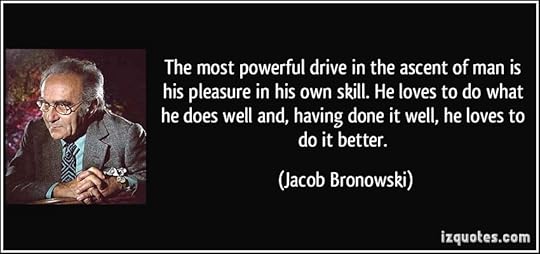
Coda: One thing we as humans are doing better at nowadays then fifty years ago is doing away with much sexist language. Case in point - the above quote by the author would be better expressed as "men and women" rather than men! However, I personally love this quote and think it is the key to a full, beautiful life: find what you are good at and do it again and again, continually becoming better at your chosen form of art.
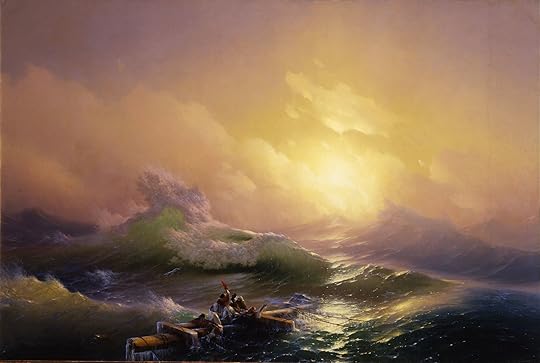
A work by 19th century Russian painter Ivan Aivazovsky

February 21, 2020
Incredible series of essays delivered by a polymath on, as you would expect a whole smorgasbord of subjects like art and science and shape and architecture and vision and music. The list could go on. I really couldn't summarise any of this myself because I lack severe amounts of brain cells in this area. So I'll just pick the best bits for you from the book:
Imagination simply means the human habit of making images inside one’s heads. And the ability to make these personal images is the giant step in the evolution of man and in the growth of every child. (sunny: but does our ability to capture images, static images, in our mind detract us from creating systems in our heads? Should we use “system-gination” more often rather than “image-ination”?) – hashtag: lets change our l&nguage to change our minds …
And designers are asked why an electric iron should be made to look as if it could fly through the air. The streamlining of such things is, of course, an echo of functional design which was appropriate in airplanes and rather less so in motor cars, where it began. The streamlining is not necessarily inappropriate to stationary things to which it extends the taste which has been trained elsewhere. We are now distressed by protuberances on an electric iron or a piece of furniture, not because we want either to fly through the air but because machines that fly through the air have taught us to question the purpose of such decorations. In this way the power industries create a unity of appreciation and bring home to us that no design can be made or judged in isolation from others. The boldness which they teach becomes a model for all design.
When Charles Dickens was an old man, he used to go about reading from his books in public and his readings always made a great sensation because he liked to read the criminal passages from his books. These passages had a prostrating effect on him. He read the great passage from Oliver Twist in which Bill Sykes murders Nancy and then in trying to escape over the roof catches himself on the noose and hangs himself. This passage had a devastating effect on Dickens: whenever he read it he had to rest for several hours afterwards. He was very ill at this time: he had some kind of illness in one foot and could not walk very well. His doctors pleaded with him not to read this passage, but just this he had to read. He had to read it because of something to do with his childhood and the prostrating effect which living for a short time in the slums and with thieves had had on him. But above all he had to read it because obviously he felt that those parts of his nature which showed a kinship with murderers and criminals wanted to come out. He wanted for a moment to be bill Sykes committing murder and dying.
It's the same poem, and yet each one of us makes his own poem. This is the nature of imagination. That everyone has to re-imagine, and to re imagine for himself. Dylan Thomas certainly imagined this poem first, certainly created the poem. And yet if you want to understand the poem you have to recreate it for yourself, fully.
Everything you that we learn in science as in art, gives us confidence and freedom to breakthrough these constraints. But we have to learn it for ourselves, in our own personal experience.
You will recall that I have been insistent throughout that the work does not exist on the canvas, in the book, until you breathe life into it. The artist creates the work, but the spectator recreates it. And you know that in the most obvious sense, every time you look more closely at the work and in a more informed way, it suddenly comes to life for you with more animation and a greater depth.
Over again the lesson of Leonardo: that the more precisely we learn the limits which nature has set, the greater confidence and with it our Liberty of action within them. Freedom is not a denial of nature but her exploration.
But the most important creative act for which nature has designed us is the begetting of children. And it is not a mere happy chance that that is an enjoyable activity.
What we meet is always particular, yet what we learn from is always general.
If the artist refuses to learn, in his own person, what the scientist is discovering about the materials in which he must work, then of course he will find these limitations are burden. And equally if the scientist is too bigoted to feel himself into the sensibility and the living values of the artist, he will propose only dead structures.
It cannot be an accident that there are no cultures devoted to science which had no art ,and no cultures devoted to the arts which had no science. And certainly no culture is devoid of both of them. There must be something deeply embedded in the human mind, specifically in the human imagination, which expresses itself naturally in any social culture both in science and in art.
Eidetic Imagery. People who have eidetic imagery tend to see the images as if it were outside their head. And therefore they follow the movement, follow its outline with their eyes, as Blake did. If you talk to them about a bicycle, you can literally see their eyes moving: or if you talk to them about a tennis match, you can virtually follow it in the movement of their eyeballs.
In the end we come to the point at which we realise that the quality of symbols in conceptual thinking of which human beings are capable, and which is mediated by the frontal lobes which begin with little monkeys, that quality combines 2 extraordinary human gifts: the gift of the eye and the gift of the ear. We use the eye most of the time in order to get information about the natural world: we use the ear most of the time in order to get experience of people.
When you have walked through the circles of the inferno with Dante, you have met the whole spectrum of human sin, Dante's view of what is the appropriate punishment but also the sinner’s own exposition of how it all happened. But it is an experiment into which you enter because the painters or the poet’s imagery entrains you so that you are suddenly aware that the person whose picture this is, or whose experience this is, is in some way the same person as you! You can think of yourself as having been born a twin to that person, because there is something about him which you understand and share. Until you do there you really do not understand the work of art and the power of literature.
The point of every life is that what your parent once did for you, you have to do. You have to grow up and you have to become a person in whom these oppositions are worked out so that they do not tell you to pieces. And in an age in which so many people suffer nervous breakdowns and spend much of their time in a helpless, unhappy isolation, that is really an important thing to say. That you will never make your life work if you think it is going to work in a simple plan. If you really think that saying, I am going to be loyal to this and it is going to serve me through life, will work: it just does not.
The Last Supper by Leonardo Da Vinci now that is something else. It is an early sketch and it is an extremely interesting 1, because you will notice the figure of Judas sitting on our side of the table. At the time that Leonardo drew this, that was the way you drew Judas : that was the way you drew the Last Supper. Judas always had to say what we in England call open speech marks below the salt close speech marks: on this side of the table, because he was in disgrace. But when Leonardo actually painted the Last Supper in Milan, Judas was sitting round the table with everyone else. He had suddenly felt that this simplistic interpretation of religion was not right and that set up a great tradition.
Imagination simply means the human habit of making images inside one’s heads. And the ability to make these personal images is the giant step in the evolution of man and in the growth of every child. (sunny: but does our ability to capture images, static images, in our mind detract us from creating systems in our heads? Should we use “system-gination” more often rather than “image-ination”?) – hashtag: lets change our l&nguage to change our minds …
And designers are asked why an electric iron should be made to look as if it could fly through the air. The streamlining of such things is, of course, an echo of functional design which was appropriate in airplanes and rather less so in motor cars, where it began. The streamlining is not necessarily inappropriate to stationary things to which it extends the taste which has been trained elsewhere. We are now distressed by protuberances on an electric iron or a piece of furniture, not because we want either to fly through the air but because machines that fly through the air have taught us to question the purpose of such decorations. In this way the power industries create a unity of appreciation and bring home to us that no design can be made or judged in isolation from others. The boldness which they teach becomes a model for all design.
When Charles Dickens was an old man, he used to go about reading from his books in public and his readings always made a great sensation because he liked to read the criminal passages from his books. These passages had a prostrating effect on him. He read the great passage from Oliver Twist in which Bill Sykes murders Nancy and then in trying to escape over the roof catches himself on the noose and hangs himself. This passage had a devastating effect on Dickens: whenever he read it he had to rest for several hours afterwards. He was very ill at this time: he had some kind of illness in one foot and could not walk very well. His doctors pleaded with him not to read this passage, but just this he had to read. He had to read it because of something to do with his childhood and the prostrating effect which living for a short time in the slums and with thieves had had on him. But above all he had to read it because obviously he felt that those parts of his nature which showed a kinship with murderers and criminals wanted to come out. He wanted for a moment to be bill Sykes committing murder and dying.
It's the same poem, and yet each one of us makes his own poem. This is the nature of imagination. That everyone has to re-imagine, and to re imagine for himself. Dylan Thomas certainly imagined this poem first, certainly created the poem. And yet if you want to understand the poem you have to recreate it for yourself, fully.
Everything you that we learn in science as in art, gives us confidence and freedom to breakthrough these constraints. But we have to learn it for ourselves, in our own personal experience.
You will recall that I have been insistent throughout that the work does not exist on the canvas, in the book, until you breathe life into it. The artist creates the work, but the spectator recreates it. And you know that in the most obvious sense, every time you look more closely at the work and in a more informed way, it suddenly comes to life for you with more animation and a greater depth.
Over again the lesson of Leonardo: that the more precisely we learn the limits which nature has set, the greater confidence and with it our Liberty of action within them. Freedom is not a denial of nature but her exploration.
But the most important creative act for which nature has designed us is the begetting of children. And it is not a mere happy chance that that is an enjoyable activity.
What we meet is always particular, yet what we learn from is always general.
If the artist refuses to learn, in his own person, what the scientist is discovering about the materials in which he must work, then of course he will find these limitations are burden. And equally if the scientist is too bigoted to feel himself into the sensibility and the living values of the artist, he will propose only dead structures.
It cannot be an accident that there are no cultures devoted to science which had no art ,and no cultures devoted to the arts which had no science. And certainly no culture is devoid of both of them. There must be something deeply embedded in the human mind, specifically in the human imagination, which expresses itself naturally in any social culture both in science and in art.
Eidetic Imagery. People who have eidetic imagery tend to see the images as if it were outside their head. And therefore they follow the movement, follow its outline with their eyes, as Blake did. If you talk to them about a bicycle, you can literally see their eyes moving: or if you talk to them about a tennis match, you can virtually follow it in the movement of their eyeballs.
In the end we come to the point at which we realise that the quality of symbols in conceptual thinking of which human beings are capable, and which is mediated by the frontal lobes which begin with little monkeys, that quality combines 2 extraordinary human gifts: the gift of the eye and the gift of the ear. We use the eye most of the time in order to get information about the natural world: we use the ear most of the time in order to get experience of people.
When you have walked through the circles of the inferno with Dante, you have met the whole spectrum of human sin, Dante's view of what is the appropriate punishment but also the sinner’s own exposition of how it all happened. But it is an experiment into which you enter because the painters or the poet’s imagery entrains you so that you are suddenly aware that the person whose picture this is, or whose experience this is, is in some way the same person as you! You can think of yourself as having been born a twin to that person, because there is something about him which you understand and share. Until you do there you really do not understand the work of art and the power of literature.
The point of every life is that what your parent once did for you, you have to do. You have to grow up and you have to become a person in whom these oppositions are worked out so that they do not tell you to pieces. And in an age in which so many people suffer nervous breakdowns and spend much of their time in a helpless, unhappy isolation, that is really an important thing to say. That you will never make your life work if you think it is going to work in a simple plan. If you really think that saying, I am going to be loyal to this and it is going to serve me through life, will work: it just does not.
The Last Supper by Leonardo Da Vinci now that is something else. It is an early sketch and it is an extremely interesting 1, because you will notice the figure of Judas sitting on our side of the table. At the time that Leonardo drew this, that was the way you drew Judas : that was the way you drew the Last Supper. Judas always had to say what we in England call open speech marks below the salt close speech marks: on this side of the table, because he was in disgrace. But when Leonardo actually painted the Last Supper in Milan, Judas was sitting round the table with everyone else. He had suddenly felt that this simplistic interpretation of religion was not right and that set up a great tradition.

June 20, 2013
You would think a scientist would be better at supporting his arguments rather than relying on vague, general statements.

July 28, 2007
lihatlah!
mata memang salah satu indra yang istimewa. dan ini bersama dengan tangan akan menentukan kemajuan peradaban manusia, melampaui binatang-binatang dan makhluk lain.
dengannya maka berkembanglah juga peralatan dan teknologi.
dan buku ini melontarkan isu-isu mendasar tadi.
asyik...
trims utk pak yuswadi yang mengenalkan pada buku ini.
mata memang salah satu indra yang istimewa. dan ini bersama dengan tangan akan menentukan kemajuan peradaban manusia, melampaui binatang-binatang dan makhluk lain.
dengannya maka berkembanglah juga peralatan dan teknologi.
dan buku ini melontarkan isu-isu mendasar tadi.
asyik...
trims utk pak yuswadi yang mengenalkan pada buku ini.

September 8, 2012
E x c e l l e n t !
Displaying 1 - 5 of 5 reviews