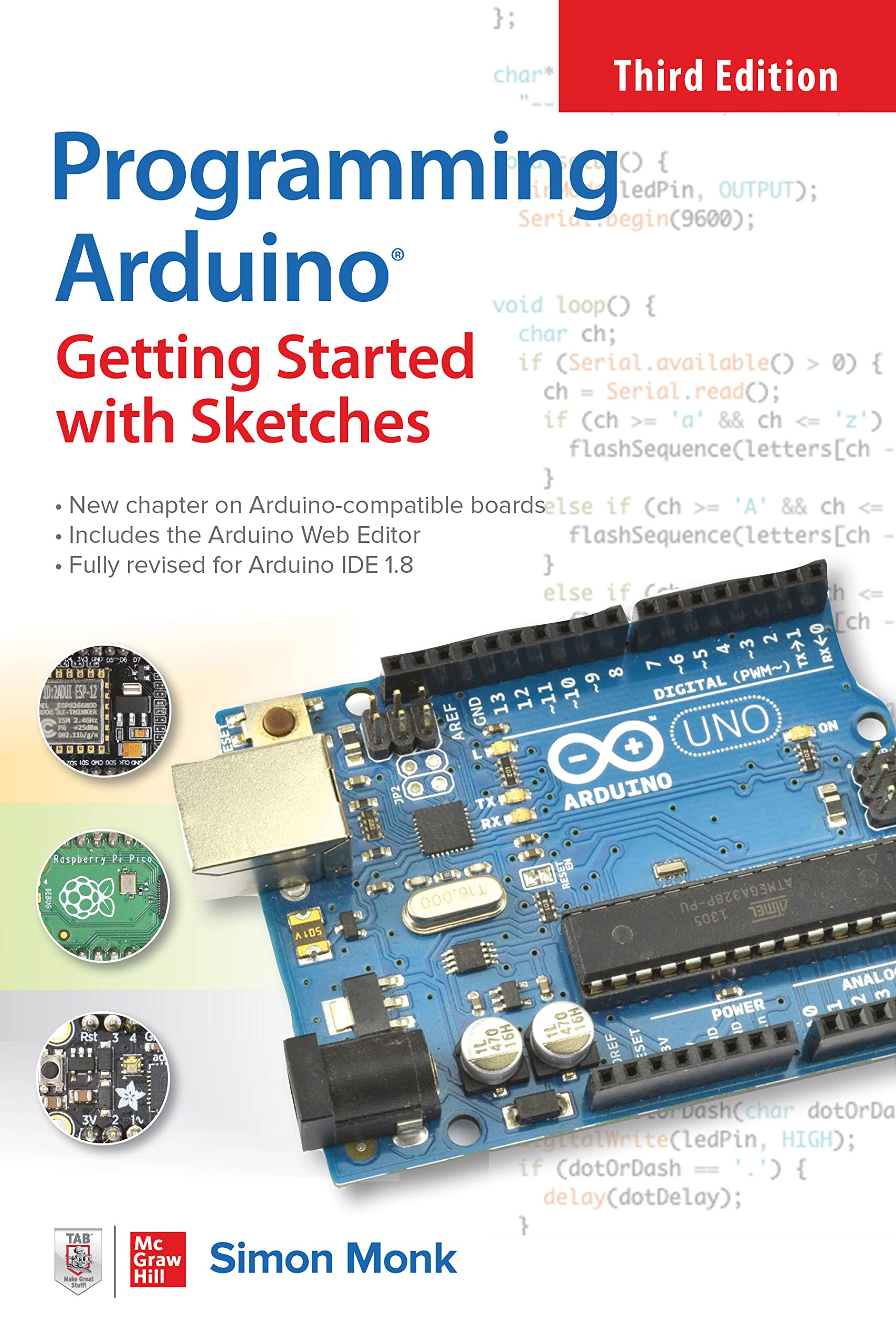
An up-to-date Arduino programming guide—no prior programming experience required!
This fully updated guide shows, step by step, how to quickly and easily program all Arduino models using its modified C language and the Arduino IDE. Electronics guru Simon Monk gets you up to speed quickly, teaching all concepts through simple language and clear instruction. Programming Arduino®: Getting Started with Sketches, Third Edition features dozens of easy-to-follow examples and high-quality illustrations. All of the sample sketches featured in the book can be used as is or modified to suit your needs. You will also get all new coverage of using Arduino as a framework for programming other popular boards.
Configure your Arduino and start writing sketchesUnderstand the basics of C language and the Arduino IDEAdd functions, arrays, and strings to your sketchesSet up Arduino’s digital and analog I/OUse Arduino-compatible boards including ESP32, Pico, and with built-in and custom Arduino librariesWrite sketches that store data in EPROM or flash memoryInterface with a wide range of displays, including LCDsConnect to the Internet and configure Arduino as a web serverDevelop interesting and useful programs for the Internet of Things
I really wanted more with this book. The overall concept is sound, teach those interested in the basics of Arduino programming. Unfortunately, the book is so far removed from the actual breadboards, components, and wiring, that it could have easily been written for almost any microcontroller or microprocessor.
I actually much preferred the basic book that came with my Arduino kit, "Arduino Projects Book" since it was focused primarily on teaching you how to connect components with supporting programming to get the controller to do as you wanted. Monk's book, on the other hand, left me feeling like, "Oh, okay I have some code, but how do I set up the connections and components to actually get it to work?"
Overall, I felt this short book was focused but lacked the depth and integration with Arduino to be useful to me long term. I don't feel I'll be reaching for this book when I need to remember that part about coding for some specific function.
Basically it failed to accomplish my specific approach to Arduino programming, namely coming up with an idea, setting up a breadboard and the components to get the circuitry created and then writing code to make it all function. I much preferred John Boxall's "Arduino Workshop: A Hands-On Introduction with 65 Projects" since it provided in-depth examples, schematics, and explanations of why specific choices were made with the specific component and coding choices.
Great book as an introducrion to the Arduino programming world, and it was written in a nicely simplified way. But what I have figured out throughout reading it, is that READING itself is not very helpful while learning this stuff. I found it more helpful to watch youtube videos, courses and practicing between the software & the hardware. So I guess I will continue learning about Arduino programming by watching youtube tutorials and courses, and applying that practically by the device itself.
A very clear introduction to programming Arduino. In addition to explaining the basics of the Arduino board, and libraries, Monk has a very clear introduction to programming in C that will serve novice programmers well, and also help re-orient those who have not used C for some time. After a fairly basic first half, Monk dives into more elaborate (yet still approachable) projects involving web servers and IoT like applications.
I got this book for 2 reasons. First, to help me understand enough to work with my 11 year old on a project, and second, to get me over the "this is firmware... I'm a software developer" hump quickly. This worked for both. I now feel confident enough to tackle some basic projects with reasonable degrees of success, and also that I can debug others in a systematic manner.
This may be redundant if you already have a deep knowledge of C, and another good Arduino tutorial, but if you feel at all intimidated by Arduino projects, and are curious about possibilities, it's worth it.
I definitely recommend this for any newbies in Arduino programming.
The book provides a wide range of basic knowledge about Arduino programming and cues for you to make further exploration in C++ programming if you want. I had been practised programming when I was at university, so I remember a little bit about C++, Python, Matlab, which are helpful when I learn to program Arduino.
Unfortunately, there are several chapters of the book I cannot practice due to lack of equipment like an LCD or an Ethernet board. I am sure I will come back for those after I buy more components. Note that the bouncer library now is upgraded to bouncer 2 (I cannot find the 1st version although the author apply the 1st version in the book), you had better check it in Arduino forum.
A seriously intense guidebook to getting started with Arduino.
Rather unfortunately though, readers are fed with a silver spoon in the sense that there is little to no attempt by Simon Monk to give readers their own problems or challenges to try and solve in order to cement their knowledge and understanding.
Instead, Monk just provides you with pages and pages of code - but doesn't really help you do anything else.
Still, I made some great thorough notes from the book. So much lost potential though - which essentially led me to taking just under a year to finish the read. There's nothing here (other than particular content like IoT) that would make you want to pick it up and read as much of it as possible, so really no motivation.
Overall, this is a pretty good book for people who are interested in programming and computers. However, it really lacks information on the hardware side, so it is not the best book for a beginner who wants to learn about Arduinos. It did have plenty of information on the programming language itself, but it made the book seem too much like a textbook, and that made the book a little boring. I would recommend this book to people who really enjoy programming, as the C language that is used with the arduino is very similar to many other coding languages.
A very basic entry to the world of Arduino. Much like how with littleBits I appreciate the idea but dislike the impracticality; I have the same arguments about Arduino. Great concept, I can see why and how it can be appealing, but once you start getting into it there's dozens of different kinds of boards (and other electronic equipment) that you have to buy and hoard. From the standpoint of versatility, a cheap computer can do a lot more (even though you'd be limited to simulations only). Nice little book, nice intro to this world, however.
It is what it says it is a book designed to get you programming the Arduino quickly. It is somewhat sparse on details at time but would be good for someone just getting their feet wet. The explanations seem good to me but I may not be the best judge having forty years of programming experience. It could go into more detail in places but for a beginner the amount of detail is probably about right.
This book is good for those who are new to programming. It covers Arduino at a very basic level. Almost 1/4 of the book is dedicated to C Programming Language (the basics), which you can skip if you already know it. Rest of the book can be skimmed over quickly and does not require much effort.
Considering the amount and quality of information provided, the price is too much to pay for. Most of the things discussed in this book can be easily found on Internet.
I will start by saying that I take some responsibility for this review rating. I did not adequately research the book other than note lots of 5 star ratings by a number of people. I should have paid more attention to the title as getting started is key. I will use it but I am going to look for more of a comprehensive reference I can turn to when stuck trying to go beyond basic function.
I’m a veteran techie with many years of embedded systems experience. I wanted a book to get a quick start on Arduino and this book did the trick. I’m rockin on Arduino now! It touched on a lot of things so if you want more in-depth information, you’ll need go to a more advanced book or search online. Again, this book is focused on getting started quickly and it did a great job at that for me.
Honest reaction to Programming Arduino: Getting Started With Sketches: I wanted to throw it across the room at least twice and I couldn't stop reading. Simon, Monk writes a narrator who's smug, sharp, and wrong about almost everything, and the scene where he corrects a bartender's pronunciation of his own bar's name is pure second-hand embarrassment. By page 250 I was oddly invested in whether he'd learn anything. For readers who like a flawed lead they love to hate. Skip it if you can't spend a whole book with a jerk.
Look, nobody does a miserable family dinner like Simon Monk does in Programming Arduino. Every line of dialogue is a tiny knife, and the politeness makes it worse. It's tense, it's funny, and it's painfully familiar. Perfect for anyone who survived holiday gatherings, skip if that's still a sore spot.
Passing time at soccer practice with my PD book. Good info, but I wished it had a bit more...I guess it just shows how far my Arduino skills have come:) great for true beginners but it could have stretched our learning a bit more.
Very easy to read. Simon Monk presents the programming Arduino know-how from basic sketches to more advanced practices. The book doesn't go deep in any of the subjects being only entry level. Is a good start point if you're starting to create your pet projects using Arduino microcontrollers.
Solid introduction to writing code for an Arduino. Fun to get back into C and C++ a bit. Examples were clear, code worked, and the information was well presented.
Would recommend this succinct guide to anyone picking up one of these microcontrollers.
Don't have much to say about this book. It seemed alright. It did clarify some things about the wifi modules that had me confused. It covers a bit of programming without going too deep, it doesn't cover any electronics.
I started Programming Arduino: Getting Started with Sketches, Third Edition on a Tuesday and finished it on a Wednesday, and my sleep schedule is filing a complaint. Monk, Simon has a wicked sense of when to end a chapter. The ending's a little silly. Perfect for readers who love a page-turner, skip if you hate cliffhangers.
I finished Programming Arduino and honestly felt both smarter and a little guilty. Monk Simon holds up a mirror and doesn't flinch when you wince. Some of the points land harder than they need to. Good for readers who want to be challenged, skip if you came for comfort.