From the winner of the 2013 Nobel Prize in Literature—and one of our most beloved writers—a new selection of her peerless short fiction, gathered from the collections of the last two decades, a companion volume to Selected Stories (1968-1994).
Family Furnishings brings us twenty-four of Alice Munro’s most accomplished, most powerfully affecting stories, many of them set in the territory she has so brilliantly made her own: the small towns and flatlands of southwestern Ontario. Subtly honed with her hallmark precision, grace, and compassion, these stories illuminate the quotidian yet extraordinary particularity in the lives of men and women, parents and children, friends and lovers as they discover sex, fall in love, part, quarrel, suffer defeat, set off into the unknown, or find a way to be in the world.
Peopled with characters as real to us as we are to ourselves, Munro’s stories encompass the fullness of human experience—from the wild exhilaration of first love, in “Passion,” to the lengths a once-straying husband will go to make his wife happy as her memory fades, in “The Bear Came Over the Mountain.” Other stories suggest the punishing consequences of leaving home (“Runaway”) or leaving a marriage (“The Children Stay”). The part romantic love plays in one’s existence is explored in “Too Much Happiness,” based on the life of the noted nineteenth-century mathematician, Sophia Kovalevsky. And in stories that Munro has described as “closer to the truth than usual”—“Dear Life,” “Working for a Living,” and “Home” among them—we glimpse the author’s own life.
As the Nobel Prize presentation speech says in part: “Reading one of Alice Munro’s texts is like watching a cat walk across a laid dinner table. A brief short story can often cover decades, summarizing a life, as she moves deftly between different periods. No wonder Alice Munro is often able to say more in thirty pages than an ordinary novelist is capable of in three hundred. She is a virtuoso of the elliptical and the master of the contemporary short story.”
Collections of short stories of noted Canadian writer Alice Munro of life in rural Ontario include Dance of the Happy Shades (1968) and Moons of Jupiter (1982); for these and vivid novels, she won the Nobel Prize of 2013 for literature.
People widely consider her premier fiction of the world. Munro thrice received governor general's award. She focuses on human relationships through the lens of daily life. People thus refer to this "the Canadian Chekhov."
Alice Munro has been a wonderful discovery for me. I can’t recommend her two selected volumes—this one and an earlier collection called A Wilderness Station—enough. Please read her.
Family Furnishings, Selected Stories 1995-2014 by Alice Munro was an absolute delight.
Each of these short stories contains so much detail and character development they read like a 300-page book. How Munro packs so much punch into 20 or 30 pages I’ll never know, but she does. Many of these pieces are 5-star reads and only a small handful disappointed, and even then, they only disappointed in comparison to the brilliant ones.
My absolute favourite was The Children Stay a remarkably touching story about the end of a marriage, and a woman’s decision to leave her husband and children. The poor bloke didn’t see it coming, how often does that happen? The fallout was beautifully and tragically described by the author – as with most of these stories, there I so much to identify with. Even if the narrative didn’t personally resonate, Munro was clever enough to put me inside the character’s skin and make me feel the pain, joy, love, hate, passion or whatever that character was feeling. Some of these tales had me completely riveted.
Munro appears to achieve this with such little effort. A bit like a very good actor who portrays a character on screen with graceful ease – a slightly raised eyebrow, a nod of the head, a shrug. Such small gestures, this is what Munro does – she uses very small gestures.
Interestingly, there is a complete absence of humour in these stories about ordinary people, I can’t remember laughing, not even a chuckle (apart from the story involving a constipated dog and his poo – that made me chuckle) – but the lack of comedy wasn’t missed.
”So I open the door and try and persuade Buster to go outside where he can pass it, but too late. Right on the mat he passed it. A hunk like that (she puts her fists together), and hard. Oh boy. You should have seen it. Like rock. It was chock full of turkey quills. Then after that whoooosh, out with the soft stuff. Bust the dam you did” She says to Buster. …..and it goes on. As she continues to explain this interesting story of the hapless Buster to her guest, all of this while she eats a ham sandwich.
Ahhh…..the humanity of it all. But it was my minds-eye image of poor Buster’s face while this story was being explained that made me laugh. Poor little boy. Munro didn’t even have to describe the dog’s face; I could see it anyway. So, she painted pictures for me of things she didn’t even describe. My god!! I hope that makes sense to you guys. But that’s the magic of this author.
I have one small gripe about this chunkster (it’s over 600 pages), just as I became attached, even welded to the characters, the story would finish. Then I had to establish new relationships with a whole new cast of people, which was easy enough BUT I did find it a bit tiring, emotionally wearing. Perhaps this type of book should be left on the coffee table and dipped into every now and again. I think reading a book like this in one go, isn’t the best way to enjoy it. I should have read a story, let it sink in – then go onto the next story after a few days. Enjoy it in aliquots.
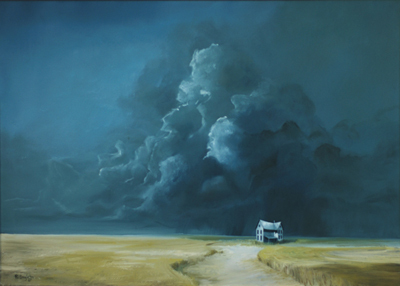
Robert E. Singleton, MIDWEST FARM HOUSE -1967 - 30" X 42" - Oil on canvas
"Now, I see these painting(s) as self portraits. In every case the house is empty and fragile, a shell of things been. Isolated and alone. Looming on the horizon is the darkness of a storm, threatening, or has the storm past. In all of these portraits it would seem that the external world around me was constantly changing. The house remained the same." Artist's statement.
Reading Alice Munro's "Family Furnishings" was a journey home...a self portrait. Not that I ever lived in a farm house. Nor Canada. Upper Midwestern and working class are my roots. I grasp for words to explain...in the perfectly composed vignettes of her short stories Munro quietly unsparingly captures what plainly inescapably is.
Beauty in strength & weakness. Strength in success & failings. Little of thrilling joy...more melancholy and beauty in that too. Eccentricity as suspect...and yet humming ever present. Distrust of anything in excess...emotion, education, fancy clothes, food with airs. The great divide of the sexes...men & women walking lifelong parallel paths...distrustful, never quite understanding the other...yet making lives & families together. Economy. In life. And in Munro's words. In over 600 pages there is one sentence that need not have been written...and it haunts me.
Published: Dallas Morning News, 14 November 2014 06:33 PM
Think of Family Furnishings as a victory lap for Alice Munro, the 83-year-old Canadian writer who received the Nobel Prize in Literature last year and has won at least one of just about every other major literary prize she qualifies for.
Munro embarked on her remarkable career at a time and place where a woman and a mother “having any serious idea, let alone ambition, or maybe even reading a real book, could be seen as suspect, having something to do with your child’s getting pneumonia” as she writes in “To Reach Japan.”
She deserves her moment in the sun especially to honor how consistently excellent her work has been — she’s that rare writer who is able to match her early career achievements and even top them in this selection drawn from her most recent six story collections.
Munro started her career writing about women like her who grew up in small towns in Canada and were seen as uppity as they excelled in academics, married young and moved away. This archetype appears several times in Family Furnishings, but Munro has broadened her scope in recent years to encompass historical fiction and even crime. Several stories are straight-up thrillers, as this master of domestic tension cranks the menace up a notch, resulting in actual crimes.
Munro almost always includes a moment that ruptures the ordinary — the discovery of a body, a car crash, a death in war, a cruel prank — but she’s more interested in the aftermath and beforemath of these incidents, the long slog between action that Hollywood would just cut out. These stretches of time are where her fiction lives because these years prove who her characters really are and determine who they are going to be.
When a crime occurs, as it does in the chilling “Dimensions,” Munro doesn’t show it directly, much less any cops-and-lawyers business that follows. She doesn’t show people falling in love — instead she joins married couples years down the line. Several of her plots hinge on affairs, but she doesn’t describe much sex. Munro always focuses on the interpersonal tango between the characters and their internal reckoning.
Munro relentlessly surprises, using clever, switchback structures that dart between perspectives and time periods to repeatedly evade readers’ expectations and ultimately deepen and complicate their appreciation of the characters’ relationships. She’ll start a story from the perspective of a child who hasn’t been born yet (“My Mother’s Dream”) or from a minor character, such as a station agent, who doesn’t appear again (“Hateship, Friendship, Courtship, Loveship, Marriage”).
Take for an example of her structural genius “The Bear Came Over the Mountain,” probably the most romantic story Munro has ever written (adapted into the 2006 film Away From Her). It involves Grant, a retired academic who reluctantly takes his beloved wife, Fiona, to a nursing home when her dementia worsens. The nursing home’s policy is that he not visit for one month so she can settle in. When Grant does see his wife again, she’s fallen in love with a fellow dementia patient and barely recognizes her husband.
Munro waits until she’s delivered this setup, evoking sympathy pangs for the devoted husband, before she releases the information that during his marriage, Grant has been extraordinarily untrue. This is a man who relished the new freedoms of the ’60s and ’70s, who just said yes to anyone who offered, while his wife waited for him at home. Still, his pain at Fiona’s betrayal is keen.
When Fiona’s beau is transferred and she deteriorates out of lovesickness, Grant goes courting on her behalf, and his love that has endured decades, countless infidelities and memory lapses is revealed as adamantine.
“You could have just driven away,” Fiona tells him in a moment of lucidity. “Just driven away without a care in the world and forsook me. Forsooken me. Forsaken.” Grant replies, “Not a chance.”
It’s hard to pick a favorite, from the Hitchcockian suspense of the quick perspective-switching “Runaway” to the grand, colorful characterization of an aunt named Alfrida in the title story, to an account of an immigrant family’s passage from Scotland to Canada in “The View From Castle Rock.” Munro’s squabbling or passive-aggressive families feel as real as the people in line next to you at the grocery store. As she writes of a family in “Wood,” “It was a clan that didn’t always enjoy one another’s company but who made sure they got plenty of it.”
It is no exaggeration to state that Munro’s short stories are among the finest that have ever been written. She’s sure to endure alongside Poe, Hemingway and O’Connor in anthologies that might spark the imagination of some future, brainy, small-town high school girl, and lure her toward unforeseen adventures.
Jenny Shank’s first novel, The Ringer, won the High Plains Book Award.
La imagen y leyenda de Alice Munro ha cambiado mucho a lo largo del último año. Todo empezó con la noticia de su muerte: ya había leído tres libros suyos, y ambos me habían marcado. Aunque hace siete años mi limitada pericia lectora me impidió entender mucho de esos cuentos incluidos en "The Moons of Jupiter", "Too Much Happiness" y "Dear Life", se habían quedado en mi cabeza y volvían a mí, en forma de imágenes o de argumentos, cada cierto tiempo. La niña perdida en "To Reach Japan"; el salto de un tren en movimiento en "Train"; los niños asfixiados de "Dimensions"; la vorágine de historias y de nombres, la tormenta de nieve que es "Too Much Happiness". Los cuentos de Munro, todos, son inolvidables, en mayor o menor medida.
Su muerte, entonces, me pegó como un martillazo, y me hizo sacar de la biblioteca su "Todo queda en casa", el millar de páginas en las que antologa los puntos más altos de los últimos veinte años de su carrera. Empecé a extrañar algunos cuentos que no están en la antología y que yo no hubiera dejado afuera, como la trama detectivesca de "Free Radicals" o el final desgarrador de "Gravel".
Iba por la mitad del libro cuando aparecieron los testimonios de una de sus hijas: el segundo marido de Munro había abusado sexualmente de la niña durante años, y la escritora, en lugar de protegerla, mantuvo un silencio cómplice con su esposo y la revictimizó. Me costó trabajo volver al libro después. Me costó entrar de nuevo en el mundo cruel y a la vez tierno que la canadiense construye para que sus personajes vivan en él y encuentren su propio camino. ¿Qué camino elegiste para ellos y qué camino le dejaste a tu hija? ¿Por qué tu generosidad se limitó a tus protagonistas?
Muchos artículos se han escrito al respecto. Muchas opiniones, muchas perspectivas. Algunas más acertadas que las otras. Recomiendo especialmente leer el texto de Andrea Skinner, la hija de Munro, y lo que Giles Harvey escribió para el New York Times al respecto.
Es verdad que estos cuentos nos muestran mucho de lo que ella hubiera querido decir sobre estas cosas. Sobre el abuso, la mezquindad, la vergüenza, sobre el hacer daño, la sexualidad soterrada y el conservadurismo asfixiante. Sobre la vida de las mujeres. No se entiende, después de leer todas estas páginas, cómo es que la persona que las escribió nunca intentó enmendar las cosas. Pero también, no podemos pretender que unos cuentos que nos muestran la complejidad humana de una forma tan honesta y con tanto conocimiento de causa salgan de una persona unidimensional.
¿Qué hacer, entonces, con Munro? ¿Entendemos su situación? ¿Nos limitamos a, más que disfrutar, seguir siendo heridos una y otra vez por su escritura punzante? ¿La dejamos de lado, como no nos costó a algunos dejar atrás a tantas figuras mediáticas, como represalia a su memoria?
Al final, nadie que lea estas páginas debería entrar a ellas sin saber estas cosas. Condicionará la lectura, claro, ¿pero qué lectura no está condicionada? ¿Qué pregunta está en estos cuentos que no tengamos que hacernos sobre nuestras vidas?
Family Furnishings: Selected Stories, 1995-2014 by Alice Munro is a very highly recommended collection of 24 short stories with an introduction by Jane Smiley.
All these short stories have been previously published and are now brought together for this collection. The title stories, which are all novella length, from all six of her most recent collections have been included. As one of the great short story writers of our time, Monro has a clear insight into her characters and setting. She can capture a slice of an ordinary person's life and present it so it is reflecting the universal human condition. This is a great way to follow ongoing themes in her work and see them develop over time.
Family Furnishings is a wonderful edition to have, especially as a companion to her Selected Stories, which covers work from 1968-1994. Monro is a Nobel Prize winner and one of the most accomplished short story writers of our time. This would be an excellent way to acquaint yourself with Monro's writing, perhaps savoring it slowly, one story at a time, especially since the collection is 640 pages. Let's face it: she is an exceptional writer and this is an tremendous addition to any collection of short stories.
Contents: The Love of a Good Woman; Jakarta; The Children Stay; My Mother’s Dream; Hateship, Friendship, Courtship, Loveship, Marriage; Family Furnishings; Post and Beam; The Bear Came Over the Mountain; The View from Castle Rock; Working for a Living; Hired Girl; Home; Runaway; Soon; Passion; Dimensions; Wood; Child’s Play; Too Much Happiness; To Reach Japan; Amundsen; Train; The Eye; Dear Life.
Disclosure: My Kindle edition was courtesy of Knopf Doubleday for review purposes.
Reading this book cover to cover was quite the undertaking. Not so much because it is long (over 600 pages!) but because there is just so much to consume: complex characters, generation-spanning plots, impeccable prose, physical and emotional landscapes. All of these are jam packed into the twenty short (or some not so short) stories in this collection. On your journey reading these stories you will dive deep into the relationships between mothers and daughters, life outside of towns, personal triumphs or struggles, or sometimes just settle or accept dear life for what is, albeit sometimes less than you expected. You'll take many trains, walk or drive rural roads, and look back, from a distance, on the little moments in someone's life that became unexpectedly monumental.
Some of these stories were new to me; some were a second read, and at least one (Childs Play) was a fifth or sixth visit. Re-reading Alice Munro is a great idea--you pick up things you missed and also things you just think about differently, especially if it has been a while.
The thing with Munro, is that she makes you WORK. And lord knows, I'm lazy – particularly in reading, hence why avoid the titans of Russian literature. Well, as well in other aspects of life. It’s why I choose running over cycling, so I don't have to test my patience to learn how to maintain a bicycle. Or if I’m learning a musical scale with too many sharps and flats required, I find it causes too much of a mental strain and, I tend to skip over these. You get the picture. There's a whole book on this (Thinking, Fast and Slow). The point is if reading is too mentally taxing, the joy is gone.
So there's that, and often times, the stories were so ambiguous, they may well require several reads and post analysis - of which there is a plethora of, and I found myself having to refer to several times after finishing a story. The small details, heck, sometimes the whole point was lost on me, due to the difficulty in following the story (to my chagrin, I had missed a MURDER of a child in one of them, until a review had to make that clear for me). Again, having to do this felt like homework. Truthfully, I'm shocked at how deep people go (are these all university students?) - analyzing street names, character initials, meaningless utterances that somehow are meaningful. Apparently, this is where Munro's genius lies. This over-analysis is something I've also bore witness to in a piece of jazz - people actually transcribe and analyze entire pieces, to the point that I have to ask , did the musician really intend to do that, or were they just feeling it? Can’t we just enjoy the song? Other difficulties were the unconventional non-linear story lines, they jump from one place and time to another. Oh look here, I’ll start this story at the end and then go backwards, towards the end. It didn’t work for TENET and it didn’t work here. Jesus, I was lost so many times, and what a horrible mistake it was to read this behemoth straight through. We’re talking a couple of hundred of characters, which I often got confused. Was Sue the aunt of Charlene – ah fuck no, that was two stories ago.
There had been a hope, that reading this would revive some Canadian patriotism deep down in me, unfortunately the recurring feeling I had was, dear god, how incredibly boring the place can be. There can’t be anything drier to read about then Canadian history (I mean the history we are fed – not the real one about Native American slaughter). Munro’s stories just aren’t contemporary enough for me – several take place in the 1800’s where Jane Doe worked at a sawmill, and then went to church. Ho hum. Even the landscape – you think of small-town Canada as something charming – but nothing could be further from the truth. You need to take drugs to combat the boredom of living there once industry packs up and leaves. Unless you have a massive cottage on the lake, the rest is a barren wasteland – literally and especially culturally. The lone bright spot was a story about a hired help working for a wealthy family with a cottage on the lake – and how she observed these people having access to elite sports: sailing, tennis, golf, and that just make me appreciate Europe all the more – these activities are easily assessable to the common man, not only for Lord ROGERS (one of the Canadian media oligarch families that charges THE MOST EXPENSIVE mobile data plans in the world – which at this point is time is damn near a public necessity, but somehow they’re allowed to just keep fleecing the hordes of immigrants). Excuse me, I got off on a tangent. The stories were mighty let downs and now I must lament the loss of nearly a month of reading.
The more I love a book, the less I could put words into a review--this is what I felt after reading Family Furnishings: Selected Stories, 1995-2014.
This collection includes 24 short stories. So much can be said about Munro's masterful storytelling, her deep insight into human condition, her precise language and sharp observation. Glad I am not the only one who could not figure out how she did it--as Julian Barnes wrote, “I have sometimes tried to work out how she does it but never succeeded, and I am happy in this failure, because no one else can—or should be allowed to—write like the great Alice Munro.”
These are the favourites of my favourites:
Runaway (a complex, multilayered drama)
The View from Castle Rock (what a transatlantic journey filled with complicate characters and amazing dramas! Reading the story is liking watching a movie)
Too Much Happiness (has anyone expanded it into a 500 page historical novel yet?)
Jakarta (another complex, multilayered drama)
Dimensions (perhaps the most disturbing story in the collection)
Nettles (the loneliness and loss, and the brave woman who trudges on. I can totally relate to her)
Hired Girl (a coming-of-age story, a little sad and a little comic)
Cómo abordar todo lo que siento? Tenía muchas incertidumbres de leer a Munro y que no llegase a entender sus cuentos y no llegasen a gustarme. Pero, me ha arrollado súbitamente! Cabe aclarar que no los leí de un tirón. Leí la mitad en una semana y postergue su lectura 3 meses, porque no dejaba de pensar en todo lo que hay implícito en cada escena, en cada personaje, su vida misma que podría coincidir... sin embargo la otra mitad me la leí en 4 días, y aun sigo digiriendo cada cuento y encontrándo más detalles que me abruman y a la vez me asombran. Esta antología tiene: Unos cuentos geniales, con giros inesperados (y eso que tiendo a imaginarme los finales) que me dejaron helada y a la vez anonadada. No puedo elegir un cuento favorito, porqué todos me encantaron, aun así hay dos o tres que resuenan en mi mente, por su contexto, descripciones y personajes brutales y tan ordinarios, que es eso lo que gusta de su escritura, la vida misma. El listón altísimo. Simplemente una genia.
Alice Munro's stories deserve to be read and re-read every five or ten years. Every single story in this great collection was previously published in a different collection, but as I re-read some of them from 10 or 15 ago, I was surprised to find out that how I felt about some of the characters have changed because of my own life experience over the years, which has given me a much better understanding of human nature and what life is about in general. This collection begs to be read by all!
Family Furnishings is my second foray into the mind of Alice Munro, but will certainly not be my last. Munro writes the best prose––and the best short stories––of any modern author with whom I am familiar. Her disarmingly prosaic and delectably mysterious tales unveil the hidden meanings lurking within the mundane corners of everyday existence.
After finishing this thick collection, which contains highlights from Munro’s career from 1995 through 2014, I suspect her writing might be better digested in smaller chunks, or read more slowly than my usual pace. These stories are deceptively dense; the writing isn’t difficult, but if you don’t pay attention to every detail, you will miss something essential. I was fortunate to have read some of the stories before, and certainly got more out of them the second time around. Now that I’ve delved a bit deeper into Munro’s work, I think I’ve begun to grasp some of the overarching themes that make her writing so powerful.
Most of Munro’s characters are lower- to middle-class people living in unexceptional mid-20th century settings: farmers, teachers, laborers, business owners, husbands, wives, children. A solid portion of Munro’s narrative alchemy derives from her ability to portray such people as accepting their lot in life while also being quietly subversive. Munro’s characters persist not by taming the rush of life’s inevitable misfortunes, but by slowly comprehending their finer qualities:
"For everybody, though, the same thing. Evil grabs us when we are sleeping; pain and disintegration lie in wait. Animal horrors, all worse than you can imagine beforehand. The comforts of bed and the cows’ breath, the pattern of the stars at night––all that can get turned on its head in an instant. And here she was, here was Enid, working her life away pretending it wasn’t so. Trying to ease people. Trying to be good." (35).
People are always trying to “be good” (or at least to “be themselves”) in a historical context. Munro’s life began at the outset of the Great Depression and has continued through the first decade of the 21st century, so it makes sense that her writing exhibits a preoccupation with the tension between rural and urban communities, with the essential differences between provincial and globalized cognition. This transition from local to global consciousness was the great leap of the late-20th century, but Munro’s writing captures a time before the Internet, before the omnipresent deluge of information from every corner of Earth, when small communities constituted their own little universes. Nowhere is this more evident than in the recurring standoff between “town” and “country”:
"In those days people in town did generally look upon the people from the country as more apt to be slow-witted, tongue-tied, uncivilized, than themselves, and somewhat more docile in spite of their strength. And farmers saw people who lives in towns as having an easy life and being unlikely to survive in situations calling for fortitude, self-reliance, hard work. They believed this in spite of the fact that the hours men worked at factory jobs or in stores were long and the wages low, in spite of the fact that many houses in town had no running water or flush toilets or electricity. But the people in town had Saturday or Wednesday afternoons and the whole of Sundays off and that was enough to make them soft." (368)
Having experienced both settings intimately, Munro is champion of neither; she prefers to demonstrate how communities fail to understand one another, as well as to shed light on the brief moments where mutual apprehension is somehow achieved.
The rules of existence were not so clear in pre-globalized times of transition, and Munro’s stories are therefore suffused with an anticipation of something like magic. In the absence of any undergirding world order with which to categorize or justify breaches in tradition and etiquette, Munro’s characters are responsible for conjuring their own explanations for the events that shape their lives. Eschewing resentment and nihilism, they cultivate hardy and utterly unpretentious demeanors with which to weather the world’s many trials.
All of this hinges on the element of Munro’s talent that is perhaps most eminent: her taciturn but staunch avowal that no one has full access to the melange of prefigured circumstances, choices, and random happenings that determine life’s course. Human experience occurs within spheres of knowledge that are limited by the implacable structures of our body-minds and the greater workings of a world we can only partially internalize, one breathing sliver at a time. Munro is the battering ram splintering the illusion that we can grasp ourselves and our lives with certainty:
"Jumping off the train was supposed to be a cancellation. You roused your body, readied your knees, to enter a different block of air. You looked forward to emptiness. And instead, what did you get? An immediate flock of new surroundings, asking for your attention in a way they never did when you were sitting on the train and just looking out the window. What are you doing here? Where are you going? A sense of being watched by things you didn’t know about. Of being a disturbance. Life around coming to some conclusions about you from vantage points you couldn’t see." (573)
Human life is ineluctably haunted by judgments made “from vantage points” unavailable to us. It is a necessity of both survival and sanity that we ignore this reality, but we also reflect and learn more effectively when we take it into account. So we celebrate the work of creatures like Alice Munro, who wake us up to from time to time. “It is forbidden for us to know…” she writes, “what fate has in store for me, or for you––” (167). Forbidden to know, yes––but not to speculate, not to dream. And it is through these speculations, these dreams, these tireless lines of inquiry, that the stories of ourselves take form. And it is not the strict veracity of these stories that ultimately matters, but their resonance with our past selves, present struggles, and hopes for the future.
Cut off from full knowledge, we are not hopeless, not entirely blind. We are impaired. Life is a compromised state, always contingent, always edged toward defeat and death. But it is not beyond us to watch and listen to our lives as they pass us by, nor is it impossible to build coherent structures of meaning.
"It was not until now, not until this moment, that she had seen so clearly that she was counting on something happening, something that would change her life. She had accepted her marriage as one big change, but not as the last one.
So, nothing now but what she or anybody could sensibly foresee. That was to be her happiness, that was what she had bargained for. Nothing secret, or strange.
Pay attention to this, she thought. She had a dramatic notion of getting down on her knees. This is serious." (212-3)
How are we to seek such moments of fleeting clarity? We cannot. But we can notice when they come upon us, can wrestle them from the river of consciousness, and tuck them away for those final moments of existence, when we face our mortality and wonder what life was to us, to anyone. Nothing, of course. But we will tell ourselves otherwise. And if we are very lucky, that final hallucination will be a good one.
This review was originally published on my blog, words&dirt.
Please note my five stars. Five stars means it's amazing. But amazingly GOOD? Or amazingly AWFUL? Can both be true????
FAMILY FURNISHINGS is a decidedly NOT SHORT book showcasing 24 of Alice Munro's 1995-2014 not always SHORT stories.
Yes, the author is a literary golden girl and, certainly if I were Lemony Snicket - or am I thinking of Pseudonymous Bosch -- oh well if I were one of those writer guys, I would now say:
stopping reading is what you really ought to do--- though if you stop you'll miss my secret confession. Gotcha! But my secret is not earth shattering. Un-gotcha. Meaning, if I were you, I'd stop reading. Now.
Oh, my, are you still reading????
First: golden girl.
Honestly, what could be more " big league" for a writer than winning the Nobel Prize in Literature? Well, in 2013 Canadian author Munro, born in 1931 and who has been writing and publishing short story collections for decades, did indeed receive that award specifically for her literary mastery of the short story.
Aside: how do I know that her award was for her short story writing? That's simple. That's all Alice Munro writes: short story after short story after short story.
Now, even if you aren't ready for my confession, here it is: I have more than one confession!
First, I am in more than one book group; and the reason I am reading FAMILY FURNISHINGS right now is only because it’s the next book pick for one of those book groups because, well, ahem,
I myself don’t read short story collections..
So, if I were you, I wouldn't listen to the rest of my opinion.
Sorry, another interruption: notice the useful subjunctive "were" here that signals I am aware I am not you, signaling that even after reading so many fictional pages, I still can distinguish fictional worlds from non- fictional ones and have NOT totally lost my grip on reality. But if your own reality grip feels a trifle tenuous, read some nonfiction and put off Munro. Why?
Well, Munro writes fiction; yes yes she writes about everyday people like you and me except her "people" live mostly in Ontario, but they are fictional!! Not real!! Though -- golly gee-- they do seem, seem, seem awfully real!!!!
Thus, if you find yourself reading Munro, be careful; she will lure you into thinking her fictional reality is a true reality. Yikes.
I am almost done with confessing. You may have already guessed: I have had decades of intentionally eschewing (if that doesn't mean avoiding like the plague, delete eschewing and substitute the “plague cliché”)
I repeat, I’ve had decades with an allergy to short story collections. Collections! I don't mind reading one short story, but collections are not for me. You want to know why? This is another confession.
The better the short story, the more painful it becomes to finish one masterpiece, then turn the page and plop into new characters in an unrelated story. That positively makes my head spin after about two stories. And I hate that feeling.
So I can't really recommend this big fat book of excellent short stories for a book group or for that matter I can't recommend any collection of high calibre short stories -- at least for anyone like me that transitions from one short story to another so pathetically.
That's my very sad secret confession. The better the short stories in a collection, the worse will be my recommendation.
No, if you can read one short story and take long breaks before you begin another short story, then Munro gets my highest caution—or should I say my worst praise ??
In summation: no collections for me. Just one story now and then -- especially when they are so very, very good.
Flawless characters. These stories are finely honed and yet Munro is so skilled that there is not a stitch showing when she is done. The strength of this set is of course a bit of a cheat, being a collection of collection, yet it is still impressive how every story rings true, how the stories contain only essential detail, and yet how those details are shown naturally, so that they do not jump up and down and shout, "Hey, look! I'm important!", how the dialogue is, word for word, honest and in character, how the writing avoids all pretense, how the imagery stays with the reader.
I have read some of these stories before, but most were new to me. I have always preferred novels to short stories, but Munro's ability to present an entire lifetime in the brief format of a story is always amazing! Her writing is always beautiful no matter the "ugliness" of the subject matter or the individual characters. The stories are never predictable, and I am often surprised by the direction they take.
Alice Munro is a great writer, but her stories fail to engage me. They feel bloodless and distant. I have a hard time remembering the characters or plot from one reading to another. I'm not sure why, but there you go.
"Alfrida was always referred to as a career girl. This made her seem to be younger than my parents, though she was known to be about the same age."
"The word “smart” when it was used about me, in the family, might mean intelligent, and then it was used rather grudgingly—“oh, she’s smart enough some ways”—or it might be used to mean pushy, attention-seeking, obnoxious. Don’t be so smart."
"That was the kind of lie that I hoped never to have to tell again, the contempt I hoped never to have to show, about the things that really mattered to me. And in order not to have to do that, I would pretty well have to stay clear of the people I used to know."
Short stories are not my favourite. A member of our book club suggested reading 3 stories from this book: 1. The View from Castle Rock 2. The Bear Came Over the Mountain (the story on which the movie, "Away from Her" reportedly was based) 3. Family Furnishings
Since I always wanted to read something by Alice Munro I thought this was a good idea. I enjoyed reading these three stories but I'll stick to full books.
Antología que merece el tiempo. El cual fue largo pero disfrutable. Cada vez que lo dejaba y volvía me acordaba porqué los relatos de Alice me gustan.
Te presenta escenarios tediosos y aburridos pero que luego hacen clic con la historia y se vuelven inolvidables y hasta reconfortantes. No sé cómo describir esa sensación.
I only got a little way into the stories, and at first, felt a Ray Bradbury vibe and was excited, since I love his short stories. And I have heard from lovely friends over the years that Munro was a favorite, but about four stories in and I couldn’t do it - too much anger and full-blown misanthropy. I just couldn’t continue.
Antología de la segunda mitad de la obra de Munro, con una selección de al menos tres cuentos por cada uno de los seis libros que publicó desde 1998 hasta su último en 2012. Hay una recompensa en leer tantos cuentos que abarcan tanto tiempo: muchos temas y lugares vuelven, algunas tramas se repiten con variaciones y el estilo de los primeros cuentos reaparece en los últimos, después de un periodo de experimentación algo irregular.
De los veinticuatro cuentos he disfrutado mucho de veintidós. En general me han recordado bastante a Cheever en su forma tensa de desarrollar historias cotidianas, más cercanas al thriller que al melodrama. Algunas particularidades que he disfrutado son las historias del territorio canadiense y lo expansivas que son las tramas, hasta el punto de que muchas parecen novelas concentradas aunque nunca apresuradas.
Mis siete cuentos favoritos (y el libro al que pertenecen):
7- 'Amundsen' ('Dear Life', 2012). Una maestra viaja a un sanatorio de tuberculosis en un territorio del norte canadiense en pleno invierno para dar clase a niños enfermos. Nos muestra la idiosincrasia de un lugar tan duro, los cotilleos de los empleados del sanatorio, el romance, la amistad y una de las elipsis típicas de Munro tan elocuentes y tristes.
6- 'The love of a good woman' ('The love of a good woman', 1998). Novela corta con diferentes fragmentos alrededor de un crimen en un pueblo pequeño. El primer fragmento sobre la aventura del grupo de niños que encuentran el cadáver, el segundo sobre una cuidadora de una mujer enferma y el tercero sobre la revelación del misterio. Divertidísima y tensa, me recordó tanto a Bolaño, en su estructura, como a Stephen King en varias de sus tramas.
5- 'The view from Castle Rock' ('The view from Castle Rock', 2006). Munro fantasea con los detalles del viaje real que hizo un antepasado suyo de Escocia a Canadá a principios del siglo XIX. Nos habla de cómo vivía la familia en Escocia, de la aventura en barco llena de subtramas y del destino de varios de sus familiares una vez emigrados.
4- 'My mother's dream' '(The love of a good woman', 1998). La narradora nos cuenta una confesión que le hace su madre cuando es adulta sobre cómo tuvo que vivir en la casa familiar cuando el padre murió en la guerra, y cómo sus cuñadas cuidaron de las dos. El conflicto con las hermanas, el despego del bebé con su madre y la desesperación de todas provocan una escena tensísima que me recordó a algún enredo con suspense de Shirley Jackson.
3- 'Hateship, Friendship, Courtship, Loveship, Marriage' ('Hateship, Friendship, Courtship, Loveship, Marriage', 2001). Maravillosa novela corta sobre una mujer que trabaja cuidando a un anciano viudo y que decide abandonarlo y llevarse unos muebles en tren para atravesar el país e ir en busca del amor. Pronto se nos muestra la implicación que tiene todo esto: quién es el hombre que la ha seducido, qué origen tienen esos muebles y quién es responsable del conflicto. Todo es sorprendente y complejo en esta historia.
2- 'Train' ('Dear Life', 2012). Un hombre llega de la guerra y salta del tren en marcha antes de llegar a su pueblo. El azar le lleva a conocer a una mujer solitaria y a ofrecerle su ayuda. Seguimos al hombre durante décadas y vamos conociendo las claves de su misterioso comportamiento. Podría ser un cuento de Cheever tanto por la aventura masculina como por la aparición de uno de sus más característicos personajes: el portero de edificio de ciudad. Es tan evidente que estoy seguro de que es una especie de homenaje.
1- 'The bear came over the mountain' ('Hateship, Friendship, Courtship, Loveship, Marriage', 2001). Bellísima historia sobre la enfermedad de una mujer que tiene que ingresar en un hospital y de su marido al que ya no reconoce. Parece convencional pero todo lo que ocurre en el hospital, la trama del marido fuera del hospital y la escena final es original y emocionante.
They could have probably selected Alice Munro’s text messages and I’d be clapping, kneeling, sobbing, laughing, praying.
Alice Munro can’t stop pinpointing the essence of life perfectly. An example, when a character leaves her children and hubby for this other man and is reckoning with her choice: “A fluid choice, the choice of fantasy, is poured out on the ground and instantly hardens; it has taken its undeniable shape”
Favorites: The Children Stay, Family Furnishings, Soon, Silence, Hired Girl, Dimensions, Free Radicals.
Another favorite quote: “This is what Mary plainly sees, in those moments of anguish—that the world which has turned into a horror for her is still the same ordinary world for all these other people and will remain so even if James has truly vanished, even if he has crawled through the ship’s railings— she has noticed all over, the places where this could be possible— and is swallowed in the ocean. The most visual and unthinkable of all events, to her, could seem to others like a sad but not extraordinary misadventure. It would not be unthinkable to them. Or to God. For in fact when God makes some rare and remarkable beautiful human child, is He not particularly tempted to take His creature back, as if the world did not deserve it?”
I had had crazy expectations of this book, having read the equivalent of Volume 1. Yet I was also concerned that the stories may skew more towards the later stories in that volume (e.g. "The Albanian Virgin") which I felt to be unnecessarily convoluted and not all that enjoyable. This volume starts with "The Love of a Good Woman" which leans in that unfortunate direction, but after that it gets better and better.
I've already reread half the stories when I finished the last story, and can't wait to get back to rereading the rest. That's just how satisfying this anthology is.
My favorites so far (in the order of appearance in this book, and ignoring some true gems including "Jakarta" "Family Furnishings" "Runaway" "Dimensions" "Wood" "Child's Play"): 1. "My Mother's Dream": How does someone capture what it is to be a daughter, to be a mother, to be a woman, to be a human, so perfectly? The story weaves between the present and past tense: something about the universal and the particular? "And such long time it takes for today to be over. For the long reach of sunlight and stretched shadows to give out and the monumental heat to stir a little, opening sweet cool cracks. Then all of a sudden the stars are out in clusters and the trees are enlarging themselves like clouds, shaking down peace." just may be three of the best sentences I've ever encountered. 2. "Hateship, Friendship, Courtship, Loveship, Marriage": My reading experience is reminiscent of that of my reading The Old Man and the Sea--I approach the ending imagining I know what's about to happen (and being a bit bummed out), then the actual ending blows me away by the sublimeity. 3. "The Bear Came Over the Mountain": THE best twist ending I have ever encountered, not rooted in any of the standard techniques, but an organic and yet marvelous outgrowth of everything in the story up until that point. Pure, amazing catharsis. And the second best love story in the book. 4. "Passion": THE best love story in the book, and one of the sexiest stories I've ever read . Oddly reminiscent of a Lana Del Rey music video, just about 58 times sexier. 5. "The View from Castle Rock": If this were a movie, it would have a spectacular opening sequence of the titular view. As satisfying as any good historical fiction novel, but much, much more compact. 6. "Amundsen": This is a story I had once set out to write, also set in the snowy north, also about an unfulfilled love affair. I gave up, as I couldn't think of a way to make it not mawkish. And here it is, terse, coolly clinical, and yet punches one in the guts with the closing, "Nothing really changes about love."
I slowly made my way through this collection of short stories. Munro is such an engaging author. I was quickly wrapped up into the storylines of new, yet complex characters. She has the habit (at least in my point of view) of ending stories abruptly, it left me wondering about the characters for a while longer
Hateship Courtship Friendship Loveship: 5 stars Slips seamlessly between points of view, creates sympathy for every character, and so masterfully plotted that the mystery begins on he first page and keeps building the drama until the second-last scene!