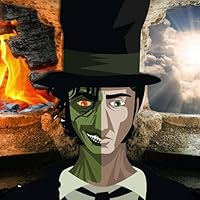
This tale of revenge is less gothic than many of Poe's other tales, yet it still packs an allegorical punch. Here we have a story of a dwarf who's a court jester to a king who just loves a good joke, often at the dwarf's expense. But the king goes too far when one day he throws wine in the face of the dwarf's friend, "a young girl very little less dwarfish then himself." The revenge involves getting the king and his ministers to dress as "Eight Chained Ourang-Outangs" at a masquerade and then.... No, I won't spoil the end. Instead, I'll take up a couple of other points of interest.
First, the narrator. He's never named and it's never clear what exactly his relation is to the events he relates. I find this interesting because Poe always took great care with his narrators, often making them unreliable in the most fascinating ways. We know that this narrator was a subject of the king (he repeatedly calls him "our king"), but that's it. Part of me wondered, as I read, whether the narrator was actually the dwarf himself, because the narrator is quite biting and sarcastic toward the king, calling him a "tyrant" and a "monster" and (repeatedly) "fat." As for the ministers, they "all took after the king...in being large, corpulent, oily men, as well as inimitable jokers."
But the better explanation, I think, is that the narrator isn't the dwarf himself, but rather is relating this tale as a form of allegory. Indeed, there's some indication that this is being told some time after the events described, as the narrator goes out of his way to explain that "[a]t the date of my narrative, professing jesters had not altogether gone out of fashion at court" and that "[d]warfs were as common at court, in those days, as fools." Later, the narrator makes clear that "orang-outangs... had, at the epoch of my story, very rarely been seen in any part of the civilized world." At the "epoch of my story"? Hmm. That seems like long ago. Yet at the very beginning of the tale, the narrator suggests he personally knew the king: "I never knew any one so keenly alive to a joke as the king was." So perhaps we have an old man telling a story of his youth, a cautionary tale that has, given the passage of time, slipped the moors of realism and resides now in the realm of allegory.
This brings me to my second point of interest, namely the allegorical nature of this tale. You can read into it any number of things: a criticism of slavery, alcoholism, or monarchy itself, all of which were very much live issues in Poe's day. But for me it seemed almost like a fairy tale, divorced from worldly concerns--the kind of thing you'd read in the Brothers Grimm. It had a fairy tale's lightness about it, a jauntiness that belied the rather horrible things described. And the end is pure fairy tale magic itself.