

What do you think?

In Place/Out of Place: Geography, Ideology, and Transgression
What is the relationship between place and behavior? In this fascinating volume, Tim Cresswell examines this question via "transgressive acts" that are judged as inappropriate not only because they are committed by marginalized groups but also because of where they occur.
In Place/Out of Place seeks to illustrate the ways in which the idea of geographical deviance is used as an ideological tool to maintain an established order. Cresswell looks at graffiti in New York City, the attempts by various "hippie" groups to hold a free festival at Stonehenge during the summer solstices of 1984–86, and the Greenham Common Women's Peace Camp in Berkshire, England. In each of the cases described, the groups involved were designated as out of place both by the media and by politicians, whose descriptions included an array of images such as dirt, disease, madness, and foreignness.
Cresswell argues that space and place are key factors in the definition of deviance and, conversely, that space and place are used to construct notions of order and propriety. In addition, whereas ideological concepts being expressed about what is good, just, and appropriate often are delineated geographically, the transgression of these delineations reveals the normally hidden relationships between place and ideology-in other words, the "out-of-place" serves to highlight and define the "in-place." By looking at the transgressions of the marginalized, Cresswell argues, we can gain a novel perspective on the "normal" and "taken-for-granted" expectations of everyday life. The book concludes with a consideration of the possibility of a "politics of transgression," arguing for a link between the challenging of spatial boundaries and the possibility of social transformation.
Tim Cresswell is currently lecturer in geography at the University of Wales.
In Place/Out of Place seeks to illustrate the ways in which the idea of geographical deviance is used as an ideological tool to maintain an established order. Cresswell looks at graffiti in New York City, the attempts by various "hippie" groups to hold a free festival at Stonehenge during the summer solstices of 1984–86, and the Greenham Common Women's Peace Camp in Berkshire, England. In each of the cases described, the groups involved were designated as out of place both by the media and by politicians, whose descriptions included an array of images such as dirt, disease, madness, and foreignness.
Cresswell argues that space and place are key factors in the definition of deviance and, conversely, that space and place are used to construct notions of order and propriety. In addition, whereas ideological concepts being expressed about what is good, just, and appropriate often are delineated geographically, the transgression of these delineations reveals the normally hidden relationships between place and ideology-in other words, the "out-of-place" serves to highlight and define the "in-place." By looking at the transgressions of the marginalized, Cresswell argues, we can gain a novel perspective on the "normal" and "taken-for-granted" expectations of everyday life. The book concludes with a consideration of the possibility of a "politics of transgression," arguing for a link between the challenging of spatial boundaries and the possibility of social transformation.
Tim Cresswell is currently lecturer in geography at the University of Wales.
- GenresGeographyNonfiction
216 pages, Paperback
First published January 1, 1996
Ratings & Reviews
Friends & Following
Create a free account to discover what your friends think of this book!
Community Reviews
Displaying 1 - 2 of 2 reviews

October 4, 2020
I’m going to start with a few definitions. The first is the difference between space and place. Although some social geographers refer to ‘social space’, the author here uses ‘place’ to mean that. That is, a space that has social meaning associated with it becomes a place. By ideology the author says this is ‘meaning in the service of power’. He makes it clear that he is not using the term in the Marxist sense, but more as Bourdieu uses it – and even then he criticises Bourdieu for his emphasis upon social class – as he says, virtually ignoring other forms of social power – to quote, “No mention is made of the ways in which doxa operates in relation to gender, ethnicity, age, sexuality, or place of residence” (p.21). Which brings us to another word we need to define – doxa. Bourdieu refers to this somewhere as ‘answering yes to a question I haven’t yet asked’. That is, doxa is the taken for granted, our automatic response. Some people refer to this as ‘common sense’ – but it is even more fundamental than that, I think, it is unchallenged because it is assumed as something that structures the way the world is. And because doxa is the taken for granted, finding ways in which the assumptions made by doxa are brought to people’s awareness is seen as a revolutionary act. That is, what is unspoken and assumed suddenly needs to be justified and even enforced since someone has transgressed it. In Bourdieu’s terms, what was doxa becomes orthodoxy – what was taken for granted as always being the case needs to be asserted and imposed. The reason why it is imposed relates back to the definition of ideology, as meaning in the interests of power – what is doxa, what is taken for granted, is taken for granted because it serves the interests of those with power. Transgressions of the taken for granted challenge power and are therefore met with resistance and reaction from those with power. However, the mere act of resisting requires a conscious act of justification for what was taken for granted – and that immediately ends the ‘naturalness’ of the doxa.
Okay, a difficult start, sorry about that, but things should get easier now. This book looks at a series of places where transgressions occur that challenge doxa, that is, where doxa is resisted, and so it highlights where doxa becomes the orthodox. To do that it needs to show how and where power exists in those places. For there to be a transgression in a place, there needs to be a ‘correct’ way of behaving in that place that is challenged by the transgression.
The three major places investigated are New York (looking at why graffiti is seen as a transgression), Stonehenge (New Age people challenging the meaning of a British cultural icon), and the Greenham Common Women’s Peace Camp, which is the one I’m going to spend the most time discussing.
In each case a transgression occurs in what is seen as the proper use of places – people tagging ‘other people’s property’ or women camping out for extended periods to protest military bases. The author then discusses the reaction to these transgressions. What is particularly interesting is the level of disgust that accompanies each these. The disgust is literal, something Bourdieu predicts too, of course, with the people committing the transgression often being referred to as being filthy, smelly and morally repulsive. This is particularly stressed in the chapter on the Greenham Common women, the smell of these women became such a trope in the right wing press that people visiting the site were often surprised when they didn’t notice any stink at all. The author makes the point that the women were particularly seen as transgressing social norms. Many were labelled lesbians, all were seen ‘unnatural’ since they had ‘abandoned’ their families. Even when not literally said, the proper place for women was seen as the home, and so them being at a protest for months in a field beside a military site broke with this established stereotype. They were compared to witches and hysterics – and thus the positive stereotype of woman as homemaker was replaced by a series of negative female stereotypes and insults.
The women attached artworks to the fences around the military base, but in much the same way that the graffiti from New York was seen as vandalism, rather than art, so too were the women’s artworks. These often contained references to a spiderweb motif referencing the web of life. Menstruation is discussed here too, particularly in relation to Western culture’s obsession with concealment and notions of defilement due to even suggested contact with menstrual blood. Because this was a women’s camp, the women were seen as being ‘out of place’ due to their location beside a military camp, a place marked as masculine. As the author says, the only women generally associated with such camps are prostitutes and other women there to service the facility. The order and permanence of the masculine place is also contrasted with the slipshod disorder of the women’s camps. There is a wonderful part in this where a local woman complains that the women’s camp is destroying her picturesque view of the countryside – however, her ‘view’ includes the military base, something she doesn’t notice at all as an eyesore. The taken for granted in the interests of the existing power relation literally becomes unseen, even while it is right in front of your nose.
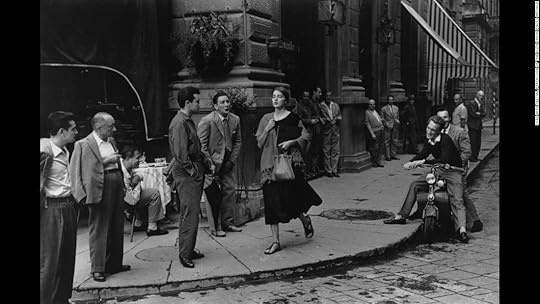
The point of transgressions is in them allowing the possibility of change, not that they require a change to happen, more that a space is opened where change finally becomes an open possibility. The problem is that transgressions are never welcomed – and so they leave the transgressor in an often terrifying place. My favourite example, even if mocked up, is the photograph ‘An American Girl in Italy’ where the young woman is being leered at by a dozen or so men while walking down a street. Her transgression is in her age, her being alone, her being in a place she may not have even realised was marked male. Transgressions are never comfortable, but for change to occur, they remain necessary.
Okay, a difficult start, sorry about that, but things should get easier now. This book looks at a series of places where transgressions occur that challenge doxa, that is, where doxa is resisted, and so it highlights where doxa becomes the orthodox. To do that it needs to show how and where power exists in those places. For there to be a transgression in a place, there needs to be a ‘correct’ way of behaving in that place that is challenged by the transgression.
The three major places investigated are New York (looking at why graffiti is seen as a transgression), Stonehenge (New Age people challenging the meaning of a British cultural icon), and the Greenham Common Women’s Peace Camp, which is the one I’m going to spend the most time discussing.
In each case a transgression occurs in what is seen as the proper use of places – people tagging ‘other people’s property’ or women camping out for extended periods to protest military bases. The author then discusses the reaction to these transgressions. What is particularly interesting is the level of disgust that accompanies each these. The disgust is literal, something Bourdieu predicts too, of course, with the people committing the transgression often being referred to as being filthy, smelly and morally repulsive. This is particularly stressed in the chapter on the Greenham Common women, the smell of these women became such a trope in the right wing press that people visiting the site were often surprised when they didn’t notice any stink at all. The author makes the point that the women were particularly seen as transgressing social norms. Many were labelled lesbians, all were seen ‘unnatural’ since they had ‘abandoned’ their families. Even when not literally said, the proper place for women was seen as the home, and so them being at a protest for months in a field beside a military site broke with this established stereotype. They were compared to witches and hysterics – and thus the positive stereotype of woman as homemaker was replaced by a series of negative female stereotypes and insults.
The women attached artworks to the fences around the military base, but in much the same way that the graffiti from New York was seen as vandalism, rather than art, so too were the women’s artworks. These often contained references to a spiderweb motif referencing the web of life. Menstruation is discussed here too, particularly in relation to Western culture’s obsession with concealment and notions of defilement due to even suggested contact with menstrual blood. Because this was a women’s camp, the women were seen as being ‘out of place’ due to their location beside a military camp, a place marked as masculine. As the author says, the only women generally associated with such camps are prostitutes and other women there to service the facility. The order and permanence of the masculine place is also contrasted with the slipshod disorder of the women’s camps. There is a wonderful part in this where a local woman complains that the women’s camp is destroying her picturesque view of the countryside – however, her ‘view’ includes the military base, something she doesn’t notice at all as an eyesore. The taken for granted in the interests of the existing power relation literally becomes unseen, even while it is right in front of your nose.
The point of transgressions is in them allowing the possibility of change, not that they require a change to happen, more that a space is opened where change finally becomes an open possibility. The problem is that transgressions are never welcomed – and so they leave the transgressor in an often terrifying place. My favourite example, even if mocked up, is the photograph ‘An American Girl in Italy’ where the young woman is being leered at by a dozen or so men while walking down a street. Her transgression is in her age, her being alone, her being in a place she may not have even realised was marked male. Transgressions are never comfortable, but for change to occur, they remain necessary.

Read
September 8, 2013In Place/Out of Place gets the gist of it right, and he uses three examples to give his readership a narrative sense of how "placedness" works. Now, I'd like it if the three examples in question were a bit less stridently first-world, but minor quibble.
Another minor quibble: I don't know why Tim Cresswell seems so surprised that the Daily Mail is a right wing rag-- it's cheap entertainment, not news, and to critique its use of sexist, paranoid, and racially charged language is a bit duh. We're not learning anything new there.
Another minor quibble: I don't know why Tim Cresswell seems so surprised that the Daily Mail is a right wing rag-- it's cheap entertainment, not news, and to critique its use of sexist, paranoid, and racially charged language is a bit duh. We're not learning anything new there.
Displaying 1 - 2 of 2 reviews