

What do you think?

Dark Sun: Prism Pentad #5
The Cerulean Storm
Athas, world of the dark Ruled for thousands of years by power-mad sorcerer-kings, its cities have become vile centers of slavery and corruption. Only heroes of the greatest strength and bravest heart can stand against the might of these overlords. The Prism Pentad is a tale of such heroes.
Rajaat, the First Sorcerer, betrayed by his champions at the moment of his paramount victory, has been imprisoned beyond space and time, but he alone can return Athas to its verdant splendor.
Rajaat, the First Sorcerer, betrayed by his champions at the moment of his paramount victory, has been imprisoned beyond space and time, but he alone can return Athas to its verdant splendor.
344 pages, Paperback
First published September 1, 1993
About the author
Troy Denning
191 books684 followersAlso known as Richard Awlinson.
See http://en.wikipedia.org/wiki/Troy_Den...
See http://en.wikipedia.org/wiki/Troy_Den...
Ratings & Reviews
Friends & Following
Create a free account to discover what your friends think of this book!
Community Reviews
Displaying 1 - 30 of 40 reviews
August 22, 2015

Dark Sun nailed this aesthetic, just 30 years too early.
The final book of the Pentad is a return to form after the slog of The Obsidian Oracle. I can recall being irritated by the opening half of the book as a lad because a series of Very Unfortunate Events cause the entire Free Tyrian Legion and even the well-armed Dwarven militia to all die gruesome and summary deaths, but decades later I recognize that rather than a sign of their "failure" it underscored the scale of the threat that Our Heroes were facing. Also, if any blame need be ascribed it ought to go to scummy old Tithian since it was his conniving that put all those victims in harm's way, anyway.
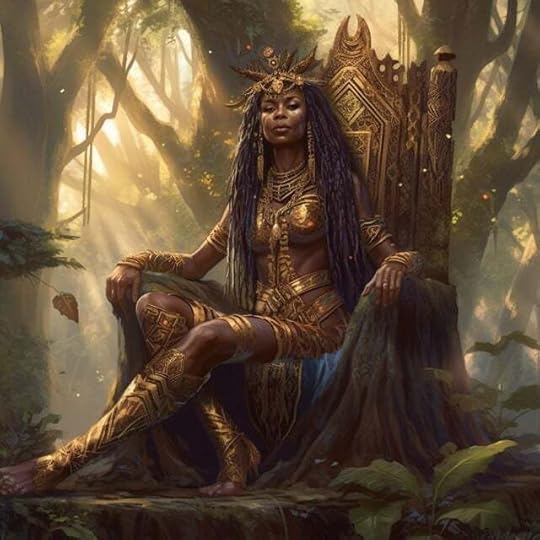
The Oba of Gulg, One of the Two Sorcerer Queens to Appear
A cool feature of the gang's hopeless quest to slay the dragon is the appearance of the remaining Sorcerer Kings of Athas we had yet to meet, several of whom meet their bitter-yet-deserved ends. You really get the feeling Rikus, Sadira and Co. have truly "levelled up" when they are facing down foes of this magnitude on all fronts after struggling mightily to kill just the one Sorcerer King, even with the element of surprise, in the first book.
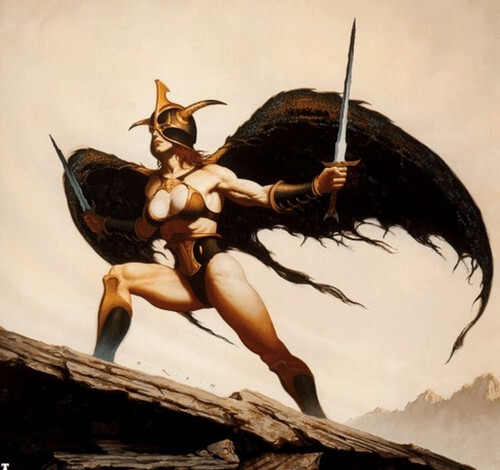
It was nice to see Athas' Best/Worst Mom Neeva get her time to shine on this cover. I found this badass Brom image of her in her silly winged cape costume in tribute.
Most interesting of all is how the rest of Athas' blighted history is revealed as well as the true motivations behind Rajaat the First Sorcerer's genocidal campaigns that so damaged the ecosystems and climate. Without spoilers I'll just say they were all of them deceived...
I am likely spitting my precious body's moisture into the searing wind but I wish the setting would get resurrected in some meaningful way. In these times, in particular, of both ecological anxiety and increasing concerns over the abuse of tyrannical state power it feels timely.
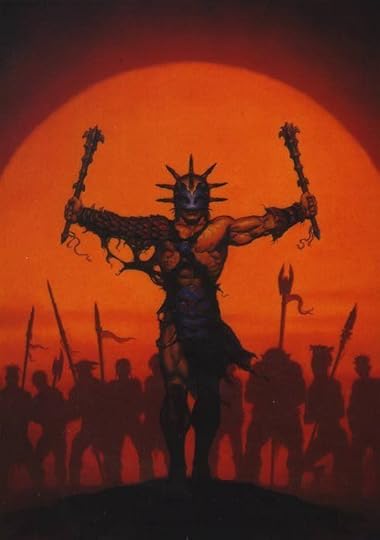
For some of us the Red Sun of Athas will shine on forever.

October 5, 2022
An epic tale filled with psionics, undead and immortal sorcerers. Into the full fury of the crimson sun.

March 9, 2024
Finally finished. These books are not great, but this one's a lot better. It's better written and it's better paced. Books 2-4 each focus on a character or two, having to introduce a bunch of other characters to supplement them--and I never really liked that bit, since the core characters are probably the best characters. Here, in Book 5, we return to all the main characters (well, sort of...) so it's a bit stronger because it doesn't have to introduce new characters who we care little for.
The plot is a bit ruler-straight, with no great twists, but Tithian's evil scheme is just twisty enough to qualify as a... well, as a 'plot'! We also get a bigger reveal of Athasian history (and isn't that what we're reading for?) which is good. So, best of the last four books--but I suspect the best one is Book 1.
Ultimately, there's no enough in this series to justify five books. I'd have thought two to three at most, with more foreshadowing of the later elements earlier on. Wouldn't it have been nice to start with the sorceror kings imprisoning Rajaat for reasons unknown, the narrative interspersing scenes of the Black with the ongoing events in the real world, perhaps a glimpse of Ur Draxa before it was blown up etc. Obviously, when they were released this kind of WAS what happened (for instance, I remember, the first time I read it, having already read the Valley of Dust and Fire, so most of this book made WAY more sense). So maybe, at the time, this book would score higher. But context's a bitch, and so is my rating system, so three stars it is!
The plot is a bit ruler-straight, with no great twists, but Tithian's evil scheme is just twisty enough to qualify as a... well, as a 'plot'! We also get a bigger reveal of Athasian history (and isn't that what we're reading for?) which is good. So, best of the last four books--but I suspect the best one is Book 1.
Ultimately, there's no enough in this series to justify five books. I'd have thought two to three at most, with more foreshadowing of the later elements earlier on. Wouldn't it have been nice to start with the sorceror kings imprisoning Rajaat for reasons unknown, the narrative interspersing scenes of the Black with the ongoing events in the real world, perhaps a glimpse of Ur Draxa before it was blown up etc. Obviously, when they were released this kind of WAS what happened (for instance, I remember, the first time I read it, having already read the Valley of Dust and Fire, so most of this book made WAY more sense). So maybe, at the time, this book would score higher. But context's a bitch, and so is my rating system, so three stars it is!

January 18, 2010
In my opinion, the final book slightly redeems what has been a downward-sliding series. The end is satisfying and well done, but the journey to get there was not.
First, as with the previous books, the characters are still pretty shallow. The final book sees the protagonists engaged in encounter after encounter, and fight after fight; very little chance of development. The exception being the really awkwardly-done and shallow love relationships between Rikus, Sadira, Neeva, and Caelum. Would've really benefitted from some dialogue or internal reflection on their motivations and perseverance... after all, these people are going after a group of the most powerful beings on the planet... with a child in tow!
The second problem was the power level. Our protagonists seem to have "levelled up" to be on par with the sorcerer-kings in the span of 5 books. While the author tried to make it partially luck-based, it was really off-putting to see the Dragon and the sorcerer-kings facing off the protagonists and coming out the losers. It was just extremely silly to have Rikus and Neeva and Caelum struggle against mere giants in the earlier part of the book, yet standing up against poweful undead spirits and sorcerer-kings and the Dragon. And where a single sorcerer-queen decimated an army and almost killed Sadira, yet later on FIVE of them couldn't kill even one of the "heroes". And I'm still baffled as to how the author could have forgotten about the Balican fleet and army that was supposed to be escorting the sorcerer-kings...
On the plus side, the flavourful bits about Athas' history was nicely done, as before, but strangely, there was absolutely no reaction from the protagonists regarding entering the city of Ur Draxa... but maybe not so surprising, considering it's the same as their absolute lack of reaction when they entered a lush forest for the first time in book 1. Other than that, the plot twists weren't quite that cliched, so that was refreshing, especially that bit about Rkard. The final fight to stop the titular "cerulean storm" was actually quite well done and believable, a lot better than the Dragon battle, although... no, I'll stop ranting; too many little bits of unlikely things to bother complaining about.
The summary is that, yes, it's definitely better than the middle books, and yes, it's a decent end to a somewhat poorly-executed series. Just don't expect much of it.
First, as with the previous books, the characters are still pretty shallow. The final book sees the protagonists engaged in encounter after encounter, and fight after fight; very little chance of development. The exception being the really awkwardly-done and shallow love relationships between Rikus, Sadira, Neeva, and Caelum. Would've really benefitted from some dialogue or internal reflection on their motivations and perseverance... after all, these people are going after a group of the most powerful beings on the planet... with a child in tow!
The second problem was the power level. Our protagonists seem to have "levelled up" to be on par with the sorcerer-kings in the span of 5 books. While the author tried to make it partially luck-based, it was really off-putting to see the Dragon and the sorcerer-kings facing off the protagonists and coming out the losers. It was just extremely silly to have Rikus and Neeva and Caelum struggle against mere giants in the earlier part of the book, yet standing up against poweful undead spirits and sorcerer-kings and the Dragon. And where a single sorcerer-queen decimated an army and almost killed Sadira, yet later on FIVE of them couldn't kill even one of the "heroes". And I'm still baffled as to how the author could have forgotten about the Balican fleet and army that was supposed to be escorting the sorcerer-kings...
On the plus side, the flavourful bits about Athas' history was nicely done, as before, but strangely, there was absolutely no reaction from the protagonists regarding entering the city of Ur Draxa... but maybe not so surprising, considering it's the same as their absolute lack of reaction when they entered a lush forest for the first time in book 1. Other than that, the plot twists weren't quite that cliched, so that was refreshing, especially that bit about Rkard. The final fight to stop the titular "cerulean storm" was actually quite well done and believable, a lot better than the Dragon battle, although... no, I'll stop ranting; too many little bits of unlikely things to bother complaining about.
The summary is that, yes, it's definitely better than the middle books, and yes, it's a decent end to a somewhat poorly-executed series. Just don't expect much of it.
April 20, 2021
A fitting end to this "pentad" of five novels. The book is filled wall-to-wall with brutal action scenes, which fits the tone established in the earlier books, but doesn't offer much of a character arc for any of the protagonists.
The authors of these D&D books have to make a tough call regarding how much to hew to the rules of the game. Here, the D&D level-up dynamic is honored. In the first book our heroes were struggling against security guards and lizards, and now they're a credible threat to dragons and lich-kings. The class trajectories are accurate to the game, warts-and-all. Sadira the wizard is more powerful than all the other heroes combined, while the warriors and clerics are in a supporting role. But the descriptions of damage waffle back and forth between abstract "hit points" punishment, and more realistic specific injuries.
Rkard is described as being six years old, but behaves like an adult. I don't know why so many science fiction and fantasy authors insist on portraying young children with adult personalities.
The early fights with the giants are confusing and feel like filler. But the multi-front battles involving combat, psionics, and magic, are lucid and interesting. The final battle has stakes, a sense of urgency, and provides a satisfactory payoff to the series.
The authors of these D&D books have to make a tough call regarding how much to hew to the rules of the game. Here, the D&D level-up dynamic is honored. In the first book our heroes were struggling against security guards and lizards, and now they're a credible threat to dragons and lich-kings. The class trajectories are accurate to the game, warts-and-all. Sadira the wizard is more powerful than all the other heroes combined, while the warriors and clerics are in a supporting role. But the descriptions of damage waffle back and forth between abstract "hit points" punishment, and more realistic specific injuries.
Rkard is described as being six years old, but behaves like an adult. I don't know why so many science fiction and fantasy authors insist on portraying young children with adult personalities.
The early fights with the giants are confusing and feel like filler. But the multi-front battles involving combat, psionics, and magic, are lucid and interesting. The final battle has stakes, a sense of urgency, and provides a satisfactory payoff to the series.
April 11, 2009
Good read but Borys should have kicked all of the heroes asses. They got lucky. Tithian the medler...
Back to the Sea of Silt. I love the ship battles in this series. Reminded me of Dune without the weirdness. Psionics, another favourite of mine. Dark Sun incorporates all of these powers in a wonderful, new, kind of way. It is no longer a cumbersome rules set, the powers are natural. Magic is the power that has a light \ dark side. The way we are thinking "green" today (2009)- this whole series would probably have a new respect if read again.
Back to the Sea of Silt. I love the ship battles in this series. Reminded me of Dune without the weirdness. Psionics, another favourite of mine. Dark Sun incorporates all of these powers in a wonderful, new, kind of way. It is no longer a cumbersome rules set, the powers are natural. Magic is the power that has a light \ dark side. The way we are thinking "green" today (2009)- this whole series would probably have a new respect if read again.
June 15, 2021
this book sums up the story very well.
the history of the world is unique and interesting, the final (first) boss fight was tens, the real boos fight was even more tens, and i love the solution with the big bad. if they would just beat him an be done with it the whole story would feel pointless.
the magic the Razak uses us awesome and well written.
all in all a 4.6 stars :)
whom would have thought that a book that was written 30 years ago would survive that passage of time this well?
the history of the world is unique and interesting, the final (first) boss fight was tens, the real boos fight was even more tens, and i love the solution with the big bad. if they would just beat him an be done with it the whole story would feel pointless.
the magic the Razak uses us awesome and well written.
all in all a 4.6 stars :)
whom would have thought that a book that was written 30 years ago would survive that passage of time this well?

September 18, 2017
I picked this up because I was feeling a little nostalgic for the PC games I had played in my teens. Since I've got a sprained foot, and it was close at hand, I figured it would help me stay still on the couch.
It's probably the worst piece of low-brow fiction that I've read in years; poorly edited, plenty of loose ends, and full of uninspiring prose. If anything, I kept taking my foot off its elevated position just to get a break.
It's probably the worst piece of low-brow fiction that I've read in years; poorly edited, plenty of loose ends, and full of uninspiring prose. If anything, I kept taking my foot off its elevated position just to get a break.


December 13, 2022
This final book in the main Dark Sun series is really an embarrassment to the fantasy genre. You can tell that the author has lost all interest in actually trying to write anything good at this point. Every chapter has some obligatory battle in it, some insurmountable foe that the good guys just barely and miraculously escape from. There is no real world building, character development or thought put into the plot. Things just happen without reason, we jump through time to another meaningless battle and then another and another, drawing things out when instead the story could have been really developed well if just some effort had been put into it. Even the prose gets lazy and simplistic. I think he was just finishing out a contract of five books that he knew few people would ever read, probably working on other books at the same time.
Whole important scenes between characters or skip just so that we can advance time and go straight into another battle. It’s really sad, did they think that this was what people want to read even in the nineties? No offense, but is this what geeky teens wanted to read?
Not to mention that Denning killed off some of the best characters in the series with hardly any mind whatsoever.
It’s so hard to find good fantasy that isn’t mindless action or slow paced, dark doldrums. A few series stand out while others will be forgotten by history. This is one of the latter.
Whole important scenes between characters or skip just so that we can advance time and go straight into another battle. It’s really sad, did they think that this was what people want to read even in the nineties? No offense, but is this what geeky teens wanted to read?
Not to mention that Denning killed off some of the best characters in the series with hardly any mind whatsoever.
It’s so hard to find good fantasy that isn’t mindless action or slow paced, dark doldrums. A few series stand out while others will be forgotten by history. This is one of the latter.

July 11, 2022
Leveling up comes to its natural conclusion in this, the culmination of the series as we see our protagonists go from struggling against trashy monsters to tackling the Dragon itself. The book is a reflection of dungeons and dragons at its heart and as such some of the issues found earlier in the Pentad rear their heads once more. The lack of character development and internal introspection (and even the lack of time for such as our heroes go from one encounter to the next and play their luck) is peculiar for such character arcs present here, even given the prior criticism, especially when contrasted to some in the series. On the plus side, the world building remains solid and the twists and turns are well done.
May 15, 2024
The final book is an action packed conclusion to the series. It feels like one drawn out final battle with too many turns to stay interesting and no real surprises. I was looking forward to see the heroes of the first book finaly reunited. As you can see from my rating, I was disappointed. The few scenes that feature interesting character interactions give a glimpse of what the book could have been, if the author had put a little more focus on his characters rather than his banal McGuffin-plot.

October 10, 2025
The Dark Sun world is a really fun character. The actual characters in this series, not so much, though the dastardly Tithian was a lot of fun and receives a nice villains demise. Our bland heroes go up against a smorgasbord of bad guys in this one: the evil sorcerer-kings of Athas (all of em! at once!), the dreaded Dragon Borys, and the ancient sealed away evil lich Rajaat. But it's good ole, eternally backstabbing Tithian that holds the story together.
October 6, 2021
I didn't expect this series to be that good. Honestly, I did enjoy resting this a lot. And I lined that the characters learn from their mistakes. The only book in the series I didn't like was the second one (dunno what happened with the writing there).
Quite an entertaining series, especially, for those who like d&d and are intrigued by the setting of the Dark sun.
Quite an entertaining series, especially, for those who like d&d and are intrigued by the setting of the Dark sun.

December 21, 2023
A moderate end to a thrilling series.
This book is well written and featured an appealing end to an epic story. I gave the book 4 stars as it was not the wonderful story as it could have been. It was not exciting as I anticipated and was a bit lacklustre in some places. It was a bit droll in some areas and a little bit tedious.
This book is well written and featured an appealing end to an epic story. I gave the book 4 stars as it was not the wonderful story as it could have been. It was not exciting as I anticipated and was a bit lacklustre in some places. It was a bit droll in some areas and a little bit tedious.

June 6, 2019
An outstanding fantasy series
The Dark Sun series is a gripping cutthroat study of incredible compelling characters and absolutely original world building. I cannot recommend highly enough. Start with book one and enjoy.
The Dark Sun series is a gripping cutthroat study of incredible compelling characters and absolutely original world building. I cannot recommend highly enough. Start with book one and enjoy.

June 5, 2020
An excellent finish to a wonderfully unique and unexpected series. My only real criticism, which all of the books in this series share is that they often end quite abruptly - a more subtle wind down between the characters, particularly in the final part here would have been welcome.

October 28, 2023
Full review here:
https://jamesgenrebooks.blogspot.com/...
All in all, the series holds up as a memorable D&D adventure series, although one probably not as high quality as the DragonLance Sagas.
https://jamesgenrebooks.blogspot.com/...
All in all, the series holds up as a memorable D&D adventure series, although one probably not as high quality as the DragonLance Sagas.
May 11, 2017
A thrilling and satisfying conclusion to the Prism Pentad.

March 24, 2023
This was an exciting read, no doubt about it, but I liked the other books in the series more.

March 30, 2023
Now THAT was an ending! I'm gonna miss Athas and the old crew...
Wait, no it won't, I'm just gonna read the next Dark Sun series!
Wait, no it won't, I'm just gonna read the next Dark Sun series!

August 3, 2023
An adequate end to a fairly good series. Really makes me want Wizards to release some up to date DnD rules for Dark Sun though.

April 24, 2025
Love this shit

February 8, 2026
All action scenes. Characters lost all remaining morsels of likability. Too bad!

August 18, 2026
This one might be the worst in terms of gender politics, but the climactic action scenes were super sweet.
March 20, 2017
very different look on normal races of fantasy. loved the whole series and great ending. not expected at all

May 12, 2017
Grim and vicious as Dark Sun should be. A satisfying end to the series, as well as seeing just how odious Tithian can be.

March 25, 2010
A decent read, and definitely a fun read for fans of the Dark Sun setting. It's a harsh and unforgiving world and a pair of former gladiators, a former slave and a treacherous would-be king will face the greatest threat to their world, and find that it really wasn't. There's a worse threat. Something that will threaten Athas' very way of life.
It's fun, but it goes without saying that since this is the fifth book in the series you should definitely read the first four before you get to this one. You'll be a bit out of touch, and some things just won't make sense. Take the time to read the whole series and you'll be in for the ride of your life.
It's fun, but it goes without saying that since this is the fifth book in the series you should definitely read the first four before you get to this one. You'll be a bit out of touch, and some things just won't make sense. Take the time to read the whole series and you'll be in for the ride of your life.

February 27, 2011
The entire series is a very solid story. It established the backstory for the Dark Sun Campaign Setting of D&D way back in the days of Second Edition, and is still quite enjoyable. It provides the "feel" for Athas as a devastated world (particularly the first two books), although the rest of the series focuses so much on the struggles of the main characters that the living conditions in Athas are lost in the background at times. Sometimes it feels like Denning doesn't know what to do with some of his characters (like Agis) and their deaths feel pointless and out of place. Overall good, especially as a source of inspiration to running Dark Sun-based D&D games.

December 26, 2015
Not quite the neat conclusion that these usually tightly plotted books have. At the novel's end, Athas' fate remains unclear, though there are signs greener (and bluer) things are on the way. As with the remainder of this series, there is minimal characterisation and the protagonists survive far too many dangerous and magical upheavals.
I'm not sure if I'll try any of the other Dark Sun books yet as I wasn't exactly grabbed by the setting this series presented. It's a compelling world from the video games and role playing source material, but I don't think the Prism Pentad really seized hold of it as well as it should've.
I'm not sure if I'll try any of the other Dark Sun books yet as I wasn't exactly grabbed by the setting this series presented. It's a compelling world from the video games and role playing source material, but I don't think the Prism Pentad really seized hold of it as well as it should've.
Displaying 1 - 30 of 40 reviews