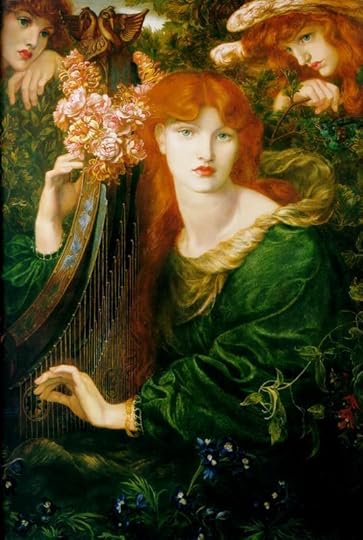
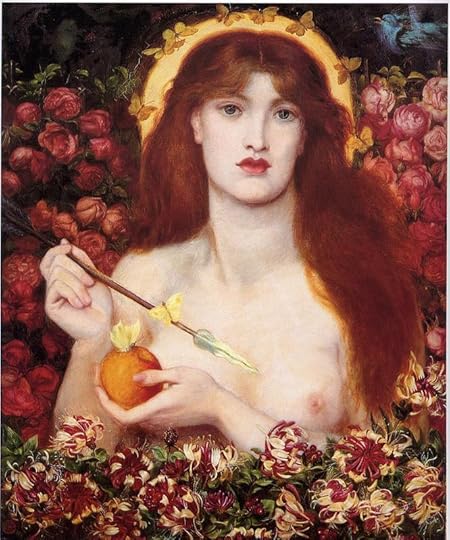
A collection of Christina Rossetti's poetry asking the question "what is love?". The poetry explores the love of mothers and children, of nature - especially of animals, flowers and the seasons. Illustrations are taken from the works of her brother and other artists of the Pre-Raphaelite circle.
Christina Georgina Rossetti, sister of Dante Gabriel Rossetti, wrote lyrical religious works and ballads, such as "Up-hill" (1861).
Frances Polidori Rossetti bore this most important women poet writing in nineteenth-century England to Gabriele Rossetti. Despite her fundamentally religious temperament, closer to that of her mother, this youngest member of a remarkable family of poets, artists, and critics inherited many of her artistic tendencies from her father.
Dante made seemingly quite attractive if not beautiful but somewhat idealized sketches of Christina as a teenager. In 1848, James Collinson, one of the minor pre-Raphaelite brethren, engaged her but reverted to Roman Catholicism and afterward ended the engagement.
When failing health and eyesight forced the professor into retirement in 1853, Christina and her mother started a day school, attempting to support the family, but after a year or so, gave it away. Thereafter, a recurring illness, diagnosed as sometimes angina and sometimes tuberculosis, interrupted a very retiring life that she led. From the early 1860s, she in love with Charles Cayley, but according to her brother William, refused to marry him because "she enquired into his creed and found he was not a Christian." Milk-and-water Anglicanism was not to her taste. Lona Mosk Packer argues that her poems conceal a love for the painter William Bell Scott, but there is no other evidence for this theory, and the most respected scholar of the Pre-Raphaelite movement disputes the dates on which Packer thinks some of the more revealing poems were written.
All three Rossetti women, at first devout members of the evangelical branch of the Church of England, were drawn toward the Tractarians in the 1840s. They nevertheless retained their evangelical seriousness: Maria eventually became an Anglican nun, and Christina's religious scruples remind one of Dorothea Brooke in George Eliot's Middlemarch : as Eliot's heroine looked forward to giving up riding because she enjoyed it so much, so Christina gave up chess because she found she enjoyed winning; pasted paper strips over the antireligious parts of Swinburne's Atalanta in Calydon (which allowed her to enjoy the poem very much); objected to nudity in painting, especially if the artist was a woman; and refused even to go see Wagner's Parsifal, because it celebrated a pagan mythology.
After rejecting Cayley in 1866, according one biographer, Christina (like many Victorian spinsters) lived vicariously in the lives of other people. Although pretty much a stay-at-home, her circle included her brothers' friends, like Whistler, Swinburne, F.M. Brown, and Charles Dodgson (Lewis Carroll). She continued to write and in the 1870s to work for the Society for Promoting Christian Knowledge. She was troubled physically by neuralgia and emotionally by Dante's breakdown in 1872. The last 12 years of her life, after his death in 1882, were quiet ones. She died of cancer.
”Your instinct was so sure, so intense that it produced poems that sing like music in one’s ears. Yet for all its symmetry, ours was a complex song. When you struck your harp many strings sounded together. You had a keen sense of the visual beauty of the world. No sooner have you feasted on beauty with your eyes than your mind tells you that beauty is vain and beauty passes. Death, oblivion an rest lap round your songs with their dark wave. A firm hand pruned your lines; a sharp ear tasted their music. Nothing soft, otiose, irrelevant cumbered your pages. In a word, you were an artist.” (Virginia Woolf on Christina Rossetti in The Second Common Reader).
I dream of you to wake: would that I might Dream of you and not wake but slumber on; Nor find with dreams the dear companion gone, As Summer ended Summer birds take flight. In happy dreams I hold you full in sight, I blush again who waking look so wan; Brighter than sunniest day that ever shone, In happy dreams your smile makes day of night. Thus only in a dream we are at one, Thus only in a dream we give and take The faith that maketh rich who take or give; If thus to sleep is sweeter than to wake, To die were surely sweeter than to live, Though there be nothing new beneath the sun.
However Christina Rossetti (1830-1894) would have disagreed with the presentation of this sonnet here – she insisted that none of the individual poems be singled out - I couldn’t resist inserting the one which might be my favourite from Monna Innominata(1881), subtitled ‘Sonnet of Sonnets’, a sequence of fourteen Petrarchan sonnets intended to be read as an unity, all about love.
In the sonnets Rossetti gives a voice to the ‘unnamed ladies’ whom poets in courtly tradition sung the praises of, riposting to their verses by engaging into a dialogue with Dante and Petrarch - each sonnet containing as an epigraph a line from both poets speaking to Beatrice and Laura. Reversing the traditional male perspective on the woman as the silent object of desire and thematising the feminine voice in poetry, addressing the muteness of the muse with a whiff of rebelliousness, this fitted in amazingly well with my current reading project.
Struck by a common feature in their approach of unfulfilled love, Rossetti’s poetry reminded me of Emily Dickinson (they were born in the same year), despite the differences in tone and temperament of their poetry (the fixed sonnet form of Rossetti at times might come across as a pinching corset in comparison with the exuberant poetry of Dickinson) - both poets relying on the afterlife to be united with their beloved and complete a love which was not possible in life, regardless of the nature of that barrier that kept love from their lives – in Rossetti’s case, according to the preface she wrote for Monna Innominata the barrier ‘held sacred by both, yet not such as to render mutual love incompatible with mutual honour’ – religion.
Like the recent Women & Power: A Manifesto, reading about this ‘Sonnet of Sonnets’ and Rossetti invites to reflect on the issue of the silencing of women, now and in the past - the concept behind the Monna Innominata remarkably in line with present day concerns. The sequence has been considered a parody on the traditional love sonnets written by men. It inspired diverse (proto) feminist interpretations as well as the contrary – while in one sonnet the woman speaking positions the lovers as equals (‘So shall we stand - As happy equals in the flowering land - Of Love, that knows not a dividing sea’), another tends to venerate submissiveness as the culmination of love (‘To love you without stint and all I can – since woman is the helpmeet made for man’). Rossetti has been labelled a sanctimonious hypochondriac, her poetry pathologised and dismissed as the work of slip-shod Sibyl - like the work by other ‘poetesses’ unworthy of inclusion in the literary canon. In this respect the appreciation of Rossetti’s voice still seems to stir quite mixed emotions, at times expressed with a misogynist undertone.
Alas unfamiliar with troubadours, courtly love, the love sonnet tradition, Dante and Petrarch, I am aware a lot of this poetry’s depth and intertextual joys and finesses went over my head. Nonetheless, (and despite the religious overtones articulating spiritual struggle and considerations on the transcendent fulfilment of passion rather alien to me), I could relate to the longing and desire these poems convey and savoured the nostalgic, elegiac and romantic hues tinting some of the stanza’s - of which the mellifluous lyricism prompted me to read the sonnets four times since I found them in the library. What more could I say than that this Monna Innominata sonnet sequence is eloquent and beauteous, as well as intriguing and thought-provoking? Fortunately I could quote from another woman’s eloquent eulogy to do the poet more justice.
Read cover to cover for the first time, although I've dipped into it several times in the past.
On the one hand, the collection seems a bit scraping-the-bottom-of-the-barrel-ish (why attempt to collect the few love poems of a poetess who primarily wrote devotional poetry--and then leave out half of "A Birthday"?). On the other hand, it's Christina Rossetti, and she's a wonderful, underappreciated poetess.