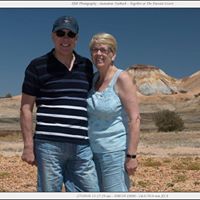
In 1855 an impoverished young English scientist went to chance his luck in Australia - as Government Astronomer and superintendent of Telegraphs for the small colony of South Australia. With him went his young wife Alice - after whom Alice Springs would be named. Charles Todd was following a dream - the near impossible task of stringing a telegraph wire across the wilderness of the Australian outback. In 1997, Charles Todd's great-great-great-granddaughter, Alice, followed in his footsteps. Her plan was to track the telegraph - and her ancestors - from Adelaide over the thousands of miles of desert, outback, swamp and mountain that Charles Todd had crossed in the 1860s with his four hundred men.
Marvelous fun. Trekking through the outback with Alice Thomson and her long-suffering husband Ed on the trail of Thomson's Australian great, great grandparents Charles and Alice Todd. Part travelog, part genealogical research with lots of insights into Australian's early colonial history and modern Aussie culture.
Thomson is a British journalists whose grandparents made a reverse migration from Australia to England. She is named after her intrepid great, great grandmother and got bitten by the family history bug (something I well understand). Like all good family historians Thompson combines oral history and archival documents, letters and old photographs. Thompson's search was made easier (and more interesting) because Charles Todd played a major roll in one of colonial Australia's first engineering feats: stringing a telegraph wire from Adelaide, through the forbidding and uncharted Outback, all the way to Darwin on the jungle-filled North coast.
Alice and Ed made the daft plan to follow the original route taken by Charles Todd and his team of engineers and explorers--a project announced in the local press with an article suitably titled Mad Dogs and Englishmen. They actually managed to do it--in two stages--and lived to tell the tale in this very entertaining book.
It's closer to 3.5 stars and truthfully at points it was just 3 stars. But I have to round it up for the style of Alice Thomson's prose and personality. They are intricately embedded within each other.
Because you KNOW how she feels about nearly everything (including aborigine present day situation/ placement within the organized Australian system etc.) but you aren't going to get quotes that push the ideal, agenda, position in your face. Instead you get her- Alice. And I love that quality.
But for the original Alice, the one who Alice Springs, Australia is named after? That Alice. I didn't get to know her enough in her middle or late age. Todd I did. He seems like a true blue obsessive entrepreneur doer with the mech to make it happen. Somehow.
It will let you know 1000 facts and realities about Australia, Adelaide especially, and the inner continent of "Centralists" too. Not only for this era but for the one of the mid nineteenth century under the Empire Queen.
Poor Ed (her husband). God bless him, because he just can't get sick! Again! It's hard to be married to an intrepid. Oh yes!
Australia knowledge seekers must read this one. Fires and drought have occurred since before a human approached.
This isn’t the book about Alice that I’m trying to trace but I read it anyway. I found I was enjoying the history parts about Todd and the bits about Alice more than the upto date travels of the author. Interesting and enjoyable read.
A book about the creation of the first Trans-Australia Telegraph line. Written by the great-great-granddaughter of the woman for whom Alice Springs is named. Brilliant.
I love historical non-fiction about great achievements by humans that actually made things better.
First off, for any Northern Hemisphere residents a note about the sheer size of Australia. It is bigger than you can imagine. More than twice+ the size of India, three+ times the size of Mexico and so on.
One Australian state, Western Australia, if it were a country, would be the 10th largest country in the world.
A telegraph line??? You may wonder what the fuss is about.
If you are old enough to remember pre-internet then the change that the internet made was nothing compared to the introduction of the telegraph.
In 1980's New Zealand I could phone my parents in England. In the 1850's, had I been alive, I could only receive letters and read newspapers that were 3 months old. If one of your family in England died at Christmas it would be April before you knew. After the introduction of the telegraph you'd know within hours at the most.
Back to the book.
The interior of Australia, roughly the size of the US was completely unknown and the few brave souls who had tried looking for a trans-continental route had all perished in the attempt. Finally in 1862, John McDouall Stuart crossed the continent by following Aboriginal trails that linked waterholes thereby forming a route that could sustain both humans and animals.
Here's a quote from the book: “The commitment was really quite staggering. They had undertaken to build a telegraph line three thousand kilometres long through country about which they knew nothing other than what Stuart had told them many years ago, and which was unoccupied by white people for 2,250 kilometres. What they did know was that the country was dry, with long stony deserts and sandhills running at right angles to the route, that there were no tracks, that most of it contained little timber for poles, and that every item of equipment, food, building materials and other stores would have to be carted most of the way.”
The line would require 37,000 iron poles, along with insulators, batteries, wire and telegraph equipment imported from England. Poles were to be placed 80 km apart and a repeater station built every 250 km. A team of surveyors, linesman, carpenters, labourers and cooks were required; and the materials, food and supplies had to be transported to the workers by bullocks, horse drawn wagons, and Afghan cameleers."
The author, (the great-great-granddaughter of the woman for whom Alice Springs is named),, follows the original route of the telegraph line and writes of the original achievement as she goes so it's a curious mix of auto-biography, a road trip and historical fiction. It actually works quite well and her hereditary status is acknowledged at various points along the way, including Alice Springs.
It avoids the trap of long lists of dates and places, instead it focuses on the people and brings them to life and thye carry the story along.
Side note: The Aussies are no strangers to long lengths of wire strung across impossible terrain. The Rabbit Proof Fence ran some 2000km (?) The Dingo Fence runs some 5600 kms, equivalent running a fence from New York City to Guatemala City.
Good book, interesting how much Alice knows about her famous and important ancestors. Wonder what kind of Australia would be around today had Todd not been able to connect North and South.
Alice Thomson's great-great-great-grandfather was Charles Todd, who led a party to install the telegraph through the centre of Australia in the 1800s. Her great-great-great-grandmother was Alice Todd, for whom Alice Springs was named. This is a joint story in two halves, as Thompson shares the history of her relatives and also as she embarks on a journey from England with her husband Ed to follow in Todd's footsteps, and discovers the beauty and wildness of Australia.
Sir Charles Todd, polymath and early adopter of emerging Victorian technologies takes a ship to Australia with his new young wife, where against all the odds he builds the first South to North Telegraph. His determination and self-belief are as astonishing as the completion of the line in just two years, having overcome appalling extremes of weather- 40 degree heat in the Central desert, months of The Wet around Roper river, infestation, malnourishment & personal privations that would defeat most of us. He also overcame attacks on his good name & nature and political meddling. The story is told by his Great, Great Granddaughter who is a good writer but failed, for me, to explain the attraction to this hostile & primitive sounding country with her own disastrous and uncomfortable re-tracing of the Telegraph's route. For a large part the reading was as difficult as Todd's story, but ultimately here is another Victorian Englishman (as great as Brunel or Pugin) who achieved the seemingly impossible, brought the equivalent of our 'Internet' to a new continent and I had never heard of him!
What an interesting story of how the telegraph line was established across Australia. Well told by the gg daughter of Charles and Alice Todd whose names are immortalised in the outback. Having travelled through parts of The Kimberleys I enjoyed seeing names of places I had been to. The hardships endured by the men who laid the line, the self centred determination of Charles and the stoic nature of Alice are all well depicted
Read in advance of a visit to Australia and a train journey from Darwin to Adelaide. I doubt our journey will be as physically strenuous as Alice Thomson's and will be aware of out tourist status, but this was entertainingly written, even if it did leave me somewhat astounded at the patient resilience of Alice Todd.
This has everything I love in a book. Well researched, a story of pioneers that would be hard to surpass and putting it into modern-day comparison by following the route. It's an honest account of an amazing single-minded man and his long-suffering wife. Great story.
Brilliant! I loved every page of detail. What a lot of research. Alice the author brought to life the way people in those days lived and survived. A tough bunch. She has every reason to be immensely proud of her ancestors.
Part historical account, part travel memoir, this book examines the creation of a telegraph system that connected Australia to the rest of the world. Written by a journalist who also happens to be a descendant of the project lead, it highlights those who built the system and the obstacles they faced in so doing.
The author and her husband drive across Australia's unforgiving interior to get a better feel for the pioneers' struggles and to gain insights from locals. Their own adventure is amusing, but the historical aspects are what make this book sing, so to speak.
The men were ill-prepared for the outback, the women were left behind to care for their families, and there was precious little spirit of cooperation. Men bickered with one another, as did state and territorial governments. Given the natural and human-made obstructions, it's a miracle the project ever got completed.
This is an enjoyable read that provides a window into a world scarcely imaginable. The tale is both revealing and well told.
This is the biographical story of Charles Todd, the man who successfully managed to connect Australia with other continents by taking the telegraph across its interior and Alice Todd his wife who gave her name to the famous Alice Springs. Written by Alice Thomson their great great granddaughter it is also partly a travel story as in 1997 she and her husband retrace the steps that the Todd’s had taken over a hundred years previously. She vividly describes the trials and tribulations of these Victorian explorer’s and those of her and her husband. In crossing some of the most isolated and hazardous terrain in the world, they discover that some parts of the Australian outback have changed little since Victorian times. Even with all modern day advantages to help them it was still not and easy task in modern times.
It was an amazing feat that these pioneers achieved and Alice’s account made me realise just how much this was so!
I enjoyed the way the author took us on a journey in time. We learn about the characters and events which led to the construction of the overland telegraph through South Australia while at the same time (well alternate chapters) we revisit the track with the descendants of those courageous explorers in our time. Alice Thomson has an easy writing style which makes this book enjoyable and informative for those who want to learn more about the history of our state.
A history lesson told through the eyes of a descendant of those that created history. I thought it was a nice change to the normal history book about these subject; with this book being told in this fashion, you get the feeling that the history is still alive and belongs to the present as much as the past. I enjoyed reading it.
Given to me by a friend just before I moved to Aussie, this book really whet my appetite for the country. Part travelogue-part family history - part pioneering history,it's a really entertaining way to find out about the early days of Australia.
The story of Alice and Charles Todd who implemented the telgraphic system in Australia, intertwined with Alice and Eds story who retrod their footsteps in the 1990s. Incredible story, how hard the Todds life must have been and Alice (who Alice Springs was named after) was a real trouper.