What happens after we die? This difficult question has fascinated people for thousands of years.
An Atlas of Afterlives sets out to explore and explain the many underworlds, otherworlds, heavens and hells believed in by cultures from across the world, throughout history. From paradise gardens to fiery kingdoms, from shadowy isles of the dead to ghostly galleons on an eternal voyage, these visions of eternity are fascinating examples of human creativity and storytelling.Organised by continent, this book will take you on an eerie journey to discover legendary places from different mythologies. Each lavishly illustrated spread invites you into a different realm of the dead, with deities, demons and other details drawn from historical sources ranging from ancient Egyptian scrolls to Chilean folklore. With wonder, curiosity and sensitivity, every one of these awe-inspiring places is presented in its cultural context, combining real, historical fact with the magical atmosphere of the unknown – and unknowable. Discover afterlives from all over the world,
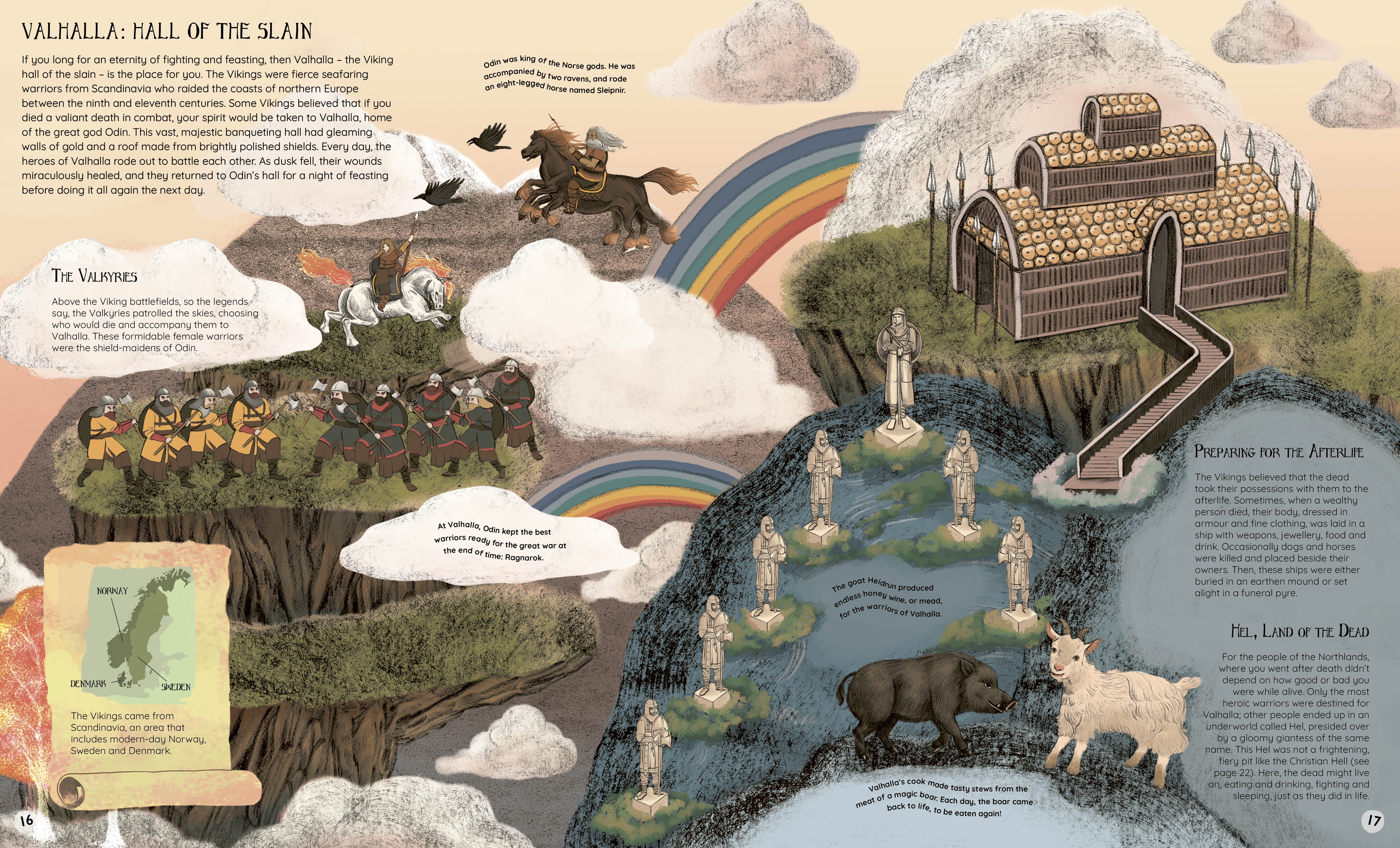
The gloomy kingdom of Hades, ancient Greek god of the dead Valhalla, mead hall of fallen Norse heroes Duat, ancient Egyptian River of Death Jannah, the beautiful Islamic garden of heaven Kakuriyo, the invisible realm of spirits in Japanese Shinto beliefs The Gates of Guinee, the Voudou portal said to be hidden in New Orleans The Lakota Trail of Spirits in the Milky Way Kibu, island of ghosts to the Torres Strait Islanders of Australia Many, many more. With stories, histories and mapsto get lost in, An Atlas of Afterlives is a truly unforgettable departure from our everyday lives into the depths of world mythology, exploring a fundamental question in an accessible, respectful and totally unique way. This lavish volume will fire the imaginations of curious explorers aged 9-12 keen for a glimpse of what lies beyond.
Once a children’s book editor, Emily Hawkins is now a full-time author. Her work has been featured on the New York Times bestseller list (Oceanology, 2009) as well as winning the Children’s Travel Book of the Year Award (Atlas of Animal Adventures, 2016). Along with her background in children’s non-fiction Emily has a strong interest in myth, folklore and storytelling. In 2020 she wrote A Natural History of Fairies, which has been translated into twelve languages, selling more than 100,000 copies worldwide. Emily holds a first-class English degree from Nottingham University, and lives in Winchester, UK.
I got this book because I'm a huge mythology fan and the afterlife is featured prominently everywhere, regardless of which mythology we are talking about. Moreover, I can never resist a good map. :D
It's definitely a book that works a lot with visuals. Thus, there are more illustrations than there is text (or so it felt for me), but I didn't actually mind (having known about that in advance).
So whether we talk about one of the present day religions or mythologies from our ancient past, whether we talk about the western world or any other corner of this planet, people have always been half scared and half fascinated by death. More specifically, humans have always wondered if there is something MORE, something that comes AFTER. In the endeavor to make sense of it all, to find comfort or whatever, we've invented a host of places that are sometimes rewards and sometimes punishments for how we lived our lives, and sometimes just the next step in one's journey.
This book attempts to show all these different forms of "heavens", "hells", "gardens", worlds above or below or beyond. It thus paints some very nice pictures of the different cultural approaches to death when mapping these eerie places from all continents of this planet.
(All of the above pictures are also links to the bigger versions where you can see the gorgeous details since GR is usually messing with the image quality severely and I hate it.)
How people treat and think of their dead tells you a whole lot about their approach to life - this book nicely emphasizes that, too. Certainly a lighter examination of the subject, but still significant and very nicely "packaged". Definitely perfect as the first step or maybe even a reference on what to look up next.
I received an advance reader copy of this book to read in exchange for an honest review via netgalley and the publishers.
An Atlas of Afterlives is one of the best non-fiction, historical information books for children about ancient times and afterlives from around the globe. Each afterlife story has a two page spread full of fantastic illustrations and packed full of easy but informative facts and information too. I enjoyed how this book seemed to be on an even keel in relation to areas such as religious beliefs and treated each religion as an individual and not showing influence or favouritism towards any in particular - each was held in equal regard. Any fans of ancient Egypt and Greek mythology will be sure to devour this book! I wish I'd had this as a child it would have become a very treasured read for me!
This is a fascinating and gorgeously illustrated look at the different afterlives believed in around the world, present and past. I was intrigued by how similar all of the afterlife myths are. There are a few main themes and many ideas that seem to be near-universal.
I especially liked how each story was treated with equal gravity. Christianity wasn't given extra weight, none of them were made out to be "lesser" or "more primitive" or "backwards." The style was very similar to books on Greek mythology that I read as a kid: matter-of-fact renditions of stories.
Each depicted afterlife story was laid out on a beautiful two-page spread full of color and whimsical detail. The informative text was scattered around the page in blurbs that draw the eye around and keep the information in easily digestible chunks.
I would definitely recommend this to any kid who loves stories about Greek mythology or Ancient Egypt.
*Thanks to NetGalley, Quarto Books, and Wide Eyed Editions for providing an early copy for review.
First of all I really need to know who the intended audience for this book was since although written with children in mind I cannot even conceive of an adult actually wanting their child to read this. Part of the crowd will be against this book due to the fact that it provides readers with other religious views that they may not believe in and the other part will be against it since it is about religious views. And then when it comes down to it there is this whole why is this a topic we want to approach with children, especially when other similar topics are scowled upon as well.
Anyway the book breaks down the world into continental sections and for whatever reason they chose to start in Europe instead of maybe a place like Africa where Egypt is quite famous for its funerary traditions. Maybe they did this since so many are now familiar with European concepts or history or maybe they chose Europe since that is where they are most comfortable with, perhaps even from.
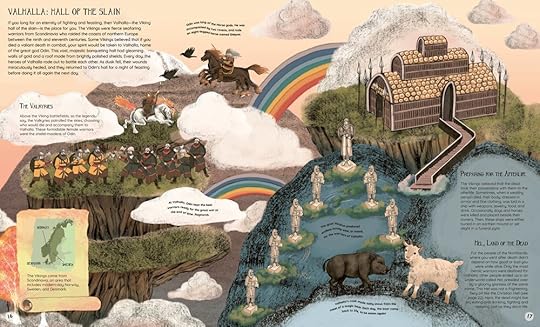
The first stop is classic Hades from Ancient Greece while apparently it wasn't deemed worthy or of note to mention this is also for the most part what the Ancient Romans believed in with their adopted pantheon. Quickly following is the Nordic Valhalla and a few pages in you get Christianity tucked into Europe although basically that isn't quite the headquarters.
The book is divided up into continents for the most part while each section is started off with a map of that region. Locations included on the map are possible "hell gates" or other underworld entries, locations of interest such as the Terracotta soldiers or other burial sorts and also the mentioned afterlife locations. Even if these locations appear on the map it doesn't guarantee that there will be an included entry for them.
For actual entries each entry is provided with a spread. This is led by an introduction about the people, some of their history and a caveat. From there the information is split up between titled paragraphs or captions while most pages have a map in one of the bottom corners with some information about the geography although there are a few uncaptioned maps.
So this is what really agitated me with the book, which is basically everything. Although catering to young readers and unable to really get into the meat of these beliefs I found it intriguing that the author chose to use the caveat in almost all the entries as "the (group of people for the page) had many different beliefs, about the afterlife" before continuing to portray the major one on the page. Unfortunately this wasn't always factual or was partially factual such as in the case of the Nordics in which there was no mention that half the slain Vikings were sent to Valhalla and the other half were sent to Freya's hall although strangely enough the concept of others being sent down to Hel made it in.
Christianity is probably the only one that has two spreads with one exploring the Jacob's ladder and how it led to the thought of a stairway to Heaven although every Christian I know doesn't believe that is the actual way you get there. And then the spread following after is dedicated mostly to the Dante-Catholic view of Hell. And for others who may be interested in the Judeo-rooted beliefs although the Jewish sheol is mentioned on the map it doesn't go into details for the Jewish belief (although from the text under sheol the author claims this was an underworld and not the grave as many take it for) while easily skipping over the concept of the Muslim Hell thus just mainly presenting their paradisaical afterlife.
From there only one pronunciation guide was included and that was for Xibalba while the reader is left to try to sound out the other names included. When I think about the way my sister told me the school taught her daughter to grade books this one would surely fail the grading system.
Another aspect that makes my hackles raised is the fact that Emily Hawkins chose to wave her virtue by making mention that the Europeans kidnapped millions of Africans then transported them across the Atlantic for the Kalunga line. I think she needs to do further research as to the original kidnappers but that is one part of history that never seems to be told correctly anymore.
As if this wasn't enough partial truths, twisted history and sides taken the illustrations are just as bad. Take for example Charon from Ancient Greece who is portrayed as the Grim Reaper while ferrying around a boat that is basically made of some type of ribs bones. From what I can remember of Greek mythoi that would have been quite impossible for heroes such as Psyche, Theseus, Orpheus or Theseus just to mention to enter via ferry the underworld when they had need to.
The book the ends up with an Afterword that winds up with something that basically summarizes as Oh, and if you aren't religious then just remember your body will decompose and become elements that share to the building blocks of all other living things so remember death isn't the end but just the beginning.
If the information was factual and researched well I could possibly see a point with this book being a stepping stone into the subject of mythology but it isn't. Along with the main subject of death, which is already scary for little ones, and conflicting beliefs this book is just awkward in my honest opinion.
Wonderful introduction for the various myths/legends of the afterlife. The book takes careful consideration detailing the cultures of the world & the ways they've depicted the afterlife throughout history. A beautifully illustrated work bringing the tales to life. Would recommend to older children, 8-12 & anyone curious about afterlife traditions.
*Kind thanks to Edelweiss and the publisher for providing a DRC in exchange for an honest review.*
The Publisher Says: What happens after we die? This difficult question has fascinated people for thousands of years. An Atlas of Afterlives sets out to explore and explain the many underworlds, otherworlds, heavens and hells believed in by cultures from across the world, throughout history. From paradise gardens to fiery kingdoms, from shadowy isles of the dead to ghostly galleons on an eternal voyage, these visions of eternity are fascinating examples of human creativity and storytelling.
Organised by continent , this book will take you on an eerie journey to discover legendary places from different mythologies. Each lavishly illustrated spread invites you into a different realm of the dead, with deities, demons and other details drawn from historical sources ranging from ancient Egyptian scrolls to Chilean folklore. With wonder , curiosity and sensitivity , every one of these awe-inspiring places is presented in its cultural context, combining real, historical fact with the magical atmosphere of the unknown – and unknowable.
Discover afterlives from all over the world, With stories , histories and maps to get lost in, An Atlas of Afterlives is a truly unforgettable departure from our everyday lives into the depths of world mythology, exploring a fundamental question in an accessible, respectful and totally unique way. This lavish volume will fire the imaginations of curious explorers aged 9-12 keen for a glimpse of what lies beyond.
I RECEIVED A DRC FROM THE PUBLISHER VIA EDELWEISS+. THANK YOU.
My Review: Remember Emily Hawkins? Her effort regarding mythical kingdoms led me to look for, and forward to, this beautiful looking item: The artist, Manasawee Rojanaphan, has a great design sense and a broad imagination. This is some of what is covered: The careful effort to present the world's thinking about the thing that happens after we die is admirable; the clarity and concision of the stories; the sensitive artwork that invites close and sustained examination, all add up to much more than just the sum of the pretty parts.
Your curious folklore and mythology-loving tween will enjoy it as an aesthetic object, as will any teens still (re)reading the many modern takes on mythology. It is a useful reference book for the grade-school set. It wouldn't look too terrible on Grandpa's hearthside reading chair, either. All ages can find some appreciation for its facets; the hallmark of a truly well-made and -thought-through book.
This gorgeously illustrated, large-format book explores different beliefs about the afterlife throughout the globe. There are atlas pages focused on different continents, with location markers for where different beliefs originated, and there are double-page spreads that explore a variety of different religions and belief systems.
The illustrations are beautiful and eye-catching, and this book is a helpful source of cultural education, but I have multiple critiques. On a technical note, the double-page spreads feature random bits of text that are sometimes difficult to read, since the font is small and the font color doesn't always show up well against the illustrations.
Regarding the content, I thought it was seriously questionable that the author didn't include Judaism. It gets a reference on the page about the Christian idea of heaven, and if you read all the markers on an atlas page, you'll see a mention of Sheol, the place where departed spirits go in Jewish belief. But that's it! This major world religion doesn't get a section devoted to it, and while highly localized religions and ancient religions that have died out get plenty of individual attention, Judaism gets none. It's difficult to see this as anything other than an act of bias.
Also, I was unimpressed with the author's coverage of Christianity. The page about heaven illustrates and references the story of Jacob's ladder, mentioning that Judaism and Christianity share this story, and the page summarizes some common beliefs about heaven in a super bland, generic way, without getting into distinctive Christian beliefs.
The author does not mention Jesus, and does not mention the belief that Christians will experience a physical resurrection at the end of time. The belief in a future bodily resurrection based on the historic resurrection of Jesus Christ is one of the most unique and distinctive elements of the Christian faith, but I wondered if the author was even aware of it.
Granted, there are plenty of Christians who only think of heaven in terms of disembodied spirits floating around, but that's an idea from Plato, not from the Bible. I thought it was disappointing that the description in this book only focused on the vaguest of cultural ideas, without actually engaging with the belief system.
There is also a section about the Christian idea of hell, but this is just a summary of medieval beliefs and imagery from Dante's Inferno. I think it's key to explore the cultural influence of Dante's imagination about hell, but I expected more in addition to this, and I was surprised that the author only addressed the medieval era here. She seriously makes it sound like the concept of hell began and ended with medieval people, and nothing could be further from the truth. Beliefs about hell vary widely among Christian communities, but they go back to the very beginning of the faith and are relevant globally, not just in medieval Europe!
Based on this experience, I took the rest of the book with a grain of salt, knowing that the author had probably skewed her presentation of other faiths and belief systems as well. I learned some interesting things, but since I knew that I couldn't count on this book to accurately portray the basics of my faith, I assumed that I couldn't count on it to get everything else right, either. I would mainly recommend this to secular people who are interested in sampling different religious ideas from around the world, but who don't care about precision.
I received a free copy from the publisher through Amazon Vine in exchange for an honest review.
Śmierć - temat, który dotyczy wszystkich, lecz nikt nie lubi o śmierci rozprawiać dniami i nocami. Jasne, ona przyjdzie, ale lepiej i tym nie myśleć, lepiej żyć. Lecz pomimo strachu budzi ona także niesamowitą, wręcz chorobliwą ciekawość a ludzie pragną wierzyć, że nie jest końcem... a dopiero początkiem czegoś znacznie większego. Wiemy też, że co kraj, to obyczaj, więc wizji życia po śmierci jest tyle, ile kultur, tradycji, narodowości i nawet folklorystycznych naleciałości - więc: co wieś, to obyczaj - można rzec. Emily Hawkins w swoim absolutnie zjawiskowym ATLASIE ZAŚWIATÓW dokonała próby przybliżenia nam tych obrazów życia po życiu biorąc na warsztat... cały świat. Autorka sięgnęła do zamierzchłej historii np. Starożytnego Egiptu, czy świata Inków, jak i do wierzeń wciąż obecnych np. Islamu, buddyzmu i chrześcijaństwa. Dostajemy zatem holistyczny obraz ZAŚWIATÓW tych religijnych, jak i tych mitologicznych. Książka została bardzo dobrze zaprojektowana. Podzielono ją ze względu na kontynenty i każdy zbiór ZAŚWIATÓW poprzedza mapa z uproszczonym widokiem krain pełnych duchów i zjaw. W dalszych częściach możemy poczytać o konkretnych niebach, rajach, piekłach, przewoźnikach, statkach pełnych duchów, demonach, bogach itd. Całość tworzy spójną i naprawdę piękną pozycję przeznaczoną dla dzieci, ale w praktyce dla każdego, dużego i małego. ATLAS ZAŚWIATÓW - PRZEWODNIK PO PODZIEMNYCH, ZIEMSKICH I NIEBIESKICH KRÓLESTWACH ZMARŁYCH, to nie tylko tekst, a także fenomenalne ilustracje! Manasawii to talent ilustratorski nie do podważenia. Dzięki tym obrazom nasza wyobraźnia szaleje i także szybciej przyswajamy podaną wiedzę. Cudowna perełka artystyczna, barwna, szalona, piękna podróż skłaniająca do refleksji nad życiem, historią ludzkości, nad śmiercią i nad tym, co będzie po ostatnim oddechu. Książka jest doskonale wydana. Mamy duży format, twardą oprawę, spektakularne złocenia, jakościowo bardzo dobry papier, dbałość o kolory - to jest po prostu cacko! Tutaj wszystko jest spójne i dopracowane do perfekcji. Pozycja IDEALNA na prezent UWAGA dla każdego, nie tylko dla dziecka. Wiedza nie tylko ważna, interesująca, ale także praktyczna, ponieważ w dzisiejszym świecie kultury i tradycje przenikają się szybciej i mocniej niż kiedyś. Zawsze warto poznać korzenie i wizje, jakie snuje człowiek - istota świadoma bliskości śmierci. Podsumowując, jeśli interesuje was życie po życiu, kultura, historia, tradycja, mitologia, folklor i religia - to jest to pozycja doskonała, wprost stworzona dla was. Ja jestem olśniona zarówno wnętrzem, treścią, ilustracjami jak i wiedzą, jaką ATLAS ZAŚWIATÓW jest przepełniony. Chcecie wiedzieć, czym jest MOST CZINWAT? A może BAG NOZ, tajemniczy i upiorny statek znajduje się w kręgu waszych zainteresowań? Lub zastanawiacie się, jak trudna będzie wspinaczka DRABINĄ JAKUBOWĄ? Tutaj odnajdziecie odpowiedzi i zaspokoicie pragnienie wiedzy o duszach, które opuściły ciało. POLECAM!
życie po życiu Wydawnictwo Kropka egzemplarz recenzencki
Book Review: An Atlas of Afterlives by Emily Hawkins
⭐⭐⭐⭐ out of 5 stars
An Atlas of Afterlives by Emily Hawkins takes readers on a fascinating exploration into the various realms believed in by cultures around the world. With its stunning illustrations and informative content, this book provides a captivating journey into the afterlife.
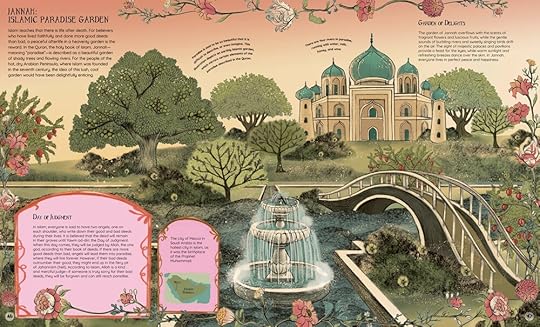
The book is organized by continent, allowing readers to delve into the various mythologies and beliefs from different cultures. From the gloomy kingdom of Hades in ancient Greece to Valhalla, the mead hall of fallen Norse heroes, and from the ancient Egyptian River of Death to Jannah, the beautiful Islamic garden of heaven, readers are offered a comprehensive look at the diverse afterlife beliefs.
One of the standout features of this book is its visually striking illustrations. The eye-catching cover sets the tone for what lies inside. Each two-page spread is lavishly illustrated, bringing these mythical realms to life. The illustrations not only enhance the reading experience but also serve as a visual feast for the eyes.
Beyond its visual appeal, An Atlas of Afterlives also delivers on the historical information. Each spread is filled with informative facts and mythologies, providing readers with a deeper understanding of the cultural context behind these beliefs. The book strikes a perfect balance between presenting real historical facts and maintaining the magical atmosphere of the unknown.
However, there is one small issue that I found with this book. Some of the text is quite small, which may pose a challenge for younger readers or those with visual impairments. It would have been beneficial to have larger font sizes to ensure accessibility for all readers.
Despite this minor setback, An Atlas of Afterlives is sure to be a hit among mythology enthusiasts and those interested in exploring different religions. It offers a unique and accessible way to engage with a fundamental question that has fascinated humanity for centuries.
In conclusion, Emily Hawkins' An Atlas of Afterlives is a visually stunning and informative book that takes readers on an enchanting journey into the depths of world mythology. With its beautiful illustrations and engaging content, it provides an unforgettable departure from our everyday lives.
⚠️This review was written based on personal opinions and experiences with the book. Individual preferences may vary⚠️
Dziś przychodzę z polecajką książek dla młodszych czytelników, którzy lubią się bać. 😱 Te trzy pozycje od @wydawnictwo_kropka idealnie nadadzą się na #spookyseason 🎃👻 i jesienny czas, 🍂 ale równie dobrze można po nie sięgnąć o każdej porze roku. Dostarczą one nie tylko rozrywki, ale też wiedzy i ważnych przesłań. 👍
Pierwsza książka to "Zrostek", czyli retelling bazujący na klasycznej powieści "Frankenstein". 🧟♀️ Jest to historia okraszona nutką grozy, która zmusza do refleksji nad naturą człowieczeństwa i prawdziwym znaczeniem słowa "potwór". 🤔 Zrostek, powstały z połączenia różnych części ludzkich ciał, na pierwszy rzut oka budzi strach, ale tak naprawdę jest szlachetną istotą o wielkim sercu. ❤️ W książce poruszone są uniwersalne i niezwykle aktualne tematy: wykluczenia społecznego, pochopności osądów i nietolerancji. Przesłanie tej niezwykle mądrej lektury wybrzmiewa naprawdę mocno, dlatego będzie cenną lekcją dla młodej osoby. 👌
Kolejna propozycja to cudnie wydany "Atlas zaświatów", który odkrywa tajemnice krain zm@rłych, ☠️ zapisanych niegdyś w wierzeniach ludów z wszystkich zakątków świata. Znajdziemy tu powszechnie znane, ale też i mniej popularne wizje zaświatów. Eksplorację ubogacają piękne ilustracje, 😍 które tworzą niesamowity klimat i pomagają wyobrazić sobie opisywane krainy. Czyż jesienne wieczory 🍂 to nie idealny czas na fascynującą, choć miejscami mroczną podróż przez krainy zm@rłych❓️👻
Ostatnią, ale nie mniej ciekawą od pozostałych propozycją, są "Straszydła". Ten przepiękny album oferuje przyprawiającą o dreszcze podróż przez świat najbardziej znanych postaci z horrorów. 🫣 Szata graficzna książki zachwyca, 🤩 a jej mroczny klimat wprowadza w odpowiedni nastrój. Uwaga - niektóre ilustracje są naprawdę przerażające❗️😱 Narratorem jest tu sam Edgar Allan Poe, który oprowadza nas po galerii potworów i upiorów, przedstawiając kolejno takie legendarne postacie jak Dracula, potwór Frankensteina czy tajemniczy Upiór w Operze. Każdej historii towarzyszy szczegółowy opis. 👌
Dieses Review bezieht sich auf die deutsche Ausgabe mit dem Titel "Atlas – Welten des Jenseits: Von Totenreichen, Paradiesen und überirdischem Leben", erschienen bei arsEdition unter der ISBN 9783845859675.
Ich nehme es ehrlich gesagt den Menschen nicht ab, die behaupten, dass sie daran glauben, dass sie nach dem Tod ins Nichts fallen. Das ist nicht vorstellbar. Diese Menschen haben nur das Weltbild nicht gefunden, das nicht zu ihnen passt. Da bekanntlich noch niemand aus dem Reich der Toten zurückgekommen ist, macht sich jeder Kulturkreis und jede Gemeinschaft ihre eigenen Gedanken, wie es wohl nach dem Tod weitergehen könnte.
Es dürfte wohl niemanden überraschen, dass sich auf den Kontinenten über etliche Jahrhunderte hinweg, vollkommen unterschiedliche Modelle des Jenseits entwickelt haben. Da passt es sehr gut, mal die bekanntesten in einem Atlas zusammenzufassen und diese kindgerecht aufzubereiten. Das ist meines Erachtens den Autoren des »Jenseits-Atlasses« sehr gut gelungen. Sie zeigen, welche Jenseits-Modelle auf den jeweiligen Kontinenten mit Ausnahme der Antarktis geläufig sind.
Jedem Modell ist eine Doppelseite gewidmet. Je nach Komplexität haben mal die Zeichnungen mal die Texte mehr Raum spendiert bekommen. In beiden Fällen sind die Anordnungen so gewählt, dass auch Kinder relativ zügig das Jenseitsmodell erfassen können. Die Erklärung sind zumeist für Kinder verständlich gehalten. Für einige wenige schwierigere Worte, findet sich ein kleines Glossar am Ende.
Dieser Atlas ist ein Sachbuch und stellt die Modelle wertfrei vor. Es gibt keinerlei Präferenzen für oder gegen ein Modell. Das gilt insbesondere für die Religionen, die alle gleichberechtigt vorgestellt werden. Natürlich gibt es nicht das präferierte Weltenmodell. Ich halte es mit dem Schlusssatz des Nachworts: »Wie man es auch sieht – der Tod ist nicht nur ein Ende, sondern immer auch ein Anfang.«
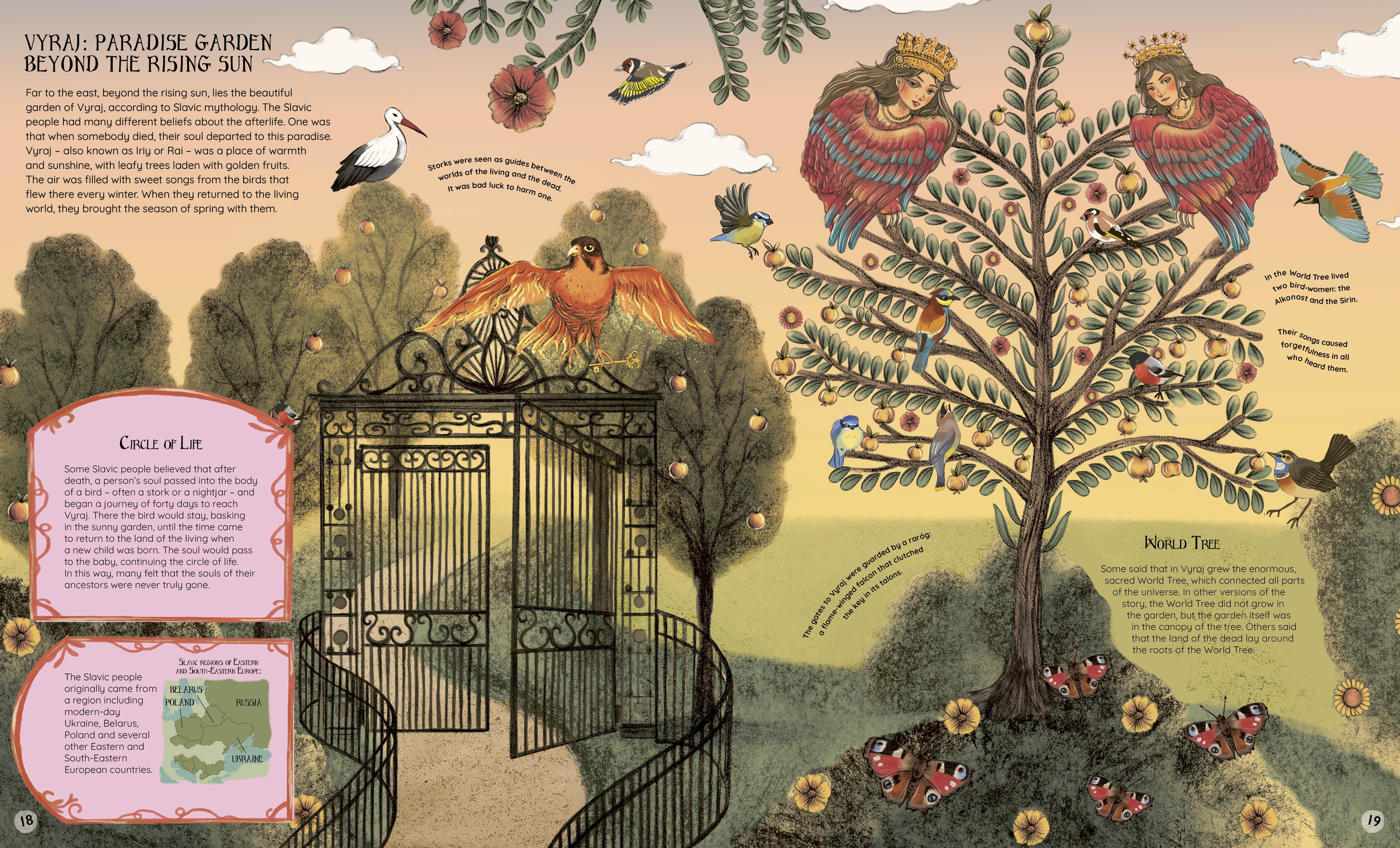
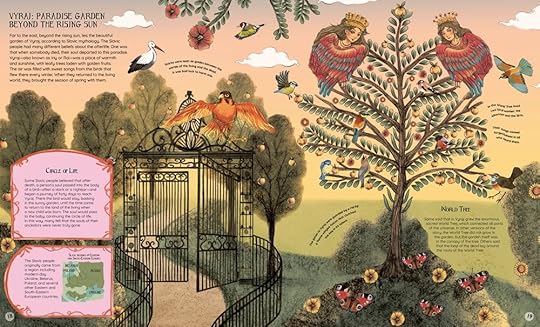
When I say this is a map of heaven and hell, we're not shown the Pearly Gates and the roads around it, and the like. No, this is a book showing where on our real, proper, live Earth the multitude of concepts of the afterlife have existed. From Valhalla to Hades, and even to Vyraj, which I'd happily admit to not having heard of, this takes us around all the continents and gives us some nice little details about the many eternities we've come up with. The Kalunga Line is as far as the eye can see into the Atlantic from Africa, and marks the land of the dead's border with our realm – not for us to willingly cross, like the Styx or perhaps the Sanzu River. If we're not being tested with a list of names and a feather on the scales, we cross the Chinvat Bridge – carefully. Torres Strait Islanders expect their spirits to be clubbed over the head to firm them up.
Here then are places we visit willingly, places we find much reason to avoid, and places we might want to go to if we decide to gain mythological status and/or catch up with a loved one (or four). Cultures that very rarely get a mention in books for this age range (the older half of primary school up to pre-GCSEs, in British terms) are here, as well as the major religions. Visually we're doing quite well – at least until we see the leader of the Wild Hunt not so much riding his beast, but, er, well, riding it. That aside, this has to be thought of as a success – I dare say this category has quite a few entrants aimed at the school library, but every world religion section will need something very much like this. So very much like this, they might as well choose this for want of better. A strong four stars.
Though the primary audience age of this book is 9-12 it is an extremely informative and enjoyable read for adults as well with all the lesser-known afterlife legends from around the world.
The book dedicates a fully illustrated double page to each of the featured mythic places with snippets of information are scattered through the scenic illustrations. The legends are organized by continents with a double page map at the beginning of each section featuring not only the legends elaborated later but mentions examples from a lot of other cultures.
I really liked the variety of legends featured from a cultural and geographical point of view as well as their approach to the afterlife. I think apart from some myths and legends from Europe and Asia, most concepts and stories are unfamiliar to the average reader. Also, it's not just heavens and underworlds but there's a nice variety of legends about ghost ships, phantom rides and even the terracotta army is featured. Also it spans through time from the very first ancient cultures to modern day voodoo and having sources spanning from indigenous myths to Dante.
A glossary at the end of the book helps younger audiences to understand words and concepts they might be unfamiliar with.
Thank you to NetGalley and the publisher for providing the ARC.
Nie ma chyba osoby, która choć raz w życiu nie zastanawiała się nad tym, co dzieje się z człowiekiem po śmierci. Ja wierzę w niebo, ale czy wszyscy myślą i wierzą w ten sam sposób? Otóż nie. Przed wami krótkie historie z każdego kontynentu, przekazywane z pokolenia na pokolenie. W atlasie, poza wspaniałymi obrazami odzwierciedlającymi krainy umarłych, znajdziecie mapy kontynentów i ich historie. Każda wiara ma swoją unikalną wizję życia po śmierci – kraina umarłych nie wszędzie znajduje się w niebie. Przed wami m.in. „Trzy światy Inków”, które ukazują podziemny świat życia i śmierci Ukhu Pacha, oraz Mictlan – podziemny świat Azteków, zamieszkiwany przez bogów i trzynaście niebios. W książce znajdziecie również Kothluwalawę – Salę taneczną zmarłych. To tylko kropla w morzu fascynujących historii, które odkryjecie sami. Zbliża się święto Wszystkich Świętych, co stanowi doskonałą okazję, aby pokazać dzieciom, że nie wszędzie obchodzi się to święto tak jak w Polsce. Książka poszerza wiedzę o innych religiach i światach zmarłych, zachęcając młodych czytelników do głębszej analizy. Duży format i twarda oprawa sprawiają, że posłuży nie tylko jednej osobie, ale całej rodzinie i przyszłym pokoleniom.
This is a beautifully illustrated book taking children on a tour through different afterlife beliefs across the globe. There is a well-balanced mix of ideas covered, and it isn’t excessively gloomy or morbid - there’s an undertone of comfort throughout many of the pages. Each belief is summarised on a double-page spread, with small paragraphs of text as well as short notes accompanying the images. There’s obviously much more that could be said about each idea, but I think the author has done a fantastic job at summarising and picking out the most engaging parts for the intended audience. It covers the usual suspects like Hades (Ancient Greek) and Duat (Ancient Egyptian), as well as lesser known destinations like Mictlan (Aztec), Lua-O-Milu (Hawaii), and Adlivun (Inuit). There’s also a blend of world religions, including Jacob’s Ladder (Christianity), Jannah (Islam), and the Buddhist Underworld. My little one (6yo) loved the stories about the different ghost ships and boats, despite these sometimes having the spookiest illustrations spreads!
In An Atlas of Afterlives, Emily Hawkins takes young readers on a simple and thoughtful tour of humanity’s stories all answering the same question – what happens after we die? This beautifully illustrated, atlas-inspired book provides clear background on each story, interesting facts that connect the stories to our modern experience, and simple connections across cultures.
While the layout of the book could provide readers with more direction (which blurb should I read next?), especially since some of the sections built on each other, the content itself is understandable to a broad audience. I especially appreciate the glossary at the end to support a broader understanding, and the thoughtful afterword.
While I might not be the intended audience, I learned SO MUCH from this book. It was intriguing and I can't wait to share it with my children. It is such a thorough look at beliefs surrounding the afterlife. A great cooperative analysis with a respectful look at each. This book doesn't present one as better than the other and doesn't show a bias in page space for one belief over another. This is a great book for both religious families taking the time to understand the views of others and secular families introducing the beliefs of others. You won't be disappointed by this beautiful book that shows respect to all beliefs.
Thank you to NetGalley and the publisher for the opportunity to read and review this book.
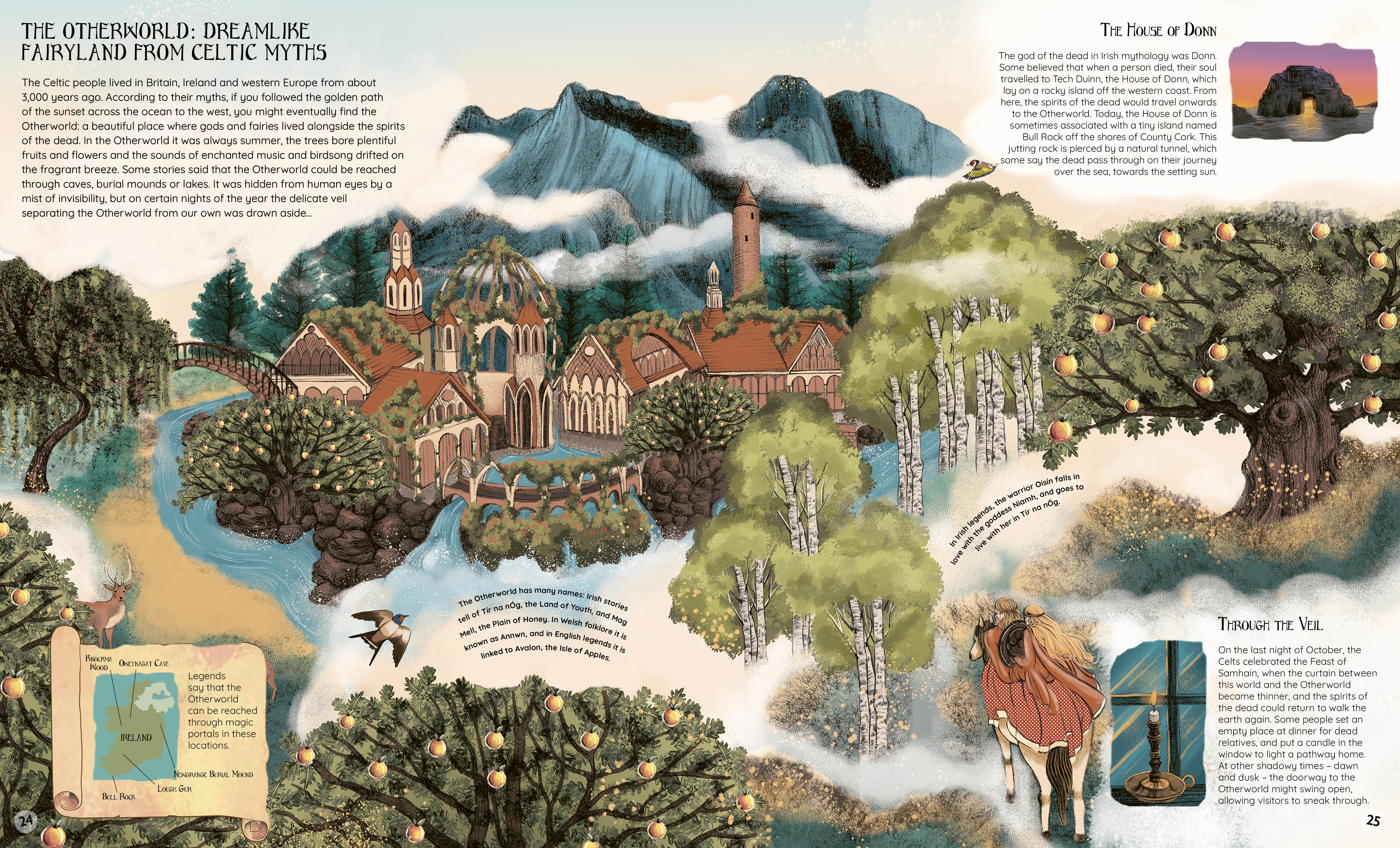
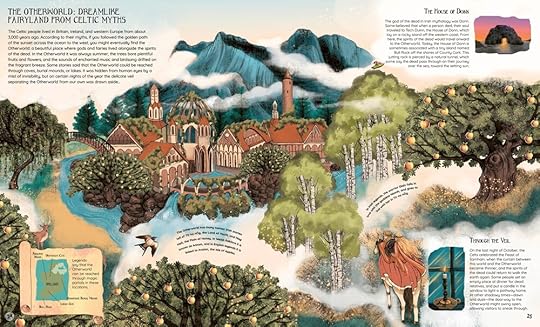
It is always fun to read about other cultures and how others view life, and in this case, death. While many may be aware of some of the stories, (perhaps Greek Underworld, Heaven, or Valhalla) there are still so many more that may be new to read about. Vyraj and the Otherworld sounded particularly beautiful. While the Land of No Return was especially bleak. It was interesting to note some of the differences and similarities between cultures. Never realized how much water is mentioned in relation to crossing to the afterlife. The added stories for some of the sections was a nice touch.
It's a great read, discovering what other cultures perceive about the afterlife. There are many differences, but I also found similarities. However, at the end, it's still a mystery to humankind.
It's a great idea to put the afterlives on an atlas, I really love looking at them! What's more, the illustration is really mesmerising, like I cannot take my eyes off of them. Really pleasing to the eyes and having good correlation with the narration.
Magnificent! Both for young and old, this is a thorough, detailed explanation of different schools of thought on death, the afterlife and the regions of the world and time periods they came to be. This book delightfully informs the reader of the history of each philosophy as well as providing great maps and visuals. I'm in love with this book and certain it will appeal to many age groups.
I found this book very interesting. It had a good page to page organization. However I found that it was hard to follow on the page. All of the small blurbs made it hard for me to follow. The illustrations were incredible. I definitely enjoyed how each afterlife story was organized based on the main country it is from.
Great book showing the similarities and differences between the world's beliefs on the afterlive. Ranging from spirits staying in our world, a heaven in the sky, a hell under the earth, multiple levels to the underworlds, the land of the dead being out across the sea to the west, or even if the dead living on in the sea (or a boat). Beautiful illustrations too!
This book just blew me away. I love it. It is packed with interesting information and stunning illustrations. The topic though is a tad heavy for use in class, so maybe better as a book for reading for pleasure.
O jaka to jest dobra książka! Mnóstwo mitologii z całego świata, przystępnie przedstawione na prawdę wrażliwe tematy, do tego piękne ilustracje i wydanie, przeczytałam raz dzieciom a drugi raz sama na spokojnie. No cudna
An Atlas of Aferlives is a lovely illustrated guide to afterlives, underworlds, and death worldwide and through cultures. It includes details of mythological afterworlds, including Hades from Greek mythology and Valhalla from Norse mythology, to practices revolving around the dead such as Dia de los Muertos, or Day of the Dead, celebrated in Mexico and other Latin American countries. It's interesting, educational and includes incredible illustrations to go with the stories from worldwide.
Amazing! A stunningly illustrated journey into the lands of the unknown, as visioned by peoples and cultures from all around the earth. Glimpses of eternity with captivating and vibrant examples of spirituality and humanity 🪽✨ 🌈
*Temporary access e-copy received via Netgalley in exchange for an honest review.
As with An Atlas of Lost Kingdoms, the only thing I took issue with here are the unprofessionally thrown together pages, with high-quality illustrations contrasting with the low-quality graphic design. This series is still such a cool concept, and I know that kids won't mind, but the discrepancies really stand out to the adult eye!
***I received a digital copy from the publisher through Netgalley in exchange for an honest review.***