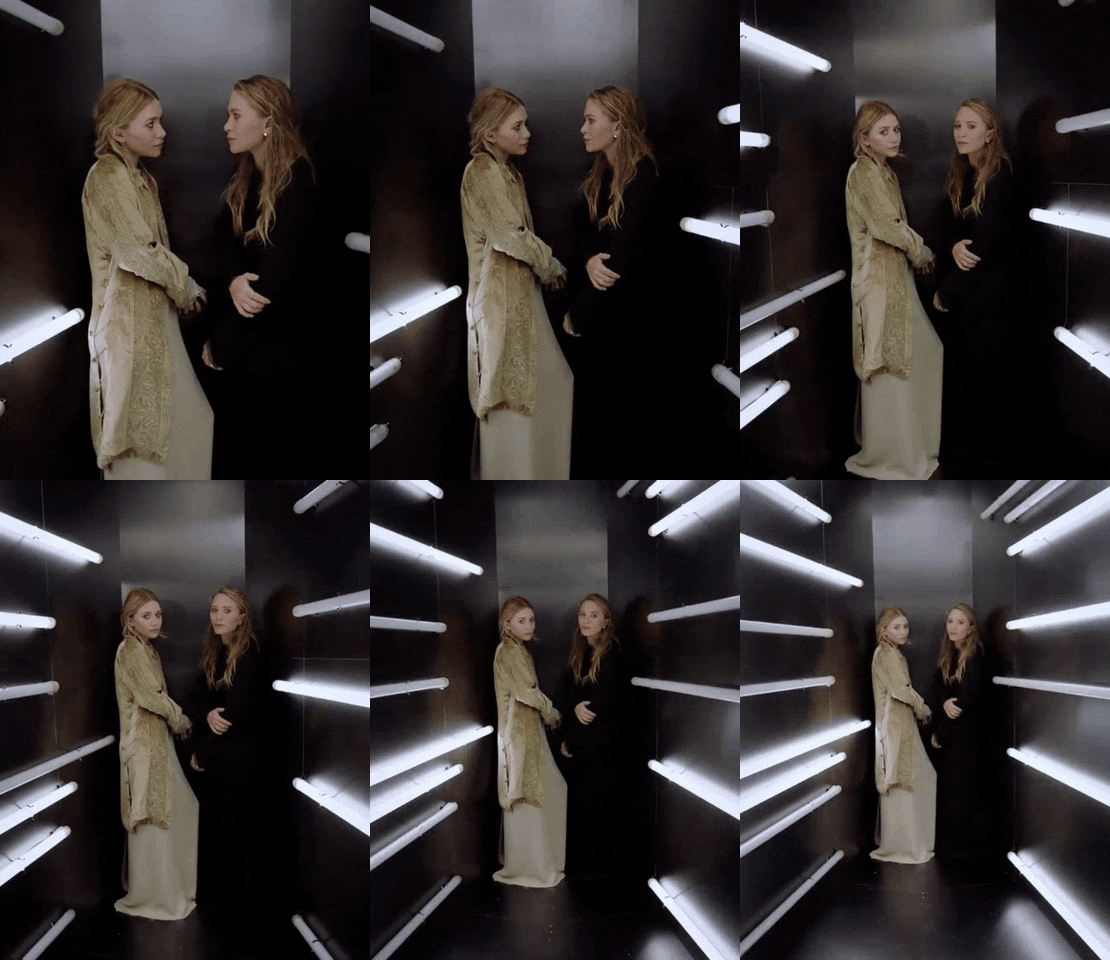
Audrey Niffenegger's spectacularly compelling second novel opens with a letter that alters the fate of every character. Julia and Valentina Poole are semi-normal American twenty-year-olds with seemingly little interest in college or finding jobs. Their attachment to one another is intense. One morning the mailman delivers a thick envelope to their house in the suburbs of Chicago. From a London solicitor, the enclosed letter informs Valentina and Julia that their English aunt Elspeth Noblin, whom they never knew, has died of cancer and left them her London apartment. There are two conditions to this inheritance: that they live in it for a year before they sell it and that their parents not enter it. Julia and Valentina are twins. So were the estranged Elspeth and Edie, their mother.
The girls move to Elspeth's flat, which borders the vast and ornate Highgate Cemetery, where Christina Rossetti, George Eliot, Radclyffe Hall, Stella Gibbons and Karl Marx are buried. Julia and Valentina come to know the living residents of their building. There is Martin, a brilliant and charming crossword-puzzle setter suffering from crippling obsessive compulsive disorder; Marijke, Martin's devoted but trapped wife; and Robert, Elspeth's elusive lover, a scholar of the cemetery. As the girls become embroiled in the fraying lives of their aunt's neighbors, they also discover that much is still alive in Highgate, including - perhaps - their aunt.
Audrey Niffenegger (born June 13, 1963 in South Haven, Michigan) is a writer and artist. She is also a professor in the MFA Creative Writing Program at Columbia College Chicago.
Niffenegger's debut novel, The Time Traveler's Wife (2003), was a national bestseller. The Time Traveler's Wife is an unconventional love story that centers on a man with a strange genetic disorder that causes him to unpredictably time-travel and his wife, an artist, who has to cope with his constant absence.
Her Fearful Symmetry (2009), Niffenegger's second novel, is set in London's Highgate Cemetery where, during research for the book, Niffenegger acted as a tour guide.
Niffenegger has also published graphic and illustrated novels including: The Adventuress (2006), The Three Incestuous Sisters (2005), The Night Bookmobile (2009), and Raven Girl (2013). Raven Girl was adapted into a ballet by Resident Choreographer Wayne McGregor and the Royal Opera House Ballet (London) in 2013.
A mid-career retrospective entitled "Awake in the Dream World: The Art of Audrey Niffenegger," was presented by the National Museum of Women in the Arts (Washington D.C.) in 2013. An accompanying exhibition catalogue examines several themes in Niffenegger's visual art including her explorations of life, mortality, and magic.
Here’s a question: What would you do if you had an overbearing, bossy twin sister whom you needed to get away from??
a. Bear with it – she’s family after all. b. Elope with your middle-aged boyfriend. c. Get your parents involved and have a long family chat. d. Willingly die, and then try to resurrect yourself without her knowledge.
? ?
The meek twin in this story... she goes for option d.
... ...
This book was full of really absurd people doing really absurd things. The only way I managed to finish this was by lounging in front of the TV with a cricket match on and skimming though chapters during commercials.
Having read and liked The Time Traveler's Wife, I was expecting this to be...well, not so terrible.
Very disappointed.
This entire review has been hidden because of spoilers.
Her Fearful Symmetry is a Victorian ghost story set in contemporary London, fittingly in and near a graveyard. Elspeth Noblin has died. Neighbor, friend and lover Robert, who is working on a thesis about the cemetery, is bereft. In her will, Elspeth left her apartment and almost all her belongings to twin nieces Julia and Valentina, but attached odd conditions. They must live in the flat for a year, and their parents may not enter the premises. After the 21-year-olds move in, Elspeth’s presence emerges and grows stronger. Is she a kind auntie to the girls or somehow dangerous? It is a ghost story, after all.
Audrey Niffenegger - from Random House Australia
The symmetry of the title permeates the story. Elspeth and her sister Edie are identical twins. Julia and Valentina are mirror-twins. The struggles between both sets of sisters is a core theme here. There is a strong cast of secondary characters. Martin creates crossword puzzles and performs anthropological research but while he is blessed with intelligence and charm, he is afflicted with a severe case of OCD. His problem is so intense that Marjike, his wife of 25 years has finally had enough and has moved back to the Netherlands. Julia befriends Martin. Valentina forms a strong friendship and then a more-than-friends relationship with Robert, another parallel.
There is much here about right and wrong, life and death. Where is that line drawn? Is the line in the same place for all people? Can one cross over the line and then step back? What defines identity?
Niffenegger is the author of The Time Traveler’s Wife, a huge best seller. Many readers came to this book looking for a reprise of that one. Having not read the earlier work, I was spared such expectations, so comparisons were not possible. However one consistency is that both deal in fantasy and romance.
This is an engaging, fun read, offering believable characters, an intriguing premise, and some nifty twists. You may not have to sleep with the lights on after reading this. It is not scary in that intense way. But it delivers enough creepiness to make you uncomfortable at things that go bump in the night for quite a while.
My initial reaction was that I really disliked this book. On reflection, I still really dislike it but for a different reason than I thought! I think what Niffenegger was trying to do here was present a group of deeply dysfunctional characters & put them in a ghost story & let nature take its course. Why anyone would want to read such a thing is beyond me, but there it is.
Elspeth Noblin dies & leaves her London flat, which overlooks Highgate Cemetery, to her nieces, 20-year-old American twins Julia & Valentina. The only conditions of the bequest are that they live in the flat for a year before selling it if they wish to; & that their parents (Elspeth’s sister Edie – these two are also twins – and Edie’s husband Jack) never set foot in it. We’re led to believe that there’s some deep, dark secret behind this. Much later, we find out what it is. By that time we a) don’t care and b) realize the people really affected by the secret are Edie & Jack – two “side” characters who appear in the first 74 pages of the book, & then not again until page 333 of 400! And Jack knew the secret all along, of course – AND NEVER SAID ANYTHING?! Wait while my head explodes…
Elspeth, of course, returns as a ghost. I couldn’t figure out how I was supposed to feel about her until close to the end of the book. Am I supposed to like her or hate her? Was she good or bad? I’m OK with ambiguity & a willing suspension of disbelief, but if a writer is doing a book about a creepy cemetery; ghosts; weird twin girls who dress in white; twin-swapping; & grave-robbing – it really helps if the writer gives us some clues as to who is good and who’s bad! Niffenegger beats us over the head with some of the plot points (see below), but doesn’t lead us into the motivation behind her characters’ actions. This is the writer’s job.
Julia & Valentina are the freakish twins. They’re 20 & they still dress alike – mostly in a lot of white. Oh, because they’re weird and ghostly! I GET it! They’re pathologically dependent on one another. Julia is the dominant twin who has, throughout their lives, decided where they should go & what they should do, while calling her sister “Mouse” & telling her that she’ll never be able to exist alone, blah blah blah. There’s about 300 pages of Julia & Valentina being snippy with one another, or depressed, or floating aimlessly about making tea, or bothering the neighbors. No wonder Robert doesn’t want to meet them!
Robert is Elspeth’s boyfriend, & why Ms. N. would want to make this guy her male lead, I have no idea. A more ineffectual character you will never meet. I’d like him better if he was evil, but he’s just Nothing. Ms. Niffenegger pushes him here & there on the page, but he never comes to life in any way that makes sense. He’s writing a research thesis on Highgate Cemetery & has been doing so for years. (He can’t finish it.) He also leads cemetery tours. He’s obsessed with Elizabeth Siddall – he says, “perhaps because she was beautiful and died young.” Oh, & Siddall was a woman who ended up being dug up after she was dead by her lover, OH OH OH foreshadowing! I can’t possibly see what’s coming next!!
He’s having trouble getting over Elspeth, but her specific directions in her will were for him to meet the twins when they arrive & help them out in their new surroundings. If he’s so besotted with Elspeth, why doesn’t he do what she wanted? We don’t know – except that the twins really are insufferable & I wouldn’t want to meet them either! So he stalks them for what seems like a few hundred pages. Why?! Why?! Oh, so that he can meet them IN THE CEMETERY where they finally show up for a tour!
Page 171 literally begins a chapter with, “Days went by and nothing much happened.” (Wait while my head explodes again.)
Robert finally begins to get over Elspeth, thanks to his growing attraction to Valentina, though Valentina of course looks like Elspeth. At this point, Ghost Elspeth figures out a way to “appear” to Robert & the twins & talk to them. Then there’s a few hundred more pages of Robert & Elspeth talking, the twins & Elspeth talking, & the twins being increasingly annoyed with one another as Julia tries to exert more control over Valentina. Elspeth realizes she can (wait for it) take the soul from a living being – which kills that living being - & if she’s quick she can put it back. She finds out she can do this BY ACCIDENT. Even though her ghost can’t so much as push a door shut. Hmmm. OK….
So then there’s animal death (but Niffenegger makes it OK by ACTUALLY HAVING THE TWINS CALL THE CAT “LITTLE KITTEN OF DEATH” when they adopt it so you know it’s coming!) - & then Valentina & Elspeth cook up a crazy idea which makes no sense, & even Elspeth doesn’t want to do it at first, & Robert thinks it’s a bad idea but oh, he goes along with it, because….why? He doesn’t know but he tells Valentina not to trust Elspeth because “she wasn’t very nice, even when she was alive!” Wait wait, I thought this was the couple who had a love beyond death for one another….????!
On page 316 Robert finally “brings himself” to read Elspeth’s diaries which she’s left to him. Oh, big secret is revealed….and….that’s that. Seriously. Nothing happens, because the secret has nothing to do with what’s been going on for the past 250 pages!! And then, 30 pages later, you find out Jack (Edie’s husband, father of the twins) knew all along. What the….?! No kidding, this whole part of the book could have been left out & you’d never know it…except Niffenegger needed a plot device that would keep the girls’ parents out of London for a year. Oh, and then the inevitable happens & we get past that & then Edie & Jack are going back to America & leaving their daughter behind because “she won’t come with us.” Ms. N., do you want to make your characters come to life? Parents don’t leave their child behind, alone, in a country thousands of miles away, when their other child has just died—even if the child is 20 years old. The parents would drag her off protesting, or they’d stay themselves.
Having firmly established that if you’re a twin you must perforce be mentally ill, Niffenegger goes soft on us & lets us know that it must be better to be dead & a happy ghost, rather than alive & forced to deal with your sister. Yeeeccccchhhh.
In fact the next part of the book, where Elspeth has taken over the girl’s body & is living with Robert, is interesting to me—but just when it’s getting interesting—What’s it like to live in a body that doesn’t belong to you? What’s it like to live with the woman you loved, who died, & who you have also described as “not very nice,” who came back as a ghost & killed a 20 year old girl while you stood by & watched, & now you’re living with your love’s soul in the dead girl’s body???!!! But at this very interesting part of the book, it ends! (Though apparently Robert didn’t really like the dead/alive thing….)
You know who I really liked in this book, & believed in as characters? Martin & Marijke. Totally a side story—but I loved them.
I also thought a lot more could have been done with the Highgate Cemetery setting – the book felt strangely flat & lacking in atmosphere to me in that way. I’ve been at Highgate & it’s pretty creepy. There was lots of historical information in the book, & lots of description about what it’s like to work there, which seems in fact very business-like! I don’t doubt that – a cemetery is a business, after all. The flats where all of them were living seemed a lot more creepy than the cemetery!
If you want to read a really good, atmospheric, creepy ghost story with excellent character development, read Sarah Waters’ “The Little Stranger.”
It also occurs to me – you know who could write a really great psychological mystery about these same characters, only leaving out the ghosts but just going with the facts of their lives as Niffenegger presents them? Barbara Vine. This kind of thing is right up her alley. A bunch of weird people living in an old building in London - & what happens to them. There’d be a death, but no ghosts – and it would be BELIEVABLE. You’d still hate the characters, but with Vine you might understand what makes them tick. Niffenegger doesn’t help us out there.
As for Her Fearful Symmetry it was so bad it’ll probably be made into a hit movie. Just add vampires. Congratulations.
This entire review has been hidden because of spoilers.
This was difficult to put down but I deliberately tried to read slowly beause it was such a pleasure to read. Niffenegger is one of the finest contemporary writers and noone does longing and stymied love better than she does.
This book reminded me of "Time Traveler's Wife" as well as "The Lovely Bones." The stories center on an apartment building right off of Highgate Cemetery in London. One apartment belongs to Elspeth Noblin who dies on the first page of the book and bequeaths the apartment to her twin nieces in America, with the stipulation that they must live there for a year before selling and that their mother, Elspeth's own twin, can never set foot in the apartment. The top floor apartment is occupied by Martin, who suffers terribley from OCD. Niffenegger's rendering of OCD is the most painful and seemingly realistic depiction that I've come across. Elspeth's somewhat younger lover lives in the first floor apartment and works as a tour guide at Highgate Cemetery.
This book is well worth reading BUT you really need to suspend disbelief and just go with the really wild premise. This is part love story, part ghost story, maybe even a little Sci Fi. Suspenseful, surprising, and beautifully written.
Audrey Niffenegger does it again throwing down innovative storytelling creativity - this one is an incredibly original and delicious tale about twins, isolation, mortality, envy, want and need. A very special tale set in and around a wondrous Highgate cemetery. Not too mention a delightful sub-plot about an extreme OCD sufferer being 'mended' by one of the twins. Good stuff! 8 out of 12, freaky Four Stars. 2010 read
I thoroughly enjoyed Her Fearful Symmetry. Having heard plenty of mixed reviews about this one, I wasn't sure how I would find it. On top of that, it was soon due back at the library, and I had 4 other library books calling my name desperately. I needn't have worried. This book definitely got me thinking and I like it when a book does that - when it stays in my mind for a long time after I actually finished reading it.
Her Fearful Symmetry is definitely a challenging book. Challenging not because of writing style or incoherent ideas. Challenging because it questions a lot of accepted conventions that you might have. At least it did for me. I remember feeling the same after reading The Time Traveler's Wife. I would say that is the only similarity between the two books, that and Audrey's beautiful writing style.
This book got me thinking about a lot of things, but primarily about the relationship between twins. I have never known any twins, so I can't say how accurate Her Fearful Symmetry is on this topic. But I like to believe she took an extreme case for telling her story. The twins, first Elspeth and Edwina, and then Edwina's twin daughters, Julia and Valentina, are highly inseparable. After being together for years, cracks are bound to appear. What I found interesting, was how each set of twins responded to the troubles in their tightly-woven fabric. When the reason for the estrangement of Elspeth and Edwina was revealed however, I was a bit disappointed, since that wasn't something I would expect to drive close sisters apart, not after being so close and sharing everything for almost 25 years. Maybe I am seeing it differently, but I expected something more severe. It just didn't seem a reasonable excuse to drive two twins apart, and worse, stay apart for years and not let any communications between the two parties. I almost got the sense the twist was included as an afterthought, like it didn't really fit in there. This was the only problem I had from this otherwise riveting read.
Another huge element of this book is the relationship between lovers. How far are you willing to go to keep your other half from finding some secret? Especially if that secret is built on a lie. Do you never wonder if your partner really loves you for who you are or for who they imagine you to be? I found this question come up many a time in the relationships of both sets of twins. It is tragic because it leads to a lot of suspicion that could have been avoided. It is sad because no one knows what's true anymore, and something the twins' father, Jack, asks Robert towards the end gives an idea of the enormity of this predicament.
This whole story is set around a graveyard, and as expected, we have ghosts too. Elspeth returns as a ghost and is stuck in her apartment. Valentina especially gets to know her better, and in the process the two make some very unpleasant discoveries. I wouldn't go into that since it's a spoiler, but it's definitely a very strong issue and I think, unethical (even in a haunted world). The particular incident literally left me shell-shocked and, to use the expression, gasping for air. It's been a long time since a book did that to me. I've never been able to forgive the character responsible for it, but then Audrey Niffenegger's books don't really go in the directions you want them to. They more likely leave you with questions, tears sometimes, but in a strange way, satisfaction too, since they get you thinking more than if circumstances had taken a much "beaten" path.
There were some questions that I found unanswered as I read this book though, and one was, why only Valentina could see Elspeth's ghost (eventually), or even sense it, while the rest could only feel the coldness of her touch. It felt like a tantalizing mystery whose answer I waited for.
I love Audrey Niffenegger's writing style. That's something I enjoyed in The Time Traveler's Wife, as well, and I just found myself turning page after page, no matter how slow the story might be going. Not that the story is slow, but there were a few chapters, that I didn't care much for when I was reading. Like, one chapter showing Robert's nightly habit of sitting by the cemetery for a long time. Another one, detailing Martin's disease and how he behaves. After finishing the book though, I did realize they were important chapters since those attributes of the characters had great bearing on the story to follow.
As in The Time Traveler's Wife, the one thing I struggled with in this book was the ease with which the characters accepted that which is not normal. In the former, we didn't really have any one shriek with fright when a man came about saying he travels through time. I doubt I would sanely accept someone telling me that. In Her Fearful Symmetry, we have characters accepting that ghosts can exist. Sure, I know there are a lot of people who believe in ghosts. But wouldn't you still get that fierce creepy chill that emanates from your back? Here I just noticed acceptance. Maybe it is just as well, since the characters stay near a graveyard or work in it. But I would have loved it if someone just shrieked and ran out of the house, once, just once.
Overall, I loved this book and have a new respect for Audrey Niffenegger for writing about very unconventional issues. I think you need a great deal of courage to write some of the things she wrote about, since they are issues you will either be yay and nay for, and we readers can't very easily accept everything we read about, just because it is written in print. This one is a very different type of book from The Time Traveler's Wife, but nevertheless, a good one in its own right.
Like so many other readers, I was enchanted by The Time Traveler’s Wife. There was a willing suspension of disbelief on my part (which goes against my skeptical and cynical nature) but the story was sweet and engaging enough to pull it off. Not so much with Her Fearful Symmetry. Again, through at least the first 2/3 of the book, I was willing to suspend disbelief and go with the story. But then it just got ridiculous beyond the point where I enjoyed the story anymore.
Essentially a ghost story, Her Fearful Symmetry features two sets of twins, the older Elspeth and Edie, and Edie’s daughters Valentina and Julia. The story opens with Elspeth succumbing to leukemia in a London hospital. Her twin sister and nieces have not seen her in more than 20 years, as a rift between Elspeth and Edie as well as distance (Edie lives in Chicago) drove them apart. Elspeth leaves everything to the twins, stipulating that they live in her London apartment for a year and their parents are not allowed to visit. Elspeth’s ghost lives in the apartment and eventually learns to communicate with the twins. It takes a long time and some wonderful descriptive elements to get this far – easily half the book. There are some well drawn characters that add to the story (particularly the OCD neighbor), but after this long set up, the story just devolves into absurdity. Disappointing ending after a good start.
Audrey Niffenegger’s ‘Her Fearful Symmetry’ is for the most part, a good, solid old fashioned ghost story with a contemporary setting. The backdrop to the novel, and what to an extent becomes the dominant character in the story, is London’s Highgate Cemetery – which is paradoxically an obvious but inspired and perfect choice. It’s a fascinating, hugely atmospheric and wonderful place to visit and is ideal as the setting for a haunting story of the supernatural such as this one.
Audrey Niffenegger worked as a tour guide at Highgate Cemetery whilst researching the novel and successfully conveys the feel, atmosphere and history of the Cemetery throughout. This provides the novel with foundation of authenticity on which to base a story which clearly requires the reader to display a certain degree of suspended disbelief. There are nods to Dickens throughout, echoes of Susan Hill and notably (to an extent) Mary Shelley.
‘Her Fearful Symmetry’ – is Niffenegger’s second novel and is a far less showy or flashy affair than its predecessor, the hugely commercially successful – ‘The Time Traveler’s Wife’. As a whole ‘Her Fearful Symmetry’ is better written thought out and delivers a stronger narrative as well as a more satisfying story than ‘Time Traveler’s Wife’. Neither does it feel as self-consciously clever as its predecessor. Clearly there are some plot contrivances, implausibilities and improbabilities to ‘Fearful Symmetry’ – yet somehow Niffenegger manages to get the story as a whole to successfully hang together.
Niffenegger also manages to avoid creating what could have been a very clichéd, overdone, predictable and tired ‘contemporary’ ghost story – especially considering the basic elements here – identical/mirror twins, Highgate Cemetery, a grieving widower, an inheritance with strict conditions etc, etc. – But somehow, avoid it she does and in the process delivers a strong, convincing and compelling story. It is an altogether gentler story than ‘Time Traveler’s Wife’ and all the better for that.
Tyger! Tyger! burning bright In the forests of the night, What immortal hand or eye Could frame thy fearful symmetry? --William Blake, "The Tyger"
When an acclaimed author (Audrey Niffenegger) takes a phrase from an inscrutable poem ("The Tyger"), readers (such as myself) are apt to expect a great story. Without a doubt Niffenegger's prose is elegant, her place descriptions (London and Highgate Cemetery) are exceptional, and her intricate plot has great promise.
That promise is not fulfilled.
Niffenegger speaks of ghosts that dissipate in to the ether, so to speak, because they haven't been dead long enough to figure out how to keep themselves together and harness their intent. I like this viewpoint within the story. Unfortunately, it also describes the story.
We are introduced to several sets of twins who, as it turns out, are so focused on being twins that they (in one case) do fearful and silly things and (in another case) are relatively boring. In each set, one twin wants freedom and the other wants the status quo. Interesting? Could have been, but it wasn't.
At best, most of the characters were totally dysfunctional with the possible exception (oddly enough) of the man with OCD who lived in the flat upstairs, up above the American twins who come to London when their aunt (Espeth) dies and leaves them an apartment up above Robert who works as a volunteer at the adjoining Highgate Cemetery. He was Espeth's lover both before and after she died.
Like ghosts without sufficient practice and power to organize themselves and enjoy the afterlife (with or without haunting the living), the plot becomes weaker and weaker as the novel goes on until on the final pages it evaporates altogether. Yes, there's a grim resolution to it all, but it's a weak one and we no longer care.
I suspect the author fell in love with the cemetery and wanted to write a story about it. Naturally, the dead came to mind. But they weren't strong enough to frighten us or make us care about the symmetry.
I read Niffenegger's first novel before the days of Goodreads; and I remembered when I decided to rate it, I wavered between 3 (liked it) and 4 stars (really liked it). I ended up opting for 4 stars, because I did remember so much of it due to its sense of place and its unique storytelling. Her second novel has these same elements -- her strengths are obviously her imaginative story lines, which she roots in concrete reality. But the story, which started out strong, lost its way long before the weak ending.
My strongest complaints, though, are with some of the writing. The point-of-view was all over the place, changing sometimes from sentence to sentence within a paragraph. I don't have a problem with this kind of thing if it can be pulled off, but here it seemed inelegant and clunky (even lazy). And while the writing was very visual (to great effect, in many instances) some of the details were unnecessary and pedestrian.
It had such potential and could have been so much more.
The bond between twins is fascinating. The sameness, and the differences between them. Two sets of twins, mothers and daughters. One pair estranged from each other, the other pair closer than close. A London apartment overlooking a cemetery. The comfort of counting, trying to see music, and ideas that are concealed by other ideas. Is this a weird twins story, or a beautiful ghostly tale? It's very different. I liked it, but it didn't blow my socks off. One thing is for certain, I will never look at a sky full of crows the same way again.
Oh my - this is the BEST book I have read in AGES! If I could give it more stars in the rating I would. Having just finished this book, I'm having flash-backs to the "Women in Literature" classes I took at the University of Puget Sound. I loved those classes because we would debate/discuss the significance of women and their relationships with other women and with men. I wish I could have one of "those" discussions regarding this book!
This book is excellent on so many different layers and levels, my head is still considering them all.
I was hesitant to pick up this book, because I had such a love/hate relationship with Audrey's "Time Traveler's Wife." However, I'm so glad I picked up this book. The language was clean and there was no "carnal" sex in this book (unlike my opinion of Time Traveler's Wife). So, these missing elements did NOT interfere with my enjoyment of this book.
I had a couple of plot elements figured out at the beginning of the book, but the author took a couple of turns I did not expect and the layering of the characters was a real pleasure.
I highly recommend this book. And, if you are a local friend that would like to go to lunch and discuss it - I would love that!
Just some thoughts: I loved this novel...but in a completely different way than I love The Time Traveler's Wife. I wasn't sure what to expect so I tried not to have any expectations, which is exactly the attitude to have going into this book. It has what now seems to be Niffenegger's style of writing that's smart & funny & quirky but somehow all seems to come together easily. It has a few curveballs, so don't bother reading ahead (like I did...only to confuse myself until I read straight through--must get rid of this terrible habit!). Overall, I enjoyed it because it's one of those stories that stays with you after you've finished the last page. I had that "I *have* to talk to someone else who's read it" feeling after I read it, and that's one of the things I love most about books: sharing them.
Wow, disappointing! Kept waiting for this to get good, and it never quite did. The two major "surprises" are painfully transparent well before they actually happen (I was hoping that I was being misled, because it couldn't be that obvious, could it?), most of the characters aren't very sympathetic, and the pacing is slow. Glad I didn't give into the impulse to buy a copy for myself, and instead borrowed it from the library - I'd be even more upset...
And of course, I'd be more forgiving if I hadn't loved the author's first book so very very much. It's like this was a first draft of the ghost story she really wanted to write, and it got accidentally published by mistake. Or maybe the sex scenes were supposed to be scrubbed out and it was intended to be a young adult novel?
I'm almost sorry I read this - I waited so long for it to come out, and I wish I were still waiting, imagining how wonderful it will be when it's finally published. Perhaps I'm a little biased, but I think I'll go re-read A Fine and Private Place to cleanse my palate and remind myself of what a good ghost story can be like.
I got caught up in this book very quickly. It's slow-paced in some ways, but then intense, shocking things happen quite frequently. Julia and Valentina are mirror twins, completely consumed with and by each other. I've noticed this representation of twins, especially those who are identical or mirror image twins features quite often in books and films. I find it interesting, the idea that these two people are so in sync with each other that they find it challenging to let anyone else in, though I have no idea if this is an actual reality for real-life twins or merely a persistent literary trope. Valentina was my preferred twin, though Julia had moments where I managed to appreciate her too. I tend to favour the quiet characters over the loud and bolshie ones! The twins mother is Elspeth's twin sister and there a BIG SECRET which is the reason why they no longer speak.
Living above them is a man called Martin, whose OCD has completely taken over his life, leaving him unable to leave his apartment, consumed by rituals, many involving cleaning and counting. His friendship with Julia was one the the highlights of the book for me, and why I grew to like Julia despite finding her annoying. Living below then is Robert, their dead aunts lover who spent a year anxiously awaiting the twins arrival, and now avoids them/stalks them. Also, their aunt Elspeth remains in the flat, a ghost who is still learning the ropes. Valentina is much more in tune with her presence than Julia is.
The first two parts of the novel were hypnotic, with the twins exploring London, watching TV, not really doing much. Elspeth practices being a ghost, her progress painstakingly at first. I enjoyed all this, the information about the neighbouring graveyard, Valentina's growing desperation to escape her twin - it felt almost dreamlike and was also clearly building toward something.
I appreciated that this novel was so different to what I had expected. I half-figured out the BIG SECRET but was off track with a few aspects. Edie and Elspeth's twin relationship was in some ways more interesting than that of Julia and Valentina's because something severed it, almost completely. Julia seems to fear the idea of this happening more than anything, while Valentina can't help but wish for it. Despite my concern over much of Robert's conduct, I found him a likeable character. I especially enjoyed his nighttime wandering of the cemetery. Highgate cemetery sounds fascinating. Robert's tours were brilliant - the way Victorian's treated death is incredibly elaborate. I enjoyed the glimpses that this novel gave into some of these practices.
When Elspeth dies, she leaves her papers to her boyfriend and her flat to her twin's children, the twin sisters Julia and Valentina. J&V are very pale, very slim, and although they're nearly 21, very unformed. They have no friends, no lovers, little education, and no interests besides watching tv together. They are astoundingly boring.
Meanwhile, their upstairs neighbor is struggling with OCD and a passionate love for his wife, who has left him because of it. And their downstairs neighbor is Robert, Elspeth's grieving boyfriend. And their own flat seems to be haunted...
Niffenegger has a beautiful writing style, and her characters always feel precise and real to me. She knows the specifics of their lives--what kind of wine they like, how they brush their teeth, what they feel at 3 in the morning. She knows every inch of their environments, and describes them with a casual fluidity. But although every other character felt real and probable to me, I never bought Julia and Valentina. For one thing, they flop around in their lives like limp fish. For another, they are SO DUMB that they even infect other characters with stupidity. I think Niffenegger was trying to write a book about codependency and secrets, but the secrets were so dumb and we were mostly told, not shown, the codependency. There are kernels of a much better novel in this book (Robert and the cemetary, or Martin and Marjike), but they are overtaken by the gothic grand gestures of the two sets of twins.
I don't even know where to start with this book. The fact that it was set in and near Highgate Cemetery in London gave it a creepy, gothic, horror movie kind of quality. One of the main characters is the ghost of the late Elspeth Noblin. The description of the twin sisters, Julia and Valentina, portrays them as almost ghost-like as well. They are whispy, pointless, lackluster, colorless young women who have no identity outside their twin-ness. The upstairs neighbor is a recluse who suffers from obsessive-compulsive disorder and lives his life in ghostly isolation as well.
The book is divided into three parts. As always, I like Niffenger's writing style. She's interesting and easy to read and introduces characters with unbelievable (literally, unbelievable) problems like time-travelling or being a ghost with remarkable credibility. But she went off the rails with this book. It was an absolute and total train wreck. I felt like I was reading the book version of a campy Frankenstein movie. It almost felt like she wrote part of it with a movie in mind. The big secret that the author kept hinting at? One set of twins switched identities. Gee. Really? Isn't that just about the oldest twin prank in the book? Don't most books using twins as main characters use the same plot twist? Does that even qualify as a plot twist anymore?? I thought the ending was just downright ridiculous. And macabre. I loved Time Traveler's Wife. It was so original. And this one just felt like "been there, done that, eww gross."
The fact that this book is titled after a line in one of my least favorite poems ever* should perhaps be a strike against it, but the title is quite fitting and somehow makes even more sense in this context than in Blake's use of it. This is the story of two sets of twins (hence the symmetry) who have an extremely odd system of relationships -- "system," because the story explores the highly varied and yet remarkably similar relationships between the four twins. To say too much about these relationships would be to give away bits of the plot, but let me just say it was not at all what I expected, and the title word "fearful" is definitely apt.
While this story lacked (for me, at least) some of the magic of The Time Traveler's Wife, it is just as artfully written and explores the intricacies of relationships with the same deftness and insight as Niffenegger's earlier work. I would have liked to learn a bit more about Jessica and James, whose characters seemed to be placeholders and whose stories were never fully developed, but otherwise Niffenegger does a phenomenal job of developing a very intriguing cast of characters. Some of the traits are a bit extreme, perhaps -- there was certainly room for a bit more gray area on the black-and-white spectrum -- but overall the people seemed real and their actions were largely believable. (Whether or not you believe in ghosts, of course, remains up to you.)
One of the things that delighted me most about this story was that the text did not seem to "Americanized" -- the British slang remains intact, and the text makes reference to London life without apology to a clueless American audience. I'm by no means an expert here, so perhaps one of my non-American friends can chime in on the veracity of Niffenegger's use of British English, but hey, at least she spells "bollocks" correctly (*nudge* Shannon).
On the other hand, one of the things that delighted me least was how unabashedly straightforward all the characters were. Julia even points out that "American" may be a euphemism for "rude," so it seems that Niffenegger was conscious of how straightforward all the characters were, but it seems that perhaps she couldn't help herself and had to use this sort of brashness to progress the plot and explain some of the intricacies. Given that we see so many characters' perspectives in the narration, this seemed like a bit of a cop out.
I can't say the ending was totally a surprise -- I could see it coming a few chapters in advance, especially coming as it did on the heels of so many characters' questioning and extrapolating. And to be honest, I have to wonder how much of her idea for this story came from talking to Neil Gaiman as he was writing The Graveyard Book. There are some interesting parallels between the stories, and in some ways this seems to be almost a grown-up version of the same (not a bad thing, but still...). But overall, I loved the story, and very much enjoyed the fact that Niffenegger continues to be unconstrained by the strictures of reality as we know it. Her writing remains a delight.
* Tiger, tiger, burning bright / In the forests of the night, / What immortal hand or eye / Could frame thy fearful symmetry? William Blake "The Tyger" (1794).
"The Time Traveller's Wife" this is not; TTW was a poignant story about normal people trying to live in, and make sense of, an abnormal situation. In contrast, "Her Fearful Symmetry" has a shortage of even moderately well-adjusted, let alone likable, characters and a storyline that resulted in a significant number of eye rolls and sighs of "good grief" (simultaneously, on occasion) particularly in the first ~1/3. I thought the 2nd 1/3 was more enjoyable as the twins became more individual, Robert became merely conflicted rather than disturbing, and Martin and Marijke were still trying to find their way. The final 1/3 covered a lot of ground but seemed a bit obscure in some interaction details (Robert and Jessica, Julia and Valentina).
For people who "loved" TTW, I would recommend tackling this book with significantly lowered expectations as there simply cannot be anywhere near the level of emotional attachment to the characters. I suggest borrowing this book from the library until you have read it and have a better sense of whether or not you want to add this to your personal library.
I suspect that Anne Tyler could have made a good book about Martin and Marijke, who I found to be more likable and (OCD aside) more grounded than Elspeth, Robert or the twins.
While I certainly didn't expect this to be a clone of The Time Traveler's Wife (and I hate when authors write the same novels over and over, like, say, Jodi Picoult), this book was exponentially "less than" TTTW.
The main characters (Julia and Valentina the twins, Robert Fanshaw, Elspeth) were not likable or warm. I had some sympathy for Valentina and her desire to split from her overbearing twin, but the scheme concocted to acheive this was over the top (even more over the top than a time traveling man ... somehow that was more believable than this premise). Elspeth's experience as a ghost kept me engaged for a time, but at the end my sympathies for her, wane.
The secondary characters of Martin and his wife were intriguing. Martin suffers from OCD and can't/won't leave his house, even after his wife of 25 years moves to Amsterdam. His story is the most triumphant of the lot.
The writing was not as sharp as in TTTW, the pace was slow - lots of description of the cemetery (for which the author has great fondness, but boring to read about). Overall such a let down from an author I hoped would write beautiful stories for years to come.
Many thanks to Regal Literary for sending me an ARC, and also to Audrey for accepting my invitation to appear here for a Q&A session!!
I don't think there is a more fitting time of year for curling up with this novel - Chilly mornings, Damp afternoons, wrapped in a blanket watching the leaves change color and fall to the ground....
It's a ghost story but so much more.
It's a story about transition, about love, about separation, about strength, about deciet, about abandonment. It's hopeful, and sad, and wonderful, and pathetic, and confusing, and thrilling.
It's everything a good book should be. It was beautiful. And in my opinion, better than TTW.
'Her passing touch was death to all, Her passing look a blight; She made the white rose-petals fall, And turn'd the red rose white.'
Julia and Valentina are twins and pretty much do everything together. Elspeth their aunt leaves them her apartment in London and a lot of money in her will, BUT forbids their parents to enter the apartment ever. Also Elsepth herself is stuck in her apartment after her death as a ghost and when the twins move in the apartment she tries to connect with them to figure it out.
It's a medium-paced book which mainly focuses on characters build-up. The book also tells the story of their neighboring apartments and their point of views. There's this guy Martin who suffers from severe OCD and struggles everyday to better himself so he could go reconcile with his wife in Amsterdam. I really really liked his story, it was kind of emotional. Then there's Robert, Elspeth's lover, who lives beneath the twins apartment and works in a cemetery next to the apartments. I fkng hate him btw.
As Julia and Valentina continue to live in London, Valentina feels like she's always dominated by Julia and has no say of her own, tbh Valentina is a lil bish, she overdramatized everything, she could've just left for the university she wanted to and cut ties but she was hostile towards Julia and blamed her for not letting her go, I think deep down she knew that she herself couldn't leave and didn't have the guts to do it and therefore came up with an absurd plan and deserved what she got.
I was flabbergasted by the way everybody believed when Robert told some certain people about the ghost lol, cause in movies a husband of 5+ years won't believe when his wife tells him there's a ghost haunting their house BUT your co-worker might😂.
I loved reading this book cause I started it after having a fever and was kind of in a slump and this book was perfect for that, I don't think it'll be everybody's cup of tea cause the things build up slowly and you may get bored.
There's a huge plot twist at the end which had me shook. The ending is saddening and satisfying that it did make me teary-eyed.
I'm vascilating between three and four stars. I lean towards three only because The Time Traveler's Wife is one of my favorite books of all time and so my expectations were high.
What a creepy, twisted book! So fun! This is the story of enmeshed twins who live in their aunt's haunted flat in London. I especially enjoyed the sub-plot of Martin and Marijke. I think my favorite part had to be the history of Highgate Cemetary that was woven in throghout the book. Also, the poetry references in the book were awesome. (Now that I'm writing my review I lean toward four stars.) And the ending was very cool. The last paragraph, amazing. Oh, and Niffenegger certainly knows the art of sculpting language.
I was put off by the sister relationships going on in the book. I think this is because I read the author's graphic novel, The Three Incestuous Sisters, and while these characters weren't incestuous, they had a very unnerving relationship.
Her Fearful Symmetry is seriously creepy. I read it because I really enjoyed the author’s debut novel. But this book is far from enjoyable: the characters are despicable (all of them), the storyline is nonsensical (lots of whys and hows and whats), and it’s just creepy.
Update-1/6/10. I'm amending my review of this book, and making a new rule that I will not do reviews for at least a day once I've finished. What changed for me here was a lack of connection with the characters. I can't rate this as five stars because I really, in retrospect, didn't like any of them all that well or how they behaved.
I awaited this novel with eager anticipation and read it so fast, I will have to revisit it. I hate plot summaries, that is what Amazon and book jackets are for, so let me synopsize. London, Highgate Cemetery, Twins, Love, Death, OCD, Grief, Ghosts. Again, Niffenegger's theme is love. There are two love stories at the heart of this novel: the love of twins, and love that is cracked, but not broken.
At first, I thought there was a third: love that is broken by death. But as I write this review, having finished the novel a mere half an hour ago, I have to take it back. All of the lines of the novel point out love that is changed by death, but never broken.
Again, Niffenegger turns our expectations of a ghost story and a love story inside out, and leaves this reader with a new perspective on familiar concepts. In particular, the title, which I puzzled over for the vast majority of the book, became completely clear in the end. The characters are rich and well-drawn, each was an individual, and vividly portrayed. As with The Time Travelers Wife, each character makes moral choices that make sense within the narrative, but one has to question in the broader sense.
However, it is this complexity of choice that has fascinated me about Neffenegger's writing. She makes the fantastical so real, and her characters so clear, that how her characters react is completely understandable. In short, I loved this book almost as much as The Time Travelers Wife, my second favorite book of all time. In presenting a view of life beyond the veil it reminded me of The Lovely Bones, as a new take on what happens after you die. As a story of twins, I gained insight into a world that Isn't part of my experience. As a novel of love, I am reminded: love is never perfect, love changes over time, but it is seldom broken.
I am now BITTER LIKE A BITTER, BITTER THING that this book, however panned it was, got its author a zillion-dollar advance and huge print run, while Peter S. Beagle's A Fine and Private Place, a wonderful book that actually combines the supernatural and the natural world beautifully, is still barely known. Pah.
She said, "I know what it's like to be dead. I know what it is to be sad." And she's making me feel like I've never been born. -The Beatles
I made another garden, yea, For my new Love: I left the dead rose where it lay And set the new above. Why did my Summer not begin? Why did my heart not haste? My old Love came and walk'd therein, And laid the garden waste.
She enter'd with her weary smile, Just as of old; She look'd around a little while And shiver'd with the cold: Her passing touch was death to all, Her passing look a blight; She made the white rose-petals fall, And turn'd the red rose white. -Arthur William Edgar O'Shaughnessy
Her Fearful Symmetry is dark, intelligent, clever and sophisticated - a story of new beginnings. Well, this was an interesting and rather weird book in my opinion - which is why I'm giving it 5 Amazing stars! On my second reading, I saw happy endings for most of the characters. One of my top ten favorite fiction books. Read in 2010, 2015, 2020, 2022 and 2024.
Favorite Passages: PART ONE A Flower of the Field How am I supposed to live without you? It was not a matter of the body; his body would carry on as usual. The problem was located in the word how: he would live, but without Elspeth the flavour, the manner, the method of living were lost to him. He would have to relearn solitude.
The Mirror Twins "It's like a fairy tale." "Or a horror movie," said Valentina. ________
"We've got to prepare. We don't want to be like those dumb Americans who go to Europe and only eat at McDonald's and speak English real loud instead of the local language." "But they speak English in England." "You know what I mean, Mouse. We need to study."
Bleach "You are like a bad pet," she'd told him. "You're like a human squirrel that never goes out, that just sits in the flat all day and all night, licking the same spot. I want to be able to open the windows. I want to walk into my own flat without having to put bags on my feet." ________
The invention of the Internet had allowed Martin to abandon the outside world. Or rather, the Internet had enabled him to relegate that world to the role of support system for his world, the one that flourished inside his flat. ______
He would say her name over and over until it devolved into meaningless sounds - mah REI kuh, mah REI kuh - it became an entry in a dictionary of loneliness.
Night in Highgate Cemetery At night there were no visitors, no weeds to pull, no enquiries from journalists - there was only the cemetery itself, spread out in the moonlight like a soft grey hallucination, a stony wilderness of Victorian melancholy. ________
He was unable to believe in heaven. In his Anglican childhood he had imagined a wide, spacious emptiness, sunlit and cold, filled with invisible souls and dead pets. As Elspeth began dying he'd tried to revive this old belief, digging into his skepticism as though belief were simply and older sediment, accessible through strip-mining layers of sophistication and experience. He reread Spiritualist tracts, accounts of hundred-year-old seances, scientific experiments with mediums. His rationality rebelled. It was history; it was fascinating; it was untrue. ________
"I'll haunt you," she'd said when they'd told her she was terminal. "Do that," he had replied, kissing her gaunt neck. But she was not haunting him, except in memory, where she dwindled and blazed at all the wrong moments. ________
Outside, the cemetery assumed its daytime aspect; dawn gave way to day, the staff arrived, phones rang, the natural and the human worlds spun on their separate but conjoined axes.
PART TWO The Mirror Twins Everything in the room seemed to have been drained of colour. Julia wondered if the colour had all collected somewhere else; perhaps it was in some closet, and when they opened the door it would all flood back into the objects it had deserted. She thought of Sleeping Beauty, and the palace, still for a hundred years full of motionless courtiers.
Stalking Days passed in a blur of Neal's Yard, Harrod's, Buckingham Palace, Portobello Road, Westminster Abbey and Leicester Square. Robert sensed the twins' determination: they seemed to be circling London's most public spheres, looking for a rabbit hole into the real city underneath. They were trying to construct a personal London for themselves out of the Rough Guide and Time Out.
A Deluge What if these people were Satanists, or child abusers, or people who cut up inquisitive young women with chainsaws? Did they have chainsaws in Britain, or was that only an American serial killer thing?
Pearls He might be insane, but he's very cheerful. ______
"Do you often refer to yourself in the first person plural?" ______
Why do I feel like I'm at the edge of a hole? _______
She thought, He's insane and I understand him. But maybe he isn't completely crazy. Like a sort of lucid craziness, like a dream. _______
"You're very - American, aren't you?"
Her Electrical Nature What's wrong with me? I feel positively fuckwitted, I think death has knocked fifty points off my IQ
Squirrels Martin knew that there were two realities: the actual one and the felt one.
Primrose Hill "It's bloody cold up here," said Julia, jumping up and down and hugging herself. Valentina frowned. "Don't say 'bloody.' It's swearing." "Okay. It's jolly cold up here. It's blooming cold. Gorblimey, it's cold up here." Julia began to do a sort of dance. It involved running in circles, skipping and hopping in place every now and then while throwing her body sideways. _______
Julia let out a little shriek and exclaimed, "Yowza!"
A Tour of Highgate Cemetery "What about vampires?" "What about vampires?" "I heard there was a vampire in the cemetery." "No. There were a bunch of attention-seeking idiots who claimed to have seen a vampire. Though some people do say that Bram Stoker was inspired to write Dracula by an exhumation here at Highgate."
Birthday Greetings Three hours and twenty-eight minutes to kill before dinner. Just enough time for a shower.
Squirrels in Human Form "We're squirrels in human form," she whispered. "And so are you."
Breathe "I've never been to a birthday party at a cemetery." ________
"You seem to have a thing for dead girls," Valentina said. _______
"Don't you think it's time we started having our own lives?" Oh, God, just let go, Julia "We do! We have our own lives together - " Valentina!
Birthday "Hey, now," said Phil, "don't disrespect the cake."
Ghostwriting "Help, I'm dead." _______
What is more basic than the need to be known? It is the entirety of intimacy, the elixir of love, this knowing.
PART THREE A Proposition IN SHORT YOU ARE INSANE
Counting A dark form stood framed in the window against the darkness of the room, like a hole in reality. Valentina stood up and shielded her eyes with her hand, trying to see. Elspeth? No, there's nothing there. It had been a disquieting thought, the dark thing in the dark . . . No, it's nothing. Elspeth wouldn't be so . . . strange.
". . . animals aren't permitted to be buried in Highgate Cemetery, it's a consecrated Christian burial ground." "Non even Christian animals?" asked Julia ________
"I want to go to school. I want to have a boyfriend, I want to get married and have kids. I want to be a designer, I want to live in my own flat by myself, I want to eat a whole sandwich by myself. Not necessarily in that order," she added. "You can have all the sandwiches you want," Julia replied. She meant it as a joke, but Valentina stood up and walked off abruptly.
Resurrection Day
Departures She experienced one of those rare moments when understanding of the world alters and a previously impossible thing is admitted, if not understood. _______
Once I thought there were two realities, inner and outer, but perhaps that's a bit meagre; I'm not quite the same person I was last night, and when I get to Marijke's I won't be the same man she married or even the one she walked out on . . . How will we recognize each other, after all that's happened? How will we manage to realign our realities, which are moving away from us even as we travel toward them? . . . . Everything is so fragile, and so glorious. He closed his eyes. Here it comes . . . here's the future . . . and here it is again . . .
The End The summer insect songs pressed at her from all sides, a shimmering choir that lay like a blanket of sound over the fields. ______
Tonight she felt a pause, suspense: the world was adjusting itself into a new pattern. Something was going to happen.