

What do you think?
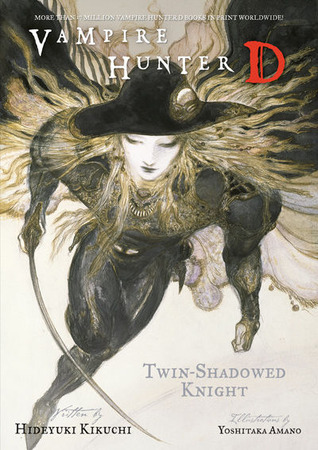
Vampire Hunter D (Dark Horse Publication Order) #13
Vampire Hunter D Volume 13: Twin Shadowed Knight - Parts One and Two
When Vampire Hunter D entered the town of Sedoc it was in search of answers to the meaning of a dying vampire's last words: "Find Muma." But when he meets Mia, the daughter of the local fortuneteller, he learns the mists emanating from a smoking crater on the outskirts of Sedoc have reanimated thousands of corpses, compelling them to crawl from their graves and hurl themselves into the smoking chasm. When D goes to investigate, he finds himself split in two: a second Vampire Hunter D, full of passion and lust and hunger for the company of women, is born!
* Features eleven black-and-white line illustrations by Yoshitaka Amano.
"Richly descriptive, filled with bone crushing action and horror aplenty, this is one wild ride down the highway to Hell." - Active Anime
* Features eleven black-and-white line illustrations by Yoshitaka Amano.
"Richly descriptive, filled with bone crushing action and horror aplenty, this is one wild ride down the highway to Hell." - Active Anime
317 pages, Paperback
First published November 30, 1996
Ratings & Reviews
Friends & Following
Create a free account to discover what your friends think of this book!
Community Reviews
Displaying 1 - 25 of 25 reviews

March 28, 2012
D has acquired an evil twin. This twin is charismatic, sarcastic, charmingly arrogant, insouciant and rather curious about his other self. In short, he possesses much of the emotional components that the real D lacks. However, he’s also lacking D’s talkative left hand, which makes you wonder just who or what the fake D is.
D’s entire journey in this novel is precipitated by the death of another unreal opponent who sends him on his way with a final cryptic word: Muma. Thus D embarks on yet another fantastic journey, one that reminds this reader of an unsettling and particularly pointless journey to Oz, one in which he has to kill someone that he could have wiped out right at the beginning of the novel, thus sparing the readers a long and tedious journey to nowhere. Couple that with inexplicable rescues and the constant reappearance of a seemingly deathless foe that exists for no other purpose than to destroy and you’ve got a truly turgid novel on your hands.
As usual, over-the-top fighting goes hand in hand with awkward exposition and the florid prose that are Mr. Kikuchi’s trademarks. It’s hard to care when the protagonists are up against emotionless foes that are nothing more than giant machines or broken-down facilities; evidently no one told Mr. Kikuchi that readers find it hard to be invested in fights against soulless, merciless things unless the heroes themselves are more than two-dimensional characters (oops).
The book is only slightly redeemed by the character of the fortuneteller’s daughter Mia. While somewhat spirited, she proves to be little more than a damsel in distress, managing to be a capable fighter at spots, and a love interest for the boy Kuentz. But Kuentz is so easily shunted out of the main story, he adds little to it while poor Mia suffers the fate of too many people on the Frontier.
D’s entire journey in this novel is precipitated by the death of another unreal opponent who sends him on his way with a final cryptic word: Muma. Thus D embarks on yet another fantastic journey, one that reminds this reader of an unsettling and particularly pointless journey to Oz, one in which he has to kill someone that he could have wiped out right at the beginning of the novel, thus sparing the readers a long and tedious journey to nowhere. Couple that with inexplicable rescues and the constant reappearance of a seemingly deathless foe that exists for no other purpose than to destroy and you’ve got a truly turgid novel on your hands.
As usual, over-the-top fighting goes hand in hand with awkward exposition and the florid prose that are Mr. Kikuchi’s trademarks. It’s hard to care when the protagonists are up against emotionless foes that are nothing more than giant machines or broken-down facilities; evidently no one told Mr. Kikuchi that readers find it hard to be invested in fights against soulless, merciless things unless the heroes themselves are more than two-dimensional characters (oops).
The book is only slightly redeemed by the character of the fortuneteller’s daughter Mia. While somewhat spirited, she proves to be little more than a damsel in distress, managing to be a capable fighter at spots, and a love interest for the boy Kuentz. But Kuentz is so easily shunted out of the main story, he adds little to it while poor Mia suffers the fate of too many people on the Frontier.

July 8, 2012
You will see something new.
Two Ds.
D One and D Two.
These Ds might actually bite you.
Though at least one of them still wants to have fun.
Then, out of the... weird, ominous pit-thingie...
Came D Two and D One!
(YOU KNOW YOU WERE ALL THINKING IT.)
Well, the ending to this one was very abrupt and anti-climatic, but that was some seriously hilarible crack, that right there was. D two is childish and fun-loving and excitable! (AND ALSO A PSYCHOPATH.) The Ds... BICKER. Nay, they positively BANTER. They play rock-paper-scissors with the heroine of the week! D is nearly mobbed by fanghouls! And the man of the week to end up sexually attracted to D is... UH, ALSO D?!
CRYING I CAN'T
I JUST
I CAN'T
Two Ds.
D One and D Two.
These Ds might actually bite you.
Though at least one of them still wants to have fun.
Then, out of the... weird, ominous pit-thingie...
Came D Two and D One!
(YOU KNOW YOU WERE ALL THINKING IT.)
Well, the ending to this one was very abrupt and anti-climatic, but that was some seriously hilarible crack, that right there was. D two is childish and fun-loving and excitable! (AND ALSO A PSYCHOPATH.) The Ds... BICKER. Nay, they positively BANTER. They play rock-paper-scissors with the heroine of the week! D is nearly mobbed by fanghouls! And the man of the week to end up sexually attracted to D is... UH, ALSO D?!
"...the fake D glared at the Hunter out of the corner of his eye, but while he was doing so, he began to go into a daze and had to hurriedly face forward again. D's handsome features had captivated him--even though it was his own face."
CRYING I CAN'T
I JUST
I CAN'T
August 1, 2011
This one was pretty good. There are still some very confusing descriptions of action scenes and certain things, which might be a result of the translation or just the way they are written. Overall it was nice to get a little more background story about D, and pleasing to have the 'other D' that acted more outgoing and said more than our favorite Vampire Hunter.

October 29, 2024
all reviews in one place:
night mode reading
; skaitom nakties rezimu
Luck had it that I’ve found another Vampire Hunter D series by Hideyuki Kikuchi book for October Reads. Thirteenth book called Twin-Shadowed Knight, apparently put together of parts one and two.
My Opinion: Dystopian sci-fi world, where vampires known as Nobility, have ruled the lands with both their science and their supernatural abilities. Humans, once Nobility began to decline and disappear, leaving their experiments, mutations, monsters, and structures behind, began to carefully learn how to live around it all, often assuming Nobility’s knowledge will be somehow tainted, that it’ll affect them, or re-summon the curse of them back onto the land, as if the creatures they left behind wouldn’t be enough. In this world, there’s thus hunters. Specialized in either dealing with said creatures, or outright – remaining Nobility, often insane due to whatever others like them chose and managed to escape. D is one of the most famous and infamous vampire hunters, extremely gorgeous, and extremely skilled. 13th novel, so befitting October month, tells yet another tale of how he’s related to the Ancient Ancestor, the Great One, never said but often implied to be Dracula.
A solid 4 out of 5, pretty good.
Luck had it that I’ve found another Vampire Hunter D series by Hideyuki Kikuchi book for October Reads. Thirteenth book called Twin-Shadowed Knight, apparently put together of parts one and two.
My Opinion: Dystopian sci-fi world, where vampires known as Nobility, have ruled the lands with both their science and their supernatural abilities. Humans, once Nobility began to decline and disappear, leaving their experiments, mutations, monsters, and structures behind, began to carefully learn how to live around it all, often assuming Nobility’s knowledge will be somehow tainted, that it’ll affect them, or re-summon the curse of them back onto the land, as if the creatures they left behind wouldn’t be enough. In this world, there’s thus hunters. Specialized in either dealing with said creatures, or outright – remaining Nobility, often insane due to whatever others like them chose and managed to escape. D is one of the most famous and infamous vampire hunters, extremely gorgeous, and extremely skilled. 13th novel, so befitting October month, tells yet another tale of how he’s related to the Ancient Ancestor, the Great One, never said but often implied to be Dracula.
A solid 4 out of 5, pretty good.

July 2, 2026
I'm over here screaming: "There can be only one!" Highlander style.
D having a twin had me up in arms. But even the real D was off kilter, or kind of out of character at times in this.
In honesty, I didn't enjoy this story, I was left with more questions than answers. There was lore dropped and then the rug was pulled right at the end? I would rather go read one of the volumes I rated 3 stars again, than try and unravel this one.
D having a twin had me up in arms. But even the real D was off kilter, or kind of out of character at times in this.
In honesty, I didn't enjoy this story, I was left with more questions than answers. There was lore dropped and then the rug was pulled right at the end? I would rather go read one of the volumes I rated 3 stars again, than try and unravel this one.
January 12, 2010
In this installment, the vampire hunter is pitted against his doppleganger and, in the process, begins to uncover some of his past. I find it amusing that it took 13 volumes to actually learn something about D, but part of having the mystery is what keeps me wanting to read more.
I keep getting recommendations from people who see me reading this series, people who will say "hey, if you like that sort of thing, you should read the Twilight Series!" I haven't read the Twilight series, nor have I seen either of the movies, but I have to say that not all vampire books are the same. Vampire Hunter D belongs in the same catagory as Stephen King, in my opinion; it's closer to horror. There's no romance in it whatsoever, not in the classical sense, anyway.
I think one of the things I like most about this series is the melding of fantasy and science fiction. I really like dytopias; Revelations is my favorite book of the Bible. Lord of the Flies has been one of my favorite books since I was a child. Maybe that makes me a bit morbid, but hey, that's me. All I can do is patiently wait for the next volume, which hopefully hits shelves in March.
I keep getting recommendations from people who see me reading this series, people who will say "hey, if you like that sort of thing, you should read the Twilight Series!" I haven't read the Twilight series, nor have I seen either of the movies, but I have to say that not all vampire books are the same. Vampire Hunter D belongs in the same catagory as Stephen King, in my opinion; it's closer to horror. There's no romance in it whatsoever, not in the classical sense, anyway.
I think one of the things I like most about this series is the melding of fantasy and science fiction. I really like dytopias; Revelations is my favorite book of the Bible. Lord of the Flies has been one of my favorite books since I was a child. Maybe that makes me a bit morbid, but hey, that's me. All I can do is patiently wait for the next volume, which hopefully hits shelves in March.

February 1, 2013
I have to admit that I really expected more from this book. The initial write up on the back made it seem as if the second "D" that is birthed from the crater was going to be some out of control version of the normally very restrained and cold hero that I love to read about. And I was very much lookig forward to that. When he crawls out of the crater, this second "fake D" as he's called does in fact does go on a killing spree. But there was nothing in the book about his enjoying the company of women or even doing any real flirting, much less anything else. The idea behind who the "twin" is and why he suddenly appeared--tied in with the mysterious place Muma--was compelling, but I felt as if there was much that was kind of left hanging. I did love the character of Mia, but again felt stymied there, as her fate was not something I enjoyed after rooting for her most of the book. I might reread this again, just to see if I got more out of it a second time.

May 18, 2010
Who's who? That's the question. Although it's not that hard to tell. In the first place one D is taciturn and distant and the other is a talky joker. And also let's not forget Lefty, D's symbiotic sidekick that lives in his left hand.
Lots of action in this one, and we get to see a lot more of D's character, though that's not saying much, but we get a lot more insight into D though both his actions and his doppelganger's. Sometimes it seems that the translation causes a bit stiff English, but the picturesque scene descriptions do come through quite well.
However, don't dive directly into this one, start at the first one and go from there. There's a lot of mythology that you might miss out on if you don't start from scratch
Lots of action in this one, and we get to see a lot more of D's character, though that's not saying much, but we get a lot more insight into D though both his actions and his doppelganger's. Sometimes it seems that the translation causes a bit stiff English, but the picturesque scene descriptions do come through quite well.
However, don't dive directly into this one, start at the first one and go from there. There's a lot of mythology that you might miss out on if you don't start from scratch

March 6, 2019
Probably the worst VHD book I've read. The author has some good ideas but then jumps from one to the next with no sense of logic. One chapter this guy is an enemy, the next he is an ally and you're left wondering "did I skip some pages or is this just too weird". Then he reuses the end of the previous book. Completely disappointed with this one! Took me almost one month to finish as it was very hard to pick it up again.

March 16, 2024
Who is Cain? Who is Abel?
Review in reference to GraphicAudio adaptation: https://www.graphicaudio.net/vampire-...
So I've read the book long hand around last summer, because I knew there was going to be a long wait for this GA adaptation to come out, I just didn't know how long it would take. But now that I've formally given a listen to this adaptation (and will do more listens in the future) I've come to the conclusion that if there were to be another film adaptation of Vampire Hunter D after Bloodlust, this story should be next.
Since the start of adapting Vampire Hunter D to GraphicAudio, David Cui Cui has captured the essence of the character and has done a good job at knowing when to show emotion when the scene calls for it. While reading through the book, it got me curious as to how the other D might sound like. In some cases, some people might hire other actors who might sound similar to the guy voicing the character. Like in Dragon Ball Z for example, Bardock, the father of Kakarot (Goku) looks exactly like him, but if you were to listen to the Funimation dub, he's not voiced by Sean Schemmel. Instead he's voiced by Sonny Strait, best known for voicing Krillin.
Twin Shadowed Knight, on the other hand, David Cui Cui voices both the normal D and the more talkative and cocky D, but even with him voicing both of those characters, he manages to even keep those characters mysterious; stuff like that reinforces the title of my review for this story overall: Who is Cain? Who is Abel?
Even Yoshitaka Amano had that same mentality for this volume, if you were to pick up a copy of the book, via digital or physical, you'll find a fantastic picture of the two vampire hunters together, but you'll never know who is who.
Review in reference to GraphicAudio adaptation: https://www.graphicaudio.net/vampire-...
So I've read the book long hand around last summer, because I knew there was going to be a long wait for this GA adaptation to come out, I just didn't know how long it would take. But now that I've formally given a listen to this adaptation (and will do more listens in the future) I've come to the conclusion that if there were to be another film adaptation of Vampire Hunter D after Bloodlust, this story should be next.
Since the start of adapting Vampire Hunter D to GraphicAudio, David Cui Cui has captured the essence of the character and has done a good job at knowing when to show emotion when the scene calls for it. While reading through the book, it got me curious as to how the other D might sound like. In some cases, some people might hire other actors who might sound similar to the guy voicing the character. Like in Dragon Ball Z for example, Bardock, the father of Kakarot (Goku) looks exactly like him, but if you were to listen to the Funimation dub, he's not voiced by Sean Schemmel. Instead he's voiced by Sonny Strait, best known for voicing Krillin.
Twin Shadowed Knight, on the other hand, David Cui Cui voices both the normal D and the more talkative and cocky D, but even with him voicing both of those characters, he manages to even keep those characters mysterious; stuff like that reinforces the title of my review for this story overall: Who is Cain? Who is Abel?
Even Yoshitaka Amano had that same mentality for this volume, if you were to pick up a copy of the book, via digital or physical, you'll find a fantastic picture of the two vampire hunters together, but you'll never know who is who.

July 15, 2024
God dammit I JUST wrote in my 50% progress update that I was waiting for this story to do something for it to not feel like a filler episode and in the last few mins it drops an unholy lore implication bomb that changes the way I think about the overarching (and yet unfinished) story of D’s hunt for the Sacred Ancestor.
Definitely got more interesting in part two. And a smaller cast, too. Now all that’s left is less confusing fight scenes (though they’re alleviated by the audio drama I listened to).
Definitely got more interesting in part two. And a smaller cast, too. Now all that’s left is less confusing fight scenes (though they’re alleviated by the audio drama I listened to).
June 15, 2022
This wasn't one of my favorites. An evil twin of D appears and then it just weirder from there. There was some information on D's origin scattered throughout, but the way it was written made the reader think it may or may not have been "true." In other words, we still don't know much about his origin.
Still a great series, but this wasn't one of the better volumes.
Still a great series, but this wasn't one of the better volumes.

June 25, 2023
FINALLY, we really learn some stuff about D and his origins, beyond the tenuous connection to the Sacred Ancestor, Dracula. We also get hints about his destiny, tied up in this place which was accidentally activated early. Does this also give us an actual hint to D's age? It may, but nothing concrete.
I liked this one very much, and it has reinvigorated my enthusiasm for this series.
I liked this one very much, and it has reinvigorated my enthusiasm for this series.
September 26, 2025
Y volvemos a tener a una chica de 16 años que se enamora de D y termina de forma tragica, pero ahora adicionando a un "gemelo" de D.
Quizás el autor ya se esta quedando sin muchas ideas para seguir escribiendo xD pero al menos mostraron un poco mas del "ancestro" y el "Dark D" fue divertido.
Quizás el autor ya se esta quedando sin muchas ideas para seguir escribiendo xD pero al menos mostraron un poco mas del "ancestro" y el "Dark D" fue divertido.
This entire review has been hidden because of spoilers.
October 4, 2018
When you get this far into a series, it's hard to find anything new to say about it. The further adventures of D though, so well worth reading.

July 9, 2022
Fun Story. I love this series.
November 2, 2023
It’s a Vampire Hunter D novel, so I got more or less what I expected. This one was a little more confused than some of the others, and seemed a bit anticlimactic in comparison, though.

September 12, 2026
Disjointed, forgets storylines etc. Can be skipped
February 17, 2023
An interesting premise
The Words of the Wind whisper and compel D to seek out "Muma"
A Psuedo-Siamese Twin of D has emerged causing confusion as the two confront each other a secret facility of the Nobility has come online against disrupting the normalcy of the area causing the living dead to rise
An interesting premise in terms of a mystery similar to that of Raiser of Gales or Tale of Dead Town with the core being around the past experimentation of the Sacred Ancestor a now illusory ghost of a god that D seems to seek out as well as remaining Nobility
this Volume seems to reveal more shades to D's backstory the author still keeps it vague as that's the intended mystique of the character of D being the layers of mystery wrapped around him from a blue pendant that can open various doorways and bypass security systems of Noble Castles and Facilities to a Parasitic left hand that's capable of reviving him through the consumption of the 4 elements and imbuing the energy that comes rippling out like a furnace into his constitution
That being said I find how the story is carried to be remarkably unsatisfying in how it attempts to carry the story
D's Doppleganger/Twin does contrasting personality to his visage counterpart what being colored with acts of sadistic violence and wry amusement from them it does make for an interesting duo as they also seem to have a shared existence in the fact that while different individually they are the same kind lifeform imagine if you split a single being into two and those two developed their own personality but innately they are the same thing that's how I would describe it
but not enough is done to flesh D's twin out beyond vague allusions to how he views things
>“Clucking his tongue, the fake D glared at the Hunter out of the corner of his eye, but while he was doing so, he began to go into a daze and had to hurriedly face forward again. D’s handsome features had captivated him—even though it was his own face. He could recall seeing it in the mirror hundreds of times before. And each time it had held him spellbound. Undoubtedly that D lacked the narcissism the fake D had in abundance.
“What the hell?” he spat, perhaps fearing the strange movements of his own heart, or maybe he was simply embarrassed”
as usual we do have a heroine being the Fortune Teller who prophesies D's arrival to the village near the center of activity and grows to care for the both of them despite the monstrosities both are capable of in their own different ways
empathetic and fiercly prideful in her duties as a fortune teller she acts almost like an intermediary between these two opposing figures
the duo idea is interesting but needs more work beyond a single two-parter story and this sort of thing does arouse a bit a frustration with how these novels work where each story is a snapshot of D's adventures through this dark post apocalyptic future of mutants and monster
it allows for versatility for the author in the sense that he gets to explore so many different types of stories but the restriction being that although we learn more eventually D resets back to his status quo in the beginning of every book allowing for a vague timeline of events
theirs a restriction here that is quite unsatisfying as some storylines and premises in these books have the ability for development past the novel inception where they're born and sort of getting to see them in other situations for more characterization
I'm perfectly fine for Volumes like Pilgrimage of the Sacred and Profane where each character has their respective arc started and completed in the novel in a way that doesn't over or under stay it's welcome but their are some ideas I feel Kikuchi can't do justice with isolated story settings and it would be nice if he could be more flexible in this aspect of the series
but what I got here I still liked it's just the potential that goes to waste that I find really sad
The Words of the Wind whisper and compel D to seek out "Muma"
A Psuedo-Siamese Twin of D has emerged causing confusion as the two confront each other a secret facility of the Nobility has come online against disrupting the normalcy of the area causing the living dead to rise
An interesting premise in terms of a mystery similar to that of Raiser of Gales or Tale of Dead Town with the core being around the past experimentation of the Sacred Ancestor a now illusory ghost of a god that D seems to seek out as well as remaining Nobility
this Volume seems to reveal more shades to D's backstory the author still keeps it vague as that's the intended mystique of the character of D being the layers of mystery wrapped around him from a blue pendant that can open various doorways and bypass security systems of Noble Castles and Facilities to a Parasitic left hand that's capable of reviving him through the consumption of the 4 elements and imbuing the energy that comes rippling out like a furnace into his constitution
That being said I find how the story is carried to be remarkably unsatisfying in how it attempts to carry the story
D's Doppleganger/Twin does contrasting personality to his visage counterpart what being colored with acts of sadistic violence and wry amusement from them it does make for an interesting duo as they also seem to have a shared existence in the fact that while different individually they are the same kind lifeform imagine if you split a single being into two and those two developed their own personality but innately they are the same thing that's how I would describe it
but not enough is done to flesh D's twin out beyond vague allusions to how he views things
>“Clucking his tongue, the fake D glared at the Hunter out of the corner of his eye, but while he was doing so, he began to go into a daze and had to hurriedly face forward again. D’s handsome features had captivated him—even though it was his own face. He could recall seeing it in the mirror hundreds of times before. And each time it had held him spellbound. Undoubtedly that D lacked the narcissism the fake D had in abundance.
“What the hell?” he spat, perhaps fearing the strange movements of his own heart, or maybe he was simply embarrassed”
as usual we do have a heroine being the Fortune Teller who prophesies D's arrival to the village near the center of activity and grows to care for the both of them despite the monstrosities both are capable of in their own different ways
empathetic and fiercly prideful in her duties as a fortune teller she acts almost like an intermediary between these two opposing figures
the duo idea is interesting but needs more work beyond a single two-parter story and this sort of thing does arouse a bit a frustration with how these novels work where each story is a snapshot of D's adventures through this dark post apocalyptic future of mutants and monster
it allows for versatility for the author in the sense that he gets to explore so many different types of stories but the restriction being that although we learn more eventually D resets back to his status quo in the beginning of every book allowing for a vague timeline of events
theirs a restriction here that is quite unsatisfying as some storylines and premises in these books have the ability for development past the novel inception where they're born and sort of getting to see them in other situations for more characterization
I'm perfectly fine for Volumes like Pilgrimage of the Sacred and Profane where each character has their respective arc started and completed in the novel in a way that doesn't over or under stay it's welcome but their are some ideas I feel Kikuchi can't do justice with isolated story settings and it would be nice if he could be more flexible in this aspect of the series
but what I got here I still liked it's just the potential that goes to waste that I find really sad

December 27, 2016
Having read most of the books so far, I have to say this one is my second favorite after Vampire Hunter D Volume 06: Pilgrimage of the Sacred and the Profane.
While the blurb is a little misleading (D's twin doesn't spend much time in the company of women, although he does flirt with the novel's heroine, Mia. The real D, on the other hand, may or may not have gotten laid based on an odd scene where Mia offers him her blood in exchange for his services... and he accepts.) this book has a lot more substance than its crack premise would suggest. The opening scene was especially well-done; the atmosphere and circumstances really drew me in. Yes, D does fall into a pit and another D emerges in his place. Yes, the two bicker, fight, and eventually kill one another. Yes, the fake D really is just as enchanted by D's good looks as everyone else, even though it's his own face... But we get to see D's birthplace and learn more about his origins. And D's father, the Sacred Ancestor, makes a more substantial appearance here than in the previous books. This is definitely meatier than, say, Vampire Hunter D Volume 02: Raiser of Gales, but not as crammed and unfocused as Vampire Hunter D Volume 11: Pale Fallen Angel - Parts One and Two. I liked this much more than I did both of those, which I would argue are among the weakest in the series. This is the series at its best - pulpy, fun, and engaging, but not entirely frosting. There's cake underneath it. Moist cake.
...I'm going to go buy the other books now.
While the blurb is a little misleading (D's twin doesn't spend much time in the company of women, although he does flirt with the novel's heroine, Mia. The real D, on the other hand, may or may not have gotten laid based on an odd scene where Mia offers him her blood in exchange for his services... and he accepts.) this book has a lot more substance than its crack premise would suggest. The opening scene was especially well-done; the atmosphere and circumstances really drew me in. Yes, D does fall into a pit and another D emerges in his place. Yes, the two bicker, fight, and eventually kill one another. Yes, the fake D really is just as enchanted by D's good looks as everyone else, even though it's his own face... But we get to see D's birthplace and learn more about his origins. And D's father, the Sacred Ancestor, makes a more substantial appearance here than in the previous books. This is definitely meatier than, say, Vampire Hunter D Volume 02: Raiser of Gales, but not as crammed and unfocused as Vampire Hunter D Volume 11: Pale Fallen Angel - Parts One and Two. I liked this much more than I did both of those, which I would argue are among the weakest in the series. This is the series at its best - pulpy, fun, and engaging, but not entirely frosting. There's cake underneath it. Moist cake.
...I'm going to go buy the other books now.

Read
March 13, 2011I found the second D intruguing and his relationship with the more elusive and commonly known D as much so. The story has one main, difficult question to answer: Which one us deserved to live, which deserved to perish?
I mean, who is to say what is fair? That one was able to live, while the other layed dormant for thousands of years. It is arguable though that D, being the tortured and long-suffering soul he is would envy his twin while the latter has similar feelings towards him.
I guess, the way I saw it was - the grass is always greener on the other side. And although it came down to a battle of skill, I think the real D repvailed because he had more ambition to live for and more reason to proceed with life while the other D's reasons were skewed.
I mean, who is to say what is fair? That one was able to live, while the other layed dormant for thousands of years. It is arguable though that D, being the tortured and long-suffering soul he is would envy his twin while the latter has similar feelings towards him.
I guess, the way I saw it was - the grass is always greener on the other side. And although it came down to a battle of skill, I think the real D repvailed because he had more ambition to live for and more reason to proceed with life while the other D's reasons were skewed.

July 26, 2009
another solid entry into the vampire hunter d series by kikuchi. this one finds d traveling in order to find a mysterious place called muma. on the way he meets a fortunetellers daughter and an exact copy of himself that is all passion and fire where he is not. they travel together in order to protect the village and find out the mysteries of muma and of d himself...or themselves.
August 24, 2013
Best in the series so far imo! D's "twin" is interesting add, plus we got more info of D's history :)

September 28, 2024
Not bad, not great, just an average D adventure.

May 11, 2011
One of the weaker entries in the series.
Displaying 1 - 25 of 25 reviews