From the slapstick comedy of Charlie Chaplin and Stan Laurel, the surrealism of Spike Milligan and Monty Python, and the golden age of political incorrectness helmed by Benny Hill, to the alternative scene that burst forth following the punk movement, the hedonistic joy of Absolutely Fabulous, the lacerating scorn of Jimmy Carr, Ricky Gervais, and Jo Brand and the meteoric rise of socially conscious stand up comedy can be many things, and it is a cultural phenomenon has come to define Britain like few others.
In Different Times, David Stubbs charts the superstars that were in on the gags, the unsung heroes hiding in the wings and the people who ended up being the butt of the joke. Comedians and their work speak to and of their time, drawing upon and moulding Britons' relationship with their national history, reflecting us as a people, and, simply, providing raucous laughs for millions of people around the world.
Different Times is a joyous, witty and insightful paean to British comedy.
This book gets some reviewers’ goats (I’m not sure there are multiple goats, I think actually there’s only one) – take the title of one review in the online magazine The Critic
Militant humourlessness A pseudo-history of British comedy leaves one depressed
Or this from the Irish Independent
British comedy is no laughing matter, at least in this writer’s hands David Stubbs has created a readable social history, even if his diatribes and humourlessness jar with his subject
I can see this – Davis loves to tick off 60s and 70s tv shows for their poor attitudes towards everyone who isn't a straight white middle class male (i.e. the vast majority of human beings who have ever lived) and he is most eager to finger comedians who were feeding us Conservative propaganda and quite often were actually voting Conservative too! Screech! This for David puts a person beyond the pale. He is the living embodiment of the modern assumption that of course comedy either is or should be socially progressive; and furthermore, that the kindly lefties have successfully prised this thing called comedy out of the dead hands of the sexists, racists, homophobes and transphobics and things are so much better now than they ever were.
Article from The Guardian in 2020 :
Rightwing comedians not funny enough for BBC shows, says insider Source says producers have sought Conservative-leaning performers, but most ‘aren’t very good’
Some of the comedy David (and the rest of us) grew up with which made us roll around busting our sides back then has not worn well- say for example Manuel in Fawlty Towers. It’s the same problem readers find in old novels – my favourite example is Miss Pettigrew Lives for a Day, a 1938 comedy which is so cute and sweet and funny until suddenly Miss Pettigrew explains to her maid why it’s impossible to marry a Jew. We all know how many times we can suddenly bang our noses on these ancient taken-for-granted contemptuous attitudes. When does this oldfangled nastiness wreck the comedy and when can we shrug and overlook it?
Unfortunately David, when he constantly berates old comedy for its bad attitudes, does indeed sound like an old fart grump somewhat (oh no!) like myself. His book is quite compelling (for British comedy fans only I should think) but it’s not a barrel of laughs. For instance, he loves Monty Python but is very keen to expose its unacceptable parts – talking about one of Terry Gilliam’s animations he says :
that it is the woman who is “liberated” from her clothing, and not the man, says much about how male-determined, how cis-heteronormative, ideas of sexual freedom were in the 1960s and 1970s.
One thing that came across very strongly, and demonstrated poignantly how different those times were, is what television meant to people back then :
The good, the bad, the rubbish, the grown-up and incomprehensible: you watched the telly because the terrible alternative was not watching the telly.
For watching the television, regardless of what was on, was what you did, the unthinkable option being to switch the TV off and go do something infinitely more boring instead.
Well, I guess if you substitute your phone or your laptop for the television, you will still get the same idea.
I give this book points for covering a lot of ground, from Chaplin to The Office. But yes, it's very earnest
Still, it was great to fund someone else who hates Spike Milligan!
I really don’t find Spike Milligan very funny. And when I say not funny, I mean deadeningly unfunny. … I sometimes feel if just one reader is persuaded, after reading this book, not to bother watching Q (Spike’s tv show) this entire enterprise will have been worthwhile.
Very well said David. So true.
Tommy Cooper joke :
I went to the doctor, I said “I’ve broken my arm in several places”. “Well” he said “you shouldn’t go to those places.”
Any history of comedy with an introduction entitled ‘How political correctness saved British comedy’ is clearly coming out fighting. Before the advent of alternative comedy in the late 1970s, with its ‘non-racist, non-sexist’ agenda, a great deal of British comedy, including the gold as well as the dross, was casually littered with attitudes that are now unacceptable and should have been unacceptable then: racism, sexism, homophobia, etc. For much of the 20th century British comedy was dominated by white men to such an extent that, as David Stubbs observes, it ‘was not so much about the human condition as the white, male condition’. Stubbs grew up in Britain during the 1960s and ‘70s, watched a huge amount of comedy on TV, contemporary stuff and old films, and fell in love with much of it. The tension between his continuing love of the comedy and contempt for the attitudes too often threaded through it drives much of this book and makes for fascinating reading. ‘Sometimes it’s just single moments’, he writes, ‘but they jar like a bone in an otherwise tasty fish supper’.
Stubbs is not an advocate of cancel culture. He believes that comedy from previous times can still speak to us in the present and make us laugh. He is dismayed by the fact that even the best of the old comedy shows and films are now rarely shown on mainstream television and many young people are growing up with a severely limited knowledge of comedy history. Nor is it a matter of imposing contemporary values on the comedy of a previous age. His concern, rather, is to analyse comedy to show what it reveals of the attitudes prevalent in the era(s) in which it was made.
He recognises that what seems hopelessly stereotypical now might have been refreshingly novel and even liberating in its day. Julian and Sandy were an exuberantly camp couple given to erupting noisily into the 1960s radio comedy Round the Horne, baffling their urbane host Kenneth Horne - a straight man in more senses than one - with their gay innuendo and liberal employment of Polari. The fact that they were played by gay actors, Kenneth Williams and Hugh Paddick, lent their characterisations authenticity. In a Britain that was still busy putting gay men in prison, Julian and Sandy were bold, impossible to dislike and outrageously funny. They were the agents of the joke, rather than the butt of it, and remain among my all-time favourite comedy characters. Unfortunately, the template was then endlessly repeated to tiresome, increasingly unfunny and ultimately repressive effect, in the work of subsequent lesser comedians and scriptwriters in countless sitcoms and sketch shows throughout the 1970s.
Before the revolution of alternative comedy, and with honourable exceptions, British comedy was populated by such stock characters, as if culled from a mandatory comedy writing manual issued to all comedy writing hacks: gay men, husbands, wives, vicars, the elderly… the comedy writing manual had a stereotype for all of them. Racial stereotypes were commonplace and went largely unremarked. Once the stereotypes had been swept away the path was clear for the inventive and idiosyncratic characters of the sketch series The Fast Show, the credible gay hero of the sitcom Gimme Gimme Gimme, the feminist inflected comedy of French and Saunders and Jo Brand, and the well-observed comedy of the Asian sketch show Goodness Gracious Me.
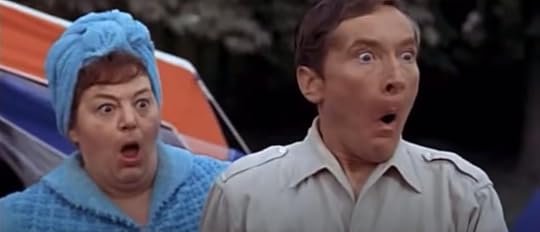
Particularly when discussing old-school comedy, Stubbs walks a tightrope between celebration and censure. Just occasionally he falls off it. He sounds uncharacteristically humourless and puritanical when berating a perfectly innocuous Morecambe and Wise sketch. Similarly, although he’s right about the reactionary politics of the Carry On films, he might have acknowledged that, in the context of a 1950s British film comedy culture in which sex seemed not to have been invented, their saucy seaside postcard humour might justifiably have been seen as a step forward.
Stubbs certainly does have his blind spots. Surprisingly, for a comedy buff who is also a music critic, he is not a fan of the comic song. Without wishing to sound chauvinistic, Britain has been rather good at funny songs: Noel Coward, Flanders and Swann, Jake Thackray, the Bonzo Dog Band, Victoria Wood. Stubbs, however, dismisses an entire and eclectic tradition in a few casual sentences.
For the most part, though, his analysis is perceptive, nuanced and scrupulously even-handed. There is much to admire and enjoy about this book. Stubbs draws attention to some brilliantly talented mid-twentieth century female comedians who work has been marginalised by history, including Joyce Grenfell and Eleanor Bron. He has the honesty to admit that he has never found the humour of Spike Milligan, that sacred cow of British comedy, remotely funny. He writes well about how TV comedy helped to bind the nation together in the 1970s (the 1977 Morecambe and Wise Christmas show was watched by an estimated audience of up to twenty eight million). He’s very good on the limitations, and even self-deceiving smugness, of television and radio political satire. And I cheered when he put the boot into the tired notion that comedy should be ‘edgy’ (in the 21st century ‘edgy’ comedy has largely degenerated into an excuse for comedians to punch down at the marginalised and persecuted).
I’m not sure how many of the comedians and shows featured in Different Times will be familiar to readers outside of Britain (some of them might not be familiar to anyone at all under the age of fifty). Some British comedians have enjoyed international success (Chaplin, Stan Laurel, Benny Hill, Monty Python, Rowan Atkinson as Mr Bean) but many, including some of the best (Tony Hancock is just one great name from the past that springs to mind), have remained largely unknown beyond their own country. Stubbs concentrates on film and, particularly, TV comedy, bypassing stand-up almost entirely. He admits that, almost necessarily, his history is incomplete. It is, nonetheless, a comprehensive account of the main players and trends in 20th century British comedy, and the ways in which it reflected, and often failed to adequately reflect, the nation.
He makes some observations on the disappearance of a tradition of sheer silliness from British comedy. Silliness is what I personally miss most in contemporary comedy, which tends towards naturalism and truthfully observed characters. It once ran through all strands of British comedy from the comparatively left-field (The Goon Show, Monty Python, Vivian Stanshall, Ivor Cutler) to the mainstream variety comedians (Morecambe and Wise, Tommy Cooper, Ken Dodd). There is, at least, the consolation of the sublimely silly Count Arthur Strong, whose wonderfully funny work combines the traditional and the post-modern (inexplicably, Stubbs mentions him only once in passing). Sadly, he seems like an increasingly atypical and even anachronistic figure.
Different Times ends on a positive note. Following an outbreak of cynicism and cruelty in comedy in the noughties, Stubbs argues that the keyword for the best of current British comedy is ‘kindness’. It is also more inclusive, diverse and multicultural than ever before. This won’t, in my view at least, automatically make it funnier. Truly great comedy will always be a rarity as most people simply lack the peculiar concatenation of qualities required to achieve it (a sort of intense intellectual rigour combined with an ability to take a sidelong look at everything). Most of the time we have to settle for being moderately amused. Still, a diverse and thoughtful comedy based on our shared humanity is something to be welcomed without reservation.
And the greatest living British comedian, according to Stubbs? Stewart Lee. No argument from me on that one, either.
David Stubbs is a fan. He loves comedy and this book is in part a homage to his viewing from childhood onwards. He is also hugely ambitious in attempting to cover British Comedy from Chaplin to now. This book displays a sort of sleight of hand in covering all the usual suspects whilst proclaiming clearly at the start that it is also about the omissions- what's been left out and what that tells you - the author also occasionally makes an appearance with a memory (this is partly about his viewing history ) as well as encounters with some celebs mentioned. Stubbs provides a clever introduction outlining an episode of Outnumbered where a German exchange student mistakes Boris Johnson for a comedy character because of his antics - despite the fact he’s just the major of London. Cue a hint at the absurdity of comedy and its ability to be misread. Stubbs breaks the supposed rule that you shouldn’t analyse comedy and sets out his stall as someone in favour of the much derided PC brigade- he’s happy that comedy has become aware of cruelty and latterly bends towards kindness. By the time Stubbs gets to the 1960s the book lapses into the decade format and a sort of Wikipedia feel which is saved by his perceptive commentary on numerous sitcoms and franchises like “carry on” and Python. At times he understates- Reginald Perrin isn’t just about Boredom and Ennui! He seems relieved to get to the 1980s and lovingly describes the usual suspects. Similarly the 90s are less divisive and the lad culture not only gives us Newman & Baddiel but Chris morris and The Day today. The coverage of a large number of sit coms and personalities is impressive and Stubbs often has interesting things to say. The noughties are a decade of comedy cruelty ( post 9/11) with the likes of Jimmy Carr , Ali G and The thick of It. Conversely post noughties has arched back to kindness as the lessons learnt over the decades has dumped the crude stereotypes and the mockery of different and diversity. Comedians are more aware of their power to hurt and want to follow the rules. Stubbs ends on an optimistic note and I was impressed with the care he took in teasing out the journey of comedy and sometimes the tangents - Ever Decreasing Circles as a dark loop back to some seventies themes - Martin Bryce as a lonely anonymous figure like Frank Spencer or Hancock.
An excellent thoughtful read - rare these days - and one of the best books I’ve read on the genre. You don’t have to agree with everything Stubbs says but you can admire the fact that he’s said it - see this as an interim report on the state of comedy and a very useful reference book for cultural writers and thinkers.
This is a curious book. It’s a very serious “study” of comedy; too serious at times. Stubbs trawls through all the main British comedies and comedians from Charlie Chaplin to Fleabag. His take on the latter goes some way towards exemplifying the problem with the book: “I don’t feel it’s for me to ‘mansplain’ [it].” Well why bother to mention it?
Stubbs is too concerned with being (dread phrase) ‘politically correct’ to do his subject the justice it deserves. He lambasts Dad’s Army for having hardly any black characters in it, without so much as a nod to the fact that it would have been astonishing for that to have happened at the time it was written and created. At one point, with reference to an appallingly racist ‘joke’ made by the Major in Fawlty Towers, he says, “It should have been cut. If you wouldn’t do it now, you shouldn’t have done it then.” Stubbs loves Fawlty Towers - if anything, he loves it a little too much and spends a too long writing about it - but his unwillingness to recognise that it was, like every cultural ‘artefact’, a product of its time, makes him seem po-faced and rather precious. Of course we now recognise that racism is, and was, wrong, but Cleese and Booth couldn’t have seen that at the time, just as Phoebe Waller-Bridge can’t possibly know today what cultural transgressions she may have committed in the eyes of an audience in the 2070s.
I enjoyed the book, but would have enjoyed it more had Stubbs flagged up the issues sensitively and appropriately, making us aware that they existed, rather than criticising comedians for things that just were not in their purview.
Different Times is a mammoth compendium, attempting to provide a vertiginous range of snapshots of all of what was going on in British comedy, inevitably gravitating towards television, but there are also judicious references to the stage, radio and film mediums.
The book’s opening wisely focuses on the misuses of comedy by Boris Johnson, a man grotesquely ill-equipped to be a Prime Minister who governed in an inept and corrupt fashion from 2019-22. Stubbs’s thesis is that there has been a tendency for humour to be used to keep power relations squarely as they are, with certain forms of humour ‘sending things up, but keeping us down’. (p.8)
He quotes Billy Connolly at length from a 1970s TV appearance, such a vital perspective that I’ll quote it fully now: ‘The British people are not overtly racist, but given the opportunity they switch on to racism very quickly. You know, they listen to so many broadcasts on the radio about how desperate the situation is with Pakistanis and West Indians flooding into the country – a total lie – and then mohair-suited comedians pouring out racism to the extent that Black comedians are doing it, which I find desperately dangerous. I feel dirty. Comedians play a very important role in society; you should see things that the average guy in the street can’t see and point out the absurdity in something that’s just accepted.’ (pp.233-4)
Connolly wisely explains the responsibility of independent comic writers and performers to observe us, make us laugh at ourselves and steer us away from the baser values and actions. In a time when a Telegraph article (02/12/2023) claimed, notably, that ‘working class’ viewers see the BBC as being too PC, it is vital that British comedians are diverse truth tellers about Britain’s complex realities.
Now, such an ambitious volume can’t help but have its limitations. Several of the gazetteer capsule comments on specific programmes feel like they need deeper exploration – I Didn’t Know You Cared (1975-79) (p.165), Dave Allen at Large (1971-79) (p.165), A Bit of Fry and Laurie (1989-95) (pp.287-8), Rab C. Nesbitt (1988-2014) (p.299) and The Rag Trade (1961-78) (p.205). Furthermore, I feel that Northern comedians Robb Wilton and Frank Randle need more than three sentences between them, given their copious respective influences on Dad’s Army (1968-77), Manchester band The Fall and Gethin Price in Trevor Griffiths’s stage play Comedians (1975).
Such exclusions are clearly inevitable in any book aiming at a vast historical coverage like this. I’d personally have loved to see references to: Attention Scum (2001) and Early Doors (2003-04); the baroque force of Natasia Demetriou as a writer and performer; or, indeed, Him and Her (2010-13) and Mum (2016-19), Stefan Golaszewski’s tremendous duo of sitcoms infused with intelligence and awkwardness. These shows are like refined Ayckbourn and Esmonde and Larbey refracted through a contemporary Mass Observation lens, with an underlying deep warmth.
While Stubbs draws deft attention to Peter Terson’s Play for Today (PfT), The Fishing Party (1972) as a bridge between the wonderful Jane Freeman’s performances in that and in Last of the Summer Wine (1973-2010), he does not even mention Trevor Griffiths’s PfT version of Comedians (1979). This is a gap, as he touches on the vast significance of how comedy arises from and shapes the everyday, in terms of responding to and constructing norms of language and behaviour. This is one of PfT’s most searching dramas, about how what’s behind the jokes is important and who is being targeted, and pointing the way to the Alternative Comedy movement that Stubbs extols. This is an even greater omission given that Stubbs is yet another writer to quote David Nobbs’s brilliant writing of Jimmy’s paranoia in The Fall and Rise of Reginald Perrin (1976-79), a litany which includes PfT at its epicentre (pp.188-9).
Stubbs claims that The Good Life (1975-78) shied away from race; it did not entirely. As, at the close of a series 2 episode, Tom and Barbara effectively mock Margo’s apparent, real racism, drawing it out from her when they claim people with an Asian name are moving in next door to her. Their ‘superior’ liberal stance in regarding this all as a source of uproarious merriment is, of course, just as crass as Margo’s reaction, and is a very telling moment concerning the paradoxes at the heart of 1970s comfort. This elision suggests the difficulty of taking on such a vast terrain within 400 pages, which Andrew Male adroitly demonstrated in Sight and Sound when giving far more detailed, fairer attention to ‘Allo ‘Allo! (1982-92) than Stubbs does here.
I feel that the sections on Peep Show (2003-15) and Ever Decreasing Circles (1984-89) needed exploration of the central relationships, having watched those both again relatively recently. In Dad’s Army, Sergeant Wilson’s lack of concentration and persistence with career paths seems to me to strongly foreshadow that of Paul Ryman in Edmonde and Larbey’s latter comedy.
These minor quibbles aside, Stubbs provides a heartening and well argued historical analysis. Stubbs persuasively claims, via Alexei Monroe, that, for all its evasions of the serious issues of the Second World War, Dad’s Army provides a far less apt path towards Brexit than Are You Being Served? (1972-85), with its episode ‘Camping In’ (04/04/1973) resonating with pinched nostalgic conservatism (p.176). By and large, Stubbs rightly extols the beloved trinity of Dad’s Army, Steptoe and Son (1962-74) and Fawlty Towers (1975-79), while being even more fulsome about Victoria Wood, Reeves and Mortimer and The Royle Family (1998-2012), wherein the family ‘say but don’t say, ‘Here we are, this is who we are. And we shall not be moved.” (p.319).
There are also brilliantly incisive evocations of language and performance: ‘Harold Steptoe’s wonderfully idiosyncratic accent is a comic exaggeration of this tendency, attempting to take flight like a clumsy fowl, in stark contrast to the unapologetic bog-coarseness of his old man’ (p.103). There’s a wonderful judicious section about Laurel and Hardy and also an evocative account of Ealing’s film comedy cycle (1948-55), with an especially vivid, memorable account of its musical underscores. Stubbs advocates for unique talents like Tommy Cooper, all childlike universality, and Les Dawson, especially a memorable passage on Dawson and Roy Barraclough’s Cissy and Ada sketches in Sez Les (1969-76) (p.153). He also points out how so many of the classic British sitcom characters are lads not men, epitomised by Clement and La Frenais's sitcoms… (p.186).
There’s a superb vignette about Liz Smith (p.318) which captures some of the essence of a brilliant serio-comic performer who was strongly associated with the Play for Today tradition. Regularly, he alights on pearlers of the absurd, like in the film Carry on Cleo (1964), with the dialogue “Sinister, dexter, sinister, Dexter!” (as in left, right, left, right) (p.114). Stubbs unearths unusual, odd details; like Les Dawson’s novel of a socialist dystopia, A Time Before Genesis (1986) (!) or how the now fairly righteous socialist firebrand Charlotte Church blacked up as a male DJ in the cultural desert of 2006.
The book explicitly celebrates the 1980s Alternative Comedy revolution and how it subtly infused much 1990s comedy which was, on the face of it, far less political. He makes a compelling, cumulative case that the 1990s was a golden mean, reflecting its fairly benign geopolitical temperature, with an unprecedented diversity in the voices and perspectives in comedies like The Day Today, The Fast Show, Father Ted, Goodness Gracious Me and dinnerladies. This moment was replaced by an abyssal decline into crueller comedy in the Noughties, which totally lacked the intellectual precision and absurdism of Chris Morris’s work or the underlying jocularity of many of the aforementioned 1990s shows.
The heart of the book, which was neatly contained in a trailing Guardian article, concerns the move back towards a gentler, more humanistic form of comedy during the 2010s, much of it rooted in diverse places. Detectorists (2014- ) and This Country (2017-20) are the emblems here, plus Derry Girls (2018-22), and Ghosts (2019-23); add to these, the skilled dramedies Back to Life (2019-21), Don’t Forget the Driver (2019), In My Skin (2018-21) and The Outlaws (2021- ).
The Stubbs argument about the cruel turn of the 2000s – developing from Jason Okundaye’s 2020 article in Tribune – is compelling, but needs a little fleshing out. However, Stubbs convincingly draws the links with Reality TV as it developed, which engendered a desensitizing hardness which prepared people for and justified austerity, building on Phil Harrison’s fine book The Age of Static: How TV Explains Modern Britain (2020). In a book rightly extolling the gentleness turn and Hylda Baker (pp.168-170), Different Times is perhaps surprisingly lenient on Russell Brand, an exemplar of the nasty Noughties and its string of lairy chancers who polluted culture well into the next decade: Dapper Laughs, anyone?
There’s an astute reference to how much The Office (2001-03) led the way towards the increased kindness in the 2010s, but oddly no mention of how this is affirmed by Brent’s redemptive actions near its end and his rejection of the toxic masculine Chris “Finchy” Finch. But these are minor gripes, given the broad historical truth that Stubbs is articulating. This book is a more mass market complement to strong academic books about British comedy from Andy Medhurst (2007) and Jürgen Kamm and Birgit Neumann's edited collection (2016).
The book’s only real limitations are due to its vaulting ambition: there are always going to be some omissions to disappoint everyone. It is, however, a powerfully argued book assessing the waxing and waning of different forms of British comedy over time, which argues boldly for the 1980s-90s era as offering a great improvement, while still paying loving homage to earlier eras. Above all, Stubbs asserts that what lies underneath the jokes matters, rather than simply eliciting laffs. However fitfully, we are making progress towards kindness over cruelty.
A fine history of comedy from Chaplin to the present day exploring the good, the bad and occasionally the downright ugly/unfunny of British comedy. Highlights of the series are recalled fondly reminding us why we loved a particular series and some of those largely forgotten comedy actors who faded from memory and mainstream. The book overlaps into music, culture and politics in particular providing the context of the time. The author can add the garland of comedy expert to rock expert. Not bogus!
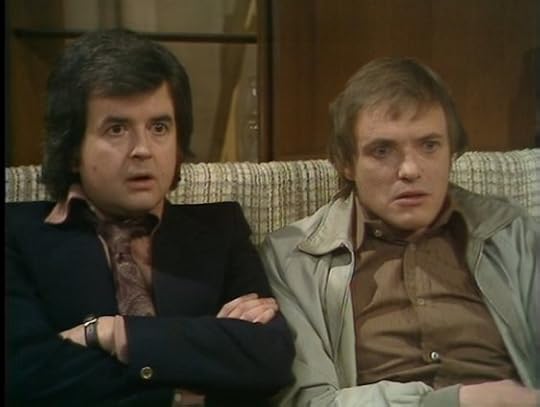
An early contender for book of the year! David Stubbs wrote the best book on electronic music "Mars By 1980" and now has written a very similar style of book this time on the history of British comedy. As he states early on he can't cover everything (just as he didn't really talk about Jean Michel Jarre in Mars By 1980) but covers really well some landmark comedy shows such as Hancock, Whatever Happened to the Likely Lads? and there's always snippets of information that I was previously unaware of. He also manages to namecheck my favourite line from the Likely Lad's film which always makes me smile
British comedy is so different from what we are used to viewing in North America. It is irreverent, and often far from politically correct in the past and more toward the present. But that does not mean it does not elicit laughs, even if we cringe a tad and feel some guilt from laughing at people as opposed to with them. David Stubbs who is noted for his books on music, has created a most interesting book, a very daunting project to study the history of British comedy. DIFFERENT TIMES pretty well runs the gamut of just about every comedy television show out there, as well as significant movies that definitely created amusing moments and scenes. And we have a lot to be thankful for in North America, because some of the classic American shows were inspired by British television shows. For example, Man About The House, a program about a man living with two women, was the inspiration for Three’s Company. All In The Family was based on the hit British show Till Death Do Us Part. As well Steptoe and Son became the launching pad for Sanford and Son starring Redd Fox. There were a lot of shows in the book, that many on this side of the pond are not familiar with, but there are also a boatload of titles that we watched religiously back in the 70’s and 80’s, and appreciated them for the outright lunacy involved. Who can forget such shows as Are You Being Served? which was set in a department store, with an oddball assemblage of workers, with Captain Peacock in charge. Mrs. Slocombe and Miss Brahms, were comic relief on so many fronts, and the show was international in appeal and laughs. Other shows that were popular outside of Britain included, On The Busses, and the popular Doctor series. Doctor in The House only had two seasons and twenty-six episodes, but they were classics in every sense of the word. Few could ever forget the Benny Hill Show, where offbeat humour and often sexist situations were the order of the day. Anything was fair game, and we laughed in spite of ourselves. David Stubbs also talks in length about Monty Python, which changed the shape of British television, launching even more semi-insanity. There were spin-off movies from Monty Python, like The Life Of Brian, that again raised debate about how humour could actually go. Brits take their television seriously, because back in 1964 when Steptoe and Son was much-watch comedy, Prime Minister Harold Wilson asked BBC television to put the show on at a later hour on election night, worried voters would stay home and watch that show rather than go out and for his party. DIFFERENT TIMES talks about all the great shows by decade, and is a great read for lovers of British comedy in all its forms. The author has delved extensively into what made British people laugh, which translated into a most thorough analysis of the subject.
Any book that spends pages and pages describing Dad's Army in excruciating detail but glosses over The Goons and Q with a few dismissive paragraphs isn't really a history book, it's an opinionated diatribe presented in chronological order. It's fine to hate Milligan (Stubbs makes it clear that he finds him "painfully unfunny") but if you're claiming your book is history you can't just write about what you like. I'm pretty sure most real historians aren't fans of Hitler but they don't airbrush him from their history books.
Different times should have been a blog. I'm waiting for someone else to tackle this subject and do it the justice it deserves.
Convincing, considered, entertaining, and informative.
Stubbs - a writer whose work I have enjoyed since his days on Melody Maker - is a warm and wise companion, taking us through the development of British comedy from Stan Laurel and Charlie Chaplin up to the present time.
It’s generous, but critical, with grit enough to challenge some sacred cows, and question the value of comedy if not everyone can be in on the laugh.
I'm a fan of David Stubbs' books on music, so I was excited to dive into his book on comedy. An excellent take on the ever-evolving comedic sensibilities of a society constantly moving forward regardless of naysayers and their antiquated thoughts on "oh, you can't say that anymore"
A great read for those of us interested in the eclectic world of British Comedy from the brilliant to the loved. Full of memories for a boomer like me and a well written collection of how and why essays on how those who made and make us laugh as an island.