

What do you think?

Personal Narrative of a Journey to the Equinoctial Regions of the New Continent
One of the greatest nineteenth-century scientist-explorers, Alexander von Humboldt traversed the tropical Spanish Americas between 1799 and 1804. By the time of his death in 1859, he had won international fame for his scientific discoveries, his observations of Native American peoples and his detailed descriptions of the flora and fauna of the 'new continent'. The first to draw and speculate on Aztec art, to observe reverse polarity in magnetism and to discover why America is called America, his writings profoundly influenced the course of Victorian culture, causing Darwin to 'He alone gives any notion of the feelings which are raised in the mind on first entering the Tropics.'
For more than seventy years, Penguin has been the leading publisher of classic literature in the English-speaking world. With more than 1,700 titles, Penguin Classics represents a global bookshelf of the best works throughout history and across genres and disciplines. Readers trust the series to provide authoritative texts enhanced by introductions and notes by distinguished scholars and contemporary authors, as well as up-to-date translations by award-winning translators.
For more than seventy years, Penguin has been the leading publisher of classic literature in the English-speaking world. With more than 1,700 titles, Penguin Classics represents a global bookshelf of the best works throughout history and across genres and disciplines. Readers trust the series to provide authoritative texts enhanced by introductions and notes by distinguished scholars and contemporary authors, as well as up-to-date translations by award-winning translators.
400 pages, Paperback
First published January 1, 1804
About the author
Alexander von Humboldt
1,163 books223 followersExpeditions of German scientist Baron Friedrich Heinrich Alexander von Humboldt to Latin America from 1799 to 1804 and to Siberia in 1829 greatly advanced the fields of ecology, geology, and meteorology.
Friedrich Wilhelm Heinrich Alexander Freiherr von Humboldt, a naturalist and the younger brother of the Prussian minister, philosopher, and linguist, Wilhelm von Humboldt, explored. Quantitative botanical work of Humboldt founded biogeography.
Humboldt traveled extensively, explored, and described for the first time in a generally considered modern manner and point of view. He wrote up his description of the journey and published an enormous set of volumes over 21 years. He first proposed that forces once joined South America and Africa, the lands, bordering the Atlantic Ocean. Later, his five-volume work, Kosmos (1845), attempted to unify the various branches of knowledge. Humboldt supported, included, and worked with Joseph-Louis Gay-Lussac, Justus von Liebig, Louis Agassiz, and Matthew Fontaine Maury and most notably conducted much of his exploration with Aimé Bonpland.
Friedrich Wilhelm Heinrich Alexander Freiherr von Humboldt, a naturalist and the younger brother of the Prussian minister, philosopher, and linguist, Wilhelm von Humboldt, explored. Quantitative botanical work of Humboldt founded biogeography.
Humboldt traveled extensively, explored, and described for the first time in a generally considered modern manner and point of view. He wrote up his description of the journey and published an enormous set of volumes over 21 years. He first proposed that forces once joined South America and Africa, the lands, bordering the Atlantic Ocean. Later, his five-volume work, Kosmos (1845), attempted to unify the various branches of knowledge. Humboldt supported, included, and worked with Joseph-Louis Gay-Lussac, Justus von Liebig, Louis Agassiz, and Matthew Fontaine Maury and most notably conducted much of his exploration with Aimé Bonpland.
Ratings & Reviews
Friends & Following
Create a free account to discover what your friends think of this book!
Community Reviews
Displaying 1 - 28 of 28 reviews

December 1, 2017
Humboldt's work doesn't contain all that much specific documentation of his scientific observations, as many natural historians before him did. It does, however, present as an intriguing Romantic work with many poetic descriptions of nature and the people who lived in the areas he visited. This book is the more interesting parts of the notes he took on his travels (or well, more interesting to the general public).
August 9, 2020
Mi sono appassionato alla figura di Alexander von Humboldt soprattutto grazie alla biografia a lui dedicata ( che si chiama l'invenzione della natura). È stato uno scienziato e un esploratore, dotato di intuizioni visionarie. Il suo lascito più importante è proprio l'idea di natura come sistema interconnesso dove gli elementi si influenzano a vicenda. Questa è un'antologia del resoconto del suo viaggio in Sud America. Viaggio compiuto da scienziato, infatti non mancano continue misurazioni, ma anche da divulgatore fortissimo ( e leggendo queste pagine si capisce il perché von Humboldt ai suoi tempi ha reso la scienza popolarissima) che ogni tanto si lascia andare in pagine altamente letterarie e suggestive.

February 7, 2014
Humboldt's travelogue through Spanish America and the Canary Islands from 1799 to 1804 sound fresh and vivid. It's the closest thing to time-traveling. The author takes us to a time when practically all America south of the US border was one varied but politically unified entity. The 300 hundred years passed since colonization had barely made any difference in the way peoples and races lived on the continent. No progress either economically or socially. So the most interesting thing of this book, in my opinion, lies on this ability to make a still picture of 300 hundred years of life in South America.
Afraid that the book would be too technical, too botanical, I had left it aside for too long, regrettably. This is humanity at work, civilization-making (or rather staling), this is a picture of humanity surrounded by humbling nature. Man strives to improve his condition against that of his neighbor, fights to better his social condition against those who are not his kind, his race, his relatives. But man is humbled over and over again by nature.
It is thought-provoking, if not downright funny, to see supposedly civilized Spaniards trying to civilize their Indian “pupils”. Retrospectively both failed, as always happens when the one-eyed lead the blind. Fat chance of finding any literate Spaniards among the “civilized” conquerors and colonists. The Catholic church endeavored to keep the monopoly of literacy for so long, in Spain as well as in America.
Humboldt's clarity of mind and sensibleness are made apparent, to mention one example, when he takes on the praise lavished on the Guanches of the Canary Islands, who became a fashionable topic among Spaniards, only “when Spain was at the zenith of her glory”. More so: “When nations are mentally exhausted and see the seeds of depravity in their refinements, the idea that in some distant region infant societies enjoy pure and perpetual happiness pleases them.” Utopias and hypocrisy were things Humboldt didn't fall for as socialists-turned-environmentalists today do: “enormous forest fires are also caused by the carelessness of the Indians who forget to put out their camp fires.”
Being myself a Spaniard by birth I have to deplore how little, if at all, has the Spanish idiosyncrasy changed since immemorial times, and am amazed how well this author detects faults in our national soul: “a shoemaker of Castilian descent … received us with gravity and self-sufficiency characteristic in those countries where the people feel they possess some special talent.” One might think the author a little arrogant himself, but this is not so. Humboldt is equanimity personified. The shoemaker “pulled a few small opaque pearls from out of his leather pouch and forced us to accept them, making us note down … that white and noble Castilian race had given us something that, across the ocean, was thought of as very precious.”
More on Spanish traits: “The missionary in San Fernando was an Aragonese Capuchin … sitting in his redwood armchair most of the day without doing anything, he complained of what he called the laziness and ignorance of his countrymen … however seemed quite satisfied with his situation.” It is also very symptomatic of Spaniards from all regions to see their “lively curiosity manifested … in the middle of American jungles for the wars and political storms in the Old World.”
Spanish old prejudice against manual labor (when done by themselves, that is), as was described in 16th century Spanish literature, picaresque mostly (e.g. Lazarillo de Tormes), lives on and well: “Many of the whites of European stock, especially the poorest … leave their townhouses … dare to work with their own hands, which, given the rigid prejudices in this country, would be a disgrace in the city.”
Humboldt does recognize the divide between the English-speaking world and the Hispanic world, as reflected in their American versions, and as early as the 1800's: “Beyond the Atlantic ocean, only the United States of America offers asylum to those in need. A government that is strong because of freedom, and confident because it is just, has nothing to fear in granting refuge to exiles.”
A book to relish because it blends beautifully Hispanic cupidity and arrogance with nature's zero tolerance for stupidity and tough reality. The Spanish-speaking world continues to reap what it sows.
Afraid that the book would be too technical, too botanical, I had left it aside for too long, regrettably. This is humanity at work, civilization-making (or rather staling), this is a picture of humanity surrounded by humbling nature. Man strives to improve his condition against that of his neighbor, fights to better his social condition against those who are not his kind, his race, his relatives. But man is humbled over and over again by nature.
It is thought-provoking, if not downright funny, to see supposedly civilized Spaniards trying to civilize their Indian “pupils”. Retrospectively both failed, as always happens when the one-eyed lead the blind. Fat chance of finding any literate Spaniards among the “civilized” conquerors and colonists. The Catholic church endeavored to keep the monopoly of literacy for so long, in Spain as well as in America.
Humboldt's clarity of mind and sensibleness are made apparent, to mention one example, when he takes on the praise lavished on the Guanches of the Canary Islands, who became a fashionable topic among Spaniards, only “when Spain was at the zenith of her glory”. More so: “When nations are mentally exhausted and see the seeds of depravity in their refinements, the idea that in some distant region infant societies enjoy pure and perpetual happiness pleases them.” Utopias and hypocrisy were things Humboldt didn't fall for as socialists-turned-environmentalists today do: “enormous forest fires are also caused by the carelessness of the Indians who forget to put out their camp fires.”
Being myself a Spaniard by birth I have to deplore how little, if at all, has the Spanish idiosyncrasy changed since immemorial times, and am amazed how well this author detects faults in our national soul: “a shoemaker of Castilian descent … received us with gravity and self-sufficiency characteristic in those countries where the people feel they possess some special talent.” One might think the author a little arrogant himself, but this is not so. Humboldt is equanimity personified. The shoemaker “pulled a few small opaque pearls from out of his leather pouch and forced us to accept them, making us note down … that white and noble Castilian race had given us something that, across the ocean, was thought of as very precious.”
More on Spanish traits: “The missionary in San Fernando was an Aragonese Capuchin … sitting in his redwood armchair most of the day without doing anything, he complained of what he called the laziness and ignorance of his countrymen … however seemed quite satisfied with his situation.” It is also very symptomatic of Spaniards from all regions to see their “lively curiosity manifested … in the middle of American jungles for the wars and political storms in the Old World.”
Spanish old prejudice against manual labor (when done by themselves, that is), as was described in 16th century Spanish literature, picaresque mostly (e.g. Lazarillo de Tormes), lives on and well: “Many of the whites of European stock, especially the poorest … leave their townhouses … dare to work with their own hands, which, given the rigid prejudices in this country, would be a disgrace in the city.”
Humboldt does recognize the divide between the English-speaking world and the Hispanic world, as reflected in their American versions, and as early as the 1800's: “Beyond the Atlantic ocean, only the United States of America offers asylum to those in need. A government that is strong because of freedom, and confident because it is just, has nothing to fear in granting refuge to exiles.”
A book to relish because it blends beautifully Hispanic cupidity and arrogance with nature's zero tolerance for stupidity and tough reality. The Spanish-speaking world continues to reap what it sows.
May 7, 2025
"A short time after the discovery of America, when Spain was at the zenith of her glory, the gentle character of the Guanches was the fashionable topic, just as in our times we praise the Arcadian innocence of the Tahitians. In both these pictures, the coloring is more vivid than true. When nations are mentally exhausted and see the seeds of depravity in their refinements, the idea that in some distant region infant societies enjoy pure and perpetual happiness pleases them."
Read
January 12, 2022There is a lot to potentially say about this book, little of it new. So I will just contain my review to the aspects of publishing.
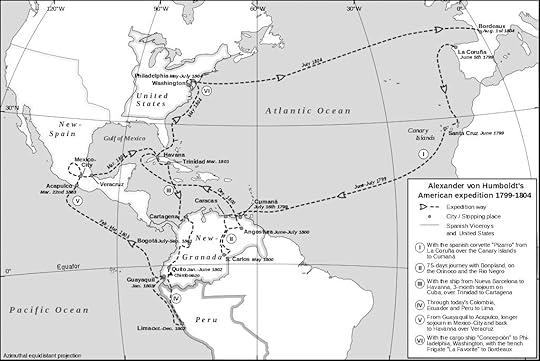
There were quite a few small things that I felt they could have done to really improve the quality of the book. They could have included a much more detailed map, and appendix of the animals and plants he found that contain both their common names and Latin binomials, and a few pages dedicated to some of his plant plates would have been very interesting. I often found myself on my phone looking up his exact expeditions on google maps or looking up pictures of "Malpighia cocollobaefolia" because I do not recognize the binomial. Additionally, it would have been cool to include an appendix with more extensive writings on science, local history, political economy, etc. which were a large and essential part of the original "Personal Narratives". Lastly, it felt a little weird to talk about how influential Kant's aesthetic theory was to Humboldt in the introduction yet cut out out many of the sections where Humboldt applies them. I understand that stuff needs to get cut for an abridged version, but sometimes it felt like it was at the expense of the reader.
There were quite a few small things that I felt they could have done to really improve the quality of the book. They could have included a much more detailed map, and appendix of the animals and plants he found that contain both their common names and Latin binomials, and a few pages dedicated to some of his plant plates would have been very interesting. I often found myself on my phone looking up his exact expeditions on google maps or looking up pictures of "Malpighia cocollobaefolia" because I do not recognize the binomial. Additionally, it would have been cool to include an appendix with more extensive writings on science, local history, political economy, etc. which were a large and essential part of the original "Personal Narratives". Lastly, it felt a little weird to talk about how influential Kant's aesthetic theory was to Humboldt in the introduction yet cut out out many of the sections where Humboldt applies them. I understand that stuff needs to get cut for an abridged version, but sometimes it felt like it was at the expense of the reader.

Read
July 20, 2020Having just finished reading Humboldt's COSMOS, and Andrea Wulf's "The Invention of Nature" about Humboldt, it seems time for me to read this before our Book Discussion Group turn's to the Wulf biography in the middle of August. I have this treat ahead of me.
To begin, this Gutenberg version has been somewhat condensed according to the persons converting it digitally from the 1907 British edition of this publication. Humboldt's Personal Narratives of South America was published in three volumes. The entire Volume One is what Project Gutenberg provided and which I finished. This edition translated from the French and edited by Thomasina Ross.
TRANSLATOR AND EDITOR's Introduction: "Prior to the travels of Alexander Von Humboldt and Aime Bonpland, the countries described in the following narrative were but imperfectly known to Europeans. For our partial acquaintance with them we were chiefly indebted to the early navigators, and to some of the followers of the Spanish Conquistadores. The intrepid men whose courage and enterprise prompted them to explore unknown seas for the discovery of a New World, have left behind them narratives of their adventures, and descriptions of the strange lands and people they visited, which must ever be perused with curiosity and interest; and some of the followers of Pizarro and Cortez, as well as many learned Spaniards who proceeded to South America soon after the conquest, were the authors of historical and other works of high value. But these writings of a past age, however curious and interesting, are deficient in that spirit of scientific investigation which enhances the importance and utility of accounts of travels in distant regions. In more recent times, the researches of La Condamine tended in a most important degree to promote geographical knowledge; and he, as well as other eminent botanists who visited the coasts of South America, and even ascended the Andes, contributed by their discoveries and collections to augment the vegetable riches of the Old World. But, in their time, geology as a science had little or no existence. Of the structure of the giant mountains of our globe scarcely anything was understood; whilst nothing was known beneath the earth in the New World, except what related to her mines of gold and silver. It remained for Humboldt to supply all that was wanting, by the publication of his Personal Narrative. In this, more than in any other of his works, he shows his power of contemplating nature in all her grandeur and variety."
HUMBOLDT'S PURPOSE IN THIS TRIP, as he states in his introduction: "I had in view a two-fold purpose in the travels of which I now publish the historical narrative. I wished to make known the countries I had visited; and to collect such facts as are fitted to elucidate a science of which we as yet possess scarcely the outline, and which has been vaguely denominated Natural History of the World, Theory of the Earth, or Physical Geography. The last of these two objects seemed to me the most important. I was passionately devoted to botany and certain parts of zoology, and I flattered myself that our investigations might add some new species to those already known, both in the animal and vegetable kingdoms; but preferring the connection of facts which have been long observed, to the knowledge of insulated facts, although new, the discovery of an unknown genus seemed to me far less interesting than an observation on the geographical relations of the vegetable world, on the migrations of the social plants, and the limit of the height which their different tribes attain on the flanks of the Cordilleras.
The natural sciences are connected by the same ties which link together all the phenomena of nature. The classification of the species, which must be considered as the fundamental part of botany, and the study of which is rendered attractive and easy by the introduction of natural methods, is to the geography of plants what descriptive mineralogy is to the indication of the rocks constituting the exterior crust of the globe. To comprehend the laws observed in the position of these rocks, to determine the age of their successive formations, and their identity in the most distant regions, the geologist should be previously acquainted with the simple fossils which compose the mass of mountains, and of which the names and character are the object of [uncomparable] knowledge. It is the same with that part of the natural history of the globe which treats of the relations plants have to each other, to the soil whence they spring, or to the air which they inhale and modify. The progress of the geography of plants depends in a great measure on that of descriptive botany; and it would be injurious to the advancement of science, to attempt rising to general ideas, whilst neglecting the knowledge of particular facts."
ATLANTIC CURRENTS INFORM EUROPEANS. Here is a quote from this first chapter. "deposits every year on the western coasts of Ireland and Norway the fruit of trees which belong to the torrid zone of America. On the shores of the Hebrides, we collect seeds of Mimosa scandens, of Dolichos urens, of Guilandina bonduc, and several other plants of Jamaica, the isle of Cuba, and of the neighbouring continent. The current carries thither also barrels of French wine, well preserved, the remains of the cargoes of vessels wrecked in the West Indian seas. To these examples of the distant migration of the vegetable world, others no less striking may be added. The wreck of an English vessel, the Tilbury, burnt near Jamaica, was found on the coast of Scotland. On these same coasts are sometimes found various kinds of tortoises, that inhabit the waters of the Antilles. When the western winds are of long duration, a current is formed in the high latitudes, which runs directly towards east-south-east, from the coasts of Greenland and Labrador, as far as the north of Scotland. Wallace relates, that twice (in 1682 and 1684), American savages of the race of the Esquimaux, driven out to sea in their leathern canoes, during a storm, and left to the guidance of the currents, reached the Orkneys. This last example is the more worthy of attention, as it proves at the same time how, at a period when the art of navigation was yet in its infancy, the motion of the waters of the ocean may have contributed to disseminate the different races of men over the face of the globe."
FACTS HUMBOLDT REPORTS IN THIS BOOK. "Those who have for a long time inhaled the air of the sea suffer every time they land; not because this air contains more oxygen than the air on shore, as has been erroneously supposed, but because it is less charged with those gaseous combinations, which the animal and vegetable substances, and the mud resulting from their decomposition, pour into the atmosphere. Miasms that escape chemical analysis have a powerful effect on our organs, especially when they have not for a long while been exposed to the same kind of irritation."
CANARY ISLANDS: "We must not be surprised that, previous to the time of Aristotle, we find no accurate notion respecting the Canary Islands and the volcanoes they contain, among the Greek geographers. The only nation whose navigations extended toward the west and the north, the Carthaginians, were interested in throwing a veil of mystery over those distant regions. While the senate of Carthage was averse to any partial emigration, it pointed out those islands as a place of refuge in times of trouble and public misfortune; they were to the Carthaginians what the free soil of America has become to Europeans amidst their religious and civil dissensions.
The Canaries were not better known to the Romans till eighty-four years before the reign of Augustus. A private individual was desirous of executing the project, which wise foresight had dictated to the senate of Carthage. Sertorius, conquered by Sylla, and weary of the din of war, looked out for a safe and peaceable retreat. He chose the Fortunate Islands, of which a delightful picture had been drawn for him on the shores of Baetica. He carefully combined the notions he acquired from travellers; but in the little that has been transmitted to us of those notions, and in the more minute descriptions of Sebosus and Juba, there is no mention of volcanoes or volcanic eruptions. Scarcely can we recognise the isle of Teneriffe, and the snows with which the summit of the Peak is covered in winter, in the name of Nivaria, given to one of the Fortunate Islands. Hence we might conclude, that the volcano at that time threw out no flames, if it were allowable so to interpret the silence of a few authors, whom we know only by short fragments or dry nomenclatures. The naturalist vainly seeks in history for documents of the first eruptions of the Peak; he nowhere finds any but in the language of the Guanches, in which the word Echeyde denotes, at the same time, hell and the volcano of Teneriffe.
Of all the written testimonies, the oldest I have found in relation to the activity of this volcano dates from the beginning of the sixteenth century. It is contained in the narrative of the voyage of Aloysio Cadamusto, who landed at the Canaries in 1505. This traveller was witness of no eruptions, but he positively affirms that, like Etna, this mountain burns without interruption, and that the fire has been seen by christians held in slavery by the Guanches of Teneriffe. The Peak, therefore, was not at that time in the state of repose in which we find it at present."
FLYING FISH- "f the sea covered with flying-fish,* (* Exocoetus volitans.) which threw themselves up into the air, twelve, fifteen, or eighteen feet, and fell down on the deck. I do not hesitate to speak on a subject of which voyagers discourse as frequently as of dolphins, sharks, sea-sickness, and the phosphorescence of the ocean. None of these topics can fail to afford interesting observations to naturalists, provided they make them their particular study. Nature is an inexhaustible source of investigation, and in proportion as the domain of science is extended, she presents herself to those who know how to interrogate her, under forms which they have never yet examined. I have named the flying-fish, in order to direct the attention of naturalists to the enormous size of their natatory bladder, which, in an animal of 6.4 inches, is 3.6 inches long, 0.9 of an inch broad, and contains three cubic inches and a half of air. As this bladder occupies more than half the size of the fish, it is probable that it contributes to its lightness. We may assert that this reservoir of air is more fitted for flying than swimming; for the experiments made by M. Provenzal and myself have proved, that, even in the species which are provided with this organ, it is not indispensably necessary for the ascending movement to the surface of the water. In a young flying-fish, 5.8 inches long, each of the pectoral fins, which serve as wings, presented a surface to the air of 3 7/16 square inches. We observed, that the nine branches of nerves, which go to the twelve rays of these fins, are almost three times the size of the nerves that belong to the ventral fins. When the former of these nerves are excited by galvanic electricity, the rays which support the membrane of the pectoral fin extend with five times the force with which the other fins move when galvanised by the same metals. Thus, the fish is capable of throwing itself horizontally the distance of twenty feet before retouching the water with the extremity of its fins. This motion has been aptly compared to that of a flat stone, which, thrown horizontally, bounds one or two feet above the water. Notwithstanding the extreme rapidity of this motion, it is certain, that the animal beats the air during the leap; that is, it alternately extends and closes its pectoral fins. The same motion has been observed in the flying scorpion of the rivers of Japan: they also contain a large air-bladder, with which the great part of the scorpions that have not the faculty of flying are unprovided. The flying-fish, like almost all animals which have gills, enjoy the power of equal respiration for a long time, both in water and in air, by the same organs; that is, by extracting the oxygen from the atmosphere as well as from the water in which it is dissolved. They pass a great part of their life in the air; but if they escape from the sea to avoid the voracity of the Dorado, they meet in the air the Frigate-bird, the Albatross, and others, which seize them in their flight. Thus, on the banks of the Orinoco, herds of the Cabiai, which rush from the water to escape the crocodile, become the prey of the jaguar, which awaits their arrival.
I doubt, however, whether the flying-fish spring out of the water merely to escape the pursuit of their enemies. Like swallows, they move by thousands in a right line, and in a direction constantly opposite to that of the waves. In our own climates, on the brink of a river, illumined by the rays of the sun, we often see solitary fish fearlessly bound above the surface as if they felt pleasure in breathing the air. Why should not these gambols be more frequent with the flying-fish, which from the strength of their pectoral fins, and the smallness of their specific gravity, can so easily support themselves in the air? I invite naturalists to examine whether other flying-fish, for instance the Exocoetus exiliens, the Trigla volitans, amid the T. hirundo, have as capacious an air-bladder as the flying-fish of the tropics. This last follows the heated waters of the Gulf-stream when they flow northward. The cabin-boys amuse themselves with cutting off a part of the pectoral fins, and assert, that these wings grow again; which seems to me not unlikely, from facts observed in other families of fishes."
PUBLISHER'S BRIEF: One of the greatest nineteenth-century scientist-explorers, Alexander von Humboldt traversed the tropical Spanish Americas between 1799 and 1804. By the time of his death in 1859, he had won international fame for his scientific discoveries, his observations of Native American peoples and his detailed descriptions of the flora and fauna of the 'new continent'. The first to draw and speculate on Aztec art, to observe reverse polarity in magnetism and to discover why America is called America, his writings profoundly influenced the course of Victorian culture, causing Darwin to reflect: 'He alone gives any notion of the feelings which are raised in the mind on first entering the Tropics'.
To begin, this Gutenberg version has been somewhat condensed according to the persons converting it digitally from the 1907 British edition of this publication. Humboldt's Personal Narratives of South America was published in three volumes. The entire Volume One is what Project Gutenberg provided and which I finished. This edition translated from the French and edited by Thomasina Ross.
TRANSLATOR AND EDITOR's Introduction: "Prior to the travels of Alexander Von Humboldt and Aime Bonpland, the countries described in the following narrative were but imperfectly known to Europeans. For our partial acquaintance with them we were chiefly indebted to the early navigators, and to some of the followers of the Spanish Conquistadores. The intrepid men whose courage and enterprise prompted them to explore unknown seas for the discovery of a New World, have left behind them narratives of their adventures, and descriptions of the strange lands and people they visited, which must ever be perused with curiosity and interest; and some of the followers of Pizarro and Cortez, as well as many learned Spaniards who proceeded to South America soon after the conquest, were the authors of historical and other works of high value. But these writings of a past age, however curious and interesting, are deficient in that spirit of scientific investigation which enhances the importance and utility of accounts of travels in distant regions. In more recent times, the researches of La Condamine tended in a most important degree to promote geographical knowledge; and he, as well as other eminent botanists who visited the coasts of South America, and even ascended the Andes, contributed by their discoveries and collections to augment the vegetable riches of the Old World. But, in their time, geology as a science had little or no existence. Of the structure of the giant mountains of our globe scarcely anything was understood; whilst nothing was known beneath the earth in the New World, except what related to her mines of gold and silver. It remained for Humboldt to supply all that was wanting, by the publication of his Personal Narrative. In this, more than in any other of his works, he shows his power of contemplating nature in all her grandeur and variety."
HUMBOLDT'S PURPOSE IN THIS TRIP, as he states in his introduction: "I had in view a two-fold purpose in the travels of which I now publish the historical narrative. I wished to make known the countries I had visited; and to collect such facts as are fitted to elucidate a science of which we as yet possess scarcely the outline, and which has been vaguely denominated Natural History of the World, Theory of the Earth, or Physical Geography. The last of these two objects seemed to me the most important. I was passionately devoted to botany and certain parts of zoology, and I flattered myself that our investigations might add some new species to those already known, both in the animal and vegetable kingdoms; but preferring the connection of facts which have been long observed, to the knowledge of insulated facts, although new, the discovery of an unknown genus seemed to me far less interesting than an observation on the geographical relations of the vegetable world, on the migrations of the social plants, and the limit of the height which their different tribes attain on the flanks of the Cordilleras.
The natural sciences are connected by the same ties which link together all the phenomena of nature. The classification of the species, which must be considered as the fundamental part of botany, and the study of which is rendered attractive and easy by the introduction of natural methods, is to the geography of plants what descriptive mineralogy is to the indication of the rocks constituting the exterior crust of the globe. To comprehend the laws observed in the position of these rocks, to determine the age of their successive formations, and their identity in the most distant regions, the geologist should be previously acquainted with the simple fossils which compose the mass of mountains, and of which the names and character are the object of [uncomparable] knowledge. It is the same with that part of the natural history of the globe which treats of the relations plants have to each other, to the soil whence they spring, or to the air which they inhale and modify. The progress of the geography of plants depends in a great measure on that of descriptive botany; and it would be injurious to the advancement of science, to attempt rising to general ideas, whilst neglecting the knowledge of particular facts."
ATLANTIC CURRENTS INFORM EUROPEANS. Here is a quote from this first chapter. "deposits every year on the western coasts of Ireland and Norway the fruit of trees which belong to the torrid zone of America. On the shores of the Hebrides, we collect seeds of Mimosa scandens, of Dolichos urens, of Guilandina bonduc, and several other plants of Jamaica, the isle of Cuba, and of the neighbouring continent. The current carries thither also barrels of French wine, well preserved, the remains of the cargoes of vessels wrecked in the West Indian seas. To these examples of the distant migration of the vegetable world, others no less striking may be added. The wreck of an English vessel, the Tilbury, burnt near Jamaica, was found on the coast of Scotland. On these same coasts are sometimes found various kinds of tortoises, that inhabit the waters of the Antilles. When the western winds are of long duration, a current is formed in the high latitudes, which runs directly towards east-south-east, from the coasts of Greenland and Labrador, as far as the north of Scotland. Wallace relates, that twice (in 1682 and 1684), American savages of the race of the Esquimaux, driven out to sea in their leathern canoes, during a storm, and left to the guidance of the currents, reached the Orkneys. This last example is the more worthy of attention, as it proves at the same time how, at a period when the art of navigation was yet in its infancy, the motion of the waters of the ocean may have contributed to disseminate the different races of men over the face of the globe."
FACTS HUMBOLDT REPORTS IN THIS BOOK. "Those who have for a long time inhaled the air of the sea suffer every time they land; not because this air contains more oxygen than the air on shore, as has been erroneously supposed, but because it is less charged with those gaseous combinations, which the animal and vegetable substances, and the mud resulting from their decomposition, pour into the atmosphere. Miasms that escape chemical analysis have a powerful effect on our organs, especially when they have not for a long while been exposed to the same kind of irritation."
CANARY ISLANDS: "We must not be surprised that, previous to the time of Aristotle, we find no accurate notion respecting the Canary Islands and the volcanoes they contain, among the Greek geographers. The only nation whose navigations extended toward the west and the north, the Carthaginians, were interested in throwing a veil of mystery over those distant regions. While the senate of Carthage was averse to any partial emigration, it pointed out those islands as a place of refuge in times of trouble and public misfortune; they were to the Carthaginians what the free soil of America has become to Europeans amidst their religious and civil dissensions.
The Canaries were not better known to the Romans till eighty-four years before the reign of Augustus. A private individual was desirous of executing the project, which wise foresight had dictated to the senate of Carthage. Sertorius, conquered by Sylla, and weary of the din of war, looked out for a safe and peaceable retreat. He chose the Fortunate Islands, of which a delightful picture had been drawn for him on the shores of Baetica. He carefully combined the notions he acquired from travellers; but in the little that has been transmitted to us of those notions, and in the more minute descriptions of Sebosus and Juba, there is no mention of volcanoes or volcanic eruptions. Scarcely can we recognise the isle of Teneriffe, and the snows with which the summit of the Peak is covered in winter, in the name of Nivaria, given to one of the Fortunate Islands. Hence we might conclude, that the volcano at that time threw out no flames, if it were allowable so to interpret the silence of a few authors, whom we know only by short fragments or dry nomenclatures. The naturalist vainly seeks in history for documents of the first eruptions of the Peak; he nowhere finds any but in the language of the Guanches, in which the word Echeyde denotes, at the same time, hell and the volcano of Teneriffe.
Of all the written testimonies, the oldest I have found in relation to the activity of this volcano dates from the beginning of the sixteenth century. It is contained in the narrative of the voyage of Aloysio Cadamusto, who landed at the Canaries in 1505. This traveller was witness of no eruptions, but he positively affirms that, like Etna, this mountain burns without interruption, and that the fire has been seen by christians held in slavery by the Guanches of Teneriffe. The Peak, therefore, was not at that time in the state of repose in which we find it at present."
FLYING FISH- "f the sea covered with flying-fish,* (* Exocoetus volitans.) which threw themselves up into the air, twelve, fifteen, or eighteen feet, and fell down on the deck. I do not hesitate to speak on a subject of which voyagers discourse as frequently as of dolphins, sharks, sea-sickness, and the phosphorescence of the ocean. None of these topics can fail to afford interesting observations to naturalists, provided they make them their particular study. Nature is an inexhaustible source of investigation, and in proportion as the domain of science is extended, she presents herself to those who know how to interrogate her, under forms which they have never yet examined. I have named the flying-fish, in order to direct the attention of naturalists to the enormous size of their natatory bladder, which, in an animal of 6.4 inches, is 3.6 inches long, 0.9 of an inch broad, and contains three cubic inches and a half of air. As this bladder occupies more than half the size of the fish, it is probable that it contributes to its lightness. We may assert that this reservoir of air is more fitted for flying than swimming; for the experiments made by M. Provenzal and myself have proved, that, even in the species which are provided with this organ, it is not indispensably necessary for the ascending movement to the surface of the water. In a young flying-fish, 5.8 inches long, each of the pectoral fins, which serve as wings, presented a surface to the air of 3 7/16 square inches. We observed, that the nine branches of nerves, which go to the twelve rays of these fins, are almost three times the size of the nerves that belong to the ventral fins. When the former of these nerves are excited by galvanic electricity, the rays which support the membrane of the pectoral fin extend with five times the force with which the other fins move when galvanised by the same metals. Thus, the fish is capable of throwing itself horizontally the distance of twenty feet before retouching the water with the extremity of its fins. This motion has been aptly compared to that of a flat stone, which, thrown horizontally, bounds one or two feet above the water. Notwithstanding the extreme rapidity of this motion, it is certain, that the animal beats the air during the leap; that is, it alternately extends and closes its pectoral fins. The same motion has been observed in the flying scorpion of the rivers of Japan: they also contain a large air-bladder, with which the great part of the scorpions that have not the faculty of flying are unprovided. The flying-fish, like almost all animals which have gills, enjoy the power of equal respiration for a long time, both in water and in air, by the same organs; that is, by extracting the oxygen from the atmosphere as well as from the water in which it is dissolved. They pass a great part of their life in the air; but if they escape from the sea to avoid the voracity of the Dorado, they meet in the air the Frigate-bird, the Albatross, and others, which seize them in their flight. Thus, on the banks of the Orinoco, herds of the Cabiai, which rush from the water to escape the crocodile, become the prey of the jaguar, which awaits their arrival.
I doubt, however, whether the flying-fish spring out of the water merely to escape the pursuit of their enemies. Like swallows, they move by thousands in a right line, and in a direction constantly opposite to that of the waves. In our own climates, on the brink of a river, illumined by the rays of the sun, we often see solitary fish fearlessly bound above the surface as if they felt pleasure in breathing the air. Why should not these gambols be more frequent with the flying-fish, which from the strength of their pectoral fins, and the smallness of their specific gravity, can so easily support themselves in the air? I invite naturalists to examine whether other flying-fish, for instance the Exocoetus exiliens, the Trigla volitans, amid the T. hirundo, have as capacious an air-bladder as the flying-fish of the tropics. This last follows the heated waters of the Gulf-stream when they flow northward. The cabin-boys amuse themselves with cutting off a part of the pectoral fins, and assert, that these wings grow again; which seems to me not unlikely, from facts observed in other families of fishes."
PUBLISHER'S BRIEF: One of the greatest nineteenth-century scientist-explorers, Alexander von Humboldt traversed the tropical Spanish Americas between 1799 and 1804. By the time of his death in 1859, he had won international fame for his scientific discoveries, his observations of Native American peoples and his detailed descriptions of the flora and fauna of the 'new continent'. The first to draw and speculate on Aztec art, to observe reverse polarity in magnetism and to discover why America is called America, his writings profoundly influenced the course of Victorian culture, causing Darwin to reflect: 'He alone gives any notion of the feelings which are raised in the mind on first entering the Tropics'.
April 12, 2018
I'd like to give this book 3-1/2 stars. I've read better travel accounts. But Humboldt was writing in the early 1800s. His native tongue was German, but he wrote in French, and this is a translation into English. It would have been helpful to have a better, more detailed map of the interior route. It was hard to follow where Humboldt was and where he was going. But parts of the book that describe the native people and culture were fascinating.
September 17, 2020
A fascinating adventure with a 19th Century polymath. This translation is highly readable and conversational. Humboldt's exploits in the Age of Enlightenment are populated with pirates, South American Indians, European Catholic missions, exotic flora and fauna, innumerable natural wonders, and the excitement of scientific discovery. The story is a tribute to Humboldt's and to his companion Aimé Bonpland's intrepid spirits

January 25, 2008
Alexander Von Humboldt's "Personal Narrative of A Title With Way Too Many Words". Feeling a bit cheated that it's only selections of his actual Narrative, but let's look past that for the moment. I'd expected something much along the lines of Darwin, but oh, how much more I am loving this. Not to disparage Darwin or anything, but HUMBOLDT <3! Which just makes me angrier that it's only exerpts.
April 9, 2026
This abridged version of Humboldt’s “Personal Narrative” gives us an enjoyable taste of the travels of the scientist and explorer in South America between 1799 and 1804.
Humboldt did not just study nature; he also enjoyed its beauty, and the book contains vivid descriptions of the sights he saw. He wrote that: “No words can evoke the feelings of a naturalist who first steps on soil outside Europe.”
This is very similar to how Charles Darwin later described his feelings on first setting foot in a Brazilian forest in “The Voyage of the Beagle”.
Humboldt’s Narrative had a big influence on Darwin when he first read it as a student at Cambridge. It contributed both to Darwin’s urge to travel and to his desire to contribute something to scientific knowledge. He even took a copy of Humboldt’s book on the Beagle with him. Later, when Darwin’s own “Voyage” book was published, Darwin was delighted when Humboldt himself praised it.
Another link between Humboldt and Darwin is the fact that both were strongly opposed to slavery. Humboldt wrote this, for example:
“Nowhere else in the world seems more appropriate to dissipate melancholy and restore peace to troubled minds than Tenerife and Madeira. These effects are due not only to the magnificent situation and to the purity of the air, but above all to the absence of slavery, which so deeply revolts us in all those places where Europeans have brought what they call their “enlightenment” and their “commerce” to their colonies.”
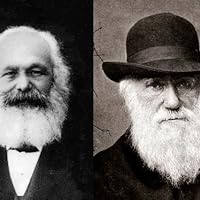
In his science Humboldt was a polymath whose research covered anthropology, biology, botany, geography, geology, zoology and more. But he also saw that nature was an interconnected whole and that “Everything is interrelated”. This view, that we need to see the unity of nature whilst trying to understand the parts that make up the whole, is similar to an aspect of what Marxist (but non-Stalinist) scientists such as Richard Lewontin refer to as the dialectical view of nature.
Sadly, Humboldt is not widely remembered today. But it is not surprising that his name is not as well known as Darwin’s. Humboldt contributed a great deal to science, but he did not make such a world-shattering breakthrough as Darwin did when he came up with natural selection as the mechanism for evolution.
Humboldt did not just study nature; he also enjoyed its beauty, and the book contains vivid descriptions of the sights he saw. He wrote that: “No words can evoke the feelings of a naturalist who first steps on soil outside Europe.”
This is very similar to how Charles Darwin later described his feelings on first setting foot in a Brazilian forest in “The Voyage of the Beagle”.
Humboldt’s Narrative had a big influence on Darwin when he first read it as a student at Cambridge. It contributed both to Darwin’s urge to travel and to his desire to contribute something to scientific knowledge. He even took a copy of Humboldt’s book on the Beagle with him. Later, when Darwin’s own “Voyage” book was published, Darwin was delighted when Humboldt himself praised it.
Another link between Humboldt and Darwin is the fact that both were strongly opposed to slavery. Humboldt wrote this, for example:
“Nowhere else in the world seems more appropriate to dissipate melancholy and restore peace to troubled minds than Tenerife and Madeira. These effects are due not only to the magnificent situation and to the purity of the air, but above all to the absence of slavery, which so deeply revolts us in all those places where Europeans have brought what they call their “enlightenment” and their “commerce” to their colonies.”
In his science Humboldt was a polymath whose research covered anthropology, biology, botany, geography, geology, zoology and more. But he also saw that nature was an interconnected whole and that “Everything is interrelated”. This view, that we need to see the unity of nature whilst trying to understand the parts that make up the whole, is similar to an aspect of what Marxist (but non-Stalinist) scientists such as Richard Lewontin refer to as the dialectical view of nature.
Sadly, Humboldt is not widely remembered today. But it is not surprising that his name is not as well known as Darwin’s. Humboldt contributed a great deal to science, but he did not make such a world-shattering breakthrough as Darwin did when he came up with natural selection as the mechanism for evolution.

December 23, 2025
I first learned of Humboldt in college in a climate science class. In that class we had a lecture on the history of climate science, and the teacher mentioned how Humboldt on his travels from 1799-1804 in South America correctly identified human-caused climate change (not the greenhouse gas effect (that was some Irish dude later on, I think), but simply the human capacity to inadvertently mess with local climate patterns). Then years later I read The Invention of Nature, which was a delightful biography of Humboldt. That book made me fully appreciate his extraordinary life, and just how important of a scientist Humboldt was, despite his relative obscurity nowadays (but once you first hear his name, you'll start to notice how many things bare his name in his honor, like rivers, universities, etc). His life's work was truly a watershed moment in the history of science, and figures like Darwin wouldn't have come to pass without the precedent work of Humboldt. In that biography, it mentioned this book, so i wanted to learn about Humboldt's life even further, this time through his own eyes. Humboldt traveled through South America for 5 years doing extensive scientific research. This memoir covers mostly the first portion of that trip that he spent in Tenerife, Venezuela, and Cuba. The best chapter is chapter 13 where he discusses his findings at Lake Valencia in which he linked the intensive deforestation around the lake to the drying up of the lake.

December 30, 2023
This book was a long read. It took me months to complete it, a little at a time. It was so interesting to see the travels of Humbolt and his companion Amie Bonpland. Together they travel across South America by boat, mule, horse, and foot. They met all the Native tribes and the Jesuits along the way. Their objective was to gather scientific information on climatology, geology, mineralogy, plant geography, and zoology. They brought home many specimens of animals (monkeys) and dried plants. Von Humbolt also documented the lifestyles of the natives in each area and the political environment. I enjoyed this book and will probably read parts of it again. I love geography and history so this was a winner.

October 26, 2020
This book, which I read in original German is not quite what could be considered literature, but is a fascinating report on his long journey from France via the Canary Islands to Venezuela and later up the Orinoco to the then fully mysterious Casiquare canal and the Rio Negro. He reports of all the difficulties one can imagine even as a modern explorer, listing ethnic groups, personages, plants, insects, mountain ranges and other topographic elements, geological finds, often with precise descriptions. He goes on to visit the Andes and then back to Central America. It is such a pity that this writer is so underrated these days. A fascinating writer as well as adventurer and discoverer.

May 6, 2024
I was inspired to read Personal Narrative, after reading Andrea Wulf’s incredible book, The Invention of Nature.
Out of the four Humboldt books I’ve read so far, this was the most engaging. It’s written in a conversational style which draws the reader in. Despite this being an abridged version, it was fascinating to follow some of Humboldt’s journey through South America and see what things were like over 200 years ago. What he and Bonpland accomplished is extraordinary and they both deserve to be remembered for their contributions to science and ecology.
Out of the four Humboldt books I’ve read so far, this was the most engaging. It’s written in a conversational style which draws the reader in. Despite this being an abridged version, it was fascinating to follow some of Humboldt’s journey through South America and see what things were like over 200 years ago. What he and Bonpland accomplished is extraordinary and they both deserve to be remembered for their contributions to science and ecology.

July 8, 2026
I've been working on a new English translation of this work, serializing it on Substack. Humboldt's original narrative remains largely inaccessible to English readers, and this project aims to make his complete vision available.
If you're interested: humboldtnote2006.substack.com
If you're interested: humboldtnote2006.substack.com
January 27, 2024
Puh, this one was a tough one and took me almost two years to get through to it (with breaks of course). It was a travel both back in time as well as in location and I was not sure what to make of it.
The narrative is rooted in factual information, presenting a scientific and log-like approach that delves into various subjects. However, grappling with the text from today's perspective revealed disconcerting elements, particularly an overtly racist motives and the not-so-subtle influence of the church and its missionaries, which ultimately detracted from my overall experience with the book.
The narrative is rooted in factual information, presenting a scientific and log-like approach that delves into various subjects. However, grappling with the text from today's perspective revealed disconcerting elements, particularly an overtly racist motives and the not-so-subtle influence of the church and its missionaries, which ultimately detracted from my overall experience with the book.
March 10, 2024
Great book, many insights.
March 29, 2024
Fascinating!
May 2, 2025
a…respectful travel narrative that treats natives as humans?
September 2, 2026
Fascinating. Could be a bit more substantial given it's an abridgement of a 7 vol. (I think?) work.

October 24, 2023
5/5 could read about Venesualian botany all day.
I think 19th century naturalist travelouges may legitametly be my new favorite genre. Alexander Von Humboldt was my grandfather's personal hero, and the more I read of his, possibly mine too. Throughout his writings he paints a picture of life behind colonial romanticism, never missing a chance to decry slavery and the abuses of native peoples. At the same time, he dispells the ideas of Europen exceptionalism and the image of the noble savage. However, despite commentary on seemingly everything, this is mainly a book where he shares his pure love for the natural world. Its best read with a tab of Wikipedia open to look up all of the latin names he drops. Because each plant is identified by its species, you can look up exactly what he's talking about, providing a more accurate picture than a discription alone could. Yet his descriptions too are elegant and poetic.
"Nothing can compare to the majestic tranquillity of the stars in the sky in this solitary place. At nightfall, when we stared at the point where the horizon meets the meadows on this gently rolling plain, it seemed, as later in the Orinoco steppes, as if we were seeing the surface of an ocean supporting the starry vault. The tree at whose feet we sat, the luminous insects dancing in the air, the shining constellations of the Southern hemisphere, everything reminded us that we were far from our homeland. And if, in the middle of this exotic nature, the sound of cow bells or the bellowing of a bull came from the small valleys, memories of our native land were suddenly awoken. It was as if we heard distant voices echoing across the ocean, magically carrying us from one hemisphere to another. How strangely mobile is man’s imagination, eternal source of his joys and pains!"
I think 19th century naturalist travelouges may legitametly be my new favorite genre. Alexander Von Humboldt was my grandfather's personal hero, and the more I read of his, possibly mine too. Throughout his writings he paints a picture of life behind colonial romanticism, never missing a chance to decry slavery and the abuses of native peoples. At the same time, he dispells the ideas of Europen exceptionalism and the image of the noble savage. However, despite commentary on seemingly everything, this is mainly a book where he shares his pure love for the natural world. Its best read with a tab of Wikipedia open to look up all of the latin names he drops. Because each plant is identified by its species, you can look up exactly what he's talking about, providing a more accurate picture than a discription alone could. Yet his descriptions too are elegant and poetic.
"Nothing can compare to the majestic tranquillity of the stars in the sky in this solitary place. At nightfall, when we stared at the point where the horizon meets the meadows on this gently rolling plain, it seemed, as later in the Orinoco steppes, as if we were seeing the surface of an ocean supporting the starry vault. The tree at whose feet we sat, the luminous insects dancing in the air, the shining constellations of the Southern hemisphere, everything reminded us that we were far from our homeland. And if, in the middle of this exotic nature, the sound of cow bells or the bellowing of a bull came from the small valleys, memories of our native land were suddenly awoken. It was as if we heard distant voices echoing across the ocean, magically carrying us from one hemisphere to another. How strangely mobile is man’s imagination, eternal source of his joys and pains!"

October 21, 2016
Another course book done and dusted, and oddly, rather enjoyed. I picked this up thinking that it was going to be another boring scientific read, and I was pleasantly surprised. Although it may be a rather dry read, I must say that Von Humboldt's enthusiasm for everything he saw on his travels is truly felt in this book. He loves and is deeply interested in EVERYTHING - from rocks, plants, fruit, animals. 3* for the man who could do everything from geology to botany to astronomy, including paint - the cover is a self-portrait, if you don't mind.
September 22, 2013
My opinion is probably not the best judge of this book. I have very little interest in natural history, so this book (which I read for a class) was not entertaining to me. It is interesting to analyze what must have been going through Humboldt's mind on his monumental journey, but it's a niche piece, one that didn't resonate with me as much as someone who has an interest in this sort of thing.

November 27, 2007
Interesting primary source but a little dry at times. Also has many racist remarks typical of the time.

January 20, 2016
If travel writing and natural history are your thing, Humboldt's Personal Narrative is a brisk and entertaining volume. Humboldt is a sympathetic and attentive observer of nature and human nature.

to-be-finished-at-later-date
January 29, 2017I am actually reading the online version with all the footnotes, I just couldn't find it on goodreads. Hugely enjoying it and his attention to detail. This will take a while!

February 17, 2011
almost done, but easily one of the best books i've ever read

Did Not Finish
August 5, 2013I wish I could make it through this. I like the idea of it, though I don't have the patience.
Displaying 1 - 28 of 28 reviews