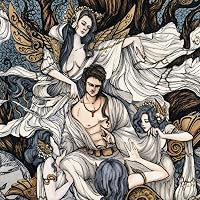
An elegant translation of the Sattasai (or Seven Hundred), India’s earliest collection of lyric poetry, Poems on Life and Love in Ancient India deals with love in its many aspects. Mostly narrated by women, the poems reveal the world of local Indian village life sometime between the third and fifth centuries.
The Sattasai offers a more realistic counterpart to that notorious theoretical treatise on love the Kāmasūtra, which presents a cosmopolitan and calculating milieu. Translators Peter Khoroche and Herman Tieken introduce the main features of the work in its own language and time.
The Gaha Sattasai (Gatha Saptasati), or The Seven Hundred, is an anthology of short poems about love and marriage in the villages of the countryside. The selection is 'traditionally' attributed to the Sâtavâhana king Hala, who reigned briefly in the first century AD. They are written in the language of Prakrit. They are the oldest surviving "anthology of lyric poems" in India. The poems are beautiful. Some philosophical and some erotic. Do read them if you're into that. I wish more people knew about this. I love reading what the normal people of India were writing in ancient times. Another similar book I read like this was "Poems of Love and War: From the Eight Anthologies and the Ten Long Poems of Classical Tamil" compiled and translated by A.K Ramanujan.
the poetry is insane .. some raunchy some so romantic i literally melted. i love seeing how society and culture at a time and place inspire poetry about the same love from different angles — the inauspiciousness of sex while menstruating, the chastity of maidens, the taboo of premarital sex, the rainy season affecting travel. 4.5 stars but would have loved more from the introduction itself, maybe more on the history of Hala or the compilation as it was added to over time, or some of the poems that were excluded because they necessitated explanation due to puns/wordplay in the original Prakrit.
The doe looked at the solitary stag With such longing That the bow dropped from the hand Of the hunter Whose wife was dear to him.
Exquisitamente editado y exhaustivo, con notas certeras y compactas que no se inmiscuyen demasiado en la interpretación del lector.
Por momentos se vuelve muy repetitivo, desde luego: en su mayoría son poemas de amor y sus recursos son muy similares debido a la tradición de su forma poética. Pero con frecuencia hay sorpresas que iluminan y ganan de nuevo la atención plena. Es un libro precioso. Un tesoro.