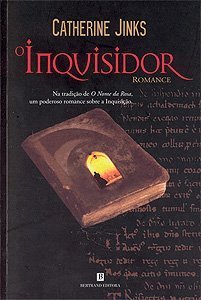
Numa época em que a heresia constitui um crime abominável que é combatido com implacável determinação pela Inquisição, o irmão Bernard está habituado a administrar uma justiça dura. Mas a descoberta do cadáver desmembrado do seu superior, torna-o também objecto de perseguição, graças ao seu envolvimento com uma misteriosa mulher. Perseguido como herege, acusado de ter cometido assassinato, Bernard tem agora de enfrentar os seus acusadores. Na França do século XIV, falhar significa morte certa.
Catherine Jinks is the Australian author of more than thirty books for all ages. She has garnered many awards, including the Children’s Book Council of Australia Book of the Year Award(three times), the Victorian Premier’s Award, the Aurealis Award for Science Fiction, the Australian Ibby Award, and the Davitt Award for Crime Fiction. Her work has been published in Australia, New Zealand, Britain, the United States, Germany, Spain, France, Portugal, Poland, Russia, the Czech Republic and Thailand.
Catherine was born in Brisbane, Queensland, in 1963. She grew up in Papua New Guinea, where her father worked as a patrol officer. Her high-school years were spent in Sydney, NSW; in 2006, her alma mater, Ku-ring-gai High School, named its library after her.
From 1982 to 1986, Catherine studied at the University of Sydney, graduating with an honours degree in medieval history. She then worked on Westpac Banking Corporation’s staff magazine for approximately seven years. In 1992 she married Peter Dockrill, a Canadian journalist; in 1993 she and her husband left Australia for a brief spell in Nova Scotia, where she began to write full time. They returned to Australia in 1994, and Catherine gave birth to her daughter Hannah in 1997. Since 1998, she and her family have been living in Leura, NSW.
She has two brothers, and two pet rats. Like most people in Leura, she has become a slave to her garden, but not to the extent that she’ll buy rooting powder.
Catherine has been writing books since she was eight years old. She doesn’t expect to stop writing them any time soon.
Author photo: Catherine Jinks in front of 'Conceptual Networks', by artist Paul du Moulin. Photo by Paul du Moulin
I've had this one sitting on my bookshelves for some time now, and finally decided to pick it up and read.
Mystery set in 14th century France at the time of the Inquisition - so right up my alley. The narrative is set out as a recounting (or an accounting) of events that took place shortly after the arrival of a new superior, Fra Augustin Duese, in the first person, by the main character Brother Bernard Peyre of Prouille.
Without giving too much away, this debut work focuses on a small area in Southern France, known for it proliferation of heretics commonly referred to as Cathars. Whilst overburdened with his work for the Holy Office of the Inquisition, Bro. Bernard is now called upon to solve a mystery involved the murder of one of the Inquisitorial officers. It is a time rife with religious controversy, heresy, suspicion and deception as small villages close ranks against the Inquisition.
The novel is well researched, giving the reader an ample glimpse of the times, the culture, the social structures as well as providing a good "murder mystery" that needs to be solved. The characters were suitably structured (and combative) for the time period, although there were times when Bro. Bernard grated on me and I wanted to give him a good old fashioned slap.
However .... as we the reader get ever closer to the denouement and solution, things take a turn (or twist) and this is where the ending felt rushed and rather unsatisfactory for my liking.
I am sure this will appeal to many - it did to me afterall.
This book takes place during the counter reformation were the Roman Catholic church is trying to put all the Protestant branches to claim "purity" over the land. Be warned that it does quote religious books, and talk from the point of view of one of the characters who is the instrument of counter reformation. The narrator is trying to to prove that he did not commit a crime to the pope of the time. He talks about all his time with his previous superior and what he did while he was with him. He even includes the idea that they locked protestant captives in a dungeon.
It is very timeline oriented, and stays very closely to one person's point of view and his comments. There is even extreme amounts of religious zeal and background using bible quotes and more stories. there is talk about the use of monasteries for these "Inquisitors" and even custom built dungeons and church buildings. There are these "Perfects" which are the religious priests of the protestant churches, some of which discourages reproducing and says that children are demons.
This is a very good book despite being strongly religiously tied, and more interestingly, a book where your thought of innocence or guilt in the crime accused will be pulled every which way and constantly changed. I suggest the book to anyone looking for a book with many twists and turns.
A wonderful, wonderful depth of research. The central character, the inquisitor Bernard, was utterly believable and intriguingly complex. Given the stereotypical 'bad guy' image (quite understandable) of medieval inquisitors, Jinks's feat in managing to create reader empathy with such a figure is remarkable. I loved the setting (14th century Provence, notorious for its many heretics), historical detail, and the overall mystery/romance plot. BUT I could not give this author a full 5 stars because of the conclusion. The culprit turned out to be a very minor character upon whom suspicion and even the plot focus had never fallen. Jinks breaks a primary rule of murder mysteries here! She also breaks a primary rule of romance by not revealing the conclusion/future trajectory of the romance relationship. Of course, this was always going to be fraught, given that the hero is a monk, but I would have liked to have been given a hint! Nevertheless, I will continue to read anything Catherine Jinks publishes. Conclusions are damn hard. She remains in my estimation a fantastic author of medievalist historical fiction.
This entire review has been hidden because of spoilers.
Dang. Very, very good right up to the end, which just fell flat for me. Bah. Still an excellent job of doing a character study of a medieval person. I really liked the focus on the narrator’s own spirituality and seesawing back and forth over his perceived blessings and faults. I liked his blind innocence that led him so far astray. Disappointing, but a noble effort.
4.5 stars A cracker of a red! Catherine Jinks is an outstanding storyteller, and this is a beauty! Set in a time and place that only devoted scholars would have much experience with or exposure to, she brings to life the most obscure settings, characters, and stories.
Apart from a slight wobble in the middle, this novel doesn't put a foot wrong, and I was turning pages quicker than a table fan on a hot Sunday afternoon toward the end.
A primeira metade é muito monótona, consistindo basicamente na introspecção da personagem principal quanto ao seu caminho religioso. Estive quase a desistir.
I like Catherine Jink's historical novels for the authenticity of her writing about medieval life and religion and this book is no exception. It is the first book in a trilogy looking at the Inquisition in the south of France in the 1300's, a period that Jinks knows well. As always, the inter-relation of theology and everyday life is fascinating, and in this novel, the well drawn characters bring the period to life. The hero, who is an inquisitor, is an interesting character, tormented by his job and the pressure it places on him when he falls in love with a woman in prison as a heretic. An interesting and gripping read. Can't wait for the next novel in the series.
The Inquisitor is a novel set in the 14th century. The protagonist, Brother Bernard, inquisitor of heretical depravity, falls into a web of conspiracies during the investigation of the murder of his superior, Father Augustine. Jinks manages to convey the spirit of the times, when the Church was the earthly power that ruled in a quasi-totalitarian way even in the last corner of Europe. The plot is full of unexpected twists, keeps the suspense until the end. One detail, it starts very well and in the middle it declines and gets slow, but in the end it picks up the pace with an excellent ending. I recommend it.
It was very hard for me to read, as a non-religious person. But I kept at it, as I usually like finishing books I have started. Overall, it was a fine read, although I admit it was a little senior for me. I had to read it with a dictionary at my side!
If I had to recommend it, it would be to more senior, and maybe religious readers, who would have a better understanding of the concepts in the story.
Me gustó bastante. Creo que lo más interesante es ver cómo actuaba la Inquisición, en donde por una simple acusación te podían tachar de hereje. También me gustó el tratamiento de los personajes, el protagonista, a pesar de ser un cura, es muy humano y lleno de pasiones, así que simpatizas de inmediato con él.
Eso si, el final fue un poco angustiante, pero igual es interesante. Una buena lectura para pasar el rato.
No está mal, aunque la narración se hace lenta en muchos pasajes. Es interesante, para mí, la posibilidad de conocer los eventuales puntos de vista de un miembro del clero, algo liberal para su tiempo, en una época de la humanidad tan confusa y cruel como la de la inquisición, planteamientos soportados por la fomación profesional de la autora
Empece el libro con gran interés. Me gustan las novelas históricas y la oscura edad de la Inquisición; pero me ha defraudado mucho. La trama principal apenas es mantenida, la resolución ( la cuarta parte final del libro se torna un poco más interesante) es acertada y clarifica algo la historia; pero no me ha enganchado en absoluto. Lo he leído rápido solo por el deseo de terminarlo cuanto antes.
2.5 - the plot got a little mired down by bunny trails that were introduced but never really followed. The premise that someone as blind and arrogant as the protaganist could rise as far as he did is a bit farfetched.
Persuasive and credible as a 14th century inquisitor's missive. Would be a bit like "Name of the Rose", if written as a joint venture between George MacDonald, Agatha Christie and John Foxe. And consults with imaginative prelates of some type.
In a time most books I read could not impress me as much as to make me remember their titles after five years (let alone their authors), this one marked the name 'Catherine Jinks' as one of the best authors of Historical books.
First book by Catherine Jinks I read. This book is set in the 1300's when a monk is murdered and the inquisitor must find the truth behind his death. Things get messy for the inquisitor and there's more than just finding the truth in the line.
just couldn't do it. Thinking about this book when I had free time made me NOT want to read. I couldn't get past the dense style. Need to find some spoiler reviews to find out what happened.
Describe muy bien la psicología de una época en que todo se veía a través de las Escrituras y en que desviarse un pelo del dogma podía suponer la ruina personal y de la familia. Me ha gustado pero debo reconocer que El notario de la misma autora me gustó mucho más.