

What do you think?

Spider-Man 2099 Classic
Spider-Man 2099 Classic, Vol. 1
Venture, the Specialist, the Vulture - the future is full of menaces, but none so vile as a corrupt government and the corporations behind it! A scary future needs a hero who's just as creepy - perhaps a Wall-Crawler of some kind? See the world of tomorrow and the cast who inhabit it as the Spider-Man of 2099 battles evil in both high and low society in the 2099 imprint's flagship title, written by industry legend Peter David! Collecting Spider-Man 2099 #1-10.
239 pages, Paperback
First published January 1, 2009
About the author
Peter David
3,669 books1,403 followersPeter Allen David (aka David Peters), often abbreviated PAD, was an American writer of comic books, novels, television, films, and video games. His notable comic book work includes an award-winning 12-year run on The Incredible Hulk, as well as runs on Aquaman, Young Justice, SpyBoy, Supergirl, Fallen Angel, Spider-Man, Spider-Man 2099, Captain Marvel, and X-Factor.
His Star Trek work included comic books and novels such as the New Frontier book series. His other novels included film adaptations, media tie-ins, and original works, such as the Apropos of Nothing and Knight Life series. His television work includes series such as Babylon 5, Young Justice, Ben 10: Alien Force and Nickelodeon's Space Cases, which he co-created with Bill Mumy.
David often jokingly described his occupation as "Writer of Stuff", and he was noted for his prolific writing, characterized by its mingling of real-world issues with humor and references to popular culture, as well as elements of metafiction and self-reference.
David earned multiple awards for his work, including a 1992 Eisner Award, a 1993 Wizard Fan Award, a 1996 Haxtur Award, a 2007 Julie Award, and a 2011 GLAAD Media Award.
His Star Trek work included comic books and novels such as the New Frontier book series. His other novels included film adaptations, media tie-ins, and original works, such as the Apropos of Nothing and Knight Life series. His television work includes series such as Babylon 5, Young Justice, Ben 10: Alien Force and Nickelodeon's Space Cases, which he co-created with Bill Mumy.
David often jokingly described his occupation as "Writer of Stuff", and he was noted for his prolific writing, characterized by its mingling of real-world issues with humor and references to popular culture, as well as elements of metafiction and self-reference.
David earned multiple awards for his work, including a 1992 Eisner Award, a 1993 Wizard Fan Award, a 1996 Haxtur Award, a 2007 Julie Award, and a 2011 GLAAD Media Award.
Ratings & Reviews
Friends & Following
Create a free account to discover what your friends think of this book!
Community Reviews
Displaying 1 - 30 of 100 reviews

December 31, 2015
I was super into this series back in the nineties, but back then I could only get my hands on random issues from time to time, so reading this from the start was pure gold.
The world of 2099 is very much a product of its time, your typical dystopian world governed by corrupt megacorporations, with its own goofy slang, where heroes like Thor no longer exist and are mythologized through religion, with aesthetics heavily inspired by movies like Johnny Mnemonic, Judge Dredd and other cyberpunk worlds of the nineties.
I had a lot of fun revisiting this, I enjoyed the world building, Miguel O'Hara as the lead, and the art, which still holds up very well today, Rick Leonardi created one of the coolest superhero costumes of all time for this Spidey, definitely one of my favorites.
Spider-Man 2099 is pure serialized fun, but its certainly no groundbreaking material, looking back, I think Peter David failed in delivering memorable story arcs, villains, and side characters, but if you enjoy Miguel O'Hara, chances are, you're gonna have a lot of fun reading this one.
The world of 2099 is very much a product of its time, your typical dystopian world governed by corrupt megacorporations, with its own goofy slang, where heroes like Thor no longer exist and are mythologized through religion, with aesthetics heavily inspired by movies like Johnny Mnemonic, Judge Dredd and other cyberpunk worlds of the nineties.
I had a lot of fun revisiting this, I enjoyed the world building, Miguel O'Hara as the lead, and the art, which still holds up very well today, Rick Leonardi created one of the coolest superhero costumes of all time for this Spidey, definitely one of my favorites.
Spider-Man 2099 is pure serialized fun, but its certainly no groundbreaking material, looking back, I think Peter David failed in delivering memorable story arcs, villains, and side characters, but if you enjoy Miguel O'Hara, chances are, you're gonna have a lot of fun reading this one.

June 23, 2012
Back in the 90s when this first came out, I totally fell in love with Miggy O'Hara! Of all the 2099 titles, Spider-Man was my favourite and it's a shame that Peter David left the title after his excellent run (coincidentally, it was around this time that the 2099 stories went downhill). This collected edition tells the origin and first adventures of Spider-Man 2099 and even after so long, they're still fantastic! I love this Spider-Man and appreciate the characterisation even more after reading an interview with Peter David who said that he intentionally made Miggy "zig, where Peter Parker zagged" in order to make him stand out as his own character and not a Peter Parker "clone". So where Peter Parker was quiet out of the mask, Miggy was mouthy. Where Spider-Man was quippy, Spider-Man 2099 was mostly silent.
Spider-Man 2099 was a great title and I really want to read more of him, it's just a shame that the (fairly) recent Timestorm 2009-2099 was a poor re-telling of Spider-Man 2099. Bring back this version of Miguel O'Hara and give him some new adventures!
Spider-Man 2099 was a great title and I really want to read more of him, it's just a shame that the (fairly) recent Timestorm 2009-2099 was a poor re-telling of Spider-Man 2099. Bring back this version of Miguel O'Hara and give him some new adventures!

November 9, 2021
The year is 2099, and the world is a sick dystopian one which is ruled by evil and corrupt mega-corporations. There are no more superheroes and the classic ones of the past are just part of myths and legends.
Enter Migeul O'Hara, an arrogant scientist working for Alchemax, one of the evil mega-corporations, who is forced to undergo an experiment after being betrayed by his own boss. He gains spider-like powers and dons a costume to fight a personal battle against the ones who wronged him. But slowly, he begins to understand that with great power comes great responsibility, and uses his powers to oppose the megacorps.
The series starts off slow, but it gets so much better by the end. It is great to see Miguel's journey as he ultimately embraces the heroic identity and legacy of Spider-Man. It really feels that Peter David has not created a Peter Parker clone, but a different character indeed. The artwork by Rick Leonardi is also amazing, very expressive and dynamic.
Enter Migeul O'Hara, an arrogant scientist working for Alchemax, one of the evil mega-corporations, who is forced to undergo an experiment after being betrayed by his own boss. He gains spider-like powers and dons a costume to fight a personal battle against the ones who wronged him. But slowly, he begins to understand that with great power comes great responsibility, and uses his powers to oppose the megacorps.
The series starts off slow, but it gets so much better by the end. It is great to see Miguel's journey as he ultimately embraces the heroic identity and legacy of Spider-Man. It really feels that Peter David has not created a Peter Parker clone, but a different character indeed. The artwork by Rick Leonardi is also amazing, very expressive and dynamic.

August 20, 2017
3.5 Stars
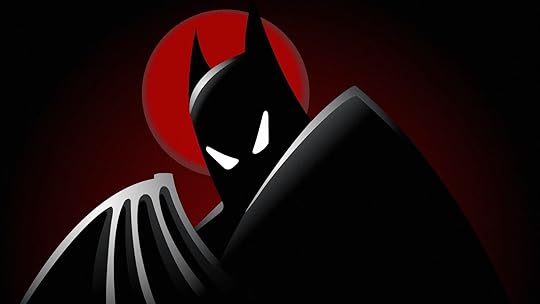
I think this was the first time I had seen Spider-Man 2099:

And so duh, I wanted to read the comic to THAT !
So of course, as any good procrastinator would do, I read the comic 7 years later.
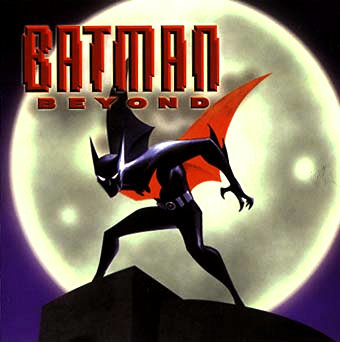
And boy was this written in the '90's! Not that that's necessarily a bad thing, eh hem:
Hem, eh, he he hem:
HACK, ha, HEM hrm, eh hem:
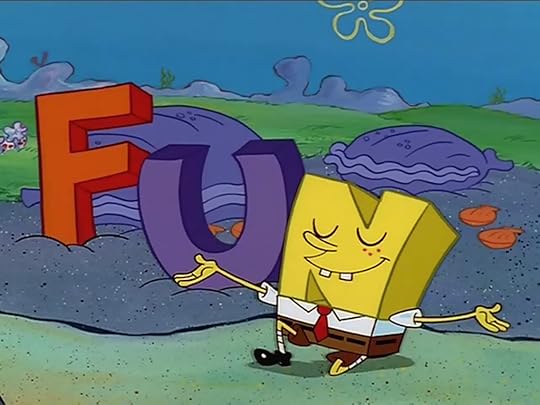
...
Well. Uh. Anyway.
Spider-Man 2099 is an interesting idea in concept, but I wouldn't wholeheartedly say it was as good in execution.
Its science fiction design of 2099 is probably the most dated thing about the comic. The hover cars are all very rounded, buildings are super shiny, and the clothing is 100% '90's conception of futuristic clothes. Oh, goodness, the clothes.
So basically, it's the year 2099 and big corrupt businesses rule, etc. So Spidey, in this incarnation a dude named Miguel O'Hara, starts out working for one of the biggest businesses which turns out to be filled with a bunch of really bad dudes. So Spidey starts to hear good ol' Jiminy Cricket say that he should probably quit working with these sickos. Here's how his resignation goes:
Spidey: "I quit."
Boss: "Okay. Here drink this."
Spidey: "Okay, thanks."
Boss: "Oh, you know that drink was laced with drugs that bond to your DNA so you will like, die if you don't get more drugs."
Spidey: "Aw, shock, really??" (Apparently "shock" is the equivalent of our current s-word in 2099.)
So Spidey decides to try and fix his DNA in a giant DNA enhancement machine which just the day before totally mutated a convicted criminal into a freakish creature that died 5 seconds later. Sounds like a plan. Long story short, one of the jerkish employee scientists comes in while he's in the machine and turns it on full power because he wants to kill him... for calling him fat or stupid or something earlier that day.... Ah, sweet revenge.
And O'Hara is cured of his drug addiction! And...
Vampire Spider-Man is born!
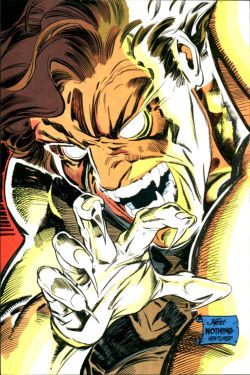
In the rest of the comics, O'Hara finds himself caught in different situations which bring him to the conclusion that with great power comes a lot of freakish bad guys. Oh, and great responsibility.
A side-note, I did find Vulture 2099 to be pretty interesting. He was different, but I could still see the Vulture in him... in a way. I have to say, actually giving him the same diet as real vultures was smart and disturbing, making him what I thought was the best villain in the book.
In personality, this Spider-Man is not extremely different from the original. He's still a smart aleck, a concerned soul, and has his moments of angst. Yet, I could see plenty of the '90's come out in him. He has his moments of dark thoughts, and occasionally will scream something like "I'll kill you!" Part of me liked that, but it is pretty derivative of '90's comics.
Some of the storylines were better than others (again, the Vulture story was one of the better ones). But some aspects of the 2099 setting were just flat out weird. Things like the Thorites: people who basically worship Thor and await his return to defeat the evil government and bring back the age of the Heroes. Think that's weird? Well, they also talk like Shakespeare and wear Thor cosplay.

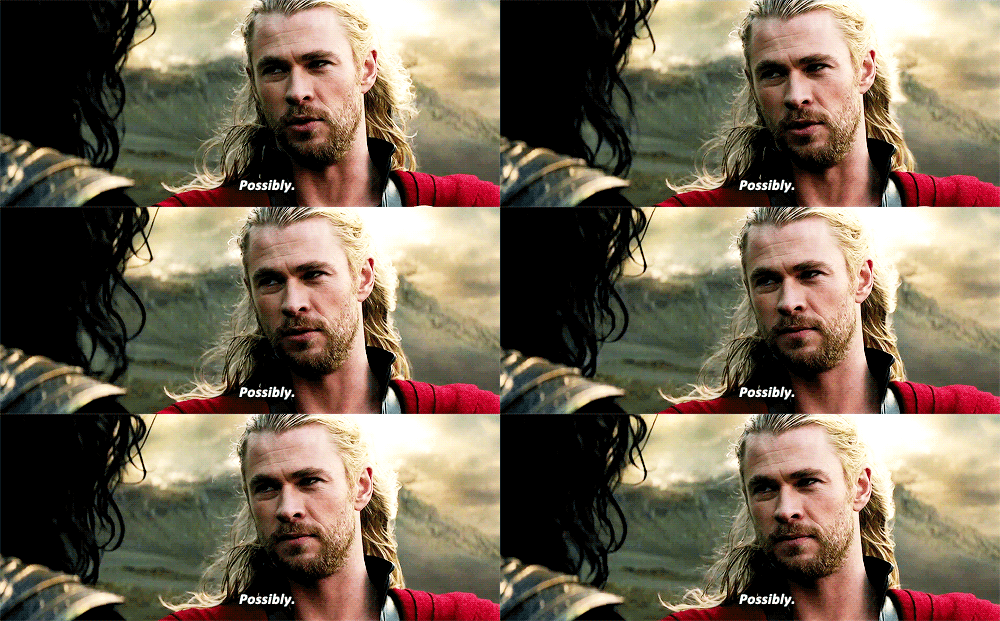
The art was decent, pretty much what one might expect from a comic written 20+ years ago. The writing was okay, a few times people would say something kind of corny, and several times the pages were filled with speech bubbles making it a bit of a slower read.
So, ultimately, Spider-Man 2099 is pretty fun, but it could use some tweaking. Planning on continuing it to see where it swings off to.

I think this was the first time I had seen Spider-Man 2099:
And so duh, I wanted to read the comic to THAT !
So of course, as any good procrastinator would do, I read the comic 7 years later.
And boy was this written in the '90's! Not that that's necessarily a bad thing, eh hem:
Hem, eh, he he hem:
HACK, ha, HEM hrm, eh hem:
...
Well. Uh. Anyway.
Spider-Man 2099 is an interesting idea in concept, but I wouldn't wholeheartedly say it was as good in execution.
Its science fiction design of 2099 is probably the most dated thing about the comic. The hover cars are all very rounded, buildings are super shiny, and the clothing is 100% '90's conception of futuristic clothes. Oh, goodness, the clothes.
So basically, it's the year 2099 and big corrupt businesses rule, etc. So Spidey, in this incarnation a dude named Miguel O'Hara, starts out working for one of the biggest businesses which turns out to be filled with a bunch of really bad dudes. So Spidey starts to hear good ol' Jiminy Cricket say that he should probably quit working with these sickos. Here's how his resignation goes:
Spidey: "I quit."
Boss: "Okay. Here drink this."
Spidey: "Okay, thanks."
Boss: "Oh, you know that drink was laced with drugs that bond to your DNA so you will like, die if you don't get more drugs."
Spidey: "Aw, shock, really??" (Apparently "shock" is the equivalent of our current s-word in 2099.)
So Spidey decides to try and fix his DNA in a giant DNA enhancement machine which just the day before totally mutated a convicted criminal into a freakish creature that died 5 seconds later. Sounds like a plan. Long story short, one of the jerkish employee scientists comes in while he's in the machine and turns it on full power because he wants to kill him... for calling him fat or stupid or something earlier that day.... Ah, sweet revenge.
And O'Hara is cured of his drug addiction! And...
Vampire Spider-Man is born!
In the rest of the comics, O'Hara finds himself caught in different situations which bring him to the conclusion that with great power comes a lot of freakish bad guys. Oh, and great responsibility.
A side-note, I did find Vulture 2099 to be pretty interesting. He was different, but I could still see the Vulture in him... in a way. I have to say, actually giving him the same diet as real vultures was smart and disturbing, making him what I thought was the best villain in the book.
In personality, this Spider-Man is not extremely different from the original. He's still a smart aleck, a concerned soul, and has his moments of angst. Yet, I could see plenty of the '90's come out in him. He has his moments of dark thoughts, and occasionally will scream something like "I'll kill you!" Part of me liked that, but it is pretty derivative of '90's comics.
Some of the storylines were better than others (again, the Vulture story was one of the better ones). But some aspects of the 2099 setting were just flat out weird. Things like the Thorites: people who basically worship Thor and await his return to defeat the evil government and bring back the age of the Heroes. Think that's weird? Well, they also talk like Shakespeare and wear Thor cosplay.
The art was decent, pretty much what one might expect from a comic written 20+ years ago. The writing was okay, a few times people would say something kind of corny, and several times the pages were filled with speech bubbles making it a bit of a slower read.
So, ultimately, Spider-Man 2099 is pretty fun, but it could use some tweaking. Planning on continuing it to see where it swings off to.
June 1, 2023
WOOOOOOOW
This was fucking awesome.
Miguel is a genius when it comes to scientific stuff but he also has a ton of baggage with him mentally. Switch over to something goes wrong and he wants to quit his job, the CEO of that job basically drugs him, and in 2099 some drugs are stuck inside your DNA till you die. So Miguel tries to reverse it but thanks to a "co-worker" of his, he's injected with all the Spider powers they've been trying to develop and BAM. Miguel becomes a mutated creature with Spider like powers.
However, Miguel is far different than Peter. No silly jokes during fights. He does kill if needed, and honestly he doesn't seem to feel all that bad about it. This futuristic city is far more bleak than modern day. The supporting cast are all interesting, and with their own motivations make for interesting character. The villains, including Vulture were terrifying. The art is great, with some awesome poses as well as some brutal fight scenes and deaths. The overall look of the city adds to the tone really well.
Everything about this works for me. I love different universes that can stand completely on their own. Not since maybe Ultimate universe have I enjoyed a elseworld as much from Marvel.
A 5 out of 5.
This was fucking awesome.
Miguel is a genius when it comes to scientific stuff but he also has a ton of baggage with him mentally. Switch over to something goes wrong and he wants to quit his job, the CEO of that job basically drugs him, and in 2099 some drugs are stuck inside your DNA till you die. So Miguel tries to reverse it but thanks to a "co-worker" of his, he's injected with all the Spider powers they've been trying to develop and BAM. Miguel becomes a mutated creature with Spider like powers.
However, Miguel is far different than Peter. No silly jokes during fights. He does kill if needed, and honestly he doesn't seem to feel all that bad about it. This futuristic city is far more bleak than modern day. The supporting cast are all interesting, and with their own motivations make for interesting character. The villains, including Vulture were terrifying. The art is great, with some awesome poses as well as some brutal fight scenes and deaths. The overall look of the city adds to the tone really well.
Everything about this works for me. I love different universes that can stand completely on their own. Not since maybe Ultimate universe have I enjoyed a elseworld as much from Marvel.
A 5 out of 5.

August 21, 2023
My main complaint is that all the swear words were replaced with “shock” and the characters swear a good amount. However I really love this reimagining of Spider Man and I love Miguel. Doesn’t pass the bechdel test lol. The plot was really fun and the world building was interesting. I just really really love Spider-Man. Everything made sense in universe imo. Love that. I love Spider-Man!!!!!!!

February 16, 2025
A great gateway into Miguel O’Hara that holds up nicely in most ways but shows its age in others.
Prior to reading I would’ve already considered myself a Miggy fan but reading his origin has dialled it up to 11.
He’s extremely well written throughout, both with and without the mask and brings with him the hillarious quips yet emotional weight you’d expect from a Spider-Man successor.
The majority of his supporting cast also worked well - I loved Miggy’s brother Gabe, Alchemax as a corporate antagonist is so far so good and both Venture and The Specialist are good initial entries into the rogues gallery.
The same unfortunately can’t be said for Vulture 2099. Whilst his design is top tier, the character is (for lack of a better word) a dosser and has already been written out of the series. It’s a shame as I consider Vulture to be an A-list Spider-Man villain so to throw away the 2099 iteration this early feels like a waste.
The art is also incredibly lacklustre in places. In several action sequences (the worst place for art quality to deteriorate) it’s really difficult to tell what’s supposed to be happening, taking away from the immersion.
The series has a lot of potential and has already solidified Miguel as a top 5 Marvel character for me but unless the art can get some consistency, it will likely be capped at a 4 moving forward.
Prior to reading I would’ve already considered myself a Miggy fan but reading his origin has dialled it up to 11.
He’s extremely well written throughout, both with and without the mask and brings with him the hillarious quips yet emotional weight you’d expect from a Spider-Man successor.
The majority of his supporting cast also worked well - I loved Miggy’s brother Gabe, Alchemax as a corporate antagonist is so far so good and both Venture and The Specialist are good initial entries into the rogues gallery.
The same unfortunately can’t be said for Vulture 2099. Whilst his design is top tier, the character is (for lack of a better word) a dosser and has already been written out of the series. It’s a shame as I consider Vulture to be an A-list Spider-Man villain so to throw away the 2099 iteration this early feels like a waste.
The art is also incredibly lacklustre in places. In several action sequences (the worst place for art quality to deteriorate) it’s really difficult to tell what’s supposed to be happening, taking away from the immersion.
The series has a lot of potential and has already solidified Miguel as a top 5 Marvel character for me but unless the art can get some consistency, it will likely be capped at a 4 moving forward.
This entire review has been hidden because of spoilers.

June 30, 2023
Inhaled it! This was only my second time reading a legit superhero comic, so definitely took some adjusting to, in a matter of hours, in the middle of the night. But what a great ride! Mig’s backstory is interesting as all get out, and he’s a pretty darn well rounded character for 10 issues. And FUNNY. Wish we could’ve seen more of Gabriel, he was a blast.
The plots are wild, in a good way- some interesting “1984” parallels and themes of questioning corporations and morality. ABSOLUTELY worth a shot if the latest animated Spider-Man movie had you wanting more from a certain grief-and-fury-filled, tortured vampire-ninja-antihero.
The plots are wild, in a good way- some interesting “1984” parallels and themes of questioning corporations and morality. ABSOLUTELY worth a shot if the latest animated Spider-Man movie had you wanting more from a certain grief-and-fury-filled, tortured vampire-ninja-antihero.

February 16, 2023
This spider-man story is really weird and dystopian especially issue 9. That was super weird.

February 10, 2018
This was a nostalgia read for me as I purchased the original floppies on a monthly basis when it first came out. Looking back on it with fresh eyes I have to say it still holds up pretty well. It has some of the clunkiness of the storytelling of the time but the art by Rick Leonardi is still very strong and the overall narrative and idea, as created and executed by Peter David, is interesting and a compelling take on the Spider-Man concept.
There were some things I didn't love in hindsight, like the design of the costume or the obvious convenience of Miguel just taking on the Spider-Man name like there were no other options available, but seeing as Marvel was trying to brand this whole 2099 thing as different but parallel, I can give it a soft pass.
I liked it. It was fun. I might even give it 3.5 stars. I will definitely keep going with my nostalgia read of the series and probably look up some if its 2099 peers.
There were some things I didn't love in hindsight, like the design of the costume or the obvious convenience of Miguel just taking on the Spider-Man name like there were no other options available, but seeing as Marvel was trying to brand this whole 2099 thing as different but parallel, I can give it a soft pass.
I liked it. It was fun. I might even give it 3.5 stars. I will definitely keep going with my nostalgia read of the series and probably look up some if its 2099 peers.

November 14, 2020
One of the best Spider-Man stories I've ever read.

November 7, 2018
3.5
Quite enjoyable, but also dated... That art! And a lot of thought bubbles, and even more "narration" from the characters (talking out-loud to themselves) explaining what they're doing and thinking, and why, which I dislike. Also a lot of... ellipsis.
The world building is good/interesting. The future is owned by large corporations; NYC is built up upon, the poorest living layers below the rich and connected; funny Thor cults (Thorites) run about; and cool self-mailing booths exist that Miguel can change into his costume in and send his clothes home. Peter David has addressed an issue no other writer has! Where do their clothes go when heroes fight crime? (≧▽≦)
There are a few laugh out loud moments...
Miguel: "His name was Spider-Man. One of the premier boys from the old heroic age, 'round the turn of the century. Proportionate strength of a spider."
Aaron: "What do you mean, "proportionate?""
Miguel: "It means he didn't get a swelled head about it."
And,

Spider-man thinking: *Okay...caught him flatfooted. Now... have to say something that will shake him up. Show him who's boss.*
*And not let him know that I'm terrified out of my skull.*
*Something like...like...*
"Hi."
*That wasn't it.*
LOL.
It's quite funny how silent Miguel/Spider-Man is actually. To the point where the villains he's fighting yell at him to talk back.
The Specialist: "Speak! Or is your tongue paralyzed with terror?"
I never thought I'd read a Spider-Man comic where Spider-Man wasn't the quippy/jabbering sort.
Also, does this Spider-Man kill now? Or rather, let bad guys fall to their death?
I like the O'Hara family drama. I like Gabriel, and the issue at the end with their Mom Mother's Day.
Overall, Spider-Man 2099 is fun. You can really see Miguel growing into some sort of Spider-Man by the end of Vol 1.
From-
Miguel: "What was Gabe saying? With great power... must come great responsibility. Wrong. Completely wrong. With great power comes great guilt."
and Momma O'Hara: "(Spider-Man is) Someone who sees the big picture, and is trying to redraw it. Someone who cares."
Miguel: "... Maybe he's just... Just someone who got caught up in things. Someone who... if he never put the costume on again, he'd be perfectly happy to go back to his life, what if...?"
To-
Miguel: "...The world is what we make of it. And... at lease until I've managed to find a cure for my...condition... I'm going to start making it into a vision that I can stand to look at."
Sounds like Spider-Man material to me. ;)
Quite enjoyable, but also dated... That art! And a lot of thought bubbles, and even more "narration" from the characters (talking out-loud to themselves) explaining what they're doing and thinking, and why, which I dislike. Also a lot of... ellipsis.
The world building is good/interesting. The future is owned by large corporations; NYC is built up upon, the poorest living layers below the rich and connected; funny Thor cults (Thorites) run about; and cool self-mailing booths exist that Miguel can change into his costume in and send his clothes home. Peter David has addressed an issue no other writer has! Where do their clothes go when heroes fight crime? (≧▽≦)
There are a few laugh out loud moments...
Miguel: "His name was Spider-Man. One of the premier boys from the old heroic age, 'round the turn of the century. Proportionate strength of a spider."
Aaron: "What do you mean, "proportionate?""
Miguel: "It means he didn't get a swelled head about it."
And,
Spider-man thinking: *Okay...caught him flatfooted. Now... have to say something that will shake him up. Show him who's boss.*
*And not let him know that I'm terrified out of my skull.*
*Something like...like...*
"Hi."
*That wasn't it.*
LOL.
It's quite funny how silent Miguel/Spider-Man is actually. To the point where the villains he's fighting yell at him to talk back.
The Specialist: "Speak! Or is your tongue paralyzed with terror?"
I never thought I'd read a Spider-Man comic where Spider-Man wasn't the quippy/jabbering sort.
Also, does this Spider-Man kill now? Or rather, let bad guys fall to their death?
I like the O'Hara family drama. I like Gabriel, and the issue at the end with their Mom Mother's Day.
Overall, Spider-Man 2099 is fun. You can really see Miguel growing into some sort of Spider-Man by the end of Vol 1.
From-
Miguel: "What was Gabe saying? With great power... must come great responsibility. Wrong. Completely wrong. With great power comes great guilt."
and Momma O'Hara: "(Spider-Man is) Someone who sees the big picture, and is trying to redraw it. Someone who cares."
Miguel: "... Maybe he's just... Just someone who got caught up in things. Someone who... if he never put the costume on again, he'd be perfectly happy to go back to his life, what if...?"
To-
Miguel: "...The world is what we make of it. And... at lease until I've managed to find a cure for my...condition... I'm going to start making it into a vision that I can stand to look at."
Sounds like Spider-Man material to me. ;)

October 16, 2024
Competent but non-essential 90s superheroics. I remember buying the first issue of “Spider-Man 2099” when it came out so this was a fun nostalgia read for me. Unfortunately, there’s not too much going on here other than Peter Parker meets the Jetsons, even with writing by Peter David and art by Rick Leonardi. Every month the new Spider-Man, Miguel O’Hara, faces off against a surprisingly anachronistic villain: first a cowboy, then a samurai. Meanwhile, in every issue a longer, overarching story progresses a few steps at a time, with Miguel trying to reverse the experiment that gave him the powers of Spider-Man.
While I don’t love Rick Leonardi’s pencils overall, his drawings of Spider-Man 2099 in costume and bouncing around Nueva York are amazing, and the one thing worth checking out. His visuals in those sequences are like ballet, full of beauty, tension, and strength. It would’ve been great if that was the overall focus of the book, then action could’ve been our reward as well.
While I don’t love Rick Leonardi’s pencils overall, his drawings of Spider-Man 2099 in costume and bouncing around Nueva York are amazing, and the one thing worth checking out. His visuals in those sequences are like ballet, full of beauty, tension, and strength. It would’ve been great if that was the overall focus of the book, then action could’ve been our reward as well.

April 6, 2019
Nice look into a permanent part of the Spider-Man family from the 2099 run back in the 90's. I already knew Peter David was a wonderful writer but this is further proof for me, and the way that this Spider-Man is different and yet still, Spider-Man, well, it's cool. The artwork was wonderful, and I enjoyed reading one of the more successful offerings of Marvel's "2099" line that also included Dr. Doom, The X-Men, The Incredible Hulk, the Fantastic Four, and more.

March 1, 2022
A España llegaron los 12 primeros números de la serie original de Spiderman 2099, donde se narran los orígenes y primeras andanzas del personaje. El contexto de crecimiento vertical que presenta Peter David es muy interesante, con algún instante especialmente destacable como el submundo en que se mueve el Buitre de esta época, que es tremendamente sórdido y decadente. Lamentablemente, el argumento es súper plano y se limita a una huida hacia adelante continua que no acaba de llevar a ningún sitio. El trabajo de Leonardi es sencillamente brutal, empezando por el genial diseño del traje. Por lo demás, el estilo de dibujo rotundo y algo cuadrado le va estupendamente al cómic, recordando al Romita Jr. de Daredevil, precisamente con Al Williamson también como entintador.

December 28, 2018
One of my first comics ever so I've got massive nostalgia. I still dig Peter David's writing and Art Leonardi's pencils still have a dynamic sense of movement with insightful layout.

April 14, 2024
A fun bit of nostalgia. This is the first 10 issues of the Spiderman 2099 run. A whole lot of exposition as this was the first book in the 2099 line. Still engaging enough.

October 7, 2025
Fun read! I didn't know anything about Miguel other than the Spiderverse movies so this was interesting to see.

September 25, 2015
The Good: Different than any other take I've ever seen on the infamous wall-crawler, this Spider-Man is not the Peter Parker of today or yesteryear, but Miguel, a man of tomorrow. Just like the classic superhero, the new Spidey finds himself in one insane adventure after another...but, the supporting characters are no Uncle Ben, Aunt May, and Mary Jane Watson. While some purist may say not to fix what isn't broken, as many times as the traditional Peter Parker arc has been done and redone--even outside of the comics!--it's good to have it changed up, especially by a legend such as Peter David. It also stays mostly clean when it comes to content; as bad as it gets is an immodest outfit here and there and one interrupted passionate kiss.
The Bad: Nothing really bad about it; it just wasn't shockingly amazing, which is why I'm only giving it four stars.
Conclusion: Are you tired of seeing Spider-Man lose his Uncle Ben, fight the Green Goblin, try to impress Mary Jane Watson, etc., etc., etc.? Then, this book is for you! Comics master Peter David, who has also written novelizations of the Tobey Maguire Spider-Man films and several Star Trek novels, brings us a much different take on the beloved superhero. It may be old-school--these comics date back to 1992!--but, like much good entertainment, its appeal is timeless. Comic book fans should definitely seek this one out.
Score: 4/5
The Bad: Nothing really bad about it; it just wasn't shockingly amazing, which is why I'm only giving it four stars.
Conclusion: Are you tired of seeing Spider-Man lose his Uncle Ben, fight the Green Goblin, try to impress Mary Jane Watson, etc., etc., etc.? Then, this book is for you! Comics master Peter David, who has also written novelizations of the Tobey Maguire Spider-Man films and several Star Trek novels, brings us a much different take on the beloved superhero. It may be old-school--these comics date back to 1992!--but, like much good entertainment, its appeal is timeless. Comic book fans should definitely seek this one out.
Score: 4/5

April 25, 2009
Set in a pretty standard cyber-punk dystopia setting, this book contains my favorite web-slinger of all time. Pretty sacrilegious I know, but I can't help it. The twelve year old inside me still loves Miguel O'Hara more than Peter Parker, so I guess I do too. Great character design to say the least.
This volume starts off gangbusters with the three part origin story of Spider-Man 2099, but certainly looses steam with each subsequent issue. Which if memory serves me right, that pretty much describes the entire Marvel 2099 imprint. Though I'd still love to see more S-Man 2099 volumes released if Marvel sees to it.
This volume starts off gangbusters with the three part origin story of Spider-Man 2099, but certainly looses steam with each subsequent issue. Which if memory serves me right, that pretty much describes the entire Marvel 2099 imprint. Though I'd still love to see more S-Man 2099 volumes released if Marvel sees to it.
June 17, 2012
Ok, lot of idiot haters out there with the reviews. This is a freaking awesome series. Sadly as a kid I only got up to the 20somethingish issue, where he battles a super-sadistic Venom 2099. But as a kid, I loved this Spider-Man more than classic spider-man. The dark undertones of the series and edgier stylizing made this an instant classic for me. Perhaps it is the dark in me that really loves it, as this Spider-Man's moral code was a bit south of classic Peter Parker.

April 24, 2014
I had never heard of this title until I was browsing around on my local library's website. I gotta say, the story is not bad. The toughest thing I had to get past was the "what the shock" swearing to most things. The origin story seemed a little "hokey", but just in the first volume, the character develops quickly.

April 6, 2014
I was expecting a very 90s book and I read it fueled by nostalgia, but it actually turned out to be a very fun read! Everything about this character and his world is very interesting. I also love the fact that Spiderman from 2099 is Peter Parker's opposite in every way.

May 3, 2023
Não dá nem pra dizer que fui influenciado pelo saudosismo, porque não me lembrava de nada das histórias.
Achei bem divertido. Tem uma pegada mais séria (com uma ou outra pitada de humor), como um thriller de perseguição.
Agora é esperar o próximo volume.
Achei bem divertido. Tem uma pegada mais séria (com uma ou outra pitada de humor), como um thriller de perseguição.
Agora é esperar o próximo volume.

November 16, 2012
Refreshing take on Spider-man. I really like the dystopian type setting. Just...new everything. I enjoyed it.

May 31, 2013
Spider-man 2099 is way better than I thought it would be. It made me want to read more of the 2099 universe.
September 7, 2018
Artwork was horrendous and character wasn't relatable

October 14, 2020
Ho adorato questo volume, una vera e propria macchina del tempo. Il ciclo è bello, ma 4/5 è il voto di un marvel zombie nostalgico ❤️


May 30, 2023
What happens when you combine the dystopian worlds of George Orwell’s 1984, Blade Runner, and Metropolis, adding our favorite web-slinger from ‘Marvel Comics’? ‘2099’ presents us an alternative future for the Marvel timeline, where a fascist mega-corporation known as Alchemax is in control of this newer version of New York City, with the help of an authoritative police-force known as the Public Eye. Flying cars, heroes long gone, titanic skyscrapers, cyborgs, this future has it all. Enters Miguel O’Hara, a brilliant mind working for Alchemax, who is being exposed to an experiment that attempted at replicating the original Spider-man’s powers, after trying to get rid of a special kind of drug manufactured by his own corporation, and that it was forced on him by his boss. Now, O’Hara will use his brand-new condition to adopt the identity of ‘Spider-man’, in order to continuously sabotage Alchemax: Tyler Stone.
Writer Peter David, as well as the lead artist of 9 of the 10 issues presented in this volume, Rick Leonardi, both accomplish to craft this newer version of Spider-man, encapsulating the decade of its release, while at the same time, providing a fresher and attractive world that already has the difficult task of being its own thing, aside from the classic 616-Earth of Marvel. This could easily be considered the most successful of the “2099” versions of some of the most popular characters in Marvel Comics, such as The Punisher, even the X-men. Spider-man manages to differ from the 616 version, delivering an alter ego that is considerably distinguishable, compared to Peter Parker, since Miguel O’Hara is a far ruthless and darker personality. It is quite interesting to see where the “futuristic” scenery for a familiar superhero came from, with the creation of the 2099 line, is easy to see where something like “Batman Beyond” came to be, even the animated series, ‘Spider-man: Unlimited’, undoubtedly was heavily inspired by David’s conception.
The story revolving around ‘2099’ might not appear as much, but it was surprisingly deep, taking these strong sci-fi references here and there, and the aforementioned Orwellian atmosphere with Alchemax and its fascist corporative control over society, that clearly resembles the likes of something like “The Big Brother”. Perhaps that’s where the appeal for this particular series comes from, but nonetheless, it is part of what makes this newest version of Spidey resonate so hard with the audience, so much that it quickly became a fan-favorite, specially after his appearance in several videogames and comic-book crossovers, such as ‘Edge of Spider-verse’.
Now, is it better than Peter Parker’s? Well, I don’t really think David’s intentions towards this version were to out shadow the classic one. O’Hara by his own is a strong and worthy character, for an alternative version, even if this future isn’t necessarily the definitive one in the main comic book timeline. His appearance, his attitude, even his abilities vary from the original one, and the world around him works in a specific way, so even his motivations for being a “superhero” are different enough to provide a stand-alone development. If I have to complain about a single element in this series, it is the secondary characters; O’Hara’s brother, Gabriel, Miguel’s fiancé, Dana, and even the antagonist, Tyler Stone, they all work just fine for the purposes of the script, but they aren’t either narratively, nor visually interesting for us to care, and at times they seem to get in the way of the main story. I’d like to think they get better in the subsequent volumes, but in this one, their respective presentation never hooked me enough to care for them, or even their relationship towards Miguel. What I did enjoy, was the inclusion of unique and threatening villains; there is a cyborg cowboy, a samurai, and an alternative version of the Vulture with a creepy twist to him, that made me interested in seeing other classic Spidey-foes with their respective “2099 treatment”.
As a beginning of an alternative version of a familiar and beloved character, this worked just fine; Miguel O’Hara is his own character, and at any point David tries to copycat Peter’s traits, so that works to his favor as a unique addition to these “elseworlds”. These first 10 issues are promising, and so far, both Peter David, and Rick Leonardi, are both a great combo of creators for this specific title. Kelley Jones drew issue #9, although, the story in it didn’t gave him something particularly interesting or excelling to draw, so it might be perhaps the most forgettable issue in this volume. For fans of Spidey this is a must read, mostly due to its uniqueness as part of an alternative Earth in the Marvel Universe, and because of the strong literary references its creators took in order to craft this great world. A product of its time, but a good product, nonetheless.
Writer Peter David, as well as the lead artist of 9 of the 10 issues presented in this volume, Rick Leonardi, both accomplish to craft this newer version of Spider-man, encapsulating the decade of its release, while at the same time, providing a fresher and attractive world that already has the difficult task of being its own thing, aside from the classic 616-Earth of Marvel. This could easily be considered the most successful of the “2099” versions of some of the most popular characters in Marvel Comics, such as The Punisher, even the X-men. Spider-man manages to differ from the 616 version, delivering an alter ego that is considerably distinguishable, compared to Peter Parker, since Miguel O’Hara is a far ruthless and darker personality. It is quite interesting to see where the “futuristic” scenery for a familiar superhero came from, with the creation of the 2099 line, is easy to see where something like “Batman Beyond” came to be, even the animated series, ‘Spider-man: Unlimited’, undoubtedly was heavily inspired by David’s conception.
The story revolving around ‘2099’ might not appear as much, but it was surprisingly deep, taking these strong sci-fi references here and there, and the aforementioned Orwellian atmosphere with Alchemax and its fascist corporative control over society, that clearly resembles the likes of something like “The Big Brother”. Perhaps that’s where the appeal for this particular series comes from, but nonetheless, it is part of what makes this newest version of Spidey resonate so hard with the audience, so much that it quickly became a fan-favorite, specially after his appearance in several videogames and comic-book crossovers, such as ‘Edge of Spider-verse’.
Now, is it better than Peter Parker’s? Well, I don’t really think David’s intentions towards this version were to out shadow the classic one. O’Hara by his own is a strong and worthy character, for an alternative version, even if this future isn’t necessarily the definitive one in the main comic book timeline. His appearance, his attitude, even his abilities vary from the original one, and the world around him works in a specific way, so even his motivations for being a “superhero” are different enough to provide a stand-alone development. If I have to complain about a single element in this series, it is the secondary characters; O’Hara’s brother, Gabriel, Miguel’s fiancé, Dana, and even the antagonist, Tyler Stone, they all work just fine for the purposes of the script, but they aren’t either narratively, nor visually interesting for us to care, and at times they seem to get in the way of the main story. I’d like to think they get better in the subsequent volumes, but in this one, their respective presentation never hooked me enough to care for them, or even their relationship towards Miguel. What I did enjoy, was the inclusion of unique and threatening villains; there is a cyborg cowboy, a samurai, and an alternative version of the Vulture with a creepy twist to him, that made me interested in seeing other classic Spidey-foes with their respective “2099 treatment”.
As a beginning of an alternative version of a familiar and beloved character, this worked just fine; Miguel O’Hara is his own character, and at any point David tries to copycat Peter’s traits, so that works to his favor as a unique addition to these “elseworlds”. These first 10 issues are promising, and so far, both Peter David, and Rick Leonardi, are both a great combo of creators for this specific title. Kelley Jones drew issue #9, although, the story in it didn’t gave him something particularly interesting or excelling to draw, so it might be perhaps the most forgettable issue in this volume. For fans of Spidey this is a must read, mostly due to its uniqueness as part of an alternative Earth in the Marvel Universe, and because of the strong literary references its creators took in order to craft this great world. A product of its time, but a good product, nonetheless.
Displaying 1 - 30 of 100 reviews