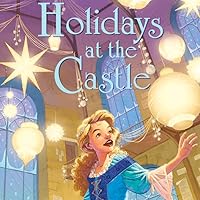
This is one of those books I read as a child that I actually remembered somewhat accurately. The plot, and basic feel, minus bits and pieces. I of course did not recognize at that time fat shamming, which it seems is in many of her books. The overweight people in this series, are not evil or bad even, but their fatness is used as a learning experience for the readers, basically saying overweight people are not disgusting or without talent. When the main character begins to understand that appearances are not important the audience is still left with an uncomfortably problematic book. In this one we see the children encounter those of their own age, and immediately are informed that they are on a restrictive diet because they are fat. Later on in the book Janet pretty constantly states how fattening all the food is, she herself is eluded to as being too skinny "gaunt" even. So there really is no perfect place to be. There is also mentions of lazy eyes as a feature in antagonists, every single time they appear in case you forget, they make Cat uncomfortable and are described as shifty and immoral, dirty and poor. Throughout this book, and the 4th which I am currently reading, we have example upon example of Diana Wynne Jones trying to teach children that being judgmental, selfish, and apathetic in ones own life is actually wasting a life (aka the 9 lives of the christomancy), and asking for help and being honest will enrich your experiences. Unfortunately, using fatness, or physical deformities just cannot be successfully exploited to do that, it doesn't matter if the overweight characters turn out to be wonderful and a skinny one is ambitious and evil. Why can't authors write about overweight people without continually convincing protagonists and readers that they are human first, we don't have to wait for a plot twist to reveal their actual positions in the story. It is the same as saying that these marginalized and oppressed groups have to work so hard to gain basic rights in reality, and that is wrong, so I am going to make all of my characters do that too. Just break the mold and make them the best to begin with!
Why can't we have a lazy eyed protagonist on the larger size of the spectrum! I know I am being picky, and this is a children's series, but you can't be on a high horse of morality and then give "the bad guys" lazy eyes! This is from the prospective of an extremely sheltered young boy, so we have to give the narration a bit of a break, his judgement aren't really at fault, it's the authors extremes. What I did like was how clearly abuse was written into the relationship between Gwendolyn and Cat. It was insidious, and a great example of how certain people can enthrall others despite manic episodes of attitude, from coddling to shamming. It is interesting that Gwendolyn never struck her brother, but her abuse continually put him in danger without him being conscious of it, all the while going along in admiration at her skill set that he believed he didn't possess. When we learn her talent is his own it puts a question to the reader about their own self esteem and how they are influenced by others that are misusing and exploiting power, a power they too possess and are not actively using it because they are disenfranchised or oppressed. This could easily be an example of the negative aspects of socialization in our culture (brainwashing ext), that oppresses individual empowerment and self worth to the advantage of others, you then get someone like Cat, who has disassociated from his own life and abilities, who isn't fighting back or even realizing that he should be. His obedience is pointed out by Janet and others, and he is resistance to change even if we can see it frees him to be his own person with his own power. All change has an impact, even if it is positive it causes anxiety. We do see him challenging himself towards the end of the book of course. I would like to mention that Cat does not change his perspective because of the boxing of his ears or seeing his sister beaten with a shoe. That is just child abuse, and perhaps was placed there to show that abusing your child just makes them mistrustful, rebellious, and more secretive, I would like to think that, but as both characters that initiated physical violence were unpunished and toted as good influences I am guessing that just came from modes of the time. If it was an example of the meaningless violence of reformation it wasn't bad, it had absolutely no positive effect as violence never does in reforming individuals, especially those who are already abused.
I think that about covers it, oh yes Janet's parents didn't notice the swap, which could be another dig at negligent parents, or it could also be a comment on feeling out of place with your own position in life, as all the other "Gwendolyns" ended up better off and more comfortable. It is a counterpoint to Cats position, the idea that a dispossessed person has no growth or sense of self, but can change under the right circumstances and become a person instead of a victim. Whereas the Gwendolyn theory basically states that all of these young women were in the wrong space for their personality types, that they were born fully formed in their identity. I could read a lot into many parts of this book, many are very interesting but the surface level lessons are less complex and for an older reader a bit problematic. Still good, writing is well done. 3 stars.