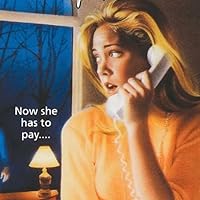
Catherine is a soft, soft cheese.
The Watcher had the potential to be a fascinating book, on the level of something like Perfect Blue, but in execution it's a half-baked thriller. Not to say that it is completely without entertainment value.
There is something interesting about the notion that "the watcher" is a sinister term typically used in horror to describe some anonymous diabolical villain, shrouded in shadow, but here, Catherine the protagonist is also The Watcher, as voyeuristically tuned in to the lives of the characters on her soap opera as her tormentor is tuned in to Catherine, regarding her not as a human being but as a plot point, a chess piece to be moved about the board in order to satisfy this stalker's whims. There's a fascinating moment at the end where Catherine is facing off with her would-be killer in an isolated location, and the two of them wait, in tense standoff, while the TV plays in the background, both of them unable to act until they know what happens next. As if they have mutually agreed that Catherine's fate in real life must echo the fate of her analogue character on Lost River, Cassandra. As if Catherine herself might actually be willing to die to fulfill her real-life parallels to a work of fiction. As if neither of them know how to exercise their free will and can only follow the arbitrary dictations of a television show produced thousands of miles away--a show that has no real power over its viewers except the power that said viewers bestow upon it. There's something there that is thematically profound, about our almost desperate connection to storytelling and the impact it can have on our lives--positive OR negative--about the way we narratize our own existences to give them meaning, a sense of destiny, in the same way that the characters with whom we identify cannot help but enact their own predetermined destinies. Without stories, are we rudderless? Without narrative, are our lives completely empty? Is it better to die to give our own stories a satisfying ending than to live aimlessly? But this theme isn't really developed.
A big problem with the book is that it never quite figures out how hard to commit to the soap-opera angle. Some of the incredible incidents in Catherine's life are the result of her stalker faithfully recreating elements of Lost River, but others--like the reveal that love interest Travis looks identical to his dead uncle--seem to be operating on a melodramatic logic of their own. So the story occupies this weird stylistic middle space where it aspires to be a plausible approximation of our own world, as distinctly separate from the soap opera Catherine watches, while also indulging in flourishes of storytelling excess that are entirely characteristic of a soap opera. I would have been okay with this if it was Lael Littke's intention to gradually morph Catherine's "real" world into the world of Lost River, but that doesn't really seem to be the case, structurally speaking; the incredulity doesn't slowly build with inevitable progress. It's just that sometimes Catherine's world makes perfect sense, and sometimes something totally random and contrived needs to happen to facilitate the red herrings.
I like how the book keeps referring to "bloodred roses" as though that is something special and distinct from any regular red rose.