Ontdek de bijzondere vogelwereld door indrukwekkende verhalen en prachtige illustraties.
Dit rijkgeïllustreerde boek beschrijft 80 fascinerende vogels van over de hele wereld. Van de ijverige republikeinwever uit Namibië, die gigantische nestkolonies bouwt in de woestijn, tot de volhardende streepkopgans uit Centraal-Azië, een van de hoogst vliegende migrantenvogels die de Himalaya tweemaal per jaar oversteekt.
Vele vogels hebben een belangrijke rol in folklore en mythes en sommige zijn zelfs verheven tot nationale symbolen. Door andere vogels te bestuderen kwamen wetenschappers tot belangrijke nieuwe inzichten en zo kwamen vernieuwende projecten ter bescherming van natuur, dier en mens tot stand. Elke vogel op aarde vertelt een belangrijk verhaal, en elke vogel werpt nieuw licht op onze relatie met de natuurlijke wereld. Een reis om de wereld in 80 vogels is een unieke verkenning van de hoogvliegers van het dierenrijk.
Wetenschappelijk studies van andere vogels leidden tot nieuwe inzichten en vernieuwende projecten ter bescherming van natuur, dier en mens.
Actually, there's a lot of cool and interesting details on 80 different impactful bird species written in an engaging way that really worth the gander.
I mean, seriously, don't be turkey. Finch this up and sing its praises like a nightingale.
Another entry in the Around the World in 80 ... series. This time, we look at the most iconic or memorable birds of the world.
The book, like the other I've read only last month, is divided into 7 chapters that take the reader from continent to continent: - Africa - Eurasia - North America - South and Central America - South and Southeast Asia - Australasia - Oceans and Islands
We get a nice overview of what the birds look like, their way of life and brief anecdotes of what they are known for (like them being national emblems and why, if they are featured in important literary works, legends or myths etc). To my delight, we also get a lot of quirky information.
I love birds. They have so much ... soul. Ever seen a cockatoo rock to some of Elvis' music? Or a hand-raised kakapo thinking a human man is the love of his live? Or did you know that with at least 11000 species they are the most diverse vertebrate class on the planet? They can sing the most beautiful songs, shriek the eeriest cries, create the most stunning nests, dance the funniest mating dances and so much more! They can also be toxic, fiercely loyal and/or incredibly smart. What made them such a success, however, is that they can get to and practically live anywhere on the planet. Their avian abilities also mean they can escape danger and relatively easily re-settle which makes them highly adaptive too.
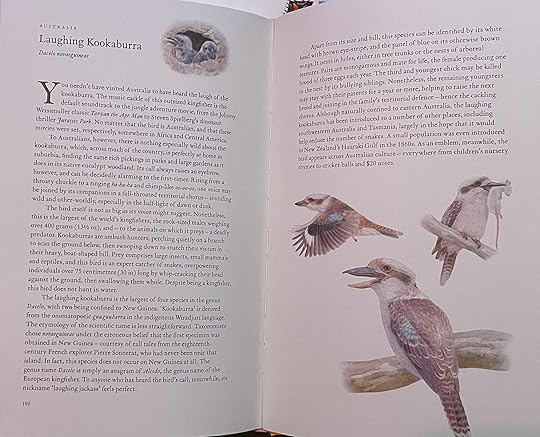
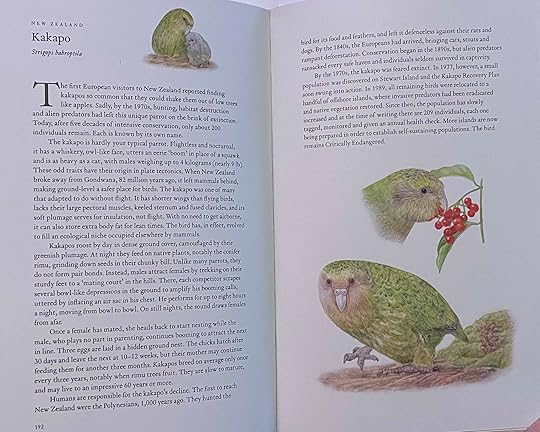
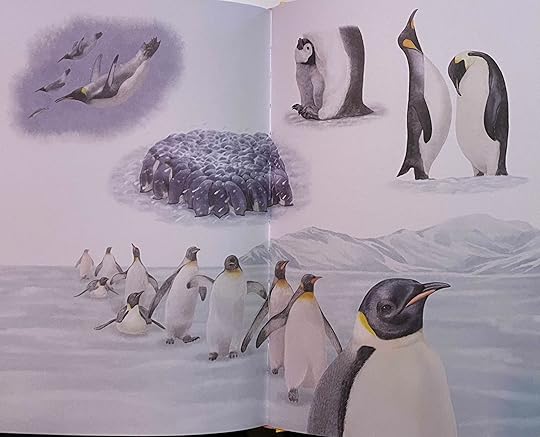
Here are the entries and illustrations for some of my favorite brids from around the world that were featured in this book:
The writing style in this wasn't as quirky and entertianing as in the one about trees, but it was still delivering the facts in a very amicable and non-boring way.
Once again, the book provides a very nice if not too detailed look at the most recognizeable birds from each of the above-mentioned regions. Along the way, you can learn some very nice cultural tidbits related to these amazing animals and see how the animals have influenced us humans, be it related to fashion, research, medicine, technology or other fields.
First and foremost, I do of course understand (and as Mike Unwin also points out in the introduction to his 2022 Around the World in 80 Birds) that choosing eighty global bird species to textually showcase is extremely difficult. But that being said and even if totally accepted, I do find it rather majorly problematic and equally quite strange that Unwin basically ignores ALL endemic Hawaiian birds in Around the World in 80 Days and also features not one single woodpecker species (which I guess peeves me personally since woodpeckers happen to be my favourite birds) and not to mention that there in my opinion also needs to be a section on bird evolution included in Around the World in 80 Birds (and in particular since most ornithologists and palaeontologists now accept and believe the theory that birds are actually the one group of dinosaurs to have survived the extinction event of 65 million years ago, that today's birds are not just related to dinosaurs but actually are a type dinosaur) as well as specific chapters on (human caused) extinct and critically endangered birds.
For while Mike Unwin does in fact (and fortunately) show the conservation status of and the threats facing the bird species he has chosen for Around the World in 80 Birds, Unwin's criticism and his condemnation of what has caused and is causing avian conservation issues (habitat destruction, large scale hunting and poaching, climate change etc.) is almost never even remotely vehement enough for me personally (and usually also consists of just a few sentences at best) and with there also being kind of a verbal hesitation by Mike Unwin to be all that critical of Europe and North America (such as for example Unwin calling how Atlantic puffins are still being killed en masse in Iceland "harvesting" instead of this being shown as a slaughter) but seemingly not so much of Asia and of areas south of the equator concerning birds going extinct and becoming critically endangered (which I do of course hugely agree with but also want similar attitudes and similar levels of condemnation for Europe and North America as well) and that this reluctance (which yes, I have definitely noticed during my perusal of Around the World in 80 Birds) might also be why critically endangered North American birds like the whooping crane, the Eskimo curlew, the California condor and basically ALL Hawaiian birds (since Hawaii is politically part of the USA) are not featured (as many of them are recently extinct and critically endangered solely due to human action and behaviour), and that of course a chapter on extinct birds in Around the World in 80 Birds would kind of need to mention how within just a few decades the erstwhile so very numerous and endemic to North American passenger pigeon was hunted to extinction (and same with the Carolima parakeet) and that indiscriminate logging as well as museum curators wanting stuffed and mounted specimens of ivory–billed woodpeckers were more than likely its doom.
And with regard to Mike Unwin‘s text for Around the World in 80 Birds (and generally speaking), what he writes is enlightening, engagingly penned, with lots of both scientific and also cultural/historical information about the eighty featured bird species being provided, an annotated list of books, a website and a DVD for further study (as well as the websites for a number of conservation groups), all presented in a writing style that is delightfully conversational, ornithological jargon free and thus making Around the World in 80 Birds textually suitable for basically anyone from the age of twelve onwards, and with Ryuto Miyake’s accompanying illustrations providing a realistically gorgeous and lushly coloured visual mirror (and that yes, I do not even mind there being no photographs at all included in Around the World in 80 Birds). However, that Mike Unwin does not bother with avian evolution in Around the World in 80 Birds, that he has no section devoted to extinct birds and is in my opinion often not nearly critical and condemning enough regarding birds threatened and endangered by us humans, by our actions, by habit loss, by over-hunting, pollution and the like, this has definitely rather bothered me (and enough so that my final rating for Around the World in 80 Birds simply cannot be higher than three stars, still to be warmly recommended, but also with some caveats and reservations).
Oh and finally, I also think that Around the World in 80 Birds should be including distribution maps for each of the included species, for one, simply for general knowledge, of course, and for two because some of the birds being showcased in Around the World in 80 Birds actually do not only appear in the countries and areas about which Unwin is writing (and it would thus be nice if Around the World in 80 Birds would for example visually show how the northern mockingbird also ranges into Canada and that nightingales are common in much of Europe and not just in France, and well, with migratory birds, showing their wintering grounds as well as where they breed via maps is not just interesting and informative but is also rather important regarding possible conservation issues).
80% of these birds were familiar and dear to me, and I gasped my way through it in a few hours. Now, I wish I had been less indulgent, because I miss the thrills. I’d be delighted if the title was, rather, “Around the World in 800 Birds.” I’ll read this again, and make my family read it, too, and I suppose no one can stop me from writing a sequel.
The illustrations alone in this book are worth the price of admission.The author provides not only interesting biology, but also explores how each bird species has interacted with humans, whether in folklore ,mythology or real life ….and definitely with the question of for better or for worse
Fabulous illustrations by Ryuto Miyake made this a book that anyone enjoy just for the 'pretty pictures'. But it so much more.
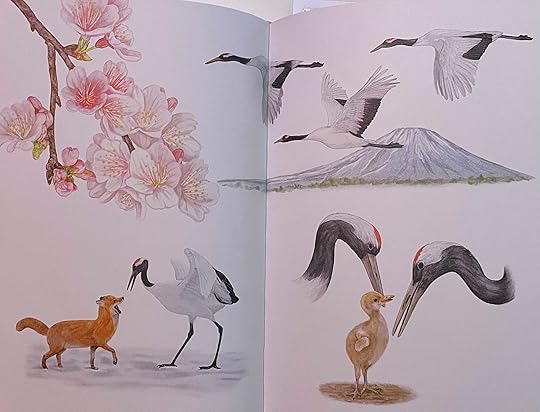
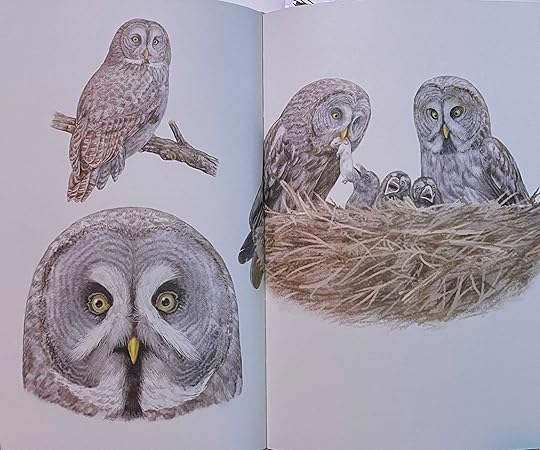
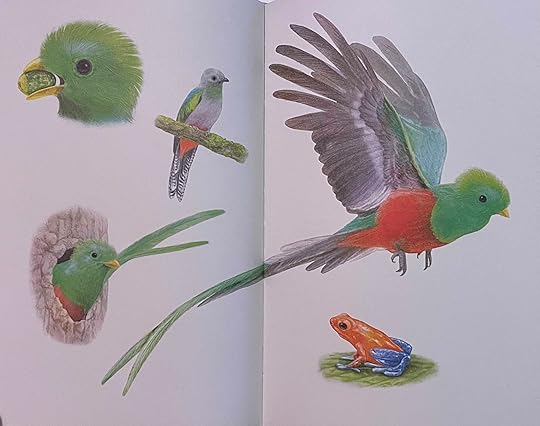
As the author said, he could likely have easily picked 80 different birds but the ones chosen are gorgeous. Some so brilliantly colorful and - I expect - quite detailed as many of the examples I have only seen in photos. The golden pheasant of China with it's bright yellow cloak. The intense green of the Guatemalan Resplendent Quetzal. The delicate dancing cranes of Japan. The white 'eyebrows' of a Great Grey Owl that actually sit on each side of his beak like migrating hairy caterpillars. . .
Each chapter discusses the bird, it's locale, migratory habits (if they do), word description of the male and female, mating and breeding along with time for eggs to hatch and how long the parents care for the chicks along with the level of conservation it currently sits at - not only in the wild but in private sanctuaries and zoos.
It's an attractive book just for the pictures but it also provides a great deal of information regarding the variety of birds that share our planet - from the flyers to the swimmers to the runners. All are unique and all have their niche that - in many cases - deforestation and chemical pollution is destroying.
Around the World in 80 Birds has been on my wishlist since we got it at the book store I work at, and I’m so happy I finally bought a copy. The book has everything you need to know if you want to learn a few facts about a total of 80 birds species. I’m thrilled to add this to my library and can’t wait to look at it more in the future. Birds are amazing creatures🐦
Along with some amazing illustrations, this book is something I would recommend for bird lovers, for those who wants to slowly learn about birds, or would like a book to look at every now and then to either get inspiration to which country to travel next or get instant facts💥🪶
Een reis om de wereld in 80 vogels. Door: Mike Unwin. Illustraties: Ryuto Miyake.
Na Een reis om de wereld in 80 planten en Een reis om de wereld in 80 bomen is er nu een boek over vogels. Weliswaar door een andere schrijver en een nieuwe tekenaar maar even indrukwekkend als zijn voorgangers.
Dit is een boek dat je niet van A tot Z moet lezen, mag natuurlijk, maar ik leg het boek het liefst naast het bed: om er vogel per vogel van te genieten. Wat voor vele mensen is ontstaan tijdens de lockdowns heb ik al veel langer: een liefde voor vogels. En hoewel ik geen kenner ben heb ik wel al vele vogelgidsen verslonden. Ik heb wel al ‘het één en ander’ gezien zou ik zeggen.
Maar Een reis om de wereld slaat me met verstomming: wat een kleuren, wat een variatie, hoe indrukwekkend mooi en boeiend. Van de meeste van de vogelsoorten heb ik nog nooit gehoord: rode rotshaan, vlaggendrongo, dwergmierpitta,… Andere ken ik wel maar in een lokale versie: Indische gans, groene gaai, grote renkoekoek,… Ik leer zo veel bij.
Unwin en Miyake leverden een interessant, mooi overzichtswerk van de meest fantastische vogels van de wereld. Mooi, mooi, mooi!
Read the Dutch hardcover Een Reis om de Wereld in 80 Vogels.
Loved getting to know birds I hadn’t really heard of before and learning more about old favourites. The illustrations in this book are absolutely gorgeous and made every page feel like a little gift. The information that’s provided for each bird is succinct but not insufficient. Just felt like a lovely introduction to a lot of new birds that I can delve into more. Would highly recommend!
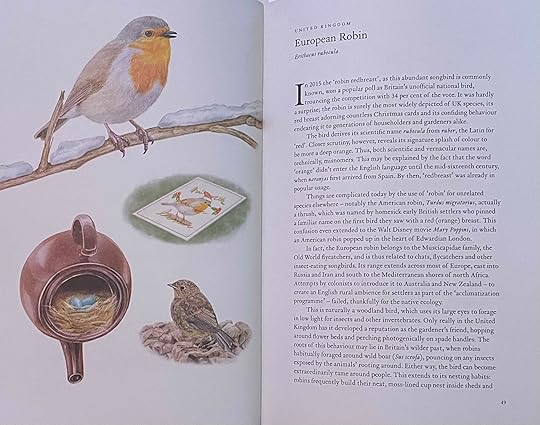
This is my favourite book of all time. It was perfect for a birding beginner with stunning illustrations and it’s written in such a charming and approachable style. I have been sharing bird facts with pretty much everyone I know for the last two weeks. Did you know that American robins are not actually in the same family as European robins and they were called robins by European settlers because of their red breasts!
I never really had grandparents. I mean, three were gone when I showed up and the one who was alive didn’t speak English and lived across an ocean so I saw her maybe five times. I’ve been really lucky in marriage many ways and one is that I’ve inherited a set of “grandparents in law” who’ve shared so much love and wisdom. My wife’s grandmother Donna and I played Scrabble, watched the Blue Jays, and, yes, talked birds. She gave me this book as a Christmas present just eight weeks ago … and died two weeks ago. I read it thinking of her. Flits and swoops into birds you may have heard of around the world – quetzals, kiwis, flamingos, oh my! – together with little behavioral or historical anecdotes that bring them to life. Plus: honestly the best bird illustrations I’ve ever seen. (Sorry Audobon!) I say: Buy it for the pictures! That’s why I laid the book face down in the picture above. Pinch in! That level of stunning art graces every single page. Ryuto, you nailed it. Great book for birders or birders-to-be. Maybe avoid if you’re already “advanced” as this may seem kind of surface for you. Highly recommended. (PS. Little synchronicity with Herman Hesse book above -- the poem / song Beim Shlafeneghen by Herman Hesse was sung by Donna’s niece at her funeral.
Can I count it as read if I've already forgotten almost all I learned? I would have been better able to process the information if it had been written up like a GR book blurb, with the size of clutch, lifespan, size of adult bird, etc., and just a one paragraph narrative. Then I could more readily compare birds and realize that, yes, this is a big parrot, but it's nowhere near the size of a big raptor, or whatever.
I'd also have appreciated it if he had actually listed the IUCN status for each as he promised in the intro. -sometimes he did but too often it was just an informal word like plentiful, and the one I was most curious about, given the text, the Satin Bowerbird, is not given any sort of status indicator at all.
He also promised something about the cultural importance of each bird. But he didn't include it for all, and it always seemed like it was given short shrift.
I did learn, from the entry for the Hoatzin, that DNA analysis does not necessarily resolve questions of taxonomy. I'm surprised & disappointed.
The art is gorgeous, though. I'd love to see lots more by the illustrator, and to own some prints, too.
Leí ya todas las descripciones de las aves ofrecidas en estas páginas, pero no terminé el libro.
En alguna reseña leí que Goodreads debería tener un estante para los libros de categoría “leyendo continuamente” y éste estaría allí. Hay libros que se quedan como recetarios de belleza, manuales para proyectos irrealizables o bitácoras de viajes a los que uno vuelve una y otra vez cuando se quiere volver a alguna base real.
(Æ leste boken i norsk men det er ikke tilgjengelig her på Goodreads. Dessverre klarte jeg ikke å bli ferdig med boken fordi jeg måtte levere den tilbake til biblioteket, æ var nesten ferdig ) Veldig fine Illustrasjoner og der var gøy å lære om så mange forskjellige Fugler. Imidlertid svært overfladiske tekster som fokuserer mer på forholdet mellom mennesker og fugler enn på fuglene selv. Derfor bare 3/5 stjerne.
Beautiful book. Although the text is occasionally dry, the immersive illustrations and relatively short blurbs about each bird make this a quick and thoroughly enjoyable read. This deserves a place on the shelf of every amateur birder.
It's a quick reading book with little information about 80 randomly picked birds by the author. Wonderful illustrations included. About most birds I've never heard about but it fascinated me pretty much that I ended up reading 'Wikipedia articles' about many of them. Loved it !
Oh my goodness, this book is beautiful. Not just in its artwork (which is spectacular!) but also in its detailed research and impossible selections. Unwin has outdone himself and I find myself wondering if he'll find another topic to explore the world with and grace us with a fourth in this series. What would it be? I don't know. But I hope he figures it out, because I really have enjoyed all of his books in this series.
Interesting enough. Enjoyed myself and especially loved the illustrations. Stylistically, this author's way of writing was clunky and awkward. Felt more than a little formulaic.
8/23/2022 Genuinely unsure how I've become some sort of go-to reviewer for books about birds, but I 100% love it, especially when it brings gorgeous, informative books like these into my inbox!
Around The World In 80 Birds is a delightful travelogue that uses birds as its focus. Charting the world by discussing eighty of the most distinctive birds found regionally -- or, in some cases, in extremely small, protected areas -- Mike Unwin discusses the scientific backgrounds, colorful histories and current realities of these remarkable avian creatures. The prose is wonderfully conversational, perfect for the amateur birder or naturalist (such as myself!) and accessible for a wide range of ages.
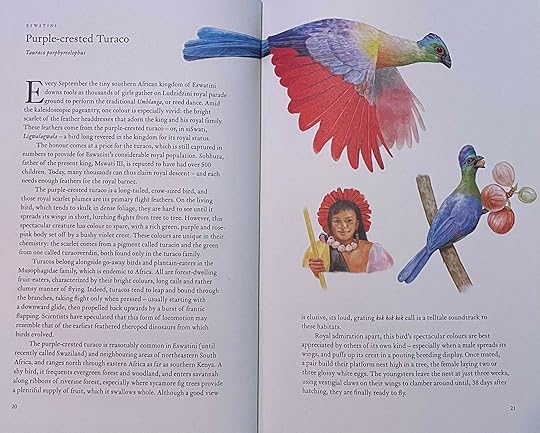
I really enjoyed the expansive variety of birds chosen here, with each entry bringing up fascinating new information about its subject, even when said subject was something I thought I already knew quite a bit of popular information about. From the bald eagle of Northern America to the jungle fowl of Southeast Asia, Mr Unwin always has something interesting to share regarding birds I thought was already well familiar with. And the entries on birds that were very much unfamiliar to me were absolute cornucopias of information. I'd never heard of the oilbird or the purple-crested turaco before but my world is much the richer for having learned about them here.
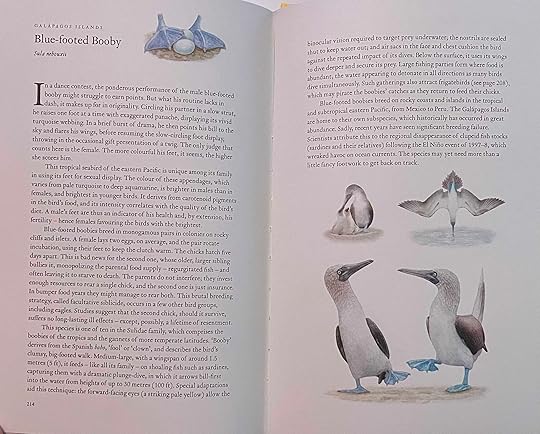
A lot of the credit for this volume, too, must go to Ryuto Miyake, whose full-color depictions of the birds, often shown in situ, are as dazzling as any illustration from the golden age of bird art. Birds are shown in their plumage, nesting and on the hunt and at play, and occasionally in their most common interactions with human beings. Their common prey and predators, and other images and symbols most commonly associated with each bird -- such as the distinctive man-made houses built for purple martins or the green swarm cloud of budgerigars in the wild -- are also portrayed, sometimes in insets, sometimes in two-page spreads. It's a remarkable show of artistic versatility, made even more impressive by the time constraints alluded to in the afterword.
The only criticism I have of this otherwise magnificent book is how occasionally scattershot the geography feels. This is much less obvious in the North American section, but is genuinely disorienting in both the South & Central American and South & Southeast Asian sections. It felt weird whipsawing back and forth across, for example, the Indian Ocean between entries instead of gradually leading from one region the next, but that's honestly a very minor critique.
This is a wonderful book to add to the collection of anyone interested in either or both birds and avian art. It's educational without feeling teach-y, and just incredibly gorgeous overall. Recommended.
Around The World In 80 Birds by Mike Unwin & Ryuto Miyake was published today August 23 2022 by Laurence King and is available from all good booksellers, including Bookshop!
-"LA VUELTA AL MUNDO EN 80 AVES" de Mike Unwin- . El mundo de las aves es un mundo sorprendente, y con los años, conforme ha ido aumentando mi contacto con la naturaleza y los animales, y mi búsqueda constante de la belleza, ha ido también creciendo mi admiración e interés por ellas. . La verdad que cuando te adentras el él, te das cuenta de que es mucho más sofisticado y fascinante de lo que pueda parecer. Yo he podido conocerlo un poquito mejor, gracias a “La vuelta al mundo en 80 aves”, un precioso libro que he ido leyendo a ratitos, y que de una manera muy atractiva y entretenida, hace un recorrido por 80 especies de aves de todos los rincones del planeta; desde el tejedor de Namibia, que construye bloques de apartamentos en medio del desierto, hasta el ánsar indio de China, un ave migratoria que atraviesa el Himalaya dos veces al año. . Y es que todas las aves tienen una historia que contar, y unas características propias que los hacen únicos y especiales, siendo además, una gran fuente de inspiración para la ciencia, la literatura, y el arte. . Desgraciadamente, no somos conscientes de su importancia, y del enorme valor vital que tienen, y ni mucho menos de los peligros a los que están sometidos, y la amenaza que suponemos nosotros para ellos. . Mención especial a la belleza de ilustraciones de Ryuto Miyake, que me han tenido embelesada toda la lectura. Y por si os pueden interesar, comentaros que @editorial_blume también tiene esta misma versión de libros, con temática de plantas, y árboles, ambos tan bonitos como este😍
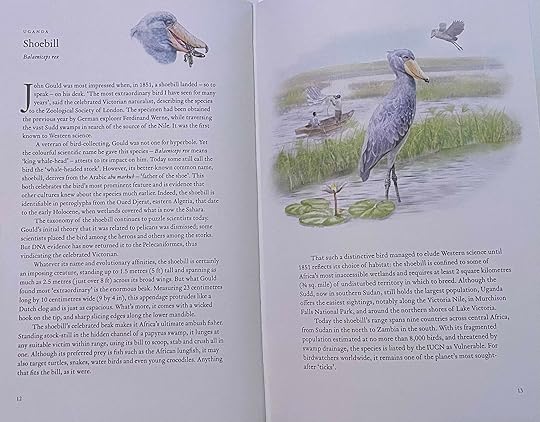
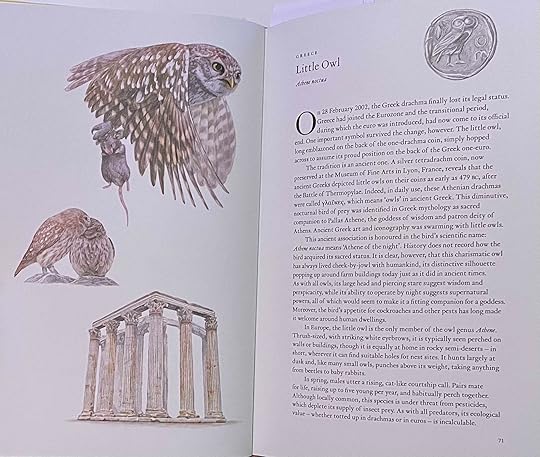
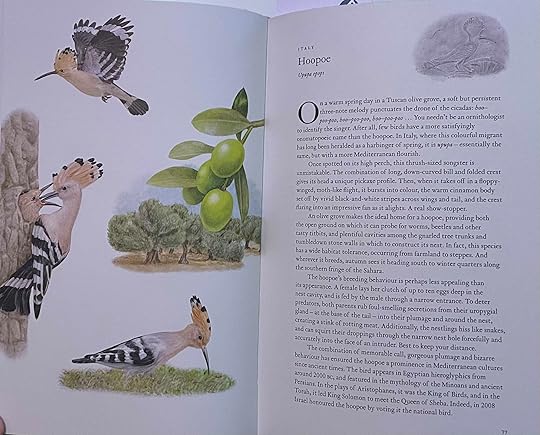
Gorgeous book. Limited to 80 birds but not limited in its appeal. Beautifully illustrated by Ryuto Miyake. The birds aren't chosen just for their visual appeal. They are selected to point out the many ways people have seen birds. Some are related to mythology, as the little owl is an emblem of Athena, patron goddess of Athens, Greece. Some are national symbols. The tiny Tororoi bailador was chosen to represent Colombia as a newly discovered species, to showcase the great variety of birds resident in that country. Some are not threatened, others are in danger, mostly through habitat loss to human activity. The writing gives a lot of interesting information on the history of the birds and how people relate to them. Organized by region: Africa, Europe, Asia, the Americas, Southeast Asia, Australia, Antarctica, and Pacific islands. oilbird (Venezuela), snow goose (Canada), hoopoe (Italy), cassowary (Australia), puffin (Iceland), shoebill (Uganda), kakapo (New Zealand), and many others. Highly recommended for anybody who loves nature. Especially bird fans of course. I plan to reread this again sometime.
A really beautiful book with some great tidbits and facts about 80 different birds from around the world. The art in this book - by Arturo Miyake - is something else and, to me, one of the biggest highlights.
That’s not to say the book itself isn’t good - it’s fantastic and has a ton of good information on in unique bird species. I do wonder how the author narrowed down his choices - some are VERY unique so you can understand why, while others sometimes are a little head scratching.
I also found that I wanted more of a consistent structure for each entry - ie. only some include information on if they’re endangered or vulnerable (or doing well), when the intro makes it seem like that’ll be key in the entries; meanwhile others talk of the social and cultural aspects of the birds (being added to flags, taken on as national emblems, etc) but others are just straightforward facts about the bird itself.
That little nitpick aside, it’s a fantastic book and definitely worth checking out for any other bird lovers!
I finished reading this a couple days ago, but I went back to peruse and take notes on interesting facts about the birds which fascinated me. (Five didn't interest me so much, like the wild turkey or the North Island Brown Kiwi). There are some weird birds! You will be mind-blown by how intelligent, peculiar, and resourceful these birds can be. I don't dub myself a bird enthusiast but after reading this I've gained a greater appreciation for the diversity and the lore behind each bird.
I am also looking forward to learning more about the animal kingdom. I tend to read a lot of fiction but there is an endless amount of material that will seem stranger than fiction if only we expand our horizons and open our minds to factual information. Great read--educational, interesting, accessible and comical to both non-bird-lovers and bird-lovers.
I forgot to add. Amazing work on the illustrations. Accurate!
I absolutely adored this book! The illustrations were superb. And the 1-2 pages of facts about each species were the perfect bite-size morsel. Some species were quite familiar, and others I had never heard of before. There was a pretty good range of birds from around the world. And each listing ended with how endangered the bird is/how impacted by human activities.
I learned that several species of birds have females who stay in a nest cavity for the entire duration of their incubation of eggs (maybe brick themselves in?) and their partner brings them (and the chicks) food.
I learned that for several predatory species the chicks stay with the parents for up to several years after catching to learn hunting techniques.
I learned that there is a huge diversity in the number of eggs that a pair will raise (as well as how many clutches they have per season). Far more birds than I expected only raise one egg per season.
This was an interesting book. It is a quick and easy read but still full of great detail and information. I learned new things about some birds I already knew, and a lot about new birds with which I was not previously familiar. The illustration are fantastic and add a lot to the volume.
The author is a Brit I believe. Some of the vernacular language is unusual for a speaker of American English. Not a complaint, not a chauvinistic critique (those fu**ing Americans!). I'm just sayin'...
The editors have done a good job adding non-metric equivalents for length and weight to the descriptions in the original.
Highly recommend this book for somebody like me who loves nature but doesn't know too much about it outside the mammal kingdom.
Overall, this felt like a satisfying return to this series, and I really enjoyed it! The illustrations are incredible, and the feel of this book makes it a luxurious read. I really enjoyed dipping in and out of it every morning.
Birds lend themselves to these short snippets so well, and I learned lots of really interesting facts! I also really enjoy the fact that this series focuses not just on birds, but on birds that are important to human populations in a variety of ways, as the human-bird interactions are always interesting.
I honestly only knocked off a star because the movement from region to region wasn't as smooth as I would expect with some geographic jumping around that could have been avoided.
Di solito sugli uccelli preferisco le guide da campo (mi piace dare un nome alle cose), e quindi credevo che non mi avrebbe interessato così tanto un libro contenente descrizioni di una pagina o due su specie di tutto il mondo… e invece mi è piaciuto moolto di più del previsto! Ho imparato tantissime cose su varie specie famose (non sapevo che gli struzzi vivessero in Africa, per esempio), ho scoperto l’esistenza di alcune specie curiose, come il Cacapò, e altri dettagli su alcune specie che già credevo di conoscere, come il rondone comune o il pettirosso. Un sacco di bellissimi disegni corredano il quadro. Una bellissima scoperta!
This was fun. The birds featured in this book are not always species found only in a particular country. Rather, they are selected for their cultural or historical significance. Some types of birds, such as woodpeckers, are entirely omitted. This is a curious choice, especially given their familiarity and the extinction of several notable subspecies (eg: the Ivory-billed Woodpecker). On the other hand, the book doesn’t feature any extinct birds at all, which may explain the omission.
Despite a few omissions, the book shares many interesting facts about the birds it features. I wished each entry was longer, but I enjoyed what I read.