Acclaimed children's author Kara LaReau was inspired to write this story after reading an article about school bullies. Ugly Fish is a big, mean and ugly fish. And because he's big and mean, he scares all the other little fish so that he can keep the fish tank all to himself. Ugly Fish enjoys swimming through his driftwood tunnel and eating his special briny food, and he won't share with anyone else. But when an even bigger, meaner fish shows up in the bowl, Ugly Fish doesn't feel so fearless anymore.
Kara LaReau was born and raised in Connecticut. She received her Masters in Fine Arts in Writing, Literature, and Publishing from Emerson College in Boston, Massachusetts and later worked as an editor at Candlewick Press and at Scholastic Press. Among other celebrated titles, she edited Kate DiCamillo’s Because of Winn-Dixie, The Tale of Despereaux, The Miraculous Journey of Edward Tulane, and the Mercy Watson series. She is the author of picture books such as UGLY FISH, illustrated by Scott Magoon, Baby Clown, illustrated by Matthew Cordell, and Goodnight Little Monsters, illustrated by Brian Won; chapter book series Witchycakes, illustrated by Ariane Moreira and The Infamous Ratsos, illustrated by Matt Myers; and middle-grade trilogies The ZomBert Chronicles, illustrated by Ryan Andrews, and The Unintentional Adventures of the Bland Sisters, illustrated by Jen Hill. Kara lives in Providence, Rhode Island with her husband and daughter and their cats.
About ten years ago, I happened on a complete aquarium kit at a yard sale for only eight bucks. What a deal, right? Of course it meant a trip to the pet store where the kids and I blew fifty dollars on fish and fish-related accessories. The store clerk was quite helpful as she advised my boys on how to carefully choose their new pets.
"Remember," she cautioned, "if one fish can fit inside another's mouth . . . IT WILL!"
Ugly Fish knows that lesson well. He is big fish (and only fish) in his tank, and he is fine with that. When another fish is introduced, well, Ugly Fish isn't about to share his aquatic abode. Down the hatch they go!
Hey, it's a dog-eat-dog fish-eat-fish world.
I guess some people see this book as having an anti-bullying message, but it doesn't really. Even if Ugly Fish had been sweet as pie to his finned fellows, he still would have It's the law of the jungle tank.
So, no real moral here. Just enjoy it for what it is - a wickedly funny tale for children who can handle the fact that cute things are occasionally tasty morsels for other cute things.
I liked this story but, oddly, I never caught on that it was a story about bullying until I read the author information on the back flap of the dust jacket. I just thought it was a story about how the tables can be turned on mean and self-centered people, and how those who are mean to others can be the victims of meanness in turn. I think what disconnected the bullying idea from the story for me was the fact that Ugly Fish ate his tank-mates. A bully doesn't generally destroy others; he wants them to live so he can bully them again. I also felt that the story ended rather abruptly, without the sense of closure I expect in picture book stories. It bothered me, too, that when Ugly Fish finally did feel lonely and began to act friendly, he wasn't rewarded for the change in attitude. Nevertheless, despite these problems, I think this book would generate a lot of discussion if read to a child or used in a classroom.
The eponymous Ugly Fish enjoys having his tank to himself in this darkly amusing picture-book from author Kara LaReau and illustrator Scott Magoon. Each new fish that is added to the tank is eaten by our ugly piscine hero, until loneliness prompts him to try a new tack. Unfortunately for him, the new addition to the tank, Shiny Fish, is just like him, only bigger...
The ending of Ugly Fish is sure to raise some eyebrows amongst those who expect picture-book fare to be sweet and light, with edifying morals. For those who enjoy more Jon Klassen-style tales, with a dark, pointed sense of humor however, it will probably be just the ticket. Parents and librarians be warned, the ending here (
I fail to see any positives in the message of this book. A bully fish chases any new fish in the tank and then eats them. Later, he suffers the same fate and a bigger bully fish takes over the tank. Not sure how to spin that with young readers.
Ugly Fish is a darkly humorous picturebook about, depending on how you look at it, either bullying or survival of the fittest (or, perhaps, survival of the biggest bully?).
Anyways, it's a lot of fun, especially for a storytime. In fact, that's how I first encountered Ugly Fish, and I remember LOVING it.
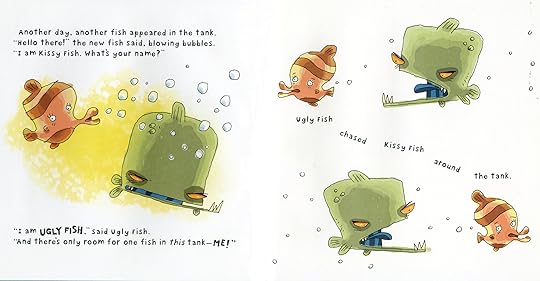
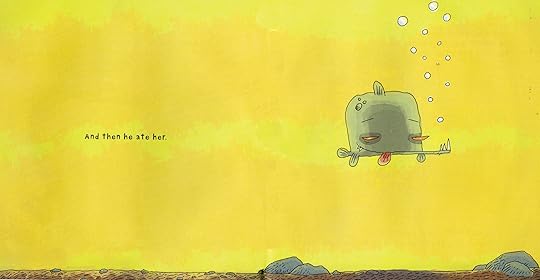
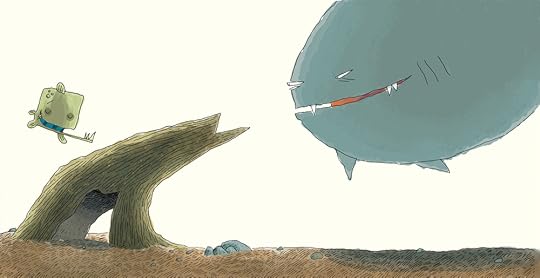
Scott Magoon's illustrations are simple, comic, and expressive:
P.S. Ugly Fish reminded me of my own "Tank of Survival" when I was in college.
Ugly Fish is the RULER of his tank and he likes having things his own way. He likes having his flakes each day, and he likes swimming around, but what he doesn't like is sharing any of those things with other fish. When they enter the tank, with their friendly smiles and happy attitudes he has a very special way of dealing with them. He EATS THEM!
Ugly Fish is content to live his solitary life until one day, he has a change of heart, and wouldn't you know it, in comes Smiley Fish...a much larger and less talkative tank-mate who may just be prepared to give Ugly Fish a taste of his own medicine.
Kids will love seeing Ugly Fish as he grumps around his tank, and the quick way he snaps up the new fish, but they will also see that being mean and not sharing is not the best way to find friends. Adults will love the semi-dark humor. The illustrations are in soft gray-shades, but are fun to look at.
A funny read, with one heck of a turn-around ending.
Ugly Fish is an onlyfish until one day a new fish appears in his tank. He chases it around and then eats it. Ditto the next roommate and the next, and the next. When he's finally alone (the way he likes it), he realizes that he enjoyed having someone around to chase - maybe he shouldn't have eaten all of his new friends? The next fish that gets introduced to the tank is a big fish, a BIGGER fish, and Ugly Fish goes out of his way to make the new fish feel welcome (he's going to do things right this time!). And then...Let's just say, you don't want to be the smaller fish.
Amusing. Ugly fish looks like a little green box with a grumpy expression and angry, unslept eyes. Great illustrations, Scott Magoon!
From the inside flap: "Ugly Fish is ugly and big and mean. And he'll never share his driftwood tunnel or his special briny flakes with ANYONE."
This entire review has been hidden because of spoilers.
I love this book. I have read it to children, adults, and college students, varying the message to fit the discussion. For children, there are powerful messages about bullying. For adults, there are messages about workplace politics, and how one should conduct themselves. For college students, I used this book when I taught creative writing and also when I taught a Psychology class. My own children love this book, and can relate on a simple humorous note. It is one to own, not borrow.
Ugly Fish likes his tank and the briny flakes that he’s fed. He loves swimming around in it so much that he doesn’t want to share it with anyone. So, because he’s big and mean and ugly, whenever another fish is introduced to his tank he eats them. But then he gets lonely and wishes for a friend. Unfortunately, his repentance comes too late, because the next fish in the tank is bigger than he is, and Ugly Fish is the one who gets eaten.
The moral is short and brutal, and the illustrations are whimsical. The appeal of this cautionary tale will be for those young readers or listeners, whose sense of justice naturally tends to an unsophisticated interpretation of the lex talionis in which the bad guy gets exactly what he deserves, the same thing that he dished out to others is what he must suffer.
Great illustrations, and a cautionary tale everyone sometimes needs to be reminded of, regardless of their age: If you act like a jerk, someone is going to settle your hash sooner or later.
Now rest assured, Ms Lareau does not use language like 'jerk' anywhere in this book. Instead it is about a pretty but greedy fish who did not want to share his home, despite repeated attempts to provide him with friends. When he finally comes around to the idea that it might be nice to have some company, his next friend isn't much interested in him. She presents the tale in a way that both surprises and horrifies - through in many repeated presentations at story time kids love this story and understand it - they aren't scared or horrified. Parents, and other adults, sometimes react in surprise and horror because the outcome is not saccharine, as most kids books.
Loved the pictures, good moral, entertaining story. The kids laughed a few times, and enjoyed the anticipation of discovering what lesson Ugly Fish was going to learn. I enjoyed that this was a book aimed at bullies instead of a book aimed at those who are bullied. Bullying requires a victim and an aggressor, and it's a problem that needs to be addressed from both angles. This book takes a look at the aggressive side of the equation in a way that is engaging, probably subtle for many kids, and in a way that opens the door for adults to discuss this issue with kids in a natural conversation. I thought this was a well done, entertaining book. And I loved the way Ugly Fish the fish was drawn! He was so ugly, he was cute!
Explanation of 5-star rating: I gave this book 5-stars because this book has a good amount of repetition and humor that an elementary student would love to read. Also, this book doesn't have the typical happy ending that comes with children's books so I think it would be of use to my classroom library.
How we might use this in our classroom/application of six traits: Of the six traits, I think this book expresses ideas well. The idea of the story is going to bring students in and keep them hooked on this story. I would use this book as a craft's mentor text to exemplify what a well-written ideal-driven story looks like.
Dr. McCracken's read aloud performance of this book made me love this book instantly. It is an entertaining story that will leave kids laughing and anticipating what comes next. The moral of the story is something that should be discussed after reading because students will have a varied natural response. The illustrations were great and engaging.
Ugly Fish is one of those picture books that sneaks up on you,cute and quirky at first, and then… BAM! That ending. Totally unexpected and darkly funny in the best way.
The story centers around Ugly Fish, who lives alone in his tank and likes it that way. He doesn't take kindly to visitors and makes sure they don’t stay long. The rhythm of the story feels playful and repetitive, lulling you into thinking you know where it's going until it veers sharply off course in the final pages. Let’s just say, if you're expecting a sweet redemption arc or a gentle lesson on friendship, brace yourself.
The artwork by Scott Magoon perfectly matches the tone: bold, moody, and slightly offbeat. It actually gave me Courage the Cowardly Dog vibes, with its exaggerated expressions and eerie charm. It works well here, enhancing the story’s slightly sinister humor.
This book won’t be for everyone, especially if you're expecting a traditional happy ending, but if you enjoy a little twist and some dark humor in your picture books, *Ugly Fish* delivers with a splash. Great for kids who like their stories a bit edgy and for adults who appreciate clever storytelling with an unexpected bite.
I want to remember this book for my future classroom because of the message that it teaches: you can change, but your reputation follows you and is unfortunately what people will see first regardless of the changes you have made. The response activities with the lesson are limitless, and I believe that students would really enjoy and connect with the story. It is comical, but it is also packed with truth.
Conceptually, this book reminded me of I Just Ate My Friend, with a similar focus on friendship and impulse control (or lack-there-of). However this one seems to have more of a bullying angle. It's certainly very funny, however I'm not sure that the final lesson is a very happy one. I guess it just pays to be top of the food chain.
This book is not what I expected. It kind of turned out to be a violent book for small children. I would, however, use it in a first or second grade classroom to teach a lesson on being nice to others even if they are not like you or you are having a bad day. It could also teach something about what goes around comes around.
Ugly Fish kind of caught me by surprise actually. The story is a little much for really little children although they might think of it as humorous. I didn't like it, the part that kids would remember would be when each of the fish was eaten. I don't like the "lesson" taught in this one and would not choose to read it to my students or my own children.
This was such a funny, laugh-out-loud book. From the illustrations to the text, this is just absolutely wonderful, especially in regards to the come-uppance of bullies and the like. Overall, this is great for grades 1 to 3, and just perfect for reading out loud to a bunch of youngsters.
This book was fun to read! I think it's a great book to read to students and use various kinds of voices for the characters to get the students even more excited. This was definitely a 5/5 star since the illustration and the writing blended well together to create a story with a moral lesson.
This book was such a fun read, and I enjoyed every part of it. I gave this book five stars due to it being creative, and the development of the main character, Ugly Fish. Also, the ending of the book was perfect due to it showing that we have to be careful with the decisions you make over the course of your life.
Reading Level: DRA Level: 30 Guided Reading: N Trait: ideas
I gave this book 5 stars because of how effective the organization, plot, and voicing was at communicating the moral of the story. Ugly fish did not want to share and was able to keep things all to himself simply because he was the bigger fish. When he was no longer the bigger fish, things did not go his way anymore.
This story works because of it's ideas. The story line was a bit morbid, but done in a funny way. The message of the story helps students see how being kind to everyone is not only the right thing to do, but we may experience other people's unkindness and realize that we should be kind.
This book was one of my favorites because it is simple and shows importance of treating others around you the way that you would want to be treated. I would like to read this in my classroom one day because it shows students that it is important to be nice to others and share with the others who are around you.