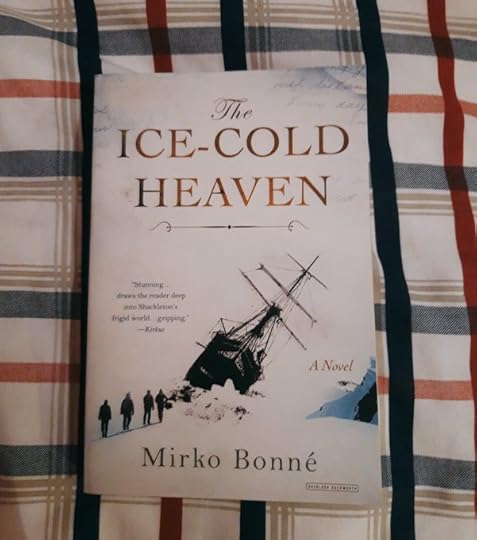
August 1914. Während über Europa der »große Krieg« aufzieht, beginnt Sir Ernest Shackleton eine gewagte Expedition. Als Erster will er den antarktischen Kontinent zu Fuß durchqueren. Mit an Bord seines Schiffes ENDURANCE: 69 Schlittenhunde, ein Grammophon, ein Fahrrad - und ein blinder Passagier. Zwischen Ölzeug und Gummistiefeln versteckt, nimmt der 17jährige Merce Blackboro Kurs auf den Südpol. Über das subantarktische Südgeorgien geht die Fahrt ins Eis. Doch der antarktische Sommer ist kurz, die Durchfahrt bleibt verschlossen. Im Weddellmeer wird die ENDURANCE über Monate vom Packeis eingeschlossen; von da an driftet sie einem ungewissen Schicksal entgegen. Für die 28 Expeditionsmitglieder beginnt eine entbehrungsreiche Odyssee durch die Weiten des Südpolarmeers, zusammengehalten von Shackletons unbeugsamem Optimismus, vorwärtsgetrieben von Kälte, Hunger und der Hoffnung auf Rettung.
Mirko Bonné wurde am 9. Juni 1965 im oberbayrischen Tegernsee geboren und zog 1975 nach Hamburg, wo er seither lebt. Er besuchte das Hansa-Gymnasium in Hamburg-Bergedorf und machte 1986 Abitur am Otto-Hahn-Gymnasium in Geesthacht, ehe er Zivildienst auf einer Krebsstation leistete, als Buchhandelsgehilfe, Altenpflegehelfer und Taxifahrer arbeitete und fast zwanzig Jahre lang Teilzeitredaktionsangestellter mit poetischem Geheimauftrag bei einem Yellow-Press- und TV-Zeitschriftenkonzern war. Seit Beginn der Neunzigerjahre ist Mirko Bonné als Autor und Übersetzer tätig.
I'm obsessed with Sir Ernest Henry Shackleton and by extension, all of Antarctica. He is my #1 hero. Shackleton's Endurance expedition is my most favorite. I've read dozens of books about it. I can spout off endless facts at the drop of a hat. I really, really love it. I have an incurable case of the ice fever.
So, having said all that, I think I would have enjoyed this book more if I didn't love the subject so much. Bonné took numerous liberties with the facts, and since I know them all, it nearly drove me crazy. Why did he change Perce Blackborow's name to Merce Blackboro? Why did he switch Blackborow's and Holness' roles in the trip to Elephant Island? Why in the world did he so radically change the journey on the James Caird? Why did he make Blackborow Shackleton's confident? There are many, many more inaccuracies. The truth is a really good story. There wasn't a need to change it. I didn't need it to be exact, but the willful changing of major details was just wrong.
My other big problem was the characterization. He perfectly portrayed the veneration that the crew had (and that I have) for Shackleton. Bakewell's unapologetic American-ness is spot on, and Blackborow was pretty good. But Worsley was almost unrecognizable, and Hurley was almost as bad. Vincent's character arc was almost completely fabricated. I've read so much about these people that it was jarring to read portrayals that were so different from the truth.
However, there was some good. Bonné's writing is gorgeous, especially when he is talking about South Georgia Island or the Weddell Sea. There were multiple times when it left me speechless. I absolutely want to read more by him because of this.
Last Saturday was the 100th anniversary of the sinking of Endurance. 100 years ago today, Shackleton and his 27 men were camped on an ice floe in the Antarctic circle trying to figure out how they were going to get home without a ship. It is my most favorite story of all time but this rendition didn't do it justice at all.
I don’t know if this book was translated and the translation got messed up, but the writing was atrocious. I couldn’t even last an entire chapter before wanting to drop it. It felt like a kid saying “hey, my name is —- and I’m going to join the Antarctic expedition because it’s cool and I want to be cool. Come join me on my adventure”.
Blech, no thanks. How is that set in the tone and voice of a 1914 stowaway??
On top of that we keep jumping here and there so fast I don’t understand what’s going on and don’t want to. Everything is told to you and there continuous moments of info dumps.
Notice Men wanted for hazardous journey. Small wages. Bitter cold. Long months of complete darkness. Constant danger. Safe return doubtful. Honor and recognition in case of success. Ernest Shackleton
“More than five thousand people replied to that,” says Worsley
- Liam ÓMhaoldomhnaigh says: " don't think this book is widely known. It's tells the story of Perce Blackborow, the young, Welsh stowaway of Shackleton's 'Endurance'.
- SAnandakrishnan the glaciologist says: Will take a look. Also enjoyed Mrs Chippys Last Expedition by Caroline Alexander. Mrs chippy was the ship cat and one of the famous pictures from Shackleton’s expedition is of mrs chippy sitting on Blackborrows shoulder...
Diezgan garlaicīgs stāsts par neveiksmīgu ekspedīciju ledājos. Nevienmērīgs un vietām lēkājošs stāstījums, lai gan ne bez izdomas un talanta. Galvenais varonis īpaši neuzrunāja un nerosināja līdzpārdzīvot. Un ik pa brīdim pilnīgi neloģismi - komanda iestrēgusi ledos, pārtika tuvojas beigām, bet visi draudzīgi izmet ārā kasti ar žāvētiem augļiem, jo vīģes nevienam negaršojot... Visi suņi un arī kuģa kaķis apēsti, ceļā dodas mazā glābšanas ekspedīcija - un te pēkšņi izrādās, ka ir simtiem konservu kārbu un galešu, ko viņiem dot līdzi... No līdzīga klāsta darbiem līdz, piemēram, Dena Simmonsa "Teroram" šim tālu, ļoti tālu.
This book was such a slog. It went along alright for the first hundred pages, but then began to slow. There were character relationships that were very confusing and poorly developed, especially Vincent’s (which I have learned since is almost entirely fabricated). It definitely had some beautiful descriptive imagery, especially of the vastness of the antarctic, but on the whole left me feeling muddy-headed and not really like I had much of an insight into anything except maybe the hero-worship and determinism of Shackleton himself. I have no issue with fictionalization of historical people and accounts, it can be done quite well, but the style of writing is just poorly suited to an adventure narrative. The ending as well was quite abrupt and poorly stapled together. It felt to me like the author got tired of writing it. I certainly got tired of reading it.
A super book on the Voyage of Sir Ernest Shackleton and his crew to the Antarctic on board the ship Endurance. This story tell you of courage and bravery of the 28 crew as the journey and get trapped in the ice at the coldest parts of Earth.. as these men were lost to the world for 635 days.. unbelievable story.,
I just couldn't get into the story. From page one, it just seemed to drag along. Once I read the acknowledgments and discovered that some characters weren't actual members of the crew, that was enough for me. I couldn't even finish this book.
I finally finished it. This book seemed to take forever to read. I found it interesting but I had a hard time getting into it. I wish it ended better. The ending seemed brief in comparison to the rest of the book. I do wonder how much it being translated to English changed it.
This exciting and largely factual novel tells the story of Sir Ernest Shackleton's Trans-Antarctic Expedition of 1914–16. I read about it in a list of German books in translation recommended by the Frankfurt Book Fair. Unlike many others in the list, however, it is quite straightforward rather than "literary" in tone. Mirko Bonné's language, at least in Alexander Starritt's clear translation, is always vivid, but makes no attempt to be poetic or picturesque. His chronological narrative eschews the modern fashion for telling stories backwards or encasing one narrative in another. In fact, I even wondered if I had stumbled into a young-adult book by mistake, not least because Bonné rather implausibly invents a 16-year-old stowaway from South Wales named Merce Blackboro as his narrator. The tone gradually changes during the course of the book, leaving behind the simple adventure-story quality of the opening, but all the same I would enthusiastically recommend it to any teenager capable of being thrilled by tales of exploration, companionship, and endurance.
In fact, though, Merce Blackboro is not entirely invented. There was indeed a Welsh stowaway on the Endurance (Shackleton's ship), named Perce Blackborow; Mirko Bonné admits to slightly changing his name to match his own initials and become, in effect, his alter ego. I am sure he has also considerably filled out his back-story and character, and given him a role in the expedition rather different from that of his near-namesake. Shackleton takes a surprising interest in the boy, probably impressed by how well he stands up to their tempestuous first meeting, and makes him his personal steward. Although I did not see much of the scholar in Merce as he is first introduced, the great explorer singles him out as a kind of intellectual apprentice. Soon he has read most of the classics of polar exploration in his mentor's library, giving him an ability to see their rapidly worsening situation in perspective, which earns him the respect of most of the other members of the crew. All these others are real people, whose thoughts and dialogue Bonné may have imagined, but not the basic facts of their histories. What started out as a story of conquest and exploration becomes instead a novel of how many different personalities working under a strong leader get along together in atrocious circumstances and help one another survive.
Stop reading now if you want to let Bonné tell the story in his own way; the rest is history.
The history books about Imperial Trans-Antarctic Expedition about are pretty dry. This fictionalization by Mirko Bonne puts faces and personalities on the voyage. He played a bit lose with the facts, but hey, it is fiction. It was enjoyable even though I knew what was going to happen. The Ice-Cold Heaven allows one to imagine a more human side to polar exploration.
I have previously Read one non-fiction book about Shackleton’s disastrous Antarctic voyage. This trip was a disaster but heroic in so many ways. That seems to be the story of many British polar expeditions.
Stop here if you do not want to know what happened.
Shackleton got no where near he was supposed to go, so he did not land on the ice, and did not complete his trip across Antarctic. His ship got caught in the ice and eventually crushed and sunk by the ice. At that point he took his men on trip over ice, hauling on sleds, the various small boats from the Endeavor. When the ice gave out they sailed up the Antarctic Peninsula to Elephant Is. At this point he and 5 others, sailed the best of the boats on an amazing small boat voyage to S Georgia. When they could not make it around S Geourgia, S took two men and crossed the mountains and glaciars on foot, sliding down the a could part of the descent, to a Norwegian whaling station. We sent help for the three men on the S side of the island, then rescuded the guys stranded on elephant I. He did not loose a man, although several died on team that made a food cache he was supposed to reach after crossing A. In some ways Frank Worsley, who navigated the open see crossing and his ship’s carpenter, Harry McNish, who remade the life boat into a sailing ship that could make the voyage are the real heroes. But it was Shackleton’s will that kept everyone together and going. By the way there are some surviving photos by Frank Hurly from the expedition in the newer non-fiction books.
An enjoyable story, with interesting information about the final Ernest Shackleton trip to the Antarctic, but unfortunately there was a complete lack of tension or drama, which should have been central to historical fiction. Several years ago I read Peter Fitzsimon's "Mawson and the Icemen of the heroic age", which was a factual account of various Antarctic explorations, including Shackletons, and I found the level of tension and engagement in the way in which he related the truth was much more engaging than this one. With a lack of character development, the story became a little tedious as time went on and by the end I didn't really care what happened to them. Pity; I generally put historical fiction among my preferred categories.
A nice fictionalized version of Shackleton's expedition. Emphasis on the fictionalized. I'm guessing the Germans don't really learn much about Shackleton? Probably not. Either way, if you're looking for a historically accurate story of Perce Blackborow (I still can't figure out why Bonne changed the name to Merce. I don't think Perce means anything dirty in German. Maybe it's slang for something that I can't find in my dictionaries? Curse my useless German degree) read "Shackleton's Stowaway" by Victoria McKernan. Far better written and closer to history.
Also, why did poor Holness get stuck with Blackborow's frostbite? Poor Holness.
The thing is... this book made me feel like I was in a foggy cloud surrounding the main character, in the way that I didn't feel like I was totally present in the scenario because a lot of seemingly important details were simpy not told. Also, the book was not very suspencious for the most part. But I must say, especially to the end, I started to really enjoy it, for example when things got intense. After reading it, it felt weird to read other books that weren't set in a world full of ice. So, I guess it still kinda got me invested in the setting and athmosphere. And, another pro is that it's a little hoistory and geography lesson ;)
This is a fictionalized account of Sir Edward Shackleton's failed attempt to cross the Antarctica on land. The young man who narrates the story, Merce Blackboro, is based on the character of Perce Blackborrow, who was a member of Shackleton's crew. Bonne does a great job of describing the events that occurred, with some poetic license, of course. I love stories about Shackleton and exploration and survival in general, so I found this to be a great read.
8/10 VFM 28%. A really enjoyable book, especially given I have zero interest in explorers or the Antarctic! Well written, excellent translation from the German and a fascinating tale based on a true story. Could only have been improved by a few pictures and maps as even Google maps are scarce on detail down there! Worth rereading and a keeper. Even better, hardback was only £1 from the poundshop !
While this fictionalized account of a stowaway on Ernest Shackelton's trip with the ENDURANCE is interesting, it is not as interesting as the real account that Ernest Shackelton wrote about this voyage and their struggle for survival. The book is still in print and very worth reading.
This was one of those "grab it on the way out of the library" books. I didn't expect to enjoy it so much. It's a fictional account of the Shackelton expedition from the standpoint of a (very real) stowaway. Beautifully written and very engaging.
This work is a translation from German. However, the translator is not credited with the book details nor is this book found under the name of the translator. Please add the name Alexander Starritt.
I need to read the book again to provide a balanced review.
I love reading books about this kind of topic because it scares me. I just can't imagine what it would be like to be caught in ice during a time that gives no option of rescue. It was a bit long winded, which is why I took off some stars, but still a good read.
I found this to be a good read, though very slow moving. adventure and survival in this fictional telling of Shackleton's attempt to cross the Antarctic