

What do you think?

Déogratias
Le génocide rwandais. 8e prix René-Goscinny.
80 pages, Hardcover
First published January 1, 2000
About the author
Jean-Philippe Stassen
12 books22 followersBorn and raised in Belgium, Stassen has traveled all over the world. His books have been published in many languages, and his remarkable artistry has won him many awards. Some of his works are imbued with the places he lived, such as Tangiers in The Old Frenchman's Bar. From the Maghreb to Latin America, to South Africa and Mozambique, Stassen eventually settled with his family in Rwanda, where they live today.
Ratings & Reviews
Friends & Following
Create a free account to discover what your friends think of this book!
Community Reviews
Displaying 1 - 30 of 251 reviews

November 4, 2017
GRAZIE A DIO PER COSA?

Con tutti i cadaveri sparsi in quei cento giorni, i cani si trasformarono in predatori, bestie feroci.
Ambientato in Rwanda subito prima e subito dopo il genocidio del 1994, questo fumetto racconta la storia di Deogratias, un ragazzino che ha due sorelle, Apollinaria e Benina.
Deogratias è hutu e le sorelle e la mamma sono tutsi: una piccola differenza che diventa enorme. Come dire che il conflitto inizia in casa.
E Deogratias è perfino innamorato di una ragazzina tutsi.

Il fumetto ha un’introduzione che sintetizza la storia del Rwanda che ha portato al genocidio.
Il belga Stassen non è tenero con i suoi compatrioti, responsabili della divisione etnica (le carte d’identità con il presunto gruppo etnico chiaramente specificato furono uno strumento che condannò a morte migliaia di tutsi). E non è tenero neppure con i vicini francesi: nelle sue tavole mostra la loro collaborazione con i genocidari, che rifornirono di armi in modo massiccio (a cominciare dal figlio dell’allora presidente Mitterand).
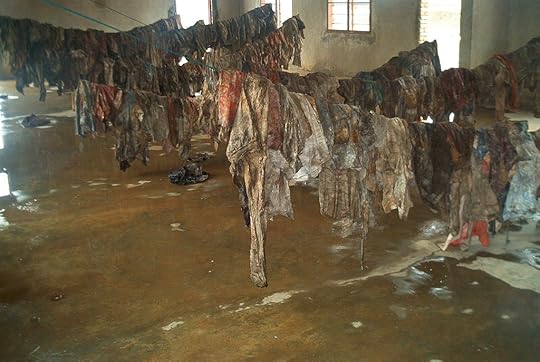
Murambi, il Memoriale del Genocidio: i vestiti dei cadaveri recuperati dalle fosse comuni, lavati e stesi ad asciugare, potevano aiutare a dare un’identità ai corpi.
Inizia come un’ordinaria storia d’amore adolescenziale, un ragazzino innamorato di una ragazzina. Ma morte e follia sono in agguato, complici alleate e intrecciate.
Il confine tra normalità e pazzia s’assottiglia e sfuma per Deogratias, che si trasforma in un cane, scelta estetica di Stassen per rappresentarlo come assassino.
Come sempre la campana non suona solo in Rwanda, solo in Africa: non solo lontano da noi, ma anche qui, più vicino di quanto si possa pensare, nella nostra stessa testa.
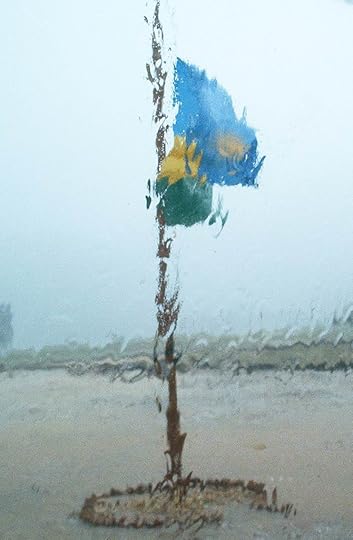
La bandiera del Rwanda.
Con tutti i cadaveri sparsi in quei cento giorni, i cani si trasformarono in predatori, bestie feroci.
Ambientato in Rwanda subito prima e subito dopo il genocidio del 1994, questo fumetto racconta la storia di Deogratias, un ragazzino che ha due sorelle, Apollinaria e Benina.
Deogratias è hutu e le sorelle e la mamma sono tutsi: una piccola differenza che diventa enorme. Come dire che il conflitto inizia in casa.
E Deogratias è perfino innamorato di una ragazzina tutsi.
Il fumetto ha un’introduzione che sintetizza la storia del Rwanda che ha portato al genocidio.
Il belga Stassen non è tenero con i suoi compatrioti, responsabili della divisione etnica (le carte d’identità con il presunto gruppo etnico chiaramente specificato furono uno strumento che condannò a morte migliaia di tutsi). E non è tenero neppure con i vicini francesi: nelle sue tavole mostra la loro collaborazione con i genocidari, che rifornirono di armi in modo massiccio (a cominciare dal figlio dell’allora presidente Mitterand).
Murambi, il Memoriale del Genocidio: i vestiti dei cadaveri recuperati dalle fosse comuni, lavati e stesi ad asciugare, potevano aiutare a dare un’identità ai corpi.
Inizia come un’ordinaria storia d’amore adolescenziale, un ragazzino innamorato di una ragazzina. Ma morte e follia sono in agguato, complici alleate e intrecciate.
Il confine tra normalità e pazzia s’assottiglia e sfuma per Deogratias, che si trasforma in un cane, scelta estetica di Stassen per rappresentarlo come assassino.
Come sempre la campana non suona solo in Rwanda, solo in Africa: non solo lontano da noi, ma anche qui, più vicino di quanto si possa pensare, nella nostra stessa testa.
La bandiera del Rwanda.

July 5, 2018
I don't really feel capable of giving this a full review without first reading more about the Rwandan Genocide. I can say that the art didn't really feel emotive enough for the harrowing subject matter. It's not a happy story. It's not an easy read. But from a purely literary standpoint, I didn't feel that it told me enough to really understand the character and so I didn't feel 100% engaged, which is essential for a subject like this one.
When I have time I'm going to go back and read some non-fiction on the subject and try and revisit this.
When I have time I'm going to go back and read some non-fiction on the subject and try and revisit this.

September 13, 2012
This is what I wrote in September 2012, when I had read a fraction of the graphic novels I have read now:
Rwanda, genocide, told through a very complex lens, a graphic novel, beautiful and agonizing, not for kids…maybe.
I gave it five stars in part because I thought it was uniquely focused on social justice issues, and thought that was rare. I also had read books on the Rwandan genocide and thought optimistically that it might be read by a YA audience in schools.
Since I am teaching a YA class this summer, I reread this novel, which would seem to be partly autobiographical about a Belgian main character named, like the author, Philippe, though I can't be sure of the nature of the connection to the author. It is written and illustrated by Stassen. I think the art is just okay now, and the story sort of opaque and not that insightful about the genocide. It's not for a YA audience; threes some some issues of appropriateness, and I just don't think a kid would gain insight or have interest in it. It was a winner of a big comics award in Europe when it came out, but I just don't think it is all that great now. There are moments when it evokes the horror, of course. Deogratias experiences the loss of love… and sanity, in the process. But I still think overall it lacks impact for me as it may initially have done.
Rwanda, genocide, told through a very complex lens, a graphic novel, beautiful and agonizing, not for kids…maybe.
I gave it five stars in part because I thought it was uniquely focused on social justice issues, and thought that was rare. I also had read books on the Rwandan genocide and thought optimistically that it might be read by a YA audience in schools.
Since I am teaching a YA class this summer, I reread this novel, which would seem to be partly autobiographical about a Belgian main character named, like the author, Philippe, though I can't be sure of the nature of the connection to the author. It is written and illustrated by Stassen. I think the art is just okay now, and the story sort of opaque and not that insightful about the genocide. It's not for a YA audience; threes some some issues of appropriateness, and I just don't think a kid would gain insight or have interest in it. It was a winner of a big comics award in Europe when it came out, but I just don't think it is all that great now. There are moments when it evokes the horror, of course. Deogratias experiences the loss of love… and sanity, in the process. But I still think overall it lacks impact for me as it may initially have done.
July 18, 2009
Although the graphic novel is comparable to that of a comic book in appearance, this particular graphic novel is anything but comical. This book is about a horrific genocide that took place in Rwanda, Africa as recent as 1994! Over 800,000 African men, women, and children were brutally murdered while the rest of the world stood by and did nothing, and in this novel J.P. Stassen brings the story of this unimaginable event to his readers in an extremely unique and creative way. The visual images that Stassen provides helps the reader to follow along effortlessly with the protagonist,a young Rwandan/Hutu boy who is forever psychologically damaged by the civil war taking place. People are mutilated with machetes, and women and girls are brutally raped in unimaginable ways, however, the images in this graphic novel does not reflect those sorts of images. The images are very appropriate for young adults and not "graphic" in that way at all. They simply follow the life of a young Hutu boy and the events taking place around him as well as the personal struggles he is faced with. There is an introduction in the beginning of the book that gives a brief background of the incident which helps the reader to better understand the novel. For me, the novel gives a whole new meaning to the term "divide and conquer." It validates my belief that this has been a strategy often used by the few to rule and control the many, a theory that Dr. Martin Luther King once spoke of. Wow! all I could think about after reading this novel was the power of propaganda, the skillful use of the "divide and conquer" tactic, and the "see no evil, hear no evil" motto when there is nothing to be lost or gained. But mostly I am left saddened and sorry for the people of Rwanda, while at the same time angry and appauled with the U.S. (the so-called world's police) for just standing back and doing nothing to help save the lives of hundreds of thousands of human beings.

January 1, 2015
This is a stunning graphic novel. I absolutely loved the drawings, with their thick black contours, the colors and the style.
It's the story of Deogratias, a Hutu kid who lived through the times of the genocide in Rwanda. The horrors he's been witnessing cause him to lose his mind and become an alcoholic. There are many flashbacks to when he was younger and healthier, but unlike other reviewers I did not find that confusing. I think it's a story well told.
I also thought that the editor's idea of writing a summary of Rwanda's recent history as a forward to the book was a very good one. This way, westerners who did not have the chance to familiarize themselves with those events can learn a lot from this small book. And this is where this book is really important, I think: in our culture, we are constantly reminded about the WWII holocaust and other tragedies, but not much about the suffering that these poor people of Rwanda had to endure, on both sides, Hutus and Tutsis.
As an aside note, the author doesn't seem to have a great esteem of Rwanda's missionaries and priests, as they come across as hypocrites and cowards in his story.
Another note: the book description above is incorrect. Deogratias is not in love with Benine, but with her sister Apollinaria.
my wonderful blog is here
It's the story of Deogratias, a Hutu kid who lived through the times of the genocide in Rwanda. The horrors he's been witnessing cause him to lose his mind and become an alcoholic. There are many flashbacks to when he was younger and healthier, but unlike other reviewers I did not find that confusing. I think it's a story well told.
I also thought that the editor's idea of writing a summary of Rwanda's recent history as a forward to the book was a very good one. This way, westerners who did not have the chance to familiarize themselves with those events can learn a lot from this small book. And this is where this book is really important, I think: in our culture, we are constantly reminded about the WWII holocaust and other tragedies, but not much about the suffering that these poor people of Rwanda had to endure, on both sides, Hutus and Tutsis.
As an aside note, the author doesn't seem to have a great esteem of Rwanda's missionaries and priests, as they come across as hypocrites and cowards in his story.
Another note: the book description above is incorrect. Deogratias is not in love with Benine, but with her sister Apollinaria.
my wonderful blog is here

September 12, 2010
Deogratias, the protagonist of this graphic novel, is a young boy, living in a country torn by ethnic strife as the Hutu prepare and eventually attempt to eliminate the Tutsi. The story swings back and forth between the time before and after the genocide, and readers watch as a young boy concerned only about girls transforms into a young man tortured by his memories.
I was struck, emotionally, by the plight of Deogratias as he suffers mentally in the brutal aftermath of the genocide. His madness sinks my soul in anguish. And yet, overall, I was a bit disappointed. The juxtaposition of past and present seemed less than ideal, and the lack of depth to the plot and the characters left me feeling as if I had just scratched the surface of the story. Honestly, I enjoyed the text-based introduction to the graphic novel more as it informatively and evocatively covered the historical situation.
I was struck, emotionally, by the plight of Deogratias as he suffers mentally in the brutal aftermath of the genocide. His madness sinks my soul in anguish. And yet, overall, I was a bit disappointed. The juxtaposition of past and present seemed less than ideal, and the lack of depth to the plot and the characters left me feeling as if I had just scratched the surface of the story. Honestly, I enjoyed the text-based introduction to the graphic novel more as it informatively and evocatively covered the historical situation.
June 11, 2018
The introduction provided me with much needed knowledge on the Rwanda genocide and history. It helped me to better appreciate the story of Deogratias, a man who suffered through the horrors of war. Deogratias’ tale unfolds dually with both past and present represented - the reader is able to tell the difference due to the state of Deogratias’ white shirt (pristine and new in the past, dirty with holes in the present). As with the shirt, this graphic novel’s art adds a lot to the story and invokes emotion. Ultimately, the reader learns of Deogratias’ ordeals and his now broken mind and soul. It was heartbreaking and frustrating and unfortunately too real.
Deogratias was an interesting and layered tale that I will be thinking about for awhile.
Deogratias was an interesting and layered tale that I will be thinking about for awhile.

Read
November 26, 2008I'm going to have to read this a few more times before I'll be able to talk intelligently about Deogratias. The constant time shifts, flashbacks, and parallel narratives make for a very difficult read. Beautiful art, at times disturbing and provocative.
Like other reviewers, I want to say that I know not nearly enough about the Rwandan genocide. I need to read more.
I read this book because I'm considering designing a unit around it. The language and at times the content is much more mature than I'd been expecting. Yet, these aren't words or images high schoolers haven't seen before. But, wow.
Seriously, going to have to reread this one.
Like other reviewers, I want to say that I know not nearly enough about the Rwandan genocide. I need to read more.
I read this book because I'm considering designing a unit around it. The language and at times the content is much more mature than I'd been expecting. Yet, these aren't words or images high schoolers haven't seen before. But, wow.
Seriously, going to have to reread this one.

November 28, 2018
Interesting. I'm curious about the target audience here—not YA, surely? There's some useful context at the beginning, before the graphic novel starts, that I think would be necessary for readers coming in without much understanding of the Rwandan genocide. That said, I could have used a bit more context within the story: I wasn't sure how much time had passed by the end, or how much danger the surviving characters were still in. More a tiny slice of life and war than anything?
It doesn't shy away from the horrors of genocide, which...it's a choice I support but makes for horrific reading in places. Some of the illustrations are not for the faint of heart. The illustration style (thick, swift strokes, almost caricatures in places) is not my choice of style but seems a good fit for the story.
It doesn't shy away from the horrors of genocide, which...it's a choice I support but makes for horrific reading in places. Some of the illustrations are not for the faint of heart. The illustration style (thick, swift strokes, almost caricatures in places) is not my choice of style but seems a good fit for the story.

May 23, 2023
Não gostei especialmente desta história... achei-a confusa. E não creio que me vá lembrar dela no futuro. Pena, pensei que iria gostar mais...

July 20, 2018
I received an electronic copy of this book from NetGalley in exchange for my honest review.
To be honest, the foreword of this book was the most interesting part, and coincidentally the most informative. I actually learned something from that part, which contained a history of the Rwandan genocide which most people are unfamiliar with. I would suggest you read just that part of this novel, and then do more research and reading on your own on this topic.
I was completely unprepared for this novel. It was much darker and more violent than I was expecting, and I as definitely expecting some violence - it is a story of a boy in the middle of a genocide after all. But they way the grotesque violence was conveyed was just poorly done. It comes from places you don’t expect and really just feels gross. Which makes sense, the real life situation is disgusting. But this felt like the violence and gross behaviors were just there for shock value and did not do actual justice in conveying the real life situation. I won't go into specifics of the story-line for spoiler reasons in case any of you decides to pick it up.
The main character is apparently going through some serious mental trauma, and therefore his POV is unreliable and scattered. It made for a very jarring narrative. Yes it leaves an impression and is most definitely harrowing, but i’m just disappointed in the author’s choice of events and decision for this particular story to convey his message.
I also wish there was more POC representation in the creation of this novel. From what I can tell, the art and writing were both done by J.P. who is a white European traveler of Jewish descent. I wish there was actual African art in this, or that the author had collaborated with an African author to write the story.
I don’t know, I’m sure I’m not making any sense here, but really I was disappointed by this novel. It could have done much more important work, but ultimately did not manage to get through.
To be honest, the foreword of this book was the most interesting part, and coincidentally the most informative. I actually learned something from that part, which contained a history of the Rwandan genocide which most people are unfamiliar with. I would suggest you read just that part of this novel, and then do more research and reading on your own on this topic.
I was completely unprepared for this novel. It was much darker and more violent than I was expecting, and I as definitely expecting some violence - it is a story of a boy in the middle of a genocide after all. But they way the grotesque violence was conveyed was just poorly done. It comes from places you don’t expect and really just feels gross. Which makes sense, the real life situation is disgusting. But this felt like the violence and gross behaviors were just there for shock value and did not do actual justice in conveying the real life situation. I won't go into specifics of the story-line for spoiler reasons in case any of you decides to pick it up.
The main character is apparently going through some serious mental trauma, and therefore his POV is unreliable and scattered. It made for a very jarring narrative. Yes it leaves an impression and is most definitely harrowing, but i’m just disappointed in the author’s choice of events and decision for this particular story to convey his message.
I also wish there was more POC representation in the creation of this novel. From what I can tell, the art and writing were both done by J.P. who is a white European traveler of Jewish descent. I wish there was actual African art in this, or that the author had collaborated with an African author to write the story.
I don’t know, I’m sure I’m not making any sense here, but really I was disappointed by this novel. It could have done much more important work, but ultimately did not manage to get through.

July 9, 2009
This is a difficult to book to read for a variety of reasons.
One - you have to pay close attention. There are flashbacks peppered throughout, and they happen without warning, or any change in color or design - mostly you just have to see if the main character's shirt is ripped into shreds or not to know if this is before or after the war.
Two - it is about racism, imperialism, genocide, and basically people being horrific to other people.
But the book is very effective at relating the motivations behind these actions, and at showing the horrible price paid by victims who managed to survive the worst.
I think the artwork is stunning. Stassen utilizes a very sophisticated palette that really drew me in.
One - you have to pay close attention. There are flashbacks peppered throughout, and they happen without warning, or any change in color or design - mostly you just have to see if the main character's shirt is ripped into shreds or not to know if this is before or after the war.
Two - it is about racism, imperialism, genocide, and basically people being horrific to other people.
But the book is very effective at relating the motivations behind these actions, and at showing the horrible price paid by victims who managed to survive the worst.
I think the artwork is stunning. Stassen utilizes a very sophisticated palette that really drew me in.

September 14, 2018
I refrained from giving this graphic novel five stars, only because of the excruciatingly depressing content. Although fictional, this book was based largely on fact-the Rwandan genocide. Very depressing, but also very touching-Deogratias made me hate him but also pity him terribly-he *spoiler alert*-is so psychologically damaged from the atrocities that he has seen and been forced to commit, that he reverts to turning-in his mind-into a dog. So pathetic and so horrendous, but the book really helps to explain the reasons why??, with a knife-like precision that a regular book couldn't have accomplished.
April 22, 2019
With the goal of reading more diversely & more translated works, I found this in the library and it looks interesting. And now, I think I can appreciate an introduction in a book because if I didn't read it, I could be totally lost of what's going on.
The story is about discrimination & Rwanda genocide with some element of sexual discovery. Deogratias is the name of our main character who had lost his 'screw' in the head after an incident that was revealed towards the end of the graphic novel. He is a teenager and at the beginning of the book, we can see, like some of his peers, he is more concern about his curiosity of sex compare to anything else. I cant say more than that because the story is quite short. And I absolutely would not recommend this to those under 15 even tho you could definitely learn something from it.

April 11, 2021
I’m not sure I’ll be able to write a full, coherent review on this one.
What I didn’t like: the art style- mostly how there was no differentiation between flashbacks and the rest of the story; I didn’t learn anything about the genocide except for the author’s portrayal of how it affected the MC; the use of the N word
What I did like: the introduction written by Beata Umubyeyi Mairesse- I thought this was the most interesting part of the book as I actually gained insight into the events that look place in Rwanda leading up to and after the genocide, and this peaked my interest enough to do more research; the art of the night sky/stars- this is what actually drew me to the book in the first place; I learned what Urwagwa (banana beer) is- this was all the MC seemed to want!
I guess this just wasn’t what I expected.
What I didn’t like: the art style- mostly how there was no differentiation between flashbacks and the rest of the story; I didn’t learn anything about the genocide except for the author’s portrayal of how it affected the MC; the use of the N word
What I did like: the introduction written by Beata Umubyeyi Mairesse- I thought this was the most interesting part of the book as I actually gained insight into the events that look place in Rwanda leading up to and after the genocide, and this peaked my interest enough to do more research; the art of the night sky/stars- this is what actually drew me to the book in the first place; I learned what Urwagwa (banana beer) is- this was all the MC seemed to want!
I guess this just wasn’t what I expected.

May 6, 2018
I had never seen a graphic novel about the Rwandan genocide, so the novelty will grab some readers. Deogratias is a teenager living in Rwanda who is trying to survive. The story flips quickly between the past and present, with the present Deogratias being vacant-eyed and covered in stains. I didn't feel invested in the story or characters until 3/4 of the way through. I think it would be difficult to read for someone who didn't already know some of the history behind it. A small section at the beginning explains about the genocide in Rwanda for this reason. The book had graphic violence, nudity, and language, so it would be difficult for me to recommend this to younger readers, even teenagers. I did like the dog parallel to Deogratias throughout the book, which showed war as dehumanizing. *Read via NetGalley

April 4, 2018
A story of the Rwandan genocide told through the lens of one young survivor, this is a tough read. The preface is informative, though it will make you want to learn more about Rwanda and its conflicts immediately. The art is perfect for the story, particularly when our protagonist transforms into a dog (a heartbreaking coping mechanism he has developed). I'm not sure this is a title I want to revisit - it's not a happy story, but it is a necessary one.
I received access to this title via NetGalley in exchange for an honest review.
I received access to this title via NetGalley in exchange for an honest review.

December 18, 2020
My first reaction was that I *didn't* like this book because it makes you feel gross by the end. There is no characters to like, even when you're trying hard to do so, you WANT to. But when I got over that, I realized this strong reaction is probably because this is actually done quite well. It's engaging, I didn't find it confusing (as some reviewers seemed to). The art is ENGAGING and jarring. So, with a step back, I realized I think I liked this quite a lot. Within the context of the intro on history and the story laid out, I believe I learned some more about history as well.

October 8, 2018
The riveting and dark tale is often too much for most readers but it's a necessary story that showcases the history and dysfunctionality of the country in one of the bleakest times. With the elements of magic to help understand the story in a way that Maus did, it brings an audience closer to a story that they wish to distance themselves from.
The illustrations do justice to the darkness and the coloring and font size are appropriate to the story that often don't interfere with the storytelling.
The illustrations do justice to the darkness and the coloring and font size are appropriate to the story that often don't interfere with the storytelling.

January 2, 2024
this was about a topic I am unfamiliar with which was really interesting to learn about however I needed more development of characters to truly connect to the story

February 27, 2023
Very woke. Creepy artwork. Overly convoluted story. Annoying introduction.

July 10, 2019
Deogratias: A Tale of Rwanda by J.P. Stassen. GRAPHIC NOVEL. First Second (Macmillan), 2018. $22
Language: R (8 swears, 6 “f”); Mature Content: R; Violence: R.
BUYING ADVISORY: HS - OPTIONAL
AUDIENCE APPEAL: LOW
Frames in this graphic novel switch between events leading up to the Rwandan Genocide and the after-effects on one individual, Deogratias, who participated in the brutality. The story rotates around two girls and their mother and the white missionaries they work for. Deogratias is in love with the girls but betrays them in the end. His punishment is to become a dog and beg for mercy from the village.
I have to acknowledge that this book takes on the most difficult and brutal of subjects, so I feel hesitant to say it was too dark, given it is a mirror held up to actual events. But the events were portrayed unflinchingly and comprehensively, taking on foreign hypocrisy, rape, murder, prostitution, alcohol abuse, and of course genocide. The illustrations were not gratuitous, but that does little to soften the difficult subject matter.
Jen Wecker, HS English Teacher
https://kissthebook.blogspot.com/2019...
Language: R (8 swears, 6 “f”); Mature Content: R; Violence: R.
BUYING ADVISORY: HS - OPTIONAL
AUDIENCE APPEAL: LOW
Frames in this graphic novel switch between events leading up to the Rwandan Genocide and the after-effects on one individual, Deogratias, who participated in the brutality. The story rotates around two girls and their mother and the white missionaries they work for. Deogratias is in love with the girls but betrays them in the end. His punishment is to become a dog and beg for mercy from the village.
I have to acknowledge that this book takes on the most difficult and brutal of subjects, so I feel hesitant to say it was too dark, given it is a mirror held up to actual events. But the events were portrayed unflinchingly and comprehensively, taking on foreign hypocrisy, rape, murder, prostitution, alcohol abuse, and of course genocide. The illustrations were not gratuitous, but that does little to soften the difficult subject matter.
Jen Wecker, HS English Teacher
https://kissthebook.blogspot.com/2019...

March 5, 2011
Even though it grates against my bibliophilic tendencies I am looking for ways to incorporate graphic novels into education and had hoped that this one about the Rwandan genocide could be a possibility, but I'm not so sure. While I know that a majority of 9th graders are somewhat immune to violence and language and wouldn't bat an eye at the lines/graphics/racial slurs in this book, I'm not convinced that their parents would be so open minded. I also wish that this particular story wasn't told in flashback. I found it confusing at times I know this history of Rwanda pretty darn well. There is a great, though brief introduction that gives an overview of the entire conflict and there are some great potential comparisons to be made between France's policies in French speaking Africa, and America's policies in Latin America, AND the book packs an emotional punch... but I wish there was less sex/graphic language, and more history to make it a little friendlier to the classroom. I would need a second opinion and perhaps parental permission slips before asking 9th graders to read it :-/

December 16, 2009
This graphic novel haunted me for several days after I finished it. Deogratias is a young boy caught in the middle of a genocide with his friends. He struggles to reconcile what is going on around him with the normal issues and concerns that come with being a teenager. The story is told through flashbacks, and each one is a little more horrific than the last. The art is not super amazing, but it fits the story. Some of the images are very disturbing and rightfully so. Stassen does a really nice job of portraying not only the physical atrocities of the Rwandan genocide, but the psychological ones as well.
While I would love to share this book with my students, I wouldn't be able to because of the language and the images. I wouldn't even recommend it to a student.
While I would love to share this book with my students, I wouldn't be able to because of the language and the images. I wouldn't even recommend it to a student.
September 6, 2014
I read this graphic novel in the hopes that it would be a good piece to add to my classroom's library. I did learn more about the Rwandan genocide from it, and thought its exploration of how violent trauma impacts mental health was well done. I found it confusing in how it would jump between time periods extremely rapidly and it was so short that the different characters were not well developed, so you really had to pay attention to who was who. I suppose these leaps in time provide readers with a disturbing sense of how the trauma of the past continues to haunt the present, and in that way it is perhaps effective at achieving its aims. However, I would hesitate to recommend it to my students as I think many of them would simply be confused.
December 15, 2015
It's stark and startling with images that rip the reader to sheds depicting the Rwandan genocide and the disgusting tactics used in a fight that pitted Hutu and Tutsi groups against each other, though in the foreword, it explains that it's more about the imperial forces that dictated this 'difference' rather than a real cultural difference between the two.
Yes, Deogratias becomes jaded and demoralized by what he has seen and done with flashbacks to before and now, the readers experiencing Deogratias' life currently.
It's heart-wrenching and a very realistic historical graphic novel.
Yes, Deogratias becomes jaded and demoralized by what he has seen and done with flashbacks to before and now, the readers experiencing Deogratias' life currently.
It's heart-wrenching and a very realistic historical graphic novel.

February 25, 2014
This was the first graphic novel I've read and even with the horror story it was trying to tell I still felt like I was reading a comic and it just didn't convey the full extent of the Rwandan horror. Other people who are used to this style will probably love it but it was not for me.

March 31, 2009
My thoughts when I closed this book were something along these lines:
"huh? wha? wha? huh? who? huh?"
"huh? wha? wha? huh? who? huh?"

February 4, 2014
Powerful and horrifying. Sharing history, especially the worst of it,with younger generation is essential and I think this book will do his part.
July 9, 2014
Not for young readers
Displaying 1 - 30 of 251 reviews