Jump to ratings and reviews
Rate this book

Nylon: The Story of a Fashion Revolution

Rate this book
"At a New York fashion show, we saw a girl clad from head to foot in artificial materials. Everything she wore was made from synthetic stuffs created by chemists. Her hat was Cellophane, her frock was Rayon. She wore 'Nylon' stockings and carried a patent-leather handbag and stood in imitation alligator shoes. Even the faint hint of musk on her imitation silk handkerchief came from a synthetic perfume."― National Geographic Magazine , November, 1939 Nylon, the wonder fabric, debuted at the 1939 New York World's Fair and created quite a sensation. Later, following the deprivations of World War II, Europeans and Americans greeted synthetic fabrics so warmly and quickly that they helped to bring about what Susannah Handley describes as a "fashion revolution." The story of synthetics in fashion, she notes, is one of chemical innovation, national pride, couture brilliance, and street style―and it reflects the social trends and desires of every generation in the twentieth century. The Story of a Fashion Revolution folds together an array of the role of technology in modern life, the changing nature of popular taste, the fortunes of the late twentieth-century garment industry, and the design innovations and artistry that synthetics permit, even encourage. Handley tells behind-the-scenes stories about companies like DuPont (inventors of Nylon, the first pure synthetic fabric) and its competitors and imitators. She introduces readers to the world of clothing design and manufacture, tracing the development of fabrics from the semisynthetic "Art Silk" early in the century to polyester, Lycra, and the newest technological fibers and desirable weaves. She examines the advertising strategies that played on and built up consumer expectations. And she describes a not-too-distant future of interactive textiles, solar suits, intelligent jackets, and the "wearable office." Lavishly illustrated, with many images in full color, The Story of a Fashion Revolution is a fascinating combination of social history, history of technology, and the story of fashion. "So rapid has been the technological progress that we can no longer be sure that the 'natural' material we see and handle is not in fact artificial, and even in the eco-fiber war it is practically impossible to establish whether or not nature's fibers hold the ethical high ground. The story of synthetics is the story of the eternal competition between nature and artifice."―from the Introduction

192 pages, Hardcover

First published January 19, 2000

1 person is currently reading
103 people want to read

About the author

Ratings & Reviews

What do you think?
Rate this book

Friends & Following

Create a free account to discover what your friends think of this book!

Community Reviews

5 stars
4 (21%)
4 stars
8 (42%)
3 stars
7 (36%)
2 stars
0 (0%)
1 star
0 (0%)
Displaying 1 - 2 of 2 reviews
Profile Image for Bruce.
446 reviews81 followers
January 5, 2013
I enjoyed the tar out of this. So much so, that when I finished it, I went looking online for an update (it was published in 1999, that's over a decade of synthetic progress now missing). Ms. Handley, where's your authorial blog?! Have you shame?

This really isn't a book about nylon, per se. Or, well, not exclusively about nylon. It's really about synthetic materials used for clothmaking and clothes, generally. If this distinction seems unfamiliar, then someone has forgotten their rubbers. (Now how *will* you keep your feets warm and dry? *Ahem.*) DuPont's nylon just happened to be the first yarn derived entirely from inorganic material and it was first marketed as stockings in 1940.

Handley traces the development of artificial fabric from the nineteenth through the twentieth centuries. It's engrossing, if not exactly a rollercoaster read. The flaws are mostly minor and easily listed: the last page of the first handful of chapters can usually be skimmed or skipped, because she uses the space mostly just to rehash or sum up the precedent content. Her chapter on the late 1980's ascendancy of Japanese fashionistas and their salvage of the reputation of polyester and vinyl to haute couture is high on adjectives and low on meaningful explanation. She is far too reliant on industry publications and press releases (chiefly articles first written for DuPont Magazine and the DuPont employee journal Better Living) for source material, which one would assume might tend to bias her scholarship. She insists on Anglo-English spellings and vocabulary (with due deference to Handley's sensibilities, I will go on catwalking my spandex in elevators, thankyouverymuch).

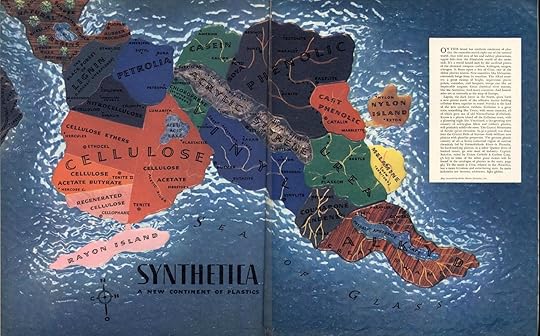
Fie and fiddlesticks. I defy you to find a better, more comprehensive book on the topic out there. And besides, Nylon has lots of awesomesauce illustrations, such as Syntheticathis one originally published in Fortune magazine in 1940. Check out the elementary compass. See? Awesomesauce!

It's also chock full of terrific factoids that'll make you want to bore your spouse with/run right out and post to Facebook, such as: what do you get when you grind cherry stones? Sawdust. (Because they're basically wood, silly.)

And did you know that if you dip cotton into nitric acid you get a substance that's quicker to ignite than flash paper? Now repeat after me, children, cellulose and nitrogen go BOOM! Thus, the joys of fin du siècle rayon:
Because they were not denitrated, the fibres were highly flammable and volatile, so much so that some early experiments, and indeed factories, came to an explosive end.… Sometimes Chardonnet's rayon was disparagingly referred to as 'mother-in-law silk,' presumably because a bolt of this fabric would make an ideal present for a troublesome mother-in-law who might obligingly sit next to an open fire or gas flame. These nitrocellulose fibres were, in fact, bombs in fabric form…. (The last remaining Chardonnet Silk factory, located in Brazil, succumbed to a final, inevitable, blaze in 1949.) (p. 19)
"What a bee-YOO-ti-ful dress! Oh, darling you really shouldn't have." "Don't mention it, Mother, and may I light you a ciggie?" Oh, Susannah. You had me at "highly flammable."

Seriously though, Nylon has several fascinating stories to tell. First, there's the chemistry. Where does this stuff come from, how is it developed, and what can't you make from it? Next there's the story of sales and tastemaking. Contextualizing the built-in bias of the book, did you know that firms like ICI, DuPont, and Courtaulds are basically going out on a limb with each new-spun patent? That's the megacorpses, valiantly and ever-patriotically fighting the harvesters of cotton, leather, linen, silk, and wool every step of the way to establish each new wonder in the world. Their new polymers must be strung out, spooled, mass-produced, then knitted and stamped, mass-produced as rolls of fabric, and then tailored, cut, and mass-produced as wash-and-wear. That's a gap of not less than 18 months from first molecule to finished material, a chasm that must transcend at least three distinct and independent commercial enterprises. If Handley's sources are to be trusted, the bloom of synthetics meant the birth of Mad Men, the marriage of high finance to fashion pre-packaged and sold. Finally, there's the bizarro world of couturiers to explore, an unending competition of conspicuous consumption, a forever war waged by the Emperor's new clothiers for the hearts and pocketbooks of imperial poseurs.

Luxury's all in the wallet of the beholder, but I have no qualms with affordable avant-garde. I'm good with comfortable, washable, practical clothing that can be reproduced on the cheap with economies of scale. Sign me up for that butcher paper t-shirt I can ink new slogans onto each week. Give me the funky, faux-leather, plastic-sheathed copper belt and suspenders with programmable LEDs that relay radio signals and project moving pictures onto my palm. Make me a sterile, nontoxic hat in any shape or form and I'll wear it! (No, really, I'm almost totally bald. I need any kind of hat.)

You hear me, Handley? Inquiring minds like mine wanna know… Tell me more!
Displaying 1 - 2 of 2 reviews

Can't find what you're looking for?

Get help and learn more about the design.