

What do you think?

Red Snow
Continuing D+Q's groundbreaking exploration of the fascinating world of Gekiga, this collection of short stories is drawn with great delicacy and told with subtle nuance by the legendary Japanese artist Susumu Katsumata. The setting is the premodern Japanese countryside of the author's youth, a slightlymagical world where ancestral traditions hold sway over a people in the full vigor of life, struggling to survive the harsh seasons and the difficult life of manual laborers and farmers. While the world they inhabit has faded into memory and myth, the universal fundamental emotions of the human heart prevail at the center of these tender stories.
Katsumata began publishing comic strips in the legendary avantgarde magazine Garo (which also published his contemporaries Yoshihiro Tatsumi and Yoshiharu Tsuge) in 1965 while enrolled in the Faculty of Science in Tokyo. He abandoned his studies in 1971 to become a professional comics artist, alternating the short humorous strips upon which he built his reputation with stories of a more personal nature in which he tenderly depicted the lives of peasants and farmers from his native region. In 2006, Katsumata won the 35th Japanese Cartoonists Association Award Grand Prize for Red Snow.
Katsumata began publishing comic strips in the legendary avantgarde magazine Garo (which also published his contemporaries Yoshihiro Tatsumi and Yoshiharu Tsuge) in 1965 while enrolled in the Faculty of Science in Tokyo. He abandoned his studies in 1971 to become a professional comics artist, alternating the short humorous strips upon which he built his reputation with stories of a more personal nature in which he tenderly depicted the lives of peasants and farmers from his native region. In 2006, Katsumata won the 35th Japanese Cartoonists Association Award Grand Prize for Red Snow.
248 pages, Hardcover
First published November 1, 2005
Ratings & Reviews
Friends & Following
Create a free account to discover what your friends think of this book!
Community Reviews
Displaying 1 - 30 of 48 reviews

August 8, 2011
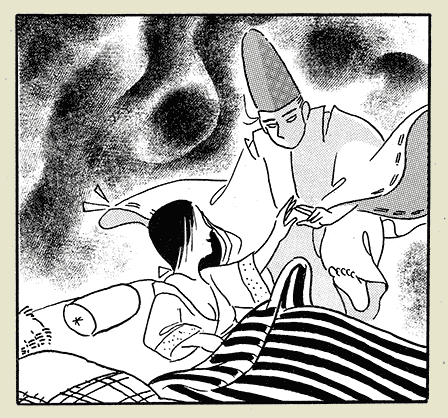
The care with which Drawn & Quarterly packaged this collection of Susumu Katsumata's short stories somewhat troubles me. It really is a handsome edition, a durable hardcover wrapped in pleasing design and containing in its backmatter an interview with the mangaka as well as an article describing the importance of the work. For those built to appreciate Katsumata's achievement here, this edition of Red Snow is almost certainly a treasure. I'm only sorry I couldn't be counted among those who would so value the production.
Red Snow, for me, has exactly one use. It proposes an unveiling of a mid-twentieth century rural Japan that stands as an illumination of a society that may be forever lost to the march of time. The details of rural, traditional Japanese culture are fascinating and Katsumata does a good job adding in trivialities that add a sense of realism to often magical stories. In "Red Snow," the story that gives the collection its title, Katsumata spends some pages showing the labour involved in preparing sake yeast. In another, he leans on the use and social texture of mulberries. Several tales involve the activity of traveling Buddhist monks. In manner similar to Stan Sakai (though more pervy), Katsumata involves some of the more mythical aspects of traditional Japanese folklore, such as kappas and tree spirits.
Most forcefully what Red Snow accomplishes, however, is to present a picture of a people. I have no measure by which to gauge the honesty of the portrait Katsumata paints through his stories, but if they are to be believed, non-urban Japan was built on the lives of a very earthy people. These are men and women whose entire lives are built on hard work and sex. If memory serves, every single story featured infidelity, rape, whores, or some manner of lusty embrace. If Katsumata's world is to be believed, then mid-century Japan was a pretty horny place in which women are routinely beaten and the patriarchy is well established and indelibly ingrained.
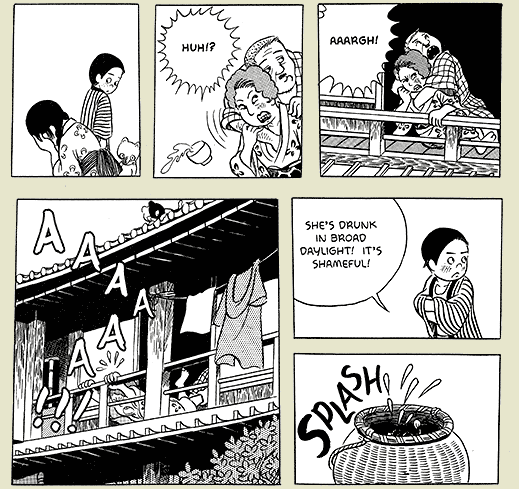
Yep. This guy is more upset by the fact that the curly-haired woman was a little drunk than by the fact that she is plainly being raped. Charming.
Not that the women don't sometimes give as good as they get. In "A Pulp Novel about a Sack," the women of a village tie up a traveler in a sack and pass him from house to house while their men are away tending to the business of their agrarian society. It's never certain just how willing a participant the man in the sack is: has he simply accepted his lot, enjoying his time in the sack or is he being somehow raped in weakened state?
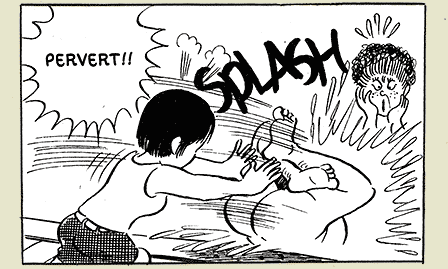
The problem with Red Snow is that as fascinating as this vantage into Japanese culture may be, the stories themselves play out awkwardly as the narrative sometimes lurches from panel to panel. Often, and this may be due to my ignorance of the culture being portrayed, it's difficult to tell exactly what is happening between panels and sometimes even in a particular panel. Katsumata's transitions, while sometimes beautiful, are more commonly too abrupt, giving the reader too few clues as to what he has in mind. And while some of his brushwork is handsome, most of his characters are drawn in a way that makes it difficult to understand exactly what they are meant to be expressing.
In the end, while there were things I appreciated in Red Snow, there were more things that I didn't. It's not a work to which I will likely return. I felt there was value in reading it but there was no enjoyment in the experience. Red Snow felt more like a chore than it did one more step into enjoyable comics literature.
[Review courtesy of Good Ok Bad.]

November 29, 2022
Una joyita del manga gekiga ("feísta"). Historias crudas donde los campesinos conviven con kappas salvajes, los monjes nómadas caen en las garras de mujeres solas y el primer deseo se vive con la intensa confusión de una borrachera de sake. Viaje a un mundo perdido para siempre.

June 19, 2019
--Mulberries
--Echo
--Cricket Hill
--Pulp Novel About A Sack
--Kokeshi
--The Dream Spirit
--Specter
--Torajiro Kappa
--Wild Geese Memorial Service
--Red Snow
An Interview with Susumu Katsumata
Susumu Katsumata: The Man and His Work, by Mitsuhiro Asakawa
--Echo
--Cricket Hill
--Pulp Novel About A Sack
--Kokeshi
--The Dream Spirit
--Specter
--Torajiro Kappa
--Wild Geese Memorial Service
--Red Snow
An Interview with Susumu Katsumata
Susumu Katsumata: The Man and His Work, by Mitsuhiro Asakawa

October 20, 2019
3/5
De cierta manera todo lo que está pasando en Santiago no me ha dejado concentrarme mucho, así que no había avanzado en mis lecturas desde el viernes.
Hoy he estado particularmente nerviosa así que mi pololo me hizo un tecito y me senté a leer un rato. Tiene historias muy lindas y el estilo de Katsumata es precioso. Algo ligero para calmar la ansiedad en estos días tan agitados.
De cierta manera todo lo que está pasando en Santiago no me ha dejado concentrarme mucho, así que no había avanzado en mis lecturas desde el viernes.
Hoy he estado particularmente nerviosa así que mi pololo me hizo un tecito y me senté a leer un rato. Tiene historias muy lindas y el estilo de Katsumata es precioso. Algo ligero para calmar la ansiedad en estos días tan agitados.

January 18, 2010
I picked up Red Snow trying to experience more of that gekiga (manga produced to rebel against the manga style of Osamu Tezuka which was stereotyped as too Disney-like and stuck with children’s manga instead of tackling more adult themes) which I’ve heard so much about in Tatsumi’s A Drifting Life. A Drifting Life is very different to Red Snow, but Red Snow feels a lot more raw and supernatural. A Drifting Life is a good introduction to the history of gekiga and the history of manga in general, but Red Snow is a lot braver in how it depicts the inherent violence (physical or psychological) that went down in Japanese country towns. The book is comprised of short stories in country areas of Japan that haven’t been fully modernised yet – harking back to the country childhood of the mangaka’s youth. What you see here is gekiga in its rawest form, simplicity but beauty of illustration, which conveys human emotion and actions very, VERY well indeed. It’s the best vintage style manga I’ve seen outside of Tezuka, and while I highly recommend Tezuka’s works the mangaka of Red Snow who is also deceased now achieves so much in his short story manga that it’s hard to imagine him as other than a manga haiku poet, since his tales often have layers of meaning you only pick up on with additional readings. It is a manga volume meant to be contemplated over many years.
The style of manga in Red Snow takes some getting used to for readers used to say, Negima! – but Negima! has its place and I don’t want to be an elitist manga snob. All I can really say to manga fans more used to the 21st Century moe style of manga is… give this a try and see what you learn about a different side to Japan than you normally see. I really recommend it not just on an artistic standpoint but for manga fans not quite ready to jump into the massive multi-volume franchises that manga has spawned, as these eat up a lot of money if you’re not prepared. Red Snow is a stand alone volume that drags surrealist and supernatural elements to the winter snows of regional farmland Japan, it’s subtle, it deals with human sexuality on a deeper level than manga and comics as a combined whole have been prepared to deal with, and it doesn’t shy away from depicting the harshness of rural Japanese life. The men are sexist pigs who can’t stand it when a woman outwits them, and the women are constantly on the alert lest a gossip ruin their reputation. These people live hard, but beautifully constructed lives that sing with every regret. It is an easy first read but the more times you read it the bleak minimalist aesthetic to exploring what are essentially both happy and unhappy lives – you’ll notice that your life by comparison isn’t as bad. Even if you’re not attacked by kappa demons on a daily basis. It’s steeped in Japanese folk legends and in that respect it’s what I call “Mythologically Accurate” which is like Historical Accuracy for mythology.
I highly recommend Red Snow for older manga readers and people who are ready to deal with adult themes in manga beyond shoujo and seinen titles. It’s dark, but you see the light glimmering as you near the end of each tunnel.
The style of manga in Red Snow takes some getting used to for readers used to say, Negima! – but Negima! has its place and I don’t want to be an elitist manga snob. All I can really say to manga fans more used to the 21st Century moe style of manga is… give this a try and see what you learn about a different side to Japan than you normally see. I really recommend it not just on an artistic standpoint but for manga fans not quite ready to jump into the massive multi-volume franchises that manga has spawned, as these eat up a lot of money if you’re not prepared. Red Snow is a stand alone volume that drags surrealist and supernatural elements to the winter snows of regional farmland Japan, it’s subtle, it deals with human sexuality on a deeper level than manga and comics as a combined whole have been prepared to deal with, and it doesn’t shy away from depicting the harshness of rural Japanese life. The men are sexist pigs who can’t stand it when a woman outwits them, and the women are constantly on the alert lest a gossip ruin their reputation. These people live hard, but beautifully constructed lives that sing with every regret. It is an easy first read but the more times you read it the bleak minimalist aesthetic to exploring what are essentially both happy and unhappy lives – you’ll notice that your life by comparison isn’t as bad. Even if you’re not attacked by kappa demons on a daily basis. It’s steeped in Japanese folk legends and in that respect it’s what I call “Mythologically Accurate” which is like Historical Accuracy for mythology.
I highly recommend Red Snow for older manga readers and people who are ready to deal with adult themes in manga beyond shoujo and seinen titles. It’s dark, but you see the light glimmering as you near the end of each tunnel.

April 4, 2022
literarischer Manga, ursprünglich erschienen zwischen 1970 und 1990 - zehn Kurzgeschichten über das ländliche Japan der Vorkriegszeit. Jede dieser Geschichten ist in sich abgeschlossen.
Es gibt Geschichten, die das Leben durchaus realistisch abbilden, bis hin zu Geschichten, die sich mit eher mythischen Aspekten der traditionellen japanischen Folklore, wie Kappa, Flüchen und anderen übernatürlichen Elementen befassen. Ein Mädchen ist mit dem belebten Geist eines Baums verbunden, die Flussgeister kümmern sich um ein menschliches Ärgernis und eine Invasion von Glühwürmchen sorgt für Rache. Was für unsere Verhältnisse rätselhafte Eingriffe sind, wird von den Dorfbewohnern als selbstverständlich hingenommen und von Katsumata, der sich nie herablassend über spirituelle Angelegenheiten äußert, auch so dargestellt.
Katsumata schreckt nicht davor zurück, die Härte des japanischen Landlebens darzustellen. Es sind Männer und Frauen, deren ganzes Leben auf harter Arbeit beruht. Jede der zehn Geschichten ist emotional komplex und häufig beschäftigen sie sich mit den niedrigsten Trieben der Menschen, deren Verhalten und deren Begehren.
Katsumatas Geschichten sind bodenständig und sie reichen von kleinen, sinnlosen Dingen, über Kämpfe zwischen den Kindern hin bis zu größeren Themen. Der Mangaka schreibt über Frauen, die in fast allen Geschichten den Männern und ihren Launen ausgesetzt sind. Die Männer sind körperlich stärker, aber auch sie haben kein glanzvolles Leben. Sie sind Bauern, kleine Ladenbesitzer und müssen tagein, tagaus die gleiche harte Arbeit verrichten.
Es gibt Geschichten, die das Leben durchaus realistisch abbilden, bis hin zu Geschichten, die sich mit eher mythischen Aspekten der traditionellen japanischen Folklore, wie Kappa, Flüchen und anderen übernatürlichen Elementen befassen. Ein Mädchen ist mit dem belebten Geist eines Baums verbunden, die Flussgeister kümmern sich um ein menschliches Ärgernis und eine Invasion von Glühwürmchen sorgt für Rache. Was für unsere Verhältnisse rätselhafte Eingriffe sind, wird von den Dorfbewohnern als selbstverständlich hingenommen und von Katsumata, der sich nie herablassend über spirituelle Angelegenheiten äußert, auch so dargestellt.
Katsumata schreckt nicht davor zurück, die Härte des japanischen Landlebens darzustellen. Es sind Männer und Frauen, deren ganzes Leben auf harter Arbeit beruht. Jede der zehn Geschichten ist emotional komplex und häufig beschäftigen sie sich mit den niedrigsten Trieben der Menschen, deren Verhalten und deren Begehren.
Katsumatas Geschichten sind bodenständig und sie reichen von kleinen, sinnlosen Dingen, über Kämpfe zwischen den Kindern hin bis zu größeren Themen. Der Mangaka schreibt über Frauen, die in fast allen Geschichten den Männern und ihren Launen ausgesetzt sind. Die Männer sind körperlich stärker, aber auch sie haben kein glanzvolles Leben. Sie sind Bauern, kleine Ladenbesitzer und müssen tagein, tagaus die gleiche harte Arbeit verrichten.

July 13, 2018
Alla scoperta, oltre che di un autore - Susumu Katsumata (1943-2007) - di un genere, cioè il "gekiga" forma di fumetto giapponese nata alla fine degli anni '50 e caratterizzata da storie di violenza e degrado. Katsumata, che realizza questi racconti fra gli anni '70 e '80, si concentra sulla ricostruzione di un Giappone antico e rurale in cui trovano scena racconti di sopruso, sesso e violenza spesso mescolati con fantasia e leggenda, con una costante polarizzazione della caratteristiche maschili e femminili. Scoperta interessante, esperienza di lettura a tratti straniante per il miscuglio di cupezza e ironia (tutta giapponese) di cui le storie sono intrise.

January 3, 2024
Pierwsze skojarzenia idą w kierunku wczesnych prac Tsuge. Nie tylko graficznie Katsumata wpisuje się w dosyć miękki styl Yoshiharu z okresu "Red Flowers", ale również tematycznie widać sporo charakterystycznego pomieszania motywów urzekających z dziwnymi i moralnie niejednoznacznymi. Przedstawiciel drugiej fali twórców magazynu "Garo" nie krył zresztą, kto był jego mistrzem w temacie historii obrazkowych.
Czytelnik nie zawsze jest w stanie ocenić czy przedstawienie np. sceny gwałtu to po prostu oddanie rzeczywistych wydarzeń, wyraz solidaryzmu z ofiarą czy może jakaś forma seksizmu. Gdy ofiara przemocowego związku staje po stronie oprawcy albo gdy dzieciak osądza kobietę o to, że jest pijana, jakby ignorując, że przy okazji ktoś ją wykorzystał, odbiorca ma prawo czuć się zmieszany. Zderzenie z takimi motywami nie jest łatwe z perspektywy europejskiej, ale odkąd przeczytałem wywiad z Tatsumim, który apelował, by nie utożsamiać bohaterów jego prac z autorem, wierzę, że to po prostu forma naturalizmu, oddająca faktyczne zachowania społeczeństwa japońskiego na danym etapie, biorę to na klatę z całą creepy otoczką i staram się nie oceniać samego twórcy.
Bywają tu oczywiście momenty poetyckie, jak w "Wild Geese Memorial Service", gdzie los kupca, który z trudem uniknął śmierci, zestawiono z corocznym rytuałem odlatujących gęsi albo w "Echo", opowiadającym o duchu drzewa nawiedzającym młodą dziewczynę. Nieco sentymentalnego charakteru nadaje całości wplątywanie w niezbyt sielskie obrazy wiejskiej codzienności elementów yokai w postaci duchów, demonów i innych elementów mitu. Wszystko to czyni z "Red Snow" dosyć intrygującą mieszankę, obok której trudno przejść obojętnie
Czytelnik nie zawsze jest w stanie ocenić czy przedstawienie np. sceny gwałtu to po prostu oddanie rzeczywistych wydarzeń, wyraz solidaryzmu z ofiarą czy może jakaś forma seksizmu. Gdy ofiara przemocowego związku staje po stronie oprawcy albo gdy dzieciak osądza kobietę o to, że jest pijana, jakby ignorując, że przy okazji ktoś ją wykorzystał, odbiorca ma prawo czuć się zmieszany. Zderzenie z takimi motywami nie jest łatwe z perspektywy europejskiej, ale odkąd przeczytałem wywiad z Tatsumim, który apelował, by nie utożsamiać bohaterów jego prac z autorem, wierzę, że to po prostu forma naturalizmu, oddająca faktyczne zachowania społeczeństwa japońskiego na danym etapie, biorę to na klatę z całą creepy otoczką i staram się nie oceniać samego twórcy.
Bywają tu oczywiście momenty poetyckie, jak w "Wild Geese Memorial Service", gdzie los kupca, który z trudem uniknął śmierci, zestawiono z corocznym rytuałem odlatujących gęsi albo w "Echo", opowiadającym o duchu drzewa nawiedzającym młodą dziewczynę. Nieco sentymentalnego charakteru nadaje całości wplątywanie w niezbyt sielskie obrazy wiejskiej codzienności elementów yokai w postaci duchów, demonów i innych elementów mitu. Wszystko to czyni z "Red Snow" dosyć intrygującą mieszankę, obok której trudno przejść obojętnie
January 19, 2011
Like many other gekiga-ka, Susumu Katsumata began his career in the late 60’s, drawing fairly traditional yonkoma gag strips. He was strongly influenced by the usual Garo greats: Shigeru Sugiura, Yoshiharu Tsuge, and Sanpei Shirato. The notoriously taciturn Tsuge, who was especially tightlipped about his contemporaries, would later become one of Katsumata’s most vocal fans and supporters. He was not alone: artists such as Seiichi Hayashi, Hinako Sugiura, and Shigeru Mizuki all count him as an outstanding influence. The appreciation for his work culminated in 2006, when a collection of his work titled Red Snow won him the prestigious 35th Japanese Cartoonists Association Grand Prize, less than a year before his death.
Unlike most of his gekiga contemporaries, Katsumata’s stories are emphatically removed from the bleak, urban slums of modern Japan, offering instead a view of a decades-old quiet rural life. These tranquil mountainsides and farming villages are nonetheless form a sort of adult fairy tale world, occasionally visited by ghosts and kappa, and yet filled with the same kind of sordid situations and characters that permeate most gekiga books.
The stories in Red Snow (perhaps as a manner of their pastoral setting) are quiet, contemplative, and pithy, giving them a haiku-like quality. There is a traditional narrative structure, and each generally has an emotional, climatic action, and yet even these are understated, and the reader is always left with an ellipsis.
Part of the composure of these stories comes from the art, which appears simple and effortless, yet belies a great refinement and balance. The characters are iconic and slightly elastic, and the gentle brush lines forming their contours often don’t connect. As such, they are people full of holes and gaps, their environments leaking into their bodies.
Their faces are a graceful balance of cartoony expression and zen-like poise; Katsumata shows us how a wealth of emotions, attitudes, and motivations can come from but a few lines on a face. Even the most contemptible characters have a subtle cuteness to their countenances; perhaps it is these endearing designs that give the stories their necessary lightness in the more unsettling instances.
But it is these instances that give the stories their importance: without the darkness, these tales would be nothing more than an exploration of the countryside nostalgia. It is crucial for the author to show that beneath the agrarian ideal, there was a bleak world of violence, rape, avarice, drunkenness, and social oppression. With all the desolation and dolor of modern Japan presented by other gekiga, only Katsumata was showing us that these same issues can manifest anywhere.
Torajiro Kappa is one of Katsumata’s best and most representative stories. It features all his favorite players: a gung-ho young boy, an abusive older man, a downtrodden woman, and a kappa who stands at the border between our world and the mythological.
The boy quickly evinces his eagerness to join his fellow townspeople as an adult, mimicking their behavior in a superficial manner. In the second panel his character is pithily defined: he encounters a passing farmer who offers him a greeting, and the boy returns it by parroting the greeting, removing his hat and taking a deep bow in an exaggerated show of respect (perhaps this is something he learned from the manga he is seen reading in the 7th panel). Right away the boy is portrayed as a cocksure youth who thinks he knows how to act righteously in the world.
This is why, upon seeing an elder farmhand beating up his wife, he implores a local kappa to avenge her. A duel is arranged, and it seems to come to draw until the man’s wife gives him some saké that strengthens him enough to severely wound his kappa opponent. Why did his beaten spouse come to his aid? Because apparently he only hits her when he drinks, yet he can only “fulfill his duties as a husband” when he drinks. So upset by this sordid situation, the kappa leaves the village, saying, “That place isn’t fit for kappa anymore.”
The kappa, the boy, and the reader come away disillusioned with the darkness and complexity of “real” adulthood. In fact, the boy and the kappa seem to share the same mind on all counts, lending credence to the theory that this kappa is a bit of imagination. But this is too dismissive; he and the kappa are on the same page because they share the same relationship to the town. They are both like a man and yet not, looking out for the well-being of their town, but not understanding much about it. They are each isolated within their own home.
Though the boy’s behavior is simple and childish, it is he who shows most potential of character, if he can withstand the influence of his backwater town. The only characters to directly address the kappa are the boy and the man when he is sober. When he imbibes the poison of adulthood, he loses this power.
For all the best intentions, nothing is changed by the end of the story. Katsumata leaves us, as always, with a lack of closure, giving his audience something to think about, without leading us towards one conclusion or another. His haiku-manga is dreamy only in that regard, and his story is fantastic only inasmuch as it includes kappa; beyond that, the world he shows us is upsettingly real.
Unlike most of his gekiga contemporaries, Katsumata’s stories are emphatically removed from the bleak, urban slums of modern Japan, offering instead a view of a decades-old quiet rural life. These tranquil mountainsides and farming villages are nonetheless form a sort of adult fairy tale world, occasionally visited by ghosts and kappa, and yet filled with the same kind of sordid situations and characters that permeate most gekiga books.
The stories in Red Snow (perhaps as a manner of their pastoral setting) are quiet, contemplative, and pithy, giving them a haiku-like quality. There is a traditional narrative structure, and each generally has an emotional, climatic action, and yet even these are understated, and the reader is always left with an ellipsis.
Part of the composure of these stories comes from the art, which appears simple and effortless, yet belies a great refinement and balance. The characters are iconic and slightly elastic, and the gentle brush lines forming their contours often don’t connect. As such, they are people full of holes and gaps, their environments leaking into their bodies.
Their faces are a graceful balance of cartoony expression and zen-like poise; Katsumata shows us how a wealth of emotions, attitudes, and motivations can come from but a few lines on a face. Even the most contemptible characters have a subtle cuteness to their countenances; perhaps it is these endearing designs that give the stories their necessary lightness in the more unsettling instances.
But it is these instances that give the stories their importance: without the darkness, these tales would be nothing more than an exploration of the countryside nostalgia. It is crucial for the author to show that beneath the agrarian ideal, there was a bleak world of violence, rape, avarice, drunkenness, and social oppression. With all the desolation and dolor of modern Japan presented by other gekiga, only Katsumata was showing us that these same issues can manifest anywhere.
Torajiro Kappa is one of Katsumata’s best and most representative stories. It features all his favorite players: a gung-ho young boy, an abusive older man, a downtrodden woman, and a kappa who stands at the border between our world and the mythological.
The boy quickly evinces his eagerness to join his fellow townspeople as an adult, mimicking their behavior in a superficial manner. In the second panel his character is pithily defined: he encounters a passing farmer who offers him a greeting, and the boy returns it by parroting the greeting, removing his hat and taking a deep bow in an exaggerated show of respect (perhaps this is something he learned from the manga he is seen reading in the 7th panel). Right away the boy is portrayed as a cocksure youth who thinks he knows how to act righteously in the world.
This is why, upon seeing an elder farmhand beating up his wife, he implores a local kappa to avenge her. A duel is arranged, and it seems to come to draw until the man’s wife gives him some saké that strengthens him enough to severely wound his kappa opponent. Why did his beaten spouse come to his aid? Because apparently he only hits her when he drinks, yet he can only “fulfill his duties as a husband” when he drinks. So upset by this sordid situation, the kappa leaves the village, saying, “That place isn’t fit for kappa anymore.”
The kappa, the boy, and the reader come away disillusioned with the darkness and complexity of “real” adulthood. In fact, the boy and the kappa seem to share the same mind on all counts, lending credence to the theory that this kappa is a bit of imagination. But this is too dismissive; he and the kappa are on the same page because they share the same relationship to the town. They are both like a man and yet not, looking out for the well-being of their town, but not understanding much about it. They are each isolated within their own home.
Though the boy’s behavior is simple and childish, it is he who shows most potential of character, if he can withstand the influence of his backwater town. The only characters to directly address the kappa are the boy and the man when he is sober. When he imbibes the poison of adulthood, he loses this power.
For all the best intentions, nothing is changed by the end of the story. Katsumata leaves us, as always, with a lack of closure, giving his audience something to think about, without leading us towards one conclusion or another. His haiku-manga is dreamy only in that regard, and his story is fantastic only inasmuch as it includes kappa; beyond that, the world he shows us is upsettingly real.

March 22, 2023
*3.5 stars

December 19, 2025
Nice art, particularly the backgrounds. The stories didn't really gel with me, probably due to my ignorance of pre-war rural Japanese culture.

December 1, 2012
I never get what some people are trying to get out of their reviews of books. They either didn't understand the book, so they write a lot of educated mumbo jumbo to show how much more they understand on the subject then the author ever did.
You know if you don't like a book or didn't understand the author it's ok. People will have more respect for you and get more out of your review if you tell it like it is
I enjoyed the book, I think for the author who grew up without much family felt the short time he spent in the country were his happiest. So what if he did or didn't exaggerate on some of the stories it helped make many of them much more entertaining. I spent much of my youth in the country during the summer time. What I found fascinating is how many of the stories were similar when you strip away the cultural nuances. Very fun reading!!!
You know if you don't like a book or didn't understand the author it's ok. People will have more respect for you and get more out of your review if you tell it like it is
I enjoyed the book, I think for the author who grew up without much family felt the short time he spent in the country were his happiest. So what if he did or didn't exaggerate on some of the stories it helped make many of them much more entertaining. I spent much of my youth in the country during the summer time. What I found fascinating is how many of the stories were similar when you strip away the cultural nuances. Very fun reading!!!

April 9, 2019
Il contesto è di sicuro affascinante, e i disegni sono in equilibrio interessante fra le fisionomie deformate e riassunte di tanta produzione giapponese e una poesia che immmerge gli ambienti in nebbie o piogge di elementi. Le pagine sono piacevoli da sfogliare, ma i racconti mi sono sembrati troppo riassunti e schematici, pur tenendo presente una tendenza tipicamente giapponese a sorvolare su certe dinamiche. È come se Katsumata non ritenesse opportuno perdere tempo a descrivere compiutamente alcune scene, lasciando al lettore il compito di colmare i relativi spazi temporali (una specie di estensione narrativa dello spazio bianco). Col risultato che a volte ho fatto fatica.

January 20, 2010
A remarkable book that shines a light on rural life in pre-modern Japan. The book alternates between cute and very adult with a somewhat simple drawing style that somehow packs an emotional punch. There is a looseness to the drawings that occasionally lead to confusion, however by the end of each story one is struck by the resonance of resolution. On the whole the stories are indeed moving.
April 2, 2010
I loved this book! It reminds me of Kenji Miyazawa's short stories in the slightly magical (but not magical realist) way he captures these odd aspects & details of old rural Japan in the short stories. Art is wonderful too.

January 18, 2010
Snippets of stories that involve undersexed poor Japanese villagers and the overlords, demons and witches that haunt them. Surprisingly dull.

October 9, 2012
Beautiful Japanese folk stories.

December 24, 2021
Das ist keine Landidylle. Das sind harte Geschichten über die kleinen Leute einer dörflichen Bevölkerung im vorindustriellen Japan. Drohende Armut ist fast allgegenwärtig, Raum für eigene Wünsche und (sexuelle) Bedürfnisse dafür kaum. Vor allem die Frauen sind Leidtragende. Oft weil die Umstände sie zur Prostitution zwingen oder sie von sexueller Gewalt betroffen oder bedroht sind und die Konsqeuenzen - der Auschluss aus der Gemeinschaft und Armut - besonders verheerend sind. Das sind schonungslose Szenen. Doch nicht immer wird das ausbuchstabiert, oft bleibt es auch bei Andeutungen, die umso erschütternder wirken. Genau hier liegt die Stärke der Geschichten, die so unglaublich vielschichtig und andeutungsreich sind, dass man sie mehrmals lesen muss, um die Bedeutungsebenen zu entschlüsseln. Dabei gibt es selten einfache Zuordnungen, sondern immer wieder Brüche - auch in die fantastische Welt der Yokai. Katsumats Stil ist nur scheinbar schlicht und einfach und die Form der Anthologie mit ihrem Nebeneinander von Geschichten verstärkt den Effekt gegenseitiger Bespiegelung und Potenzierung von Motiven. Besonders die erste und letzte Geschichte funktionieren als Rahmen wunderbar zusammen.
Mit der Veröffentlichung bei Reprodukt, die mit speziellem Karton und Farbdruck ansehnlich und liebevoll gebunden ist, liegen Katsumatas Kurzgeschichten erstmals auf Deutsch vor.
Mit der Veröffentlichung bei Reprodukt, die mit speziellem Karton und Farbdruck ansehnlich und liebevoll gebunden ist, liegen Katsumatas Kurzgeschichten erstmals auf Deutsch vor.

April 3, 2018
D&Q's latest peek into the work of "gekiga," popularized by Yoshihiro Tatsumi, is a collection of short stories by Susumu Katsumata. Like Tatsumi, the tone is dark and the depiction of humanity a little bleak. Unlike Tatsumi, the stories often feel incomplete or unfocused. Some are good, some are vague. The last couple are probably the most satisfying.

April 7, 2018
Susumu Katsumata is one of those mangaka that not only entertains, but makes you take serious notice of the form. I love the stories collected in this work, and I find it ironically fascinating that a cutting-edge (perhaps not the best descriptor) or even iconoclastic (?) practitioner of the form is so embedded in pre-modern Japanese culture and settings.

July 17, 2019
Katsumata was one of Tatsumi's peers and they seemingly operated under the same genre of gekiga. This book pairs very well with the other collections of Tatsumi's which have finally been republished stateside dealing with a lot of the same dark themes and subjects. Very strong collection and I hope we keep getting to read more of the works of the time.

March 2, 2023
Un manga al estilo tradicional. Folclore Japonés, básicamente. Ideal para aquellos que no tienen tiempo para leer y buscan algo distinto a lo comercial.
Son relatos cortos, por lo cual va bien para un ratito cada día. No obstate, cómo es lógico, algunos te van a gustar más que otros.
A mí hay algunos que me han despertado emociones totalmente contrarias, pero otros con los que no he empatizado.
Son relatos cortos, por lo cual va bien para un ratito cada día. No obstate, cómo es lógico, algunos te van a gustar más que otros.
A mí hay algunos que me han despertado emociones totalmente contrarias, pero otros con los que no he empatizado.
May 27, 2026
Una antologia d'algunes històries que va publicar Susumu Katsumata, que fan de Nieve Roja una obra important dins del Gekiga. Són relats durs, del Japó Rural, en contraposició del manga infantil que feia Osamu Tezuka en aquell moment.
August 13, 2020
Racconti dalla trama boccaccesca meno divertenti di quanto potrebbero. Alcuni sono veramente belli, nel complesso opera carina, pochi picchi ma nessun fondale.

Did Not Finish
April 1, 2022I just couldn't get into this one. Not really sure where the stories were going, and after a rape scene, I just put it down. A bit too much for me, I guess.

January 17, 2024
Outstanding selection of short stories of rural Japan at the time right before modernization. I would have to say my he is my favorite of the second wave of Gekiga writers so far.

June 2, 2025
Stories from rural Japan. Be warned, slightly pornographic in spots, not what I had anticipated.

February 12, 2016
Indeed, no matter the peoples, no matter the culture, and no matter the century under scrutiny, there is time and place for the bawdy, the abusive, and the sacrilegious. Susumu Katsumata's RED SNOW is a collection of stories that regards such an elliptical romp through Old Japan.
Katsumata's work is entertaining but yields to the dubious notion that all one needs to know can be gleaned from the gossipy predilections of blind bards, horny wives, and roguish old men trying to feel up the local servant. For most readers, RED SNOW is a flighty exercise in dirty humor. However, after multiple reads, something more important bleeds through. . .
Who can speak to the character of the passing seasons better than drunken monk? What better vessel to regale readers of the arrogance and futility of infidelity than the ghost of a woman whom, abandoned, died in childbirth?
These persons are both real and not, and their stories of jealousy, domestic violence, and neglect are likewise both real and not. The tales are tall, sure, but the emotion and sentimentality wrought by these hopeless creatures are equally genuine.
RED SNOW, for example, includes the short comic "Wild Geese Memorial Service," which follows an old man, his young daughter, and a traveling merchant whom the old man rescues from a snow bank. The merchant looks like the young woman's betrothed (lost at sea), and it's the woman's late night spooning that ultimately brings the merchant back from the brink of death.
Amusing, yes, but the story doesn't end there. Weeks pass, and the merchant, slowly regaining his health, contemplates returning to his village to face condemnation (for purportedly abandoning his crew), versus staying with the young woman and her father. He packs and unpacks his things several times. Eventually, he decides to stay, but not before cutting his hair and holding a funeral service, effecting killing off the precociousness and indecision that led him to the young woman in the first place.
RED SNOW is gekiga of a slightly different flavor. It's not action heavy and its motions are not predetermined by the rhythms of its characters' angst and ambition. The stories herein are short and sweet. And in Katsumata's art, one discovers flare after flare of narrative succinctness of the most fascinating kind.
In the story "Kokeshi," about a philandering kappa lord, panels in which Genzo Kappa makes silent love to a scrunch-faced woman are both elegant and brutal. Genzo doesn't make a sound when he has sex, but the woman grunts with noticeable restraint. Visually, Genzo doesn't actually appear . . . readers only mark his presence by silhouettes cut from the woman's pale nude form -- a hand, a hip, something more (And if Genzo, essentially, is the darkness, then what does it mean if the women of this village are helpless against the muscled arousal that is the night itself?).
In the final comic in this collection, titled "Red Snow," a young sake-maker, Ichitaro, must deal with his whiny would-be girlfriend, Tsuyako. She's angry he went to a whorehouse. What she doesn't know is that although Ichitaro certainly went to the place, he roomed with the fattest, ugliest woman there . . . and couldn't close the deal ("My dick shriveled right up."). The guys at work have a good bit of fun with it, and so entertain the young man with the tale of a mountain hag -- whose droopy breasts and period blood mark the snowy landscape once every 100 years.
It's silly and it's vulgar, but it's also terribly funny. That is, until Ichitaro looks out into the coming snowstorm and sees the mountain hag for himself, and to his utter amazement, the hag is a gekiga goddess: an unapologetically large-bodied woman, her curves pull away from the howling hills and billowing snow as if they were born from her and not the other way around; her sagging bosom and puckering belly rolls glisten in the moonlight and it's immediately clear the mountain hag is indeed one dizzying maelstrom after another -- she is lightning, she is wind, she is the sea; she is the snowstorm.
Katsumata's work is entertaining but yields to the dubious notion that all one needs to know can be gleaned from the gossipy predilections of blind bards, horny wives, and roguish old men trying to feel up the local servant. For most readers, RED SNOW is a flighty exercise in dirty humor. However, after multiple reads, something more important bleeds through. . .
Who can speak to the character of the passing seasons better than drunken monk? What better vessel to regale readers of the arrogance and futility of infidelity than the ghost of a woman whom, abandoned, died in childbirth?
These persons are both real and not, and their stories of jealousy, domestic violence, and neglect are likewise both real and not. The tales are tall, sure, but the emotion and sentimentality wrought by these hopeless creatures are equally genuine.
RED SNOW, for example, includes the short comic "Wild Geese Memorial Service," which follows an old man, his young daughter, and a traveling merchant whom the old man rescues from a snow bank. The merchant looks like the young woman's betrothed (lost at sea), and it's the woman's late night spooning that ultimately brings the merchant back from the brink of death.
Amusing, yes, but the story doesn't end there. Weeks pass, and the merchant, slowly regaining his health, contemplates returning to his village to face condemnation (for purportedly abandoning his crew), versus staying with the young woman and her father. He packs and unpacks his things several times. Eventually, he decides to stay, but not before cutting his hair and holding a funeral service, effecting killing off the precociousness and indecision that led him to the young woman in the first place.
RED SNOW is gekiga of a slightly different flavor. It's not action heavy and its motions are not predetermined by the rhythms of its characters' angst and ambition. The stories herein are short and sweet. And in Katsumata's art, one discovers flare after flare of narrative succinctness of the most fascinating kind.
In the story "Kokeshi," about a philandering kappa lord, panels in which Genzo Kappa makes silent love to a scrunch-faced woman are both elegant and brutal. Genzo doesn't make a sound when he has sex, but the woman grunts with noticeable restraint. Visually, Genzo doesn't actually appear . . . readers only mark his presence by silhouettes cut from the woman's pale nude form -- a hand, a hip, something more (And if Genzo, essentially, is the darkness, then what does it mean if the women of this village are helpless against the muscled arousal that is the night itself?).
In the final comic in this collection, titled "Red Snow," a young sake-maker, Ichitaro, must deal with his whiny would-be girlfriend, Tsuyako. She's angry he went to a whorehouse. What she doesn't know is that although Ichitaro certainly went to the place, he roomed with the fattest, ugliest woman there . . . and couldn't close the deal ("My dick shriveled right up."). The guys at work have a good bit of fun with it, and so entertain the young man with the tale of a mountain hag -- whose droopy breasts and period blood mark the snowy landscape once every 100 years.
It's silly and it's vulgar, but it's also terribly funny. That is, until Ichitaro looks out into the coming snowstorm and sees the mountain hag for himself, and to his utter amazement, the hag is a gekiga goddess: an unapologetically large-bodied woman, her curves pull away from the howling hills and billowing snow as if they were born from her and not the other way around; her sagging bosom and puckering belly rolls glisten in the moonlight and it's immediately clear the mountain hag is indeed one dizzying maelstrom after another -- she is lightning, she is wind, she is the sea; she is the snowstorm.

April 19, 2023
|| Roter Schnee von Susumu Katsumata
Aus dem Japanischen von Daniel Büchner (2021) ||
Susumu Katsumata wurde 1943 in Kahoku geboren und veröffentlichte seit 1965 Kurzgeschichten (Mangas/Gekigas) in Zeitschriften. 2006 hat er für den Kurzgeschichten Band “Roter Schnee” den 35. Japanese Cartoonists Association Award Grand Prize gewonnen. Die Geschichten sind schon in den 70er und 80er Jahren in verschiedenen Zeitschriften erschienen. 2007 ist Katsumata verstorben. In Deutschland ist der Band erst 2021 im Reprodukt Verlag erschienen, übersetzt von Daniel Büchner.
Gekiga (dramatische Bilder) ist ein Stil japanischer Mangas (Comics), der sich an ein erwachsenes Publikum richtet. Es werden eher reifere Themen behandelt und ein filmischer Kunststil verwendet, der sich durch dunkle Schraffuren, scharfe Winkel und grobe Linien auszeichnet. Es wurde damit versucht, sich vom Begriff Manga abzuheben, sowie in den USA mit dem Begriff Graphic Novel. Gekiga war in den 1960er- und 1970er-Jahren der vorherrschende Stil für Erwachsenencomics in Japan. Meist waren die Handlungen mit Gesellschaftskritik, Gewalt und Erotik versehen. Auch wurde sich sehr an den damaligen Kinofilmen orientiert, Spannungsaufbau und Erzähltechniken wurden übernommen.
Der Schauplatz aller Geschichten ist das vormoderne Japan, alles spielt auf dem Land. Die Menschen führen ein schwieriges Leben, die rauen Jahreszeiten machen ihnen zu schaffen, alle versuchen einfach nur zu überleben. Es ist eine einfache Lebensweise mit dem Glauben an die Traditionen ihrer Vorfahren. Das damalige Leben wird realistisch dargestellt, doch hebt sich Susumu Katsumata hier auch von den anderen Gekigas ab. In seinen Geschichten existieren die Wesen aus der japanischen traditionellen Folklore. Es gibt Kappas, Kodamas, also Geisterwesen und es passieren übernatürliche Ereignisse. Der Mittelpunkt der einzelnen Geschichten stehen die Gefühle der Menschen und der Umgang untereinander. Dabei wird kein Blatt vor den Mund genommen, weder wörtlich noch zeichnerisch. Oft drehen sich die Handlungen um recht sinnlose Dinge, wie streitende Kinder bis hin zum allgegenwärtigen Thema, das Frauen den Launen der Männer ausgesetzt sind. Aber keiner hat es in dieser dargestellten Welt richtig gut, alle müssen täglich hart arbeiten und versuchen sich mit kleinen Freuden, wie der Besuch eines Onsen oder ein alkoholerfülltes Treffen mit Freunden, bei Laune zu halten.
Die Geschichten sind nicht ganz zugänglich, die Leser:innen brauchen einiges an Vorwissen über Japan im Generellen, sowie die Traditionen, Gesellschaft und Folklore. Vielleicht versteht man auch einiges erst nach mehrmaligem Lesen. Auch sollte man die Zeit beachten, in der die Geschichten erschaffen wurden und in welcher Zeit die Geschichten spielen. Sonst wird man so einige Probleme beim Lesen haben. Was Katsumata aber hervorragend schafft ist uns mitzunehmen in eine fast vergessene Welt, bzw. in eine Welt, von der deutsche Leser:innen noch nie etwas gehört haben.
Aus dem Japanischen von Daniel Büchner (2021) ||
Susumu Katsumata wurde 1943 in Kahoku geboren und veröffentlichte seit 1965 Kurzgeschichten (Mangas/Gekigas) in Zeitschriften. 2006 hat er für den Kurzgeschichten Band “Roter Schnee” den 35. Japanese Cartoonists Association Award Grand Prize gewonnen. Die Geschichten sind schon in den 70er und 80er Jahren in verschiedenen Zeitschriften erschienen. 2007 ist Katsumata verstorben. In Deutschland ist der Band erst 2021 im Reprodukt Verlag erschienen, übersetzt von Daniel Büchner.
Gekiga (dramatische Bilder) ist ein Stil japanischer Mangas (Comics), der sich an ein erwachsenes Publikum richtet. Es werden eher reifere Themen behandelt und ein filmischer Kunststil verwendet, der sich durch dunkle Schraffuren, scharfe Winkel und grobe Linien auszeichnet. Es wurde damit versucht, sich vom Begriff Manga abzuheben, sowie in den USA mit dem Begriff Graphic Novel. Gekiga war in den 1960er- und 1970er-Jahren der vorherrschende Stil für Erwachsenencomics in Japan. Meist waren die Handlungen mit Gesellschaftskritik, Gewalt und Erotik versehen. Auch wurde sich sehr an den damaligen Kinofilmen orientiert, Spannungsaufbau und Erzähltechniken wurden übernommen.
Der Schauplatz aller Geschichten ist das vormoderne Japan, alles spielt auf dem Land. Die Menschen führen ein schwieriges Leben, die rauen Jahreszeiten machen ihnen zu schaffen, alle versuchen einfach nur zu überleben. Es ist eine einfache Lebensweise mit dem Glauben an die Traditionen ihrer Vorfahren. Das damalige Leben wird realistisch dargestellt, doch hebt sich Susumu Katsumata hier auch von den anderen Gekigas ab. In seinen Geschichten existieren die Wesen aus der japanischen traditionellen Folklore. Es gibt Kappas, Kodamas, also Geisterwesen und es passieren übernatürliche Ereignisse. Der Mittelpunkt der einzelnen Geschichten stehen die Gefühle der Menschen und der Umgang untereinander. Dabei wird kein Blatt vor den Mund genommen, weder wörtlich noch zeichnerisch. Oft drehen sich die Handlungen um recht sinnlose Dinge, wie streitende Kinder bis hin zum allgegenwärtigen Thema, das Frauen den Launen der Männer ausgesetzt sind. Aber keiner hat es in dieser dargestellten Welt richtig gut, alle müssen täglich hart arbeiten und versuchen sich mit kleinen Freuden, wie der Besuch eines Onsen oder ein alkoholerfülltes Treffen mit Freunden, bei Laune zu halten.
Die Geschichten sind nicht ganz zugänglich, die Leser:innen brauchen einiges an Vorwissen über Japan im Generellen, sowie die Traditionen, Gesellschaft und Folklore. Vielleicht versteht man auch einiges erst nach mehrmaligem Lesen. Auch sollte man die Zeit beachten, in der die Geschichten erschaffen wurden und in welcher Zeit die Geschichten spielen. Sonst wird man so einige Probleme beim Lesen haben. Was Katsumata aber hervorragend schafft ist uns mitzunehmen in eine fast vergessene Welt, bzw. in eine Welt, von der deutsche Leser:innen noch nie etwas gehört haben.

June 9, 2011
... dark little book ... lots of adultery and loneliness ... My main reference point for this style of manga (gekiga) is Yoshihiro Tatsumi -- Katsumata's comix contain a weird sexual mood similar to Tatsumi's, a combination of desperation and resignation that leads to odd pairings. The big difference here is setting: Katsumata features the rural poor, who are more alien to my experience than Tatsumi's urban misfits. In a rural, prewar Japan that is further defamiliarized by the existence of anthropomorphic amphibians whose lives overlap the human sphere, Katsumata finds and sustains a melancholy note that translates clearly across time, geography, and culture. His farmers, brewers, street vendors, and prostitutes suffer harsh weather, slow business, mischief of supernatural origin, and domestic violence, and there's a sense that if something bad's not happening, just wait another minute or two. Katsumata's humour, when it surfaces -- a village of abandoned women sharing the sexual services of a monk they keep tied up in a sack? -- comes attached to a wave of brutality. He's not hilarious or demented like Tatsumi. The shyness of his writing and his delicate drawings prevent the stories from escaping their own melancholic gravity. The way that poor people can't escape being poor, Katsumata's stories begin with sadness and disconnection and always return to them.
The interview and other contextualizing material at the end of the book were helpful to understanding Katsumata's worldview -- he lost his mother at a young age and never knew his father, and it seems his number one wish in life was to have a blood relative. Reading Red Snow as an inevitable form of ongoing therapy for the author is a good way of letting some light in the room.
The interview and other contextualizing material at the end of the book were helpful to understanding Katsumata's worldview -- he lost his mother at a young age and never knew his father, and it seems his number one wish in life was to have a blood relative. Reading Red Snow as an inevitable form of ongoing therapy for the author is a good way of letting some light in the room.
Displaying 1 - 30 of 48 reviews