I for one had no idea that the 14 lighthouses dotting the Scottish coast were all built by the same Stevenson family that produced Robert Louis Stevenson, Scotland's most famous novelist. But Bella Bathurst throws a powerful, revolving light into the darkness of this historical tradition.
Robert Louis was a sickly fellow, and - unlike the rest of his strong-willed, determined family - certainly not up to the astonishing rigours of lighthouse building, all of which are vividly described here.
To build these towering structures in the most inhospitable places imaginable (such as the aptly named Cape Wrath), using only 19th-century technology is an achievement that beggars belief. The comparison that comes to mind is with the pyramid building of ancient Egypt.
For instance, we learn that the ground rocks for the Skerryvore lighthouse were prepared by hand (even though the "gneiss could blunt a pick in three blows") in waves and winds "strong enough to lift a man bodily off the rock" and that "it took 120 hours to dress a single stone for the outside of the tower and 320 hours to dress one of the central stones. In total 5000 tons of stone were quarried and shipped" - and all by hand. It is mind-boggling stuff: you'll look at lighthouses with a new respect. - Adam Roberts
Bella Bathurst is a fiction and non-fiction writer, and photographer, born in London and living in Scotland. Her journalism has appeared in a variety of major publications, including the Washington Post and the Sunday Times.
Her first published book was The Lighthouse Stevensons (1999), an account of the construction of the Scottish lighthouses by the ancestors of Robert Louis Stevenson, and named one of the List Magazine's '100 Best Scottish Books of all time'.
This is a nice and friendly book, it is a discussion of the Stevenson family, starting really with Robert Stevenson, grandfather of Robert Louis Stevenson, that concentrate around four great lighthouses whose construction was designed and overseen by members of the family: Bell Rock which made Robert Stevenson's reputation, Skerryvore the work of his son Alan Stevenson, Muckle Flugga, the work of another son David Stevenson (whose sons also became lighthouse engineers), and Dubh Artach, where work was overseen by Tom Steveson, son of Robert Stevenson and father of Robert Louis Stevenson.
Robert Stevenson is the ghost at the feast and his uneasy spirit presided over the family long after his death in Bathurst's account. He got into engineering courtesy of his step-father's firm and got himself appointed as engineer to the Northern Lighthouse Board, a position which three of his sons were to hold after him (one sons got away and became a doctor instead). The construction of the Bell Rock Light made Stevenson famous - the site was submerged at high tide, so all the work was done at low tide and took almost four years to complete, Stevenson was commissioned to write a book about the project which took him thirteen years.
Alan Stevenson worked on the reflectors and lenses to improve the light output form lighthouses which in place still used candle light, Skerryvore was above the high tide line but remote in the Hebrides and stormy - the first year's work to establish barracks for the 150 craftsmen required to build the lighthouse, fixing - iron bars in to the rock to hold a wooden structure was destroyed by winter storms. Alan was of a more literary disposition than his father and while on site corresponded with William Wordsworth. The workforce suffered from sea sickness and inadequate quantities of beer, traditionally lighthouse keepers were expected to maintain a cow and fend for themselves, Skerryvore was so difficult to reach that instead Alan recommended enhanced rations for the lighthouse keepers. As at Bell Rock even bringing in construction materials was a challenge as the rocks had no anchorages, the boats bobbed about while they craned great dressed stones on to the site. For convenience and out of an appreciation of the working conditions the stones were cut to size and dressed off site, however the work had to be precise so the finished construction was waterproof and storm resistant.
But aside from a natural desire to read about nineteenth century civil engineering cruelly destroying the economies of local communities that benefited from wrecked ships and an understandable compulsion to know how a 19th century engineer monetised and publicised their work we're reading to understand Robert Louis Stevenson, a book like this and Bathurst says that he was the Stevenson she was most in love with, is part of the archaeology of his (un)consciousness and mental world.
Robert Stevenson, as benefits the founding patriarch haunted all his sons and comes over as a particularly troubled and fearful person, who everyone else had to work round. He was especially engaged in the question of how his boys would earn a living, there was only one right answer to this question, although others might be reluctantly found to acceptable and since the engineering was a family business there was no escape from the father who would be on their case questioning the quality of their mortar and second guessing their design decisions. Differences of opinion were hard for the father to live with. Several of his children to his complete incomprehension were sickly, Bathurst is of the opinion that Alan Stevenson developed M.E., since that disease hadn't been discovered at that time instead he simply had a mysterious case of degenerative paralysis as far as his contemporaries were concerned. The family had a mild tendency to be obsessed by thoughts of a cruel and vindictive God, Alan felt his disease was punishment for making people work on Sundays to complete Skerryvore faster. Aside from this they were a perfectly normal Victorian family.
If the book has a weakness, it is that Bathurst's interest rapidly tails off, Robert and Alan receive most attention, then Robert Louis, the last Lighthouse Stevensons were still building and inspecting Lighthouses well into the 20th century, She round up with a chapter on the Lighthouse keepers - the books they were given (one or two others in addition to the Bible were allowed), the liquor permitted for medicinal purposes, instructions for cleaning and so on. But all that is gone as all these lighthouses are now automated. One of the curiosities was that the Stevensons were responsible (or assumed responsibility) for the lighthouse keepers - insisting there should always be three, so that if one died another could not unfairly be accused of murder, the fear of this occurring had apparently led a lighthouse keeper not to have reported the death of his colleague who instead mouldered grimly in the lighthouse.
Read this after watching a programme about the Bell Rock Lighthouse, one of the lighthouses mentioned in the book. In awe of the man who designed this and the men who built it over 200 years ago. To discover the family were engineers who designed and built some of the most well known lighthouses was fascinating, though I'm pleased that RLS decided to write books like Treasure Island and Kidnapped.
OK, there's a fair train of thought in composing this review. Basically:
If you read one book about the building of the main and most ambitious and challenging Scottish lighthouses make it this one.
Which poses the question: why do you want to read this? You bought this, and that book about sheep (Counting Sheep, more to follow) is this a mid life crisis?
Probably. Does enjoying it make it worse or better though?
This is an accessible book that concentrates on the human story of the family who built those lighthouses, the Stevensons. Black sheep Robert Louis did nae bad out of writing, but primarch Robert Stevenson was a force to be reckoned with. This book charts the development of the family and the engineering trade - Robert Stevenson was the typical pioneer while his sons in later Victorian times had the benefits of shared education with the drawbacks of bureaucracy. Where the kindle version falls flat is without more pictures of the actual lighthouses (there are some drawings etc). Five minutes on google is enough to bring home just how isolated or jaw droppingly difficult building lighthouses in places like Muckle Flugga, Skerryvore or Bell rock truly were.
With a good balance between the family, with excellent and extensive quoting from the bank of letters left by the family, this is a comprehensive guide.
Fascinating book about the Stevenson family of lighthouse engineers, full of rich detail and character portraits of the people involved, with a real sense of the grandeur and loveliness of Scottish lighthouses, landscape and sea.
Interesting. I had never realized that whole villages relied on wrecks for their living, so they would be against building lighthouses. And even some sailors didn't want them - they were accustomed to short, dangerous lives, and trying to make sailing safer seemed like messing with God's plans. It's a disturbing thought that people would stand by and watch sailors drown, because interfering might upset God, and they would sometimes even hold sailors under, because obviously God wrecked the ship so wanted them dead. And even when lighthouses were starting to be built around Britain, there was often the excuse that 'if God had wanted a lighthouse there, he would have put one there'. Later the lighthouse board (NLB) used this excuse: "if a lighthouse were needed there, we would have built one there already, but we haven't, so obviously it's not needed".
The Stevensons started to merge into one for me, and I had trouble remembering which was Muckle Flugga and which was Skerryvore and which Stevenson built which. And I would have liked a little more on Robert Louis Stevenson's life: the author just assumed that his life is now legend so there's no need to talk about him in this book. Personally I know next to nothing about him.
My favourite thing in this whole book, and what will stay with me the longest is this:
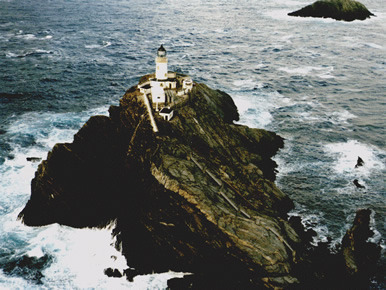
Muckle Flugga lighthouse. A heck of a rock to build a lighthouse on, but mostly a great name. I'm currently using it as an insult (don't be such a Muckle Flugga!), a swear word (turn the Muckle Flugga TV off!), an endearment (thank you, my little Muckle Flugga), and an exclamation (Muckle Flugga, it's hot today!). Husband and son are getting Muckle Flugging sick of it.
The Lighthouse Stevensons in the story of the many generations of Stevensons whose priority was with the Scottish lighthouse building. In the 18th century Thomas Smith married Robert Stevenson’s widowed mother which merged their two families, and thus began from scratch the building of the lighthouses in Scotland. Of the hundred thousand or so people employed on the sea in the 1750s, between 30% to 40% would not have survived to see old age. Those who escaped death through disease, ill treatments, or hardship had little hope of surviving shipwrecks. There had been lighthouses in England for awhile, but Scotland had other challenges such as atrocious weather, “wreckers” (those who lured ships to claim their possessions), and most felt that shipwrecks were Providence (God’s will).
The patriarch was the determined Robert Stevenson (1772-1850). He, and his four generations, served the lighthouse-building industry for many years. In 1786 the Northern Lighthouse Trust (NLT) was established and Robert Stevenson was the chief engineer. He and his eight sons (excluding Robert Louis) designed and built the 97 manned lighthouses on the Scottish coast. His discovery to use interlocking granite blocks (to hold up to forceful winds), and the use of new lamps and lenses over their predecessor- candles, was a huge move forward. Anyone who was involved in the buildings of these lighthouse must have not only great patience, but great strength. Many times “would-be solutions” ended up in catastrophes. For all Robert Stevenson’s philanthropy, he was also remembered as a domineering man who took credit for some advances even though he was a small piece of the puzzle. I can’t imagine how Robert Louis Stevenson’s father allowed him not work for him as his other siblings did (even his daughter was his secretary.) Robert Stevenson's finest achievement was the construction of the Bell Rock Lighthouse. Overall a great read!
This book surprised me. It was fascinating and enthralling. I had zero interest in reading it, but now it's probably one of my top ten all time favorites.
Still good the second time around. I really like this book.
I much preferred reading about Robert and Alan. Maybe that's because they were earlier on and so had to come up with creative solutions to problems instead of just building standard lighthouses in later years. Or maybe because the author didn't give as much time to the later Stevensons. It seems like she got tired of writing by the end of the book. Or maybe they were just more interesting people.
I could have done without the last chapter about lighthouse keepers and how their profession is dying. It just didn't quite seem to fit.
I've chosen to read this book because of the connection it has to my husband's family. Robert Stevenson is his 4th Great Grandfather, which means my children also share this heritage and I want them to know about it. Recently, we were able to purchase a copy of this book for our family library.
I once watched a documentary about the building of the Bell Rock Lighthouse, which is partially covered during high tide. It was fascinating how Robert Stevenson and his team built it in stages, only during low tide at first, and they would stay on a ship nearby for the entire season as they built. I'm amazed by the engineering and strategy they used to succeed in this magnificent feat. The documentary highlighted some challenges they faced. But their sacrifices saved thousands of lives by warning ships of the dangerous shoals. I am eager to read the rest of the story.
(As an aside, I’m glad we can now do half stars, etc.—finally!) This is a very good book about Scottish lighthouses and the works of the Stevensons on them, as well as a good biography of several of the Stevensons (related to Robert Louis). Some of the chapters are a bit long—which is OK!—I just find that a bit much at times—too much info in one go—but the info is good, so it’s just a personal quirk. In any case, a very interesting look at how the lighthouses were planned and built.
I have a thing about lighthouses but this made for very interesting reading about family whose name is synonymous with lighthouses around the Uk. Fascinating insight into how remarkable their construction was interlaced with curious family dynamics.
A thoroughly enthralling book on the building of many of the lighthouses around the Scottish coast. Of course, the famous Stevenson family were responsible but thankfully RLS decided that the life of an engineer was not for him. In fairness he did give it a try but couldn't wait to get out and start writing and in addition he did pen 'A Family of Engineers' that recorded the Stevenson family tradition in the field, or more appropriately on the water.
Bella Bathurst's inspiring account of the men who planned and built the lighthouses is gripping reading. How the devil they did so on perilous rock reefs with the sea battering them almost to death is beyond me and I am very much in the RLS camp!
Skerryvore is one that gets fully discussed (and as a youngster I often wondered why RLS had a Skerryvore editioni of his works) and it seems to have been one of the most difficult to complete, bearing in mind that it was 38.5 feet taller than the Bell Rock lighthouse and 70 feet taller than the famous Eddystone lighthouse.
How the family ran the business and became the driving force in lighthouse development is meticulously discussed in a tale that has one rivetted to the seat ... and thankful to be there and not in the Atlantic wastes!
RLS would have been proud of Bella Bathurst's tale.
Everything you didn't know you wanted to know about how the lighthouses of Scotland got built by the the Stevenson family of engineers - the one that also produced the writer Robert Louis. Reading this book I learned, once again, how incredibly creative and industrious our nineteenth century ancestors were. How they triumphed when all the odds were against them - lack of formal education, absence of adequate health care, career blocking social stratification, religious prejudice, penury, "primitive" technology, mortally destructive forces of nature, back breaking working conditions - the list goes on and yet they plunged forward with their determination to improve whatever they found wanting.
You don't have to be interested in lighthouses, or history, or science, or even Stevensons to be drawn into this story of incredible feats of engineering ingenuity and physical fortitude brought forward by sheer force of will and determination.
Very interesting. As a lighthouse lover, having visited over 70, I rated it a 5-if you are not a lighthouse lover, perhaps a 4. Either way, it is a very well told history of the family who was responsible for the construction of most of the lighthouses in Scotland, most of which are still standing. The Stevenson's were also responsible for lights in other parts of the world, and their engineering influenced lighthouse building everywhere. The book tells of the incredible difficulties of creating those lights, and gave an insight to the men behind them. And yes, they were also the ancestors of Robert Louis Stevenson of Treasure Island fame. A must read for any lighthouse lover.
Well OK, technically, this was a gift from my daughter because she knew I had become fascinated with Robert Louis Stevenson after a trip to Scotland, but just because the Stevenson family operated lighthouses and just because someone wrote a book about does not make this volume leap off the shelves ...
A very enjoyable book on (effectively) the history of lighthouses, as pioneered by the grandfather, father, uncle and cousins of the writer Robert Louis Stevenson, whose fame has come down through history better despite the Bell Rock surely contributing more to human history than Treasure Island.
Lighthouses are an obvious necessity - though not everyone agreed when they were first mooted. Lighthouses were seen as interfering with God's will. Anyone sailing a ship into rocks was by definition stupid and deserved what they got. Many communities grew up around dangerous coastal areas in the knowledge that shipwrecks would bring them what passed for wealth in the olden days. Rent was higher on the more dangerous side of the island. RLS' father noted a case where his ship was floundering off an island and the locals came to shore not for rescue, but to watch the ship sink and the crew drown so they could start taking what was on the ship. It's all rather eerie.
If sailors believed in fate and isolated locals wanted shipwreck flotsam and jetsam, it was ultimately merchant men who got their way - shipwrecks hurt trade. Sailors could be easily replaced, but not goods.
Early lighthouses - Hook Head actually isn't mentioned, despite being the second oldest extant lighthouse in the world - didn't quite face up to the extremes of weather they needed to face. There's some fantastic storms covered - one in 1703 sunk a ship carrying £750,000 in gold; when it was salvaged, it was found the storm had fused the gold into the ship's iron works. Tales of waves moving multi-ton blocks of stone are common place. Eddystone lighthouse in Cornwall - studied by the early generation Stevensons - was built in the late 17th century. A heavy storm in 1703 was a perfect early test. its designer sailed out to sea to see how the lighthouse's beacon would work at a time of need. The lighthouse fell over, and in the dark, its designer's ship sank and he drowned. The next incarnation burned down some 50 years later - the lighthouse keepers escaped, but one complained of pains in his stomach and died 12 days later. An autopsy revealed a seven-ounce ball of lead in his stomach - he had been presumably looking up the lighthouse stairs calling to his companions when a drop of molten lead fell into his open mouth.
Bell Rock off the east coast of Scotland was the first main Scottish lighthouse to be built. These are clearly extraordinary constructions, and their building is told in detail. Workers scrambling on a small water-swept reef of rock, often fully under sea, trying to unload one-tonne blocks from a boat without damaging them, and then putting them in perfect place - all without anything approaching modern technology. Yet they're still in use today. At one stage in the construction, Robert - RLS's grandfather - found him and his workers cut off on the reef as the tide rose over the rocks; their transport boat had cut loose. Completely stranded in the mist, they were resigned to their fate until, by chance, a supply boat hove into view carrying the post.
The Stevensons seem typical Scots - dour, hard-working, God fearing, and either rapacious drunks (one lighthouse had a tunnel leading to the nearest pub) or tee-total. RLS' uncle suffered from MS in later life - this was outside the scope of medical knowledge at the time, and the uncle figured this was God's way of punishing him for making keepers work on the Sabbath (albeit subject to the usual maritime rule that one of them would say Mass in the house).
But while the Stevensons - and their construction of other lighthouses as Muckle Flugga and Dhu Heartach - dominate the tale, the book is as much about lighthouses as about the Stevensons. Lighthouses had three keepers because if there were two and one died, the other could hardly defend himself against the charge of murder. (As is so often the case with these sort of rules, it arose because the issue did actually happen). The mystery of the disappearance of the three Flannan Light keepers is also considered - the house was found in a Marie Celeste state with no signs of violence and logs maintained up to the previous week. It's reckoned the keepers were all washed away by a huge wave while bringing supplies on board - testament to the dangers of the work.
The book concludes through RLS' cousin's son - the fourth generation of lighthouse leaders - to the modern world (or modern in 1999, when the book was written) as lighthouse automation was completed and modern GPS even made them redundant. They're expensive to maintain, and the original builders would almost certainly have made them automatic if they could have. Some of the arguments against their removal, though, seem to come back to the silliness of the arguments against them in the first place - "Everyone knows that relying on satellite technology and GPS alone is complete rubbish. What happens when the technology fails? When there's no-one to report on boats in danger, or give out local weather conditions?" The counter argument? "Computers don't get drunk, don't go insane, don't fall asleep. They just break down sometimes."
But they also provide comfort to sailors at sea, so they stay. It's a reassuring note to end a fascinating book on.
Between 1790 and 1940, eight members of the Stevenson dynasty were responsible for the design and construction of almost a hundred lighthouses that, to this day, still operate around the Scottish coast. Any account of so many achievements would likely run to many volumes and, no doubt, be a dry affair. The Lighthouse Stevensons (1999), Bella Bathurst’s biography of the family, is a potted account of their triumphs, an often dramatic account that plaits the families’ lives, the development of engineering, and the maturing of what is now the Northern Lighthouse Board (NLB), responsible for the lighthouses’ upkeep, into an engaging and informative story.
While opening with some of the needs for lighthouses in Scotland, and how, in neighbouring England, their employ had been somewhat hampered by private interests, Bathurst brings us into the genesis of the Stevensons and their pharological entwinement. Robert Stevenson’s father, Alan, died and his widow married Thomas Smith, a lampmaker, appointed to the recently instantiated NLB. Under his stepfather, Robert’s engineering skills rapidly advance, and he built some lighthouses while still serving his apprenticeship. Bathurst also gives us a precise on Eddystone, a rock lighthouse off the Cornish coast, built by John Smeaton, regarded as the father of civil engineering.
Eddystone, and Robert’s visit to see it, was to be an inspiration for the first major achievement of the Stevensons. Robert showed himself as savvy at politicking as he was at engineering to be charged with the design and construction of the Bell Rock, the world’s old sea-washed lighthouse, located over ten miles off the eastern coast, effectively on a rock. To build something that has stood the test of time so far out to sea, in the dawn of the Industrial Revolution, is an outstanding feat, and Bathhurst injects the story with real drama and awe so that, when the unaccommodating waves take out a year’s work, we feel the workers’ sorrow, but are invigorated by their determination to continue. If the sea was making it difficult, so too were the press-gangs ready to bundle men off to the Napoleonic conflicts overseas.
Robert Stevenson had pinned his reputation on the Bell Rock, and while he managed this early in her career, he remained a foreboding presence in the careers of his descendents. Bathurst takes us into some of their crowning achievements, notably the even more perilous and dramatic construction of Skerryvore, fourteen miles off Tiree, itself on the western reaches of the Hebrides archipelago. To read about the planning that goes into such a construction, the manpower, the ever-present risk to life from a tempestuous Atlantic, is jaw-dropping. But it also comes with family drama as Robert’s son, Alan, becomes his own man in its delivery.
Accounts of other rock lighthouses, notably Muckle Flugga and Dhu Heartach, by other Stevensons, provide just as interesting a history, although there’s a marked difference in these stories’ delivery, which doesn’t soar to the same heights as those before. However, Bathurst also gives us insight into the Stevenson that thankfully got away. Robert Louis Stevenson, author of classics like Kidnapped and Treasure Island, was Robert’s grandson (and Alan’s nephew), and much of his own accounts of his family history inform this work. He had been intended to be an engineer, but he never set aside his literary leanings the way his uncle had been encouraged.
Where Bathurst intially limns a Scotland with a darkened coast, with dangerously rocky seas, frequent shipwrecks and myriad lives lost, the Stevensons lit it up and made it safer over their watch. The last Stevenson died in 1971. The last keeper left his post in 1998. The lighthouses are remotely maintained from Edinburgh. Automation may have ended lighthouse keeping as a profession, but they all stand to this day, signalling out to sea, and the four pinnacles of engineering in this book shine as lasting examples of human endeavour, monuments to men working at the edges of civilisation, building against the odds, for, as per the NLB’s motto, the safety of all.
This is a reread for me, as we're planning a trip to Scotland and I want to familiarize myself with the country from a lot of angles. It's a well-done book, though I can't follow the technical commentary at times, and had to look up terms online.
The story itself is remarkable: Four generations of men (always men) in the Stevenson family basically invented the lighthouse in Scotland and put an end to centuries of unnecessary deaths for mariners trying to navigate the country's rocky, storm-tossed coast. One of the men who should have been in the third generation is Robert Louis Stevenson, the famous author, who defied his father's wishes and become an author. But Stevenson first trained as an engineer under his dad's direction, and he used his experience visiting and working at lighthouse sites for some of the activity and descriptions in his novels, such as "Kidnapped."
The book is written for the layperson, so it includes both history and technology, and it attempts to go fairly light on the tech side, but while still explaining the extraordinary achievements. I like the way the outposts for the lighthouses are described --- windswept, wave-swept spits of land often 10-15 miles offshore from some desolate area in the north. In the most challenging locales, the land was only maybe 100 meters wide at low tide and mostly submerged during high tide. It's mind-blowing that anyone could build on those sites, especially in a era before power tools, as the key building period was the 1790s-1840s.
The author also does an excellent job of explaining the need for the lighthouses and the forces that opposed them. Most chilling were the "wreckers," people who lived in villages along the coast and relied on salvaging wood, metal, and manufactured goods from the wrecks. They would actually try to make ships run aground by putting coal fires on points of land to indicate a safe passage that was actually a rocky shoal, and they would rescue goods but let the sailors drown. And preachers would tell them on Sunday, "It's the will of god to put rocks there and to send ships to be battered against them. You are not responsible for saving the men."
There were other forces arrayed against the solutions as well, such as a fear that French invaders would use the lights to set safer courses --- a genuine worry given that construction was going on during Napoleon's time. And the civil authorities felt like it was a private problem for ship owners, not something that society should spend money on.
But eventually, sanity prevailed, in large part due to the first two generations of Stevensons, who both lobbied for lighthouses and showed that they could be built and then manned by reliable people with decent lights. Then, the book does a great job of explaining the arduous, endless work of the engineers to design and build the lighthouses, as well as bridges, roads, harbors and other works of the nation during the crucial decades. It's unimaginable to me how hard they worked.
It's an inspiring story that tells us non-Scots about an aspect of the country that we wouldn't likely understand. And as I see lighthouses on my visit, I will have a great appreciation for the effort and ingenuity and hardship involved.
The name "Robert Louis Stevenson" probably rings a bell for most of us - he did author a few famous literary classics like "Treasure Island" and "The Strange Case of Dr. Jekyll and Mr. Hyde" - but beyond being one of those authors we were all forced to read at some point in our educational careers, Robert Louis Stevenson has another interesting credit to his name: he is descended from a line of intrepid Scottish lighthouse engineers.
In Bella Bathurst's fascinating history, we are taken on a journey that encompasses four generations of Stevenson's and four iconic Scottish lighthouses, starting with Robert Stevenson (1772 - 1850), the famous author's grandfather, who, in partnership with his own stepfather, developed the career of "lighthouse engineer" and built the famous (and many deemed impossible) Bell Rock Lighthouse. We meet Robert's sons, Alan (1807 - 1865) and Tom (1818 - 1887), brothers who could not be more different, but who both pursue the legacy established by their indefatigable father, and each build their own impossible light - Alan's Skerryvore and Tom's Muckle Flugga. Finally, we are introduced to Alan Stevenson's son, David Alan (1854 - 1938), who unlike his literary-inclined cousin - Robert Louis was Tom's only son - follows in the family's footsteps and builds his own legacy in the Dubh Artach Light.
Moreover, on this 200-year journey, Bathurst also immerses us in the maritime culture of Scotland in the 1700s and 1800s. We learn of the initial reluctance since lighthouses would put an end to the wreck salvage that served as many's livelihood. We read about the fatalism of the populace in accepting that a career at sea was, by its nature, dangerous... and short. And the incredulity. How will these lighthouses be built, and who is going to maintain these structures, on the most dangerous spits of rock in the North Atlantic?
I am an admitted lighthouse nut, so it would be very difficult for me not to enjoy Bathurst's work, but I would say to those who are unsure about reading an entire book on lighthouses: give this one a shot. There is more to this incredible history than lugging blocks of granite and installing lighthouse lenses. The Stevenson's were, as most families are, complicated, dysfunctional, and devotedly loyal. The Lighthouse Stevensons is just as much about the devotion and legacy of family as it is about the towers of light scattered along the Scottish coastline.
A collective biography of the generations of Stevensons who built and maintained the lighthouses of Scotland. This is meant as an entry point to the history, as Bathurst spells out in the introduction. She ranges back and forth over diverse topics, from family biography to the development of engineering as a profession to technical details about oil and lights. Everything connecting the Stevensons to lighthouses gets a brief moment to shine, but don't expect any deep dives.
This was an absolutely fascinating book. I've only the barest awareness of Robert Louis Stevenson, and didn't know anything about his family history. The Stevenson family was right in the middle of some very interesting times in Scotland - how many different public services the family ended up developing was incredible. From lamps to lighthouses to bridges and warfs, very little seemed to have been built in 1800s Scotland without at least one Stevenson man on the job.
Bathurst has a very simple style of writing - it gets the information across clearly without dipping into too many tangents. She finds a good balance between all the different threads of her story, giving each equal weight despite how disparate they can be. She is clearly interested in her subject and wants her readers to enjoy learning about it as much as she does. What could have easily been drily technical comes alive with humanity, as she connects the mechanics of building lighthouses with the men doing the work.
There are some odd formating problems with the ebook. Many words are misspelled - 'th' gets rendered as a 'du' quite a lot. And this ebook edition begins with a list of illustrations but the actual pictures are not included anywhere.
I could have given this book 5 stars except for one major flaw, no maps or pictures of the lighthouses cited. The author didn't even bother to include drawings or pictures of the Lighthouse Stevensons who are the reason for the book. I don't understand the reasoning for this.
Other than that, it is a well-written story of a family, obsessed with the building of lighthouses, especially Scottish ones. Robert Stevenson is the crux of the story as a civil engineer in the early 19th century whose masterpiece, Bell's Rock, set his reputation. However, he was a workaholic in his position of chief engineer for the Northern Lights Board. Just reading about his duties is fatiguing as he built other lighthouses and made yearly tours of them. Somehow he also found time to have numerous children, but only five survived childhood. The one girl became his secretary, while the only boy to rebel, Bob, became a doctor. After finding this out, we never hear of him again!
The three sons who toed the lighthouse line were Alan who built Skerryvore Light, David who built Muckle Flugga, and Thomas the dreamer. Thomas turned out to be a competent engineer who built Dubh Artach and Chicken Rock, but is probably best known as the father of Robert Louis Stevenson.
Robert Stevenson, the patriarch, demanded much from his family, in their education and life in general. He kept a close eye on all their projects by letter. He was a man who had to be in control of everything. His sons and grandsons carried on the lighthouse tradition that he so successfully created.
I once lived on an island that carried a lighthouse built by the Lighthouse Stevensons. I lived on the island from about 1970 to about 1974 and all that time I had no idea of its history. Or of the history of any of the lighthouses that circle Britain. I learned about them, their builders and quite a lot about Edinburgh history while reading this book, and the book itself is a late discovery. I first saw the book while staying at Cantick Light, a set of lighthouse keepers' cottages on the island of Hoy, in Orkney, while there for a music festival two years ago. It took me a while to find it. Here is the story of a family who does not seem as if they could exist in our modern world of short attention spans. Here is a family of engineers who spanned four generations and produced a children's story author, Robert Louis Stevenson, Tusitala, the teller of tales. The light on my island was and is Start Point light on the island of Sanday. It was built in Robert Louis's time as an apprentice in the family business: 1806. What is staying with me, beside the success of the family with near impossible projects, is that the author, Bella Bathhurst, has snatched this story from being forgotten as she makes a point of the beauty of Victorian engineering and, while understanding the path that demanning lighthouses and computerizing keepers' jobs was inevitable, mourns the grace and human touch of the original sphere of lighthouse life.
The accomplishments of Scottish engineers in the 19th century are legendary. From railroads to bridges to roadways, the canny Scots built structures that still serve us today.This is equally true in the area of lighthouse construction, a story that revolves around three generations of the Stevenson family of Edinburgh. Starting at the end of the 18 th century, the men of this family undertook the design and construction of dozens of lighthouses along the rugged Scottish coast. Bella Bathurst focuses on the construction of four of the lighthouses, each in its own way the signature achievement of different Stevensons. Working on rocky outposts off the coast, the building of the Bell Rock , Skerryvore, Muckle Flugga and Dubh Artach are compelling stories of the vision of the engineers and the impossibly difficult efforts of the workmen on each site. Two major complaints about this book. It was very poorly edited, with many typos and several sentences that do not begin with a capital letter. Second, works of non-fiction need indexes! This would help readers keep the various members of the Stevenson family straight. Ironically, perhaps the most famous member of this family was a failed engineer. After being pressured to join the family business, Robert Louis Stevenson pursued a literary career that produced “ Kidnapped”and “ Treasure Island”. His skills as an editor would have helped this otherwise fascinating account of the Stevenson lighthouses.
Outstanding Historical Account of Scottish Lighthouse Design and Construction ... In Scottland, the ancestors of the renowned author Robert Louis Stevenson are more famous than the author himself. His grandfather, Robert, and subsequent generations of Stevenson engineers designed and built almost one hundred lighthouses along shorelines and on offshore reefs along the Atlantic and North Sea sides of the northern British Isles. This was accomplished over 200 years in the nineteenth and twentieth centuries. It is a fascinating story, and the reader will get a full appreciation of the technical and logistical difficulties involved, compounded at times by some of the most frightening and powerful weather on the planet. - David B. Crawley, M.D. – Author of “Steep Turn: A Physician's Journey From Clinic to Cockpit” and “A Mile of String: A Boy's Recollection of His Midwest Childhood.”
I found myself alternating strangely between “this is so boring and I wish I was reading anything else,” and “I really wish this author went into detail here (usually about the actual science and engineering stuff involved in building lighthouses in godforsaken Scottish islands in the 19th century).”
Like there was this throwaway paragraph here:
“Glass, stone and water were an uneasy mixture, and Robert spent much of the next two months in a state of near panic waiting for the new lantern glass to be fitted up and ready. In this, as in many other aspects of the works, Robert designed according to circum-stance. He had to find a new kind of glass, built to withstand heavy seas and sizeable enough to be seen from a distance. In front of the rotating reflectors, Robert intended to place panes of red glass which, when turned, would give the Bell Rock an alternately red and white beam. Up until then, no red glass of the right size yet existed. Robert, as usual, made it exist.
AND IT JUST ENDS THERE. I WANT TO KNOW HOW HE MADE IT EXIST.
Anyway, kind of disappointing. Lighthouses are such inherently dramatic structures that it’s a shame this reads so dry.
This book fulfills the ATY 2026 reading challenge prompt 46: a book that’s not a novel”
Bella Bathurst's book chronicles the Robert Louis Stevenson family's involvement in building 14 of the original lighthouses on the coast of Scotland is appropriately named "The Lighthouse Stevensons". If you enjoy lighthouses, you might be surprised to find out how very complicated they were to build. They look like such simple and sturdy structures. I was also amazed to find out how they chose lighthouse keepers...I never appreciated the toll it took on family life while providing good wages, pension, health benefits,etc. I knew about the logs that had to be kept but did not know about the rule books they had to follow in an exacting fashion. Each lighthouse received certain books that were to be read and utilized--some by the whole family. When our family toured some lighthouses in America during the latter 1960's and into the 1970's, they were still "manned"---not automated like they are today. [Disclaimer-I admit that I decided to read this book because I thought the author's name was interesting. I also recalled reading Mr. Stevenson's novels as a teen. I ended up with a very good read.]
I enjoyed this book much more than I expected, and am now wondering why it languished on my shelves for so many years. The book is about exactly what it says in the title. The father, uncles, grandfather and, step great grandfather of Robert Louis Stevenson were all pioneering engineers who were responsible for building some of the most remote lighthouses around the Scottish coast. The author did a really good job striking a balance between writing about the lighthouses and about the men (the women in their lives really didn't feature much at all beyond Louis' grandmother) who built them. She writes about the conditions that had to be overcome, the resistance by the locals to building the lighthouses and therefore reducing the wreckage coming their way, the battles with Trinity House in London, and the amount of planning that was involved in each one. She also writes about the personalities of the men involved, helped, it would seem, both by Louis' writing, but also the copious amounts of notes and written work they left behind. A really enjoyable read, that is part biography, and part social history of Scottish engineering.