Jump to ratings and reviews
Rate this book

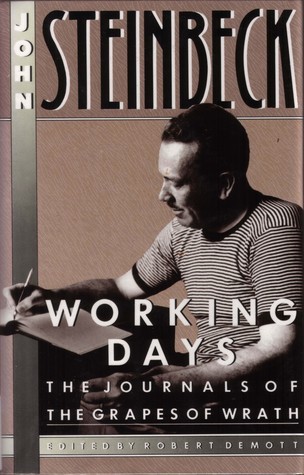
Working Days The Journals of the Grapes of Wrath

Rate this book
Jphn Steinbeck wrote The Grapes of Wrath in one concentrated burst of activity between June and October of 1938.

Throughout the time he was creating his greatest work, Steinbeck faithfully kept a journal revealing his arduous journey toward its completion.

Working Days records in intimate detail the conception and genesis of The Grapes of Wrath, through the aftermath of its publication, and its huge yet controversial success. Readers will find it a unique and penetrating portrait of an emblematic American writer creating an essential American masterpiece.

254 pages, Hardcover

First published January 1, 1989

113 people are currently reading
2288 people want to read

About the author

John Steinbeck

1,050 books26.4k followers
John Ernst Steinbeck was an American writer. He won the 1962 Nobel Prize in Literature "for his realistic and imaginative writings, combining as they do sympathetic humor and keen social perception". He has been called "a giant of American letters."
During his writing career, he authored 33 books, with one book coauthored alongside Edward F. Ricketts, including 16 novels, six non-fiction books, and two collections of short stories. He is widely known for the comic novels Tortilla Flat (1935) and Cannery Row (1945), the multi-generation epic East of Eden (1952), and the novellas The Red Pony (1933) and Of Mice and Men (1937). The Pulitzer Prize–winning The Grapes of Wrath (1939) is considered Steinbeck's masterpiece and part of the American literary canon. By the 75th anniversary of its publishing date, it had sold 14 million copies.
Most of Steinbeck's work is set in central California, particularly in the Salinas Valley and the California Coast Ranges region. His works frequently explored the themes of fate and injustice, especially as applied to downtrodden or everyman protagonists.

Ratings & Reviews

What do you think?
Rate this book

Friends & Following

Create a free account to discover what your friends think of this book!

Community Reviews

5 stars
262 (33%)
4 stars
329 (41%)
3 stars
165 (21%)
2 stars
25 (3%)
1 star
4 (<1%)
Displaying 1 - 30 of 115 reviews
Profile Image for Maxwell.
1,440 reviews12.4k followers
December 17, 2025
You MUST read The Grapes of Wrath before reading this book, if that wasn't clear from the title. You should read that book regardless because it's excellent, and this too is an excellent book that gives incredible insight into Steinbeck's state of mind as he toiled over the first manuscript of what would become of the greatest American novels.

The majority of the book is the transcriptions of Steinbeck's journal (around 100 entries) he kept during the 5 months when he was writing The Grapes of Wrath. There's also great auxiliary material from editor Robert DeMott that provides additional context and also gives helpful footnotes to much of what Steinbeck journals about. The book also includes an additional 20 or so entries from a year after TGOW's publication which showcase the response to the novel and impact on Steinbeck's career and thus on his state of mind.

I already adore Steinbeck but this made me love him even more. It's so fascinating to get a first-hand account of what plagues an author's thoughts while working on a piece of art that they feel they must get out of themselves. He's vexed my constant communications from his publishers, film directors adapting his work, his friends and colleagues, the fly that keeps buzzing around his office, his noisy neighbors, the laundry machine downstairs that clunks away. It's funny and relatable, that even one of the greats had everyday issues distracting him from his important work.

And yet, he powered through. Even when he didn't feel capable, he was relentless in his commitment to his craft and voiced regularly how he just had to tackle the day's 2000 words to get the manuscript completed on the schedule he'd set for himself.

I also appreciated the book highlighting two very important figures in getting TGOW complete--his wife at the time, Carol, who not only typed up the very first manuscript of the novel but also came up with its title(!); as well as Thomas Collins, a migrant camp manager who Steinbeck had traveled with to various camps in California and whose correspondences provided Steinbeck with material for the novel that would prove invaluable to its accurate depiction of the migrant labor crisis.

I have loved Steinbeck's non-fiction as much as his fiction, and this was no exception. He also expressly gave this journal over to be published, but not until after his death, which I appreciated. I think it's hard to rate someone's private diary, but combining that with the preface and introductory material, as well as the footnotes I mentioned, this was an accessible and engaging read that I would highly recommend for any TGOW and Steinbeck lovers like myself!
Profile Image for Corinne.
68 reviews247 followers
September 3, 2015
I read 'The Grapes of Wrath' first when I was a teenager. Recently, I re-read it, along with ‘Working Days: the journal of the Grapes of Wrath’, and I could understand this novel a lot better through the perspective of the author.

For example, I saw why Steinbeck separated the General Chapters from the Specific ones and why he alternated them, what was the role of the rain in the story, and why he built Ma Joad the way he did. I found reading the two books together moved me a lot more than before.

Tom’s encounter with Casey at the beginning of the story laid the foundation for the transformation of their lives: for Tom, resurrection of his spirituality; for Casey, the resurrection of his practicality. A great complementary role, portrayed subtly and progressively.

The symbol of the tortoise is significant: Tom moving on a perilous ground, being hit by hostilities that throws him off balance, but then he finds his direction again, just like the tortoise. The novel is full of such effective parallels.

For me, it’s one of the rare American novels where I could have access to the inner thoughts of the characters, which makes the novel intimate.

The construction of the micro-society is certainly Steinbeck’s vision of the ideal society, but he didn’t keep his characters in that illusive security. He did just enough to pull them out of the misery, and then left the readers to imagine the end.

The final act of Rose of the Sharon seems so much more powerful because Steinbeck had set her up from the beginning as just the opposite!

But, for me, the most powerful character in the story remains Ma Joad, for her maturity, wisdom, patience, and resilience. Rarely, have I come across a feminine character like her.
Profile Image for Murray.
Author 151 books743 followers
February 23, 2025
🍇 An important journal tracing one artist’s creative process and deserves to be read alongside his similar work on producing East of Eden.
Profile Image for Kim.
426 reviews540 followers
January 7, 2013

Steinbeck wrote his Pulitzer Prize winning novel The Grapes of Wrath in an exhausting period of intense creativity from June to October 1938. During that period and for some time thereafter, he kept a journal in which he wrote before he started work each day. Steinbeck set out what he expected to achieve on that day and recorded his hopes, dreams and frustrations. He repeatedly expressed his determination to make the book a good one, but also his fear that it wouldn’t be. Steinbeck reported on bouts of depression and anxiety and his deep feeling of inadequacy about his writing. In the aftermath of publication of the book, he recorded the disturbing effect its extraordinary success had on his life. This book includes a comprehensive introduction and each of Steinbeck’s journal entries, annotated by editor Robert Demott.

Steinbeck sent the journal to his editor and friend Pat Covici in 1950. He wrote:
Very many times I have been tempted to destroy this book. It is an account very personal and in many instances purposely obscure. But recently I reread it and only after this time did the unconscious pattern emerge. It is true that this book is full of my own weaknesses, of complaints and violence. These are just as apparent as they ever were. What a complainer I am. But in rereading these became less important and the times and the little histories seemed to be more apparent … I had not realized that so much happened during the short period of the actual writing of The Grapes of Wrath - things that happened to me and to you and to the world.

Steinbeck asked that the journal not be published during his lifetime and that it be made available to his children if they should ever want “to look behind the myth and hearsay and flattery and slander a disappeared man becomes and to know to some extent what manner of man their father was.”

This book provides an amazing insight into the creative process and into Steinbeck’s mind. It is a testament to his steadfast determination to make The Grapes of Wrath the best book it could be. Highly recommended for Steinbeck fans.
Profile Image for Bonnie.
169 reviews310 followers
May 15, 2009

I found this a very interesting read. I think that all authors, would-be-authors, and readers wondering about the process of creating a novel, would agree with me. Note: Some parts of Steinbeck’s journal entries are slightly repetitious, but each entry is short enough that I found it easy, and not at all distracting, to skim through such passages.

The book begins with a 57 page “Introduction” – lengthy, but with some interesting points to make:

- The Grapes of Wrath has been less judged as a novel than as a sociological event, a celebrated political cause, or a factual case study. If the past fifty years have seen little consensus about the exact nature of the novel’s achievement, there has been plenty of proof that elicits widely divergent responses from its audience.

- As she did with all her husband’s manuscripts, Carol typed and edited
The Grapes of Wrath, served in the early stages as a rigorous critical commentator… and, in a brilliant stroke, chose the novel’s title from Julia Ward Howe’s “Battle Hymn of the Republic”….

- Contrary to popular belief, Steinbeck never traveled with a migrant family all the way from Oklahoma to California.

- Although he published prolifically after
The Grapes of Wrath, it would be twelve years before Steinbeck summoned the resources to attempt, in East of Eden, another “big” book with a similarly exalted conception and theme…. A prophetic post-modernist, Steinbeck’s real subject in Cannery Row, East of Eden, Sweet Thursday, The Winter of Our Discontent, and the Journal of a Novel was the creative process itself.

PART II: THE DIARY OF A BOOK (May-October 1938):

The following are a few snippets to give you an idea of what these (100+) journal entries are like. (I have omitted the actual dates and time of each entry: for the most part, Steinbeck wrote daily, usually beginning at around 11:00 a.m.)

- Entry #10: …. Now to the day’s work and now Muley comes in and the reason for the desertion becomes apparent. Also, the night comes in with sleeping in the darkening plain and stars [ed. – Chapter 6:]. And after that I think a small inter chapter or maybe a large one dealing with the equipment of migration. Well here goes for Muley. Well that is done. I like Muley. He is a fine hater. Must write a few letters now.
- Entry #12: …. Today Tommy Joad tells about prison and I don’t know whether the chapter will finish or not. That’s not the problem. Rob and Mary write they want to come down. They can’t. I am well into this now and nothing is going to be allowed to interfere. When I am all done I shall relax but not until then. My life isn’t very long and I must get one good book written before it ends….
- Entry #13 …. The failure of will even for one day has a devastating effect on the whole, far more important than just the loss of time and wordage. The whole physical basis of the novel is discipline of the writer, of his material, of the language. And sadly enough, if any of the discipline is gone, all of it suffers….
- Entry #14 …. Yesterday was a bust. I could have forced the work out but I’d lost the flow of the book and it would have been a weak spot….
- Entry #15 …. Not an early start today but it doesn’t matter at all because the unity feeling is back. That is the fine thing. That makes it fun and easy to work…
- Entry #16 …. Yesterday the used car lot and today Tom and Casy go home to the family, if they get there [Ed.—beginning of Chapter 8:]. Must go slowly and introduce these people fully and carefully for I will be with them for a long time…
- Entry #18 …. This is a huge job. Mustn’t think of its largeness but only of the little picture while I am working. Leave the large picture for planning time…But I am assailed with my own ignorance and inability…Honesty. If I can keep an honesty it is all I can expect of my poor brain…If I can do that it will be all my lack of genius can produce. For no one else knows my lack of ability the way I do…
- Entry # 40 … I wonder if I will ever finish this book. And of course I’ll finish it. Just work a certain length of time and it will get done poco o poco. Just do the day’s work. Some days I think I am getting sour but I don’t know. Some days I think I am getting sour but I don’t know. Then comes a good day and I am lifted again. And I can’t tell from the opening. Often in writing these beginning lines I think it is going to be all right and then it isn’t. Just have to see…
- Entry #42 …. Only 8 days to finish half. And today I cut out another section.


In Part III: AFTERMATH (1939-1941), twenty-three more irregular entries follow a short commentary. “Following its official publication date on April 14, 1939, The Grapes of Wrath remained atop the best-seller lists for most of the year, selling roughly 428,900 copies in hard cover at $2.95 apiece. (In 1941, when The Sun Dial Press issued a hard-back reprint selling for $1.00, the publisher announced that over 543,000 copies of Steinbeck’s novel had already been sold.)”

The last section, NOTES AND ANNOTATIONS a Bibliographical Preface, includes interesting clarifications of many of the entries in the two parts that comprise John Steinbeck’s journal entries.

Steinbeck’s diary entries actually total only one hundred pages. The rest of the book contains background information by the editor, Robert Demott. To say that the book should be dismissed because of this would be a mistake. At the same time, I expected to discover more insights into the day-to-day working mind of the author who wrote The Grapes of Wrath. If I were to read this the novel again, I would definitely have Working Days at my side as I read. At the same time, I can say that I recommended this book as a compelling read on its own merits.

Profile Image for Shuhan Rizwan.
Author 7 books1,107 followers
March 16, 2021
দীর্ঘ উপন্যাস লেখাটা অনেকটা ইট দিয়ে চীনের প্রাচীর তৈরির মতোই ব্যাপার, শ্রমিকের মতোই লেখককে এগোতে হয় একটা একটা শব্দ বসিয়ে। কিন্তু এই যাত্রা যতটা শারিরীক, মানসিক তার চেয়ে অনেক বেশি। সেজন্যেই বোধহয় প্রায়ই আমরা প্রিয় লেখকদের আবিষ্কার করি ক্ষ্যাপাটে, ছিটগ্রস্থ বা উন্নাসিক বলে।

জন স্টেইনব্যাক তার অতুল কীর্তি ‘দা গ্রেপস অফ ড়্যাথ’ লিখেছেন ১৯৩৮ এর দ্বিতীয়ার্ধে। প্রায় দুই লাখ শব্দের সেই উপন্যাস লেখার অভিযানে কী চলছিলো তার মনে, ছোট এই জার্নালটা থেকে সেটার একটা আন্দাজ পাওয়া যায়। ইউরোপে তখন দ্বিতীয় বিশ্বযুদ্ধের দামামা জোরালো হচ্ছে, স্টেইনব্যাক নিজেও বাড়ি পাল্টাচ্ছেন, এ যুগের ফেসবুক আর মেইল বার্তার সমতুল হয়ে তার কাছে প্রতিদিন আসছে অসংখ্য চিঠি আর আবেদন। আর তার মাঝে স্টেইনব্যাক নিজেকে প্রতিদিন মনে করিয়ে দিচ্ছেন যে তাকে শেষ করতেই হবে এই উপন্যাস।

ঔপন্যাসিকের চিরকালের ক্লান্তিকর অসুখী জীবনের একটা ঘোড়া তাই দৌড়ে বেড়াচ্ছে দিনলিপিগুলোয়। কোথাও স্টেইনব্যাক বলছেন, ‘একটা দিন লিখতে না বসার মানে উপন্যাসের গোটা কাঠামোটাই ধ্বসে পড়া’। আবার কোথাও একেবারে ভেঙে পড়েও নিজেকে মনে করিয়ে দিচ্ছেন, ‘জীবনে আর যা লিখেছি, তার সবই ফালতু। এইটেই আমার সেরা লেখা, এটাকে শেষ না করলে মরেও শান্তি পাবো না।’

বইটার বড় অংশ সম্পাদকের মন্তব্যে ভর্তি। আর দৈর্ঘ্য মাত্র চার মাসের বলে স্টেইনব্যাকও যেন একই কথা বারবার বলছেন নানা জায়গায়। তা সত্ত্বেও, লেখার পেছনে লেখকের মাথার ভেতরে উঁকি মেরে দেখতে চায় যে, তার জন্য এটা উপভোগ্য একটা বই।
Profile Image for M. Sarki.
Author 20 books237 followers
January 27, 2015
http://msarki.tumblr.com/post/1093374...

The most private of men writes a diary, keeping it current on each day he actually sits down to work on a novel which would become The Grapes of Wrath. Keeping a journal was something John Steinbeck had attempted in the past to no avail. But it is our great fortune that he succeeded at the most important time of his life to practice the discipline that not only earned him great literary rewards but also secured his memory in our American consciousness.

This journal is one of the best literary works I have ever read as Steinbeck’s truth rings loud and clear, his desperation both real and imminent, and the personal frustrations of being a writer not only presented in fact but written upon us with his blood. What initiated two summers ago for me in my first reading of Travels with Charley was a new interest in the person John Steinbeck, more so than even his fictions. Though extremely controversial and outspoken, Steinbeck valued his privacy and solitude. He kept few friends, but those he did have were close and of like mind. The emotional pain he suffered in his amorous relationships is made all too clear in this journal written at a time of both great literary achievement and the impending failure of a marriage between two people seemingly highly suited to one another’s goals in life. It is unfortunate that the physical and passionate side of this relationship could not be redeemed and saved. But Steinbeck left this wife for another ill-fated lover who became his second wife and ultimately the mother of his children.

The journal takes place at a time in the world of beating war drums, fascism, and Hitler’s rise for world dominance and destruction. Meanwhile Steinbeck was struggling with fame and the pressure coming from the needy of every stripe. And as he was attempting to write what would become his greatest novel, his new neighbors were irritating the life out of him with their hammering and radios being played so loudly he could not think. But as disagreeable as this was to him it all helped to shape his diary into a fascinating window for peering into the life of a most interesting man of letters. I truly hated for this book to end. But it did, and what was finally and forcefully gleaned from this exercise was his firm belief in the importance discipline plays to any writer of note.
Profile Image for Amanda Stevens.
Author 8 books353 followers
May 28, 2020
The main takeaway here is that Steinbeck lived in a quagmire of self-doubt the entire time he was drafting one of the greatest American novels of all time. But he went to work anyway. As a writer I take immense encouragement from his determined discipline and his desire to write “one good book” in his lifetime. Well, sir, you certainly accomplished more than one.

Favorite quote: “Here is a strange thing—almost like a secret. You start out putting words down and there are three things—you, the pen, and the page. Then gradually the three things merge until they are all one and you feel about the page as you do about your arm. Only you love it more than you love your arm.”
Profile Image for Joe Bruno.
389 reviews6 followers
June 20, 2023
This was quite illuminating. It really showed Steinbeck's mind as he wrote, how split he was in how he felt about what he was writing. The 2000 words a day thing, there had to be revision of course, but it seemed to pour right out of this guy, the timeless writing. I had forgotten how big a book it was. I pulled down my copy to follow along at some point, it is 600 pages long and he seemed to have created it in his head and then wrote it on the page.

He wrote this;

"Yesterday the work was short and I went over the whole of the book in my head - fixed on the last scene, huge and symbolic, toward which the whole story moves. And that was a good thing, for it was a reunderstanding of the dignity of the effort and the mightyness of the theme. I felt very small and inadequate and incapable but I grew again to love the story which is so much greater than I am."

Quite a talent and quite a book, "The Grapes of Wrath." I wonder now if it does not affect the younger readers the way it did when it came out or the way it affected me when I first read it. I read a couple of passages from it while I read this journal and recalled the wonder I had at first reading.

I borrowed this from the library, I don't imagine any but the most hardcore Steinbeck fan would need to own it. I am considering going back and re-reading TGOW. I may or may not, I have some other things to get to and it is 600 pages. It did change my life though, the first time. This Journal reminded me of that.
Profile Image for Bruna Duarte.
60 reviews3 followers
August 8, 2024
How bizarre is it to read - and rate - someone's journal? With that being said, the hyperfixation demon within me would be thrilled if every book I loved had its author's-journal counterpart. It was a privilege to have more 'The Grapes of Wrath' material to read and obsess over.

Johnny, I love you, you will always be famous. You're a weird lil anxious, insecure, nature-loving pen freak just like me.
Profile Image for Andrew Peacock.
Author 7 books19 followers
March 21, 2020
What a fabulous book for a writer to read. If Steinbeck had all these worries about distraction and lack of self confidence maybe there is hope for the rest of us. The idea of writing down all the things that bother you about writing and then just writing is so inspiring. Time to go put something down on paper.
82 reviews
January 13, 2010
There is no better way to disabuse people of the notion that writing is easy than to hand them this book. Steinbeck fans will appreciate the journal's insights into his personal life, but any reader should come away from this with some sense of the determination and grinding discipline that writing projects demand.
Profile Image for Patrick Howard.
169 reviews1 follower
November 1, 2023
“My reach for some kind of ideal happiness is chemical.”

It is alternately enthralling and irritating to consume this chronicle of frustrated genius. Steinbeck powered through The Grapes of Wrath amidst turmoil large and small, expressing his grievances via this working log. There’s plenty of entertainment & engaging content here for Steinbeck devotees, though his fragmentary thoughts are infrequently suited towards any real analysis or depth.
Profile Image for Kristi Duarte.
Author 3 books35 followers
September 13, 2019
LOVE THIS BOOK!!!!! Grapes of Wrath is one of my favorite books ever, its language is so perfect, and as an author I aspire to reach that level (good luck with that, right?). Reading this book should be a must for any author, because it's so helpful to read that even geniuses doubt their talents, get tired of writing in the middle of a project, take more days than necessary off, etc. I recognized myself so much in his journal notes that I have recommended this book to everyone in my writer's group.
Profile Image for Twila Newey.
309 reviews22 followers
February 6, 2017
I coupled this with my reading of The Grapes of Wrath, which was fascinating and supports my theory that something prophetic was going on with Steinbeck. There was a drive to write the book, to make it visceral and real, to preach his sermon on the greatness and failure of America as an ideal. Here is what stuck out for me:
1. one day at a time, 2 pages a day
2. the over all sweep and separate movements of the book all existed in Stienbeck's mind prior to writing
3. the way he often laid out the work for the next day.
4. that he wrote in chaotic life conditions (noise, moving, calls for publicity, use of his name, etc.)
5. the fluctuation between self-doubt and confidence in his ability as a writer
6. his thoughts/feelings on the rise of fascism and the effect on the country so similar to current feeling of our country
As an interesting aside, I also happened to be reading The Kaizen Way simultaneously and see Steinbeck intuitively using the ideas behind that small step method to some degree.


"Yesterday the work was short and I went over the whole of the book in my head-fixed on the last scene, huge and symbolic, toward which the whole story moves." (#28)

"This family [the Joads] must live...And there is this frightful fear that I won't be able to do it, that it is too much for me." (#59)

"I did it but it may not be good. I don't know." (entry #35)

"This is a hell of a time to be writing a book. Everything in the world is happening and I must sit here and write. Well, if I ever finish it will be some kind of triumph". (entry #34)

"Just work a certain length of time and it will get done poco a poco. Just do the days work." (entry #40)

"Well, two pages a day will do it in time. And the time slips by. Just a matter of doing the daily stint" (#46)
Profile Image for Stephanie Ricker.
Author 7 books106 followers
March 8, 2014
Anyone who doesn’t think writing is hard work should read this collection, taken from Steinbeck’s daily writing notes. The poor man sweats bullets the whole time and pours blood, sweat, and tears into his manuscript. Even though Steinbeck had quite a few published works by this point, he angsts constantly about how he’s not a real writer, and soon everybody is going to find it out. He alternates between thinking his work is crap and hoping that it’s brilliant. He has to psych himself up to write each day and most of the time ends up bullying himself into cranking out a page even though he doesn’t feel like it. In short, he expresses the rollercoaster of emotions that every writer seems to go through during the writing process, and I felt tremendously encouraged by that. His excitement when his wife came up with the perfect title for the manuscript he’d been slaving over for months was touching and so…relatable. Hey, I know that feeling! This is a great read for fans of Steinbeck, or for any writer, regardless of whether they enjoy Steinbeck’s works.
Profile Image for Krys.
36 reviews
November 19, 2009
How did he do it? Steinbeck gave himself 6 months to write Grapes of Wrath (after several years of research), then sat down and penned the whole Pulitzer-winning manuscript in one concentrated burst--in two drafts mind you. How did he begin each day? What was he thinking? What obstacles did he face (plenty) & how did he deal with them? For a writer struggling through a manuscript, this diary is pure inspiration. Even Steinbeck had days when he felt like the world was about to discover what a loser he was as a writer. (He won a Nobel Prize in 1962.) Given fascinating context by editor Robert DeMott, a prominent Steinbeck scholar.
The controversy surrounding the release of Grapes of Wrath makes me wonder about some of the reviews on GoodReads.com--everybody likes to dislike a lot of books (including me) but what truly endures?
Profile Image for Falina.
555 reviews19 followers
November 10, 2016
I love reading people's journals and I love John Steinbeck, so that explains the four stars. I hate that people can't or won't talk about the struggles they go through much of the time -- I know it can be depressing or considered selfish, but it's so alienating to feel something inside and see no traces of it in others. It's particularly fascinating to see inside the mind of someone who went on to become a Pulitzer and Nobel Prize winning author, and to discover he is just as unsettled, petty, whiny, and confused as I am most of the time. I don't think while he was writing this journal he intended for it to be read by anyone, unlike his East of Eden journal, which is less emotional and more structured. This might be the most "real" writing by Steinbeck I've encountered so far (and I've read nearly all of it at this point).
Profile Image for Victoria Mixon.
Author 5 books68 followers
November 23, 2010
Again, Steinbeck's daily record of his struggles to sit down and write his novel is a gift to all writers. Obviously, he worked from a plan he'd previously spent a great deal of time and energy forming, and obviously his manuscript later went through editorial development with his editor and close friend Pat Covici. But the day-to-day professional attitude toward his job, toward the process of his craft---that's something no aspiring writer can ever hear enough about.

It takes a long time to become a writer. It takes years and years to write a single good book. And life interferes.

We need to know this in our bones.

Plus, it turns out Steinbeck referenced my hometown in The Grapes of Wrath. Who knew?
Profile Image for Sissy Van Dyke.
Author 2 books10 followers
May 9, 2020
This is my favorite writing book. It's an intimate portrait of the writing mind and a great example of writing as hard, mental work. This, despite the fact that Steinbeck wrote Grapes of Wrath in five months! Steinbeck's National Book Award, Pulitzer Prize and, eventual Nobel Prize are confirmations of the value of fast and free-writing. When you tap into the Wild Mind, you lose control of the work, and I think that's a great thing. I believe that a spirit resides within me that is a much better writer than I will ever be.
Profile Image for Tyler Weaver.
Author 5 books5 followers
September 4, 2015
Five stars for the diaries, three for the editor's commentary.
Profile Image for Margaret Madden.
755 reviews173 followers
December 16, 2015
His wonderful to have access to the inner thoughts, and insecurities, of one of the most talented writers of the 20thC...
Profile Image for Devin Murphy.
Author 7 books183 followers
November 23, 2016
This is a really fascinating book as it reveals how down on himself he was during the writing of his masterpiece. It showed me the nature of all artistic endeavors being married to self-doubt.
Profile Image for Brent Ecenbarger.
722 reviews10 followers
December 16, 2020
… but I am sure of one thing-- it isn’t the book I’d hoped it would be. It’s just a run of the mill book. And the awful thing is it’s the absolute best I can do. Now to work on it.” John Steinbeck - One week before finishing The Grapes of Wrath(pg. 90)

My copy of Working Days: The Journals of the Grapes of Wrath is 128 pages long. Of that, I’d say about 75 pages are journals, the rest is contextual notes provided by the author to explain what was going on in the time period Steinbeck wrote his most acclaimed novel. The first 100 entries take place almost daily while he writes the book. The last twenty or so jump forward a year after it was published and honestly have little to do with The Grapes of Wrath and likely only got included because they were written in the same physical journal as the earlier entries.

There’s technically three sections in this book, the first is one entry before beginning The Grapes of Wrath with a long intro about what was going in Steinbeck’s life. He had already published Of Mice and Men and In Dubious Battle, two books which were correctly regarded as masterworks and had given him some financial success and critical acclaim. Other books like Tortilla Flat were not as successful, but there was a steady stream of people trying to adapt his work for the stage of movie screen. When Steinbeck began to write The Grapes of Wrath, he set out to write a longer novel than all his others, possibly even that mythical Great American Novel that gets whispered about by the titans of literature. He traveled to Oklahoma, visited government camps in California, and seemed to have the idea for The Grapes of Wrath but not how to pull it off.

His first try was an abandoned novel called The Oklahomans; then he wrote an entire book and destroyed it believing it was too manipulative. As he sat down to write The Grapes of Wrath, he focused on 2,000 words a day, five days a week. Occasionally he’d get ahead by a bit, sometimes he’d fall behind. My biggest take away from this book was self-doubt. In almost every entry, Steinbeck worries that what he has written is not any good, and talks about what a struggle it is to write every book he’s previously written; it never gets any easier for him. He wrote everything down by hand, in a tiny cursive, with his wife Carol (who gave The Grapes of Wrath its title) typing it up after the fact.

Steinbeck is my all-time favorite writer, by quite a bit. More than anything, his use of language is so much better than other authors in terms of creating a mood, evoking emotion or bringing a character to life. It seems so easy reading his books because the quality is always so steady (critics give him credit for six major works, but the minor ones are also great). To read him conjures a titan of literature. To read Working Days humanizes him in more ways than one.

Sure, some of the entries reinforce his celebrity status. Steinbeck often mentions hanging out with Charlie Chaplin and Spencer Tracy, getting invitations from the president, or buying a ranch bigger than any human should ever own. On the flip side, there’s also marital problems (he and wife Carol would divorce a few years later, her replacement would be wife two out of three), health problems, and depression. I really liked the first one hundred pages of this. When things jump forward a year, the entries start jumping as well and the intimate journal becomes much harder to follow. I haven’t read Steinbeck: a Life in Letters (it’s on my list) but for a quick read that gives a better understanding of an author, this was well worth the time.
Profile Image for Roy Lotz.
Author 2 books9,046 followers
November 11, 2024
I don’t know whether I could write a decent book now. That is the greatest fear of all. I’m working at it but I can’t tell. Something is poisoned in me.

This journal is not at all what I expected. I assumed it would be deep ruminations about the state of the country during the Dust Bowl, or sketches of how the plot ought to develop, or notes on aesthetics or literary ambitions. It is none of those things. Rather, this journal was where Steinbeck would unload his negative thoughts onto a page before moving on to the real work of writing. It served as a kind of palette cleanser, so that the baggage of his life would not weigh his fiction down.

As such, it is somewhat repetitive, and remarkably negative. The entries alternate between short notes about Steinbeck’s daily life—so-and-so came to visit, the neighbors have music on too loud, the wife is going to the dentist, etc.—and worries about his own inadequacy, of which there are many. I have to admit that I found it refreshing to see that great authors can be burdened with the same self-doubt and fatalism that afflicts so many of us. Indeed, perhaps the most extraordinary thing about this diary is its ordinariness.

Nevertheless, by the end of this diary, I was deeply impressed by Steinbeck—not due to his eloquence or brilliance (neither of which are on full display here), but because of his work ethic. He chained himself to his desk and pushed through all the dark clouds in his brain, and finally managed to produce an American classic in less than half a year’s work. Amazingly, he seems to have had virtually the whole book in his head from the beginning; he is never at a loss for how to proceed. Even more incredible, he seems to have written The Grapes of Wrath in one go, with little revision.

So Steinbeck had a powerful work ethic, yes. But very few authors in history could have written such a large book so well and so quickly. It is a terrific feat. And yet the poor man was hard on himself: “It’s just a run-of-the-mill book. And the awful thing is that it is absolutely the best I can do.” If even John Steinbeck, at the height of his creative powers, had imposter syndrome, what hope is there for the rest of us?
202 reviews1 follower
January 9, 2017
For writers, this book is REALLY good.

Steinbeck wrote this journal alongside his writing of The Grapes of Wrath. He used the journal as way of keeping himself honest. He required of himself that he write almost daily, around 2,000 words per day. He had already written "Of Mice and Men" and "Tortilla Flats" without the journal concept, and maybe he developed this journal idea as a way to start his writing every day, but also as a way to keep track of the time he began working each day, and partially as a way to plan out which characters or plot selections he would develop.

What is inspirational about the book is that he constantly shows a lack of faith in his writing -- as I would guess many writers feel about their own writing. He was consistently faced with distractions -- noise from building going on outside of his small house, requests from people needing money or other writers looking for advice, or the demands of the theatrical world. "Of Mice and Men" was currently a theatrical production, and there was talk of a movie in the works at the time. Steinbeck also had a variety of friends that he regularly spent time with -- Charlie Chaplin was not the least of these friends. All of these distractions conspired to keep him away from his work -- but for the most part, Steinbeck managed to stay on schedule (helped along, of course, by his devoted wife who acted as typist and editor).

In spite of it all, Steinbeck took a solid five months to write this 600+ novel that would help him receive the Nobel prize in literature. I was impressed with his work ethic, and less than impressed with his health complaints and neediness. Having said that, reading the book proves that although incredibly talented, Steinbeck was a mere mortal who had the guts to stick with his goal against all odds.
Profile Image for Dave Carroll.
412 reviews8 followers
October 26, 2019
Just finished Working Days: The Journals of the Grapes of Wrath by John Steinbeck.

Like Journal of A Novel: The East of Eden Letters, it is a posthumous work intended more for Steinbeck scholars and much too obsessed fans.

It was compiled by Steinbeck as a writing exercise to limber up his hand and mind before beginning each day's work on the novel.

It offers deep insight into the process and pries open the well sealed lid of privacy that Steinbeck had placed over his private life.

It is interesting that they released this after the East of Eden Letters probably out of respect to Carol, his first wife who had been the driving force of his writing through Grapes but found herself being eased out for the younger, newer Gwyn Conger who seemed to be a bit of a muse for the aging writer.

Interestingly, Steinbeck was inspired by his and Carol's relationship which found themselves being reimagined as Cathy and Adam in East of Eden. Little changes were revealed in comparing the two journals such as Steinbeck's evolution from the pen to very specific kinds of pencils for his later work.

Steinbeck couldn't type and the early manuscripts were painstakingly transcribed by Carol and, after their divorce, typists for hire.

For the Steinbeck fan, it's an insightful book if you're the type that likes to peek in people's private diaries and letters (we writers call that character study).

Only one more posthumous work left but, before we complete this comprehensive study of Steinbeck, I return to my International Literary Project, this time to The Bahamas with Guanahani My Love by Marion Bethel.

Have a productive and mind expanding weekend!
Profile Image for Alan Gerstle.
Author 6 books11 followers
August 18, 2019
Ever wish you could enter the psyche of a writer while he/she was writing a novel and buzz around the brain and see what is really going on? Now through the miracle of Steinbeck's notebook (written coevally with Grapes of Wrath) you don't have to miniaturize yourself like i fantastic voyage. Instead of having to go inside, Steinbeck has done you the favor of kicking all his concerns, fears, worries, schedules, etc. Out the brain's doorway. Like a person with his possessions strewn on the front lawn after being evicted, Steinbeck's intermittent thoughts are available to see and ponder. For example, he figures if the book is successful, he can die. Everything after will beca footnote--sign of a stresses out mind. He derides himself for not getting enough writing done, then redeems himself by making up for lost time. This book may present the best evidence for the idea that the only reason you should write is because you feel compelled to. Even if you're being offered money, the incentive is not sufficient. You may not satisfy the terms of the publishing agreement and it's hard to prove you did. Take heart. Steinbeck was worried about this, being aware of his limited skills, but his motivation was buttressed by viewing his role as that of a muckraker. Makes me wonder what kept the Bloomsbury group going, with their motivation coming from the idea they had such superior consciousnesses thar everyone would be ecstatic to read their literary output.
Profile Image for Bonnie Schroeder.
Author 3 books11 followers
May 31, 2022
A journal Steinbeck kept while writing The Grapes of Wrath, this book was an enlightening glimpse into Steinbeck’s world. I learned, among other things, that he wrote the entire first draft of Grapes by hand, and his then-wife Carol typed the manuscript. Carol also gave him the book’s title. Plagued with physical ills and crushing doubt about his writing ability, he kept up a daily entry of the book’s progress and the obstacles he had to overcome, the demons both inner and outer . He did enjoy part of the process, as this entry, written post-Grapes, reveals: “Oh! Lord, how good this paper feels under this pen. I can sit here writing and the words slipping out like grapes out of their skins and I feel so good doing it…Here is a strange thing—almost like a secret. You start out putting words down and there are three things—you, the pen, and the page. Then gradually the three things merge until they are all one and you feel about the page as you do about your arm. Only you love it more than you love your arm.”
Profile Image for GD.
4 reviews
November 29, 2021
"Working Days" has to do with you and me. It also involves being a genius, but still resting as a human.
It is refreshing to find a journal about a simple man who only tries to write an ambitious novel. In this journal we discover a John Steinbeck full of doubt. A man who operates behind what he still ignores will be one of the most representative American novels ever written. Every fear is there.

Each entry into the WD portraits a face hidden from this novel genius.
Page reveals a very man. A man who kept saying "talent-free" to himself. A man who constantly doubts the ingenuity of what is about to produce, even more, I see a man who daily fights against my monsters, my procrastination, my distractions.

Working Days confirm that before an opera is conceived, whatever its calibre, the human is present. And with that, the fear of failure, the fear of not completing the timeline, the fear of not being endorsed by other.
Displaying 1 - 30 of 115 reviews

Join the discussion

Can't find what you're looking for?

Get help and learn more about the design.