Stinkhorns, puffballs, the "corpse finder," deadly Galerina , Satan's bolete, birch conks, black mold, the old man of the woods--the world of fungi is infinitely varied and not a little weird. Now, in Mr. Bloomfield's Orchard , Nicholas Money introduces readers to a dazzling array of fungi, from brewer's yeast and Penicillium to the highly lethal death cap. We learn of Madurella , which can erode bones until they look moth-eaten; Cordyceps , which wracks insects with convulsions, kills them, then sends a stalk out of the insect's head to release more infectious spores; and Claviceps , the poisonous ergot fungus, which causes hallucinations. Money also showcases the lives of famed mycologists--including Reginald Buller who wore horse blinders as he walked to work, the better to study luminescent fungi in his dark lab, and Charles Tulasne, the Audubon of fungi, whose illustrations of specimens border on art. And he recounts his own childhood introduction to fungi in Mr. Bloomfield's orchard, where trees and fruit were devoured by a rogue's gallery of bitter rot, canker, rust, powdery mildew, rubbery wood, and scab. Replete with historical photographs and simple yet effective illustrations, told with a refreshing sense of humor, Mr. Bloomfield's Orchard will fascinate anyone interested in the natural world.
First of all, I have a hard time recommending this book wholesale, because my dude makes a lot of tasteless jokes about his wife, various ethnic groups, feminism, etc. It's annoying and unnecessary to brighten up the text -- he writes about even the somewhat confusing or potentially dry aspects of fungus reproduction in an entertaining and interesting fashion. And that's why I kept reading, in spite of the random uncomfortable commentary; the actual substance of the book is fascinating.
A quick rundown by chapter (mostly because it's pretty dense and I'm trying to recall what all it contained):
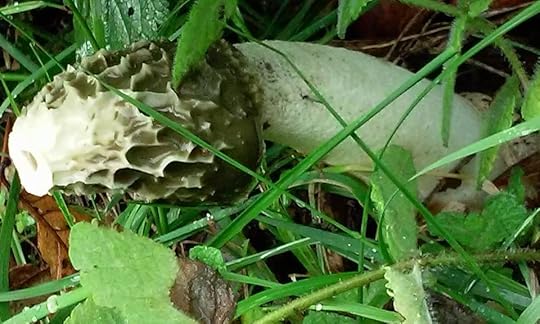
In the first chapter, we are introduced to variety of stinkhorn mushrooms, which look like dicks sticking up out of the ground. Money takes this as an opportunity to talk about various evolutionary pathways and which enzymes might have been altered to present various mushroom configurations. Then we get into mechanisms of spore dispersal, particularly the catapult mechanism that basidiospore-type fungi employ, which uses a droplet of water to rocket each individual spore off the gill. (This book is largely focused on the various reproduction strategies of fungi, which are many and strange.)
Chapter two is a gross delight; here we talk about all the terrible stuff fungi can do to you. Most of the fungal diseases described tend to prey on people with compromised immune systems, though not all. We learn that the keratinized protein that make up hair can be digested into delicious food by various fungi, such as ringworm. Then we move on to one that eats bone, and Cryptococcus neoformans, which can eat into the brain. (The author then makes a quick digression into what enzyme pathways could be attacked to inhibit such infections.) Startlingly, we then learn that these yeast actually have a sexual life phase called Filobasidiella, a mycelium-growing spore-releasing organism that was long believed to be a separate species.
But NOW we must talk about melanin, which apparently fungi use in fun and exciting ways. Apparently melanin is used to protect invasive yeast, not just from UV radiation or whatever humans are doing with it, but also from the immune systems of the critters it invades. Naked, melanin-less yeast can be ejected from the body much more easily.
There are some more brain-eating fungus (Mucorales), and a horse-eating fungus (pythiosis insidiosi).
Onto chapter three. This one is all about hyphae, and/or mushroom tentacles. These guys are what allow fungi to penetrate any surface and absorb nutrients from just about anywhere. They are pressurized, and one individual fungus can spread their network of hyphae across tens of acres (see, Armillaria, which occupies a big chunk of Oregon.) The cells of hyphae, unlike those of plants or animals, tend to be connected across many linkages, so nuclei can squeeze back and froth along the chain. Using hyphae, fungi can eat up granite by secreting acids, which can later be followed up by plants. (Oddly, the rice blast fungus exerts even more pressure, and it has been used to penetrate Kevlar.)
Chapter four! Onto bizarre reproductive cycles, of course starting with Cordyceps, which in fact infects a variety of insects. Spore-filled stalks grow out of the fungal victims (cicadas, spiders, ants, termites). We are introduced to "ascomycetes" in this chapter, which are defined by certain of spore. This part I didn't quite follow, but we will return to spore classification repeatedly. Ascomycetes use cannons rather than slingshots to get their spores out and about. Interestingly, Cordyceps is related to Claviceps, or ergot, which has historically caused much misery to persons who eat rye flour. He then chats about Saccharomyces cerevisiae, baker's yeast. Yeast is good for grabbing nutrients in liquid, hyphae are good for grabbing nutrients in solid form. Other ascomycetes of note: morels and truffles. Nom, nom, etc.
Chapter five goes into great detail about Arthur Henry Reginald Buller, a mycologist who found the slingshot mechanism used by basidiospores. He lived in Canada. He was not well-loved by many colleagues. We digress briefly to Curtis Gates Lloyd, an amateur mycologist. He engages in mushroom politics. Extravagant mustaches abound.
Chapter six plows back into the fungal world, most particularly prismatic spores found in fast-flowing streams called "Ingoldian spores." This is the jumping-off point to talk about various spores in water, particularly those with flagella. This is perhaps the least enchanting chapter, as we talk a lot about the spore dispersal mechanisms of water molds.
Chapter seven: various sorts of sexual reproduction in fungi. This chapter talks a great deal about oomycetes, that is, water molds, which are not actually fungi at all. We also visit mycelia which mate with not just one other but multiple other mycelia, making rather complex offspring. (My favorite fact from this chapter is that hyphae cells only look like plant cells because they're always cut in cross-section; they're actually incredibly long. Also, every mushroom cell is like a stem cell and can regrow the whole mess at any time.)
Chapter eight gets back to the good stuff, i.e. horrible things mushrooms can do to you. We talk about Amanita virosa, which contains a potent liver toxin, and which takes a few days to kill the unwary snacker, as well as Amanita phalloides, the death cap. Apparently these both look rather like an edible mushroom from southeast Asia, which is a cruel coincidence. Money shares his frustration with identifying Little Brown Mushrooms, which I can respect. The going theory for why mushrooms produce such long-acting toxins, when it wouldn't necessarily help in warding off bears or humans or what-have-you, is that it probably discourages insect larvae from slowly munching their way through a variety of fruiting bodies. We briefly hop to Amanita muscaria, fly agaric, a psychedelic shroom. It is not terribly interesting, or at least not any more interesting than the variety of mushrooms which cause gastrointestinal distress, asphyxiation, and aflatoxin poisoning (the last being exemplified by a horrible turkey poisoning that left 100,000 birds dead in 1960). Money is not overly concerned about black mold, though he does lean toward the belief that fungal toxins have been used in certain incidents of chemical warfare.
The final chapter explains the title, and a lovely image it is -- of an ancient orchard, congealed into a dense mat of leaves, shadows, and mushrooms. This leads neatly into the bane of all apple growers, cedar-apple rust (called hawthorn-cedar rust in the text, or Gymnosporangium globosum), which has a complex and annoying life cycle. Black stem rust of wheat and barberries, Puccinia graminis, is even worse, with extra phases of various sorts of spore development. We learn about how clever (er, well-evolved) these fungi are in finding leaf stomata by which to invade plants, and how disease-resistant wheat resist their incursions. Black stem rust can be controlled by keeping barberries away from wheat, but coffee rust, a fungus with a similar life cycle, exists only on coffee, making its control a tricky proposal. We finish the book by talking about Magnaporthe, the rice blast fungus, which as previously mentioned, can drill through Kevlar with its hyphae (!) and Phytophthora infestans, the potato blight.
So. If any of that sounds interesting, this may be a book to flip through.
I've been assembling and photographing them for some time; but, recently, I've been making a sort of sampling of the (symbolic) meanings attached to the plants.
Here's what I've collected:
1-Mushrooms as a way to connect to the Other Side; native American Indians used them.
2-Symbolism of the growth process/life-cycle.
3-Dreaming about them, may imply (wish for the) reception of "Higher knowledge".
4-Mushroom as a symbol of the human soul.
5-Health and relationship problems.
6-Financial mismanagement.
7-Male fertility.
Well, too many meanings. Maybe; it makes you wonder; they're mysterious, no doubt.
8-Ah!!some years ago I read they were connected to sites where UFOs had landed.
I really enjoyed the super enthusiastic narrative voice which made the sciency parts of the book easier to understand (through the use of interesting analogies and metaphors, etc).
Not a book for a beginning mushroom enthusiast. Money uses technical terms like "sporangia" and "chytrid" and often refers to fungi by their Latin binomials (which in some cases is understandable as few water molds have common names ;), but still makes it tough for a beginner). I think he even states in the preface that his writing is half aimed at biologists and that it's best if readers have at least some scientific education.
However, even for someone with some knowledge of fungi and biology, I had to read through this book twice to absorb any of the information. Money's writing is simply not engaging and is often scattered and disorganized. He loves to digress into tangents and non sequiturs and the book's chapters seem to only loosely stick to one theme. I understand that his goal is to make the book fun to read, but it's really just distracting from scientific concepts that take some concentration to understand.
The title is also a bit misleading as he spends far more time discussing water molds, rusts, and infectious pathogens than mushroom-forming fungi. However, I did enjoy learning about more complex mycological concepts, such as how mushroom-forming fungi disperse their spores and fungal sexual reproduction. I also found his chapter on mycologists A.H.R. Buller and Curtis G. Lloyd delightful :)
So, this book is a mixed bag and best read by those who have already developed an intense interest in mycology and have some scientific knowledge of mycology and biology.
_Mr. Bloomfield's Orchard_ by Nicholas P. Money is an interesting introduction to the world of fungi and mycologists.
The first chapter looked at mushrooms. He began with a discussion (and illustrations) of the infamous phallic mushrooms. Surprisingly, they shared more similarities with their namesakes than just their overall shape; while most of the volume of the erect fungal fruiting body is air, like in the mammalian penis its erection is maintained by pressurized fluid rather than any column of solid tissue (though in the case of mammals, it is blood, while the mushroom is supported by pressurized water).
Many mushrooms like flowers rely upon insects (often flies) that they have attracted to disperse their spores. Stinkhorns and the Sumatran giant corpse flower evolved parallel features to attract carrion-feeding insects.
Though mushrooms exist only for spore production and dispersal they are absolutely amazing feats of mechanical engineering. Spores are catapulted from spore-producing structures called basidia by immense mechanical forces. Thanks in part to the mushroom being cooler than its surrounding environment, water condenses on two different parts of the spore's surface. When these two globs of water become large enough to make contact, the resulting convergence produces enough power to hurtle a spore at thousands of g's away for a few milliseconds before it falls beneath the cap and is swept away by air currents (in the right lighting one can see a dusty plume of basidiospores swirling away).
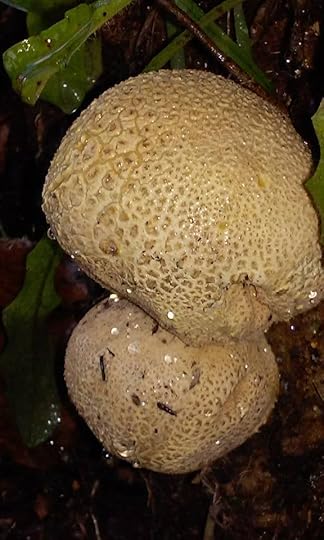
Some fungus though are not as water-dependent in their method of spore dispersal (such as puffballs, which expel their spores in response to any disturbance). As a result these mushrooms are able to colonize drier soils, even deserts.
Chapter two looked at several fungal infections (mycoses), such as the infections of skin, hair, and nails caused by a group called dermatophytes and meningitis (which is caused by a yeast known as _Cryptococcus_). Fungi though are mainly opportunistic and many can only colonize human victims if there is already some injury or disease at work.
There was a discussion of why many fungi are black. They possess melanin, a pigment like that found in human skin. This substance helps fungi avoid detection and destruction by the immune system when inside a body and for those on the exterior of buildings or rocks serves to protect the fungus's living cells from the damaging effects of solar radiation (this also protects the algal partner of lichen by the way).
Chapter three looked at a very important aspect of understanding fungal biology, how they penetrate things. All fungi flourish by burrowing into solid substances and transforming them into food, whether they are leaves, wood, skin, a house, or even growing into granite to seek out food. In this chapter the author looked at the potent mechanical forces (using water pressure, an appreciation of which is vital in understanding fungal biology) and cell-wall degrading enzymes that fungi employ. The reader learns that fungi draw upon a "seemingly boundless catalog of enzymes to digest their surroundings" and that fungi are surprisingly flexible in this regard, that even fungi for instance that normally digest only plant tissues have an innate capacity to consume animal tissue, an astonishing nutritional flexibility.
Chapter four examined the life cycles of some fungus species, how some fungi alternate asexual (anamorphic) stages with sexual (teleomorphic) stages. Properly naming fungi in the different stages of their life cycle is hard - "there is nothing more perplexing in the entire field of mycology" - and has lead to a vast number of fungi given scientific names twice because the observer discovered the fungi at only one part of its larger life cycle.
Chapter four also featured discussions of ergot fungus (a pathogen of rye whose toxins can cause hallucinations and gangrenous hands and feet), truffles, lichen, and yeast (incredibly important to both human nutrition and biological research, though the author admits "hard as I have tried, I've never felt excited by this simplest of fungi").
The fifth chapter looked at two pioneering mycologists.
Chapter six looked at two types of water fungi, the passive Ingoldian spores, which float through the water, if fortunate hitting a suitable new food source before it is eaten, buried in the mud, or carried away by the current to oblivion, and the zoospores, which are active swimmers, seeking new food sources (an example of the latter are the chytrids, which have been blamed in part for a worldwide decline in frogs).
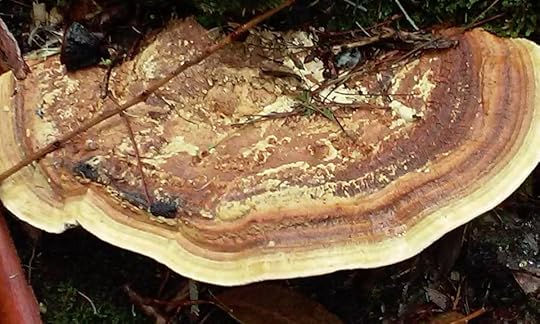
The seventh chapter looked at sexual reproduction and the production of fruiting bodies in fungi, particularly mushrooms. Surprisingly, some mushrooms are the result of group sex as they have developed after many compatible strains have fused in the soil. As a result, a single species of ink-cap mushroom for instance might encompass hundreds of different strains. When different strains of fungus meet, they either fight or fuse. If they fight, "warring mycelia attack their opponent's hyphae and produce thick, melanin-impregnated walls to resist each other's poisons" but if they fuse they produce fruiting bodies, whether it is a mushroom on the forest floor or a bracket fungus growing outside a tree.
Chapter eight looked at mushroom poisons, whether they produce gastrointestinal distress, hallucinations, organ damage and failure, or death. Not all mycotoxins are produced by fruiting bodies, as non-fruiting mycelia produce substances called aflatoxins, traces of which can be found in many different foods.
The author discounted notions that fungi are so toxic so as to kill off those who would eat them. As many of these toxins are very slow acting, sometimes taking weeks to take full effect, he believed that mycotoxins exist to target rival fungi and produce an extra supply of nutrients in the form of dead bacteria.
The final chapter looked at fungal caused plant diseases, examining in particular black stem rust on wheat, potato blight, and rice blast, revisiting the complexity of fungal life cycles (which in some species involve different species at different stages), and also looked at mycoparasites (fungi that infect other fungi).
I love science. Science literature that’s aimed at the general public is my jam. And “Mr Bloomfield’s Orchard” has been one of my favorites thus far.
I loved the dry wit and humor that is sprinkled throughout the book, and the numerous illustrations of the life cycles of various mushroom species is invaluable. But this is not a text for casual citizen scientists. There is an expectation that you will remember the lessons from previous chapters and the lessons build upon each other (much like an actual science class).
The material can be quite dense at times, when describing the technical aspects of reproduction or the methods of how a particular fungus moves from a small dot to a larger capped mushroom in your lawn. But I also think that’s necessary - we have terms to describe these functions and mechanisms, and watering it down won’t serve to educate anyone.
I have come away with better knowledge of what, exactly, a fungus is and how there are so many different ways they work. If you don’t remember much from biology class, the basics will be addressed, though you may want to go watch a video on the difference between meiosis and mitosis, and have a dictionary handy.
Enjoyed the info and stories about fungi and mycologists. Did not enjoy the self-reflective asides that may have been intended to be funny or the reference to things like Michelle Pfeiffer's long blond hair or his message therapist girlfriends hands on him. And pretty much the entire first chapter was way over the top with the penis/erection/spawn/sexual deviants and Little Red Riding Hood's chastity references. Dude. Actually started skimming about 1/4 through to pick out the info interesting to me.
This author doesn't miss an opportunity to flaunt his privelege and express his revolution to anyone around him including feminists, christians, other researchers and anyone who is not heterosexually monogamous, including fungi or celibate researchers whose work he admires. The science he described was interesting enough for me to endure the pompous writing and terrible jokes, but I couldn't shake the feeling that I was reading a grade school essay written by a rich kid in the 50's and that the incessant crass remarks were inside jokes to tease his personal friends.
Has some interesting material, and the author is gifted at explaining. However, he tries too hard to be titillating, possible because he's a college prof trying to attract students to a course on fungi. The result is way too much discussion of fungi shaped like the male reproductive organ. I cannot recommend this book to any of my high school students who want further reading.
An excellent introduction to the world of mycology and very entertaining. The author's sense of humor and wit reminded me of two great professors at WSU; Dr. Spence and Dr. Jonas. Those guys could make the Krebs Cycle fun!
I've decided not to rate this book. I found it too densely scientific for my personal taste- when I picked this up I was looking for odd and fascinating stories about mushrooms. I walked away knowing a lot more about mushrooms, but wishing I'd picked up a different mushroom book.
I read this years ago, but after taking mycology I thought I'd revisit it. I am so glad I did. This book was so much fun when you know a little more of what is going on with those fungi.
The title of this short book is not explained until the last chapter, but the subtitle is clear: The mysterious world of mushrooms, molds and mycologists. I was fascinated. I had no idea of just how dangerous fungi can be - inhalation of spores, poison, corrosion of building materials to make our houses collapse. I had no idea of the massive Armillaria, probably the world's largest single organism, lurking under 2200 acres of Oregon woodland. I had no idea of the tiny Ingold fungi digesting flotsam in streams. And I had only the vaguest idea of why mushrooms are the shape they are.
It's fascinating stuff and unfortunately Money's writing style isn't always up to it; at times he is too technical for a general audience, and elsewhere is not as deft at weaving peronal reminiscence into his narrative as, say, Gould (though few could match him). But his enthusiasm shines through, particularly his almost inarticulate joy in the process of research and discovery; and his material is vastly more interesting than I had thought it could be. I enjoyed this book much more than I had expected to.
Mr. Bloomfield's Orchard is a charming romp through the world of mycology that left me feeling much more familiar with fungi without necessarily knowing more about them. He seems to explain things well, and his prose is actually funny and quite readable. However, the way he formatted the book seemed poorly suited for the kind of intro to fungi knowledge I was seeking. It seems like he was trying to offer this knowledge, but to include subtly enough to make it more interesting than pedantic. However, I think this was done at the expense of the possibility of some nice explanation. A glossary would also have been very helpful. One plus, however, was the way he explained processes by telling the story of their scientific discoveries. This gave a nice picture of the world of working mycologists as well as the scientific method as a whole.
Hmm. It's a topic I'd be fascinated but and it does have its moments. But frankly it has ones that simply aren't quite as riveting for me. Perhaps I really don't need quite that much depth on spore dispersion mechanisms? Who knew... ;-)
Still a useful book and it does cover some materials you might not find elsewhere in books aimed at the non-scientist. But probably not the first book I'd recommend to someone interested in our fungi friends.
I only got through chapter two. I'm sure there's some interesting information in there, but I couldn't get past all of Money's negative "jokes" about cultures different from his own, people he disagrees with, and people he works with.