

What do you think?
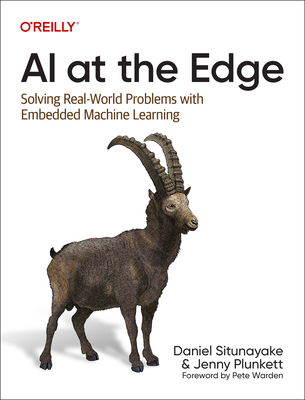
AI at the Edge: Solving Real-World Problems with Embedded Machine Learning
Edge AI is transforming the way computers interact with the real world, allowing IoT devices to make decisions using the 99% of sensor data that was previously discarded due to cost, bandwidth, or power limitations. With techniques like embedded machine learning, developers can capture human intuition and deploy it to any target--from ultra-low power microcontrollers to embedded Linux devices. This practical guide gives engineering professionals, including product managers and technology leaders, an end-to-end framework for solving real-world industrial, commercial, and scientific problems with edge AI. You'll explore every stage of the process, from data collection to model optimization to tuning and testing, as you learn how to design and support edge AI and embedded ML products. Edge AI is destined to become a standard tool for systems engineers. This high-level road map helps you get started.
512 pages, Paperback
Published February 14, 2023
Ratings & Reviews
Friends & Following
Create a free account to discover what your friends think of this book!
Community Reviews
Displaying 1 - 5 of 5 reviews

January 30, 2026
Long post.
This textbook is not very good at anything. It is a poor embedded systems textbook and an awful Machine learning introduction.It breezes over every subject it touches on, giving you the solution and selling you the software to do it without actually explaining the idea and how it works. I’ve been thinking about this “pop-engineering” sub-consciously for a while and I’ll try to make it more explicit here.
fast.ai was an old online textbook I read when I was in high school. I was just getting into artificial intelligence back then and after reading it I was totally put off on the subject. It explained AI as an amalgamation of already solved problems and it was your job to simply apply the solutions. It taught usage not understanding.
Teaching in this way drains engineering of all its luster and serendipity. The universe becomes a set of rules you must follow rather than a set of equations you can exploit. You’re limited by what you can do by the tools at hand rather than creating new tools connecting the ideas you understand. You become the code monkey, the robot, the child. You move things around until they work then move on.
I have coworkers who do exactly this: throw spaghetti at the wall and then present the outcome as if it were insight. “I changed this mode register because it worked.” When the same problem appears again, they have to relearn everything from scratch because they never understood what they did the first time. I have been guilty of the same thing.
Engineering is already an applied science, that is we instantiate the proven ideas of scientists, but that doesn’t mean engineering is easy. There is real difficulty in applying clean principles to messy reality, and real beauty when the full system finally coalesces. A good engineer pursues this for the beauty of the solution not the simplicity of the idea. This is closer to Ortega’s idea of the “noble” person: someone who refuses to be satisfied with only what they need to know, who digs deeper simply because they must.
This “pop-engineering” attitude shows up culturally too. It makes me think of a line from Pat the Bunny’s Friends in Real Life (with full respect for his music): “Ruby on Rails, I love that shit.” Taken literally, it is stupid in a particular way. The pop-engineer loves tools because they confer identity, not because they enable excellent work. The tool makes them feel unique and superior to the mass, while ironically making them more interchangeable and mass-produced.
The pop-engineer likes science precisely because they do not understand it and do not want to. They prefer faith in the expert on the hill, because the expert sustains their livelihood. They hate suffering but want the status of “knowing.” They specialize so narrowly that they become brittle and useless outside their lane. Augustine captured something relevant here: no one enjoys suffering, but a person can love that they are able to suffer or that they have suffered.
And to be fair, the pop-engineer has a real economic role. In every industrial cycle there is a phase where cheap labor that does not ask questions is valuable. They do what they are told, drink the kool-aid, and snicker while doing it “ironically.”
But that mode of being is not edifying for anyone, and it is increasingly obsolete. AI is beginning to automate exactly the kind of shallow, tool-driven labor that pop-engineering thrives on. I welcome that. If an engineer cannot pass the buck to the expert, they are forced back toward the only durable advantage: understanding.
The job, as often as possible, is to stare directly at what you do not understand and refuse to move on until you do.
I’m at Intel for a meeting so this is all front of mind and I hope by making clear bad from good I can become a better engineer.
This textbook is not very good at anything. It is a poor embedded systems textbook and an awful Machine learning introduction.It breezes over every subject it touches on, giving you the solution and selling you the software to do it without actually explaining the idea and how it works. I’ve been thinking about this “pop-engineering” sub-consciously for a while and I’ll try to make it more explicit here.
fast.ai was an old online textbook I read when I was in high school. I was just getting into artificial intelligence back then and after reading it I was totally put off on the subject. It explained AI as an amalgamation of already solved problems and it was your job to simply apply the solutions. It taught usage not understanding.
Teaching in this way drains engineering of all its luster and serendipity. The universe becomes a set of rules you must follow rather than a set of equations you can exploit. You’re limited by what you can do by the tools at hand rather than creating new tools connecting the ideas you understand. You become the code monkey, the robot, the child. You move things around until they work then move on.
I have coworkers who do exactly this: throw spaghetti at the wall and then present the outcome as if it were insight. “I changed this mode register because it worked.” When the same problem appears again, they have to relearn everything from scratch because they never understood what they did the first time. I have been guilty of the same thing.
Engineering is already an applied science, that is we instantiate the proven ideas of scientists, but that doesn’t mean engineering is easy. There is real difficulty in applying clean principles to messy reality, and real beauty when the full system finally coalesces. A good engineer pursues this for the beauty of the solution not the simplicity of the idea. This is closer to Ortega’s idea of the “noble” person: someone who refuses to be satisfied with only what they need to know, who digs deeper simply because they must.
This “pop-engineering” attitude shows up culturally too. It makes me think of a line from Pat the Bunny’s Friends in Real Life (with full respect for his music): “Ruby on Rails, I love that shit.” Taken literally, it is stupid in a particular way. The pop-engineer loves tools because they confer identity, not because they enable excellent work. The tool makes them feel unique and superior to the mass, while ironically making them more interchangeable and mass-produced.
The pop-engineer likes science precisely because they do not understand it and do not want to. They prefer faith in the expert on the hill, because the expert sustains their livelihood. They hate suffering but want the status of “knowing.” They specialize so narrowly that they become brittle and useless outside their lane. Augustine captured something relevant here: no one enjoys suffering, but a person can love that they are able to suffer or that they have suffered.
And to be fair, the pop-engineer has a real economic role. In every industrial cycle there is a phase where cheap labor that does not ask questions is valuable. They do what they are told, drink the kool-aid, and snicker while doing it “ironically.”
But that mode of being is not edifying for anyone, and it is increasingly obsolete. AI is beginning to automate exactly the kind of shallow, tool-driven labor that pop-engineering thrives on. I welcome that. If an engineer cannot pass the buck to the expert, they are forced back toward the only durable advantage: understanding.
The job, as often as possible, is to stare directly at what you do not understand and refuse to move on until you do.
I’m at Intel for a meeting so this is all front of mind and I hope by making clear bad from good I can become a better engineer.
August 14, 2023
Useful insights into the rapidly evolving industry. Emphasis on practical use cases gives readers valuable resources and implementation ideas.

October 21, 2023
Solid intro with a good path for how to start. I was impressed how much time is spent on ethics - which is critical for ai.
The Last 3 chapters could have been one.
The Last 3 chapters could have been one.
June 15, 2024
"This is the must-read book for everyone pursuing this field."

June 22, 2024
Good book but too much of an advertisement for Edge Impulse. Add a star back if they rename the 2nd edition as "AI at the Edge using the Edge Impulse platform"
Displaying 1 - 5 of 5 reviews