This book has been helping students navigate through the thickest of literary and cultural theory for well over a decade now. This new and expanded third edition continues to offer students and readers the best one-volume introduction to the field.
The bewildering variety of approaches, theorists and technical language is lucidly and expertly unravelled. Unlike many books which assume certain positions about the critics and the theories they represent, Peter Barry allows readers to develop their own ideas once first principles and concepts have been grasped.
The book has been updated and includes two new chapters, one of which (Literary theory -- a history in ten events) innovatively surveys the course of theory, while the other (Theory after ‘Theory’) maps the arrival of new 'isms' since the second edition appeared in 2002.
In 1959 Frank Sinatra recorded his great version of Cole Porter’s “What is this thing called Critical Theory?” 36 years later Peter Barry in this excellent book explains that it’s a network of ideas developed in the 60s, 70s and 80s which challenged the status quo of liberal humanism and made flesh that haunting phrase from Marx :
all that is solid melts into the air
Critical theory puts you wise. You thought you had an identity? That, like, you were a YOU? Guess again - you don’t. Sorry bout that. Yeah, I know. So many things you thought were absolute, you were such a sweet kid, but now you know they’re contingent. Stability is so 1950s. Things is tough all over. Definitions? Ungraspable. Dictionaries? Xeroxes of snapshots taken by whitewater canooists hurtling down the dangerous chasms of illusion and the flumes of fantasy called language. Disinterested intellectual inquiry? Common sense? Canons of great writers? You can kiss all that goodbye, that’s gone like jobs for life, like horseless carriages and divorceless marriages, they’re so gone it’s like they were never here. This is a relative universe. My name is Barthes. Come on in. it's okay, once you get used to it.
CILLA
A mere seven years after Frank’s profound statement of non-faith came Cilla Black (discovered as you all know working the cloak-room at The Cavern) singing “What’s it all about, Alfie?” She hadn’t at that point read Barthes, Saussure or Levi-Strauss or she would have changed this beautiful Bacharach/David song’s coda to “when you walk let linguistics and structuralism lead the way/And you may find love any day”. It would have been cheeky but so right.
ARETHA
So critical theory was at war with every previously accepted cultural concept, and also, having the courage of its convictions, it was at war with itself. In 1980 Aretha Franklin, one of popular music’s greatest post-structuralists, recorded “What a Fool Believes” which from the perspective of a dedicated follower of Jacques Lacan expertly lashed into the corny structuralist’s romantic conviction that meaning ultimately resides in scientific method and language – in verse three Aretha is pitiless about Barthes’ use of diagrams, for instance – and throughout the song her fearsome voice convinces even the casual listener that the signified must always escape the signifier.
FAB
You may think that after the terminal scepticism and playful despondency of the post-structuralists theory itself had nowhere to go, and we were left with endless Beatles revivalists singing “Paperback Derrida”
Sir or madam will you read his book It took him years to write and it’s worth a look "Of Grammatology" or "Counterpath" They’re all heavy slogs but you wanna read a paperback Derrida Paperback Derridaaaaaah
or Dave Davies’ classic “Lets all drink to the death of the author” or the Dixiecups’ weird celebration “Eco Eco”. But in 1991 the Spice Girls brought a real breath of fresh theoretical exploration as their giant hit “Who Do You Think You Are?” presented the world with a bracing three and a half minute tour round the complexities of post-colonialism and identity politics in general (that the flipside was yet another cunning Beatles revival “He’s Said, She’s Said” was in this case only apt.)
ZOMBIES! WHERE ARE THE ZOMBIES? WE HAVE TO HAVE ZOMBIES!
From Sinatra to the Spice Girls, from Levi-Strauss to Baudrillard – a hectic four decades which Peter Barry in this very smart book sums up with panache. You’ll be reaching for Youtube or Spotify or even Grooveshark constantly as Peter Barry infuses new meaning into old chestnuts like “She’s Not There” by the Zombies and “The Windmills of Your Mind” by Noel Harrison. (Note : Peter Barry is not related to John Barry who recorded the Bond theme. That would have been cute, but it isn’t true.)
As a student, as an instructor and as a 'someone' helping others understanding the complex theories of literature, I did not find any better book than this one by Peter! I will recommend this book to anyone who wants to understand literary theories from the scratch and even the advanced students can use this book rather fairly!
I didn’t discover this book until halfway through a graduate level class on Postcolonial Theory. This would be after trying to keep my head above water while reading Derrida in the original language. I wish I’d read it years ago.
Despite its bland title and intimidating chapter headings, this book is very accessible. Each chapter takes a different ideological camp of literary theory –- from Post-structuralism to New Historicism –- and breaks it down into understandable terms. A brief history of each theory is given, along with an introduction to important scholars and influential works in the field. For me, the most helpful aspect was the practical application: the bullet pointed lists of what scholars from each camp actually do, and the mini-essays interpreting specific poems and short stories using the principles of each camp of literary criticism. (Several poems and short stories are included in the appendix and it was fascinating to see the same story interpreted differently depending on the chapter.)
For me, reading this book was like discovering the cipher to a code that I was already supposed to know. The articles for my class, which are littered with references to Foucault, textual deconstruction, Bhabha, and Narratology, are beginning to make sense. The genius of this book is its ability to take obtuse terms and abstract concepts and to bring them down to earth. The author writes in an easy going, casual voice, and isn’t afraid to poke fun at his own profession at times. After Derrida, it’s a breath of fresh air.
You would think it would be something akin to a beginner's guide because of its title, Beginning Theory, but thanks to its obscure writing style, it doesn't feel like a beginner's guide.
There are probably better books about literary and cultural theories out there. This one is not one of them, so therefore I do not recommend it.
This is an excellent introduction to literary theory. The different brands thereof are explained clearly in brief, easy-to-follow chapters.
My only complaint would be about the chapters on Feminist Criticism and Gay/Lesbian Criticism. I don't think either of these topics was covered well, as if Barry himself didn't fully understand the implications of their philosophical approach. Barry is British, so this might simply be because of a disconnect between the American version of Feminist Criticism I'm already familiar with and its British counterpart. But his tone in these chapters is somewhere between confused and doubting, and he fails to illuminate the broader implications of the theories advanced. Maybe, unintentionally, political conservativism got in the way objectivity. Whatever the case, these chapters need to be supplemented by additional reading.
The rest of the book really is fantastic. I'd recommend it for writers like me who want a basic understanding of the theoretical ideas without having the sludge through countless wordy texts to get there.
10/10 in fulfilling its purpose of introducing the students to the complex yet essential world of Literary Theory and Criticism.
It explains in an easy to understand language, a concise outline of various literary theories in their chronicle order. It attempts to explain the main theories through series of questions and answers, encouraging readers to think about the various aspects of theories an relate to them to a greater extent. The addition of resources at the end of each literary theory is also helpful for people interested in exploring the topics that interest them.
In short an excellent resource not only for English majors but for pure novices interested in Literary theory in general.
Beginning Theory offers the literary studies student a fantastic primer to help navigate the often convoluted and complex domain of literary theory. Barry shows us that theory need not be daunting, and successfully manages to convey difficult concepts in a voice that is consistently conversational, and never dry. I appreciated his occasional interjection of self for the way in which it humanised the text. The book covers all the major theoretical approaches from Structuralism, through Psychoanalytic, Marxist, and feminist criticism, as well as newer areas such as Ecocriticism. Barry weaves the theoretical positions of each, within a historical framework. Since all theory arises out of distinct social, cultural and political processes, the historical backdrop provides an additional anchor for learning.
Although this is marketed as a beginner's guide, the breadth of coverage, and expert condensing of detail, makes it a must for any student of literary or cultural studies. I've revisited it again and again during my Masters, and it's now an invaluable addition to my study shelf.
A nice, concise gloss of one scholar's estimation of theory's most important movements and themes. I was considering this as a possible text to use in an introductory theory class I'm teaching. Ultimately, there are three major reasons why I won't be using it.
1. Age. Even in its updated form, this book is more than a decade old. A lot can happen in a discipline in that amount of time, and students tend to see texts like this as definitive. I worry about setting them up to be not just name droppers, but even worse, old news name droppers.
2. Pedagogy. This format of tight, narrative-focused chapters that tie up many thinkers into a chapter-based -ism might work for old teaching models (like the quintessential college lecture that Barry likely used in his instruction along with most other UK academics) but there's not a great way to use this text in a more discussion-based and student-centric classroom.
3. Gloss. Finally, and most importantly, I think students who read this text as part of a college course should ask for their tuition money back. I was struck more than once that Barry's interactions with the original theoretical texts (from Aristotle to Greenblatt and Bhaba) were markedly different than mine. And it's not hard to determine why. We're different people. These primary texts are rich with subtle and playful reasoning. I had to tackle these texts on my own, and I had strong connections with the powerful theoretical ideas contained in a Foucault or a Derrida. The texts were dense, but, like Barry himself mentions in his introduction, effort is usually well rewarded. My job as a professor is to prepare, push, and reward that same effort in my students. We will never cover all the texts mentioned in these pages, but the skills my students gain in reading even a small subset will improve their intellectual success much more than an encyclopedic big picture view could.
So, I certainly recommend this as an excellent back pocket text for the enterprising student (or the faculty member hurriedly trying to brush up on a narrative of theory to use or resist in her own syllabus) but definitely not a classroom text.
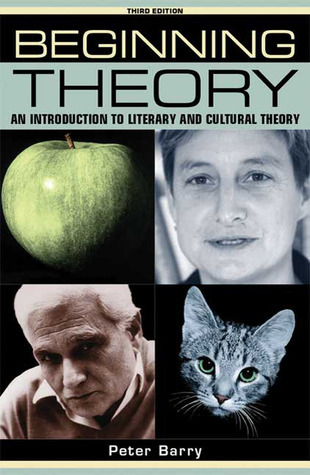
I remember sitting in a class on essay writing a few months ago where the professor asked us to write a paragraph and volunteer to read it out loud. When I read mine he made a remark (which I have, ironically, forgotten) to which my answer was that "well, it makes my essay more friendly." This seemed like an outrageous thing to value in an essay to the professor and I think he said something along the lines of "You want to give information, not make friends." I know, dumb. (needless to say I have been less than attentive of the rest of the classes; here's hoping I don't flunk it.) Okay, so the thing about this book is that it's just so friendly, so full of character and not at all at runs the risk of being "uninformative" (cue the eye-rolling). In fact the humor has the effect of making the divulged information stick. In the introduction to the 13th chapter he says that he has always "preferred to integrate information into a themed narrative." and I mean, job well done Mr. Barry. It was really informative, full of helpful references and extremely unprejudiced. I can say a lot of good things about the book, but let's just say it was an absolute delight to read and leave it at that. P.s. Just one thing though, can anyone explain the COVER to me?? dammed if I get it.
Quite the comprehensive yet accessible introduction. Peter Barry goes over most the major areas within literary and cultural theory, and introduces them well with the necessary figures and using easy to follow examples. Reading this book is easier and more fun than one would expect and I much enjoyed the attention given to the figures playing central roles in theory as well as the events that changed the direction of thought, opinions, and trends.
veryy insightfull!!! would recommend if you have no experience with any theory applicable to literature, philosophy,…. and would like to expand your knowledge;))
дякую пітеру за поглиблення мого спгс! і за нагадування ставитися до серйозного з веселістю й навпаки. пояснити поетику арістотеля на прикладі реклами кітячого корма 🤌🤌 люблю тебе, пітере.
хз як ставити оцінку підручнику, тому 4, бо я насолоджувалася, але не ексайтед
I taught this book at Regent in ENGL 485 (Senior Seminar for English majors).
Introduction Ch. 1: Theory before 'theory' Ch. 2: Structuralism Ch. 3: Post-structuralism and deconstruction Ch. 4: Postmodernism Ch. 5: Psychoanalytic criticism Ch. 6: Feminist criticism Ch. 7: Queer theory Ch. 8: Marxist criticism Ch. 9: New historicism and cultural materialism Ch. 10: Postcolonial criticism Ch. 11: Stylistics Ch. 12: Narratology Ch. 13: Ecocriticism Ch. 14: Literary theory – a history in ten events Ch. 15: Theory after 'Theory'
ইন্টেলেকচুয়াল কথাবার্তায় প্রায়ই কিছু কিছু নাম বা পরিভাষা ( termoniologies) ঘুরেফিরে আসে যেমন- মিশেল ফুঁকো, ডিকনস্ট্র্যাকশন, অরিয়েন্টালিজম ইত্যাদি নানান কিছু। আমার তাত্ত্বিক জ্ঞান প্রায় শূন্যের কোঠায়। Peter Barry সাহেবের এই বইয়ের মাধ্যমে তত্ত্ব জগতের কিছু তালাশ পেলাম। অনেক কিছু জেনেছি আবার অনেক কিছু বুঝিনি তবে বইটি বেশ সুলিখিত। লেখক সুন্দর করে স্টেপ বাই স্টেপ একেকটা জিনিস ব্যাখ্যা করেছেন। তাত্ত্বিক পর্যালোচনায় উৎসাহী পাঠকদের প্রথম সবক হিসেবে বইটি বেশ দারুণ।
Read this for Critical Theory. It worked for the class, but half the time I had no idea what the author was talking about and only sort of understood after class discussions. I know the point of theory is that there is no bottom line but it would have been extremely helpful to have one for those of us who don't care for theory that much and just need a basic understanding.
Pretty fricken great book I enjoyed this. I stare at it on my bookshelf as a write this! So if my year 12 teacher finds my review, it was me that stole the books. cheers legend
(4.5) I love this shit! Classic 'I wish I'd read this during uni', I'm afraid that is the way of these things, sometimes. But perhaps I wasn't ready for it yet. Oh well, I'm into it now!
Mr. Barry is SUCH a great writer, clear, insightful and witty. He takes your hand and guides you through the foggier environs...
I've dipped me toe properly now and I'll continue to explore new depths in future, hopefully. Additionally, I find the rise and fall of this feverish interest in new ways of thinking about the world is such a fascinating window into the 20th Century. Because frankly, the era is over - there are no news stories about theory, or high profile intellectual battles being fought in the mainstream. We've sadly regressed into two poles of blooming fascism and those opposed to it - there is no room for the nuance contained here in the current media landscape. I wonder if the flourishing of all these new intellectual possibilities will prove another facet of the extraordinary cultural shifts that the events early in the previous century ushered in. I mean, to imagine the institution of something as radical as a national health service seems alien to modern England. Yet it happened.
Anyway, waffling on. I find it hugely useful and inspiring to begin to properly engage with this world again, and do believe that the intellectual curiosity, scrutiny, and (most of all) passionate discussion is something I and We need to keep carrying the flag for.
The FIRST EVER BOOK I bought, when I came to English Department for an easy start to all the literary theories. It's a reader friendly book & quite handy to go through all the basics of the theories.
Again, I haven't completely finished this book during the course BUT I feel like I've read enough to say that "I've read it". It was quite interesting but since the teacher told us that the post-structuralist analysis was completely wrong, I'm only giving it 2 stars.
Reading this overview, one would be forgiven for thinking that all the theory and criticism of the last century took place in England and America. I was also disappointed that there was no treatment of phenomenology. Otherwise, I found it very helpful for plotting the historical and intellectual trajectory of the discipline as an ongoing dialectic of historical and aesthetic valences.
the chapters on liberal humanism, structuralism, and poststructuralism are pretty good. feminism, queer theory, psychoanalysis, and marxism chapters are kind of weird. i also just dont think a book on capital “T” Theory should be written by one person, so it was doomed from the start imho
I literally fell asleep reading this book twice. I can't rate this any higher than one star. For your information, I'm a straight A student and have carried my fair share of dead classes. Barry's just melatonin in human form; he's too powerfully boring for even me.
Barry's book is peak terrible academic writing. There's some interesting theory in there, but it's bogged down by the overly dense language purple enough to dye the pages. Also, it's horribly formatted. Who in the hell thought it would be a good idea to cramp the pages with small, single-spaced text? Also hello, why aren't the important terms more clearly marked, like in bold or something? I guess it fits Barry's writing style of prioritizing fancy words over comprehension, but it's definitely not student or beginner-friendly, despite what this book's title says.
On the bright side, trying to read just one chapter of this textbook is an effective cure for insomnia.
Διάβασα αυτό το σύγγραμμα για το πρώτο εξάμηνο του μεταπτυχιακού Δημιουργικής Γραφής στο ΕΑΠ, σε μετάφραση.
Παρά τον όγκο πληροφορίας στη θεωρία, διαβάζεται πραγματικά άνετα. Ο Μπάρι κάνει αυτό που πρέπει να κάνουν όλοι οι διδάσκοντες: καταλαβαίνει τόσο καλά το αντικείμενο, που το εξηγεί απλά και κατανοητά. Το κάνει εύκολο.
Στην ουσία, αυτό το βιβλίο είναι εισαγωγή στη θεωρία της λογοτεχνίας, στην ιστορία της εξέλιξης της κριτικής και ταυτόχρονα ανάλυση της κάθε κριτικής θεωρίας. Έχει σύνοψη, το ξεχωριστό τμήμα "Κάτσε και σκέψου" σε κάθε κεφάλαιο, παραδείγματα από κριτικές σε εμβληματικά έργα του παρελθόντος και γενικώς επιστρατεύει κάθε μέσο για τη διδασκαλία της κάθε θεωρίας.
Φυσικά, μιας και είναι εισαγωγή, απλώς εισάγει στην κάθε θεωρία. Αλλά το κάνει αριστουργηματικά.
Surprisingly accessible. Much easier to get through than I anticipated. I think I would still point to An Introduction to Literature, Criticism and Theory as my favorite lit crit book so far, but this has its merits. Most of the time, Barry insists on conveying information in a narrative form, talking through paragraphs, rather than relying on lists, boxes, or diagrams for explanations. I don't think this is always the best approach, but at least his writing was mostly easy to understand. Still, there were many names, titles, and references I didn't know, so much went over my head.