The transition of Coral Fairweather from village beauty to village outcast begins with the fathering of her child by a vagrant painter. Soon, fuelled by suspicion and gossip and spurred on by a malicious widow, the village's bitter witch-hunt speeds towards a terrifying climax.
Shena Mackay was born in Edinburgh in 1944 and currently lives in London. She is a Fellow of the Royal Society of Literature and also Honorary Visiting Professor to the MA in Writing at Middlesex University.
Her novels include the black comedy Redhill Rococo (1986), winner of the Fawcett Society Book Prize; Dunedin (1992), which won a Scottish Arts Council Book Award; and the acclaimed The Orchard on Fire (1995) which was shortlisted for the Booker Prize for Fiction. Her novel Heligoland (2003) was shortlisted for both the Orange Prize for Fiction and the Whitbread Novel Award.
While I can't speak to her later work, in her early novels Shena Mackay manufactures the type of disjointed realism characterized by barbed language and unusual syntax, casual violence, and occasional hallucinatory episodes that I associate with writers such as Barbara Comyns and Janet Frame. Here we encounter rural English village life in all its petty, eccentric, and sometimes malevolent messiness, despite the increasingly desperate efforts of certain parties to keep it all neat and tidy. The plot wanders with aimless steadiness (or steady aimlessness) toward the inevitable closing tragedy. You feel it coming all along, but Mackay keeps the specifics to herself until the very end.
Blurb from Brigid Brophy: 'Shena Mackay's macabre, overwhelmingly original imagination blooms into sheerly surrealist images.'
“There is a savage poetry to this short novel that tells the violent impressionistic story of an English village belle, Coral Fairbrother, who is seduced one innocent day by an itinerant painter. Having thus fallen from the village’s grace, Coral plummets into ever greater depths of disgrace. The village, whose women once envied her, whose men coveted her, now mocks and rejects Coral. Their leering tolerance soon turns to evil. And at last the villagers join a malicious widow in the all out persecution of this girl who has never, consciously, done any harm.”
Quirky, haunting little book. While I didn’t totally understand everything because some of Mackay’s writing was hard to decipher, I found I enjoyed this story. I was only going to read 50 pages and stop for the evening but I read til I was done because I was so sucked into the story.
What a gem this book is. Quick and easy to read, but leaving a lasting impression. I discovered Old Crow through Bob Stanley's introduction to Ritual by David Pinner (also published in 1967). Old Crow doesn't have the mystery of Ritual (a pagan whodunnit this ain't), but both books share a sinister malevolence, and paint pastoral Britain as anything but idyllic. If anything Old Crow is a more disturbing book that Ritual, simply because the nastiness displayed by the village's 'respectable' characters is inspired purely by ignorance and hatred - in other words the worst kind of behaviour doesn't need to be driven by the supernatural, just plain flawed human nature.
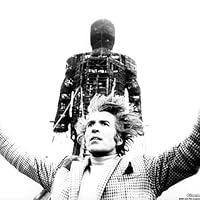
The rural folk of Old Crow are either hand-to-mouth poverty stricken, or (with the exception of Dennis) bigots considered as respectable society. Some weird shit goes on behind the doors of their homes - just as The Wicker Man (based on Pinner's book) is cited as an influence by Steve Pemberton and Reece Sheersmith, I wouldn't be surprised if Old Crow's village had in some way inspired the creation of Royston Vasey.
What I love most about this book though is the economy of language - as a reader you sometimes have to work hard to decipher the subtext, which I love. Also there's so much raw nature in the book you can almost smell the cow shit. At times it put me in mind of DH Lawrence - but without all that existential self-loathing.
A puzzling book. Confusing and frustrating to read as it is often not clear who is being referred to or speaking. A pretty grim manifestation of 1950's village life, at once surreal (character- wise) and sparklingly real (descriptions of the natural world). It reminded me of Red Shift by Alan Garner: memorable but oddly stilted and strange in terms of dialogue and phrasing. I think I'll stick with her later work!
I didn't enjoy this as much as I usually enjoy her books. It was a bit confused. I thought it might be an early book where she's settling into her style, and it is, but I have enjoyed earlier ones more. Odd.