A dream recaptured. A life on a new track. The absurdity of death. Laughter in the face of reality.
With this series of intersecting vignettes, Inio Asano explores the ways in which modern life can be ridiculous and sublime, terrible and precious, wasted and celebrated.
Inio Asano (浅野いにお, Asano Inio) is a Japanese cartoonist. He is known for his character-driven stories and his detailed art-style, making him one of the most influential manga author of his generation. Asano was born in 1980 and produced his first amateur comics as a teenager. His professional debut happened in 2000 in the pages of the magazine Big Comic Spirits. Since then, he has collaborated with most of the major Japanese magazines of seinen manga (comics for a mature audience). Among Asano's internationally acclaimed works are: the psychological horror Nijigahara Holograph (2003-2005); the drama Solanin (2005-2006); the existentialistic slice-of-life Goodnight Punpun (2007-2013); the erotic A Girl on the Shore (2009-2013); the sci-fi Dead Dead Demon's Dededede Destruction (2014-2022).
I can understand why a lot of people don't "get" this graphic novel. The book doesn't exactly draw you in, the plot doesn't flow seamlessly from one vignette to the next, and it's not easy to see how the vignettes are connected. Actually, Asano's "What a Wonderful World" is rather mundane, and I mean that in the best possible way. It somehow captures the realities of life... that is, life for the younger generations.
The vignettes, or tracks, as they are called in the book, are connected to each other by the reappearance of characters in different stages of their life. Where a character is a lead in one story, they later become a supporting or background character. This is a perfect example of the "show, don't tell" rule of writing. In this first volume, Asano shows us nine of the stories to be told in a small city.
The characters are a group of disaffected youth in the grips of an existential crisis. Each one is trying to figure out their place in the world, weighing the cost of following their dreams against conforming to societal pressures and "selling out." It's a beautifully realistic portrayal of the mediocrity of life. More authors should aspire to write like this.
The art in this novel is stunning. Asano focuses not only on his characters and their surroundings but also on the subtitles: facial reactions, a blood stained collar, power lines, broken windows on dilapidated cars. The panels seem to be playing up the negative space around the characters. Sometimes he accomplishes this by including the characters' inner thoughts in white text on black panels. Mostly, though, he does it with scenes that are so still and lifeless that you can feel the gaping void in the characters' lives.
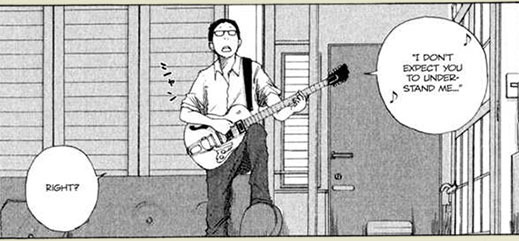
If I could compare this book to a movie, it would be "Thirteen Conversations About One Thing" because the style is very much in the same vein. "American Beauty" also comes to mind, in terms of theme. What was most often brought to my remembrance, though, was the poem, "A Dream Deferred" by Langston Hughes. The theme, tone, and style is so similar to Asano's book. This is perfectly captured by a discussion between Tamotsu and Endo, who decides to join the family business instead of pursuing his ambition to become a pro-skater: "So you’ve given up your dream and decided to settle? Ha ha. How pathetic. / Yeah, but … I feel lighter now that I don’t have to carry around the weight of that dream." Yes, the book is rather melancholy, but you don't feel bad about it because, in every vignette, Asano give us a little glimmer of hope.
Across the canon of the living dead, the spread of zombification has represented (or been said to represent) any number of social nightmares. In Invasion of the Body Snatchers, it was communism or consumerism or nothing at all, depending on whom you ask. In The Dawn of the Dead, Romero was said to have taken on consumerism. Or maybe he took on social hierarchies and the power struggles between the haves and the have-nots, between the whites and everyone else. Depends on who you ask. Still, Western visions of the undead plague have tended to revolve in some sense around materialism, around goods and what they mean to a society. Even latter-day hybrids combining zombie mythos and the Outbreak-style disease-control disaster story like 28 Days Later can be seen as treatments of the roles in which the masses are trapped by a consumerist society. Consumerism, materialism, and the fears that grow out of these broken social directions all find a bounty of indicators in Western zombie fiction, but what do the undead look like in other cultures?
Probably something a lot like those who succumb to the mysterious plague in Inio Asano's What a Wonderful World!
While American iterations of the myth generally sit pretty squarely in the realm of horror and are marked with gore and viscera, Asano's freshman work doesn't contain any of the stuff. It's not scary either, not in any traditional sense. In fact, until the final chapters, one might not even notice anything remotely zombie-ish about any of it. While there's death and those who fall prey to predators, there's no rotting flesh or buzzing flies (though, to be fair, there is a dragonfly in one scene). There's no mass panic and very few people hiding away in their apartments. All the same though, there is a zombifying plague afoot and I suppose it's even possible to read it as a reaction against the consumerist identities that Japanese society imposes on its citizens.
Apropos of its title, What a Wonderful World! (note the exclamatory!) unfolds as a two-disc concept album, weaving numerous characters and themes together to propose a multifaceted vision of 21st-century Japan and its future. Each only tangentially-related track (as Asano refers to his chapters) spins the reader closer to his narrative crescendo, nearer to the book's ideological index case. And Asano seems full-well attuned to the irony with which Louis Armstrong's 1968 single pushed its way into a history rife with domestic racism and international violence; Armstrong sings as if blind or naive to the frustrations of the real world (though he was anything but). Asano, who seems interested in painting a portrait of the State Of Things at the dawn of third-millennium Japan, posits beautiful scenery and relationships even over the corroding husk of civilization. A lot of the more melodramatic manga wallows in apocalyptic imagery in order to speak of a broken Japanese society, but Asano—with the same subtlety he uses when approaching the undead trope—doesn't feel the need for a bomb. He just shows things as they are, believing that to be apocalypse enough for any rational being.
Tonally, What a Wonderful World! hops around a bit from track to track. Sometimes vibrant, sometimes somber. Asano doesn't hit the reader over the head with any one message. Some might find what looks to be a mere collection of short stories to be a bit scattered, but by book's end I personally saw him driving everything toward a single goal—something that quietly turns in the face of what everything in the world is saying and demurely gives it the finger. (Asano's finale is not so raucous as the punk bands with which his story begins—those musicians have, after all, been cowed and brought to heel by oppressive structures of consumerist society.) In the end, he mimics Armstrong's own rejection of what is sensible to the eyes and proposes that rebellion is found in beauty and the careful tending of our relationships one with another. Asano's solution to the slack-jaws that society never tires of pumping out with assembly-line utility: stop being such a cog, look around, and let's all exclaim together, "What a Wonderful World!"
And then we get hit by a car.
Notes! Note 1: The art in this thing is spectacular. A couple years ago, I hadn't heard of Asano. Then I had the good fortune to be skimming Tom Spurgeon's site (unfortunately I can't find where anymore) and saw this image:
[Behold the image that sold me on the series. Click to embiggen.]
That propelled me to check out what on earth could be the book that held such dynamic static images. And while What a Wonderful World! definitely has some of the marks of an early work, the seeds for some of the later wonderful images he's created are well-evident here.
Note 2:What a Wonderful World! boasts an unwieldy assortment of characters. From reading reviews and talking to friends, a common complaint revolves around the difficulty in telling one character from another and in remembering how different characters relate within the scope of the story. To help readers place all the characters accurately, I've provided this chart mapping out the connections or relationships between Asano's characters. (Note that instances of smaller images are in place to provide visual reference to a character's alternate visual identity—e.g. Horita with mohawk vs. Horita in the present). I've also provided references to characters of low importance simply so that readers might help distinguish them from other characters (e.g. the Bear's Girlfriend vs. the Bear's hostage).
[Click to enlarge image.]
And here's a second infographic. Same information, just prettier. And harder to read. Oh, and characters appear on the line in order of their appearance in the book. So there's that.
This manga only has one thing wrong with it- that it is in danger of getting passed over because it isn't as slick or flashy as the other stuff out there right now. While readers of Asano's other works such as 'Solanin' will be used to his understated yet powerful manga, those who haven't yet discovered his work might not notice it because it doesn't have a ninja or busty young woman on the cover.
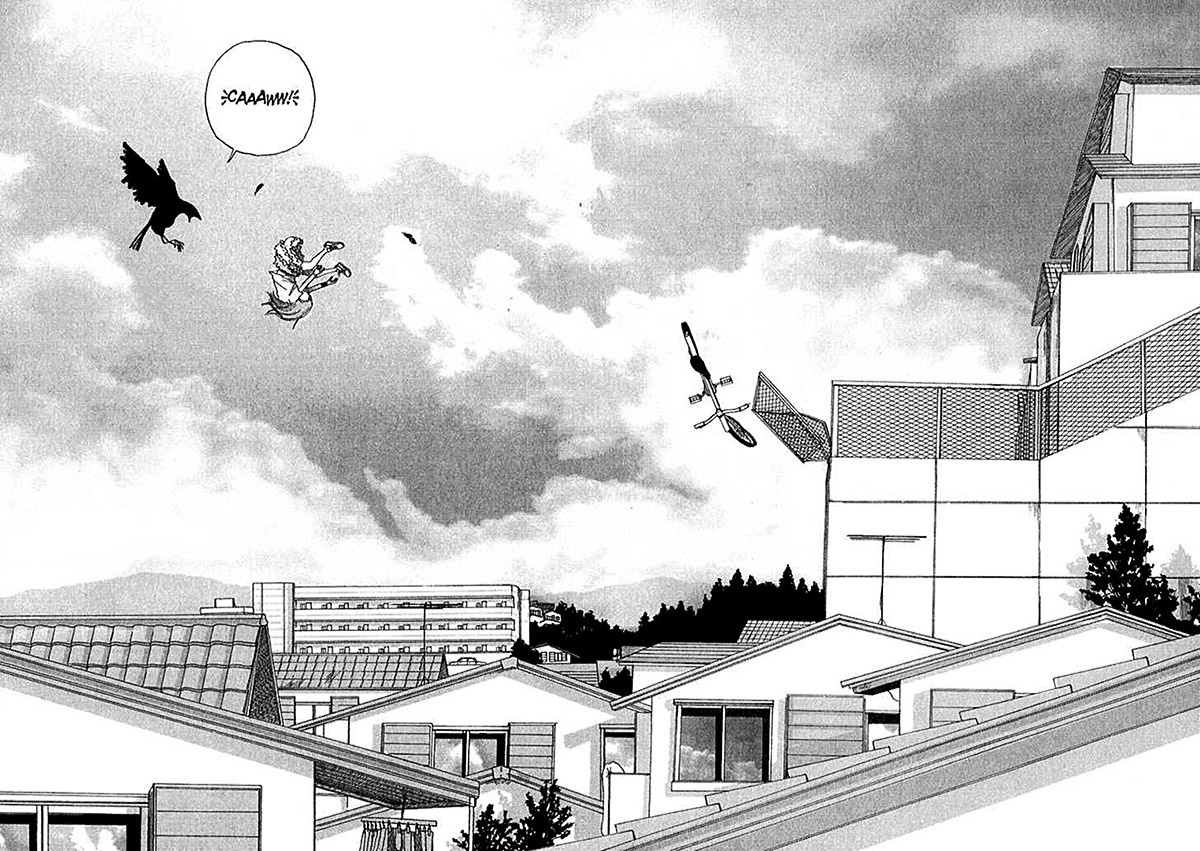
The stories in this first volume are varied, yet all interact in some format. The same picture might be seen by two different people in different places. A location frequented by one character may be visited by another. Very few of the characters actually meet one another but the stories are all entwined in their own special ways. The first story of the volume features a young tomboyish woman who wishes her life was a shojo manga as she aimlessly wanders through her life. Other stories include a schoolgirl who is bullied not only by her peers but also by a mysterious black bird & a tale about a trio of teen boys who each wonder if they'll ever get the chance to realize their dreams.
I really enjoyed this manga, but then I knew I would. Asano's work is incredibly powerful. His artwork isn't the typical "big eyes, small mouth & panty shots" style that is so prevalent in today's manga, which is why most of his stories work so well. The art is pretty lifelike & as a result the characters are all more believable for it.
I also liked how his characters interact with each other. There's no huge moral, no super character that saves the day & no happy go lucky girl who succeeds without really trying. People hurt & get hurt in these stories. Not every story has a gung-ho happy ending. But every story is satisfying, even when the stories may not end as you hoped that they would.
If you like good quality manga, buy this series right now. Luckily for us, both volumes of this series have been released at the same time, so you can snap them both up right now- no waiting for the next volume to be released. This guy is the real deal- Asano is going to be one of the names that people will be touting years later as "one of the best".
"What a Wonderful World!" presents in a simple way the curse of mundane life. The author, showcase the sadness present in modern society, in a way you start to feel ashamed of being a part of it. From stories with kidnapping, linching, and suicide to just the simple life life of a thirty year old man, the plotless literary work of Inio Asano, uses that in a genious manner to make the reader really reflect on their part in society as a hole and what they are doing with the life. You are just one in the middle of many, so the overwealming pressure you feel everyday, may not be necessaire. Happiness is what you decide it is. The book is genious is many of its aspects, but indeed there are many boring stories in the middle of it, which not belittle the work. The artstyle is perfect for the feelings the book want to portray, despite being simple. I just have to thank Inio Asano, for the amazing work made throughout the many stories in the book, and the many characters I feel in love with.
This is a well-drawn quirky graphic novel consisting of a series of vignettes highlighting the anomie of teens in an unnamed Japanese city, as each one struggles with some aspect of reaching adulthood - such as passing a test to get into college, settling down and getting a "responsible" job as opposed to pursuing a career as a rock musician, working out problems in relationships, coming to terms with adulthood.
Each vignette seems to "flirt" with suicide or oblivion in some way - in one of the final vignette a character shockingly actually does commit suicide. In another vignette, a character jumps off a ledge but then holds on to a pole that's holding up a billboard on the ledge, as he realizes he does want to live after all. For some, the meaninglessness of life is buried in video games, smoking, sex, drinking, and reading manga. The social strata is one of alienated youth, on the edges of society, trying to find a way to fit in, and be "successful."
This isn't exactly a depressing volume although it deals with depressing topics. There are sketchy plots or no plots, just the day-to-day existence of alienated youth. One upbeat moment occurred when a couple of teens who had been arguing, reconciled went for a walk and discovered a wonderful cherry tree, that they had never known existed nearby, in their neighborhood of stark concrete high-rises, commuter trains, and in general, urban sterility.
The dialog was snappy and the drawing is good. If you are interested in reading stories about somewhat depraved, sometimes depressed, and maybe even desperate Japanese youth, this volume is for you.
This review will be for both volumes of What a Wonderful World! by Inio Asano.
There's honestly not a lot I can say about this manga. Told as a series of separate simultaneously occurring events, WAWW is a beautifully drawn graphic novel. The characters are relate-able, albeit forgettable. Each chapter (track) is a separate mini-story and in the final few chapters each are loosely tied together. While this sounds like a great idea for a graphic novel, it is weakly wrapped up and feels rushed. We're so briefly thrown into all these characters lives that I don't find myself caring for any of them really. By the time I finally distinguish the different personalities in one story, I'm ripped away from them. I really only gave this a 3 and not a 2 because it really is masterfully drawn and written. And while confusing throughout the middle, the beginning and end are nice. Decent, but played out message of "there is good/happiness/hope in the world."
I don't know, maybe I'm missing something.
PS - This came out before Solanin, and after reading both, it's plain to see he recycled bits and pieces of character stories/personalities/and even designs.
I really hesitated between giving it three or four stars because this is both a great a manga and an underwhelming one. This a depiction of the highs and lows of a handful of Japanese young people, the stories are subtle and yet deep. Asano brings in tough subjects like suicide and desperation, trying to find your place in a society that really only wants you to conform.. It's pretty depressing to be honest although there are glimpses of hope. I think the content is great, the form not so much, it's hard to keep track of the characters and their stories, since it's presented in a "slices of life" kind of way. At the same time, they are all beautifully interwoven..
Let's give it a good 3,5 stars despite its flaws, just because it's really relatable and touching.
This series is made of two volumes, and I’m reviewing both.
One of Asano’s first mangas, produced back in 2002-2004, presumably during college or immediately after his college years. If you’ve come to this manga after reading his later stuff, the first thing that will strike you is that the drawings look very amateurish. To put together a professional manga these days you need a professional team, with someone for example dedicated exclusively to drawing backgrounds. In the case of this manga, Asano himself still had to improve at drawing characters; for the first couple of chapters I couldn’t even tell that the main character was a girl. However, producing this series was formative for the author, and by the end not only he draws more sophisticatedly, but the composition of his mini plots has improved as well.
I suspect that he might have started this series with the intention of making it an episodic succession of mini plots starring the first main character he introduces, but, in a scatterbrained manner characteristic of such an early period in an artist’s career, the series quickly turns into a string of mostly unrelated, a chapter or two long mini-plots involving peripheral characters from other chapters; something like Sherwood Anderson’s “Winesburg, Ohio”, which I didn’t enjoy particularly.
As common themes through the chapters we have some people fearing how quickly everything changes, and trying to hold on to their current states against the inevitable flow. They fear that the impending need to earn enough money to keep a roof over their heads will strip them of their freedom and individuality. Some suspect that although they might try to carve their own private paths, they aren’t talented enough to survive that way. Others fear that their romantic relationships are doomed to fail, some in particular because the women won’t tolerate going out with someone who can’t produce enough money as he’s busy trying to make it on his own terms. Others find themselves in their late twenties and already having been discarded by society, and wonder if all they have left is accustoming themselves to failure. Some worry that the struggle, even just being alive, might not be worth it. Very common themes for artistic types in their early twenties, who have no clue if their works will be good enough for them to avoid wasting most of their adult lives in some office, which for those people is the equivalent of giving up, of dying. I've written this in a sort of condescending way, although I am/was one of those artist types who for years wanted to live through selling his stories. I found out I wasn't cut for it (no contacts, just unpleasant in general as a person, and maybe my stuff just wasn't good enough), and I'm now typing these words from my office desk. It's a death of sorts, of course; in the afternoons I don't have the energy for anything of value, but conveniently I already told the stories that I really, really needed to tell, so it's fine for now. That's what I tell myself.
For me the most interesting thing about this short series is that if you have read later works by this author, you can see him working in here with some of the seeds. We have a precursor of “Oyasumi Punpun”’s dark spot in a talking crow who pesters one of the protagonists; when questioned about why, the crow says, “You reek like you want to die. As long as you reek that way I will never leave your side.” We have a couple who look pretty much the same like the main one in “Solanin”, and the guy also wants to play guitar in a band. One of the characters, a druggie addicted to cough syrup, dreams of becoming a bird and flying away, and he ends up . Obviously, the main protagonist of “Oyasumi Punpun”, along with his family, is drawn like a bird caricature. We have a precursor of the forms the protagonist of “Oyasumi Punpun” evolves to; when a bully faces his own image in a mirror he sees a dark, mostly featureless face. There are probably other involuntary references like those, but I can’t remember them now.
Beyond the amateurish art in general, particularly in the first chapters, there are other things that didn’t sit well with me. The writing, while displaying some of his characteristic brilliance, is far less subtle than I was used to, and surprisingly naïve at times; the naivety is particularly shocking coming from an author whose later works have such a bleak outlook on society and humanity in general. I can’t help but see the influence he spoke about in “Reiraku”, when a girlfriend he had in college, and who had enjoyed his first mangas, ended up screwing him over psychologically by “recognizing” him as a monster. Her leaving him seemed to have marked him significantly, giving him maybe his first big hint that having a normal relationship was going to be impossible for him despite his initial hopefulness. Additionally, some character actions are unjustified; for example, when one of the protagonists starts in a new school, one of her classmates insists on bullying her for no apparent reason. There are gangs beating up people randomly, which happens like three or four times. Again, there are probably other examples I can’t remember.
Still, there were tender moments, a few of them involving, surprisingly as well, supernatural elements; one of the characters is a shinigami, a god of Death from Japanese folklore, who is moved by one of the characters’ wish to come back to life because he still hadn’t done anything of worth, or when that shinigami, masquerading in the world of the living as a dog, lamented its kind owner’s sudden passing.
I enjoyed it in general, but I wouldn’t start with this one. It wouldn’t be my second nor my third of Asano’s either.
3 to 3.5 stars. I like the concept of short stories that tell a tale of modern life, but then if they're interwoven back and forth, wish I could tell the characters apart better... or have a bit more time with each of them before going to the next story.
The second volume was also interesting and some of the characters seemed familiar, but again, I got confused, especially when shinigami came into it.
Meh. Asano' early work. About a dozen or so vignettes that are loosely tied together. Not long enough for any investment in the characters or story and the only thing that I enjoyed was the touch points that barely tied all of them together. I'm a big fan of his work but this isn't good. I'll give the second Volume a try but just because I want to read everything by him.
Hmm. I'm wavering between at 1 star or a 2 star. It had it's moments but I'm not one for some of the strange antics. Props to Asano's art style though, I love it.
Inio Asano just has this amazing innate ability to capture the ugly side of life. He talks about the dirty parts most people hide, the realism of life and how we deal with it day-to-day. We saw that in おやすみプンプン コミック 全13巻完結セット and again in Dead Dead Demon's Dededede Destruction #1.
Make no mistake, this is a mature book for mature readers. Unlike other 'mature' material, though, there is little violence and only pg-13 nudity. The maturity stems from the very real, uncompromising analysis of humanity. Themes of suicide, disillusionment, heartbreak, ennui, and death are all prevalent in this manga. Depending on a person's mindset, this could end up becoming a very depressing book. On the other hand, there is a solid theme of finding a place in society and learning to be happy even when reality doesn't match the dream.
to do: a collection of short stories, mostly centering on the unpredictable moments in life. rather dark: the lead characters commit suicide, get hit by trucks, die trying childish stunts, are shunned by society, recede in drunkenness, quit their jobs and live purposeless, etc. the characters are loosely recurring, giving a weak character-based link between stories-- besides the strong thematic connection--and drawing the reader into the book, page after page. the symbolistic is omnipresent; it would be a long analysis. the graphics are good overall, less polished than in Solan in but more varied; looks like the assist is exploring. lighting is at times amazing, but there are also many places where the shadows are inconsistent within the same scene. overall, I liked it, but less than solanin.
I've had the two volumes of What a Wonderful World! for some time, but I've just now gotten around to reading them, and doing so in preparation of our March manga episode of the podcast devoted to two recent English publications from Asano. The stories in these two volumes are all interconnected in some way, making them what I've called in my scholarship "graphic cycles," a comics equivalent to a short-story cycle. The style of the individual pieces remind me a lot of Yoshihiro Tatsumi's style of short storytelling. They're slice-of-life narratives that don't usually tie up "neatly," but instead, have a more abrupt feeling of closure. In this way, they're more realistic in their presentation.
interconnected short stories about teens and young adults primarily. Each character seemed to live on the outer edge of their communities--they just didn't quite fit in with the rest of the world out there. Some are morbid but made me smile or chuckle because of the unexpectedness of it all. Like the panel when Syrup is flying and then the next page states he died. Or the boy who flips over the railing appearing to have committed suicide but only grabs the bar as he still wants to live.
Unexpected and brilliant in its execution. Must go get more now.
Overall it was okay. I didn't expect anything of it other than it being slice-of-life. A couple of stories were really nice; I easily related to them, especially in the transitional period I am presently in. Some of the stories I understood but I just didn't get anything out of it; I tried, I really did but I just didn't care. I guess that's what Inio Asano was trying to covey: that everyone lives different lives. Some we can understand and relate to while others we just don't understand (whether or not we try to).
Let me begin by saying that I'm actually a huge fan of Mr . Asano's works . Especially Oyasumi Punpun , which has since remained my favourite story ever , and yes I'm aware it's a manga obviously but it was seriously my favourite plot between anything I've ever read. This piece of work however was just a disappointment . Don't get me wrong there were some parts I loved , but upon finishing this manga I couldn't help but feel underwhelmed . I don't know maybe I'm miss judging this . Maybe it's just for the fact that I didn't quite understand the plot .
Inio Asano gives us a beautiful collection of short stories about everyday people at a crossroads. Lyrical, opaque and beautiful, these tales are all about reclaiming individuality and refusing to adapt to the expectations of other people and society. Basically every story follows the same formula of presenting a character and ending in a cathartic moment of taking a leap of faith. Still, there is enough artistic vision in each installment, making them work on their own perfectly.
We all live in our own ways. And we all have doubts about whether it's right or wrong. But there isn't a right or wrong way to live.
Look. Check out the view of this dirty town. The world's unfair and full of contradictions. I wanna turn into a bird and fly away. But I know I can't. So I don't care if my dreams are just dreams! What's important is right now! Whether I can see what's straight ahead!
Beautifully evokes the sensation of life being a series of random, semi-connected events. Experiencing the different story lines made me feel like a rock skipping over the surface of a pond - never really experiencing the depth of what was happening. I wish there was more closure to the stories, but I guess that’s not the point. I read this very quickly so I might want to go back and re read it at some point.
This entire review has been hidden because of spoilers.
Another good book by inio asano the artwork was ok but the story was interesting moving to next character to next character pretty much saying there is no protagonist just a bunch of side characters with different ideals and dreams and honestly i hope it goes well for all of them im excited to see what happens in the next book and im gonna buy it right away.