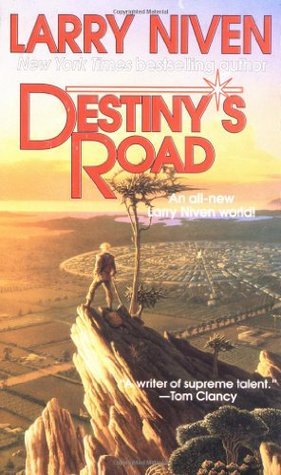
Portions of Destiny’s Road represent Larry Niven at his best. At least, in my opinion, Niven is at his best when he imaginatively considers how things might work in different biomes with different variants of technology. Niven and his frequent co-author (famous in his own write) Jerry Pournelle were optimistic enough about space colonization and industrialization that they were instrumental in supporting the L5 Society which, in turn, became the National Space Society.
Destiny’s Road, as the title implies, is a “road story.” In some ways, it is a hybrid between The Fugitive and Route 66 but that part of the story is used to delineate a hypothetical history of Destiny, a space colony. In many ways, it was the road story that kept me reading but the “how” and “why” that kept me thinking. For example, why would autochthonous species not attack immigrant species? They might not if there was something dangerous in the blood of the immigrant species or if there was something missing from the blood of the invasive species. This explained something of why Earthlife was able to take root in a potentially hostile biome. And the ultimate answer is a really good one as anyone lacking sufficient quantities of that “ingredient” from their biochemistry can tell you.
In a time when the colony is beginning to experience the faltering of the technology from the original economy, there is a fascinating mix of “wild west”/”gypsy” (in terms of using “wagon trains,” at least, elements and what the colonists call “settler magic” (referring to the original technology). The caravans bring some of the “settler magic” and the ingredient mentioned in the last paragraph to the more distant towns in the colony world. This is originally part of the plan for dissemination of what is necessary for life as well as for procreation without in-breeding (It’s an interesting concept even though I can’t see it working in traditional society. Maybe desperate times do call for desperate measures.
There is a sapient autochthonous population on Destiny and it appears that some humans interacted with them. However, much like U.S. colonists with its population, there was a certain situation where the colonists had exposed that indigenous population to a fatal infection. If they allowed those dying within the infected population to intermingle with the general population, it was almost certain to be, pardon the expression Orson Scott Card fans, xenocide. Does one kill off the infected population? What if they might have had a capacity for recovery for which earth-like humans would be unaware? It’s an ugly (and implied, not directly asked) ethical question and brings to mind other experiences of imperialistic arrogance both in the past and potentially in the future.
Politically, as part of the protagonist’s research, he discovers that there were many “hydraulic empires” (empires built on controlling access to water or some other important research) over the course of Earth history. These empires sustained themselves by using the resources of other countries and regions until the empires themselves became corrupted enough to be overtaken by barbarians (“at the gates?”). In Niven’s fictional history, the United Nations had become a one-world government prior to the launch of the colony ships and is itself destroyed by barbarians within rather than outside. Even though Niven wrote Destiny’s Road in 1997, one could substitute U.S. for the U.N., forget the one-world government or space colonization and it would be right on. As the protagonist explains in the novel, “They’d grown their own barbarians.” (p. 373)
Such a short review can’t do justice to all of the ingenious social, technological, and political aspects of Destiny’s Road. I did feel that the pacing of the book was uneven. At one point, not characteristic of my reading habits, I set the book aside for at least two-three weeks. I’m glad I finished it; the trip was worth it, but I can’t recommend it as highly as most of Niven’s works that I’ve devoured.