

What do you think?
St. Leibowitz #1
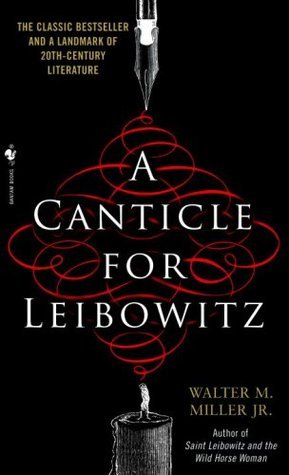
A Canticle for Leibowitz
Winner of the 1961 Hugo Award for Best Novel and widely considered one of the most accomplished, powerful, and enduring classics of modern speculative fiction, Walter M. Miller, Jr. 's A Canticle for Leibowitz is a true landmark of twentieth-century literature -- a chilling and still-provocative look at a post-apocalyptic future.
In a nightmarish ruined world slowly awakening to the light after sleeping in darkness, the infant rediscoveries of science are secretly nourished by cloistered monks dedicated to the study and preservation of the relics and writings of the blessed Saint Isaac Leibowitz. From here the story spans centuries of ignorance, violence, and barbarism, viewing through a sharp, satirical eye the relentless progression of a human race damned by its inherent humanness to recelebrate its grand foibles and repeat its grievous mistakes. Seriously funny, stunning, and tragic, eternally fresh, imaginative, and altogether remarkable, A Canticle for Leibowitz retains its ability to enthrall and amaze. It is now, as it always has been, a masterpiece.
In a nightmarish ruined world slowly awakening to the light after sleeping in darkness, the infant rediscoveries of science are secretly nourished by cloistered monks dedicated to the study and preservation of the relics and writings of the blessed Saint Isaac Leibowitz. From here the story spans centuries of ignorance, violence, and barbarism, viewing through a sharp, satirical eye the relentless progression of a human race damned by its inherent humanness to recelebrate its grand foibles and repeat its grievous mistakes. Seriously funny, stunning, and tragic, eternally fresh, imaginative, and altogether remarkable, A Canticle for Leibowitz retains its ability to enthrall and amaze. It is now, as it always has been, a masterpiece.
Library Binding
First published October 1, 1959
About the author
Walter M. Miller Jr.
157 books1,092 followersFrom the Wikipedia article, "Walter M. Miller, Jr.":
Miller was born in New Smyrna Beach, Florida. Educated at the University of Tennessee and the University of Texas, he worked as an engineer. During World War II, he served in the Army Air Corps as a radioman and tail gunner, flying more than fifty bombing missions over Italy. He took part in the bombing of the Benedictine Abbey at Monte Cassino, which proved a traumatic experience for him. Joe Haldeman reported that Miller "had Post Traumatic Stress Disorder for 30 years before it had a name".
After the war, Miller converted to Catholicism. He married Anna Louise Becker in 1945, and they had four children. For several months in 1953 he lived with science-fiction writer Judith Merril, ex-wife of Frederik Pohl and a noted science-fiction author in her own right.
Between 1951 and 1957, Miller published over three dozen science fiction short stories, winning a Hugo Award in 1955 for the story "The Darfsteller". He also wrote scripts for the television show Captain Video in 1953. Late in the 1950s, Miller assembled a novel from three closely related novellas he had published in The Magazine of Fantasy and Science Fiction in 1955, 1956, and 1957. The novel, entitled A Canticle for Leibowitz, was published in 1959.
A Canticle for Leibowitz is a post-apocalyptic (post-holocaust) novel revolving around the canonisation of Saint Leibowitz and is considered a masterpiece of the genre. It won the 1961 Hugo Award for Best Novel. The novel is also a powerful meditation on the cycles of world history and Roman Catholicism as a force of stability during history's dark times.
After the success of A Canticle for Leibowitz, Miller never published another new novel or story in his lifetime, although several compilations of Miller's earlier stories were issued in the 1960s and 1970s.
In Miller's later years, he became a recluse, avoiding contact with nearly everyone, including family members; he never allowed his literary agent, Don Congdon, to meet him. According to science fiction writer Terry Bisson, Miller struggled with depression during his later years, but had managed to nearly complete a 600-page manuscript for the sequel to Canticle before taking his own life with a gun in January 1996, shortly after his wife's death. The sequel, titled Saint Leibowitz and the Wild Horse Woman, was completed by Bisson and published in 1997.
Miller was born in New Smyrna Beach, Florida. Educated at the University of Tennessee and the University of Texas, he worked as an engineer. During World War II, he served in the Army Air Corps as a radioman and tail gunner, flying more than fifty bombing missions over Italy. He took part in the bombing of the Benedictine Abbey at Monte Cassino, which proved a traumatic experience for him. Joe Haldeman reported that Miller "had Post Traumatic Stress Disorder for 30 years before it had a name".
After the war, Miller converted to Catholicism. He married Anna Louise Becker in 1945, and they had four children. For several months in 1953 he lived with science-fiction writer Judith Merril, ex-wife of Frederik Pohl and a noted science-fiction author in her own right.
Between 1951 and 1957, Miller published over three dozen science fiction short stories, winning a Hugo Award in 1955 for the story "The Darfsteller". He also wrote scripts for the television show Captain Video in 1953. Late in the 1950s, Miller assembled a novel from three closely related novellas he had published in The Magazine of Fantasy and Science Fiction in 1955, 1956, and 1957. The novel, entitled A Canticle for Leibowitz, was published in 1959.
A Canticle for Leibowitz is a post-apocalyptic (post-holocaust) novel revolving around the canonisation of Saint Leibowitz and is considered a masterpiece of the genre. It won the 1961 Hugo Award for Best Novel. The novel is also a powerful meditation on the cycles of world history and Roman Catholicism as a force of stability during history's dark times.
After the success of A Canticle for Leibowitz, Miller never published another new novel or story in his lifetime, although several compilations of Miller's earlier stories were issued in the 1960s and 1970s.
In Miller's later years, he became a recluse, avoiding contact with nearly everyone, including family members; he never allowed his literary agent, Don Congdon, to meet him. According to science fiction writer Terry Bisson, Miller struggled with depression during his later years, but had managed to nearly complete a 600-page manuscript for the sequel to Canticle before taking his own life with a gun in January 1996, shortly after his wife's death. The sequel, titled Saint Leibowitz and the Wild Horse Woman, was completed by Bisson and published in 1997.
Ratings & Reviews
Friends & Following
Create a free account to discover what your friends think of this book!
Community Reviews
Displaying 1 - 30 of 8,201 reviews

December 20, 2008
I'm not a Christian, but I live in a Christian society, and it's all around me. Reviewing on Goodreads brings home how many authors can be classified as some kind of Christian apologist. I have very different reactions to them. At one end, I can't stand most of C.S. Lewis - I feel he's there with his foot in the door trying to sell me something, and I'm just hoping that I can get him to take his foot away without being openly rude. At the opposite end, I think Dante is a genius, and that The Divine Comedy is one of the greatest books ever written.
A Canticle for Leibowitz is towards the positive end of this spectrum. It's a post World War III novel, where most of the US is a radioactive wasteland, and civilization has more or less collapsed. The only people who still keep any of the lost heritage of the past are a few scattered monasteries. The book tracks the history of one of these monasteries over the course of several hundred years. It's low-key, moving, and often surprisingly funny. Everything is informed by the simple, unquestioning faith shown by the monks. They don't know why they're doing what they are doing, other than that it must be God's will.
The author shows you the ridiculous aspects of the story - I particularly liked the illuminated parchments of circuit diagrams decorated with vines and cherubim. And yet he is totally on the monks' side, and after a while the reader is as well. They're doing something important, even though they don't know what it is, and it makes their lives deep and meaningful. Even when they die horrible deaths (several of them do), they do it with dignity, knowing that it's the price that needs to be paid.
If Christianity were always like this, I guess I'd be a Christian too. It's a lovely book, that will leave you feeling better about people.
A Canticle for Leibowitz is towards the positive end of this spectrum. It's a post World War III novel, where most of the US is a radioactive wasteland, and civilization has more or less collapsed. The only people who still keep any of the lost heritage of the past are a few scattered monasteries. The book tracks the history of one of these monasteries over the course of several hundred years. It's low-key, moving, and often surprisingly funny. Everything is informed by the simple, unquestioning faith shown by the monks. They don't know why they're doing what they are doing, other than that it must be God's will.
The author shows you the ridiculous aspects of the story - I particularly liked the illuminated parchments of circuit diagrams decorated with vines and cherubim. And yet he is totally on the monks' side, and after a while the reader is as well. They're doing something important, even though they don't know what it is, and it makes their lives deep and meaningful. Even when they die horrible deaths (several of them do), they do it with dignity, knowing that it's the price that needs to be paid.
If Christianity were always like this, I guess I'd be a Christian too. It's a lovely book, that will leave you feeling better about people.

October 5, 2008
Odd as it sounds, this is hot toddy, warm blanket comfort food for me. Admittedly, that’s not the typical description of this cynical, bleak-themed, post-apocalyptic SF classic. However, the easy, breezy style with which Miller explores his melancholy material manages to pluck smiles from me whenever I pick it up. This go around, I listened to the audio version which was recently released it was as mood brightening an experience as my previous read through.
Despite dealing with dark, somber subject matter and ultimately ending on a tragic crescendo of “humanity is stupid, savage and screwed,” the journey of the novel is so filled with engaging characters and genuine humor that the surrounding depression and moroseness of the narrative theme just can’t seem to grab hold of you. At least, it never laid an accusing finger on me.
Canticle is broken up into 3 Sections, each taking place approximately 6 centuries apart. Beginning in the 26th century, 600 years after the Flame Deluge when nuclear buffoonery laid waste to civilization, the central focus of the story is a Roman Catholic monastery founded by a Jewish weapons engineer for the purpose of safeguarding and preserving human knowledge.
Shortly after the geniuses of the 20th Century decided to light up the globe like Hell's own 4th of July, the surviving residents of Planet “radiation burn” decided that brains and books were overrated and followed up the Flame Deluge with the Simplification, whereby they roasted all of the books (along with any person smart enough to read or write one).
Isaac Leibowitz, after being part of the military machinery that microwaved the planet, made it his mission in life to try and preserve knowledge for the future. Thus the Albertian Order of Leibowitz was founded.
The first third of the book introduces us to the post apocalyptic world and gives a back-story on the Flame Deluge and the mission of the Order of Leibowitz. Located in what was the Southwestern United States, the Order tracks down and smuggles 20th century “memorabilia” into the abbey (a process known as “booklegging”) while trying to avoid being killed (and possibly eaten) by the self-described “Simpletons” roaming the wastelands.
The next section of the book takes place in the 32nd Century and shows humanity finally emerging out of the dark ages of the Simplification and beginning to once again embrace the knowledge. This section focuses primarily on the growing feud between the resurgent secular scientists and the Church over the control and distribution of technology. Similar to our own renaissance period, the story describes science and natural law going toe-to-toe with the info hoarding monks as powerful city-states run by warlords play both sides for advantage.
Finally, in the 38th Century, the last section of the book shows humanity once again in the full flower of its technological brilliance and historical stupidity ready to give the Earth another nuclear facial (Note:I was going to use "atomic facial," but the Urban Dictionary makes that term very inappropriate here). War is coming and the forces of history are once again driving humanity like cattle towards the abattoir.
Thus we see the overarching theme of Miller’s masterpiece; the cyclical nature of history. Miller’s moral : as a species we are too stupid not to truly learn from our past blunders and are doomed to continue to screw the pooch and the planet with our giant, atomic phalluses. I know, not exactly a cheery, pump it up pep talk. However, the tone and the narrative style are anything but dreary.
Miller does a wonderful job creating a world that is large and mysterious and yet instantly recognizable and relatable. His characters are flawed, genuine and mostly decent and live through their times with a sense of purpose and optimism that belies the smothering embrace of history as it squeezes events into an all too familiar pattern.
Miller’s ability to write brightly of such bleakness is truly extraordinary. The story is dark, fatalistic and filled with pessimism yet the prose is light, hopeful and filled with optimism. The word bitter never comes to mind.
In addition to the overriding theme of history’s wheel-like pattern, Miller touches on other serious issues such as euthanasia and the right to life, the place of art in society and the nature of war itself. This is a towering science fiction work, but Miller’s messages are deftly delivered behind a humorous, engaging future history.
In sum, this book is a light touch of morale outrage. It’s a cozy warning of man’s stupidity. It’s a warm, comforting “blankie” for our inner cynic to snuggle with while we wait for the shoe/anvil to drop.
Enjoy!! 5.0 stars. HIGHEST POSSIBLE RECOMMENDATION!!
Winner: Hugo Award Best Science Fiction Novel (1961)
Despite dealing with dark, somber subject matter and ultimately ending on a tragic crescendo of “humanity is stupid, savage and screwed,” the journey of the novel is so filled with engaging characters and genuine humor that the surrounding depression and moroseness of the narrative theme just can’t seem to grab hold of you. At least, it never laid an accusing finger on me.
Canticle is broken up into 3 Sections, each taking place approximately 6 centuries apart. Beginning in the 26th century, 600 years after the Flame Deluge when nuclear buffoonery laid waste to civilization, the central focus of the story is a Roman Catholic monastery founded by a Jewish weapons engineer for the purpose of safeguarding and preserving human knowledge.
Shortly after the geniuses of the 20th Century decided to light up the globe like Hell's own 4th of July, the surviving residents of Planet “radiation burn” decided that brains and books were overrated and followed up the Flame Deluge with the Simplification, whereby they roasted all of the books (along with any person smart enough to read or write one).
Isaac Leibowitz, after being part of the military machinery that microwaved the planet, made it his mission in life to try and preserve knowledge for the future. Thus the Albertian Order of Leibowitz was founded.
The first third of the book introduces us to the post apocalyptic world and gives a back-story on the Flame Deluge and the mission of the Order of Leibowitz. Located in what was the Southwestern United States, the Order tracks down and smuggles 20th century “memorabilia” into the abbey (a process known as “booklegging”) while trying to avoid being killed (and possibly eaten) by the self-described “Simpletons” roaming the wastelands.
The next section of the book takes place in the 32nd Century and shows humanity finally emerging out of the dark ages of the Simplification and beginning to once again embrace the knowledge. This section focuses primarily on the growing feud between the resurgent secular scientists and the Church over the control and distribution of technology. Similar to our own renaissance period, the story describes science and natural law going toe-to-toe with the info hoarding monks as powerful city-states run by warlords play both sides for advantage.
Finally, in the 38th Century, the last section of the book shows humanity once again in the full flower of its technological brilliance and historical stupidity ready to give the Earth another nuclear facial (Note:I was going to use "atomic facial," but the Urban Dictionary makes that term very inappropriate here). War is coming and the forces of history are once again driving humanity like cattle towards the abattoir.
Thus we see the overarching theme of Miller’s masterpiece; the cyclical nature of history. Miller’s moral : as a species we are too stupid not to truly learn from our past blunders and are doomed to continue to screw the pooch and the planet with our giant, atomic phalluses. I know, not exactly a cheery, pump it up pep talk. However, the tone and the narrative style are anything but dreary.
Miller does a wonderful job creating a world that is large and mysterious and yet instantly recognizable and relatable. His characters are flawed, genuine and mostly decent and live through their times with a sense of purpose and optimism that belies the smothering embrace of history as it squeezes events into an all too familiar pattern.
Miller’s ability to write brightly of such bleakness is truly extraordinary. The story is dark, fatalistic and filled with pessimism yet the prose is light, hopeful and filled with optimism. The word bitter never comes to mind.
In addition to the overriding theme of history’s wheel-like pattern, Miller touches on other serious issues such as euthanasia and the right to life, the place of art in society and the nature of war itself. This is a towering science fiction work, but Miller’s messages are deftly delivered behind a humorous, engaging future history.
In sum, this book is a light touch of morale outrage. It’s a cozy warning of man’s stupidity. It’s a warm, comforting “blankie” for our inner cynic to snuggle with while we wait for the shoe/anvil to drop.
Enjoy!! 5.0 stars. HIGHEST POSSIBLE RECOMMENDATION!!
Winner: Hugo Award Best Science Fiction Novel (1961)

September 8, 2020
Quid enim mirabilius quam monachi in Apocalypse! I don’t know why, but there is something way cool about Monks in the Apocalypse. “A Canticle for Leibowitz” was published in 1959 and Walter M. Miller Jr. won the Hugo in 1961. It was a mainstream bestseller and, I believe, has remained continuously in print ever since. It’s not only considered a science-fiction classic, but also a literary masterpiece.
In 1959 the Cold War was heating up as Russia and the U.S. maneuvered for influence in Southeast Asia, Latin America, and the Middle East. In 1954 the U.S. had completed the Castle Bravo test on Bikini Atoll with a hydrogen bomb that yielded 14.8 megatons. The Soviets followed in 1955 with a 1.6 megaton test. The capability for full mutual destruction wasn’t in place by 1959, but the two superpowers were racing towards it. Meanwhile, earlier during World War II, Walter M. Miller, Jr. flew on a bomber that helped demolish a 6th century Christian monastery at Monte Cassino, Italy, clearly a catalyst for the story.
This was a novel that grew over time. Miller first authored a short story, “A Canticle for Leibowitz” around 1954 which evolved into “Fiat Homo” and was published in 1955. He then published the second section in 1956 and wrote and published the third, “The Last Canticle” in 1957. The growth of the novel allowed Miller to develop a layered, intricate tale that is rich in theme.
The plot begins with Brother Francis on a vigil in the desert. The world has fallen into a new Dark Age. With the help of a mysterious Wanderer, he discovered a fallout shelter with preserved ancient documents from before the “Flame Deluge.” Some of the documents appear to be written by his order’s founder, Leibowitz. Brother Francis and his order attempt to have Leibowitz canonized due to establishment of the Order and his preservation of pre-war knowledge. The second part of the novel sees the ending of the Dark Ages and a Renaissance begins. In the backdrop of warring city states, the Order continues to preserve and study the Leibowitz knowledge and one Brother Kornhoer, develops a treadmill-powered electrical generator. In the third section, we jump forward in time significantly (around 600 years?) and mankind now has starships and colonies on distant worlds as well as nuclear weapons. A city-level nuclear attack occurs and much of the third section deals with the Order both sheltering refugees and preparing for potential nuclear annihilation. I’ll stop there to avoid spoilers.
This book is chocked full of themes and philosophy. It explores mankind’s tendency to rise and fall, the value and danger of scientific knowledge, the tension of Church and State, and other religious conflicts. Its use of a strange title, religious terminology, and extensive Latin passages throughout the book, help to give it solemnity and gravity. However, the novel also has its humorous moments and its most interesting characters are often comical and odd. Miller also dances around mysticism and outright miracles, leaving just enough ambiguity to allow the reader to interpret the incidents.
If this book has faults, they are subtle. As far as I can recall, there are only two significant female character in the book. Even if we allow that the Order is male only, there are no female characters discussed during the ‘palace intrigue’ of State leaders or in the nomadic tribes. It certainly doesn’t pass the Bechdel test. I also found it, despite being in the backdrop of nuclear apocalypse, somewhat emotionally stunted. Most dialog focused on the intellectual aspects of the themes and very rarely on the feelings of the characters. Finally, since characters do not continue on between sections, we need to reengage with new characters in each section. The backdrop, history, and setting are the same, but it’s a little problematic to trade in characters with each section. For me, this lack of feeling and character changeover made it difficult to engage emotionally with the story. However, it didn’t limit my ability to appreciate the witty dialog and intellectual arguments. Not that it’s anywhere near the first apocalyptic novel, but I do appreciate the realistic portrayal of a post-apocalyptic world, complete with the corresponding ignorance, politics, and horror of a fallen modern civilization.
An important, intricate, if detached, exploration of a post-nuclear-war world, seen though the eyes of an eclectic order of monks told over more than a thousand years.
In 1959 the Cold War was heating up as Russia and the U.S. maneuvered for influence in Southeast Asia, Latin America, and the Middle East. In 1954 the U.S. had completed the Castle Bravo test on Bikini Atoll with a hydrogen bomb that yielded 14.8 megatons. The Soviets followed in 1955 with a 1.6 megaton test. The capability for full mutual destruction wasn’t in place by 1959, but the two superpowers were racing towards it. Meanwhile, earlier during World War II, Walter M. Miller, Jr. flew on a bomber that helped demolish a 6th century Christian monastery at Monte Cassino, Italy, clearly a catalyst for the story.
This was a novel that grew over time. Miller first authored a short story, “A Canticle for Leibowitz” around 1954 which evolved into “Fiat Homo” and was published in 1955. He then published the second section in 1956 and wrote and published the third, “The Last Canticle” in 1957. The growth of the novel allowed Miller to develop a layered, intricate tale that is rich in theme.
The plot begins with Brother Francis on a vigil in the desert. The world has fallen into a new Dark Age. With the help of a mysterious Wanderer, he discovered a fallout shelter with preserved ancient documents from before the “Flame Deluge.” Some of the documents appear to be written by his order’s founder, Leibowitz. Brother Francis and his order attempt to have Leibowitz canonized due to establishment of the Order and his preservation of pre-war knowledge. The second part of the novel sees the ending of the Dark Ages and a Renaissance begins. In the backdrop of warring city states, the Order continues to preserve and study the Leibowitz knowledge and one Brother Kornhoer, develops a treadmill-powered electrical generator. In the third section, we jump forward in time significantly (around 600 years?) and mankind now has starships and colonies on distant worlds as well as nuclear weapons. A city-level nuclear attack occurs and much of the third section deals with the Order both sheltering refugees and preparing for potential nuclear annihilation. I’ll stop there to avoid spoilers.
This book is chocked full of themes and philosophy. It explores mankind’s tendency to rise and fall, the value and danger of scientific knowledge, the tension of Church and State, and other religious conflicts. Its use of a strange title, religious terminology, and extensive Latin passages throughout the book, help to give it solemnity and gravity. However, the novel also has its humorous moments and its most interesting characters are often comical and odd. Miller also dances around mysticism and outright miracles, leaving just enough ambiguity to allow the reader to interpret the incidents.
If this book has faults, they are subtle. As far as I can recall, there are only two significant female character in the book. Even if we allow that the Order is male only, there are no female characters discussed during the ‘palace intrigue’ of State leaders or in the nomadic tribes. It certainly doesn’t pass the Bechdel test. I also found it, despite being in the backdrop of nuclear apocalypse, somewhat emotionally stunted. Most dialog focused on the intellectual aspects of the themes and very rarely on the feelings of the characters. Finally, since characters do not continue on between sections, we need to reengage with new characters in each section. The backdrop, history, and setting are the same, but it’s a little problematic to trade in characters with each section. For me, this lack of feeling and character changeover made it difficult to engage emotionally with the story. However, it didn’t limit my ability to appreciate the witty dialog and intellectual arguments. Not that it’s anywhere near the first apocalyptic novel, but I do appreciate the realistic portrayal of a post-apocalyptic world, complete with the corresponding ignorance, politics, and horror of a fallen modern civilization.
An important, intricate, if detached, exploration of a post-nuclear-war world, seen though the eyes of an eclectic order of monks told over more than a thousand years.

February 7, 2012
Brilliant.
A centuries old story following the evolving world after an apocalypse and centered on the monks of St. Leibowitz, somewhere in the American southwest.
The monks keep ancient artifacts of science and technology. Funny, sad, brutal, irreverent at times, but doggedly hopeful in its underlying themes, this is a science fiction gem but really transcends the genre to make a greater statement.
Scholars and critics have explored the many themes encompassed in the novel, frequently focusing on its motifs of religion, recurrence, and church versus state. Miller also uses some recurring elements to help bind the stories together, demonstrating exceptional imagination and virtuosity.
Miller has crafted a very good book, enjoyable for any science fiction fan and a well written work of fiction besides.

A centuries old story following the evolving world after an apocalypse and centered on the monks of St. Leibowitz, somewhere in the American southwest.
The monks keep ancient artifacts of science and technology. Funny, sad, brutal, irreverent at times, but doggedly hopeful in its underlying themes, this is a science fiction gem but really transcends the genre to make a greater statement.
Scholars and critics have explored the many themes encompassed in the novel, frequently focusing on its motifs of religion, recurrence, and church versus state. Miller also uses some recurring elements to help bind the stories together, demonstrating exceptional imagination and virtuosity.
Miller has crafted a very good book, enjoyable for any science fiction fan and a well written work of fiction besides.

Read
November 15, 2018
Captivating post-apocalyptic tale set in the Southwestern United States centuries following massive nuclear war that plunged the civilized world into a new dark age comparable to Europe's Early Middle Ages where nearly the entire population is illiterate and scattered in rustic tribes. And similar to those chaotic medieval years, Christian monks keep the flame of learning alive by copying and memorizing the contents of books.
A Canticle for Leibowitz is counted among the classic works of science fiction, the only novel by author Walter M. Miller, Jr. to be published during his lifetime, a decidedly philosophical tale well worth the read. So as not to reveal too much respecting plot, I'll make a reviewer's sideways shuffle and highlight a number of themes and topics I found especially provocative:
The Simplification
Following worldwide nuclear war, the Flame Deluge, where cities were reduced to puddles of glass, following the fallout and plagues, there arose The Simplification where the mass of survivors held educated persons responsible for the catastrophe and formed into simpleton packs that would burn books and kill anyone who was literate. Such action reminded me of the murderous Khmer Rouge in Cambodia as well as what the boy and his papa encountered in Cormac McCarthy's The Road.
Books and Learning
A certain group of monks honor the memory of Isaac Leibowitz who was martyred for his safeguarding scientific knowledge in the era of all those simpletons, honor him by becoming bookleggers (smuggling books into their monastery) or memorizers (committing to rote memory entire volumes of history, sacred texts, literature and science). In this way I recall those women and men who committed great works of literature to memory in Ray Bradbury's 1953 novel Fahrenheit 451.
Comedy of Errors
Walter M. Miller, Jr. injects a bit of humor throughout his book, most notably when young Francis is out in the desert and encounters an old man and then accidentally discovers a 1950s style Fallout Shelter that Leibowitz used. Leibowitz's memos, racing form, grocery list and blueprint are taken for important, even sacred, documents which just goes to show how low the level of insight and understanding dipped down in these dark, futuristic times.
Physical Beatings
When Francis reports to his abbot following the hubbub he created over his discovery of those documents in the Fallout Shelter and his encountering an old man that might have been a vision of Leibowitz, he's on the receiving end of repeated whacks from the abbot's stick. Such cruelty and stupidity! Does this monastery really count for the light of learning in the age of darkness? I was wondering if author Walter M. Miller, Jr. was making a statement about the human tendency, even within a spiritual community, for violence and inflicting pain.
Mutants
At the time Miller wrote his novel the bombings of Hiroshima and Nagasaki made a powerful impression on the national psyche and there was a general horror at the prospect of genetic deformities resulting from nuclear fallout. In one of his 1950s novels, Philip K. Dick details a carnival sideshow of such human monstrosities with feathers, scales, tails, wings or without eyes or faces. Likewise, journeying to New Rome, Francis passes The Valley of the Misborn, a leperlike colony peopled by "warped and crawling things that sought refuge from the world."
Culture and Renaissance
The second section of Canticle takes place some five hundred years after the time of Francis. One of the monks rediscovers electricity. But this Catholic monastery is hardly Castalia from Hermann Hesse's The Glass Bead Game - there remains a raging conflict of religion versus science: for example, one old monk claims such scientific experimentation and discoveries should be avoided as the work of the Devil. At another point this same old monk regales a visiting scientific scholar as "Sir, Philosopher" in a mocking, condescending tone, giving little doubt that asking questions and probing into nature is to be shunned.
Shamanism
There's a sequence out among one of the rustic tribes where the leader, one Mad Bear, relates that insanity is prized by his shaman as the most intense of supernatural visitations. Not unlike most writers back in the 1950s unless they were cultural anthropologists, author Miller's ideas surrounding shamanism is little more than a cartoon image. Too bad such traditions were unappreciated by the tale's futuristic monks and scientists, they might have learned something!
Benjamin
Remember that old man Francis encountered? He's still around! Hundreds of years later old Benjamin the Jew is still living out in the desert as a hermit. Has the old man transcended the boundaries of individuality and becomes all of Israel? What could the abbot and monks learn from old Benjamin? Would they even listen?
The Poet
One of the more intriguing parts of the novel is the inclusion of a surly poet staying at the monastery who can remove one of his eyes. There's a long-standing joke among the monks that the removal of the poet's eye signifies what it means to remove one's inner conscience.
Cycle of Destruction
The novel's third part is some six hundred years further into the future. There are nuclear weapons capable of ending human life on earth. Although there are also some other technological advances offering escape to some degree, the sense is Miller is making observations about the cyclical nature of creation and destruction in our all too human experience. To discover more details, I encourage you to read this classic for yourself.

“To minimize suffering and to maximize security were natural and proper ends of society and Caesar. But then they became the only ends, somehow, and the only basis of law—a perversion. Inevitably, then, in seeking only them, we found only their opposites: maximum suffering and minimum security.”
― Walter M. Miller Jr., A Canticle for Leibowitz

American science fiction writer Walter M. Miller, Jr. (1923 - 1996) was a tail gunner flying more than 50 bombing missions over Italy during World War II, one mission the bombing and destruction of the Benedictine Abbey at Monte Cassino, a traumatic experience for the author.

May 28, 2008
I read this immediately following another well-known 1950s apocalyptic / nuclear holocaust novel "Alas, Babylon." That book, which I gave 4 stars to, was an excellent story and made no pretensions to literature; its prose was plain and transparent. The novel in question, "A Canticle for Leibowitz," turned out to be one of the most irritating kinds of genre sci-fi: one with ambitions to beauty and importance that falls far short of the mark.
Now, I hate to put it that way, because I would never criticize anyone for trying. But this is one of those genre novels that somehow attained notoriety for being a step closer to literature than the typical pap, and if we're going to talk about it on that level, I have a lot to criticize it for.
The story is vague, confusing, unfocused, and seems to have some half-baked theme about religious ("objective") morality versus cultural ("subjective") morality. I mean, if it actually had something cogent to say, I would find it more interesting whether or not I agreed with it. But instead, this is another long-winded fiction novel that ambiguously proposes "questions" or moral opinions without enough plot or character to make it interesting.
The novel started off OK, and the general premise seemed interesting enough: the future history of man hundreds and thousands of years after a nuclear holocaust. I can understand the importance and relevance in a time when holocaust loomed large--and I'm not saying that threat has ceased to exist--and it's likely that the story influenced many minds on the epic horror that such a disaster would wreak on humanity. But the novel as written doesn't do justice to the scope he sets out to tackle.
Now, I hate to put it that way, because I would never criticize anyone for trying. But this is one of those genre novels that somehow attained notoriety for being a step closer to literature than the typical pap, and if we're going to talk about it on that level, I have a lot to criticize it for.
The story is vague, confusing, unfocused, and seems to have some half-baked theme about religious ("objective") morality versus cultural ("subjective") morality. I mean, if it actually had something cogent to say, I would find it more interesting whether or not I agreed with it. But instead, this is another long-winded fiction novel that ambiguously proposes "questions" or moral opinions without enough plot or character to make it interesting.
The novel started off OK, and the general premise seemed interesting enough: the future history of man hundreds and thousands of years after a nuclear holocaust. I can understand the importance and relevance in a time when holocaust loomed large--and I'm not saying that threat has ceased to exist--and it's likely that the story influenced many minds on the epic horror that such a disaster would wreak on humanity. But the novel as written doesn't do justice to the scope he sets out to tackle.

May 1, 2015
I am very cross. This is yet another book that I rated and reviewed and has disappeared from my shelves. I wonder if it happened when some librarian decided to add series information to it and thereby change the title? If it is no. 1 in a series there has to be a no. 2. There isn't. It isn't a series. According to Wikipedia,
"A Canticle for Leibowitz is based on three short stories Miller contributed to The Magazine of Fantasy & Science Fiction.[1][2] It is the only novel published by the author during his lifetime.."
That's pretty conclusive isn't it?
Maybe it wasn't that, maybe it is the GR monster that GR are content to let feed on our shelves.
"A Canticle for Leibowitz is based on three short stories Miller contributed to The Magazine of Fantasy & Science Fiction.[1][2] It is the only novel published by the author during his lifetime.."
That's pretty conclusive isn't it?
Maybe it wasn't that, maybe it is the GR monster that GR are content to let feed on our shelves.

March 26, 2019
What did the buzzards of Eden eat? If there even were buzzards in Eden. At least there will be no buzzards in Alpha Centauri. Unless the colonists bring buzzards with them ~ as Memento Mori. But it probably wouldn’t make a difference. After all, it didn’t the first time and it didn’t the second time. Should we be so naive as to think that there won’t be a third? That the colonists to other worlds will not repeat the mistakes of, not one past, but two?
Hope is a virtue whose meaning confounds me, but A Canticle for Leibowitz offers a kind of hope that I can understand: the preservation of knowledge. Both in history and in Walter Miller’s fantasy, the Catholic Church is a bastion of knowledge. This is something I can comprehend. Spiritual hope is something I can only admire from the sidelines, maybe reach out my hand and let some holy vestment brush against my straining fingers. But the preservation of knowledge, literacy, books! This I feel at the deepest level of my being.
Each of the three stories that comprise A Canticle for Leibowitz takes place at the Abbey of the Albertian Order of Leibowitz located in the American Southwest. Times change. Centuries pass. But the abbey stays the same. There are new monks of course and new buildings, new occupations and new problems, but the abbey does not change because the Church does not change. She is a force of stability and continuity in a chaotic world.
The monks in “Fiat Homo” preserve the Memorabilia of one failed civilization for the sake of the civilization to come. And they risk their lives to do so. In a world that has descended into barbarism, it is the Catholic Church that keeps the flame of civilization alive.
The monks in “Fiat Lux” are at the forefront of science and technology, yet they humbly recognize that the Church’s role as preserver of knowledge is coming to an end. The time has come to pass the torch, to unseal the Memorabilia so that scholars can study it.
The monks in “Fiat Voluntas Tua” make the greatest sacrifice of all, for they see the darkness about to fall—again. And again, they must keep the flame of civilization alive. They must preserve the Memorabilia as many times as the world calls for them to do so.
This book is beautiful in so many ways. There are the vivid descriptions of the desert landscape, the finely drawn portraits of the monks, abbots, and priests, and the eloquence and humor with which Miller infuses his narrative. But most of all, there is the beauty of Miller’s love for the Catholic Church. It radiates from every page.
“Fiat Homo” is my favorite of the three stories. It begins with Brother Francis in the desert. He is the most endearing character in the novel. He is sweet and funny, simple and good, humble and patient. He endures years of injustice from Abbot Arkos, but his commitment to truth never wavers. And the end he meets, as a result of such an innocent “vanity,” makes him all the more endearing.
In the story of Brother Francis, Miller displays his knowledge of the Desert Fathers and their role in the history of Christianity and Western civilization. Indeed, the life of Brother Francis could be another Life of Antony. Or better yet, a page out of Thomas Merton’s Wisdom of the Desert. For Brother Francis is a more approachable and relatable figure than Antony the Great. Brother Francis endures, not the onslaughts of the devil, but the harangues of Abbot Arkos, the arbitrary denial of his vocation, and the ridicule of Brother Jeris who, not content with mere ridicule, commands him to put away his pet project.
“Obediently, the monk wrapped his precious project in parchment, protected it with heavy boards, shelved it, and began making oilskin lampshades in his spare time. He murmured no protest, but contented himself with realizing that someday the soul of dear Brother Jeris would depart by the same road as the soul of Brother Horner, to begin that life for which this world was but a staging ground — might begin it at a rather early age, judging by the extent to which he fretted, fumed, and drove himself; and afterward, God willing, Francis might be allowed to complete his beloved document” (85-86).
Brother Francis spent seven Lents in the desert with the buzzards for his teachers. He knows how to wait. Miller’s humor here is both subtle and wise.
Humor is also the best part of “Fiat Lux.” Though there is no other character half as endearing as Brother Francis, the friendly rivalry between Dom Paulo and the hermit Benjamin is a close second. Their friendship transcends their religious and philosophical differences. The old Catholic and the old Jew have more in common with each other than with the increasingly secular world around them. They both bear ancestral burdens and on the eve of the new renaissance they share sympathy and wisecracks in the desert.
But Miller doesn’t just know his history. He also knows his moral philosophy. In “Fiat Voluntas Tua,” he takes on the subject of euthanasia. Civilization has once again advanced into the Space Age and once again it has contrived to destroy itself. People are suffering the horrors of radiation sickness and Abbot Zerchi is debating the ethics of euthanasia with the physician, Doctor Cors.
The physician says “pain is the only evil I know about” (298). He advances a form of cultural relativism that is anathema to Catholic morality: “I feel that the laws of society are what makes something a crime or not a crime” (295). But he also concedes that if he believed he had a soul, he might agree with the Abbot. At that, the Abbot corrects him, saying: “You don’t have a soul, Doctor. You are a soul. You have a body, temporarily” (295).
Miller handles his subject matter with sensitivity. The physician means well, but his “expedient mercy” (318) is heresy.
This is not the only place in the novel where Miller voices the Catholic Church’s position on human life and the soul. The flame deluge that plunged the world into its second dark age also created mutants. Are these mutants truly human? Or are they animals that can be destroyed?
The Church’s position is that they are human. No matter how deformed, no matter how bereft of reason, they are human beings. Thus these unfortunates came to be called the “Pope’s children.” And thus another layer of irony is revealed in the death of Brother Francis for morality is not always expedient.
And what of the future? What of the colonists speeding toward Alpha Centauri as the world ends a second time? Miller knows his eschatology too.
The human race will never be satisfied with the world for the world will never be Eden.
“The closer men came to perfecting for themselves a paradise, the more impatient they seemed to become with it, and with themselves as well. They made a garden of pleasure, and became progressively more miserable with it as it grew in richness and power and beauty; for then, perhaps, it was easier for them to see that something was missing in the garden, some tree or shrub that would not grow. When the world was in darkness and wretchedness, it could believe in perfection and yearn for it. But when the world became bright with reason and riches, it began to sense the narrowness of the needle’s eye, and that rankled for a world no longer willing to believe or yearn. Well, they were going to destroy it again, were they—this garden Earth, civilized and knowing, to be torn apart again that Man might hope again in wretched darkness” (287-288).
So why do the monks even bother? If the human race is going to set itself back to the dark ages every time it achieves a high level of civilization, why bother to preserve the Memorabilia? Why bother to keep the flame of civilization alive?
Perhaps it is because their hope is different from the world’s hope. The world needs darkness to hope for light. It needs ignorance to hope for knowledge. It needs pain and ugliness to hope for pleasure and beauty. And that is because the world hopes for Eden. But unlike men of the world, the monks do not hope for Eden. They hope for heaven.
The problem with the modern world is not simply that it knows something is missing and is dissatisfied with its imperfection. The problem is that the world is “no longer willing to believe or yearn.” The monks believe in God and they yearn for heaven. Their hope is spiritual hope. So they preserve the Memorabilia, they keep the flame of civilization alive, in order that they may preach the word of God and save souls with the hope of heaven.
The Catholic Church is not opposed to the modern world. It is not opposed to science and technology. On the contrary, the monks in “Fiat Lux” surprise the secular scholar with their interest in science and their technological prowess. But when the scholar’s speculations run amok, they shut down their mechanical wonder ~ their artificial light ~ and they restore to the wall the crucifix that had been removed to make room for the lamp. They know that science is not salvation.
“The corpus glittered with gold by candlelight” (236).
The symbolism is subtle and beautiful. That which is hidden in the bright light of the technological marvel is revealed in all its majesty in the humble light of a candle.
In A Canticle for Leibowitz, Miller offers a reminder that the business of the Catholic Church is nothing less than the salvation of souls. All souls. And even if the human race blasts itself back into the Stone Age, the Church will be there to guide it into the light and she will continue to do so until the Apocalypse. And when that happens, when Judgment Day arrives, then the buzzards will starve.
Hope is a virtue whose meaning confounds me, but A Canticle for Leibowitz offers a kind of hope that I can understand: the preservation of knowledge. Both in history and in Walter Miller’s fantasy, the Catholic Church is a bastion of knowledge. This is something I can comprehend. Spiritual hope is something I can only admire from the sidelines, maybe reach out my hand and let some holy vestment brush against my straining fingers. But the preservation of knowledge, literacy, books! This I feel at the deepest level of my being.
Each of the three stories that comprise A Canticle for Leibowitz takes place at the Abbey of the Albertian Order of Leibowitz located in the American Southwest. Times change. Centuries pass. But the abbey stays the same. There are new monks of course and new buildings, new occupations and new problems, but the abbey does not change because the Church does not change. She is a force of stability and continuity in a chaotic world.
The monks in “Fiat Homo” preserve the Memorabilia of one failed civilization for the sake of the civilization to come. And they risk their lives to do so. In a world that has descended into barbarism, it is the Catholic Church that keeps the flame of civilization alive.
The monks in “Fiat Lux” are at the forefront of science and technology, yet they humbly recognize that the Church’s role as preserver of knowledge is coming to an end. The time has come to pass the torch, to unseal the Memorabilia so that scholars can study it.
The monks in “Fiat Voluntas Tua” make the greatest sacrifice of all, for they see the darkness about to fall—again. And again, they must keep the flame of civilization alive. They must preserve the Memorabilia as many times as the world calls for them to do so.
This book is beautiful in so many ways. There are the vivid descriptions of the desert landscape, the finely drawn portraits of the monks, abbots, and priests, and the eloquence and humor with which Miller infuses his narrative. But most of all, there is the beauty of Miller’s love for the Catholic Church. It radiates from every page.
“Fiat Homo” is my favorite of the three stories. It begins with Brother Francis in the desert. He is the most endearing character in the novel. He is sweet and funny, simple and good, humble and patient. He endures years of injustice from Abbot Arkos, but his commitment to truth never wavers. And the end he meets, as a result of such an innocent “vanity,” makes him all the more endearing.
In the story of Brother Francis, Miller displays his knowledge of the Desert Fathers and their role in the history of Christianity and Western civilization. Indeed, the life of Brother Francis could be another Life of Antony. Or better yet, a page out of Thomas Merton’s Wisdom of the Desert. For Brother Francis is a more approachable and relatable figure than Antony the Great. Brother Francis endures, not the onslaughts of the devil, but the harangues of Abbot Arkos, the arbitrary denial of his vocation, and the ridicule of Brother Jeris who, not content with mere ridicule, commands him to put away his pet project.
“Obediently, the monk wrapped his precious project in parchment, protected it with heavy boards, shelved it, and began making oilskin lampshades in his spare time. He murmured no protest, but contented himself with realizing that someday the soul of dear Brother Jeris would depart by the same road as the soul of Brother Horner, to begin that life for which this world was but a staging ground — might begin it at a rather early age, judging by the extent to which he fretted, fumed, and drove himself; and afterward, God willing, Francis might be allowed to complete his beloved document” (85-86).
Brother Francis spent seven Lents in the desert with the buzzards for his teachers. He knows how to wait. Miller’s humor here is both subtle and wise.
Humor is also the best part of “Fiat Lux.” Though there is no other character half as endearing as Brother Francis, the friendly rivalry between Dom Paulo and the hermit Benjamin is a close second. Their friendship transcends their religious and philosophical differences. The old Catholic and the old Jew have more in common with each other than with the increasingly secular world around them. They both bear ancestral burdens and on the eve of the new renaissance they share sympathy and wisecracks in the desert.
But Miller doesn’t just know his history. He also knows his moral philosophy. In “Fiat Voluntas Tua,” he takes on the subject of euthanasia. Civilization has once again advanced into the Space Age and once again it has contrived to destroy itself. People are suffering the horrors of radiation sickness and Abbot Zerchi is debating the ethics of euthanasia with the physician, Doctor Cors.
The physician says “pain is the only evil I know about” (298). He advances a form of cultural relativism that is anathema to Catholic morality: “I feel that the laws of society are what makes something a crime or not a crime” (295). But he also concedes that if he believed he had a soul, he might agree with the Abbot. At that, the Abbot corrects him, saying: “You don’t have a soul, Doctor. You are a soul. You have a body, temporarily” (295).
Miller handles his subject matter with sensitivity. The physician means well, but his “expedient mercy” (318) is heresy.
This is not the only place in the novel where Miller voices the Catholic Church’s position on human life and the soul. The flame deluge that plunged the world into its second dark age also created mutants. Are these mutants truly human? Or are they animals that can be destroyed?
The Church’s position is that they are human. No matter how deformed, no matter how bereft of reason, they are human beings. Thus these unfortunates came to be called the “Pope’s children.” And thus another layer of irony is revealed in the death of Brother Francis for morality is not always expedient.
And what of the future? What of the colonists speeding toward Alpha Centauri as the world ends a second time? Miller knows his eschatology too.
The human race will never be satisfied with the world for the world will never be Eden.
“The closer men came to perfecting for themselves a paradise, the more impatient they seemed to become with it, and with themselves as well. They made a garden of pleasure, and became progressively more miserable with it as it grew in richness and power and beauty; for then, perhaps, it was easier for them to see that something was missing in the garden, some tree or shrub that would not grow. When the world was in darkness and wretchedness, it could believe in perfection and yearn for it. But when the world became bright with reason and riches, it began to sense the narrowness of the needle’s eye, and that rankled for a world no longer willing to believe or yearn. Well, they were going to destroy it again, were they—this garden Earth, civilized and knowing, to be torn apart again that Man might hope again in wretched darkness” (287-288).
So why do the monks even bother? If the human race is going to set itself back to the dark ages every time it achieves a high level of civilization, why bother to preserve the Memorabilia? Why bother to keep the flame of civilization alive?
Perhaps it is because their hope is different from the world’s hope. The world needs darkness to hope for light. It needs ignorance to hope for knowledge. It needs pain and ugliness to hope for pleasure and beauty. And that is because the world hopes for Eden. But unlike men of the world, the monks do not hope for Eden. They hope for heaven.
The problem with the modern world is not simply that it knows something is missing and is dissatisfied with its imperfection. The problem is that the world is “no longer willing to believe or yearn.” The monks believe in God and they yearn for heaven. Their hope is spiritual hope. So they preserve the Memorabilia, they keep the flame of civilization alive, in order that they may preach the word of God and save souls with the hope of heaven.
The Catholic Church is not opposed to the modern world. It is not opposed to science and technology. On the contrary, the monks in “Fiat Lux” surprise the secular scholar with their interest in science and their technological prowess. But when the scholar’s speculations run amok, they shut down their mechanical wonder ~ their artificial light ~ and they restore to the wall the crucifix that had been removed to make room for the lamp. They know that science is not salvation.
“The corpus glittered with gold by candlelight” (236).
The symbolism is subtle and beautiful. That which is hidden in the bright light of the technological marvel is revealed in all its majesty in the humble light of a candle.
In A Canticle for Leibowitz, Miller offers a reminder that the business of the Catholic Church is nothing less than the salvation of souls. All souls. And even if the human race blasts itself back into the Stone Age, the Church will be there to guide it into the light and she will continue to do so until the Apocalypse. And when that happens, when Judgment Day arrives, then the buzzards will starve.

December 8, 2007
I'd heard about this book for years. Finally decided now was the time. Turned out it wasn't. The beginning held my interest, although I did think the writing was a little self conscious. That got me through about 1/3 of the book. Then of a sudden, things shifted, and so did my attitude. Yawn. Skim. Skip. That got me through the 2nd 3rd. At that point I got wise. I am 75 years old. If I'm going to read even a portion of everything I want to read before I conk off, I can't afford to waste my time on books I'm not enjoying. Back to the library it goes. Unfinished.

December 12, 2024
The story of civilizations fall and rise and fall and... who knows then. The future post-apocalyptic land in what was the American southwest inside a remote green abbey, a patch of culture in the vast bleak desert of ignorance. Despair outside, the few almost humans struggle to survive the big calamity. Monks there at the blessed Saint Isaac Leibowitz are the only people with hope on Earth keeping lights in the darkness. The spark in the monastery may be extinguished any day, however the clergy continuously copy priceless books, ancient works need this, and they can read them, image such a useless habit in a sea of barbarism, with scattered brutal tribes hunting animals many with two legs. Brother Francis from Utah a young insecure novice at Saint Leibowitz fasting in the wilderness for Lent is the last person you'd ever think could discover precious relicts. Especially of his orders founder, a saint but not quite yet, by accident when a seemingly old cantankerous pilgrim a strange derelict in appearance shows him the way. A man of mystery could be very distinguished, still who or what he is we never know. The second part is dominated by Abbot Dom Paolo set hundreds of years later trying to preserve the abbey from outside gathering chaos, forces deteriorating into savagery. A new war begins which all through history does, in too many centuries, sad but true. The third and last section is in the 38th century everything looks well, great progress has been made, buildings rise, roads built, cities flourish a civilization returns and technology flowers as starships reach our neighboring sister planets, but human nature still has the same wickedness. And hate, greed, mistrust, jealousy remain on the Earth. Another fixup novel from three different short stories combined by the author into a smooth magnificent one of adventures, but much more important, of thought, perseverance and survival, no surprise the novel has become an ultimate classic that transcends a simple science fiction narrative though full of pain, death and destruction, with nuclear war an unending threat. Nevertheless, now well recognized both in literature and the sci-fi genre, in each category praised equally as superb. If you want a different kind of end of the universe scenario this, is it. The reader will remember it for a long, long time.

April 4, 2013
A Canticle for Leibowitz: Are we doomed to destroy ourselves time after time?
(Listened to the audiobook since so many readers disagreed with my view. Lengthy comments at Fantasy Literature)
This 1959 Hugo-winning SF classic is certainly an odd fish in the genre. It’s central character is the Order of Saint Leibowitz that survives after the nuclear holocaust (the Flame Deluge), and the story spans over a thousand years as humanity seems determined to repeat its mistakes and destroy itself over and over, with the help of science and technology, while this small group of monks strives to preserve ancient knowledge amid the collapse of civilization.
Many readers consider this book a powerful cautionary tale warning against nuclear conflict and the dangers of science. It is certainly well-written, and there are many light-hearted moments in the monks’ lives that bely the serious moral themes of the story.
The first part of the book, “Fiat Homo” (Let There Be Man), is the best in my opinion, the story of the small abbey in the American Southwest desert dedicated to Isaac Leibowitz, an engineer who secretly preserved books and knowledge and was martyred in the backlash against science following the Flame Deluge. A young novice Brother Francis discovers an ancient fallout shelter that contains many relics that may have belonged to Leibowitz himself.
This discovery causes an uproar as it may interfere with the canonization process of Leibowitz, and results in New Rome sending investigators to examine the relics, and eventually Brother Francis himself is sent to convey these relics to New Rome and present them to the Pope. He encounters a number of setbacks along the way, but manages to make it to New Rome. He learns something of the power structure of the Church, and is tasked with returning to retrieve something that was taken by thieves, but again things don’t work out as planned. The ending of this story is both tragic and ironic.
The second part “Fiat Lux” (Let There Be Light) takes place over five centuries later, as the Albertian Order of Saint Leibowitz continues to preserve the various pre-Deluge documents, although they are poorly understood. In the 32nd century, mankind is just starting to rediscover scientific knowledge, and the story revolves around Thon Taddeo, a secular scholar who is intensely interested in the relics and other knowledge preserved by the abbey of St. Leibowitz. He asks the abbey to pass the Memorabilia to his care in the city-state of Texarkana, which is ruled by the ambitious Hannegan. The abbey refuses, insisting that Taddeo come to study them.
Reluctantly he agrees to come and meets Brother Kornhoer, who has independently developed a treadmill-powered electrical generator to power a lamp. This is one of the funniest images, of a group of sweating monks pumping away at the generator to provide enough electrical light for Thon Taddeo to study documents in the library. The clash in attitudes between the knowledge-hungry Taddeo and the innocent scientific experiments of the monks forms the main part of the narrative, but the remainder features all the political scheming of Hannegan to dominate the surrounding city-states by playing them against each other. These political machinations were tedious and distracted from the story of Taddeo and the monks.
The third part "Fiat Voluntas Tua" (Let Thy Will Be Done) I disliked intensely and it negatively affected my view of the whole book. Again we move forward six centuries and mankind has again developed advanced technology including spaceships, colonies on other planets, and nuclear weapons. The world is dominated by two superpowers, the Asian Coalition and the Atlantic Confederacy, who have locked in a cold war for many decades. This time our main characters are abbot Dom Zerchi, who recommends to New Rome that the Church put into motion a secret plan to send a group of priests into space to carry on the mission of the Church in case the world is destroyed again by nuclear conflict, and Brother Joshua, the man tapped to lead this mission.
As tensions rise a limited nuclear exchange occurs, producing thousands of fallout victims. Many of these are taken into the abbey of Dom Zerchi, who has a heated debate on euthanasia with a secular doctor treating the refugees, who insists that it is more merciful to administer death to those suffering from fatal dosages, while Dom Zerchi refuses to go along with this, insisting that lives are sacred even when there is no hope, regardless of the physical suffering. His attitude really upset me, since I strongly sympathized with the doctor’s position and couldn’t understand the religious arguments against euthanasia.
The three sections of the novel each mirror separate stages of our own history, with “Fiat Homo” showing the Church preserving knowledge even as society falls into chaos and savagery. In “Fiat Lux” we see the rebirth of knowledge and culture, and in “Fiat Voluntas Tua” we see developments akin to our current world, with an adulation of material wealth and technology, along with a decline in spiritual belief. A Canticle of Leibowitz certainly is a skillful depiction of the cyclical nature of history, as humanity grows in knowledge and technology, only to overreach itself and destroy what has been so carefully built up.
However, despite the undeniably ingenious structure of the stories and skillful writing, I strongly disagreed with the ideas and conclusions of the author. First of all, I do not buy the image of the Catholic Church as the last protector and repository of science and knowledge as secular society crumbles around it. It’s ironic that the book lovingly describes the noble efforts of these selfless monks to preserve civilization for millenia, but is that the role played by the Church in Europe over the last dozen centuries?
When I first posted my initial review of Canticle on Fantasy Literature, I got a spirited response with a lot of dissenting opinions, specifically that I did not understand the Catholic Church’s role in the history of Europe, and I’ll be the first to admit that I am fairly ignorant in that area. While I am aware that the Church and monasteries have preserved many kinds of knowledge for centuries, is that not a very selective process in which any ideas that were opposed to Catholic ideology were expunged? Has the Church not repeatedly challenged and suppressed critics of its policies and positions? Does the author seriously suggest the Church has always been firmly on the side of wisdom and intellectual freedom, whereas science and technology have done more harm than good? Perhaps he conveniently forgot about Galileo and Copernicus, not to mention the shameful atrocities committed during the Crusades and Inquisitions, and by the Conquistadors?
Another important point raised by other readers was that I should make a distinction between the Catholic Church and Christianity in general, as although the Church may claim to be the only legitimate church of Christ, there is a whole other world of Protestants who pursue their faith in a different way, without all the sacraments, Eucharist, confessionals, and most importantly, without any Roman Papacy dictating what people should believe. I am an atheist without any attraction to religion, but I would be far more receptive to the Protestant belief in a direct relationship with God than having to go through some intermediary in order to be baptized and avoid burning in the fires of Hell. That’s just ridiculous, as far as I’m concerned.
So for me I was turned off by its anti-science, pro-Catholic agenda. Or was he contrasting individual belief with organized religion? The various monks in Canticle are depicted in a very sympathetic light, while secular governments and politicians are shown as power-hungry and destined to bring mankind to destruction amid nuclear holocaust. Does that mean we should abandon secular government in favor of religious rule? Would anyone in their right mind want either the Roman Catholic Church or any of the Islamic states to have control of our affairs? I’d rather be dead and gone before that comes to pass.
That’s what makes this book so confounding. The author seems to have a very dark and despairing view of mankind’s inability to avoid destroying itself, which was a very topical subject when it was written during the Cold War, but grafting on this story of Catholic monks valiantly protecting the flame of knowledge in a post-apocalyptic future just didn’t work for me at all.
I can agree with the author that science always presents the dangers of wielding powers that can destroy us, but it is up to ourselves (not a divine being who, even if it does exist, is obviously indifferent to our sordid affairs after that brilliant moment of initial creation) to harness science to positive use. Whether our current materialism is due to a lack of spirituality is certainly a valid debate, but for me I seek beauty in the natural world, and find much to admire in human endeavors, not the least of which are literature and art, and much to despise as well. But I choose not to seek betterment through religions. I like the approach of Stephen Hawking and Albert Einstein, who both have found a form of spirituality in their observations of our incredible universe and the quantum world, both of which produce an awe in me that could be viewed as spiritual.
There are an infinite number of future outcomes for global civilization, but the events of Canticle do not strike me as plausible. I would highly recommend Edgar Pangborn's Davy as a counter-argument to this viewpoint. Neal Stephenson’s Anathem is also a very different take on this, with learned monks surviving many millennia into the future preserving knowledge, but with the twist of mostly being dedicated to science and mathematics rather than religion. In fact, I see an extremely interesting discussion arising from a comparison of A Canticle for Leibowitz and Anathem, which means I better read Anathem to the end and write a comparison review. That could easily become a doctoral thesis, no?
Does anyone out there really expect the current religions of the world to lead mankind to greater peace and prosperity in the coming centuries and millennia? I for one do not, though the majority of the human race still claims membership with organized religions. Science and technology are only as beneficial as those who control them, so responsibility for their use lies completely in our hands. Considering that we have managed to survive for almost 70 years since the bombings of Hiroshima and Nagasaki, we’ve done remarkably well despite the legitimate fears of a generation of SF writers.
Our current world faces a host of problems, including environmental destruction, overpopulation, and most tellingly continued religious conflicts (mainly involving Christianity, Islam, and Judaism), but we have certainly avoided the most egregious scenarios imagined by writers after WWII. As it stands now, the biggest threat to humanity's future is named Donald J. Trump.
(Listened to the audiobook since so many readers disagreed with my view. Lengthy comments at Fantasy Literature)
This 1959 Hugo-winning SF classic is certainly an odd fish in the genre. It’s central character is the Order of Saint Leibowitz that survives after the nuclear holocaust (the Flame Deluge), and the story spans over a thousand years as humanity seems determined to repeat its mistakes and destroy itself over and over, with the help of science and technology, while this small group of monks strives to preserve ancient knowledge amid the collapse of civilization.
Many readers consider this book a powerful cautionary tale warning against nuclear conflict and the dangers of science. It is certainly well-written, and there are many light-hearted moments in the monks’ lives that bely the serious moral themes of the story.
The first part of the book, “Fiat Homo” (Let There Be Man), is the best in my opinion, the story of the small abbey in the American Southwest desert dedicated to Isaac Leibowitz, an engineer who secretly preserved books and knowledge and was martyred in the backlash against science following the Flame Deluge. A young novice Brother Francis discovers an ancient fallout shelter that contains many relics that may have belonged to Leibowitz himself.
This discovery causes an uproar as it may interfere with the canonization process of Leibowitz, and results in New Rome sending investigators to examine the relics, and eventually Brother Francis himself is sent to convey these relics to New Rome and present them to the Pope. He encounters a number of setbacks along the way, but manages to make it to New Rome. He learns something of the power structure of the Church, and is tasked with returning to retrieve something that was taken by thieves, but again things don’t work out as planned. The ending of this story is both tragic and ironic.
The second part “Fiat Lux” (Let There Be Light) takes place over five centuries later, as the Albertian Order of Saint Leibowitz continues to preserve the various pre-Deluge documents, although they are poorly understood. In the 32nd century, mankind is just starting to rediscover scientific knowledge, and the story revolves around Thon Taddeo, a secular scholar who is intensely interested in the relics and other knowledge preserved by the abbey of St. Leibowitz. He asks the abbey to pass the Memorabilia to his care in the city-state of Texarkana, which is ruled by the ambitious Hannegan. The abbey refuses, insisting that Taddeo come to study them.
Reluctantly he agrees to come and meets Brother Kornhoer, who has independently developed a treadmill-powered electrical generator to power a lamp. This is one of the funniest images, of a group of sweating monks pumping away at the generator to provide enough electrical light for Thon Taddeo to study documents in the library. The clash in attitudes between the knowledge-hungry Taddeo and the innocent scientific experiments of the monks forms the main part of the narrative, but the remainder features all the political scheming of Hannegan to dominate the surrounding city-states by playing them against each other. These political machinations were tedious and distracted from the story of Taddeo and the monks.
The third part "Fiat Voluntas Tua" (Let Thy Will Be Done) I disliked intensely and it negatively affected my view of the whole book. Again we move forward six centuries and mankind has again developed advanced technology including spaceships, colonies on other planets, and nuclear weapons. The world is dominated by two superpowers, the Asian Coalition and the Atlantic Confederacy, who have locked in a cold war for many decades. This time our main characters are abbot Dom Zerchi, who recommends to New Rome that the Church put into motion a secret plan to send a group of priests into space to carry on the mission of the Church in case the world is destroyed again by nuclear conflict, and Brother Joshua, the man tapped to lead this mission.
As tensions rise a limited nuclear exchange occurs, producing thousands of fallout victims. Many of these are taken into the abbey of Dom Zerchi, who has a heated debate on euthanasia with a secular doctor treating the refugees, who insists that it is more merciful to administer death to those suffering from fatal dosages, while Dom Zerchi refuses to go along with this, insisting that lives are sacred even when there is no hope, regardless of the physical suffering. His attitude really upset me, since I strongly sympathized with the doctor’s position and couldn’t understand the religious arguments against euthanasia.
The three sections of the novel each mirror separate stages of our own history, with “Fiat Homo” showing the Church preserving knowledge even as society falls into chaos and savagery. In “Fiat Lux” we see the rebirth of knowledge and culture, and in “Fiat Voluntas Tua” we see developments akin to our current world, with an adulation of material wealth and technology, along with a decline in spiritual belief. A Canticle of Leibowitz certainly is a skillful depiction of the cyclical nature of history, as humanity grows in knowledge and technology, only to overreach itself and destroy what has been so carefully built up.
However, despite the undeniably ingenious structure of the stories and skillful writing, I strongly disagreed with the ideas and conclusions of the author. First of all, I do not buy the image of the Catholic Church as the last protector and repository of science and knowledge as secular society crumbles around it. It’s ironic that the book lovingly describes the noble efforts of these selfless monks to preserve civilization for millenia, but is that the role played by the Church in Europe over the last dozen centuries?
When I first posted my initial review of Canticle on Fantasy Literature, I got a spirited response with a lot of dissenting opinions, specifically that I did not understand the Catholic Church’s role in the history of Europe, and I’ll be the first to admit that I am fairly ignorant in that area. While I am aware that the Church and monasteries have preserved many kinds of knowledge for centuries, is that not a very selective process in which any ideas that were opposed to Catholic ideology were expunged? Has the Church not repeatedly challenged and suppressed critics of its policies and positions? Does the author seriously suggest the Church has always been firmly on the side of wisdom and intellectual freedom, whereas science and technology have done more harm than good? Perhaps he conveniently forgot about Galileo and Copernicus, not to mention the shameful atrocities committed during the Crusades and Inquisitions, and by the Conquistadors?
Another important point raised by other readers was that I should make a distinction between the Catholic Church and Christianity in general, as although the Church may claim to be the only legitimate church of Christ, there is a whole other world of Protestants who pursue their faith in a different way, without all the sacraments, Eucharist, confessionals, and most importantly, without any Roman Papacy dictating what people should believe. I am an atheist without any attraction to religion, but I would be far more receptive to the Protestant belief in a direct relationship with God than having to go through some intermediary in order to be baptized and avoid burning in the fires of Hell. That’s just ridiculous, as far as I’m concerned.
So for me I was turned off by its anti-science, pro-Catholic agenda. Or was he contrasting individual belief with organized religion? The various monks in Canticle are depicted in a very sympathetic light, while secular governments and politicians are shown as power-hungry and destined to bring mankind to destruction amid nuclear holocaust. Does that mean we should abandon secular government in favor of religious rule? Would anyone in their right mind want either the Roman Catholic Church or any of the Islamic states to have control of our affairs? I’d rather be dead and gone before that comes to pass.
That’s what makes this book so confounding. The author seems to have a very dark and despairing view of mankind’s inability to avoid destroying itself, which was a very topical subject when it was written during the Cold War, but grafting on this story of Catholic monks valiantly protecting the flame of knowledge in a post-apocalyptic future just didn’t work for me at all.
I can agree with the author that science always presents the dangers of wielding powers that can destroy us, but it is up to ourselves (not a divine being who, even if it does exist, is obviously indifferent to our sordid affairs after that brilliant moment of initial creation) to harness science to positive use. Whether our current materialism is due to a lack of spirituality is certainly a valid debate, but for me I seek beauty in the natural world, and find much to admire in human endeavors, not the least of which are literature and art, and much to despise as well. But I choose not to seek betterment through religions. I like the approach of Stephen Hawking and Albert Einstein, who both have found a form of spirituality in their observations of our incredible universe and the quantum world, both of which produce an awe in me that could be viewed as spiritual.
There are an infinite number of future outcomes for global civilization, but the events of Canticle do not strike me as plausible. I would highly recommend Edgar Pangborn's Davy as a counter-argument to this viewpoint. Neal Stephenson’s Anathem is also a very different take on this, with learned monks surviving many millennia into the future preserving knowledge, but with the twist of mostly being dedicated to science and mathematics rather than religion. In fact, I see an extremely interesting discussion arising from a comparison of A Canticle for Leibowitz and Anathem, which means I better read Anathem to the end and write a comparison review. That could easily become a doctoral thesis, no?
Does anyone out there really expect the current religions of the world to lead mankind to greater peace and prosperity in the coming centuries and millennia? I for one do not, though the majority of the human race still claims membership with organized religions. Science and technology are only as beneficial as those who control them, so responsibility for their use lies completely in our hands. Considering that we have managed to survive for almost 70 years since the bombings of Hiroshima and Nagasaki, we’ve done remarkably well despite the legitimate fears of a generation of SF writers.
Our current world faces a host of problems, including environmental destruction, overpopulation, and most tellingly continued religious conflicts (mainly involving Christianity, Islam, and Judaism), but we have certainly avoided the most egregious scenarios imagined by writers after WWII. As it stands now, the biggest threat to humanity's future is named Donald J. Trump.

February 20, 2018
Walter Miller's A Canticle for Leibowitz is imaginative and thought-provoking. I enjoyed reading it and enjoyed it even more during a second go. While this work has very little in common with Isaac Asimov's Foundation Series (in terms of setting or character or even plot), I kept being reminded of Asimov's classic. Miller presents a primitive post apocalyptic world in which knowledge has been stowed away in a monastery (in what used to be Utah). This monastery might not be the far end of the universe, but in the context of the three interconnected stories which form Canticle it may as well be. This is a time, at least in the first tale, in which the earlier era of learning and much of the knowledge of the war itself is lost. Gaining understanding from this storehouse is no easy feat. Despite a number of centuries separating each of the three stories, Miller links the stories (and advancements in learning) in an interesting way; this in turn pushes the narrative forward in a sort of cyclical history. What Miller is suggesting by this repeated history is both disturbing and ambiguous; however, the increasingly dark humor he attaches to the narrative somehow also makes it quite entertaining. 4.5 Stars.

June 18, 2011
Crazy complex, a meditation on humanity and civilization. Divided into three parts, the first after what seems to have been a nuclear war, the second partway into a time of political consolidation and the rise of nation-states, but also the rebirth of scholarship, and the third at a toe-to-toe arms face-off. There are threads that connect the three very disparate sections; the canticle for Leibowitz standing in for the concept of knowledge, the monastery devoted to knowledge preservation, a wild-haired wanderer, the themes of humanity. Each section revolves partly around life at the monastery and a particular issue of their time. Being largely unfamiliar with the structure of the Catholic church, I felt a little hampered at times as some of the concepts Miller plays with seem to do with Church structure, and faith, and certainly a number of references seem to be in Latin. It didn't hamper reading, by any means, but I can't help wonder if it affected how I read Miller's larger messages, especially as the last third seems to deal with elemental questions of conceptual sin. The characters are used to illustrate the larger issues, but many are still well crafted and interesting. Brother Francis drew me into the book in the first section. There was a well rounded and interesting cast in the second, but the third seemed to be mere props for the message. A thoughtful and classic book.
"Both he and they knew that he had only been reading the palm of a plan, had been describing a hope and not a certainty."
"Both he and they knew that he had only been reading the palm of a plan, had been describing a hope and not a certainty."

June 2, 2011
“Have we no choice but to play the Phoenix in an unending sequence of rise and fall?
Are we doomed to it, Lord, chained to the pendulum of our own mad clockwork, helpless to halt its swing?”
Looks like we are, at least according to Walter M. Miller Jr.
A Canticle for Leibowitz is a bona fide sci-fi classic, you'd be hard pressed to find a list of “all-time great sci-fi novels” without it. I remember being given a copy of this book in my teens when I was starting to become a serious sci-fi fan. I was quite intrigued by the first few pages but soon found myself unable to maintain my interest in the narrative, due to the complex prose and my inability—at the time—to appreciate the nuances. The likes of Asimov, Clarke and Heinlein were much more accessible for me at the time. I gave “Canticle” up around page 50 and today I spotted some grey hairs on my head (just a few you know) and thought “Aha! Perhaps I’m ready for Leibowitz now!”
It is not hard to see why A Canticle for Leibowitz is generally regarded as a sci-fi classic, it is so rich with themes and nuances and leaves you with much to ponder after finishing it. Whether it is fun to read is another matter. Does fiction even need to be fun? That would be up to the reader I guess. Certainly in the subgenre of post-apocalypse fiction it is one of the greats, but if you are looking for something like The Hunger Games you'd be barking up the wrong tree. This book is as non-YA as you can get.
The novel is made up of three interconnected novellas, each one set 600 years apart.
1. “Fiat Homo” (Let There Be Man)
This first part of A Canticle for Leibowitz is set in America 600 years after a global nuclear apocalypse. The world is in a primitive state and technology is the stuff of legend. A hapless young monk Brother Francis meets a mysterious “pilgrim with girded loins” who leads him to discovery of an underground fallout shelter container documents and memos from the 20th century, some of these were ostensibly written by Isaac Edward Leibowitz, the founder of the monastic “Albertian Order of Leibowitz” to which Brother Francis belongs. This caused a sensation and eventually leads to the Church’s canonization of Saint Leibowitz.
2. “Fiat Lux” (Let There Be Light)
Set 600 years after the events of “Fiat Homo”. Scientific (re)discoveries are just beginning, much of it is based on the notes by Isaac Leibowitz. Various tribes are also beginning to make war
3. “Fiat Voluntas Tua” (Let Thy Will Be Done)
Again 600 years since the previous story. Now civilization is back in full swing, the level of tech is actually more advanced than the previous pre-apocalypse one; humanity has achieved interstellar travel by this time. Unfortunately, the more things change the more they stay the same, so the cyclical nature of human history means that we are once again about to blow each other up.

Charmingly "on the nose" book cover.
All three parts feature a different protagonist (as they are 600 years apart). All three are members of the Albertian Order of Leibowitz. Of the three Brother Francis is the most memorable due to his fecklessness and wide-eyed innocence. The other two protagonists are abbots and quite formidable.
A “pilgrim with girded loins” appears in all three parts. There are hints that he may be the immortal, mythical Wandering Jew . However, there is nothing overtly supernatural in the novel so the three pilgrims can also be considered different characters. I do love the mystical aspect of the book, several events in it can be interpreted as supernatural, but hey can also be rationalized away. Walter M. Miller was a catholic and he portrays the Catholic Church as a sort of last bastion of human civilization. Certainly the Albertian Order of Leibowitz is the single monastery that ensures the survival of human knowledge, and even humanity itself.
There is plenty of food for thought in A Canticle for Leibowitz, while the book is written from a Catholic viewpoint the book is not about Catholicism and Miller leaves many issues for the readers to decide for themselves. I believe the central theme of the book is Man’s tendency for self-destruction. Miller offers organized religion as a beacon of hope in dark times but he does not seem to demand that the readers accept this. Certain religious viewpoints are also called into questions and some strong secular arguments are put forward by some of the characters who are non-believers.
I have no real criticism of the book, it is well paced and it never really becomes dull, but there are some passages that seem quite convoluted and a chore to get through*. Personally, I don’t think it is a “fun read” as such (though there are the occasional funny moments and ironic humour scattered around). I think it is sufficiently rewarding to be worth the effort, and on that basis, I can recommend it.

___________________________
* Say What? Ineffable Quotes:
“If the creature is the name, then the name is the creature. ‘Equals may be substituted for equals,’ or ‘The order of an equality is reversible,’ but may we proceed to the next axiom? If ‘Quantities equal to the same quantity may substitute for each other’ is true, then is there not some ‘same quantity’ which both name and diagram represent? Or is it a closed system?”
“There was objective meaning in the world, to be sure: the nonmoral logos or design of the Creator; but such meanings were God’s and not Man’s, until they found an imperfect incarnation, a dark reflection, within the mind and speech and culture of a given human society, which might ascribe values to the meanings so that they became valid in a human sense within the culture. For Man was a culture-bearer as well as a soul-bearer, but his cultures were not immortal and they could die with a race or an age, and then human reflections of meaning and human portrayals of truth receded, and truth and meaning resided, unseen, only in the objective logos of Nature and the ineffable Logos of God. Truth could be crucified; but soon, perhaps, a resurrection.”
___________________________
Note
There are quite a few Latin passages in this book. These are your options:
• Use an online or offline translation app.
• Use a dictionary of some kind.
• Use your Latin-fu, if any.
• Look up Wikipedia’s page for this book, or other online guides.
• Ignore the damn things and hope for the best.
I picked the last option though you will undoubtedly have a richer understanding of the novel if you understand all the Latin shenanigans.
Are we doomed to it, Lord, chained to the pendulum of our own mad clockwork, helpless to halt its swing?”
Looks like we are, at least according to Walter M. Miller Jr.
A Canticle for Leibowitz is a bona fide sci-fi classic, you'd be hard pressed to find a list of “all-time great sci-fi novels” without it. I remember being given a copy of this book in my teens when I was starting to become a serious sci-fi fan. I was quite intrigued by the first few pages but soon found myself unable to maintain my interest in the narrative, due to the complex prose and my inability—at the time—to appreciate the nuances. The likes of Asimov, Clarke and Heinlein were much more accessible for me at the time. I gave “Canticle” up around page 50 and today I spotted some grey hairs on my head (just a few you know) and thought “Aha! Perhaps I’m ready for Leibowitz now!”
It is not hard to see why A Canticle for Leibowitz is generally regarded as a sci-fi classic, it is so rich with themes and nuances and leaves you with much to ponder after finishing it. Whether it is fun to read is another matter. Does fiction even need to be fun? That would be up to the reader I guess. Certainly in the subgenre of post-apocalypse fiction it is one of the greats, but if you are looking for something like The Hunger Games you'd be barking up the wrong tree. This book is as non-YA as you can get.
The novel is made up of three interconnected novellas, each one set 600 years apart.
1. “Fiat Homo” (Let There Be Man)
This first part of A Canticle for Leibowitz is set in America 600 years after a global nuclear apocalypse. The world is in a primitive state and technology is the stuff of legend. A hapless young monk Brother Francis meets a mysterious “pilgrim with girded loins” who leads him to discovery of an underground fallout shelter container documents and memos from the 20th century, some of these were ostensibly written by Isaac Edward Leibowitz, the founder of the monastic “Albertian Order of Leibowitz” to which Brother Francis belongs. This caused a sensation and eventually leads to the Church’s canonization of Saint Leibowitz.
2. “Fiat Lux” (Let There Be Light)
Set 600 years after the events of “Fiat Homo”. Scientific (re)discoveries are just beginning, much of it is based on the notes by Isaac Leibowitz. Various tribes are also beginning to make war
3. “Fiat Voluntas Tua” (Let Thy Will Be Done)
Again 600 years since the previous story. Now civilization is back in full swing, the level of tech is actually more advanced than the previous pre-apocalypse one; humanity has achieved interstellar travel by this time. Unfortunately, the more things change the more they stay the same, so the cyclical nature of human history means that we are once again about to blow each other up.
Charmingly "on the nose" book cover.
All three parts feature a different protagonist (as they are 600 years apart). All three are members of the Albertian Order of Leibowitz. Of the three Brother Francis is the most memorable due to his fecklessness and wide-eyed innocence. The other two protagonists are abbots and quite formidable.
A “pilgrim with girded loins” appears in all three parts. There are hints that he may be the immortal, mythical Wandering Jew . However, there is nothing overtly supernatural in the novel so the three pilgrims can also be considered different characters. I do love the mystical aspect of the book, several events in it can be interpreted as supernatural, but hey can also be rationalized away. Walter M. Miller was a catholic and he portrays the Catholic Church as a sort of last bastion of human civilization. Certainly the Albertian Order of Leibowitz is the single monastery that ensures the survival of human knowledge, and even humanity itself.
There is plenty of food for thought in A Canticle for Leibowitz, while the book is written from a Catholic viewpoint the book is not about Catholicism and Miller leaves many issues for the readers to decide for themselves. I believe the central theme of the book is Man’s tendency for self-destruction. Miller offers organized religion as a beacon of hope in dark times but he does not seem to demand that the readers accept this. Certain religious viewpoints are also called into questions and some strong secular arguments are put forward by some of the characters who are non-believers.
I have no real criticism of the book, it is well paced and it never really becomes dull, but there are some passages that seem quite convoluted and a chore to get through*. Personally, I don’t think it is a “fun read” as such (though there are the occasional funny moments and ironic humour scattered around). I think it is sufficiently rewarding to be worth the effort, and on that basis, I can recommend it.
___________________________
* Say What? Ineffable Quotes:
“If the creature is the name, then the name is the creature. ‘Equals may be substituted for equals,’ or ‘The order of an equality is reversible,’ but may we proceed to the next axiom? If ‘Quantities equal to the same quantity may substitute for each other’ is true, then is there not some ‘same quantity’ which both name and diagram represent? Or is it a closed system?”
“There was objective meaning in the world, to be sure: the nonmoral logos or design of the Creator; but such meanings were God’s and not Man’s, until they found an imperfect incarnation, a dark reflection, within the mind and speech and culture of a given human society, which might ascribe values to the meanings so that they became valid in a human sense within the culture. For Man was a culture-bearer as well as a soul-bearer, but his cultures were not immortal and they could die with a race or an age, and then human reflections of meaning and human portrayals of truth receded, and truth and meaning resided, unseen, only in the objective logos of Nature and the ineffable Logos of God. Truth could be crucified; but soon, perhaps, a resurrection.”
___________________________
Note
There are quite a few Latin passages in this book. These are your options:
• Use an online or offline translation app.
• Use a dictionary of some kind.
• Use your Latin-fu, if any.
• Look up Wikipedia’s page for this book, or other online guides.
• Ignore the damn things and hope for the best.
I picked the last option though you will undoubtedly have a richer understanding of the novel if you understand all the Latin shenanigans.

December 6, 2011
A Canticle for Leibowitz is Catholic science fiction, clearly written in the aftermath of Hiroshima and the shadow of the Cold War. It is mesmerizing, drawing on history and speculating on the future, focused around a small monastery in the American Southwest. It is also profoundly pessimistic about the fate of man and the inevitability of nuclear war.
Note: The rest of this review has been withdrawn due to the recent changes in Goodreads policy and enforcement. You can read why I came to this decision here.
In the meantime, you can read the entire review at Smorgasbook
Note: The rest of this review has been withdrawn due to the recent changes in Goodreads policy and enforcement. You can read why I came to this decision here.
In the meantime, you can read the entire review at Smorgasbook

November 13, 2010
bleak themes with a light touch. although not an easy book to get into, once i realized the effort was a worthy one, it became an increasingly absorbing read. the structure in particular was interesting, challenging - and distancing. novels with religion at their core are often absorbing to me personally, and this novel is all about the impact of religion on the building and rebuilding of society. i appreciated the humanist values and found myself agreeing with the at times progressive, other times cynical and determinist stances. all that plus some super post-apocalyptic world-building as well. a true classic and therefore probably off-putting for many.

Read
June 12, 2011This is a story about humanity. It was born of the author's experiences taking part in the destruction of the monastery of Monte Cassino during WWII and the reasonable fear of nuclear annihilation that haunted many people for many years.
If in The Day of the Triffids there is a certain gladness on the part of the author that a society they didn't much like has been destroyed by a bright comet and wandering killer plants and now they can get on with rebuilding a new order much more to their own taste, then in this book there is more a search through faith for forgiveness and meaning. Monte Cassino can be rebuilt in the author's imagination. A new order of monks can, will, must, repeat the Benedictine mission. There is absolution for the author. Man is sinful, God is love. God's love is so incomprehensibly generous that Grace is freely offered through the Catholic Church to the sinful creatures that can, will, must apparently, repeatedly destroy Monte Cassino.
Every age has its own fears. Miller's version of a nuclear war sufficiently destructive enough to end civilisation and create a few mutants but not so devastating as to end all life on the planet seems to me to be something that was only a prospect for a few brief years after the end of WWII. In that sense the story aged as rapidly as the proliferation of nuclear weapons.
Perhaps the world turn upside down fantasies of J. G. Ballard or Brian Aldiss are better suited to our current situation when environmental change and the end of an oil economy offers the unenticing promise of an alien future.
This is a book born out of guilt and the threat of nuclear annihilation in the 50s. The book consists of three moments imagined by Miller from the future history of a world that has survived the above mentioned moderately destructive nuclear war. Each moment is a separate story, each taking place largely in the same monastery. Just as the Catholic Church survived the fall of the Roman Empire and played a role in the development of new polities and civilisations so we see over the course of three stories, each separated in time, the renewal or redevelopment of an increasingly sophisticated society. Essentially this is St.Augustine updated. The earthy Rome, the earthly city has fallen and will fall repeatedly because of man's inherent sinfulness, the city of God, however lives on offering the hope of Salvation. A hope which in the final story is to be offered out beyond our planet to other worlds.
Each story is centred on the monastery, and it's monks, who are devoted to the memory of Leibowitz, a figure so obscure that we never get to learn how he came to be regarded as holy. In the first story scraps from the pre-nuclear period are regarded as relics and a monk spends years creating an illuminated copy of a blueprint. By the time of the second story set hundreds of years later new nation states have emerged in what was the USA. Then in the final story complex technological states dominate the world which stands again on the brink of a catastrophic war.
While humanity in Miller's vision is stuck in a self-destructive cycle the Church continues to offer hope of redemption and freedom from the inherent sin that perpetuates the vicious circle. The centrality of the Church as only provider of salvation on Earth is underlined by the names of the Abbots, the first begins with an A the last with a Z. The church is the Alpha and Omega, Christ's earthly body. Possibly this is where the Wandering Jew comes in. He appears in each of the three stories. The story goes that the poor fellow was doomed to wander until the second coming of Christ. This event might be taking place at the end of the final story with the pregnant woman who seems to be something both of a Mary and an Eve - this is a very Christian and specifically pre-Vatican II Catholic post apocalyptic story.
I find this book less impressive each time I go back to it. Ideally I should have read it once and never seen it again. The chapter titles Fiat Homo, Fiat Lux, Fiat Voluntas Tua like the names of the abbots seem at first clever but like the B Sharps in The Simpsons episode the cleverness wears thin at a steady rate. And, yes, Fiat Lux (Let there be light) is the chapter in which the light bulb is rediscovered. There is also my unwarranted dislike of the fact that the monk in the first story faints so often. I'm not familiar with pre-Vatican II or US-Catholic culture so I'm sure a lot is passing me by - like the significance of the Wandering Jew (actually a reference that I find disturbing), or the use of Latin. But ultimately this is an extremely constrained and bleak vision. Although Monte Cassino is rebuilt by the earnest child, the mirthful toddler will knock the blocks down again, and again and again. The final story in a way makes this worse. Now not only is life on Earth a scratched record jumping back to the beginning, repeatedly but this same pattern is now going to be stamped on other worlds throughout the universe.
If in The Day of the Triffids there is a certain gladness on the part of the author that a society they didn't much like has been destroyed by a bright comet and wandering killer plants and now they can get on with rebuilding a new order much more to their own taste, then in this book there is more a search through faith for forgiveness and meaning. Monte Cassino can be rebuilt in the author's imagination. A new order of monks can, will, must, repeat the Benedictine mission. There is absolution for the author. Man is sinful, God is love. God's love is so incomprehensibly generous that Grace is freely offered through the Catholic Church to the sinful creatures that can, will, must apparently, repeatedly destroy Monte Cassino.
Every age has its own fears. Miller's version of a nuclear war sufficiently destructive enough to end civilisation and create a few mutants but not so devastating as to end all life on the planet seems to me to be something that was only a prospect for a few brief years after the end of WWII. In that sense the story aged as rapidly as the proliferation of nuclear weapons.
Perhaps the world turn upside down fantasies of J. G. Ballard or Brian Aldiss are better suited to our current situation when environmental change and the end of an oil economy offers the unenticing promise of an alien future.
This is a book born out of guilt and the threat of nuclear annihilation in the 50s. The book consists of three moments imagined by Miller from the future history of a world that has survived the above mentioned moderately destructive nuclear war. Each moment is a separate story, each taking place largely in the same monastery. Just as the Catholic Church survived the fall of the Roman Empire and played a role in the development of new polities and civilisations so we see over the course of three stories, each separated in time, the renewal or redevelopment of an increasingly sophisticated society. Essentially this is St.Augustine updated. The earthy Rome, the earthly city has fallen and will fall repeatedly because of man's inherent sinfulness, the city of God, however lives on offering the hope of Salvation. A hope which in the final story is to be offered out beyond our planet to other worlds.
Each story is centred on the monastery, and it's monks, who are devoted to the memory of Leibowitz, a figure so obscure that we never get to learn how he came to be regarded as holy. In the first story scraps from the pre-nuclear period are regarded as relics and a monk spends years creating an illuminated copy of a blueprint. By the time of the second story set hundreds of years later new nation states have emerged in what was the USA. Then in the final story complex technological states dominate the world which stands again on the brink of a catastrophic war.
While humanity in Miller's vision is stuck in a self-destructive cycle the Church continues to offer hope of redemption and freedom from the inherent sin that perpetuates the vicious circle. The centrality of the Church as only provider of salvation on Earth is underlined by the names of the Abbots, the first begins with an A the last with a Z. The church is the Alpha and Omega, Christ's earthly body. Possibly this is where the Wandering Jew comes in. He appears in each of the three stories. The story goes that the poor fellow was doomed to wander until the second coming of Christ. This event might be taking place at the end of the final story with the pregnant woman who seems to be something both of a Mary and an Eve - this is a very Christian and specifically pre-Vatican II Catholic post apocalyptic story.
I find this book less impressive each time I go back to it. Ideally I should have read it once and never seen it again. The chapter titles Fiat Homo, Fiat Lux, Fiat Voluntas Tua like the names of the abbots seem at first clever but like the B Sharps in The Simpsons episode the cleverness wears thin at a steady rate. And, yes, Fiat Lux (Let there be light) is the chapter in which the light bulb is rediscovered. There is also my unwarranted dislike of the fact that the monk in the first story faints so often. I'm not familiar with pre-Vatican II or US-Catholic culture so I'm sure a lot is passing me by - like the significance of the Wandering Jew (actually a reference that I find disturbing), or the use of Latin. But ultimately this is an extremely constrained and bleak vision. Although Monte Cassino is rebuilt by the earnest child, the mirthful toddler will knock the blocks down again, and again and again. The final story in a way makes this worse. Now not only is life on Earth a scratched record jumping back to the beginning, repeatedly but this same pattern is now going to be stamped on other worlds throughout the universe.

January 21, 2017
“You don’t have a soul, Doctor. You are a soul. You have a body, temporarily.A very interesting read. I don’t normally read books with this level of religious content or imagery (or Latin, for that matter), and I’m sure I missed some of the allusions and references due to my lack of background. But I was quickly swept into this story, which largely takes place at a monastery in the southwestern US 600 (then 1,200 and finally 1,800) years after a future nuclear war.
A Canticle for Leibowitz argues that there is a cyclical nature of human history: a rejection of knowledge, a rapid acceptance of knowledge resulting in great progress, and finally an abuse of that knowledge leading to war and widespread death. I did not enjoy the final third as much as the first two thirds of the book, but it certainly was a fair and fitting conclusion. Well worth reading.

August 26, 2012
“When mass murder's been answered with mass murder, rape with rape, hate with hate, there's no longer much meaning in asking whose ax is bloodier. Evil, on evil, piled on evil. Was there any justification for what they did—or was there?”
I first read A Canticle for Leibowitz in high school and may have read it again soon after finishing it. It was my way then with books I had heard were “deep” and that I didn’t fully understand. Like Steppenwolf, by Herman Hesse, which I read maybe three times my senior year. Canticle is one of the great science fiction novels, considered a masterpiece of the genre, won the 1961 Hugo Award, and Walter Miller only published in addition to it a couple collections of stories in his lifetime. A sequel to Canticle was completed years after his death from a manuscript he had worked on for decades.
Canticle, which was published in 1959, is a compilation of three novellas Miller had published in a sci fi magazine. It focuses on three different but related stories set at an obscure abbey in the southwestern US some time after a nuclear war that eliminated most of the earth’s population. The Leibowitz Abbey was named for St. Leibowitz, whose fallout shelter the monks discovered near the abbey. In a box in that shelter the monks found shopping lists, illustrations of mechanical devices, and other trivia. They didn’t know what to make of it, but assumed it was important. They couldn’t read, or were just learning to decipher language in print.
Isaac Leibowitz had been a Jewish electrical engineer working for the US military. After the war, a massive campaign called The Simplification focused on the fact that education and the development of science and technology had helped create the Bomb, so deschooling, illiteracy, became the standard. Knowledge only leads to self-destruction, so simplify. Books were burned. Angry mobs blew up buildings housing cultural artifacts.
“Ignorance is king. Many would not profit by his abdication. Many enrich themselves by means of his dark monarchy. They are his Court, and in his name they defraud and govern, enrich themselves and perpetuate their power. Even literacy they fear, for the written word is another channel of communication that might cause their enemies to become united. Their weapons are keen-honed, and they use them with skill. They will press the battle upon the world when their interests are threatened, and the violence which follows will last until the structure of society as it now exists is leveled to rubble, and a new society emerges.”
Leibowitz joined the monastery to hide from the assault of ignorance, converted to Catholicism, and was eventually canonized as a saint, though the focus on his “writings” as relics makes the first part of the story at least seem like a satire. Why keep all this stuff? Why recopy it and deify it?
But this novel, I learned, came about because Miller had been a pilot who helped bomb the monastery at the Battle of Monte Cassino during World War II. He was all his life traumatized by having done this terrible thing. (Think of Kurt Vonnegut writing Slaughterhouse Five after participating, as a soldier, in the bombing of Dresden). Miller became a Catholic, and ultimately in the novel honors the Catholic Church for helping, through its monastic orders in particular, preserve important knowledge and culture across history. (Yes, eventually they save more than shopping lists.)
But Miller’s primary goal in the book is to address the question of nuclear annihilation. The second section, Let There Be Light, is set five centuries later where we see the reinvention of electricity, thanks to the monks saving documents and becoming literate. Knowledge matters. A hopeful section, overall.
The third section happens six centuries later, with nuclear energy and weapons present again, cyclical history, So The Church helped to preserve and advance knowledge, but will humankind use it to save itself?
“Listen, are we helpless? Are we doomed to do it again and again and again? Have we no choice but to play the Phoenix in an unending sequence of rise and fall? Assyria, Babylon, Egypt, Greece, Carthage, Rome, the Empires of Charlemagne and the Turk: Ground to dust and plowed with salt. Spain, France, Britain, America—burned into the oblivion of the centuries. And again and again and again. Are we doomed to it, Lord, chained to the pendulum of our own mad clockwork, helpless to halt its swing? This time, it will swing us clean to oblivion.”
I found this a powerful post-apocalyptic or dystopian book about nuclear annihilation that takes a deep look at the present--the post WWII Atomic Bomb present in which it was written, and the present now with the saber-rattling of ignorant, anti-science, self-obsessed leaders around the world happening again. There are some compelling characters, but something I don’t like is that they are often unnamed, occupying categories such as The Poet, The Doctor, The Abbot, the Scholar, as if to make it clear this is a book of ideas more than human relationships, that the characters speaking reflect different aspects of human history and society, different approaches to meaning. Bakhtin said the best of novels work as a cultural forum, and that fits this novel, but these characters don’t come alive quite as effectively as they do in a book such as The Brother Karamazov (though that’s a pretty high bar, I’ll admit).
A good book to read now. The more popular anti-nuclear book of the period was Nevil Shute’s On the Beach, but this is better all around, Ultimately a great, great book that asks whether knowledge can ever be combined with wisdom. I am also reading the bleak Falter by Bill McKibben, and it would appear we are now bent on destroying the human race once again, but don't say we weren't warned.
I first read A Canticle for Leibowitz in high school and may have read it again soon after finishing it. It was my way then with books I had heard were “deep” and that I didn’t fully understand. Like Steppenwolf, by Herman Hesse, which I read maybe three times my senior year. Canticle is one of the great science fiction novels, considered a masterpiece of the genre, won the 1961 Hugo Award, and Walter Miller only published in addition to it a couple collections of stories in his lifetime. A sequel to Canticle was completed years after his death from a manuscript he had worked on for decades.
Canticle, which was published in 1959, is a compilation of three novellas Miller had published in a sci fi magazine. It focuses on three different but related stories set at an obscure abbey in the southwestern US some time after a nuclear war that eliminated most of the earth’s population. The Leibowitz Abbey was named for St. Leibowitz, whose fallout shelter the monks discovered near the abbey. In a box in that shelter the monks found shopping lists, illustrations of mechanical devices, and other trivia. They didn’t know what to make of it, but assumed it was important. They couldn’t read, or were just learning to decipher language in print.
Isaac Leibowitz had been a Jewish electrical engineer working for the US military. After the war, a massive campaign called The Simplification focused on the fact that education and the development of science and technology had helped create the Bomb, so deschooling, illiteracy, became the standard. Knowledge only leads to self-destruction, so simplify. Books were burned. Angry mobs blew up buildings housing cultural artifacts.
“Ignorance is king. Many would not profit by his abdication. Many enrich themselves by means of his dark monarchy. They are his Court, and in his name they defraud and govern, enrich themselves and perpetuate their power. Even literacy they fear, for the written word is another channel of communication that might cause their enemies to become united. Their weapons are keen-honed, and they use them with skill. They will press the battle upon the world when their interests are threatened, and the violence which follows will last until the structure of society as it now exists is leveled to rubble, and a new society emerges.”
Leibowitz joined the monastery to hide from the assault of ignorance, converted to Catholicism, and was eventually canonized as a saint, though the focus on his “writings” as relics makes the first part of the story at least seem like a satire. Why keep all this stuff? Why recopy it and deify it?
But this novel, I learned, came about because Miller had been a pilot who helped bomb the monastery at the Battle of Monte Cassino during World War II. He was all his life traumatized by having done this terrible thing. (Think of Kurt Vonnegut writing Slaughterhouse Five after participating, as a soldier, in the bombing of Dresden). Miller became a Catholic, and ultimately in the novel honors the Catholic Church for helping, through its monastic orders in particular, preserve important knowledge and culture across history. (Yes, eventually they save more than shopping lists.)
But Miller’s primary goal in the book is to address the question of nuclear annihilation. The second section, Let There Be Light, is set five centuries later where we see the reinvention of electricity, thanks to the monks saving documents and becoming literate. Knowledge matters. A hopeful section, overall.
The third section happens six centuries later, with nuclear energy and weapons present again, cyclical history, So The Church helped to preserve and advance knowledge, but will humankind use it to save itself?
“Listen, are we helpless? Are we doomed to do it again and again and again? Have we no choice but to play the Phoenix in an unending sequence of rise and fall? Assyria, Babylon, Egypt, Greece, Carthage, Rome, the Empires of Charlemagne and the Turk: Ground to dust and plowed with salt. Spain, France, Britain, America—burned into the oblivion of the centuries. And again and again and again. Are we doomed to it, Lord, chained to the pendulum of our own mad clockwork, helpless to halt its swing? This time, it will swing us clean to oblivion.”
I found this a powerful post-apocalyptic or dystopian book about nuclear annihilation that takes a deep look at the present--the post WWII Atomic Bomb present in which it was written, and the present now with the saber-rattling of ignorant, anti-science, self-obsessed leaders around the world happening again. There are some compelling characters, but something I don’t like is that they are often unnamed, occupying categories such as The Poet, The Doctor, The Abbot, the Scholar, as if to make it clear this is a book of ideas more than human relationships, that the characters speaking reflect different aspects of human history and society, different approaches to meaning. Bakhtin said the best of novels work as a cultural forum, and that fits this novel, but these characters don’t come alive quite as effectively as they do in a book such as The Brother Karamazov (though that’s a pretty high bar, I’ll admit).
A good book to read now. The more popular anti-nuclear book of the period was Nevil Shute’s On the Beach, but this is better all around, Ultimately a great, great book that asks whether knowledge can ever be combined with wisdom. I am also reading the bleak Falter by Bill McKibben, and it would appear we are now bent on destroying the human race once again, but don't say we weren't warned.

January 26, 2022
Cruel, but realistic demonstration of the famous saying that we doomed to repeat our history. Apocalyptic chronicle shows the ugliest sides of society and human nature. If it wasn't so religious I would liked it even more.

May 2, 2011
ETA 09/03/13: Cloud Atlas to the reading path, below.
-----
I was conceived somewhere late summer/early fall of 1963, roundabout the time the Nuclear Test Ban Treaty was signed by the US, UK and Soviet Union; close to a year after the Cuban Missile Crisis and about two months before JFK's assassination. There had been an earlier miscarriage, a child who would have been a year or so older than me.
I may have picked up, in the womb, an interest in the politics of that time. My father, in particular, was clearly fascinated by it: for years, he kept a stack of newspapers from the Kennedy assassination preserved haphazardly in plastic bags in a box in the basement.
Also in the basement, as I discovered when sorting through some of my mother’s books after her death in 2000, was a box of books dating back to around that same time. In it, Dr. Spock’s Baby & Child Care and a book of baby names. On the inside front cover was a list pencilled in my mom's handwriting: Constance, Judith, Stella, Rebecca, Jennifer. (good choice, Mom).
And in the box, a pamphlet, probably 8 or 12 pages long. The cover was a deep red with large blue and yellow type on the front: “How To Build A Backyard Bomb Shelter.” This was no joke: there were blueprints, charts and diagrams, tips on how to select a site, how to provision the shelter and so on.
There was such a story being told about my parents' lives in the juxtaposition of those three books in that dusty old box in the basement, uncovered during a time of grief and remembrance. It was startling to find them there, and instantly be taken back to 1963, my own existence slightly more than a gleam in Dad's eye, but not much more than a name written in a book. To my parents, I must have felt -- the whole world must have felt -- so precarious.
A crisis point during the Cold War - the air permeated by a dread and anxiety that my generation and later ones can barely comprehend. Now, the end of the world is a slow melting of ice caps and gradual warming of the planet through a series of cumulative acts of stupidity and addiction to fossil fuels. Still distant, deniable and de-personalized, like lung cancer from smoking. Then, however: annihilation would be instantaneous. The blinding flash, the mushroom cloud and its impact on real people had been seen and felt. Then, there were living human beings whose real fingers were on real buttons beside real telephones. Rockets buried in mountains were pointed at cold-warring continents. Hiroshima and Nagasaki were not yet 20 years past and underground atom bomb testing was still shaking the earth, literally, on its axis.
For my parents, though, it was also a time of incredible -- almost delusional -- hope and optimism.
That urge to procreate - that psycho-biological drive to perpetuate the species by whatever means possible - which seems to spike during times of natural or man-made disaster in spite of, or perhaps because of, the threat of utter destruction, has always baffled and fascinated me. The desire to bring new life into a world that is doomed is statistically, logically ill-advised, to say the least. It seems equal parts insane and imperative; delusional and courageous, too.
That is A Canticle for Leibowitz, in a nutshell.
This book, first published in 1959, holds up remarkably well (although we envision the endtimes looking a little different now than they did then). A Canticle for Leibowitz is steeped in the very real, very ubiquitous, post-WWII/early Cold War socio-political context in North America.
One of the reasons for its longevity, no doubt, is its speculative fiction time-and-place setting. Taking place in three different times, centuries apart and far in the future (it wraps up circa "The Year of our Lord 3781"), its very structure illustrates our species' cyclical stupidity and irrepressible, almost biologically-driven, hope for a different outcome, against all odds.
After all human knowledge and culture is wiped out in the aftermath of a mid-20th century nuclear armageddon (and read that as a direct metaphor for the Holocaust as well as a cautionary tale for the nuclear age in which it was written -- this is a Canticle for Leibowitz, after all), an order of Franciscan monks emerge as safekeepers of what remains of all human knowledge: a shopping list, a memo to a work colleague, a blueprint for an electrical circuit (later hilariously illuminated by a bumbling monk who is central to the tri-part storyline); scraps of paper and books, painstakingly collected, protected and defended over the centuries.
The main themes at play: science versus religion; progress versus history; empiricism versus faith; the future versus the past; the existential inevitability of repeating our mistakes ad infinitum.
Reading path:
Dystopian, end-of-the-worlders: The Road - it provokes similar Rorschach-blot like questions-and-answers, with lots resting on your own interpretation and, especially, religious (or non-religious) perspective. Also, Oryx Crake and Year of the Flood - these with the technology/progress-gone-awry and alt-religion aspects, too. Adding multiple, cyclical timelines/themes/stories to its dystopian worldview, Cloud Atlas.
"If-there-is-a-god-why-does-s/he/it-allow-us-to-suffer" speculative fiction (starring priests): The Sparrow, but CfL has better, and much funnier, characters and dialogue.
Anti-war polemics with characters-as-symbols: Johnny Got His Gun - in dialogue especially, stylistically very similar in parts; Slaughterhouse Five.
Theatre of the absurd or it's deja-vous all over again (with fools-as-prophets): Waiting for Godot, Skinny Legs and All, Catch-22.
Music: Eve of Destruction and Masters of War.
Still with me after a week, and likely will be for some time to come.
-----
I was conceived somewhere late summer/early fall of 1963, roundabout the time the Nuclear Test Ban Treaty was signed by the US, UK and Soviet Union; close to a year after the Cuban Missile Crisis and about two months before JFK's assassination. There had been an earlier miscarriage, a child who would have been a year or so older than me.
I may have picked up, in the womb, an interest in the politics of that time. My father, in particular, was clearly fascinated by it: for years, he kept a stack of newspapers from the Kennedy assassination preserved haphazardly in plastic bags in a box in the basement.
Also in the basement, as I discovered when sorting through some of my mother’s books after her death in 2000, was a box of books dating back to around that same time. In it, Dr. Spock’s Baby & Child Care and a book of baby names. On the inside front cover was a list pencilled in my mom's handwriting: Constance, Judith, Stella, Rebecca, Jennifer. (good choice, Mom).
And in the box, a pamphlet, probably 8 or 12 pages long. The cover was a deep red with large blue and yellow type on the front: “How To Build A Backyard Bomb Shelter.” This was no joke: there were blueprints, charts and diagrams, tips on how to select a site, how to provision the shelter and so on.
There was such a story being told about my parents' lives in the juxtaposition of those three books in that dusty old box in the basement, uncovered during a time of grief and remembrance. It was startling to find them there, and instantly be taken back to 1963, my own existence slightly more than a gleam in Dad's eye, but not much more than a name written in a book. To my parents, I must have felt -- the whole world must have felt -- so precarious.
A crisis point during the Cold War - the air permeated by a dread and anxiety that my generation and later ones can barely comprehend. Now, the end of the world is a slow melting of ice caps and gradual warming of the planet through a series of cumulative acts of stupidity and addiction to fossil fuels. Still distant, deniable and de-personalized, like lung cancer from smoking. Then, however: annihilation would be instantaneous. The blinding flash, the mushroom cloud and its impact on real people had been seen and felt. Then, there were living human beings whose real fingers were on real buttons beside real telephones. Rockets buried in mountains were pointed at cold-warring continents. Hiroshima and Nagasaki were not yet 20 years past and underground atom bomb testing was still shaking the earth, literally, on its axis.
For my parents, though, it was also a time of incredible -- almost delusional -- hope and optimism.
That urge to procreate - that psycho-biological drive to perpetuate the species by whatever means possible - which seems to spike during times of natural or man-made disaster in spite of, or perhaps because of, the threat of utter destruction, has always baffled and fascinated me. The desire to bring new life into a world that is doomed is statistically, logically ill-advised, to say the least. It seems equal parts insane and imperative; delusional and courageous, too.
That is A Canticle for Leibowitz, in a nutshell.
This book, first published in 1959, holds up remarkably well (although we envision the endtimes looking a little different now than they did then). A Canticle for Leibowitz is steeped in the very real, very ubiquitous, post-WWII/early Cold War socio-political context in North America.
One of the reasons for its longevity, no doubt, is its speculative fiction time-and-place setting. Taking place in three different times, centuries apart and far in the future (it wraps up circa "The Year of our Lord 3781"), its very structure illustrates our species' cyclical stupidity and irrepressible, almost biologically-driven, hope for a different outcome, against all odds.
After all human knowledge and culture is wiped out in the aftermath of a mid-20th century nuclear armageddon (and read that as a direct metaphor for the Holocaust as well as a cautionary tale for the nuclear age in which it was written -- this is a Canticle for Leibowitz, after all), an order of Franciscan monks emerge as safekeepers of what remains of all human knowledge: a shopping list, a memo to a work colleague, a blueprint for an electrical circuit (later hilariously illuminated by a bumbling monk who is central to the tri-part storyline); scraps of paper and books, painstakingly collected, protected and defended over the centuries.
The main themes at play: science versus religion; progress versus history; empiricism versus faith; the future versus the past; the existential inevitability of repeating our mistakes ad infinitum.
Reading path:
Dystopian, end-of-the-worlders: The Road - it provokes similar Rorschach-blot like questions-and-answers, with lots resting on your own interpretation and, especially, religious (or non-religious) perspective. Also, Oryx Crake and Year of the Flood - these with the technology/progress-gone-awry and alt-religion aspects, too. Adding multiple, cyclical timelines/themes/stories to its dystopian worldview, Cloud Atlas.
"If-there-is-a-god-why-does-s/he/it-allow-us-to-suffer" speculative fiction (starring priests): The Sparrow, but CfL has better, and much funnier, characters and dialogue.
Anti-war polemics with characters-as-symbols: Johnny Got His Gun - in dialogue especially, stylistically very similar in parts; Slaughterhouse Five.
Theatre of the absurd or it's deja-vous all over again (with fools-as-prophets): Waiting for Godot, Skinny Legs and All, Catch-22.
Music: Eve of Destruction and Masters of War.
Still with me after a week, and likely will be for some time to come.

August 8, 2021
Catholic science-fiction about nuclear annihilation. OK, I definitely need to check this out, I thought, pulling it out of my husband’s grandmother’s enormous stash of sci-fi books. In a world where anti-science imbeciles are the reason I have barely left my apartment in 18 months (just get vaccinated, you filthy animals!), it was difficult not to cringe at times, reading a book about how a culture of anti-intellectualism effectively ruined everything. It is also fascinating to see that religion can be built around the most mundane silliness, which gets elevated to holiness because it’s not understood quite right.
I read a little bit about Mr. Miller, who used his experience as a soldier in WWII, his trauma and the way he was helped and sheltered by the monks of a Catholic monastery, as strong sources of inspiration for the three connected stories that make up “A Canticle for Leibowitz”. But there is quite a bit to unpack with this book.
Made of three novellas, each set about 600 years apart, this book describes a world where a nuclear war has destroyed most of our civilization and brought what's left of humanity back to an almost medieval society. But not everything has been lost: an engineer sought refuge with a religious community during the Simplification, when the uneducated masses blamed scientists for what had happened to humanity and destroyed all science and technology, and they have been keeping his documents safe for hundreds of years. Collectively known as the Memorabilia, those documents are preserved and copied by monks. Eventually, this knowledge will be brought back to light, and slowly but surely, humanity will rebuilt itself to a level closer to the one we are familiar with, but at what cost? And are the mistakes of the past bound to repeat themselves?
This book is an obvious product of Cold War anxiety, but it is also an very interesting thought-experiment on the cyclical nature of history, the way empires rise to glorious peaks of prosperity and sophisticated technology only to crumble, bring everyone back down to a miserable dark age, which is then followed by a slow rebuilt. Rinse and repeat. Miller seemed to think we were on the brink of tipping ourselves straight back into darkness, and alas, a quick look at current events makes it hard to disagree with him entirely. It is also a brilliantly realized post-apocalyptic story, and using the monastery devoted to St. Leibowitz as the central location that binds the three different stories together is absolutely genius. Little elements that may or may not be supernatural, thrown in for good measure, remind us that not matter how mundane our reality is, there is always a small element of the unexplained in life that we have to reconcile with our view of reality. The writing is strong, the pacing flows very well and the society imagined by Miller rings alarmingly believable.
Alas, like most Golden Age Sci-Fi, there are precious few coherent and meaningful female characters, and while I can admire the ideas, and the prose of a book like this one, this unevenness always bugs me a little. It takes over 200 pages for a female character to get a single line, and yes, I get that this isn't the point of this story, that an all-male monastery won't exactly be crawling with female characters... but it's impossible for me not to be in the least bit annoyed with this, hence the 4 stars instead of 5. I can't help but feel like, while Miller had a wild and rich imagination about what might happen post-nuclear disaster, his imagination was not rich enough to imagine what role women would play in that world, which bums me out.
Regardless, this is a fantastic and strong book, which is well deserving of it's classic status in the pantheon of science-fiction, and which completely deserved the Nebula it was awarded.
I read a little bit about Mr. Miller, who used his experience as a soldier in WWII, his trauma and the way he was helped and sheltered by the monks of a Catholic monastery, as strong sources of inspiration for the three connected stories that make up “A Canticle for Leibowitz”. But there is quite a bit to unpack with this book.
Made of three novellas, each set about 600 years apart, this book describes a world where a nuclear war has destroyed most of our civilization and brought what's left of humanity back to an almost medieval society. But not everything has been lost: an engineer sought refuge with a religious community during the Simplification, when the uneducated masses blamed scientists for what had happened to humanity and destroyed all science and technology, and they have been keeping his documents safe for hundreds of years. Collectively known as the Memorabilia, those documents are preserved and copied by monks. Eventually, this knowledge will be brought back to light, and slowly but surely, humanity will rebuilt itself to a level closer to the one we are familiar with, but at what cost? And are the mistakes of the past bound to repeat themselves?
This book is an obvious product of Cold War anxiety, but it is also an very interesting thought-experiment on the cyclical nature of history, the way empires rise to glorious peaks of prosperity and sophisticated technology only to crumble, bring everyone back down to a miserable dark age, which is then followed by a slow rebuilt. Rinse and repeat. Miller seemed to think we were on the brink of tipping ourselves straight back into darkness, and alas, a quick look at current events makes it hard to disagree with him entirely. It is also a brilliantly realized post-apocalyptic story, and using the monastery devoted to St. Leibowitz as the central location that binds the three different stories together is absolutely genius. Little elements that may or may not be supernatural, thrown in for good measure, remind us that not matter how mundane our reality is, there is always a small element of the unexplained in life that we have to reconcile with our view of reality. The writing is strong, the pacing flows very well and the society imagined by Miller rings alarmingly believable.
Alas, like most Golden Age Sci-Fi, there are precious few coherent and meaningful female characters, and while I can admire the ideas, and the prose of a book like this one, this unevenness always bugs me a little. It takes over 200 pages for a female character to get a single line, and yes, I get that this isn't the point of this story, that an all-male monastery won't exactly be crawling with female characters... but it's impossible for me not to be in the least bit annoyed with this, hence the 4 stars instead of 5. I can't help but feel like, while Miller had a wild and rich imagination about what might happen post-nuclear disaster, his imagination was not rich enough to imagine what role women would play in that world, which bums me out.
Regardless, this is a fantastic and strong book, which is well deserving of it's classic status in the pantheon of science-fiction, and which completely deserved the Nebula it was awarded.

December 21, 2016
This is essentially a book about knowledge.
What happens to the human life that survives beyond the destruction of the world?
In the ruins of what was once the United States of America, the Order of Saint Leibowitz works relentlessly to discover and preserve bits and pieces of knowledge from the time prior to the Flame Deluge. And when Brother Francis of Utah stumbles across a series of ancient writings by the holy Leibowitz himself, the discovery starts a chain of events that spans centuries of the creation and life of a new world…
A Canticle for Leibowitz is divided into three parts. The first follows the desperate search for the knowledge of a lost world. The second follows the rise and expansion of new kingdoms in a world coming out of the dark ages. The third takes mankind to the brink of annihilation once more.
Again, it is more than anything a book about knowledge. It follows the gathering and the use of knowledge after it has been lost. It explores the themes of truth, science, thought and religion, and in doing so becomes a postapocalyptic masterpiece.
And finally, Walter J. Miller’s description of the apocalypse must be the most gorgeous account of any horrible event ever written:
And the prince smote the cities of his enemies with the new fire, and for three days and nights did his great catapults and metal birds rain wrath upon them. Over each city a sun appeared and was brighter than the sun of heaven, and immediately that city withered and melted as wax under the torch, and the people thereof did stop in the streets and their skins smoked and they became as fagots thrown on the coals. And when the fury of the sun had faded, the city was in flames; and a great thunder came out of the sky, like the great battering-ram PIK-A-DON, to crush it utterly. Poisonous fumes fell over all the land, and the land was aglow by night with the afterfire and the curse of the afterfire which caused a scurf on the skin and made the hair to fall and the blood to die in the veins.
What happens to the human life that survives beyond the destruction of the world?
In the ruins of what was once the United States of America, the Order of Saint Leibowitz works relentlessly to discover and preserve bits and pieces of knowledge from the time prior to the Flame Deluge. And when Brother Francis of Utah stumbles across a series of ancient writings by the holy Leibowitz himself, the discovery starts a chain of events that spans centuries of the creation and life of a new world…
A Canticle for Leibowitz is divided into three parts. The first follows the desperate search for the knowledge of a lost world. The second follows the rise and expansion of new kingdoms in a world coming out of the dark ages. The third takes mankind to the brink of annihilation once more.
Again, it is more than anything a book about knowledge. It follows the gathering and the use of knowledge after it has been lost. It explores the themes of truth, science, thought and religion, and in doing so becomes a postapocalyptic masterpiece.
And finally, Walter J. Miller’s description of the apocalypse must be the most gorgeous account of any horrible event ever written:
And the prince smote the cities of his enemies with the new fire, and for three days and nights did his great catapults and metal birds rain wrath upon them. Over each city a sun appeared and was brighter than the sun of heaven, and immediately that city withered and melted as wax under the torch, and the people thereof did stop in the streets and their skins smoked and they became as fagots thrown on the coals. And when the fury of the sun had faded, the city was in flames; and a great thunder came out of the sky, like the great battering-ram PIK-A-DON, to crush it utterly. Poisonous fumes fell over all the land, and the land was aglow by night with the afterfire and the curse of the afterfire which caused a scurf on the skin and made the hair to fall and the blood to die in the veins.

April 13, 2022
Could I BE anymore bored? 🥸

August 20, 2018
Along with Hyperion, one of my all-time favorite SF books. It's a total crime that it wasn't included in Goodreads Top 50 Science-Fiction novels.

September 1, 2017
[9/10]
... for in those days, the Lord God had suffered the wise men to know the means by which the world itself might be destroyed ...
He also suffered them to know how it might be saved, and, as always, let them chose for themselves...
Walter M Miller published a single novel in his lifetime, so I guess he wanted to pour into it everything that was important in his life: his scientific training as an engineer, the trauma of destroying the ancient abbey of Monte Cassino from a bomber aircraft in World War Two, his conversion to Catholicism afterwards. The result is one of the enduring all time classics of Science-Fiction, a masterpiece that asks the big questions and looks at the cyclical nature of history in a story that explores humanity millenia into its possible future.
Divided in three parts about six centuries apart in the timeline, the novel explores the role of the church in the preservation of knowledge in the aftermath of a nuclear war ("Fit Homo"); the conflict between religious and secular powers, between power and responsibility in a Renaissance period when the quest for knowledge is once again ascendant ("Fiat Lux") and, finally, the destruction of an advanced civilization that has forgotten the lessons of the past and has lost the path to God ("Fiat Voluntas Tua") .
Long ago, during the last age of reason, certain proud thinkers had claimed that valid knowledge was indestructible – that ideas were deathless and truth immortal. But that was true only in the subtlest sense, the abbot thought, and not superficially true at all. [...] For Man was a culture-bearer as well as a soul-bearer, but his cultures were not immortal and they could die with a race or an age, and then human reflections of meaning and human portrayals of truth receded, and truth and meaning resided, unseen, only in the objective logos of Nature and the ineffable Logos of God. Truth could be crucified; but soon, perhaps, a resurrection.
I personally loved the challenges posed by this novel that is light on conventional plot and rich in philosophical and moral debate. As an engineer, I am inclined to side with the science part of fiction, but I don't see the need to reject religion and faith out of hand as retrograde and dangerous. Miller does a sterling job, at least in the first two parts of the novel, in penning complex, nuanced character studies and in transitioning from the particular to the general concerns about the individual versus society. His arguments are balanced between an embrace of critical thinking and adherence to religious dogma, between the preservation of knowledge and the dangers of the "will to power".
"If you doubt it, why bother studying the Leibowitzian documents?"
"Because a doubt is not a denial. Doubt is a powerful tool, and it should be applied to history."
also,
When you tire of living, change itself seems evil, does it not? for then any change at all disturbs the deathlike peace of the life-weary.
—«»—«»—«»—
Up until the very last pages of the novel I was going to rate it a full five stars and one of my favorites, but the magic thread just snapped and pulled me out of the story at a crucial moment. The balance between science and religion, between historical extrapolation and dogma suddenly tipped over into holy miracles and a complete rejection of reason in favor of what? the Second Coming? A manifesto against euthanasia? A plea in favor of suffering as a gateway to wisdom? The immortality of the soul? Of the three abbots frontlining each main part of the story, brother Zerchi struck me as the least commendable, although, to be honest, there were signs and portents of the direction the story was taking right in the very first chapter (re:miracles).
Even with my final disappointment in the overt mysticism of the ending, I still feel the novel deserves to be considered a classic and a masterpiece, a provocation and a worthy subject of debate decades after its initial publication. The world may not perish in a sea of nuclear flame as the author predicted, but right now the slower death by global warming doesn't seem so far fetched and the current world leaders appear as ignorant and self-serving today as those imagined by Miller. I may not like all his positions on faith and dogma, but I can't really argue with this one:
How shall you "know" good and evil, until you shall have sampled a little? Taste and be as Gods. But neither infinite power nor infinite wisdom could bestow godhood upon men. For that there would have to be infinite love as well.
... for in those days, the Lord God had suffered the wise men to know the means by which the world itself might be destroyed ...
He also suffered them to know how it might be saved, and, as always, let them chose for themselves...
Walter M Miller published a single novel in his lifetime, so I guess he wanted to pour into it everything that was important in his life: his scientific training as an engineer, the trauma of destroying the ancient abbey of Monte Cassino from a bomber aircraft in World War Two, his conversion to Catholicism afterwards. The result is one of the enduring all time classics of Science-Fiction, a masterpiece that asks the big questions and looks at the cyclical nature of history in a story that explores humanity millenia into its possible future.
Divided in three parts about six centuries apart in the timeline, the novel explores the role of the church in the preservation of knowledge in the aftermath of a nuclear war ("Fit Homo"); the conflict between religious and secular powers, between power and responsibility in a Renaissance period when the quest for knowledge is once again ascendant ("Fiat Lux") and, finally, the destruction of an advanced civilization that has forgotten the lessons of the past and has lost the path to God ("Fiat Voluntas Tua") .
Long ago, during the last age of reason, certain proud thinkers had claimed that valid knowledge was indestructible – that ideas were deathless and truth immortal. But that was true only in the subtlest sense, the abbot thought, and not superficially true at all. [...] For Man was a culture-bearer as well as a soul-bearer, but his cultures were not immortal and they could die with a race or an age, and then human reflections of meaning and human portrayals of truth receded, and truth and meaning resided, unseen, only in the objective logos of Nature and the ineffable Logos of God. Truth could be crucified; but soon, perhaps, a resurrection.
I personally loved the challenges posed by this novel that is light on conventional plot and rich in philosophical and moral debate. As an engineer, I am inclined to side with the science part of fiction, but I don't see the need to reject religion and faith out of hand as retrograde and dangerous. Miller does a sterling job, at least in the first two parts of the novel, in penning complex, nuanced character studies and in transitioning from the particular to the general concerns about the individual versus society. His arguments are balanced between an embrace of critical thinking and adherence to religious dogma, between the preservation of knowledge and the dangers of the "will to power".
"If you doubt it, why bother studying the Leibowitzian documents?"
"Because a doubt is not a denial. Doubt is a powerful tool, and it should be applied to history."
also,
When you tire of living, change itself seems evil, does it not? for then any change at all disturbs the deathlike peace of the life-weary.
—«»—«»—«»—
Up until the very last pages of the novel I was going to rate it a full five stars and one of my favorites, but the magic thread just snapped and pulled me out of the story at a crucial moment. The balance between science and religion, between historical extrapolation and dogma suddenly tipped over into holy miracles and a complete rejection of reason in favor of what? the Second Coming? A manifesto against euthanasia? A plea in favor of suffering as a gateway to wisdom? The immortality of the soul? Of the three abbots frontlining each main part of the story, brother Zerchi struck me as the least commendable, although, to be honest, there were signs and portents of the direction the story was taking right in the very first chapter (re:miracles).
Even with my final disappointment in the overt mysticism of the ending, I still feel the novel deserves to be considered a classic and a masterpiece, a provocation and a worthy subject of debate decades after its initial publication. The world may not perish in a sea of nuclear flame as the author predicted, but right now the slower death by global warming doesn't seem so far fetched and the current world leaders appear as ignorant and self-serving today as those imagined by Miller. I may not like all his positions on faith and dogma, but I can't really argue with this one:
How shall you "know" good and evil, until you shall have sampled a little? Taste and be as Gods. But neither infinite power nor infinite wisdom could bestow godhood upon men. For that there would have to be infinite love as well.

May 26, 2012
A Canticle for Leibowitz plunges our world deep into a new Dark Age, traces its history as it struggles to rebuild over centuries, then, Ouroboros like, sends it back to swallow the tail of its own destruction. It is so much more than your typical post-apocalyptic tale. It is bleak, dark, and cynical, yet built on a foundation of hope. It often lampoons the structures and mindset of organized religion while maintaining absolute respect for the sincerity and simplicity of faith. It delves into matters philosophical and theological, examining thorny issues while avoiding pat answers. And it is funny — eruditely so.
The novel is actually three related novellas, each one focused on the Abby of the Albertian Order of Leibowitz in what once was the American Southwest. Each novella is separated from the last by multiple centuries, allowing a sweeping vision across time. The brothers of the Leibowitz Abby are dedicated to finding, preserving, and memorizing whatever scraps of knowledge can be salvaged from the cataclysm that wiped out the civilization that preceded them. It is the holy calling of these brothers that gives the novellas continuity, as well as clever callbacks each tale gives to long dead protagonist of the preceding story.
These separate stories are uneven. The first of the three is by far the best, where we are introduced to a simple young brother of the order during the darkest age — several hundred years removed from the nuclear destruction of our civilization. This young man and his fellow monks know next to nothing about the scraps of knowledge they are dedicated to preserving, are engulfed by superstition and ignorance, yet are fully dedicated to their holy task. This tale is simply brilliant. The next two — one set at the earliest dawning of a new age of knowledge, and the last showing a fully revived yet still deeply flawed civilization — can’t quite match it only because the bar was set so high by the original.
This story’s hook — showing the progression of a civilization rebuilding from apocalypse through the eyes of generations of sincerely dedicated monks — is brilliantly original. It should be noted that to fully appreciate the book it helps to have some basic knowledge of theology and some interest in philosophy. The author spends enough time exploring philosophical and theological questions the story raises that, if you are uninterested in these subjects you will miss much of what makes the book fascinating.
The novel is actually three related novellas, each one focused on the Abby of the Albertian Order of Leibowitz in what once was the American Southwest. Each novella is separated from the last by multiple centuries, allowing a sweeping vision across time. The brothers of the Leibowitz Abby are dedicated to finding, preserving, and memorizing whatever scraps of knowledge can be salvaged from the cataclysm that wiped out the civilization that preceded them. It is the holy calling of these brothers that gives the novellas continuity, as well as clever callbacks each tale gives to long dead protagonist of the preceding story.
These separate stories are uneven. The first of the three is by far the best, where we are introduced to a simple young brother of the order during the darkest age — several hundred years removed from the nuclear destruction of our civilization. This young man and his fellow monks know next to nothing about the scraps of knowledge they are dedicated to preserving, are engulfed by superstition and ignorance, yet are fully dedicated to their holy task. This tale is simply brilliant. The next two — one set at the earliest dawning of a new age of knowledge, and the last showing a fully revived yet still deeply flawed civilization — can’t quite match it only because the bar was set so high by the original.
This story’s hook — showing the progression of a civilization rebuilding from apocalypse through the eyes of generations of sincerely dedicated monks — is brilliantly original. It should be noted that to fully appreciate the book it helps to have some basic knowledge of theology and some interest in philosophy. The author spends enough time exploring philosophical and theological questions the story raises that, if you are uninterested in these subjects you will miss much of what makes the book fascinating.

October 3, 2018
Wow. So much within these pages of speculative fiction I'm going to have trouble not only getting my head around it, but articulating any good portion of what I feel and think of it.
After the fall of the Roman Empire, Irish monks during the Dark Ages kept the flame of Western civilization alive by copying religious and classical texts. This is something of the opening premise for Miller's book. But there are big differences: nuclear holocaust was worldwide in his tale, no libraries survived, and only scraps of documents and parts of books have survived the destruction, so there is no rhyme, reason or foundation of knowledge of any real value for the next society to work from as mankind struggles to rise from the ashes.
A Jewish engineer whose few documents survived is the patron saint of a religious order built near his remains somewhere in the American southwest. The monastery scribes labor on and try to piece together his life and related work, and make surprising headway. Their repository of documents has created a reputation for their order, though they mostly just store the documents, not study them, let alone circulate them for use by others more scholarly. One of their own however, creates the "first" electric dynamo and accompanying arc light. And this is the beginning of the next ramp up to nuclear war.
The story works through three time periods at the monastery, 500 or 600 years apart. There is some comedy, but most of it is very serious.
The themes of Man's fall from grace, the pursuit of knowledge and its misuse, hope and faith in God even in the face of utter hell on earth (generations of mutations from radiation are brutally pictured), the repetition of history and our inability to learn from the past or move beyond our destructive egotism....
Miller gives us a thoughtful tract. Pessimism is very deep, for he has us taking the seeds of all our negative traits and practices to the stars with us. Some do escape the planet, and one has to wonder if that's a good thing for the rest of the universe.
After the fall of the Roman Empire, Irish monks during the Dark Ages kept the flame of Western civilization alive by copying religious and classical texts. This is something of the opening premise for Miller's book. But there are big differences: nuclear holocaust was worldwide in his tale, no libraries survived, and only scraps of documents and parts of books have survived the destruction, so there is no rhyme, reason or foundation of knowledge of any real value for the next society to work from as mankind struggles to rise from the ashes.
A Jewish engineer whose few documents survived is the patron saint of a religious order built near his remains somewhere in the American southwest. The monastery scribes labor on and try to piece together his life and related work, and make surprising headway. Their repository of documents has created a reputation for their order, though they mostly just store the documents, not study them, let alone circulate them for use by others more scholarly. One of their own however, creates the "first" electric dynamo and accompanying arc light. And this is the beginning of the next ramp up to nuclear war.
The story works through three time periods at the monastery, 500 or 600 years apart. There is some comedy, but most of it is very serious.
The themes of Man's fall from grace, the pursuit of knowledge and its misuse, hope and faith in God even in the face of utter hell on earth (generations of mutations from radiation are brutally pictured), the repetition of history and our inability to learn from the past or move beyond our destructive egotism....
Miller gives us a thoughtful tract. Pessimism is very deep, for he has us taking the seeds of all our negative traits and practices to the stars with us. Some do escape the planet, and one has to wonder if that's a good thing for the rest of the universe.
This entire review has been hidden because of spoilers.

Read
May 13, 2025Full video review here: https://youtu.be/zoNaEl_xqSs
Without a doubt deserving of the lasting legacy that it has. This is certainly the inspiration for many things known in pop culture today, namely Fallout. While parts 2 and 3 didn't hit as hard as part 1, I think the whole book has plenty to say that will leave you questioning if mankind is doomed to repeat a vicious cycle time and time again. Great read.
Without a doubt deserving of the lasting legacy that it has. This is certainly the inspiration for many things known in pop culture today, namely Fallout. While parts 2 and 3 didn't hit as hard as part 1, I think the whole book has plenty to say that will leave you questioning if mankind is doomed to repeat a vicious cycle time and time again. Great read.

December 20, 2011
An early classic in the post-nuclear holocaust genre. I have read the book two or three times in the last 50 years.
Miller was the prototypical one-hit wonder. Though he did write a lot of SF short stories before he published Canticle, he never wrote another novel.
But hey, if you only publish one novel, and it's like this one? Not bad at all.
I suppose I need to read it again, I can't really remember how it ends. Or maybe it doesn't really end, just fades away? Or returns endlessly.
Miller was the prototypical one-hit wonder. Though he did write a lot of SF short stories before he published Canticle, he never wrote another novel.
But hey, if you only publish one novel, and it's like this one? Not bad at all.
I suppose I need to read it again, I can't really remember how it ends. Or maybe it doesn't really end, just fades away? Or returns endlessly.
Displaying 1 - 30 of 8,201 reviews