

What do you think?
Head First Series
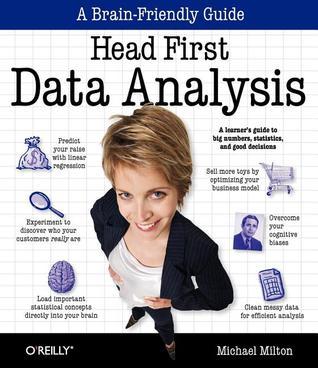
Head First Data Analysis: A learner's guide to big numbers, statistics, and good decisions
Today, interpreting data is a critical decision-making factor for businesses and organizations. If your job requires you to manage and analyze all kinds of data, turn to Head First Data Analysis , where you'll quickly learn how to collect and organize data, sort the distractions from the truth, find meaningful patterns, draw conclusions, predict the future, and present your findings to others.
Whether you're a product developer researching the market viability of a new product or service, a marketing manager gauging or predicting the effectiveness of a campaign, a salesperson who needs data to support product presentations, or a lone entrepreneur responsible for all of these data-intensive functions and more, the unique approach in Head First Data Analysis is by far the most efficient way to learn what you need to know to convert raw data into a vital business tool.
You'll learn how to: Using the latest research in cognitive science and learning theory to craft a multi-sensory learning experience, Head First Data Analysis uses a visually rich format designed for the way your brain works, not a text-heavy approach that puts you to sleep.
Whether you're a product developer researching the market viability of a new product or service, a marketing manager gauging or predicting the effectiveness of a campaign, a salesperson who needs data to support product presentations, or a lone entrepreneur responsible for all of these data-intensive functions and more, the unique approach in Head First Data Analysis is by far the most efficient way to learn what you need to know to convert raw data into a vital business tool.
You'll learn how to: Using the latest research in cognitive science and learning theory to craft a multi-sensory learning experience, Head First Data Analysis uses a visually rich format designed for the way your brain works, not a text-heavy approach that puts you to sleep.
483 pages, Paperback
First published January 1, 2009
Ratings & Reviews
Friends & Following
Create a free account to discover what your friends think of this book!
Community Reviews
Displaying 1 - 30 of 39 reviews

September 27, 2020
O livro é bem didático, os exercícios são bons, e leitura fácil. Mas o que me impede de dar cinco estrelas é a insistência de ficar na superfície dos assuntos sem se aprofundar à um nível que seja natural o entendimento do desenvolvimento dos artifícios estatísticos.

October 3, 2011
I wish I had this book during my MBA.
Rather then another praise for this great Head First book, some really good topics in this book:
Chapter 2: TEST YOUR THEORIES
How to use the method of comparison and make them explicit.
Chapter 5: HYPOTHESIS TESTING
Falsification vs. satisficing. Falsification as the heart of hypothesis testing.
Chapter 6: BAYESIAN STATISTICS
Ah, the problem with the first base: I've never seen a better explanation of the Bayes' rule.
Chapter 7: SUBJECTIVE PROBABILITIES
The subject of incecting some rigor in our hunches. A very difficult topic well explained.
I wish we had during the MBA spent less time on statistics and focused more on real life business issues. Time well spent on data analysis, big numbers, good decisions etc.
Rather then another praise for this great Head First book, some really good topics in this book:
Chapter 2: TEST YOUR THEORIES
How to use the method of comparison and make them explicit.
Chapter 5: HYPOTHESIS TESTING
Falsification vs. satisficing. Falsification as the heart of hypothesis testing.
Chapter 6: BAYESIAN STATISTICS
Ah, the problem with the first base: I've never seen a better explanation of the Bayes' rule.
Chapter 7: SUBJECTIVE PROBABILITIES
The subject of incecting some rigor in our hunches. A very difficult topic well explained.
I wish we had during the MBA spent less time on statistics and focused more on real life business issues. Time well spent on data analysis, big numbers, good decisions etc.

Read
May 23, 2011A while ago, I read an article that said statistician is the hottest growing field, so I picked up this book.
And I don't remember even one thing from this book, other than it used a mix of Excel and R to get the job done. The lack of memory says more about me than about the book. I'll have to pick it up again and re-read it. This is just a placeholder.
And I don't remember even one thing from this book, other than it used a mix of Excel and R to get the job done. The lack of memory says more about me than about the book. I'll have to pick it up again and re-read it. This is just a placeholder.
November 9, 2020
I’ve spent a long time working my way through this, reading a little bit at lunch time when things are quiet. It is a good book for that kind of slow reading, as it provides useful information in discrete chunks, and builds on previous sections at a good pace. It assumes a novice understanding of the topics, but is very readable for someone reasonably familiar with the topics (I would count myself as such on at least some of the topics).
This is not aiming to be a be all and end all educational tool, but a stepping stone/taster of the kinds of questions and analysis approaches that are useful. I would recommend it as a good option for a teenager wondering if this is the field for them, as well as anyone wanting to broaden their understanding of what data analysis is. I would not recommend it for experts, except as a pleasant read or in consideration for using some/all of the text as a teaching aid.
This is not aiming to be a be all and end all educational tool, but a stepping stone/taster of the kinds of questions and analysis approaches that are useful. I would recommend it as a good option for a teenager wondering if this is the field for them, as well as anyone wanting to broaden their understanding of what data analysis is. I would not recommend it for experts, except as a pleasant read or in consideration for using some/all of the text as a teaching aid.

January 2, 2012
Decent book. Some typos, but not unrecoverable to get at what is needed. Some presumption of MS Excel knowledge. A bit dated, since MS forces you to use the StatPlus package, no longer offering the Data Analysis add-on. It will definitely be a jump-off point to diving into more Stats and Analysis work. R seems powerful and the one great example at the end of the book showed me some great hotness graphically. It is a good workout.

July 8, 2010
A good introduction, but... a mile wide and an inch deep.

June 22, 2019
A good introductory book for data analysis, useful to anyone working with data, follows surveys or different trends (e.g. stock exchange or currency). It helps understand why surveys are done in a certain way, how experiments are carried out, at least the idea behind it and things to lookout for in order to avoid a erroneous conclusions (very important!).
On the other hand I would have loved to hear more about heuristics, they are presented briefly, not a lot of examples and not used a lot. Knowing heuristics and when to apply them can really make a difference. I generally think of them as clever tricks, having a specific context where some specific techniques can be applied where otherwise they would not work. They are derivatives of rules in certain conditions that can help solve or simplify a complex problem.
What I liked at the beginning of the book was the smart "twist" at the end. You follow what you think is right and makes sense, but at the end you are presented with a small, yet important detail that you overlooked. This was done great in the first chapters, but it slowly degraded as the book progresses. Sometimes it felt rushed and sometimes the detail was obviously ignored just to have the twist at the end.
All in all I liked the book, it's a good place to find out a few things about data analysis before embarking on this journey. Some of the things can be applied right away to some extent (e.g.: experiments, data visualisations) where others require more advanced books to properly understand and use (e.g.: regressions, big data).
On the other hand I would have loved to hear more about heuristics, they are presented briefly, not a lot of examples and not used a lot. Knowing heuristics and when to apply them can really make a difference. I generally think of them as clever tricks, having a specific context where some specific techniques can be applied where otherwise they would not work. They are derivatives of rules in certain conditions that can help solve or simplify a complex problem.
What I liked at the beginning of the book was the smart "twist" at the end. You follow what you think is right and makes sense, but at the end you are presented with a small, yet important detail that you overlooked. This was done great in the first chapters, but it slowly degraded as the book progresses. Sometimes it felt rushed and sometimes the detail was obviously ignored just to have the twist at the end.
All in all I liked the book, it's a good place to find out a few things about data analysis before embarking on this journey. Some of the things can be applied right away to some extent (e.g.: experiments, data visualisations) where others require more advanced books to properly understand and use (e.g.: regressions, big data).
June 30, 2022
I give this book 50 stars out of 5. It is the most practical head start on topics such as Data Analysis, data science, data visualization, Statistics, R, scientific studies, Bayesian thinking, business decisions, spreadsheets, SQL relational databases, functions and programming, and Regular Expressions. This book is packed with a TON of practical skills. The book stops just short of teaching you Python. It should be mandatory reading for every student or entrepreneur. I cannot recommend it enough.
June 15, 2019
A good introduction into data analysis. Most of the mathematical materials span middle and high school math. I found the reading fairly easy and it was good refresher in statistics. I would recommend this book only for people interested in a simple introduction on data science. The reading is entertaining but lacks depth across statistics and programming topics.

December 4, 2017
A basic but good primer on data analysis, good for getting started.
I like the tips pages and "there are no stupid questions".
If you're looking for something more technical and specific, this book won't cover much, use it more like Wikipedia - as a starting point.
I like the tips pages and "there are no stupid questions".
If you're looking for something more technical and specific, this book won't cover much, use it more like Wikipedia - as a starting point.

January 10, 2018
Good basic overview of analytical techniques with excel and R. I would recommend this to someone who hasn't reviewed statistics in a while or is just looking for a start in regression analysis and a couple other techniques.

May 18, 2018
Great review and fun read. I'm an experienced marketer and analyst but this helped reintroduce ideas and deepen understanding. Therefore, I think it's useful for multiple experience levels, but would especially be awesome for a beginner

June 19, 2022
If you are starting to dabble in data analytics, this book should be a good start to give you a taste. Also, if I were given another chance, I would go for Python rather than R. Python is clearer and more versatile than R.
October 7, 2017
Great writing and thinking with very shallow knowledge. For Newbies Only.
November 18, 2017
This is pretty basic but it is good for basic concepts of what doing data science is about.
April 1, 2020
Fairly ok. It just gives a basic introduction to data analysis and giving heads up on things for consideration. It lacks forward guidance.

May 4, 2021
Illustrated guide to statistics. Nicely written and very intuitive, easy to follow and very helpful with those counter-intuitive stats concepts everyone is scared of :)

August 6, 2021
Great book !
Explanation of data analysis concepts in clear & simple language.
Explanation of data analysis concepts in clear & simple language.
This entire review has been hidden because of spoilers.
April 11, 2022
内容好浅...不过也有一些些收获吧。两天看完。
March 18, 2018
Pretty shallow with a lot of unnecessary back stories that just wastes your time. The whole book can be summarized in 3 pages tops!

February 25, 2016
[Not read, just skimmed.]
I skimmed this as a statistician looking for ideas on how to teach Stats 101. This is not purely stats---maybe more like Data Science, since it also includes (very useful) things like optimization and databases.
It seems to cover the most important stats concepts without going deep into details of p-values and such.
I'm not sure about the silly pictures and word bubbles or contrived examples, but I *love* that designing experiments is already in the 2nd chapter, after a 1st chapter on framing the problem and examining your (client's) assumptions. I know we're all supposed to love being awash in Big Data, but to answer a concrete question, you still can't beat a good designed experiment (Bespoke Data?).
I'll come back and read this more thoroughly next time I'm designing an intro course.
I skimmed this as a statistician looking for ideas on how to teach Stats 101. This is not purely stats---maybe more like Data Science, since it also includes (very useful) things like optimization and databases.
It seems to cover the most important stats concepts without going deep into details of p-values and such.
I'm not sure about the silly pictures and word bubbles or contrived examples, but I *love* that designing experiments is already in the 2nd chapter, after a 1st chapter on framing the problem and examining your (client's) assumptions. I know we're all supposed to love being awash in Big Data, but to answer a concrete question, you still can't beat a good designed experiment (Bespoke Data?).
I'll come back and read this more thoroughly next time I'm designing an intro course.

February 17, 2014
Do not get fooled about the star I had given to it. This is not a bad book, it is just matter of quality it pursues. This is quite good book with regards to its aim - newbies who would like to understand what happens in data analysis, and eventually forget it after reading. Because the book is more than glorified version of help documents, and less than a academic, hard to read books as it used to be. I mean the book is not recommendable to whom seriously want to study it, with statistical basis.

November 18, 2013
Very slow, very dumbed down.
The case approach is good, but they can give it a better pace. Gave this up twice out of sheer boredom, but finally completed.
Also, had many obvious errors.
Some parts might useful for an ABSOLUTE beginner to Data Analysis.
A lot of advanced topics were mentioned which were not dealt in-depth.
My only takeaway - it got me started with R.
The case approach is good, but they can give it a better pace. Gave this up twice out of sheer boredom, but finally completed.
Also, had many obvious errors.
Some parts might useful for an ABSOLUTE beginner to Data Analysis.
A lot of advanced topics were mentioned which were not dealt in-depth.
My only takeaway - it got me started with R.

September 1, 2010
Gute Einfuehrung in die Datenanalyse im gewohnten "heads first" format (Gehirnfreundlich und unserioes :)). Auf Verstaendnis einiger grundlegender Konzepte (e.g. Regression, Bayes) und minimale Einfuehrung in einige Tools (R, Datenbanken) ausgerichtet. Netter Ueberblick, natuerlich nicht allzuviel Tiefe.

November 11, 2012
Much more simplistic than I was expecting, as it merely grazes a few basic concepts. I was hoping for more content on statistics and using the R software, but I'll have to seek that elsewhere. Nevertheless, the Head First series of books are easy to read (and occasionally mildly amusing too), so this was a breeze.
April 24, 2010
Super basic, so I didn't really learn anything *new*, but I guess I got a better idea of what analysts are actually supposed to do.
I also liked the idea of the presentation, though a lot of it looks kinda tacky.
I also liked the idea of the presentation, though a lot of it looks kinda tacky.

January 17, 2013
Very basic stuff, but a really good starting point for people wanting to learn about data analysis in general. Accessible, but still deals with a host of important issues in a good way. You don't come by that often in this particular domain of knowledge.

March 16, 2015
This book covers a wide range of topics with a good balance of depth and non-academic scenarios. It will not make the reader a mathematician but it will certainly introduce them to a variety of data analysis tools.

July 1, 2016
Started reading this when I joined Institute for Child Health Research. It's not overly technical, but it keeps you focused on the basics - ask the right questions and use lots it pictures.
Excellent training wheels.
Excellent training wheels.
May 18, 2010
Not a bad introduction to data analysis, a little on the basic side, not sure how much will translate to actual work.
Displaying 1 - 30 of 39 reviews