THE INVASION OF THE HALLUCINOGENIC PEOPLE FROM UNDEREARTH!
They had existed from time immemorial, hidden in a space warp far beneath the surface of the earth. Until now, their only form of nourishment had been a strange hallucinogenic grain. Now, they hungered for human flesh. The earth was to be their stockyards and mankind their meat...
Margaret St. Clair (February 17, 1911 Huchinson, Kansas - November 22, 1995 Santa Rosa, CA) was an American science fiction writer, who also wrote under the pseudonyms Idris Seabright and Wilton Hazzard.
Born as Margaret Neeley, she married Eric St. Clair in 1932, whom she met while attending the University of California, Berkeley. In 1934 she graduated with a Master of Arts in Greek classics. She started writing science fiction with the short story "Rocket to Limbo" in 1946. Her most creative period was during the 1950s, when she wrote such acclaimed stories as "The Man Who Sold Rope to the Gnoles" (1951), "Brightness Falls from the Air" (1951), "An Egg a Month from All Over" (1952), and "Horrer Howce" (1956). She largely stopped writing short stories after 1960. The Best of Margaret St. Clair (1985) is a representative sampler of her short fiction.
Apart from more than 100 short stories, St. Clair also wrote nine novels. Of interest beyond science fiction is her 1963 novel Sign of the Labrys, for its early use of Wicca elements in fiction.
Her interests included witchcraft, nudism, and feminism. She and her husband decided to remain childless.
Margaret Sinclair turned to writing books in the 1960's. I don't know why her short story output declines after 1960, but I think it may have had to do with monetary reasons. Science Fiction and Fantasy became big sellers in the Age of Aquarius. Authors are often forced to write to pay the bills. Although the genesis of this novel may have been in the back of her mind for years, the second part seems to have been created for the specific era it was written. The Shadow People is very much a product of it's time (1969), but it has influences which go back to the early part of the last century and beyond. As if Arthur Machen had wandered into the Fillmore Ballroom. Gary Gygax, one of the creators of the Dungeons and Dragons game, lists it as an influence. St. Clair quotes selectively from Robert Kirk's 17th century tract on faeries, The Secret Commonwealth. I suspect she used Commonwealth as a guide while writing this novel. But enough with my speculations. Dame St. Clair is no longer with us, so she can't clear-up all my wondering about her motivations. The Shadow People begins with the Summer of Love in California, although no specific years are given. The narrator, Dick Aldridge, works for a "hip" newspaper in the Berkley area. His girlfriend Carol is an up-and-coming photographer. Although they are deeply in love, one night Carol storms out of Dick's apartment after an argument. She's gone for several days and Dick decides to check out her basement flat. He finds evidence of a struggle, and decides to go to the police. After the police shuffle him off, Dick takes a bus out to Monterrey to see if she's staying with an older couple they both know (perhaps a stand in for the author and her husband?). Dick finds the isolated house vacant with no sign of Carol or the older couple, but plenty of uncollected mail in the box. And on the way back he runs into a fringe character known as Carl Hood, who mentions Carol may have left "the skin of the world." Still searching for Carol, he later encounters, Fay, the maid at his room in the Shasta Hotel. She also mentions that Carol may have "left the skin of the world." Now Dick has to know what this all means and begs Fay to tell him. She doesn't tell him much about who abducted Carol, but does show him the path to an underground world where his girl friend may have been taken. And so begins the crux of the book. Dick, taking food with him (Fay has warned him against eating or drinking anything in the underworld), makes the perilous journey underground from an isolated cellar to vast caverns, until he crosses a subterranean river into the world of the "silent people". Along the way he picks up an enchanted sword (which appears to be a Wiccan ceremonial sword from the description) which pulses when it senses danger. And there is plenty of danger in this underworld. The underworld is populated by elves, who a distantly related to humans. They come in several varieties- gray, black, green, and white. All are dangerous, but more to each other than to the humans on the surface. On occasion, they make foraging trips to the "bright world"(surface) and steal whatever they need. They feed primarily on atter-corn, a bitter meal made with psychoactive fungus, which produces hallucinogenic effects. But they also feed on human flesh when they can get it. Dick is attacked by them several times, but they seem to be incapable of much group action, since any blood spilled during a confrontation drives them into attacking each other. I don't want to spoil too much of the plot, but Dick does eventually make it back to the surface. He finds three years have passed (time passage being different in the underworld), the Summer of Love squashed, and the forces of reaction in control. The novel shifts gears at this point, turning into another "winter of our discontent" book. This is what leads me to believe the first section was mostly written years before the second, with the latter written to make the narrative more "relevant" to the current target audience. And it's the above-ground final section of the book where it runs out of gas. There's some kind of nascent fascist state in formation, but we never get much of a picture of it. People are required to wear ID tags, but you never find out how this came about in the three years Dick was underground, other than a brief mention of law-and-order politicians. There's rioting in the street and some mentions of government conspiracies. The book even mentions the CIA may want the atter-corn for chemical warfare, but this reads as an afterthought, instead of a crucial plot device. Finally, three years have allowed robotic devices to be created which can police the population and run bulldozers. There's a few pages where Dick discovers how the hills around Berkley where removed accidentally on purpose and used to fill in the San Francisco Bay. This came about in three years? I know people believed anything was possible in the 60's (the US did put a man on the moon), but such a time scale is pushing the willing suspension of disbelief. What really frustrated me were the characters of Carl Hood and Fay. Carl turns out to be some sinister figure with connections above and below ground. But you never really find out who or what he's working with or toward. Fay has more information about the underworld than she lets on, but her role in the novel is never fully resolved. There's defiantly a relation between both characters, but we don't find out what it is till the end of the book. And we never find out how said relationship figures into the big picture. In conclusion, The Shadow People is a good book, but could've been a great one. We may never know why a writer of Margaret St. Clair's caliber left so many loose ends in the novel. But she did create a horrifying vision of the underworld which influenced many writers.
I had associated this book as drawing from or referencing the Shaver Mystery mythos, a statement that on reflection is exaggerated at best. There are similarities: evil subhumans living in the secret places under the earth, the implications of their growing influence in the outer world, the unveiling of the secret knowledge to the everyday characters, and a sort of dreamlike paranoia and sense of persecution. But this work seems more drawn from Celtic or Northern European mythology, of the traditional view of elves in an evil gremlin sense combined with the mythological aspects of a visit to the underworld, with all the travails and conditions for entry and departure.
At least for the book's first half. It's not clear what St. Clair had in mind for the remainder. Dick Aldridge emerges from Underearth some years later to find a world unpleasantly changed and bearing some of the miasma and despair that pervades the subsurface. While it is suggested that the influence of Underearth is somehow responsible, and there are indications of machinations of at least one green elf, St. Clair fails to make the connection explicit and meaningful, and to expand upon the themes of the first half. Instead, it loses its way and delivers an unsatisfyingly abrupt ending.
Honestly, an injection of Shaver Mystery would have done the story some good. Are the green elves manipulating society to make the outer world more like their homeland? Is Dick seeing the world through eyes poisoned by Underearth, or perhaps by mental illness? Can we as reader really trust his narration?
Very definitely a creature of 1969 Berkeley CA written by one of the elder stateswomen of SF writing at the time, this is a tightly written urban horror fantasy novel. Kind of a cross between the films “Labyrinth”, “The Descent”, and “Strange Days” - although it preceded all three. There are other reviews that go into great length about how the book’s tonal shift deaden it’s pace and take away from it. If you think of it as “William S Burroughs’ ORPHEUS AND EURODYCE” you’ll be much closer to its core.
* Ad copy lie: "THE INVASION OF THE HALLUCINOGENIC PEOPLE FROM UNDEREARTH! They had existed from time immemorial, hidden in a space warp far beneath the surface of the earth. Until now, their only form of nourishment had been a strange hallucinogenic grain. Now, they hungered for human flesh. The earth was to be their stockyards and mankind their meat..." Of this, the entire back-cover copy, only the second sentence is not a lie, either outright or by implication. The front cover says, "They came from the Underearth to take over the world." This, too, is a lie by implication. The fact is, this isn't a story about "invasion"--unless a story about a serial killer is a story about war.
* What it is, in all probability, is one of the strangest stories you will ever read. It's about the search for protection, safety, and security in a world out of control. Two worlds, actually, each representing a side in St. Clair's perception of the world (or the U.S.) in 1969: the hippies (where else?) underground and the Man (oppressive government) on the surface. Others have said that the story falters in the second half, the half spent above ground. Certainly it does if all St. Clair is interested in is the strangeness of Underearth and the creatures who populate it. But she's after something else, something more. And to her credit, she goes for it, blasting both sides with equal venom.
* I mention this only because I think it's worthwhile to stick with the book to the end, and because it's easy not to. What sells the book to the genre fan (and this story contains elements of fantasy, horror, the occult, and even science fiction) is Underearth. Fortunately, this, all by itself, makes the book worthwhile. Yes, it's that weird. But if that's all you're in for, then you'll be left unsatisfied. (Although, in a shadowy, dystopian sort of way, the first half is really a story unto itself, about a guy who's life suddenly spins out of control, gets worse before it gets better, then ultimately spins out of control again.)
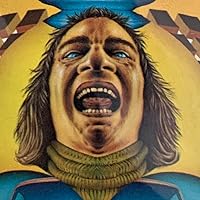
* Art lie: The cover art has nothing whatsoever to do with the story. Yes, a sword figures in the plot and, yes, it is called "Merlin's sword." But any resemblance to the kind of sword and sorcery conjured up by the artwork is just that superficial. Clearly, given the fact that almost nothing on the covers of this book is true, the publishers (Dell) had little faith in it selling on its own merits. Make of that what you will, but I think it's a shame. For those who enjoy dark fantasy and the occult, I think reading "The Shadow People" is time well spent.
Weird fiction, indeed. Published in 1969, this novel from Margaret St. Clair, one of the few well-known female SF writers from the last century, concerns a race of 'dark elves' who live in a sprawling subterranean world of caverns, tunnels and waterfalls called Underearth. They occasionally visit the surface to steal things and kidnap people and the narrative begins with one such kidnapping. I enjoyed the writing quite a bit, but my appreciation at not knowing exactly where the tale would go next was also the biggest weakness; at times, it came across as disjointed and meandering. Still, I was never bored with this very odd, somewhat dated story. 3.5 stars.
I only have one way of describing this book: Weird... in a good way!
And it starts somewhere and takes you somewhere else completely. So I won't dive into any of the details as spoilers would ruin this book.
I read it because it's part of Gary Gygax's famous Appendix N from Dungeons & Dragons. I can easily see why it's there because it starts with a good ol' fashion dungeon delve! The thing that's cool is that for once, it's not in a fantastic medieval setting. It takes plate in the Berkeley area of California in the late 60's. So please use it as an inspiration for your next D&D Session. ;)
Just so you know, it has the old school pulp style where things move along at a decent pace and suddenly speed up in the last few pages. This used to annoy me but now I'm used to it.
If you like D&D and want inspiration, it's a great read. Other than that... it's just entertaining. But that's an important quality.
Weird story about hippies, elves, an underworld and a distopian society. I've not read any of Margaret St. Clair's stories before so I didn't really know what to expect going in to this novel. It was written in 1969 and parts of it were good, while other parts seemed to slip and go nowhere. It's more of a 2.5 star read, and of interest to fans of fantasy books from the 60s and 70s.
Reads like a half baked (pun intended) creative writing project that follows no internal logic or has any consistency. Clearly inspired by drug use about drug use and…..elves. This may sound cool. It’s not. So many single line allusions that are never explained. Characters actions are illogical and not believable. I kept having to justify the authors writing decisions “because they were on drugs” for it to make sense at all. Read for its inclusion on the “Appendix N” reading list and if it weren’t for that small footnote securing its place in history, I think this book would have been forgotten by now. A throwaway of its time. An interesting read for its bizarreness, but frustrating and ultimately unsatisfying.
It started out kinda fun I thought. Then, so many plot holes you might confuse this with swiss cheese. l only finished it because I was hoping that it would get better at some point. Sadly it never did.
I managed to track down a used copy of this book, mentioned in Gygax's (in)famous "Appendix N" of inspirational reading. I an eminently readable prose style, and a story that easily kept my attention and interest. I find many of the elements that were influential in the creation of D&D and other early fantasy RPGs . . . elements of fantasy (even though it is set in a modern-ish/near-future world (for 1969): an underground world encompassing the entire world (a proto-Underdark, called the Underearth), a race much like the drow (even called "elves" in some cases, and their pets "orcs" and "ettins"), the detailed descriptions of their underground existence (including the addictive atter-corn that provides a hallucinogenic foodstuff, and the source of the "don't eat anything in the faerie-world superstition), etc. I was reminded of modules like B4 "The Lost City" (with its underground world inhabited by hallucinating Cynideceans) and D1-2 "Descent into the Depths of the Earth" . . . great stuff!
Decent read: can't remember if this is Appendix N but it's related and pertinent. Well crafted, I suppose, in a way that is unsettling. Pretty short.
There is a jarring transposition from late 60's hippie culture to fantasy underworld to gonzo robot police state which some have suggested is a mental health trope but I don't see it. Maybe a metaphor for addiction and the rise of computer-controlled fascism may be more apt - YMMV of course. I liked it because it hints at much deeper things but doesn't really pause (except for one part right near the end) to give any serious explanation. The tidied ends actually detract from the story some, to my mind.
The character of Carol is grating, but I suppose maybe as a symbolic maiden or something she fits the bill. Worth a read if you have a spare couple of hours.
This entire review has been hidden because of spoilers.
While the premise is insane - I found the writing more dated than I would have liked. There were certainly moments and I enjoyed the "spin" on elves here, ultimately, St. Clair's present moment weighs this pulp adventure down.
This is a very strange book. On one level, it’s as if St. Clair had recently read Joseph Campbell and wanted to hit all the markers of a journey underground. On the other—the real story happens when the characters return aboveground. In a sense, this is a book about what normally happens after the story is done. The hero has saved the girl, and now what?
The book starts in bog-typical late-sixties Berkeley, just as Haight-Ashbury is obviously metamorphosing into a tourist trap for the counter-culture. It ends in a dystopian future where food is scarce and there are robots everywhere checking everyone’s id card to counter riots and the black market.
The underground story echoes many famous myths, ancient and modern: Orpheus attempting to retrieve Eurydice; Persephone unable to return home because she’s eaten food underground; the shadow-walking of Zelazny’s Amber; even the cannibalism of Wells’s The Time Machine with the subterranean Elves standing in for Morlocks, and humans taking the part of Eloi—a very interesting bit of futurism in the late sixties.
The aboveground story is far less amenable to fantasy heroics. Fay’s longing for the underground makes sense, because as dismal as the underground is, a person can make a difference there far more easily than they can make a difference aboveground. Dick made many choices belowground. When he chose to leave, it was because there was someone aboveground he wanted to return to.
When he’s aboveground, he plans little more than an escape from what he’s found. And his biggest complaint is how difficult it is to save anyone (especially Carol) here.
There’s a neat scene shortly after Dick returns above ground and then finally obtains an identification card that frees him to be seen in public again. His great first act? Emptying the garbage. He’s had to let Fay empty the garbage on the off chance that a robot might see him and request his identification card. It’s significant, I suspect, that he then forgets to do it until later.
Where the book fails, it is because it fails to live up to its potential. It has all these amazing kernels (atter-corn pun intended), none of which it sprouts. Was the amazing decay of aboveground civilization related either to Dick’s long sojourn underground or his shadow-shifting between above and below? Why the extreme scarcity above ground, and where did the technological leap come from? Does the United States government have connections with the underground, and have they done something already with the soporific (and hallucinogenic) atter-corn?
Will Carol and Dick choose to merely continue escaping (to Canada, perhaps, as they dream of and as so many did in the real world in the same era) or will they do something as consequential aboveground as Dick did belowground?
None of this is dealt with, and their final receipt of luck on the last page of the book is treated as a capstone but it’s really something that will allow them to further retreat into a confined safety if they so wish. It has the appearance of a deus ex machina but a true deus ex machina usually has the effect of turning everything around. This gift does nothing of the sort.
This is a weirdly fascinating book, and partly because I have no idea what’s actually happened in it, nor what’s about to happen.
I found The Shadow People when I decided to work my way through Gary Gygax’ 1979 list of books that influenced Dungeons & Dragons (aka Appendix N).
Only three women authors were on that original list (more were added in later editions of D&D). Those three authors were Leigh Brackett, Andre Norton, and the author of The Shadow People, Margaret St. Clair.
Sadly, many publishers have forgotten about Margaret St. Clair. Fans of her work, such as novelist Ramsey Campbell, have helped her fiction re-gain the attention it deserves and have helped bring her fiction back to publication.
The Shadow People is hard to place in a simple, convenient genre -> it’s equal parts paranoid dystopia, urban dark fantasy, bare bones magical realism, sword and sorcery, psychedelic counterculture, Weird Tales, and/or Twilight Zone horror.
The novel is told in a matter-of-fact style and reminds me a bit of Philip K. Dick’s novels and of Ursula K. LeGuin’s novel, Lathe of Heaven. Where Dick and LeGuin are working with everyday characters that endure existential reality breaks, St. Clair is working with everyday characters that endure realities that weirdly seep into one another.
Case in point (spoilers ahead): elves and dwarves exist below San Francisco, but they are not exactly the elves and dwarves you might know from Tolkien, Norse mythology, Disney, Narnia, etc. These elves and dwarves are decidedly more strange. They are addicted to psychedelic corn. They are boneless and fear metal. Some cast spells with drums and can “evict” humans from their own bodies. Some can also cross over to human reality.
If you like authors that create wobbly realities and expose the loose veils between those realities, then this one might be for you. If you want safe, genre-conforming fiction, you might want to pass on this one.
NOTE: It’s an older book (published in 1969) and was a little challenging to hunt down a physical copy.
This entire review has been hidden because of spoilers.
I had high hopes for this 1969 book (some interesting reviews, and I've read a little St. Clair) but it fell very, very flat. It starts well when dark elves (who are actually devolved humans living in a vast network of tunnels) kidnap the protagonist's lover from her hip apartment in Berkeley, but St. Clair's underworld is ultimately boring — endless wandering, more mindless brutes to smash, and having the protag suffer alternating hallucinogenic highs from faerie food followed by withdrawal doesn't help stuff. And when the elves follow the protagonist back to the surface, they seem much more supernatural and magical, which doesn't fit at all. A lot of interesting ideas, but none of them work.
This is a weird lost gem. Perfectly invisible prose moves an increasingly odd story forward. It’s partly the tale of the rise of a police state, and it mirrors 2020 in too many details. But it’s also a story, maybe metaphorical, but seemingly unrelated to the dystopia, of a lost underworld. Kind of reminiscent in that part of the recent film Us, but much more smartly presented. Like, none of the underworlders stop the narrative for long and certain expository dialogue. There are just hints and guesses and possible misinformation and somehow it all seems more believable than Us. I dunno, just a quick read with inventiveness and a plot and characters they pull you towards the end.
A lovely piece of modern fantasy that is the primary source material for D&D's Underearth/Underdark. While you can see the roots of the Drow and the world in which they live in the text, this novel makes them infinitely creepier than they ever were in the games.
If there's a ding against this novel, it's in the ending. The story comes to a local maxima, but its clear that there is more to do and this is a step along the path. I doubt that St. Clair ever intended it to be part of a series, but it feels like it was setting up for a sequel that doesn't exist.
I liked this one more than St. Clair's Sign of the Labrys. It's a smaller tale and it's influence on D&D is clear - the Underdark is hugely inspired by this book. It's even got a gray dwarf. The hippie-folklore weirdness just works for me. The final act comes a bit out of nowhere, but other than that, an enjoyable read; it's a shame that it's so hard to find.
Cannibal elves, half elves, grey dwarves, Merlin’s sword, hallucinogenic fungus, a Pholdickian dystopia, a massive series of caves underneath the Bay Area of California, Fresno, magic, and failed romances collide in this kaleidoscopic and highly entertaining novel. The most inventive and wildly imaginative work on the Appendix N.
The primary "fantasy" plot is silly, uninteresting, and without focus. That story line ends a little after the half way point luckily, and the novel morphs into a rare depiction of an authoritarian state that is one of the most believable transformations of our current system and culture that I have read in fiction.
It’s a shame that this book is both hard to find and also, judging by its cover, appears to be generic sword and planet. It deserves to find an audience and it’s also not nearly as formulaic as it looks; it very strangely reminded me of the movie Troll 2, a notoriously “bad” 80’s horror movie, but it’s really very good and St. Clair is a very interesting writer.