Jump to ratings and reviews
Rate this book

Wall

Rate this book
“ Every new novel by Jen Craig is cause for celebration. They are a reminder that literature is still being written in the English language. In Wall, her brilliant third novel, Jen Craig deepens her proliferative style of self-examination as her narrator tries to contend with that most heart wrenching of how to dispose of your parents’ belongings after they die?” MAURO JAVIER CÁ RDENAS, Aphasia A woman returns to Australia to clear out her father’ s house, with an eye to transforming the contents into an art installation in the tradition of the revered Chinese artist Song Dong. What she hasn’ t reckoned with is the tangle of jealousies, resentments, and familial complications that she had thought, in leaving the country, she had put behind her— a tangle that ensnares her before she arrives.

181 pages, Paperback

Published April 11, 2023

12 people are currently reading
489 people want to read

About the author

Jen Craig

4 books35 followers
Jen Craig is the author of the novels Since the Accident and Panthers and the Museum of Fire, which was longlisted for the 2016 Stella Prize in Australia and is now published by Zerogram Press in the USA (2020). Her short stories have appeared in literary journals on both sides of the Pacific, and her libretto for Michael Schneider’s chamber opera A Dictionary of Maladies was performed in Lenzburg, Switzerland. Jen holds a doctorate on transgenerational trauma, anorexia and the gothic from Western Sydney University, and is currently living on Darug and Gundungurra lands.

(Source: https://sydneyreviewofbooks.com/write...)

Ratings & Reviews

What do you think?
Rate this book

Friends & Following

Create a free account to discover what your friends think of this book!

Community Reviews

5 stars
21 (26%)
4 stars
22 (28%)
3 stars
16 (20%)
2 stars
11 (14%)
1 star
8 (10%)
Displaying 1 - 24 of 24 reviews
Profile Image for Paul Fulcher.
Author 2 books1,959 followers
July 2, 2024
Shortlisted for the Miles Franklin Award

He had already triumphed - this Song Dong approach to the "problematic material accumulations of twentieth-century masculinity" (as I found myself saying eventually, so very easily and naturally) — this same sort of approach and yet with the "masculine and feminine slantings" of his project reversed of course, as I said. Yes, you need to imagine how it happened — this way that I was soon telling Nathaniel Lord that, "prior" to the construction of the Wall, I was intending to make "a very different sort of artwork". How I was even then in the midst of early preparations for "taking a Song Dong approach" to the leavings of my recently deceased father in Sydney" whose peculiar obsessions "had always been expressed in a minutely purposeful drive for perfection and detail" —in the labelling, for instance, of all of his books and magazines with the Dewey decimal system (as it came to me then). A mania for labelling.

This is Jen Craig's third novel after Since the Accident and the brilliantly titled, and even more brilliantly crafted, Panthers and the Museum of Fire

The author is part of a more or less connected network of some of the most innovative authors in English-language fiction including Mauro Javier Cardenas, Emily Hall, Shaun Prescott, Geoffrey Morrison, Simon Okotie and Mark Haber, several explicitly Thomas Bernhard influenced and others strong supporters of each others works.

One of those authors, Mauro Javier Cardenas is a particularly good source of book recommendations on Twitter where he typically subjects a book to the “first page test”. And commenting on her own affinity with, and admiration for, Bernhard Craig commented:

“He gives you the plot on the first page. Once that’s out of the way, you can write everything else, everything that can’t be described by plot.”

That's a perfect description of Craig's style here ... and the first page (plus a few lines) test for Wall gives:

I need to tell you that once I'd given up on the idea of turning the contents of my father's house into a vast and meticulous installation in the style of that famous artist Song Dong, it just took me getting the call from City Hire Skips as I was walking down the hill from the ridge where I was staying —this call that confirmed the bin would be arriving by one pm — to make it seem, suddenly — magically — as if the entire house were already clear of the junk and disintegrating remnants of more than fifty years of abject living, and that now there were no more distractions keeping me from the Wall. Nothing at all between me and this Wall I'd been planning to construct for well over a decade now, as you know — this Wall that, according to all the proposals and applications and descriptions I'd been putting in my CVs and artist's statements since 2002, intends to give "strong and substantial form to a very personal phenomenology of surviving anorexia". And so this Wall that, as you know very well, I have been doing nothing but talking and writing about. Just talking and writing. Because it seemed, then, that by going all out to do the very opposite of what my most trusted instincts were urging me to do, the Wall might be possible — this definitive Wall — since now I would be able to jettison everything that needed to be jettisoned, no matter how cruel I would feel as I did it. Hiring a skip only takes a second, I was telling myself over and over in some sort of automatic echo of what you had been trying to tell me earlier, Teun. In fact, I was feeling good, so utterly cheered by the knowledge that I had made this radical decision about my work and my life that, as I was walking back down the hill from the shops near the Airbnb with my most recent haul of sponges and liquids (and a brand new bucket and a squeegee mop), I was also noticing how easily the branched reflections of the sky were sliding over the chrome and glass and deco surfaces of the cars that were parked nose to tail along the street. And really, although it still felt dangerous to have done what I did by calling that number and booking a skip — and so setting in motion this decisive undoing of everything that has been blocking me from making this major work, the Wall of "Still Lives" — my ten-metre surviving anorexia Wall for the moment all I had, after the series of confusions that followed that meeting with Eileen in Newtown, was the farce of what you will call, no doubt when you read all this, my susceptibility to Eileen and Max and their anorexic daughter — and of course to Sonya and her supposed splattered body intervention at that public lecture by Nathaniel Lord. The farce, and also the unfortunate news about Eileen's shattered femur from the accident on the highway that I still need to tell you a bit more about, or at least to contextualise in a sort of a way. In short, everything that I haven't yet had the courage to describe to you properly.

Our narrator, also called (we deduce rather than are told) Jen Craig, is an artist originally from Australia where she studied at art school, but now living with her partner, Teun in the East End of London “in Bethnal Green above that shop you bought in the nineties on Roman Road”.

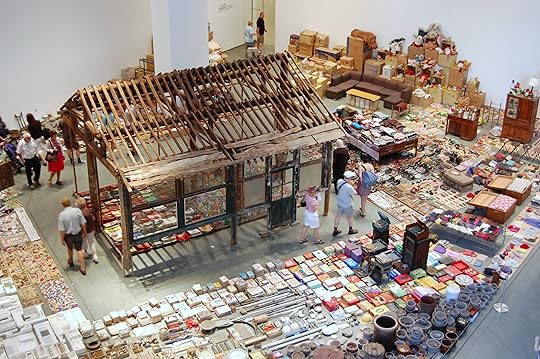
She has been working on - or rather preparing for - her major work, the Wall, for many years. But two things happen in quick succession. She receives news that her father, back in Sydney has died, and at an exhibition she encounters her former art school teacher, from decades earlier, Nathaniel Lord who expresses interest in her work. But somewhat spontaneously (although she presents this as the result of years of consideration) she suggests to him another project - to turn the accumulated possessions of her father, something of a systemic hoarder, into a piece of art in the style of Chinese artist Song Dong’s 2012 work Waste Not.

description

“An Antipodean and appropriately suburban version of Song Dong’s approach to communicative practice. This powerfully ordinarily statement of post war twentieth- and twenty-first-century anxiety”, as the enthusiastic Nathaniel Lord plays in back to her.

Her father’s house is both full of carefully categorised objects and, at the same time, accumulated years of undisposed of detritus:

The progressive accumulation, I had said — and over many, many decades — of an "extraordinary and complex system" that was only in fact dwarfed by a system - similarly immense - of "complete disorder". The one and the other — the one pitted against the other, as I said. An incredible tension between them. The one trying to overtake the other, to swallow the other with its "disturbingly encyclopaedic dimensions", its complete and utter filth and chaos. The extreme proliferation of objects, I said — this word "objects" being one of Nathaniel Lord's favourite words, as I'd even remembered from the art history tutorials I had taken with him at art school.

She flies to Australia and her father’s house in Chatswood in Sydney. The novel is told from the perspective of her thoughts on the day, some time later, that she decides that the "Chatswood Song Dong project" is simply not going to work, and instead hires a skip to dispose of his possessions.

Except this is very much not a stream of consciousness novel as what we are reading is explicitly a document written after the event by the narrator to Teun, explaining her thoughts on that day, but also various events that led to her decision, dating all the way back to a striking piece of performance art performed by her and two friends in their art college days, centred around their eating disorders. The irony of the artist using her recovery from anorexia as part of her art, given her name, is not lost on one of her former friends, given now to sarcastic comments on social media: “As Sonya had been saying all over Facebook. Doing nothing but working cynically with what my name suggests. My diet company name.

This is a more spiralling than linear account, the narrator sharing a style similar to Bernhard’s mono-maniacal characters, a trend she also shares with her father:

And how in this mode — in this dominating, mono-maniacal mode of talking and being — we would thus avoid ever having to deal with even the most recent remnants of ideas we'd left behind us — all of them old, useless and superseded, clearly. These past ideas (or things) that we ourselves had put in their apparently "temporary" places around us for a reason we never got round to discovering, since we were always so busy being "onto" something else. As if each of these remnant pieces of thought — these remnant moments (become remnant things) — were only ever waiting where they were, suspended in the air where we had last divulged them, because they were also "about to be" slotted into a system that we were still developing. Slipped so easily and logically into the one relevant, if soon-to-be-forgotten, single spot in our hoped-to-be compelling explanation that would "solve", as dad always put it, the myriad of serious problems "on our planet" that nobody else in the world had managed to solve. And hence all of this refuse, everything soon to be gathered — always about to be gathered— into the single brilliant system that we were always on the verge of explaining in full. A Wall, if you like.

A wonderful and complex novel, one to be re-read, and an author who, alongside perhaps Isabel Waidner, is one of the most interesting authors in English literature.

Some other reviews:

https://www.thevisionarycompany.net/b...

https://www.thesaturdaypaper.com.au/c...

https://meanjin.com.au/review/slow-li...

https://sydneyreviewofbooks.com/revie...
Profile Image for Nick Grammos.
277 reviews158 followers
June 21, 2023
Syncopated Rhythms of Mind

David Eagleman, the neuroscientist tells us that through experiments he has determined that we can see that time is not a linear flow. These experiments tell us that we can prove that we see time expand and contract, that the order of things come before or after, depending how we observe them or some interior thought process. Naturally, I say, writers of fiction already knew this. And perhaps someone like Marcel Proust didn’t really need proof, or at least he already had it through his own experiments in time and fiction. Which means we should read more fiction.

Jen Craig’s Wall takes us into the mind of a narrator who lives in England, derives from Australia and practices as an artist. She has returned to suburban Sydney to clear out her father’s house after his death. Her mother already deceased. Time is a largely irrelevant element inside the narrator-character’s mind. The movement of thoughts and ideas has no fixed form. Recreating this non-fixed form is a tricky matter for an author. Inside a narrator-character’s mind is an endless chain of linked thoughts and ideas, recalled events, attitudes to those events and creative processes, experiences, relationships. That last sentence in itself is a guide to how compacted the mind and the unfolding of narrated events can be. It can appear like an endless list. Lists are organising principles too, without them most of us would not get through the ephemera of our days.

Art and life meet in Wall. The experiences we all share, in this case the death of a parent, meets the organising principle of the author as it does when our narrator observes and interprets the immediate task of the clean-up of the house.And of course, the artful repurposing of the house's contents for an exhibition, planned before departure. From early on, we know she is going to manage the entire affair by ordering a series of skip bins to dispose of everything. Her father was a quirky fellow, best understood as a kind of free-thinker whose ideas formed into the kind of beliefs I’d call mad opinions and conspiracies. It’s easy to follow a train of thought and believe it’s right inside your own head if all the available limited data you use proves your thinking at any point. Such ideas exist outside linear time, freely move backwards and forwards, proving anything the organising principle wishes to prove. Such ideas go with the endless collection of materials, we call this hoarding, so the house is a mass of contradictory related bits, resources, stuff. Stuff is that term for the endless matter that flows through our consumable world if not disposed of, perhaps even as we buy and own it.

Perhaps one set of free thoughts, like the father’s, is only one step, one generation away from a work of art, there probably isn’t much difference between a mad conspiratorial fiction and a real fiction, until the concept comes together through its organising principle into an intelligent, relatable narrative. We all share family madness, loss, the need too tie it all together.

Always against ‘the competitors’ he would say who were ‘trying to steal his ideas.

Stuff, also relates to the work of Chinese conceptual artist Song Dong. His mother lived through the communist austerity of the mid-century, the family experienced poverty, privation, persecution, a come down in the world. Her attitude to this was to collect everything – bottle caps, rags, etc – stuff – until the house became a place of despairing isolation, incompatible with living. Song Dong’s response was to turn the house into art, by liberating the stuff from its recesses and displaying it to the world in a new imaginative form.

These interleavings of the stuff that was yet to be sorted. The whole of it: dust, hairs, feathers, books, papers, candles, pins, badges, sticks, leaves, and so all of the bits – all of the usual annoying bits of nothing in particular that had always scuffed around on the floor in my bedroom – wrappings from lollies, as we can call them here, and pen lids. Parts of things that could not be repaired, at least in theory. Always on the point of being sorted of course. I’m just about to sort through that stuff, mum, just leave it will you. Never forgetting the tiniest fragment of any of the matter. This confusion of one thing and another, and their intermediary substances.

Jen Craig’s narrator-character does the same thing. She has been turning her life, an anorexic life, into a conceptual art project for a long time, but the work remains unfinished, still a concept.

Not just conceptual prose, here. The rhythms, language cadence, syntax expertly guide us through a tour of an interior world. It can feel like syncopated music.

This momentously confusing place. This running down of time, of things of thoughts, of existence. This unbearably entropic existence, I was thinking as, with hands and arms now tingling from the scratches got from ripping out those splayed and vindictive plants in the driveway.

Expressly, art in language guides us through all this. As the narrator says of the matter left behind by her father, the shell of a 1980s tv for instance,

Not so much the obsession with the accumulation of objects, then, but rather with everything those objects connected to - everything they held between them and which joined them together. The remnants of my father's projects. All of his unfinished projects - his manifold theories - the haze of his ideas. Not the objects but the theories...

This new book was a tougher read than Panthers.

__________________

Postscript: Wall in the title refers to a work in progress by the artist based on her clearing of the family home after the father's death. But strangely it reminded me of John Coltrane's Wall of Sound ("sheets" not wall in fact thanks to Ian's correction) musical Jazz output during an experimental period. The narrative here might fit, it's a kind of Wall of Narrative Voice, physically on the page, there is little white space from sentence endings, dialogue, paragraphs, etc, only one break, and a part 2. The pages are justified, so it looks like a Wall of Words. Nicely tied in there with Jazz, given the rhythms of the voicing feel a little like syncopated jazz.
Profile Image for cycads and ferns.
817 reviews95 followers
February 17, 2024
The novel reads like a monologue from an unnamed narrator, an artist, addressing her partner, Teun. The artist travels from London to Sydney upon the death of her father to take possession of their family home. She finds the house in disrepair due to her late father’s hoarding. She considers incorporating the contents of the house into an art exhibition similar to Song Dong’s seminal work Waste Not. A collaboration between Song Dong and his mother, Waste Not was an art installation displaying the over 10,000 everyday items that Song Dong ‘s mother collected and refused to part with following the death of her husband. The narrator relays her interest in this new project to Nathaniel Lord, her one-time mentor at art school.
“The leavings of dad but also of mum, and the rest of us too- the entirety of our lives in this house, as well as those of all of the earlier households and people whose collections we'd made ours from the generations earlier, and so the full textured spread of what I had once got away from as quickly as I could when my anorexia failed. This fearful feeling I have always had that it is either all or nothing with me. All or nothing.”
Once inside her family home, the artist becomes overwhelmed by the sheer amount of trash and the onslaught of memories from her childhood. She decides to abandon the Waste Not project and to throw her father’s belongs away. The narrator chooses instead to go back to her previous idea, the Wall of “Still Lives”, the project she had been working on for the last decade.
Much like her father, the artist describes her own tendencies to hoard as “…my own ‘problem’ with space and clutter, as I know you like to think of the way I'm unable to stop myself filling the rooms where we live…my inability to sort, to cull, to ‘prioritise’, as you call it, even with important things.”
The narrator connects her own hoarding behavior to the lack of progress in finishing her work. The Wall, her long-term project, had been delayed due continuous additions. She describes her artistic process to Teun as “…those pieces I have been making ‘obsessively’, as you put it- those tiny figures that I ‘keep placing’ in over-wide and cluttered spatial environments….”
The hoarding of physical objects was eventually overshadowed by the obsessive way the artist held onto memories of past arguments and disappointments, a process that escalates while back in Sydney. Her thoughts repeat and continues to scrutinize the petty jealousies of old art school friends, the motives of her past advisor, the actions of family members, and even Teun’s words. Overwhelmed, the narrator rushes back home to London.
Profile Image for George.
3,262 reviews
July 6, 2024
A dense internal monologue of an unnamed narrator, an artist, possibly in her forties, (outside of pregnancy age), who arrives back in Australia to clear out her father’s house. Her father had recently died. My book copy is 181 pages but it is equivalent to a normal 320 page book as there is no dialogue, no chapters, just long compact paragraphs.

It is a memorable novel in that you are batted with the continual thought process of the narrator. She left Australia many years ago to pursue her artistic career in London. She left behind two friends, Eileen and Sonya, who she had lived with during her university art school days. As the novel progresses we learn about Eileen and Sonya and how the unnamed narrator left due in some part because of the jealousies and resentments of Eileen and Sonya to the unnamed narrator achieving some recognition for her artistic works.

I expect that many readers will be put off by the repetition, lack of good plot momentum and the unrelenting mind games that the narrator has with herself and in trying to justify her actions in Australia when communicating with her friend Tuen who she lives with in London.

I enjoy convincing internal monologues and am comfortable with the author’s writing style.

This book is shortlisted for the 2024 Miles Franklin award.
Profile Image for Robert Wechsler.
Author 9 books146 followers
March 26, 2023
Although this is a different book than Craig's Panthers and the Museum of Fire, my review of Panthers pretty much works for Wall. Primarily the content differs, which is a big difference and yet not so much what either novel is about. This novel may be more convoluted timewise, and for the most part the time sequences end rather than come to an end. But this novel is equally full of Craig’s genius in conveying what Emily Hall on the back cover calls "patterns of thought," and yet there similarly comes a point where enough is enough, fortunately right about the end. It’s really hard to write a novel like this, not easy to read it, but very rewarding for both writer and reader, I think.

If you haven't read Craig yet, and you go for fiction that is about thought rather than plot, you should give her a try.

P.S. Please, please, publishers, use more leading in your books (and, although not a problem here, a bit larger type), especially if you're not going to offer your titles in e-book formats. Not everyone is under 40. It's hard on us to read a book like this. Think of us older people as disabled and design your books to be inclusive of our needs. Thank you.
Profile Image for Kim.
1,125 reviews100 followers
September 4, 2024
An immersive novel, cleverly written in a block format, a wall of text, replicating the solidity of the subject matter a Wall of a hoard, an abandoned art project and wall of mental health issues some scaled over better than others.
The stream of consciousness, is anxiety producing and alludes to the narrators own mental health issues, questions arise near the end, about her being an unreliable narrator. Then there's a fairly quick sentence that gives away what has really been troubling her and what she's been avoiding confronting- what may have impacted all her immediate family's mental health and triggered their various unhealthy coping mechanisms.
A very clever novel, one that makes you feel uncomfortable when dealing with uncomfortable subject matter.
Profile Image for Kelly.
429 reviews21 followers
September 5, 2024
The stream of consciousness style was, at times, difficult to follow, but I enjoyed aspects of the storytelling and felt curious about what the narrator was building to (turns out, not much!), which kept me going. Very reflective and not much in the way of plot. 3.5 stars
This entire review has been hidden because of spoilers.
Profile Image for Bronte Teale.
64 reviews3 followers
December 30, 2023
Don’t love to leave a negative review on a book with not many, and I did want to like this home-grown author. But reading this felt like punishment.

Constant stream of consciousness style narration with unbearable repetitiveness within single paragraphs, seemingly for effect but made me want to throw the book away (e.g. repeating a character’s full name and job every single time they’re mentioned).

The way the character of the protagonist is revealed through recounted stories about past interactions with others reminded me vaguely of Rachel Cusk’s Outline, except that Outline works. I didn’t care about this person being written to/addressed in the book, and there was not really any effort to make me care.
Profile Image for Ali.
1,815 reviews162 followers
June 20, 2024
This novel may be short, but it is a lot. At various points in the reading, I was bewildered, enthralled and frankly, broken. Then probably back to bemused. I went from thinking from this was very-clever-but-not-really-a-novel, to that it was simply brilliant, to something a little more moderated. It was, in short, intense.
This is not really because of the subject matter (which I will get to) but because of the style. Craig writes in a stream of consciousness that can go pages without paragraph breaks. Whereas this is somewhat evocative of a modernist style like Woolf, unlike her, Craig's stream does not include the intruding daily small worries, thoughts or reminders. This is unadulterated ruminating, a pile of heightened anxiety musing which endlessly (well, for 200 pages) pursues some sense of emotional understanding and resolution. If you, like me, are prone to this kind of obsessive overthinking, it might feel a little too claustrophobic to be entirely bearable. It is exactly the thinking I read books to escape.
So I wouldn't describe this as a fun read. It can also be intellectually taxing. Keeping track of all of the events and characters requires close attention as our narrator weaves through events, apparently chaotically. Names shape our impressions - one figure always gets a full name and a descriptor, indicating both the weight and the distance he has from the narrator. Another Sonya, is sometimes shortened to Son, and sometimes not, signifying a different kind of relationship. Characters' intersections have to be pieced together. This part can bring some fun - unravelling what is going on is pleasurable to read in the right hands.
The cumulative effect, though, is really something. This story unfurls through the book, which is in-world a document written by the narrator to her partner. Through her eyes, her partner is hypercritical, with her constantly trying to hedge off his criticisms of her family, friends and country. He functions not so much as a personality, as a constantly judging eye, soundlessly cajoling her into explaining, justifying and hence interrogating herself. We see her complex relationships with her friends and her deep-centered guilt over her family, the origins of which are pieced together as they are reinterrogated. There are also more recent events. It can feel like a detective novel at times, with the source of emotion as the mystery.
Aside from all this, Craig also produces a powerful and often wincing critique of the process of selling art or the right to make art. The novel's beginning dilemma is Craig's realisation that she emotionally simply cannot turn her parents' house into the artwork she has already hyped up. As the novel spirals through, we realise the push-pull of art world expectations and emotional avoidance that churns into the creation of art pieces. Our narrator cannot parse her own intentions exactly, but we see how committing the artwork is, in part, an act of both a desire to be seen as a relevant artist and a desire to avoid the emotional work of dealing with the house. Through flashbacks, we see how she and her friends alternately protected and mined their own trauma for art, the delicate and often opaque interplay between what they want and what they want to present. The format provides little space for clear-cut answers, which suits these murky waters well.
Profile Image for Jennifer (JC-S).
3,538 reviews285 followers
September 3, 2024
The weight of the past …

Here’s the blurb:

‘A woman returns to Australia to clear out her father's house, with an eye to transforming the contents into an art installation in the tradition of the revered Chinese artist Song Dong. What she hasn't reckoned with is the tangle of jealousies, resentments, and familial complications that she had thought, in leaving the country, she had put behind her - a tangle that ensnares her before she arrives.’

I feel like a voyeur, reading this first-person monologue addressed to the unnamed narrator’s partner Teun in London. The narrator, an artist who fled Australia for London years earlier, thinks (briefly) that she can deal with clearing her father’s house by transforming the contents into an art installation. Realising that this is not possible for her, she arranges for rubbish skips to be delivered. A weight is temporarily lifted, but action as well as intent is required. And this is a difficult job for the narrator: possessions evoke memories, as does the rubbish accrued during the life of her childhood family, which now needs to be cleared. The rubbish is both physical and metaphorical. As I read, I wondered whether the idea of an art installation was an attempt at objectivity, a detached look at items though their connection to her father rather than their relevance to her? Or could it be the adoption of a process the narrator is familiar with as an artist: the need to prepare for an exhibition? Speaking of which, how important is her Wall of ‘Still Lives’?

How reliable is our narrator? How objective are her views? By the time I finished the first part of this novel, I realised her objectivity no longer mattered to me. What mattered was her perception, her description of reality, the fact that she was overwhelmed by the past. I kept trying to distinguish a timeframe for elements of the story, and then laughed at myself for doing so. Why? How many of us organise our thoughts into a strict chronological order, distinguishing cause and effect without any emotional overlay? Hmm.

Part Two of the narrative sees the narrator both clearing (and cleaning) the house as well as catching up with old friends who shared her history of anorexia (despite her partner Teun advising her not to). Will the narrator regret this? I am not sure.

Is it possible to escape the past? Should we even try?

Yes, this novel has me thinking. I am leaving the narrator behind to explore my own reality.

Jennifer Cameron-Smith
Profile Image for Jay Sandover.
Author 1 book182 followers
May 17, 2023
It can be startling when your gut reaction to a reading experience is to think of another book that is not much like it. “Not much like it until you unpack what’s going on in your own mind,” it would be better to say. Several years ago, I read Nancy Milford’s 1970 biography of Zelda Fitzgerald. When I got to the end of Zelda, I felt as if I’d taken a long and exhausting hike on a steep and hazardous mountain trail. It was draining. Zelda Fitzgerald had a complicated personality. Milford’s book is a triumph of showing how Zelda thought and what things obsessed her thinking and writing. Since it was a biography, it revealed lots of details second or third or fourth hand.

Jen Craig’s third novel Wall has a first-person narrator, but the book is as studiously devoted to truth-telling as the best biography. It is dedicated to telling no false thing. Presented as a document the narrator is writing down for her partner, Teun (the narrator is in Australia while Teun is in London where they live), the telling circles around events previously told to Teun with various levels of completeness. Where past telling may have been tainted by omissions or distortions, the document (the book the reader holds in her hand), is an effort to make up for it. It has a deep, philosophical intent. The narrator is likewise concerned with attacking the confusion she feels about how others think of her, what she calls “second-hand versions of me.” This novel gives the reader one of the best depictions of thinking in fiction that I have read in a long time.

More on my site:
https://www.thevisionarycompany.net/b...
Profile Image for Daniel KML.
116 reviews31 followers
June 16, 2023
I like books where the narrator is walking while thinking about different things (Sebald, etc). There are other books in which the narrator is riding an escalator (or a bus, or a plane) and thinking about things (e.g., The Mezzanine), I also tend to like them.

But I really like books where the narrator is just sitting and thinking about things, and in this field Gerald Murnane comes to mind as one of my favorites. Bernhard could also fit into this label, even if his thinking usually takes place in armchairs and tend to sound more like rants than actually thinking.

But now, another Australian, Jen Craig, inaugurates the category of narrators who clean their houses while thinking thoroughly and hectically about all your own personal traumas, and she does that in a brilliant way. Recommended.
721 reviews5 followers
August 10, 2024
Oh. My. Goodness.
Firstly, I'm a child of hoarders, so was drawn to this book after reading a synopsis.
The writing. Oh my. The endless paragraphs, the muddled thoughts, I felt confused, not sure of what was actually happening, disconnected yet at the same time unable to 'look away'.
However, in saying that, it is how a person could feel going through the experience of downsizing a parents things. Things that were considered 'valuable' or treasured yet are the exact opposite. I understand (or think) the writing style is trying to convey that, those many feelings. My goodness, couldn't Craig have just had snippets of that thought process throughout the book rather than THE WHOLE BOOK.
Really disappointed. It seemed more about the structure trying to work too hard and the subject matter got lost in the mess (yes, pardon that pun).
Profile Image for James Whitmore.
Author 1 book7 followers
October 9, 2024

There comes a moment that all of us have to face eventually, that moment when you can no longer avoid facing up to the task at hand, the confrontation with the detritus of living that accumulates in homes, the “stuff”, “clutter”, “rubbish”, “contents”, “remains”, “leavings”, “shit” and “crap” as it is variously titled in this short novel, whether a spring clean or a move or, in this case, preparing a dead parent’s property for sale. So it is for the artist narrator of Wall, who is never named, but we know shares the name of her author because she is accused by her nemesis of making art about anorexia that is “doing nothing but cynically working with what my name suggests”. Read more on my blog.
Profile Image for Sophie Chen.
3 reviews
November 23, 2024
This was a wall of text that required a lot of perserverance to wade through. Had a stream of consciousness style narration for a non-linear recount, lots of repetition of details, and honestly I felt as mired in the spiralling mass of text as the narrator seemed to be in her head and history. I guess in so effectively transporting the reader into Craig's mental landscape this piece worked.

Also this excerpt: "None of these girls with anything but a sense of her own fierce right to exist in the world - the goodness of being girls as they were, and hence women-in-the-making. And also unlike so many of the girls we saw on the news - the ones that got crushed, got used, got stabbed, got flung, got lured, got killed."
This entire review has been hidden because of spoilers.
1 review3 followers
January 26, 2023
"In Jen Craig’s astonishing prose, language turns on itself and its users, paradoxically bringing us closer to the very things that resist description. As Wall’s artist narrator sifts and sorts through layers of inherited rubbish, provisional arguments, and unreliable artifice—trying to find the needle in the haystack as well as, at all costs, avoid it—we are so completely drawn into her language and her patterns of thought that we begin to wonder whether the gap between art and life is ever a gap at all." Emily Hall, author of The Longcut
Profile Image for Mauro.
Author 5 books200 followers
February 3, 2023
Every new novel by Jen Craig is cause for celebration. They are a reminder that literature is still being written in the English language. In Wall, her brilliant third novel, Jen Craig deepens her proliferative style of self-examination as her narrator tries to contend with that most heart wrenching of questions: how to dispose of your parents’ belongings after they die?
490 reviews4 followers
May 19, 2023
This book was very confusing. Too much language. It was difficult to figure out what the author was saying. I know her Mother and Dad had passed away in Australia. She left England to go back home to Australia to sort through their stuff. What a mess. She was an artist who was making a wall. She had problems with her siblings and friends.
Profile Image for Chanel Chapters.
2,205 reviews250 followers
Read
December 17, 2023
DNF @15pages
I grabbed this solely based on the cover. The author's writing style just was not for me - there are no chapters and just walls of text and rambling sentences.
Profile Image for Oceansized.
35 reviews
May 4, 2024
Maybe I'm not intelligent enough to appreciate this rambling, repetitive serve of self indulgence. Probably should have aborted it after 30 pages.
Profile Image for Amanda.
381 reviews3 followers
September 19, 2024
Stream of consciousness. Challenging to read but somewhat addictive.
Profile Image for Gavan.
700 reviews21 followers
July 10, 2024
Brilliant, arduous, rewarding. I love the stream-of-consciousness style. Amazing writing skills to be able to progress the story (the cleaning up of her late fathers house), while building background, while educating the reader on philosophy behind art (and the environment and other things), while building up the narrator's character. She isn't perfect; she makes mistakes; she is human. It is a difficult book to read (in a positive way!) partly because it is hard to find a point to stop and partly because you can't skip skim quickly through it. Fantastic.
27 reviews
November 13, 2024
Might be ok story but awful reading experience. Page after page of type. No break in the type. Surely could put some breaks even if not want chapters. Persevered for awhile but just not enjoyable reading. Audio may be better.
Displaying 1 - 24 of 24 reviews

Can't find what you're looking for?

Get help and learn more about the design.