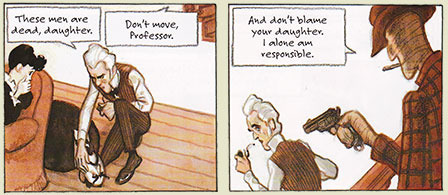
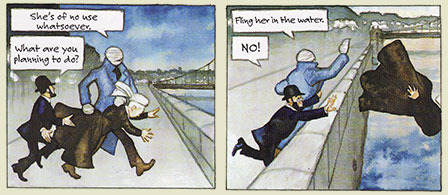
Imhotep IV is an Egyptian mummy who’s just opened his eyes for the first time in 3,000 years. Lillian Bowell is the daughter of a renowned Egyptologist. One day, when the Professor’s away, the two go out for an afternoon on the town. The heap of trouble that they land in—brought on by Mozart, afternoon tea, and a passing gentleman’s sensitive nature—only deepens when they learn Imhotep IV’s father is in town. Can Imhotep IV and Lillian stay together when both their fathers, the London Police, and even the Archeological society are desperate to drag them apart? Written by the hilarious and insightful Joann Sfar and painted in muted, sepia-toned watercolors by Emmanuel Guibert, this book is something to keep as a display piece, a thing of beauty—if you can put down the engaging story long enough for others to admire it!
Joann Sfar (born August 28, 1971 in Nice) is a French comics artist, comic book creator, and film director.
Sfar is considered one of the most important artists of the new wave of Franco-Belgian comics. Many of his comics were published by L'Association which was founded in 1990 by Jean-Christophe Menu and six other artists. He also worked together with many of the new movement's main artists, e.g. David B. and Lewis Trondheim. The Donjon series which he created with Trondheim has a cult following in many countries.
Some of his comics are inspired by his Jewish heritage as the son of Jewish parents (an Ashkenazi mother and a Sephardic father). He himself says that there is Ashkenazi humor in his Professeur Bell series (loosely based on Joseph Bell), whereas Le chat du rabbin is clearly inspired by his Sephardic side. Les olives noires is a series about a Jewish child in Israel at the time of Jesus. Like Le chat du rabbin, the series contains a lot of historical and theological information.
His main influences are Fred and André Franquin as well as Marc Chagall, Chaim Soutine, Will Eisner, Hugo Pratt and John Buscema.
From 2009 to 2010, Sfar wrote and directed 'Serge Gainsbourgh: Une Vie Heroique', a biopic of the notorious French songwriter, of whom Sfar is a self-confessed fanatic. The film, which draws substantially on Sfar's abilities as a comic book artist through its extensive use of fantasy artwork, animation and puppetry, was released in 2010 to general critical acclaim.
I didn't have a clue about this graphic novel and it was a surprise. It defies category. It is nothing you will expect which in itself is refreshing. The daughter of an Egyptian Archaeologist is dating the mummy he brought home, Imhotep 4th. There is daring, death, trials, break-in - just about anything you can think to throw in this novel has.
I enjoyed the art. I saw someone use whimsical and I think that is the perfect word for this work - whimsical. It is nothing serious and it not meant to make sense.
This is a strange and unusual story. I enjoyed it just for the sake of being surprised and unsure on every page. I've never read anything like it really. Anyone who wants a different and new kind of story should give this a go. It's in a category by itself.
Knowing that it’s about the romance between a mummy and the daughter of the man who discovered him, I expected The Professor’s Daughter to be whimsical. And it is.
What I wasn’t prepared for was for it to go beyond whimsy and into ridiculousness. That’s not a bad thing, but it caught me off guard when I thought I was reading one kind of book and it turned out I was reading another.
To be fair, there are plenty of clues that this is where Sfar and Guibert are headed. The story begins as Lillian, daughter of the renowned Professor Bowell, takes her father’s prized mummy Imhotep out as her escort for the afternoon. We get the feeling that they’ve already developed a fondness for each other, but it’s on this day that they realize they share some resentment at how the Professor treats them.
I won’t go into detail about how the date progresses because it’s too fun to witness for yourself, but let’s just say that Lillian isn’t careful enough about having Imhotep out and the afternoon ends with demands for satisfaction and the police at Lillian’s door. And then things start to really go downhill.
What we end up with is murder, more mummies (not all as nice as Imhotep), courtroom drama, voyages at sea, an assault on Buckingham Palace, jailbreaks, and Queen Victoria in the Thames. It’s all very exciting. Much more so than the quirky, little romance I was expecting.
The characters are better rounded than I imagined too. From his top hat and tails, I figured that Imhotep would be a humorously proper gentleman and that most of the jokes would be the fish-out-of-water sort. He is a fish-out-of-water, but it’s not so much played for laughs. Instead, Imhotep is justifiably resentful that he – a king in his time – is now treated like less than a slave and more like an expensive end table. There’s real pathos going on with him and we end up connecting with and rooting for him in a much deeper way than I expected.
Lillian, looking adoringly at Imhotep on the cover, isn’t as reserved or discreet as she first appears either. She’s actually got a bit of a mean streak. She’s self-absorbed and is perfectly willing to blame some of her heftier mistakes on innocent people. But she’s also the only person in Imhotep’s life who sees him as he sees himself, and vice versa. We get their attraction to each other. They’re a flawed couple, but they’re so persecuted and truly star-crossed that we cheer for them anyway.
It’s really a sweet little book, and much deeper than it first appears. Guibert’s painted illustrations reflect that sweetness too and give The Professor’s Daughter a marvelous, storybook quality that raises it above being simply a complex, adventurous romance and gives it warmth and magic as well.
I don't often review comedies for the simple reason that I have a ridiculously hard time trying to figure out what to say about them. I might be able to explore an interesting path if a comedy tries to use its sense of humour to disarm or ratify some idea or other, but apart from that I'm left with little to do but express whether I found its humour to be worth my time.
Critiquing books whose aim is little higher than simply providing the reader with a brief period of entertainment is a task I find entirely daunting. Not that there's anything wrong with point-blank entertainment. I mean, I practically adore the stuff. It's just... there's only so many times you can say "I laughed my socks off" before it all starts to sound a bit hollow. And maybe that's a good place to start.
While reading The Professor's Daughter, my clothing remained perfectly disheveled—exactly its state before I cracked its cover. No article of clothing moved in any particular direction due the influence of Sfar and Guibert's slim book. In fact, I may not have ever laughed once.
Which is not to say The Professor's Daughter wasn't either enjoyable or entertaining—it was both. This ranging tale of a mummy and his slight romance with the titular daughter of the titular professor isn't probably meant to be a generator of guffaws. Or even chortles, snickers, giggles, or smirks. It's more just an amusing kind of absurdity. One may be permitted to smile occasionally while reading, but shouldn't probably expect anything more exaggerated than an inner feeling of goodwill and something on the less expensive side of cheer.
When I describe The Professor's Daughter as absurd, I don't mean that in any deeply fractured fashion. Imhotep IV, the mummy, doesn't answer the phone only to turn into a banana and ride off on the shoulders of an infant Hitler while your face melts and reforges twelvety-four piñata sauce Michael. More, it's just madcap shenanigans built off a dialogical verve that one would find at home in Kathryn and Stuart Immonen's Never as Bad as You Think (and somewhat present in Moving Pictures). What a friend of mine would mistakenly call "random."
That right there is Queen Victoria
Fortunately, it all works pretty well and even despite all the death and mayhem, the average reader will probably come away in high spirits. Or at least spirits that are not unduly tarnished.
The romantic implications behind classic horror monsters are usually explored only when horror remains the primary focus and romance a secondary characteristic. There are exceptions to this rule, but they tend to end up creating Phantom of the Opera musicals or Anne Rice-like vampire novels. You might be able to make the case that for every werewolf, Frankenstein, and Invisible Man there's a sweet version of their story lurking somewhere, but you'd be hard pressed to say the same for mummies. Mummies just aren't sexy. Even that Brandon Fraser vehicle, "The Mummy" was more action/adventure than mummylicious. Wait. I think I need to correct an earlier statement. Mummies just weren't sexy. Now they are, thanks to a French duo that need little introduction. Joann Sfar and Emmanuel Guibert take your average mummy-run-amok tale and infuse a graphic novel with all the romantic caperings a person could expect from a well-preserved protagonist.
Lillian and Imhotep IV have much in common. She is the daughter of an Egyptian archeologist who keeps her trapped within normal early 20th century conventions. He is a mummy acquired from Egypt who will soon be on display in a museum and is trapped by the self-same archeologist. One day the two go on a walk about the London streets and quite understandably (insofar as mummy/young woman relationships go) fall in love. Happiness is not to be so easily acquired for the two, however. Lillian accidentally ends up poisoning two visitors (it happens) and when Imhotep attempts to go on the run with her, he instead ends up delivering her into the arms of a man he never wanted to deal with again: His own father Imhotep III. Now Imhotep the Younger is wanted for murder, Imhotep III is trying to rescue his son through ridiculous means, and Queen Victoria has somehow ended up floating in the Thames. Romance is rarely quite this silly or, for the matter, this enjoyable.
I'd not seen Guibert's art before, but after reading this book I feel I should seek him out. For example, I enjoyed how the colors in this book shift at the most interesting moments. At first, everything is all brown sepia. As if we're watching a photograph from the time period brought startlingly to life. It's only when Imhotep has his first dream that colors begin to seep in. A series of blue panels comes first. Later, when mummy and maid escape to the sea, the palette is all midnight greens. Then, as the book goes on, colors mix and meld more and more. A sepia scene on the ocean features a bright blue pea coat. A hospitalized mummy in blue pajamas gets red roses from a friend. By the very last panels, all the colors come into play. It's as if watching the history of Lillian and Imhotep has gone from the distant past to the present through the use of color alone. Most clever.
I'll put it this way: This is one of the finest, weirdest graphic novels of the year. You will not find anything to compare it to. It's a lovely little tale of a peculiar little romance.
I dont really know what I just read. Let me give the rating by: Story: 2 (At some point I thought that the story is getting ridiculous!) Illustration: 4 Characters: 3 Enjoyment: 2 Overall: 2.75
(One of the other reviews said "You will not find anything to compare it to." Ha! I instantly thought of Adèle Blanc-Sec. Maybe Jacques Tardi isn't as well known as he should be.)
Before the paranormal romance craze, the concept of this book would have seemed utterly bizarre: in Victorian England, the daughter of an Egyptologist and one of the mummies he brought back from Egypt fall in love. (Plus accidental murder, kidnappings, and Queen Victoria being tossed in the Thames River.)
Now, there are other zombie love stories floating around, but when The Professor's Daughter was originally published in France in 1997, it was a completely novel idea. The reason it works? The simply gorgeous illustrations by Guibert convey so much emotion, especially the beginning, when the pages were illustrated in Sepia tones.
The colors actually shift as the book progresses. The changes have meaning within the story, so I won't describe it here, but Elizabeth Bird shared an excellent review (much better than mine, actually) that explains why.
My favorite of the illustrations is on page 11. For some reason, the composition and colors strike me as being near perfect, even if there is a mummy wearing a suit in it. I would honestly hang a print of it on my wall, I find it so fascinating. It might require some explanation for visitors, though.
The storyline itself is rather bizarre, but combined with the illustrations—and a good dose of suspended disbelief—it transcends the stereotypical comic or graphic novel to become a piece of literature. I heartily recommend buying The Professor's Daughter, even if only to gaze at the lovely images.
The premise is that the daughter of a prominent Egyptologist goes for a walk with one of her father's prize mummies. They walk, talk, fall in love, and then things start to unravel as they land in heaps of trouble. The illustrations are lovely, the dialogue is mostly snappy and funny. The plot didn't full engage me (improbable, totally weird love story? meh) and the characters were pretty shallow, but it was an interesting exercise.
Eccentric, to say the least. I was charmed by the romance, the artwork, by a cameo appearance of Queen Victoria, and by the Monty Pythonesque silliness of the plot. "(A body! My goodness, no, I don't know where it came from. Oh look, there's another one on the stairs.") Just one quibble--if the mummy, under his bandages, is a perfectly ordinary-looking fellow, then why on earth would he wear them?
This graphic novel is a short, swift, and charming read. I wish I could remember now why I decided to read it in the first place, but I'm glad I did. The art is lovely, all beautifully sepia. The story, however, does tend to get a little out there in places. But the heart of it is a love story between a mummy and a Victorian lady, and I loved it.
"São peripécias atrás de peripécias numa história divertida que recomendo a todos os leitores que queiram dispensar de um pouco do seu tempo para descontrair com algumas gargalhadas."
the central concept of this book—a professor's daughter (who is constrained by the expectations of Victorian society and treated more like a virginal trinket than a human being) falling in love with a mummy (undead, dug up by her father, and treated like an asset and historical curiosity rather than a being with free will)—is incredible and rife with potential and i will probably be thinking about it for a long time. the execution is enjoyable but just okay. if you're into delilah dirk you might enjoy, though this is less adventurous and more focused on love and family dynamics. overall, i think the love story and characters could have been much better developed. (it's my own fault that i'm currently reading babel and want this to tackle the intellectual phalanxes of the british empire in the same brilliant, historical, entertaining way that babel does.)
A deft trick demonstrating the power of image is played here in The Professor's Daughter. In words alone, the concept of a mummy human romance seems anywere from strange to disgusting, but with Guibert"s drawings, the concept becomes a bit of frothy fun. Fifty eight pages is not a lot of room to tell a story of friendship to love, murder, piracy, trial, imprisonment and the kidnapping of Queen Victori. It is disjointed to the point of startling at times, but what would irritate me in pure text is just a blip to notice here. The drawings are really great- fun to flip through again to realize how well and varied are all the human postures, how nicely a really tight palet of colors are used and my favorite: the catpuring of Queen Victoria's face, stout form and unbending personality. The appearance of HRH added an extra star.
This charming, madcap Victorian romp was originally published in 1997 and has just recently been translated into English and reissued by First Second. The French pairing, Joann Sfar and Emmanuel Guibert, have infused their girl-meets-mummy love story with equal amounts whimsy and longing. Lillian Bowell is the daughter of renowned Egyptologist Professor Bowell. During one of her father's many absences, Lillian befriends one of her father's many mummies, Imhotep IV. Lillian soon feels safe with the debonair mummy and Imhotep finds the lovely lady reminds him of his long-dead wife who was not mummified and therefore will not be around to enjoy eternity with her spouse. Together these two unlikely confidantes spend a day out on the town, strolling through the streets and parks of 19th century London.
Mayhem ensues when Imhotep gets into a drunken pub brawl and Lillian is forced to drug the police who come to investigate the matter. Unfortunately, the sedative turns out to be poison and Lillian is put on trial for murder. Both fathers attempt to come to the rescue of their besotted children, but the British justice system will not be perverted and the two lovers must find a way out on their own. Always zany, at times hilarious, this original tale rushes headlong toward a satisfying, if slightly cringe-worthy conclusion. The text is enchantingly abrupt and fast-paced, and the accompanying artwork is utterly beguiling. Highly recommended.
Now this book was an adventure, it's about a mummy who comes back to life while in a professor's house and falls in love with the professor's daughter who in return also falls in love with the mummy. Then it's a twist and turn of kidnapping and murdering all in the name of love with eventually in the end, they are able to be together. But something happens towards the end which gives the reader a good "Ohhh" moment when the reach the final pages. The book is short, which has no affect on how good it is, but some of the pages feel essentially rushed and short as far as dialogue goes. Overall the book was mysterious, light hearted, and weirdly romantic at some points, but I wish there was more to the book, like how the mummies can be alive after these long years, and how the mummy looks normal underneath all those bandages. There is just to many things left unanswered within the book and that made it a little lesser of a good read.
La Fille du professeur on hyvällä tavalla sekopäinen sarjakuva. Se on 1800-luvulle sijoittuva rakkaustarina arkeologin tyttären Lilianen ja farao Imhotep IV:n muumion välillä. En oikeastaan halua kertoa juonesta tämän enempää, koska sarjakuva pitää ehdottomasti kokea itse. Albumin kuvitus on hyvin kaunista ja tehty luullakseni vesivärein. Sarja on käännetty ainakin englanniksi, mutta kieli ei ole kovin vaikeaa, joten auttavillakin ranskantaidoilla selvinnee sarjan lukemisesta.
Lähden nyt katsomaan, saisinko tilattua tämän itselleni jostakin verkkokaupasta, vaikka sarja on jo lähes 20 vuotta vanha.
Who says a three thousand year old mummy and a young woman in Victorian England can't fall in love? This is an extremely well done graphic novel about the misadventures of the pair and a host of other significant characters. The artwork is great (watercolors, I think) and the storyline is fun and exciting and has some incredibly funny twists. This one makes the top 5 of my favorite graphic novels this year.
Fun story of the one time Pharaoh of Egypt, now mummified, who awakens in the age of Victoria and falls in love with the daughter of the professor who had brought him back from his homeland. Although she is infatuated, she soon learns that it may not be her she loves but merely her resemblance to his late wife. Abductions, narrow escapes and murder, all done with a charmingly light touch by writer Joann Sfar and artist Emmanuel Guibert.
Such a great little story. Such a unique and simple concept, carried out in a really fun, light, tone. I feel like I could recommend this to to almost anyone and they would enjoy it. Emmanuel Guibert's art is beautiful as well. I don't think I've read a graphic novel or comic that had art as lovely as this one.
Not exactly sure what the purpose of the author was. Why is the professor's daughter in love with a mummy? The book just goes straight into it without giving some background so then it becomes the type of book where rather than enjoying the story for what it is you're wondering how and why the author came up with this concept. Great drawings, but lacked more substance to the story.
A sweet story, beautifully illustrated, about the very complicated love between a mummy at the British Museum and the professor's daughter Lillian (of course). It's an extremely quick read, which leaves me rather curious about other graphic novels.
While I admit I admired some of the hi-jinks and the uniqueness of the premise, my brain was at the same time rolling with disbelief and would not let me fully enjoy the whole story.
The Professor's Daughter was written originally in 1997 but was translated from French to English and published by First Second Books in 2007. Set in London, the story follows an imminent Egyptologist's daughter, Lillian, and one of his discoveries, the reanimated mummy of Imhotep IV. While out and about the city, Imhotep is involved in an altercation, which leads to trouble for the couple and lands them in jail. The Egyptologist Bowell and Imhotep III arrive unexpectedly, causing their own mayhem. Queen Victoria makes a brief appearance as part of a scheme to free Lillian and Imhotep IV. Readers familiar with the 1989 Anne Rice novel “The Mummy, or Ramses the Damned” will recognize similarities in the first few pages of the story, but Sfar and Guibert’s story quickly diverts into a whimsical and fantastical adventure.
While the story is a light-hearted romantic comedy, there an undercurrent of serious themes that runs throughout The Professor’s Daughter, adding complimentary layers to the story. Early on, the parent-child relationship is expressed from the point of view of the two adult children, Lillian and Imhotep IV. Lillian waxes to Imhotep IV that she feels as though she is a “possession” of her father’s – a feeling that Imhotep knows all too well as her father’s discovery – and that she has no freedom. She states that Imhotep is “precious” to her father, to which Imhotep reminds her that her father feels the same towards her. The subtext of this theme is that the relationships are damaged by their respective fathers careers, most specifically by Dr. Bowell.
A number of mummy stories in literature and film often included the idea of lost love and the transference of that love to a living person that resembles or is the reincarnation of the person lost. This is the second theme found in this story. In a dream, Imhotep’s children appear to him. He asks where their mother is, but they answer that they cannot see her (we find out later that her body did not go through the mummification process so her soul was not transported into the Afterlife). The children comment how much Lillian looks like their mother, so they ask if their father will marry her. He seems keen on the idea, but Lillian oscillates between loving the mummy and not: she is concerned that he does not love her, but rather her image that is the likeness of his lost Queen.
The Professor’s Daughter also provides readers vestiges of the middle class society of Victorian England as well as its justice system. For example, after Lillian’s arrest for poisoning a policeman and a gentleman, there is a brief conversation in the court that Lillian cannot be let off due to a similar case that resulted in the accused’s death. There is recognition that the justice system was skewed to the benefit of affluent middle class. One of the telling aspects of British society was the round up of mummies for Dr. Bowell’s inspection after wanted posters go up for Imhotep’s capture. While the warehouse full of mummies was an exaggeration, it may have not have been too far off given the popularity of unwrapping parties at the time and the myriad of private collections that possibly included a mummy or two.
The visuals that accompany this story are beautiful. Guibert did not overthink or overwork the illustrations; they are clean and uncluttered by extraneous detail. In fact, the six-panel layout per page is the norm, with the occasional full page single pane to emphasize specific moments in the story. The color palette Guibert selected accentuates the moods of the action unfolding across the pages. And the thin lines, thick lines, shading, and washes adorn each panel. The lettering caps off the visuals and again, Guibert has kept it simple and uncomplicated.