Jump to ratings and reviews
Rate this book

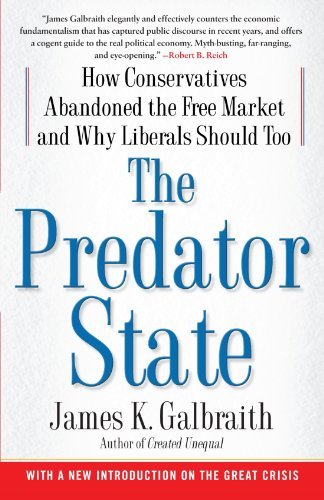
The Predator State: How Conservatives Abandoned the Free Market and Why Liberals Should Too

Rate this book
Now available in paperback, this timely book challenges the cult of the free market that has dominated all political and economic discussion since the Reagan revolution.

Even many liberals have felt the need to genuflect before the altar of free markets, but in The Predator State , progressive economist James K. Galbraith suggests that, under the Bush administration, conservatives have clearly abandoned the Reagan dogma and replaced it with crony capitalism. Tax cuts for the wealthy, deregulation, and such schemes as privatizing Social Security would divert the national treasury into private hands and give rise to "The Predator State." The real economy, Galbraith argues, has never been entirely free of government support. Indeed, he says, much of our prosperity over the decades has been the result of a mix of private enterprise and public institutions, dating back to the New Deal. While conservatives have paid lip service to free markets as the solution to everything from health care to global warming, it is clear from the current banking and Wall Street upheavals that a lack of federal regulation has led to disaster.

With witty insight, Galbraith makes it clear that we live in the age of predation. He sounds the warning bell, but also points the way to a more prosperous and progressive future.

240 pages, Paperback

First published August 5, 2008

46 people are currently reading
1452 people want to read

About the author

James K. Galbraith

49 books57 followers

Ratings & Reviews

What do you think?
Rate this book

Friends & Following

Create a free account to discover what your friends think of this book!

Community Reviews

5 stars
163 (33%)
4 stars
190 (38%)
3 stars
97 (19%)
2 stars
27 (5%)
1 star
12 (2%)
Displaying 1 - 30 of 42 reviews
Profile Image for David M.
477 reviews376 followers
February 15, 2018
Useful and illuminating. Galbraith takes the conservative intelligentsia at their word. He shows that while the ideas of Hayek, Friedman et al did have a good deal of rigor and internal coherence at one point, they were disproven within the first few years of the Reagan administration. The continued hold these ideas have on public discourse is thus plainly a matter of ideology and power relations. Galbraith does an excellent job showing how 'third way' liberals have accepted all the most disastrous premises of their supposed opponents. First and most fatally, in assuming that 'markets' always and everywhere exists, and that public policy can at most be a matter of tinkering with them.
Profile Image for Bart.
Author 1 book127 followers
February 5, 2009
This is a wonderful contribution to the world’s current reevaluation of free-market ideology and should be read by anyone with sufficient intellectual dexterity to have looked at 9/18/08 and said, I was completely wrong about everything I heretofore believed about capitalism; I think I’ll have a second go at the subject.

This is also a dense book. Despite weighing-in at barely 200 pages, this book takes a while to read. Galbraith is unsparing in a general overestimation of his readership’s fluency in the language of economics. But one needn’t have an MBA – in fact, one is, in this case like so many others recently, better off if one hasn’t misspent s/her time with attaining an MBA – to enjoy the context of what Galbraith does here.

At some point near the middle of this book, James K. Galbraith implies that economics as an intellectual discipline will never serve much of a predictive value. The most we can ask of it is that it describe the past’s finances accurately. Something Galbraith regularly convicts economics of having not done. He’s also none too impressed with the free market.

He isn’t bothered by the market’s functions. He just thinks we’ve bestowed a Godlike omniscience on the free market – investing it with qualities it simply doesn’t have. That’s not the market’s fault, again Galbraith would argue; it’s our fault, as conspicuous consumers in a predatory country, we’ve decided that the market’s apparent disinterest is a proof of its justice. But that’s asking an inanimate and in most cases imaginary entity to do the heavy lifting of ethics for us. Put that way, much of our genuflecting before the altar of the free market looks pretty ridiculous.

Galbraith takes on large, sacred ideas in a wonderful way. About education he writes:

So, what do universities do? First, there is the neglected effect of higher education on employment and labor force participation. Like the health sector, higher education in the United States is very labor intensive. It employs a great many people, including large numbers of the intelligentsia, who are thus kept contented and busy. More important than that, it provides activities and diversions for many of those who - if they were in Europe - would spend their late teenage years in the ranks of the jobless young. The American young thus reap the psychological benefits of legitimated idleness and the rituals of accomplishment provided by colleges and universities at this stage of life; as a rule, they emerge feeling vindicated rather than depressed. As a solution for youth unemployment, the American college system has to be counted one of the great triumphs of the human imagination - or perhaps of dumb luck.

Notice the richness of “legitimated idleness”? How wonderfully true.

Probably, Galbraith’s deepest-held belief about the sagacity of the free market, and its ability to fairly solve all our societal woes, can be found in this brief treatment of Japan’s emergence in the 1980s:

The crash came in 1988, precipitating a deep recession in domestic demand from which the Japanese economy as a whole did not begin to recover for over a decade. This dimmed the luster of the Japanese model for American observers, even as they largely overlooked the obvious point: there is evidently no development path than an unfettered, liberated, free capital asset market cannot screw up.

Like most economists, though, Galbraith’s wisdom is proportionate to his distance from recommended solutions. Once it comes time to solve things, he gets preachy about the environment and green jobs – going from a valuable iconoclast to a cheerleading disciple.

Still, this book is an excellent contribution to an incredible time.
Profile Image for Simon Wood.
215 reviews154 followers
January 9, 2014
THE FREE MARKET DELUSION

Hereditary Economists? Sounds a dubious proposition but J.K.Galbraith the second has written a stimulating, provocative book that is easily up to his fathers standards. "The Predator State" is a book of two halves; the first section is somewhat pedestrian in pace, generally interesting and occasionally confusing. The second and third sections see Galbraith up a couple of gears and in a relatively short space makes his case against what he regards as the reigning model for the economy:

"Today, the signature of modern American capitalism is neither benign competition, nor class struggle, nor an inclusive middle-class utopia. Instead, predation has become the dominant feature -- a system wherein the rich have come to feast on decaying systems built for the middle class. The predatory class is not the whole of the wealthy; it may be opposed by many others of similar wealth. But it is the defining feature, the leading force. And its agents are in full control of the government under which we live."

The book, which was written towards the end of the second Bushes second administration, is particularly focused on the American experience. It makes the clear that the market model is limited in relevance as a description of large sectors of the American economy and the worshiping of the market paradigm is in itself acting as a serious constraint in dealing with a number of issues the most important of which is global warming. The chapter on the limitations of carbon trading and other market solutions with regard to global warming is one of the highlights of the book.

In the course of the second half of the book he deals with many issues including inequality, contempory corporations, macro economic policy, China and the status of the dollar as a reserve currency. Galbraith, despite seeing a valid role for markets, also makes a cogent and reasonable case for an element of planning with regard to the economy and a valid role for regulation. It is refreshing to hear the case for letting the most predatory corporations be planned and regulated out of business leaving space for corporations than can survive and indeed thrive in a business environment which is more regulated and focused on the real needs of real people as well as a government sector that is like wise focused.

Though I don't agree with everything in the book and found the first section to be less than brilliant I'd still thoroughly recommend this book. In the latter part Galbraith tackles the issues with wit and concision and sinks the notion of using the term "free market" as a description of the economy as it is and as a universal solution to all economic and political ills. More importantly it is a book that makes you think. If you find this sort of book interesting then Thomas Franks "The Wrecking Crew" is an excellent description of the conservatives "free market" ideology in practice.
Profile Image for Tommy.
338 reviews39 followers
May 29, 2020
This is a pretty standard post-Keynesian criticism of the moronic bipartisan assumptions of government budgeting on GDP and shared objectives of attacking trade deficits and public debt not backed by any serious understanding of global finance or the functional role of savings but there's a very interesting take in here on how exactly the process by which the corporate economy was hollowed out by private wealth played out. He addresses very well how his fathers understanding of the American economy became outmoded. There's a defense of economic planning in a Veblenian spirit and exposition of the intellectual failure of the liberal opposition against conventional conservative opinion. On both sides of the political fence there's a big reluctance to develop an actual understanding of how real world labour markets function and instead place faith in education/training [libs with something like "coding" and maybe cons with something like "welding"]. It's always funny to see supply-siders telling education consumers they're acting irrationally as market actors and have to consider market demand.
This was written around the end of the baby Bush administration so hurricane Katrina and Enron and such is central examples in here but Galbraith was to certain that the supply-siders were already intellectual defeated since Bush wasn't exactly leaning in to hard on them but you've got guys like Arthur Laffer whispering into the ears of the chief executive again today the exact same assumptions and methods as from the Reagan years. Also turns out the EU isn't a great example for unemployment and has turned out a much bigger dysfunctional mess than anyone could of expected.
And finally we have the peculiar manifestation of the CEO as a symbol or front man, a man who by virtue of his detachment from the culture and inner workings of the corporation cannot actually control much of anything in the organization over which he presides. So what is the function of this functionary? It is precisely to spend his time idly in order to advertise to the country that things are under control—or more precisely, to obscure the fact that they are not. The Bush White House, where all of the key information reaching the President was controlled by staff loyal to the Vice President, illustrates this method. In the first days of the regime, David Broder of the Washington Post described Cheney, a former chief executive of Halliburton, as “corporate cool.” The description fit perfectly. The government has thus been remade in the image of the business firm. And in this way, it has become subject to all of the administrative and organizational pathologies that bring large private businesses to grief. It has come to absorb every great innovation in corporate mismanagement, deception, market manipulation, and fraud of the past forty years.
The Predator State is an economic system wherein entire sectors have been built up to feast on public systems built originally for public purposes and largely serving the middle class. The corporate republic simply administers the spoils system. On a day-to-day basis, the business of its leadership is to deliver favors to their clients. These range from coal companies to sweatshop operators to military contractors. They include the misanthropes who led the campaign to destroy the estate tax; Charles Schwab, who suggested the dividend tax cut of 2003; the “Benedict Arnold” companies that move their taxable income to Bermuda or the Isle of Jersey. They include the privatizers of Social Security and those who put the drug companies in position to profit from Medicare. Everywhere you look, regulatory functions have been turned over to lobbyists. Everywhere you look, public decisions yield gains to specific private persons. Everywhere you look, the public decision is made by the agent of a private party for the purpose of delivering private gain. This is not an accident: it is a system.
39 reviews3 followers
January 25, 2009
Brilliant, provocative book. Galbraith shows that most "pro-market" rhetoric is meaningless. The corporations, oligarchs, and laissez-faire apologists who deploy it conveniently ignore the myriad ways state action strengthens their own grip on power.

Given the recent financial meltdown and the bonus-enabling bailout, the book is very topical. Chapter Seven on inequality is particularly insightful, essentially rendering irrelevant much of the interminable economists' debate over the causes of inequality. I particularly like this quote:

"The deepest issue raised by the inequality of economic incomes is . . . the distribution of political power. The term of art in other countries, for people who control power in this way is oligarch." (102)

There are many good turns of phrase in the book. The conclusions are strikingly original. Galbraith's ideas about the need for planning, industrial policy, and wage-guarantees need to become part of the mainstream of political discourse. They probably only have a chance at doing so if the current recession deepens significantly.
Profile Image for Todd Martin.
Author 4 books83 followers
September 1, 2009
In “The Predator State: How Conservatives Abandoned the Free Market and Why Liberals Should Too” economist James K. Galbraith argues that the economic principles of an unfettered free market, developed and put into practice 30 years ago by conservatives during the Reagan administration, have been proven to be a complete failure in practice and have all but been abandoned by conservatives outside of academic circles. As such, he argues that liberals should stop parroting disproven market theories and work to develop a practical economic policy.

In Part I of the book, Galbraith outlines the many ways in which conservative free-market principles (based on deregulation, monetarism and low taxes) have failed and were subsequently abandoned in practice. Evidence of these disastrous policies include:
• The collapse of the subprime market and subsequent government bailout.
• Trade deals and tax policies which result in the exportation of jobs and manufacturing overseas.
• The failure of tax cuts to stimulate personal savings or investment.
• A lack of evidence supporting the conservative claim that free markets spur democracy. A ‘free market’ has devolved into a freedom to shop. Those with the means have the freedom to buy elections, legal protections, safety, clean air, and good health. Those without the means are out of luck. This type of shopping freedom does not bear any relation to the freedoms or personal liberty one might expect from a truly democratic system of governance.

Though lip service is given to the phrase “free market” actual markets are in no way free and no one is seriously proposing that they be made so. Though the reality of the free market has been a failure, the ‘myth’ continues to be echoed by conservatives and progressives alike.

In Part II, Galbraith describes the “Predator State”, a seamless merger of corporate and government interests with a common goal to convert public assets into private wealth. The quintessential example is the failed attempt to privatize social security. Should this occur private companies would reap billions while simultaneously stripping all ‘security’ from the program. The public, in a rare instance of clarity, was able to see through the attempt at privatization. Rest assured the idea will surely be revived.

Other examples of the Predator State include: the war in Iraq, the overcrowded prison system, school voucher programs, health care insurance (and its reform), the destruction and failure to reconstruct New Orleans and the banking bailouts. All one needs to do is look at the beneficiaries of these programs to understand who is pulling the strings of public policy. The media and politicians typically couch the debate under the banner of right vs left. This framing is only a smokescreen. It is the interests of the oligarchs that are at the heart of these policies.

Research, innovation, manufacturing and developing new products and selling them in the market is hard work. Parasitical interests have found that wealth can more easily be extracted by siphoning it from public programs. This wealth gives them immense political power and enables them to enact policies which allow them to perpetuate their existence. This not only harms the public, but it also devalues those corporations who are actually doing the hard work of innovation.

In Part III the author outlines some solutions to the problem, the first being that liberals and conservatives alike abandon the myth of the free market. Second, he suggests that US companies pay fixed wages for labor regardless of the country in which they operate. This would dis-incentivize companies from moving operations overseas to cheaper labor markets and would guarantee full employment at home. Galbraith points to Denmark as a successful example of this policy. The country has extremely low unemployment, liberal trade policies, budget surpluses, a highly developed welfare safety net and a high standard of living. They also have one of the highest tax rates in the world at ~50%, but I suppose that's the tradeoff one pays for economic security.
Profile Image for Harry.
234 reviews21 followers
June 5, 2023
Despite being a worthwhile and important book, The Predator State founders not on the merit of its points or the assiduousness of its evidence, but on its being borderline unreadable. Galbraith in the introduction explains that he's written this book for the layperson, so we ought to excuse the lack of detailed explanations and mathematical formulae. I dread to think what an even slightly-less-lay-oriented book would look like.

Galbraith's central point is paradoxically both revolutionary and markedly conservative. At its core, his position is not a wholesale rejection of economics as elucidated by Hayek, Friedman and so on. Rather, it's an effort to evaluate and complicate their contributions. There are two key strands of thought.

Firstly, Galbraith acknowledges that the economics espoused by the post-Keynesian free marketeers made some sense at the time. Friedman wasn't a raving lunatic, he was a serious economist doing his best to come up with serious answers to serious questions. Rather than drawing battle lines Galbraith salutes Uncle Milton's efforts and points out that he turned out to be wrong.

To take one example, Milton Friedman advocated an idea called monetarism, the belief—which almost any person you ask will now repeat, not understanding why—that money supply is the key driver of inflation and so the Reserve Bank can control inflation with the singular lever of interest rates. As Galbraith observes, this idea was demonstrated false almost immediately after it became policy in the '70s, again in the '90s and again as he was writing in the Financial Crisis of '08. This has once again been demonstrated false with the ongoing wave of post-covid inflation, and yet our policymakers repeat Friedman's platitudes about inflation as if they had the weight of truth.

Across this rather long and detailed book, Galbraith takes methodical aim at each piece of the free market canon. Monetarism, supply-side economics, free trade and the notion that deregulation improves market freedom and thus efficiency melt under his megawatt attention. Perhaps significantly, Galbraith is neither a much-scorned suspected communist from a nowhere country nor an economist-and-journalist who can be dismissed as a social justice activist. Galbraith is a distinguished academic economist and policy director in his own right, from a line of distinguished economists: his analysis can't be dismissed as either political or doctrinal, it's just good economics.

So why, if good economics applied methodically results in the deconstruction of the canon, does free market economics still dominate our ideas and policies for the running of the world?

Galbraith's second major strand of argument is against the popular assumption that free market economics and the notion of rational, far-sighted, infinitely long-lived "economic agents" that underpins macroeconomics is natural, rational or even functional. His observation is that if we assume that all of the above is case, almost any economic behaviour can be absolved: buying out daraprim and raising the cost of lifesaving drugs by 5455% is just rational economic behaviour. The economy in this model of the world becomes grade-separated from politics and power, which anyone with an ounce of historical consciousness could point out is nonsense. Rather, Galbraith argues, we need an economic understanding that considers the organisation of power in the economy as an input unto itself. Enter the predator state.

The most immediately valuable insight Galbraith presents has to do with regulation and efficiency. It is a sort of truism in economic thinking (one that has trickled down, just like wealth—despite the protestations of free marketeers—doesn't) that more regulation means more cost involved in whatever is being regulated means less output, less efficiency, less wealth. Regulation, therefore, bad. Galbraith observes that this is only true in a very specific situation: one in which the sector being regulated is dominated by ageing, outdated players who are resistant to change.

Imagine for a moment that new safety regulations are imposed on, say, the forestry sector. Most of the forestry sector is made up of giant leftovers from the nineteenth century who've been cutting down forests for decades if not centuries, and don't want to be told how to do their business. They have all the processes and polluting practices from the 1930s, they make a tidy profit, and they're quite happy that way. Imagine, also, that upstart new forestry companies have invested in better safety and cleaner operations but—despite what proponents of the crippled economics in which money flows represent desires and values might argue—people buying dining chairs don't actually tend to investigate where the wood in their furniture came from.

In such a situation the new, cleaner, safer companies are struggling to keep it up with the old, harmful, dirty ones. In this case regulation requiring cleaner operations and setting minimum safety standards offers a competitive advantage to companies prepared to deliver those public goods. The dinosaurs adapt or die; the sector as a whole becomes safer and cleaner: regulation improves efficiency.

The reason that this is significant is because of how a) logical and b) controversial it is. This is not the standard assumption that comes out of economic thinking. It's not even a chain of reasoning that rears its head in notionally sober and balanced free-market-leaning journals such as The Economist. And yet it is perfectly intuitive. This is precisely to do with that element of economic reality which Galbraith emphasises, and which is left out of traditional economics: the dimension of politics and power beyond the exchange of currency for utility. Economic dinosaurs tend to have institutional connections and weight throughout the political, academic and journalistic systems that upstarts lack. They are able to use that weight to communicate and perpetuate narratives beneficial to them, that may or may not be wholly malign to other parties.

Consider for the moment the well-attested role of the oil industry in global climate denialism. It is well understood that economic power translates into political power translates into economic power. Galbraith connects the dots, reaching back to the 1980s, and shows how our modern economics is a product of precisely that process. Not as part of some grand plan, but in an opportunistic pursuit of chances to pocket ever more cash, major economic actors have preyed upon their host societies and poisoned the discourse with the insistence that it's for the good of everyone. That we have to plod through a stultifyingly academic book to grasp the processes at work in a world of bite-sized infographics and attention-economy-booming TikToks only further emphasises his point.
Profile Image for Miriam Axel-lute.
49 reviews4 followers
July 24, 2009

I will have much more to say on this book in an upcoming column. Suffice it to say that if I could insist that the president read just one book, any book, it would be this one.

I have critiques sure — early on it could use either more technical backing up, or more layperson-friendly walking through.

But it's so incredibly refreshing to have a decidedly capitalist, non-radical economically trained someone call such thorough bullshit on the "but we have to let the markets decide" excuse for everything a handful of lazy business execs want to do to enrich themselves.

The best part though, is that it didn't just reinforce what I thought I knew. It challenged some assumptions and gave me new reasons or language for others. I'm going to have to read it again to be able to hold enough in my head to have the debate, but I intend to do so...
Profile Image for Weavre.
420 reviews11 followers
Want to read
October 29, 2008
ILL: Luzerne doesn't have it.

BuzzFlash.com's Review (excerpt)
What should we do with a free market that's really a rigged market?

James K. Gailbrath has some answers.

James K Gailbrath: "Today, the signature of modern American capitalism is neither benign competition, nor class struggle, nor an inclusive middle-class utopia. Instead, predation has become the dominant feature — a system wherein the rich have come to feast on decaying systems built for the middle class. The predatory class is not the whole of the wealthy; it may be opposed by many others of similar wealth. But it is the defining feature, the leading force. And its agents are in full control of the government under which we live."
Profile Image for Andy.
849 reviews5 followers
April 8, 2016
Galbraith made the issues relatively easy to grasp and put forth logical solutions to the problems he found. It cleared up some misconceptions I held and is really strengthened through the use of evidence that policies supporting the free-market paradigm have failed to actually accomplish the goals they set out to; or at least to accomplish them for the reasons the theory would lay out. However, reading this book now is slightly depressing. Galbraith lays out the very real possibility that America's window for using our economic position to improve the positions of the majority of Americans is closing. Between this and climate change, I find it unlikely that America will be a unified nation, much less a world power at the end of the century.
Profile Image for Evan Micheals.
678 reviews20 followers
January 31, 2016
Regarding the "free market" it provided an account of how markets don't work. Predators have an interest in developing healthy pray (making them farmers). It sacrificed a number of ideologies sacred to the political left. I feel more enlightened having read this book about contemporary macro-economics. I understand the world of macro-economics better. Obviously written with a US audience in mind - I now understand the US role, and also its responsibility as world financial leader. I obviously liked the advocacy that strong unions, created a strong middle class, which creates a stronger a more equitable economy for everyone, with the Scandinavian nations cited as an example.
Profile Image for Jrobertus.
1,069 reviews31 followers
October 30, 2010
This is a boring book; we read it for a UU book group or I would never have started it , let alone finish it. Galbraith is the son of JK Galbraith, and a UT Austin prof. His main idea is that "conservatives" have given up fighting big government and to take it over, subvert it, and use it to suck money from the taxpayers. He may well be right, but the writing is still turgid and opaque.
Profile Image for Marvin Soroos.
132 reviews2 followers
January 25, 2016
This is a book that should be read by progressive Democrats who will understand better how their thinking has been cooped by conservative economic principles that modern Republicans ignore and are inhibiting the pursuit liberal economic ideals. It is written for a general audience, but there were some chapters I had difficulty understanding Galbraith's arguments.
Profile Image for Ed.
333 reviews43 followers
November 16, 2008
only half way through but intriguing book that is a bit heavy on economics to start with but it's major thesis that the US is nowhere near a free market economy with over 50% of GDP in non market forces hands and its time to get real about this is compelling. We live in a delusional state!
Profile Image for Laura.
7 reviews8 followers
January 30, 2009
Okay, I tried. There are no charts and graphs, but the text is still too dry to read for extended periods. I have to admit that I skimmed a lot of what was written - interesting in parts, but snooze-worthy in others.
Profile Image for Shawn.
135 reviews
February 23, 2010
This was a serious slog, that I haven't really completed, which is sad because it is so short. He starts off so far to the left that only extremists will probably get past chapter three, which is when he starts to try to really say something.
Profile Image for Matthew.
198 reviews11 followers
November 10, 2025
Although published in 2008, with reasoning based on the Clinton and GWBush administrations, this book seems to describe the Trump era exceedingly well. “The Predator State” is that collection of ultra-wealthy benefactors and government insiders, across all branches, who have co-opted the functions of government to their own personal enrichment. It’s not ideological conservatism, and it’s not about Republican arguments for “free markets” anymore—those are smokescreens to keep Americans busy arguing and debating whether to vote at all. Whomever is elected, and whatever debates cross the floors of Congress, the Predators are still at work. Bush appointed people to regulatory positions at which they were unqualified and ineffective, which was the point—a hobbled federal agency won’t regulate to the best of its ability. Bush policies drove federal $ to his allies and friends, and he even instigated an invasion to accelerate the process. What has Trump done? The same, but when it’s all led by a blithering idiot, it’s even more transparently corrupt. Everything Trump has done in his 2 terms has been done before, all of the race-baiting and trade warring and deflecting responsibility and secret dealing and skimming off the proceeds and emoluments that we can just never seem to follow through on investigating and holding to account. And why not? Because that would reset the narrative, and the Democrats wouldn’t be able to get away with it the next time they’re in power. It doesn’t matter who leads the government and sets the policies when the field is already tilted, and will remain so until we look past the politicians to see who is really pulling the strings, who the true Predators are that have captured government to their own benefit.
Profile Image for Conor Ahern.
667 reviews225 followers
February 7, 2017
So basically the free market is a big myth, and the conservatives who (claim to) hold it in such high regard are really just the clever bastards who took Adam Smith's warning about the power of the state to hinder free trade as an invitation rather than a warning. Not much surprise here.

But this book was written in 2008. That last chapter about how we could mend our ways seems quaint and tragicomic at this point. Is it treasonous, shortsighted (or both?) to say that part of me awaits China's giant, world-rending "fuck you" to Trump, so that we can scrap the whole system and maybe have a chance at something defensible?
Profile Image for Bruce.
120 reviews14 followers
June 2, 2021
If I could use time travel, I would zoom back to this title’s publication, buy enough copies to send to every single business and political leader I could, then force them all to read it. Galbraith predicts pretty much everything that has happened since publication, with no doubt the resulting Cassandra syndrome that being right and having nobody care always brings. His students at U of T Austin are fortunate to have his insights, his drive, and his common sense.
35 reviews4 followers
July 15, 2018
Excellent. Does a fantastic job of dispelling myths and "magical thinking" about markets and delineates situations where they do work and where they do not, as well as when and how much government should manage them
Profile Image for Mehrsa.
2,245 reviews3,583 followers
May 26, 2019
This is a good, but not particularly new or interesting critique of monetarism, trickle-down economics, and free market orthodoxy. It might be good to start with his dad's book first and use this as an update.
10 reviews
February 27, 2011
stayed home today and finished James K. Galbraith's The Predator State. Galbraith does not have the sharp wit of his father, or the rhetorical skill, and his work is sometimes more confusing than illuminating. The Predator State is a book that attempts to bust some free-market myths and demonstrate how economic planning can and should be done to ensure America's economic future. There are some wild assertions, a few of which are never supported, but the argument is generally thought-provoking and the conclusions reasonably solid. The book is written for a general audience, which may explain some of it's shortcomings, but offers an interesting view of modern political economy that brings economics out of theoretical models and into daily life. Fans of George W. Bush will not be impressed, as Galbraith describes the Bush Administration's move to hide the selling of America to corporate interests behind a false free-market label. But even if you don't agree with Galbraith's understanding of economics - and most won't - the questions he asks are compelling ones, and his answers are worth some consideration. Many people profess faith in "free markets" but few can actually give a definition of what that term really means, and Galbraith challenges you to do just that. 
Profile Image for Ray.
1,064 reviews54 followers
October 19, 2014
Galbraith's book "The Predator State" didn't make a great audio book. It's got depth and details, and you really need to take the time to pause and understand what he's presenting, i.e., to put the book down and think about his statements. Otherwise, it's just background noise, and you find you're not really absorbing what he's talking about. If the subject grabs you, I suggest you pick up the print (or e-book) version, and put some time aside to absorb it. As an audio book, unless you've got an excellent background in free market economics, it's too challenging.
Profile Image for Steven Percifield.
36 reviews3 followers
September 3, 2013
A self-proclaimed fiscal conservative, I chose to read this book with an admittedly "know your enemy" attitude.

Not surprisingly (considering he is the son of his famous (or infamous) father) I found much of what Galbraith said to be anathema to my predispositions.

What was surprising: I found myself to be in agreement with him many, many times.

Even though he seems to be a "big government" liberal, his concerns over concentrations of power being a threat to our concepts of freedom struck a chord with me.
1 review2 followers
May 8, 2009
Superb overview of the underlying assumptions which have led us astray economically -- completely blows the doors off the current thinking of "conservative - free market" pundits and pols (both republican and democratic). A must read follow up to his Dad's classic book on the Industrial State of the 1960's. Virtually no math -- just clear and peircing analytics that are easy to understand.
Profile Image for Jonathan.
Author 3 books25 followers
July 14, 2009
90% sure 75% or so of the first 40% of this went over my head –– what exactly did I do in college? –– but the final 33 1/3% was roughly 80% comprehensible and actually persuasive in its way a good 65% of the time.
Enjoyable Fact: Galbraith père spoke at one of my own father's numerous graduation ceremonies and the old man was thoroughly unimpressed.
Profile Image for Mike.
86 reviews8 followers
December 23, 2016
I'm conflicted about this book. It's one of those books that, in an ideal world, would be read by and only by those inclined to disagree with it. It makes some important points that are too often ignored and pushes for a fresh consideration of issues that are at least as relevant today as when the book was written. But it also has moments that veer into absurd crack-pottery.
Profile Image for Matthew.
611 reviews16 followers
February 16, 2011
Very accessible. I liked it because it reinforced my already strong belief that we need to change the terms of economic debate away from the false free-market-vs-socialism dichotomy and toward data-based reality.
7 reviews
June 10, 2013
Professor Galbraith offers a refreshing summary of US economic history since the 1970s. He takes apart the mythology of free market capitalism by exposing widely-held misconceptions. I was riveted and could not put it down. It is worth reading again and again.
Profile Image for Casi Graddy-Gamel.
59 reviews27 followers
February 7, 2017
Another absolutely critical piece to the Trumpian puzzle. While it is depressing that Galbraith predicted the Trump presidency so perfectly (or rather, aggressively cautioned against exactly what we're walking into), having more information should help us act.
Displaying 1 - 30 of 42 reviews

Can't find what you're looking for?

Get help and learn more about the design.