

What do you think?

Outrageously Pogo
223 page paperback book of comics by Walt Kelly with photos, articles, and special drawings from the pages of The Okefenokee Star.
223 pages, Paperback
First published October 1, 1985
About the author
Walt Kelly
397 books53 followersAmerican animator and cartoonist best known for the classic funny animal comic strip, Pogo. He won the National Cartoonists Society's Reuben Award in 1951 for Cartoonist of the Year, and their Silver T-Square Award in 1972, given to persons having "demonstrated outstanding dedication or service to the Society or the profession."
Ratings & Reviews
Friends & Following
Create a free account to discover what your friends think of this book!
Community Reviews
Displaying 1 - 4 of 4 reviews

September 23, 2018
Walt Kelly's POGO comic strip was probably at its most culturally significant in the 1950s and 1960s, when Pogo the Possum, Albert Alligator, the seductive "Churchy" La Femme and other denizens of the Okefenokee Swamp would be invaded by the likes of "Simple J. Malarkey" (a shotgun-wielding badger who bore an amazing resemblance to Wisconsin Sen. Joseph McCarthy); later "P.T. Bridgeport," an impresario of a bear whose very balloon captions used the eponymous "P.T. Barnum" font. Kelly's animals were always more human than animal, a gang of anthropomorphized savants and wisecrackers who spoke in a mixture of Burly-Q puns, Fla/Ga patois, Irish verse, and what today would be called "jive talk."
With so much verbal invention going on, POGO at times resembled a kind of postwar KRAZY KAT melded with the satire of DOONESBURY. Kids enjoyed it, adults loved it, but the strip did not carry on for too long after Kelly's death in 1973. This volume may not represent the best-of-the-best, but it's more than good enough and is enlightened with fanzine-type recollections from fans and admirers. Note that the contents are entirely black-and-white; however, good used copies are cheap and not hard to find.
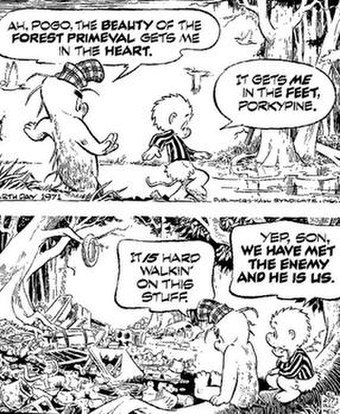
Kelly created the reverse cliché "We have met the enemy and he
is us." His 1971 Earth Day tribute makes use of that creation:
With so much verbal invention going on, POGO at times resembled a kind of postwar KRAZY KAT melded with the satire of DOONESBURY. Kids enjoyed it, adults loved it, but the strip did not carry on for too long after Kelly's death in 1973. This volume may not represent the best-of-the-best, but it's more than good enough and is enlightened with fanzine-type recollections from fans and admirers. Note that the contents are entirely black-and-white; however, good used copies are cheap and not hard to find.
Kelly created the reverse cliché "We have met the enemy and he
is us." His 1971 Earth Day tribute makes use of that creation:

September 29, 2018
Walt Kelly's Pogo influenced two of my favorite comics, Bill Watterson's Calvin & Hobbes and Jeff Smith's Bone. Of the two, Smith obviously took the most direct inspiration, from his style to lettering and even dialogue style. I don't know how exposed I was to Pogo itself before reading this collection, but...I think this might be a case of having to appreciate what it inspired over what it actually was.
I just wrote a review for another book from the 1950s. Not all the material in Outrageously Pogo is from the '50s, but it concludes with a year's worth of strips from early in that decade, and what it and the other book I allude to have in common is pre-Civil Rights everyday racism, which has otherwise been somewhat scrubbed from the historical record. Pogo is almost blackface. All Kelly's characters speak in a version of the speech pattern standard to depictions of black people prior to the Civil Rights era. I have no idea if this was the intention, but the earliest Pogo material included in the collection, and even the 1951 run at the end of it, certainly reads like that. Kelly seems to have smoothed the dialogue over the years, whether intentionally or organically (reading Pearls Before Swine, you can see how Stephan Pastis refined the crocodiles' dialogue from their initial appearances, for instance), but the impression, from 2018, is fairly unmistakable.
Beyond that, a collection like Outrageously is a great way to dive into the Pogo phenomenon. It's as much a retrospective as reprint publication, including a wide range of material from throughout Kelly's career, including a cartoon biography of P.T. Barnum, as well as grouping some strips together for different context pieces.
If I didn't instantly fall in love with Pogo (beyond the reasons of my above-discussed perceptions), I also recognized that it's certainly worth having a look at, which I say not to suggest glancing in a casual manner and then dismissing, but that the kind of devotion it inspired from some very creative individuals certainly seems justified. If Watterson and Smith ultimately went in different directions thematically, it's still easy to tell that they had good reason to have been fans. Kelly's artwork alone stands the test of time. His characters are distinctive. Today, much of what Watterson lamented about the declining state of comic strips has to do with lax artistic standards (which he has helped Pastis lampoon in Pastis's own strip). Never mind that if Watterson had worked in TV animation that he'd be running scared away from every screen imaginable these days. Kelly made his name, in part, by working with Disney, but he developed a style distinctly his own (and later Smith's and even Over the Hedge's, which in a lot of way is Pogo's most direct descendent).
The strip is otherwise topical (Kelly's interpretations of then-current affairs) but also the standard interplay between his cast of characters. One of the things I definitely noticed was that his style is dialogue-heavy. Where most strips, as we know them today, the long-running and even more recently launched ones, rely on a fairly abrupt last-panel punchline, Kelly fills all his panels with chatter, so that if you're going to appreciate Pogo at all it requires more reading (and patience) than you'd normally associate with comic strips. He doesn't have punchlines so much as a sitcom style of absurd exchanges being the whole point.
Bottom line is, I did not become a hopelessly devoted fan by reading this, but I can see why others did thanks to it.
I just wrote a review for another book from the 1950s. Not all the material in Outrageously Pogo is from the '50s, but it concludes with a year's worth of strips from early in that decade, and what it and the other book I allude to have in common is pre-Civil Rights everyday racism, which has otherwise been somewhat scrubbed from the historical record. Pogo is almost blackface. All Kelly's characters speak in a version of the speech pattern standard to depictions of black people prior to the Civil Rights era. I have no idea if this was the intention, but the earliest Pogo material included in the collection, and even the 1951 run at the end of it, certainly reads like that. Kelly seems to have smoothed the dialogue over the years, whether intentionally or organically (reading Pearls Before Swine, you can see how Stephan Pastis refined the crocodiles' dialogue from their initial appearances, for instance), but the impression, from 2018, is fairly unmistakable.
Beyond that, a collection like Outrageously is a great way to dive into the Pogo phenomenon. It's as much a retrospective as reprint publication, including a wide range of material from throughout Kelly's career, including a cartoon biography of P.T. Barnum, as well as grouping some strips together for different context pieces.
If I didn't instantly fall in love with Pogo (beyond the reasons of my above-discussed perceptions), I also recognized that it's certainly worth having a look at, which I say not to suggest glancing in a casual manner and then dismissing, but that the kind of devotion it inspired from some very creative individuals certainly seems justified. If Watterson and Smith ultimately went in different directions thematically, it's still easy to tell that they had good reason to have been fans. Kelly's artwork alone stands the test of time. His characters are distinctive. Today, much of what Watterson lamented about the declining state of comic strips has to do with lax artistic standards (which he has helped Pastis lampoon in Pastis's own strip). Never mind that if Watterson had worked in TV animation that he'd be running scared away from every screen imaginable these days. Kelly made his name, in part, by working with Disney, but he developed a style distinctly his own (and later Smith's and even Over the Hedge's, which in a lot of way is Pogo's most direct descendent).
The strip is otherwise topical (Kelly's interpretations of then-current affairs) but also the standard interplay between his cast of characters. One of the things I definitely noticed was that his style is dialogue-heavy. Where most strips, as we know them today, the long-running and even more recently launched ones, rely on a fairly abrupt last-panel punchline, Kelly fills all his panels with chatter, so that if you're going to appreciate Pogo at all it requires more reading (and patience) than you'd normally associate with comic strips. He doesn't have punchlines so much as a sitcom style of absurd exchanges being the whole point.
Bottom line is, I did not become a hopelessly devoted fan by reading this, but I can see why others did thanks to it.

April 12, 2020
Published in 1985, this trade paperback collects odds and ephemera from Kelly, including cartoons from his high school days, cartoons about PT Barnum, a fascinating bit of reportage from West Berlin in 1962, some random Sunday Pogo strips, and the entire daily run of Pogo from 1951. I've loved Pogo since I was a tad, and my respect for Kelly's talent grows every time I read or re-read any of his work. The puns, the wordplay, the bizarre leaps of logic, the body language of each of his many characters, the skillful artwork which often tells a separate story from the main one in each strip - it's all masterfully done, and all I can say is Let's Go Pogo!
March 9, 2017
Pogo is one of the most witty and endearing comic strips of all time.
Displaying 1 - 4 of 4 reviews