

What do you think?

All Souls: Poems
In All Souls , Saskia Hamilton transforms compassion, fear, expectation, and memory into art of the highest order. Judgment is suspended as the poems and lyric fragments make an inventory of truths that carry us through night’s reckoning with mortal hope into daylight. But even daylight―with its escapements and unbreakable numbers, “restless, / irregular light and shadow, awakened”―can’t appease the crisis of survival at the heart of this collection. Marked with a new openness and freedom―a new way of saying that is itself a study of what can and can’t be said―the poems give way to Hamilton’s mind, and her unerring descriptions of everyday “the asphalt velvety in the rain.”
The central suite of poems vibrates with a ghostly radioactive attentiveness, with care unbounded by time or space. Its impossible charge is to acknowledge and ease suffering with a gaze that both widens and narrows its aperture. Lightly told, told without sentimentality, the story is devastating. A mother prepares to take leave of a young son. Impossible departure. “A disturbance within the order of moments.” One that can’t be stopped, though in these poems language does arrest and in some essential ways fix time.
Tenderness, courage, refusal, and acceptance infuse this work, illuminating what Elizabeth Hardwick called “the universal unsealed wound of existence.”
The central suite of poems vibrates with a ghostly radioactive attentiveness, with care unbounded by time or space. Its impossible charge is to acknowledge and ease suffering with a gaze that both widens and narrows its aperture. Lightly told, told without sentimentality, the story is devastating. A mother prepares to take leave of a young son. Impossible departure. “A disturbance within the order of moments.” One that can’t be stopped, though in these poems language does arrest and in some essential ways fix time.
Tenderness, courage, refusal, and acceptance infuse this work, illuminating what Elizabeth Hardwick called “the universal unsealed wound of existence.”
72 pages, Paperback
Published September 5, 2023
Ratings & Reviews
Friends & Following
Create a free account to discover what your friends think of this book!
Community Reviews
Displaying 1 - 22 of 22 reviews
October 12, 2023
'Take a deep breath. They will run out'.
Absolutely blown away by this collection, made more poignant by the fact that Hamilton sadly passed away this year, and All Souls was published posthumously. Thank-you to Lucy at Little Brown Book Group for the copy.
Some of the prose in Hamilton's poetry leaves an indelible mark - carefully constructed, highly evocative, creatively confronting illness and human mortality.
Favourite parts (though certainly not an exhaustive list):
On the power of language: 'As means like but also means while. As a cloud passes. As the shadow in the early morning. As the door turns on the hinge'.
On the human condition: 'Half our days spent living in the future, an illusion'.
On time and space: 'Not time and space, but time as space. The space you take up on Earth is a period of time'.
On breathing: 'Silence and breaths taken punctuate our speaking. Rests indicate the pace of the movement of thought; they are instructions for listening'.
On mortality and illness: 'Meanwhile, the ill among us are everywhere - making efforts at elegance despite a loss of appetite for all appetite things except the easing of pain'.
As Hamilton neared the end of her days, the question she posed in the middle of the collection seems more moving now than ever: 'Can writing be a form of practice or of preparation for death?'.
A sublime collection that acts as a handbook for living, as the end always nears. Ordered her collection 'Corridor' and looking forward to it.
Absolutely blown away by this collection, made more poignant by the fact that Hamilton sadly passed away this year, and All Souls was published posthumously. Thank-you to Lucy at Little Brown Book Group for the copy.
Some of the prose in Hamilton's poetry leaves an indelible mark - carefully constructed, highly evocative, creatively confronting illness and human mortality.
Favourite parts (though certainly not an exhaustive list):
On the power of language: 'As means like but also means while. As a cloud passes. As the shadow in the early morning. As the door turns on the hinge'.
On the human condition: 'Half our days spent living in the future, an illusion'.
On time and space: 'Not time and space, but time as space. The space you take up on Earth is a period of time'.
On breathing: 'Silence and breaths taken punctuate our speaking. Rests indicate the pace of the movement of thought; they are instructions for listening'.
On mortality and illness: 'Meanwhile, the ill among us are everywhere - making efforts at elegance despite a loss of appetite for all appetite things except the easing of pain'.
As Hamilton neared the end of her days, the question she posed in the middle of the collection seems more moving now than ever: 'Can writing be a form of practice or of preparation for death?'.
A sublime collection that acts as a handbook for living, as the end always nears. Ordered her collection 'Corridor' and looking forward to it.

December 1, 2023
My dear poetry professor from undergrad, Saskia Hamilton, passed away recently. It was difficult but lovely to read this book that explores death and dying and the wonder of her son's life. I'll be thinking of her and the poetry world (and the Barnard poetry department) will miss her dearly.

Read
November 21, 2023It seems Hamilton liked dates and names, there's quite a lot of both in All Souls, I'm the opposite. Also, it was impossible for me to get the font small enough on my phone to be able to read this on with the optimal view so that part was also lost on me. The overall effect was that of a series of embryonic essays with a vague sense of restlessness and the occasional poetic flare, which wasn't really my cup of tea.
No rating.
No rating.

Read
March 2, 2024The back cover description is so pretentious it’s asinine and almost irrelevant to the contents of this book. The only parts that make sense are the words “poems and lyric fragments” “mortal hope” and “fixing time” but what they really should describe is how this book is a poet’s mind unraveling through lines of literature and observations at the end of her life. The PET scans and chemo suites and the cancer that eventually took her body and miraculously left her mind for us in these words. And this book might only make total sense for readers who have already read everything under the sun (clearly Hamilton was extremely well-read) from Whitman to Kant to Dickinson to Proust. This may help ground the reader to the words otherwise it seems like you’re an eavesdropper on a conversation you can only hear half of. The poem in the middle sequence of the All Souls poems about 1947 is heart crushing and beautiful at the same time. Honestly though, the book is about death. That eternal sleep. And breath as space and words as time.

April 14, 2026
I was a little too stupid to fully enter this book at times but I enjoyed the intelligence and restraint even though they’re not traits I tend to be excited about in poetry. Love the way she threads topics throughout the book, especially jam and light and the little boy playing video games and watching YouTube. Lots of lovely lines. Makes me want to finally read Proust.
January 10, 2025
beautiful poems
January 12, 2024
Entre poesia i crítica literària. Alguns poemes els he pogut gaudir, però en general m'he perdut una mica amb tanta referència. El que no és tan referencial és molt clàssic.

August 28, 2023
Day 28 of #TheSealeyChallenge 2023. All Souls by Saskia Hamilton published by Graywolf Press.
@SealeyChallenge @GraywolfPress #saskiahamilton
#thesealeychallenge2023 #sealeychallenge #poetry
What a terrible loss. “I passed through, I should have paused,
there were a hundred doors. One opened.” I’m honored to read this preview from @NetGalley
Some of my favorite moments:
To listen to our own breathing and to someone else’s is to experience someone’s else:
When thoughts are left without a body to animate them, marks on the paper indicate someone was here.
@SealeyChallenge @GraywolfPress #saskiahamilton
#thesealeychallenge2023 #sealeychallenge #poetry
What a terrible loss. “I passed through, I should have paused,
there were a hundred doors. One opened.” I’m honored to read this preview from @NetGalley
Some of my favorite moments:
To listen to our own breathing and to someone else’s is to experience someone’s else:
When thoughts are left without a body to animate them, marks on the paper indicate someone was here.
December 23, 2023
Beautiful and contemplative, a delight to read.

January 13, 2024
‘As’ means like but also means while: As a cloud passes. As the shadow in the early morning. As the door turns on the hinge. Who was it who said that every narrative is a soothing down. Winter sun floods the table.
I read this and The Kingdom of Surfaces: Poems by Sally Wen Mao at the same time, and there was a theme of looking at and experiencing made things in museums that also correlates with Well of Souls: Uncovering the Banjo's Hidden History by Kristina R. Gaddy in beautiful ways. This poet died before this book was published, and I felt the sadness of her anticipating her death and respect the beauty she put out to the world as she was dying. Not raging against the dying of the light, but knowing she had work to do before, so perhaps a more feminine version of fighting to the last with love instead of rage. Less resonated with me, but still, worthy of respect.
EXITS AND ENTRANCES TO THE AUDITORIUM
‘But the history of no life is a jest.’ Hallucinatory dream sentence, that, while up in the night again as if I had a newborn, seamlessly integrating into the running sleep narrative of that hour. Bashō at the end of his life noted the restlessness, the insuppressibility, of thought— As for dream, it wanders the withered fields.
Silence and breaths taken punctuate our speaking. Rests indicate the pace of the movement of thought; they are instructions for listening.
Whitman’s breath is long and open; he is restless with death. I have heard what the talkers were talking … . the talk of the beginning and the end, But I do not talk of the beginning or the end. His invitations to the reader are generous, lonely. Stop this day and night with me and you shall possess the origin of all poems.
The Dutch word for pause or suspension is onderbreking, a disturbance within the order of moments.
FARING
‘As’ means like but also means while: As a cloud passes. As the shadow in the early morning. As the door turns on the hinge. Who was it who said that every narrative is a soothing down. Winter sun floods the table.
Six days later: as the light grows, so does my will for the weight that tethers us to the ground, shoulder blades descending and meeting.
streets below, each passerby carries time internally, it opens the mind like a flower blown in its native bed.
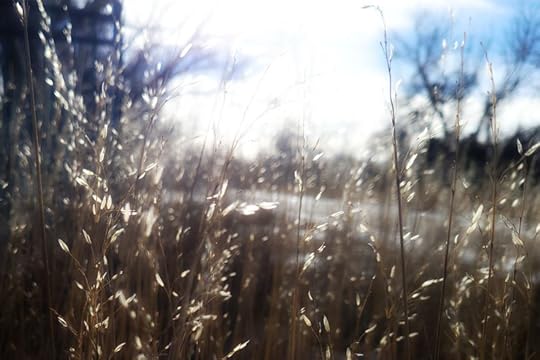
a recent image of mine on the first day of the year that reminds me of her poems, the light they give:
I read this and The Kingdom of Surfaces: Poems by Sally Wen Mao at the same time, and there was a theme of looking at and experiencing made things in museums that also correlates with Well of Souls: Uncovering the Banjo's Hidden History by Kristina R. Gaddy in beautiful ways. This poet died before this book was published, and I felt the sadness of her anticipating her death and respect the beauty she put out to the world as she was dying. Not raging against the dying of the light, but knowing she had work to do before, so perhaps a more feminine version of fighting to the last with love instead of rage. Less resonated with me, but still, worthy of respect.
EXITS AND ENTRANCES TO THE AUDITORIUM
‘But the history of no life is a jest.’ Hallucinatory dream sentence, that, while up in the night again as if I had a newborn, seamlessly integrating into the running sleep narrative of that hour. Bashō at the end of his life noted the restlessness, the insuppressibility, of thought— As for dream, it wanders the withered fields.
Silence and breaths taken punctuate our speaking. Rests indicate the pace of the movement of thought; they are instructions for listening.
Whitman’s breath is long and open; he is restless with death. I have heard what the talkers were talking … . the talk of the beginning and the end, But I do not talk of the beginning or the end. His invitations to the reader are generous, lonely. Stop this day and night with me and you shall possess the origin of all poems.
The Dutch word for pause or suspension is onderbreking, a disturbance within the order of moments.
FARING
‘As’ means like but also means while: As a cloud passes. As the shadow in the early morning. As the door turns on the hinge. Who was it who said that every narrative is a soothing down. Winter sun floods the table.
Six days later: as the light grows, so does my will for the weight that tethers us to the ground, shoulder blades descending and meeting.
streets below, each passerby carries time internally, it opens the mind like a flower blown in its native bed.
a recent image of mine on the first day of the year that reminds me of her poems, the light they give:

May 26, 2025
In 𝘈𝘭𝘭 𝘚𝘰𝘶𝘭𝘴, Hamilton perhaps relies too heavily on collage or association when structuring her long poems. Most of the collection takes the form of "lyric fragments," or unlineated verse sequenced by flourished dinkuses. This method allows Hamilton to span great distance in "Faring" and "Exits and Entrances to the Auditorium," including quotations, linguistic inquiries, anecdotes on motherhood and past love, and observations from daily life. The maturity of Hamilton's voice, however, is much more immediate in the lineated pieces from the titular poem "All Souls;" the gestures made or allegories enacted by each line feel more evident than those of their fragmented counterparts.
In the first two poems, "Faring" and "Exits and Entrances to the Auditorium," Hamilton uses negative space to guide the reader's attention and ascribe different temporal qualities to each piece. The section breaks in "Faring," which only expand or exaggerate a traditional stanzaic break, imply simultaneity or continuity, lends itself to a quicker read, a washing-over of the reader. Inversely, the breaks of "Exits and Entrances to the Auditorium," which are marked by a flourish opening to blank space until the following section begins on the next page, reinforces (visually and subconsciously) the sense of time passing, of firmly demarcated endings and beginnings. Explanations for these formal interventions can be found in the text: "Silence and breaths taken punctuate our speaking. Rests indicate the pace of movement of thought; they are instructions for listening" (14).
These moments of explanation feel rather obvious when they occur, tying neat ribbons around a poem's consequence as opposed to opening up greater interpretive space. Other poets have more lucidly and more effectively negotiated the form and content of their texts to illustrate the instability and constructed-ness of processes like reading, time, memory, and experience. Ashberry and Carson come to mind.
The final, long ekphrastic poem "Museum Going" is perhaps the collection's most successful and compelling poem, weaving critical readings of 𝘚𝘸𝘢𝘯𝘯'𝘴 𝘞𝘢𝘺 and Proust’s scholars with formal and associative analyses of Vermeer's 𝘛𝘩𝘦 𝘔𝘪𝘭𝘬 𝘔𝘢𝘪𝘥. That said, the momentum it accumulates is quick to dissipate, and like much of 𝘈𝘭𝘭 𝘚𝘰𝘶𝘭𝘴, the effect is too subtle to leave a lasting impression.
There were, of course, innumerable instances of surprise and enthralling turns of phrase.
"And there is Beckett's play 𝘉𝘳𝘦𝘢𝘵𝘩, which, after a 'Faint brief cry and immediately inspiration and a slow increase of light,' lasts thirty-five seconds and has no words." (21)
"The escapement enforces its circle" (33)
"Late in the season, eating a pear
that is the memory of a pear," (37)
"Knowing comes later, later may be
aftermath or prelude..." (44)
"...Poor old words. Even so, how out
of the way - ? to be the subject." (59)
In the first two poems, "Faring" and "Exits and Entrances to the Auditorium," Hamilton uses negative space to guide the reader's attention and ascribe different temporal qualities to each piece. The section breaks in "Faring," which only expand or exaggerate a traditional stanzaic break, imply simultaneity or continuity, lends itself to a quicker read, a washing-over of the reader. Inversely, the breaks of "Exits and Entrances to the Auditorium," which are marked by a flourish opening to blank space until the following section begins on the next page, reinforces (visually and subconsciously) the sense of time passing, of firmly demarcated endings and beginnings. Explanations for these formal interventions can be found in the text: "Silence and breaths taken punctuate our speaking. Rests indicate the pace of movement of thought; they are instructions for listening" (14).
These moments of explanation feel rather obvious when they occur, tying neat ribbons around a poem's consequence as opposed to opening up greater interpretive space. Other poets have more lucidly and more effectively negotiated the form and content of their texts to illustrate the instability and constructed-ness of processes like reading, time, memory, and experience. Ashberry and Carson come to mind.
The final, long ekphrastic poem "Museum Going" is perhaps the collection's most successful and compelling poem, weaving critical readings of 𝘚𝘸𝘢𝘯𝘯'𝘴 𝘞𝘢𝘺 and Proust’s scholars with formal and associative analyses of Vermeer's 𝘛𝘩𝘦 𝘔𝘪𝘭𝘬 𝘔𝘢𝘪𝘥. That said, the momentum it accumulates is quick to dissipate, and like much of 𝘈𝘭𝘭 𝘚𝘰𝘶𝘭𝘴, the effect is too subtle to leave a lasting impression.
There were, of course, innumerable instances of surprise and enthralling turns of phrase.
"And there is Beckett's play 𝘉𝘳𝘦𝘢𝘵𝘩, which, after a 'Faint brief cry and immediately inspiration and a slow increase of light,' lasts thirty-five seconds and has no words." (21)
"The escapement enforces its circle" (33)
"Late in the season, eating a pear
that is the memory of a pear," (37)
"Knowing comes later, later may be
aftermath or prelude..." (44)
"...Poor old words. Even so, how out
of the way - ? to be the subject." (59)

April 21, 2024
📚BOOK REVIEW📚All Souls by Saskia Hamilton🌿
Saskia's poetry collection in this book explores life, death, light and dark. A real array of topics that moves the reader throughout.
One of the poems I liked included the line 'Adult to child "do you think I'm good at telling the difference between a truth and a lie". The child goes on to say that the only thing he is good at is existing. I took from this the sadness and chaos of emotions children are feeling these days and the huge scale of change regarding the mental health crisis.
'Raising a child not a reader. Readers are scattered in families like wildflower seeds. One or two in a generation'. I love this so much. I feel like describing readers like wildflower seeds are saying that we can grow into beautiful things depending on what we are grown and surrounded with. I definitely feel lucky that I am one of my generation who loves to read so much.
Saskia's poetry collection in this book explores life, death, light and dark. A real array of topics that moves the reader throughout.
One of the poems I liked included the line 'Adult to child "do you think I'm good at telling the difference between a truth and a lie". The child goes on to say that the only thing he is good at is existing. I took from this the sadness and chaos of emotions children are feeling these days and the huge scale of change regarding the mental health crisis.
'Raising a child not a reader. Readers are scattered in families like wildflower seeds. One or two in a generation'. I love this so much. I feel like describing readers like wildflower seeds are saying that we can grow into beautiful things depending on what we are grown and surrounded with. I definitely feel lucky that I am one of my generation who loves to read so much.

April 26, 2024
The poems in this collection seemed more like to 'notes to self' or snippets of research but for some reason most worked for me. I like to read about little pieces of research or little quotes from some famous person or author. Most spoke to me at some level mostly due to curiosity. I wished the snippets (I'm call the poems that) about visiting the museums had photo examples to assist my understand. Though I do know how to use the Internet. Ha! Guess I can do the work myself.
My review: https://headfullofbooks.blogspot.com/...
My review: https://headfullofbooks.blogspot.com/...

February 11, 2024
Thank you Graywolf Press & Netgalley for this Advanced Reader's Copy!
Now available!
The idea of poetic lineage shines bright in Saskia Hamilton's collection All Souls. I was greatly intrigued by the way Hamilton interrogated the source texts and created interesting ideas! I do wish the reader had more time to.digest some of the ideas or linger just a little longer with the complexity of.the peice.
Now available!
The idea of poetic lineage shines bright in Saskia Hamilton's collection All Souls. I was greatly intrigued by the way Hamilton interrogated the source texts and created interesting ideas! I do wish the reader had more time to.digest some of the ideas or linger just a little longer with the complexity of.the peice.

April 23, 2024
What beautiful little vignettes and musings, forming a mosaic where one can repose and meditate. I feel as if each verse opens a door into a thoughtful space. As Hamilton writes, "One is arrested by the poise."
She draws on a wide collection of ideas from the Western artistic tradition—the last poem is even titled "Museum Going"—and draws scenes wonderfully with spare language. History, especially the anti-Nazi resistance, is also richly represented.
She draws on a wide collection of ideas from the Western artistic tradition—the last poem is even titled "Museum Going"—and draws scenes wonderfully with spare language. History, especially the anti-Nazi resistance, is also richly represented.
December 9, 2023
Profound ruminations on life and death with lines for the ages. Held steady from lyrical prose to poems for most of the book, but really lost me in the final "Museum Going" section. Detachment may have been the goal, but it just felt like reading a dry article in a fine art magazine. A book solely for poets.

December 20, 2023
Profound and profoundly moving. Death is not an unusual subject for a poet, but when someone (younger than this reader) shares the experience with eyes wide open, the result is humbling and heartbreaking. These poems vibrate with humanity.
January 5, 2024
Keen eyes
June 21, 2024
Beautiful lyric collection. I really appreciated the openness of the form, and found it instructive.

June 5, 2025
Some of the more traditional poems are quite lovely, but the prose poetry kind of sucks.
January 6, 2026
The prose poems are great; the sideways poems not so much
Displaying 1 - 22 of 22 reviews