

What do you think?

The Family: A Study of Power, Politics, and Evangelical Influence in Washington
Inspiration for the Netflix Documentary Series
“Of all the important studies of the American right, The Family is undoubtedly the most eloquent. It is also quite possibly the most terrifying.” — Thomas Frank, New York Times bestselling author of What's the Matter with Kansas?
They insist they're just a group of friends, yet they funnel millions of dollars through tax-free corporations. They claim to disdain politics, but congressmen of both parties describe them as the most influential religious organization in Washington. They say they're not Christians, but simply believers.
Behind the scenes at every National Prayer Breakfast since 1953 has been the Family, an elite network dedicated to a religion of power for the powerful. Their goal is "Jesus plus nothing." Their method is backroom diplomacy. The Family is the startling story of how their faith—part free-market fundamentalism, part imperial ambition—has come to be interwoven with the affairs of nations around the world.
“Of all the important studies of the American right, The Family is undoubtedly the most eloquent. It is also quite possibly the most terrifying.” — Thomas Frank, New York Times bestselling author of What's the Matter with Kansas?
They insist they're just a group of friends, yet they funnel millions of dollars through tax-free corporations. They claim to disdain politics, but congressmen of both parties describe them as the most influential religious organization in Washington. They say they're not Christians, but simply believers.
Behind the scenes at every National Prayer Breakfast since 1953 has been the Family, an elite network dedicated to a religion of power for the powerful. Their goal is "Jesus plus nothing." Their method is backroom diplomacy. The Family is the startling story of how their faith—part free-market fundamentalism, part imperial ambition—has come to be interwoven with the affairs of nations around the world.
454 pages, Paperback
First published January 1, 2008
About the author
Jeff Sharlet
18 books446 followersJeff Sharlet is the New York Times bestselling author and editor of eight books of creative nonfiction and photography, including The Undertow: Scenes from a Slow Civil War, The Family—adapted into a Netflix documentary series of the same name hosted by Sharlet—and This Brilliant Darkness: A Book of Strangers. Sharlet is a contributing editor for Vanity Fair, Harper's, and Rolling Stone, and an editor-at-large for VQR. He has also written for The New York Times Magazine, GQ, Esquire, The Atlantic, The Nation, The New Republic, New York, Bookforum, and other publications. His writing on Russia’s anti-LGBTQIA+ crusade earned the National Magazine Award and his writing on anti-LGBTQIA+ campaigns in Uganda earned the Molly National Journalism Prize, the Outright International’s Outspoken Award, and the Americans United Person of the Year Award, among others. He has served as a Nonfiction Panel Chair for the National Book Award and received multiple fellowships from MacDowell. Sharlet is the Frederick Sessions Beebe ’35 Professor in the Art of Writing at Dartmouth College. He lives in Vermont, where he is trying to learn the names of plants.
Ratings & Reviews
Friends & Following
Create a free account to discover what your friends think of this book!
Community Reviews
Displaying 1 - 30 of 517 reviews

August 4, 2009
This is a must read. In the same way that Naomi Klein’s The Shock Doctrine mapped out a process that has been going on in plain sight for a long time, Jeff Sharlet shows us a process that has been going on stealthily for many, many years. As The Shock Doctrine sheds light on an appalling abuse of power, so The Family sheds light on some very creepy goings on, primarily at home.
The notion one might have in approaching The Family is that it is primarily a tell-all about the people who live at C Street in Washington D.C., the grown-up frat house for (mostly) Republican elected officials and others involved in business and government. While there is some of that here, Sharlet is more interested in offering a historical perspective, not only exposing what underlies this ice-berg, but showing how it came to be.
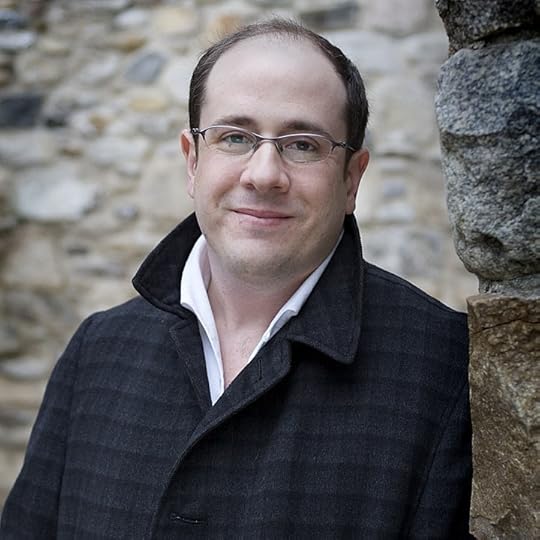
Jeff Sharlet - from his site
He traces a path from the 18th century fire and brimstone of Jonathan Edwards to the 19th century revivalist evangelical, Charles Finney, to the pulpit-pounding Billy Sunday of the 1920s through Abram Vereide, the major personal force behind what Sharlet (and its members) calls The Family. Vereide began his work in the 1930s, handing off eventually to Doug Coe, today’s leader (when this was written. Coe died in 2017. The current president is Katherine Crane.) and a familiar face and source of connections and financial support to many of our elected officials.
Underlying all is this group’s vision of the natural order as being the divine right of the wealthy and powerful to rule. The working man is seen as having no rights at all, and in fact, any attempt to organize to better his lot is seen as not only secularly seditious, but an affront against God, who has placed the worthy in their positions of ownership and power. Perhaps a better term for this might be Deo-Fascism. It will come as no surprise that major funding for this movement has always been found among the corporate elite of the country, and a major effort by this movement, throughout its history, has been to do all in their power to defeat organized labor.
I learned some new, alarming things in reading this. I always knew that many of the sci-fi films of the 1950’s were subliminal, or not so subliminal attacks on a perceived red menace. Sharlet tells of the genesis of the film, The Blob, and how it was directed by a fellow specifically intending to mainstream his fundamentalist Christian notions, and how the elements that led to the production came together at one of Abram Vereide’s gatherings.
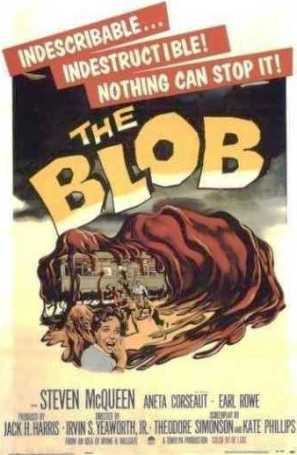
A red menace indeed
While one can use the Blob image effectively to portray how this movement functions, and the visible tip of the iceberg shielding the unseen nine-tenths, what works best for me is seeing the movement Sharlet describes as prionic in nature. Prions are infectious proteins that can lie low for extended periods of time, or stealth infections. The proteins that make them up are present in all people but the special ones that become prions are, ultimately deadly. Prions are what cause Mad Cow Disease and similar, awful diseases. The Family, The Fellowship are doing their best to spread their particular brand of infection throughout the body politic. In particular the spreaders of this worldview are interested in people in power. It is certainly possible to sell to working people an ideology based on the privileges of wealth. Just look at the anti-healthcare-reform screamers at town hall meetings, or Trump supporters these days. But a likelier medium in which to plant those seeds is with those who already have a large wedge of the pie.
These supposedly religious people would have us believe that they are submitting themselves to the will of god, of Jesus in particular. But there is only one thing before which they really fall to their knees, power. It does not matter how many tens, hundreds, thousands, even millions of people die at the hands of their members, friends and sympathizers. It does not matter to them how many lives are ruined by their steering of government towards wealth and away from work. It does not matter to them how much of mother earth is raped and plundered by their corporate supporters. What matters is power, getting it, keeping it, wielding it for their private gain, and doing all this under the guise of submitting to will of the Lord. This movement is an infection in our nation, one that will, if left unchecked, lead to the destruction of our country, and possibly more, by making ours a leadership ridden with a prionic madness. These are people who are not afraid to nuke the world in order to save it. Be afraid. Be very afraid.
One aspect of the book is that it is a rather slow read. Be prepared to take your time accumulating all the information Sharlet has unearthed. There are many players in this enterprise. I found that I often came across a name that was unfamiliar and had to backtrack to check his or her (mostly his) role in the goings on. I was disappointed that there was not a list in the back of known members, and others who had less-than-full-membership in The Family. I was a bit surprised to find Hilary Clinton referenced. But do read it, please. Everyone needs to know what is going beneath our political wet rocks.
Published - January 1, 208
Review first posted - August 2009


=============================EXTRA STUFF
Links to the author’s personal, Twitter and Instagram pages
The Revealer, a site Sharlet started to report on media coverage of religion. The work here is mostly by others
Call Me Ishmael - Jeff’s on-line journal, not his paying gig
Sharlet’s interview with Jon Stewart is worth checking out
An article Sharlet wrote for Harper's in 2009 on religion in the military, Jesus Killed Mohammed, Scary, but must-read.
-----May 26, 2018 - NY Times - A Christian Nationalist Blitz – by Katherine Stewart - Where activist faith meets fascism
-----June 20, 2018 - NY Times - The Christian Right Adopts a 50-State Strategy – by Katherine Stewart - The danger spreads
-----December 31, 2018 - NY Times - Why Trump Reigns as King Cyrus - by Katherine Stewart - a very frightening look at how the evangelical right views Trump and justifies his many crimes
-----August 29, 2019 - Vulture - What The Family Reveals About White Evangelicals, Donald Trump, and the ‘Wolf King’ - by Sarah Jones - This is a great interview with both author Jeff Sharlett and Jesse Moss, the filmmaker responsible for the Netflix series that was based on it. Check it out. Pretty alarming stuff.
-----July 1, 2020 - NPR - White Supremacist Ideas Have Historical Roots In U.S. Christianity by Tom Djelten
-----July 15, 2020 - Time - These States’ Leaders Claim to Be ‘Pro-Life.’ So Why Are So Many of Their Citizens Dying of COVID-19? By William J. Barber II and Jonathan Wilson-Hartgrove
==================================QUOTES
p 35
[Regarding a talk given by David Coe, son of Doug Coe, the Family head, at Ivanwald, a Family home in Arlington, VA. The subject is how God can forgive King David for all the atrocities he committed]
He turned to Beau. “Beau, let’s say I hear you raped three little girls. And now here you are at Ivanwald. What would I think of you, Beau?”
Beau, given to bellowing Ivanwald’s daily call to sports like a bull elephant, shrank into the cushions. “Probably that I’m pretty bad?”
“No, Beau.” David’s voice was kind. “I wouldn’t.” He drew Beau back into the circle with a stare that seemed to have its own gravitational pull. Beau nodded, brow furrowed, as if in the presence of something profound. “Because,” David continued, “I’m not here to judge you. That’s not my job. I’m here for only one thing. Do you know that that is?”
Understanding blossomed in Beau’s eyes. “Jesus?” he said. David smiled and winked.
P 43
“they take the same approach to religion that Ronald Reagan took to economics,” says a Senate staffer named Neil McBride, a political liberal with conservative convictions that puts him at odds with the Family’s unorthodox fundamentalism. “Reach the elite, and the blessings will trickle down to the underlings.”
P 44
They view themselves as the new chosen and claim a Christian doctrine of covenantalism, meaning covenants not only between God and humanity but at every level of society, replacing the rule of law and its secular contracts.
P 44
[In documents provided to members it is explained that] The cell has “veto rights” over each member’s life, and everyone pledges to monitor the others for deviation from Christ’s will. A document called “Thoughts on a Core Group” explains that “Communists use cells as their basic structure. The mafia operates like this, and the basic unit of the Marine Corps is the four man squad. Hitler, Lenin, and many others understood the power of a small core of people.”
Jesus, continues the document, does not relate to all souls equally
p 181
[One Irvin] Yeaworth, a director of “Christian education” films [was] looking to broadcast his message into the mainstream. [The result was The Blob}
p 43
“Rights,” the Family taught, are the product of an arrogant mind—an infringement on God’s authority
p 90
A rich man may have little hope of getting into heaven, but an envious one could turn to violence and lose all hope for this world or the next. Abram had to help such creatures, the derelicts, the failures. How? By helping those who could help them—the high and the mighty—that they might distribute the Lord’s blessings to the little men, whose envy would be soothed, violence averted, disorder controlled.
…Abram would coin a phrase for this vision: the “new world order.”
p 216
Contrasting American fundamentalism to secularism...in 1962, Bill Bright…who founded Campus Crusade, one of the biggest popular fundamentalist groups in the world, put it succinctly: “We worship a person, they worship ideas.” That was American fundamentalism’s Christ: a person, purged of the ideas that defined him, as if what mattered most about Jesus was the color of his eyes and the shape of his beard.
p 254
[Doug] Coe [the chief honcho of The Family] cites one of his favorite scripture verses, Matthew 18:20, “When two or three are gathered together in my name, there I am in the midst of thtem.” “Hitler, Goebbels, and Himmler were three men. Think of the immense power these three men had, these nobodies from nowhere. Actually emotional and mental problems. Prisoners. From the street. But they bound themselves together in an agreement, and they died together. Two years before they moved into Poland, these three men had a study done, systematically a plan drawn out and put on paper to annihilate the entire Polish population and destroy by numbers every single house”—he bangs the podium, dop, dop, dop—“and every single building in Warsaw and then to start on the rest of Poland.
It worked, Coe says; they killed 6 ½ million “Polish people.”
p 269
A Kansas businessman who calls [Senator Sam] Brownback his friend and has known him for years told me that the de facto price of doing business with the senator—the cost of admission for a single meeting—was, last he checked, $2,000.
p 274
Hillary [Clinton] once said she regretted that her denomination, the Methodists, had focused too much on Social Gospel concerns—that is, the rights of the poor—“to the exclusion of personal faith and growth.”
…the spirit, conservative Christians believe, matters more than the flesh, and the salvation of the former should be a higher priority than that of the latter. In worldly terms, religious freedom trumps political freedom, moral values matter more than food on the table, and if might doesn’t make right, it sure makes right, or wrong, easier
p 276
For all The Family’s talk of Jesus as a person, he remains oddly abstract in the teachings they derive from him, a mix of “free market” economics, aggressive American internationalism, and “leadership” as a fetishized term for power, a good in itself regardless of its ends.
p 386
Fundamentalism wants to ease the pain, to banish fear, forget loneliness; to erase desire. Populist fundamentalism does so by offering a certainty, a fixed story about the relationship between this world and the world to come; elite fundamentalism, certain in its entitlement, responds in this world with a politics of noblesse oblige, the missionary impulse married to military and economic power. The result is empire. Not the old imperialism of Rome or the Ottomans or the British Navy, that of a central power forcing weaker groups to pay tribute. Rather, the soft empire of America that across the span of the twentieth century recruited fundamentalism to its cause even as it seduced liberalism to its service “presents itself not as a historical regime originating in conquest, but rather as an order that effectively suspends history and thereby fixes the existing state of affairs for eternity.”
The notion one might have in approaching The Family is that it is primarily a tell-all about the people who live at C Street in Washington D.C., the grown-up frat house for (mostly) Republican elected officials and others involved in business and government. While there is some of that here, Sharlet is more interested in offering a historical perspective, not only exposing what underlies this ice-berg, but showing how it came to be.
Jeff Sharlet - from his site
He traces a path from the 18th century fire and brimstone of Jonathan Edwards to the 19th century revivalist evangelical, Charles Finney, to the pulpit-pounding Billy Sunday of the 1920s through Abram Vereide, the major personal force behind what Sharlet (and its members) calls The Family. Vereide began his work in the 1930s, handing off eventually to Doug Coe, today’s leader (when this was written. Coe died in 2017. The current president is Katherine Crane.) and a familiar face and source of connections and financial support to many of our elected officials.
Underlying all is this group’s vision of the natural order as being the divine right of the wealthy and powerful to rule. The working man is seen as having no rights at all, and in fact, any attempt to organize to better his lot is seen as not only secularly seditious, but an affront against God, who has placed the worthy in their positions of ownership and power. Perhaps a better term for this might be Deo-Fascism. It will come as no surprise that major funding for this movement has always been found among the corporate elite of the country, and a major effort by this movement, throughout its history, has been to do all in their power to defeat organized labor.
I learned some new, alarming things in reading this. I always knew that many of the sci-fi films of the 1950’s were subliminal, or not so subliminal attacks on a perceived red menace. Sharlet tells of the genesis of the film, The Blob, and how it was directed by a fellow specifically intending to mainstream his fundamentalist Christian notions, and how the elements that led to the production came together at one of Abram Vereide’s gatherings.
A red menace indeed
While one can use the Blob image effectively to portray how this movement functions, and the visible tip of the iceberg shielding the unseen nine-tenths, what works best for me is seeing the movement Sharlet describes as prionic in nature. Prions are infectious proteins that can lie low for extended periods of time, or stealth infections. The proteins that make them up are present in all people but the special ones that become prions are, ultimately deadly. Prions are what cause Mad Cow Disease and similar, awful diseases. The Family, The Fellowship are doing their best to spread their particular brand of infection throughout the body politic. In particular the spreaders of this worldview are interested in people in power. It is certainly possible to sell to working people an ideology based on the privileges of wealth. Just look at the anti-healthcare-reform screamers at town hall meetings, or Trump supporters these days. But a likelier medium in which to plant those seeds is with those who already have a large wedge of the pie.
These supposedly religious people would have us believe that they are submitting themselves to the will of god, of Jesus in particular. But there is only one thing before which they really fall to their knees, power. It does not matter how many tens, hundreds, thousands, even millions of people die at the hands of their members, friends and sympathizers. It does not matter to them how many lives are ruined by their steering of government towards wealth and away from work. It does not matter to them how much of mother earth is raped and plundered by their corporate supporters. What matters is power, getting it, keeping it, wielding it for their private gain, and doing all this under the guise of submitting to will of the Lord. This movement is an infection in our nation, one that will, if left unchecked, lead to the destruction of our country, and possibly more, by making ours a leadership ridden with a prionic madness. These are people who are not afraid to nuke the world in order to save it. Be afraid. Be very afraid.
One aspect of the book is that it is a rather slow read. Be prepared to take your time accumulating all the information Sharlet has unearthed. There are many players in this enterprise. I found that I often came across a name that was unfamiliar and had to backtrack to check his or her (mostly his) role in the goings on. I was disappointed that there was not a list in the back of known members, and others who had less-than-full-membership in The Family. I was a bit surprised to find Hilary Clinton referenced. But do read it, please. Everyone needs to know what is going beneath our political wet rocks.
Published - January 1, 208
Review first posted - August 2009
=============================EXTRA STUFF
Links to the author’s personal, Twitter and Instagram pages
The Revealer, a site Sharlet started to report on media coverage of religion. The work here is mostly by others
Call Me Ishmael - Jeff’s on-line journal, not his paying gig
Sharlet’s interview with Jon Stewart is worth checking out
An article Sharlet wrote for Harper's in 2009 on religion in the military, Jesus Killed Mohammed, Scary, but must-read.
-----May 26, 2018 - NY Times - A Christian Nationalist Blitz – by Katherine Stewart - Where activist faith meets fascism
-----June 20, 2018 - NY Times - The Christian Right Adopts a 50-State Strategy – by Katherine Stewart - The danger spreads
-----December 31, 2018 - NY Times - Why Trump Reigns as King Cyrus - by Katherine Stewart - a very frightening look at how the evangelical right views Trump and justifies his many crimes
-----August 29, 2019 - Vulture - What The Family Reveals About White Evangelicals, Donald Trump, and the ‘Wolf King’ - by Sarah Jones - This is a great interview with both author Jeff Sharlett and Jesse Moss, the filmmaker responsible for the Netflix series that was based on it. Check it out. Pretty alarming stuff.
-----July 1, 2020 - NPR - White Supremacist Ideas Have Historical Roots In U.S. Christianity by Tom Djelten
-----July 15, 2020 - Time - These States’ Leaders Claim to Be ‘Pro-Life.’ So Why Are So Many of Their Citizens Dying of COVID-19? By William J. Barber II and Jonathan Wilson-Hartgrove
==================================QUOTES
p 35
[Regarding a talk given by David Coe, son of Doug Coe, the Family head, at Ivanwald, a Family home in Arlington, VA. The subject is how God can forgive King David for all the atrocities he committed]
He turned to Beau. “Beau, let’s say I hear you raped three little girls. And now here you are at Ivanwald. What would I think of you, Beau?”
Beau, given to bellowing Ivanwald’s daily call to sports like a bull elephant, shrank into the cushions. “Probably that I’m pretty bad?”
“No, Beau.” David’s voice was kind. “I wouldn’t.” He drew Beau back into the circle with a stare that seemed to have its own gravitational pull. Beau nodded, brow furrowed, as if in the presence of something profound. “Because,” David continued, “I’m not here to judge you. That’s not my job. I’m here for only one thing. Do you know that that is?”
Understanding blossomed in Beau’s eyes. “Jesus?” he said. David smiled and winked.
P 43
“they take the same approach to religion that Ronald Reagan took to economics,” says a Senate staffer named Neil McBride, a political liberal with conservative convictions that puts him at odds with the Family’s unorthodox fundamentalism. “Reach the elite, and the blessings will trickle down to the underlings.”
P 44
They view themselves as the new chosen and claim a Christian doctrine of covenantalism, meaning covenants not only between God and humanity but at every level of society, replacing the rule of law and its secular contracts.
P 44
[In documents provided to members it is explained that] The cell has “veto rights” over each member’s life, and everyone pledges to monitor the others for deviation from Christ’s will. A document called “Thoughts on a Core Group” explains that “Communists use cells as their basic structure. The mafia operates like this, and the basic unit of the Marine Corps is the four man squad. Hitler, Lenin, and many others understood the power of a small core of people.”
Jesus, continues the document, does not relate to all souls equally
p 181
[One Irvin] Yeaworth, a director of “Christian education” films [was] looking to broadcast his message into the mainstream. [The result was The Blob}
p 43
“Rights,” the Family taught, are the product of an arrogant mind—an infringement on God’s authority
p 90
A rich man may have little hope of getting into heaven, but an envious one could turn to violence and lose all hope for this world or the next. Abram had to help such creatures, the derelicts, the failures. How? By helping those who could help them—the high and the mighty—that they might distribute the Lord’s blessings to the little men, whose envy would be soothed, violence averted, disorder controlled.
…Abram would coin a phrase for this vision: the “new world order.”
p 216
Contrasting American fundamentalism to secularism...in 1962, Bill Bright…who founded Campus Crusade, one of the biggest popular fundamentalist groups in the world, put it succinctly: “We worship a person, they worship ideas.” That was American fundamentalism’s Christ: a person, purged of the ideas that defined him, as if what mattered most about Jesus was the color of his eyes and the shape of his beard.
p 254
[Doug] Coe [the chief honcho of The Family] cites one of his favorite scripture verses, Matthew 18:20, “When two or three are gathered together in my name, there I am in the midst of thtem.” “Hitler, Goebbels, and Himmler were three men. Think of the immense power these three men had, these nobodies from nowhere. Actually emotional and mental problems. Prisoners. From the street. But they bound themselves together in an agreement, and they died together. Two years before they moved into Poland, these three men had a study done, systematically a plan drawn out and put on paper to annihilate the entire Polish population and destroy by numbers every single house”—he bangs the podium, dop, dop, dop—“and every single building in Warsaw and then to start on the rest of Poland.
It worked, Coe says; they killed 6 ½ million “Polish people.”
p 269
A Kansas businessman who calls [Senator Sam] Brownback his friend and has known him for years told me that the de facto price of doing business with the senator—the cost of admission for a single meeting—was, last he checked, $2,000.
p 274
Hillary [Clinton] once said she regretted that her denomination, the Methodists, had focused too much on Social Gospel concerns—that is, the rights of the poor—“to the exclusion of personal faith and growth.”
…the spirit, conservative Christians believe, matters more than the flesh, and the salvation of the former should be a higher priority than that of the latter. In worldly terms, religious freedom trumps political freedom, moral values matter more than food on the table, and if might doesn’t make right, it sure makes right, or wrong, easier
p 276
For all The Family’s talk of Jesus as a person, he remains oddly abstract in the teachings they derive from him, a mix of “free market” economics, aggressive American internationalism, and “leadership” as a fetishized term for power, a good in itself regardless of its ends.
p 386
Fundamentalism wants to ease the pain, to banish fear, forget loneliness; to erase desire. Populist fundamentalism does so by offering a certainty, a fixed story about the relationship between this world and the world to come; elite fundamentalism, certain in its entitlement, responds in this world with a politics of noblesse oblige, the missionary impulse married to military and economic power. The result is empire. Not the old imperialism of Rome or the Ottomans or the British Navy, that of a central power forcing weaker groups to pay tribute. Rather, the soft empire of America that across the span of the twentieth century recruited fundamentalism to its cause even as it seduced liberalism to its service “presents itself not as a historical regime originating in conquest, but rather as an order that effectively suspends history and thereby fixes the existing state of affairs for eternity.”

January 18, 2009
This book was given to me by my father-in-law, a retired Church of England minister who had numerous clashes in his career with narrow-minded Christians in and out of the Church hierarchy. He has understandable concerns about what he reads about the "Religious Right" in the US, and given the book's uniformly excellent reviews in Australia, he gave me Sharlet's THE FAMILY.
I was riveted from the first chapter: Sharlet was welcomed into the core of an organisation devoted to extending the influence of evangelical Christianity throughout the United States and the world, and he lived at their headquarters, which has the sinister name "Ivanwald". Sharlet's reporting talent is apparent from the opening sentences with their vivid depiction of typical American suburban and ex-urban communities and their earnest, basketball-playing, but possibly unconsciously intolerant residents. His thesis is that Doug Coe, the leader of a shadowy and pervasive organisation called "The Family" gives pep talks comparing his methods to those of Stalin and Hitler.
It is all deeply disturbing, esp. since Coe's supporters include many prominent Republican and some Democratic politicians. So I settled in for a good read on a vital current issue, ready to start writing cheques to the Anti-Defamation League and any other organisations I could identify, once I had finished the book, that might be on the front lines of stopping this scourge in American political life.
But starting with Page 56, Sharlet called his own credibility seriously into question. He begins a long discussion of Jonathan Edwards, the great eighteenth century New England minister to whom Sharlet traces the phenomenon of The Family. And Sharlet's discussion of Jonathan Edwards is unrecognisable. Puzzled, I went to the footnotes, where Sharlet writes that despite the "great many biographies of Edwards, my method of research for this account of his life was to rely primarily on original sources, which I tried to filter through my own half-secular mind and as I imagine a Family man might".
On the evidence of his interpretation of Edwards, Sharlet is one sick puppy. I actually took down from the shelf my copy of the most recent biography of Edwards, by the Notre Dame (hardly a centre of the Religious Right) scholar George M. Marsden, as well as my copy of Patricia J. Tracy's JONATHAN EDWARDS, PASTOR: RELIGION AND SOCIETY IN EIGHTEENTH-CENTURY NORTHAMPTON. Sharlet's grotesque description of Edwards is really shocking, and I wanted to confirm that my understanding of Edwards was founded on something other than my failing memory of these books.
It was with relief that I can report that Sharlet is basically free-associating in his discussion of Edwards, and that the lurid and disturbing claims he makes about Edwards in THE FAMILY come from the part of his psyche responsible for what Sharlet "imagines", rather than what he reads.
I returned to reading THE FAMILY with new scepticism, and then I came across Sharlet's discussion of Richard Halverson, who apparently was once in line to lead The Family before its current leader Doug Coe was appointed.
Given the late Halverson's private and public record, Sharlet has to struggle to criticize him, but his patronizing innuendoes about Halverson offer a good example of his entire method in THE FAMILY: "Halverson would help to build one of the world's largest relief agencies, World Vision, a Christian outfit that supplies food for the starving and medicine for the wounded and gospel tracts only to those who ask. Although it has been plagued by accusations of serving as a CIA front, World Vision's verifiable record is admirable . . . Halverson, in other words, was an imperialist of the old school, bringing light to the natives and clearing the way for other men to extract a dollar . . . "
The text offers plenty of clues to the alert reader about the presence of some agenda in Sharlet's book. But in the case of Halverson, as in the case of Edwards, I have my own independent information.
When I was a child, my family attended Fourth Presbyterian Church in the DC area, where Halverson was the minister, and he was a family friend. I saw him last in 1991 when he was Senate chaplain. Halverson recounted at that meeting how he and his colleague, the rabbi working with him in a pastoral capacity to the US Senate, had become very close, and that when the rabbi expressed astonishment some years before that their religious outlooks were so similar, Halverson responded "I've never heard you say anything I didn't completely agree with!" This is the man whom Sharlet paints as a sinister senior leader of a totalitarian, anti-Semitic organization plotting to take over America. I know that allegation to be false.
In fact, THE FAMILY itself is an irresponsibly written book, one of those books whose good qualities--its reporting of ordinary day to day facts that create the appearance of a vivid atmosphere, Sharlet's fluent prose, his catchy chapter titles, and so on--all serve a negative purpose, creating unfounded fear and exacerbating the already-excessive divisions in American social and political life today.
The number of works written out of either ignorance (a phenomenon not uncommon in evangelical publications) or out of bad faith and a willingness to fit the facts to one's personal agenda (what Sharlet has accomplished in THE FAMILY) is one of the chief obstacles in today's world to achieving world peace and understanding. In the aftermath of 9/11 I had long talks with an Australian woman who is a Shiite Lebanese by origin. Married at 12 and giving birth to her first child at 13, she never had the chance to pursue an education. She is highly intelligent, however. Our talks convinced me of how dangerous books such as THE FAMILY can be in this confused and hate-filled world of ours. She relied for much of her information on the Arabic-language press and radio, and a portion of that media was devoted to insane, hate-filled conspiracy theories and outright lies about the Israelis, Americans, and Jews in general. She had no way of filtering that information except through her discussions with me, and that was when I realized that her intelligence, fueled with disinformation, was very dangerous.
The 20th Century was soaked in blood, we know understand, because highly intelligent intellectuals sincerely believed that their knowledge gave them the ability, and the right, to govern others, even when their decisions contradicted age-old ethics and morality. At their core, that is where Communism and National Socialism are essentially the same. What we need to understand in the 21st century is how dangerous intelligent people with false information can be. And we need to take a stand against those who recklessly spread falsehoods masquerading as the truth. We need to speak and write the truth as we know it, so that others at least have the chance to consider both sides of an issue.
Sharlet claims to have uncovered an old form of danger to world peace and understanding: the all powerful conspiracy. In fact, he himself represents a new and powerful challenge to global understanding: those who use their positions to pollute the ocean of truth. How can my Australian father-in-law have any idea if what Sharlet writes about events in the Washington DC area are true or not? Sharlet has broken faith with readers like my father-in-law, and millions like him around the world. Alice Kaplan does an excellent job of discussing the issues surrounding reckless intellectuals who abuse their rhetorical abilities and media access in her book THE COLLABORATOR: THE TRIAL AND EXCECUTION OF ROBERT BRASILLACH.
At the end of the day, THE FAMILY isn't even good value for those who remain truly worried that people like the late Richard Halverson will one day rule America: Sharlet mainly repeats the same allegations made by David Cantor in the 1994 Anti-Defamation League study "The Religious Right: The Assault on Tolerance & Pluralism in America".
Cantor made the phrase "The Religious Right" famous with this 193 page study. Midge Decter reviewed the study at the time in the magazine COMMENTARY, which has been one of the great ornaments of American intellectual life for two generations, and not coincidently one of the great outlets for American Jewish writing on a variety of cultural, literary, social, political and religious issues. Decter wrote that the Cantor's study "is intended to warn the country of the growth, in the words of Cantor's introduction, of an 'exclusionist religious movement' seeking to 'unite its version of Christianity with state power.'
Decter summarises the playbook Cantor attributes to the Religious Right, which Sharlet claims to have uncovered 14 years later:
"Somewhere around 1990, the study notes, the decision was taken by the movement's leaders to engage in serious organizing and political activity at the grass roots, and by 1994 this decision has menacingly borne fruit:
(CONT'D BELOW IN THE COMMENT SECTION)
I was riveted from the first chapter: Sharlet was welcomed into the core of an organisation devoted to extending the influence of evangelical Christianity throughout the United States and the world, and he lived at their headquarters, which has the sinister name "Ivanwald". Sharlet's reporting talent is apparent from the opening sentences with their vivid depiction of typical American suburban and ex-urban communities and their earnest, basketball-playing, but possibly unconsciously intolerant residents. His thesis is that Doug Coe, the leader of a shadowy and pervasive organisation called "The Family" gives pep talks comparing his methods to those of Stalin and Hitler.
It is all deeply disturbing, esp. since Coe's supporters include many prominent Republican and some Democratic politicians. So I settled in for a good read on a vital current issue, ready to start writing cheques to the Anti-Defamation League and any other organisations I could identify, once I had finished the book, that might be on the front lines of stopping this scourge in American political life.
But starting with Page 56, Sharlet called his own credibility seriously into question. He begins a long discussion of Jonathan Edwards, the great eighteenth century New England minister to whom Sharlet traces the phenomenon of The Family. And Sharlet's discussion of Jonathan Edwards is unrecognisable. Puzzled, I went to the footnotes, where Sharlet writes that despite the "great many biographies of Edwards, my method of research for this account of his life was to rely primarily on original sources, which I tried to filter through my own half-secular mind and as I imagine a Family man might".
On the evidence of his interpretation of Edwards, Sharlet is one sick puppy. I actually took down from the shelf my copy of the most recent biography of Edwards, by the Notre Dame (hardly a centre of the Religious Right) scholar George M. Marsden, as well as my copy of Patricia J. Tracy's JONATHAN EDWARDS, PASTOR: RELIGION AND SOCIETY IN EIGHTEENTH-CENTURY NORTHAMPTON. Sharlet's grotesque description of Edwards is really shocking, and I wanted to confirm that my understanding of Edwards was founded on something other than my failing memory of these books.
It was with relief that I can report that Sharlet is basically free-associating in his discussion of Edwards, and that the lurid and disturbing claims he makes about Edwards in THE FAMILY come from the part of his psyche responsible for what Sharlet "imagines", rather than what he reads.
I returned to reading THE FAMILY with new scepticism, and then I came across Sharlet's discussion of Richard Halverson, who apparently was once in line to lead The Family before its current leader Doug Coe was appointed.
Given the late Halverson's private and public record, Sharlet has to struggle to criticize him, but his patronizing innuendoes about Halverson offer a good example of his entire method in THE FAMILY: "Halverson would help to build one of the world's largest relief agencies, World Vision, a Christian outfit that supplies food for the starving and medicine for the wounded and gospel tracts only to those who ask. Although it has been plagued by accusations of serving as a CIA front, World Vision's verifiable record is admirable . . . Halverson, in other words, was an imperialist of the old school, bringing light to the natives and clearing the way for other men to extract a dollar . . . "
The text offers plenty of clues to the alert reader about the presence of some agenda in Sharlet's book. But in the case of Halverson, as in the case of Edwards, I have my own independent information.
When I was a child, my family attended Fourth Presbyterian Church in the DC area, where Halverson was the minister, and he was a family friend. I saw him last in 1991 when he was Senate chaplain. Halverson recounted at that meeting how he and his colleague, the rabbi working with him in a pastoral capacity to the US Senate, had become very close, and that when the rabbi expressed astonishment some years before that their religious outlooks were so similar, Halverson responded "I've never heard you say anything I didn't completely agree with!" This is the man whom Sharlet paints as a sinister senior leader of a totalitarian, anti-Semitic organization plotting to take over America. I know that allegation to be false.
In fact, THE FAMILY itself is an irresponsibly written book, one of those books whose good qualities--its reporting of ordinary day to day facts that create the appearance of a vivid atmosphere, Sharlet's fluent prose, his catchy chapter titles, and so on--all serve a negative purpose, creating unfounded fear and exacerbating the already-excessive divisions in American social and political life today.
The number of works written out of either ignorance (a phenomenon not uncommon in evangelical publications) or out of bad faith and a willingness to fit the facts to one's personal agenda (what Sharlet has accomplished in THE FAMILY) is one of the chief obstacles in today's world to achieving world peace and understanding. In the aftermath of 9/11 I had long talks with an Australian woman who is a Shiite Lebanese by origin. Married at 12 and giving birth to her first child at 13, she never had the chance to pursue an education. She is highly intelligent, however. Our talks convinced me of how dangerous books such as THE FAMILY can be in this confused and hate-filled world of ours. She relied for much of her information on the Arabic-language press and radio, and a portion of that media was devoted to insane, hate-filled conspiracy theories and outright lies about the Israelis, Americans, and Jews in general. She had no way of filtering that information except through her discussions with me, and that was when I realized that her intelligence, fueled with disinformation, was very dangerous.
The 20th Century was soaked in blood, we know understand, because highly intelligent intellectuals sincerely believed that their knowledge gave them the ability, and the right, to govern others, even when their decisions contradicted age-old ethics and morality. At their core, that is where Communism and National Socialism are essentially the same. What we need to understand in the 21st century is how dangerous intelligent people with false information can be. And we need to take a stand against those who recklessly spread falsehoods masquerading as the truth. We need to speak and write the truth as we know it, so that others at least have the chance to consider both sides of an issue.
Sharlet claims to have uncovered an old form of danger to world peace and understanding: the all powerful conspiracy. In fact, he himself represents a new and powerful challenge to global understanding: those who use their positions to pollute the ocean of truth. How can my Australian father-in-law have any idea if what Sharlet writes about events in the Washington DC area are true or not? Sharlet has broken faith with readers like my father-in-law, and millions like him around the world. Alice Kaplan does an excellent job of discussing the issues surrounding reckless intellectuals who abuse their rhetorical abilities and media access in her book THE COLLABORATOR: THE TRIAL AND EXCECUTION OF ROBERT BRASILLACH.
At the end of the day, THE FAMILY isn't even good value for those who remain truly worried that people like the late Richard Halverson will one day rule America: Sharlet mainly repeats the same allegations made by David Cantor in the 1994 Anti-Defamation League study "The Religious Right: The Assault on Tolerance & Pluralism in America".
Cantor made the phrase "The Religious Right" famous with this 193 page study. Midge Decter reviewed the study at the time in the magazine COMMENTARY, which has been one of the great ornaments of American intellectual life for two generations, and not coincidently one of the great outlets for American Jewish writing on a variety of cultural, literary, social, political and religious issues. Decter wrote that the Cantor's study "is intended to warn the country of the growth, in the words of Cantor's introduction, of an 'exclusionist religious movement' seeking to 'unite its version of Christianity with state power.'
Decter summarises the playbook Cantor attributes to the Religious Right, which Sharlet claims to have uncovered 14 years later:
"Somewhere around 1990, the study notes, the decision was taken by the movement's leaders to engage in serious organizing and political activity at the grass roots, and by 1994 this decision has menacingly borne fruit:
(CONT'D BELOW IN THE COMMENT SECTION)

March 29, 2013
9/22/2024 addendum: This book may earn a re-read soon, as I feel that many things Sharlet was writing about when he wrote this book over ten years ago have manifested themselves in our current socio-political climate. I still know many people---good Christian people---who still think that Trump is a decent person and a viable candidate for president, even after everything that has happened. Or (and I don't know which is worse) they abhor Trump and his "foibles" but are willing to turn the other cheek because he at least represents (if not "represents") the party of everything they stand for (anti-abortion, pro-gun, anti-same sex marriage, etc.) I don't understand it, but Sharlet's book (and some of his subsequent books, like "The Undertow") have helped to clarify and elucidate some of the mindsets and philosophies that serve as a foundation for Trumpism. I don't agree with them, and I certainly still believe that they are dangerous and unhealthy, but I have a slightly better understanding of them, thanks to Sharlet... Also, I apologize for the length of this review. I was a bit more verbose in my youth...
Jeff Sharlet is a better man than me. As testament to either his objectivity as a journalist or his more-evolved sense of non-judgmentalism, Sharlet never once refers to the people he is writing about as “fanatics”, “lunatics”, “nutjobs”, “whackos”, “Jesus freaks”, or “insane”. Nor does he call them “fascists”, “bullies”, or “creeps”. Many of these words (and more) floated through my brain as I read Sharlet’s phenomenally disturbing book “The Family: The Secret Fundamentalism at the Heart of American Power”, which is very odd, because ten years ago, I may have actually sympathized with and related to the people about which Sharlet’s book is written.
Ten years ago, I would have called myself a “Born-Again Christian”, and I probably would have said it, if not with pride then without shame. Today, I have a hard time calling myself a Deist, let alone a Christian, not because I denounce the teachings of Christ (on the contrary, I try my best to live by them) but because, in my humble opinion, a portion of the people who call themselves Christians are not.
I realize that this sounds extremely judgmental and presumptuous on my part, but I can’t help the way I feel. Christianity, as it is practiced by (I would like to say a “minority” but I don’t have any statistics on this, nor do I think any truly qualitative statement can adequately be made about this, as it is my opinion based solely on observation and experience, so I will simply say) some, has subverted the true lessons of Christ.
Sharlet seems to think this as well, although he is a little more eloquent about it. He is also a lot more sympathetic towards the (mostly) men in the book, many of whom were (and, I suspect, still are) friends of Sharlet, when he was invited to live in the nondescript suburban house in Arlington, Virginia, called by its inhabitants “Ivanwald”.
This house is the central headquarters of the Family of Sharlet’s title. Also known as The Fellowship, this group is comprised of the Washington power elite---State Representatives, Senators, Judges, lobbyists, and, yes, Presidents---who use the home as a kind of Christian commune. Nonpartisan (although Sharlet admits that there are far more Republicans than Democrats) and open to women (although, again, Sharlet admits that there is only a handful of women involved), the Family has been, for decades, an organization of Christ-centered (they do not like to call themselves “Christians”) people of political clout who come together for prayer and spiritual guidance.
Charles W. Colson, the Nixon aide/Watergate felon who converted to Christianity in prison, and a respected member of the Family, in 1979, once “estimated the Family’s strength at 20,000, although the number of dedicated “associates” around the globe is much smaller (around 350 as of 2006). (p.20)”
Looked at one way, these devout men could appear to be a harmless selection of the creme de la creme of Washington, D.C. elite. One could almost respect and admire them, and, for the most part, it seems, Sharlet does.
Looked at another way, however, The Family is a frightening organization, working within the shadows and under the guise of piety and religiosity, bent on accumulation of power and world-wide domination. It may sound melodramatic and off-the-wall, until one looks deeply at the history of this organization, an organization of men who, according to Sharlet, “consider themselves a core of men responsible for changing the world. (p. 3)”
The History
It’s not a stretch to say that America is probably one of the most religious countries in the world. Religion is, after all, one of the main reasons that settlers from England first arrived on this country’s shores.
Sharlet writes, “America has been infused with religion since the day in 1630 when the Puritan John Winthrop, preparing to cross the Atlantic to found the Massachussetts Bay Colony, declared the New World the “city upon a hill” spoken of by Jesus in the Gospel of Matthew. (p. 2)”
The Pilgrims and our Founding Fathers spoke in the vocabulary of religion, and their many decisions that helped shape this country were decisions weighed by their religious convictions. Our earliest literature is the sermons of the famous fire-and-brimstone preacher John Edwards. From him, we see the embryo of American fundamentalism.
The fundamentalism of our colonial era, as compared to the fundamentalism of today, was, however, vastly different, according to Sharlet: “American fundamentalism’s original sentiments were as radically democratic in theory as they have become repressive in practice, its dream not that of Christian theocracy but of a return to the first century of Christ worship, before there was a thing called Christianity. (p. 4)” Arguably, of course, our colonial government was as theocratic as one can get, but it lacked something that today’s fundamentalists seem to have no lack of: a lust for power over others.
I have heard many Christians say that they oppose the concept of imposing their morality upon others, and I believe many of them when they say that. It’s the ultra-conservative right-wing fundamentalists who I worry about.
They don’t say it because they don’t oppose it. Their goal is to impose their morality on everyone, and they aren’t afraid to admit it.
Sharlet writes, “Both populists and elites [within the Family] call their attempts to control the lives of others “evangelism”. (p.8)”
Whether it’s an attempt to prevent women from having the choice of abortions or preventing gay couples from reaping the benefits of marriage, Christian fundamentalists clearly want to set the rules, and they cleverly attempt to do this using the Christ card.
If the Family had their way, Sharlet implies, abortion would be outlawed, gay marriage would be outlawed, homosexuality would be outlawed. Divorce, adultery, pornography---the list of things that they would most likely love to see abolished would be quite long.
So, why does the more rational-minded liberal Christian and secular segments of the population not speak out more? One of the reasons is that very few people even know the Family exists, not because they are secretive but simply because they do not talk about it. The Family is Fight Club: the first rule of the Family is: Don’t talk about the Family. Second rule is: Don’t talk about the Family.
As Sharlet explains, “This so-called underground is not a conspiracy. Rather, it’s a seventy-year-old movement of elite fundamentalism, bent not on salvation for all but on the cultivation of the powerful, “key men” chosen by God to direct the affairs of the nation. (p.7)” In simpler terms, as the Family themselves describes in a confidential mission statement: “We desire to see a leadership led by God. (p. 19)” So, who started this Family, and why? The answer begins with one man.
Abraham Veriede
Known by most people as “Abram”, Veriede was a Norwegian-born preacher who arrived in this country right before the catastrophic effects of the Great Depression devastated this country. Somewhat annoyed by what he saw as an effiminization of Christianity, Abram longed for a faith made of sterner stuff.
Sharlet writes, “For nearly 2000 years, Abram concluded, Christianity---that is, the religion, the rituals, the stuff of men with their weak, sinful minds---had bent all its energies toward the poor, the sick, the starving. The “down and out”. Christianity gave them fishes when it could and hope when it had nothing else to offer. But what good had it done? What had been accomplished between Calvary and 1935? (p. 89)”
In Abram’s mind, the answer to that question was “nothing”. Instead of preaching to the so-called “down and out”, Abram shifted his focus on people who could, based on their own successes, get things done: men of industry and power, the Carnegies and Rockefellers of the world. This, in essence, was Abram’s “revelation”: “To the big man went strength, to the little man went need. Only the big man was capable of mending the world. (p. 89)”
Sharlet describes Abram’s theology as “a religion for the elite---”the up and out,” as he called them” and called his “trickle-down faith the Idea, and it was really the only idea he ever had... (p. 91)”
Abram envisioned a world ruled by powerful men who were themselves ruled by Christ, a perfect world, in his opinion. He coined the phrase “new world order” to describe this brave new world. The questions were, where and when to begin.
Thankfully, a dockworker strike in 1934 in San Francisco helped answer those questions. This was the spark that lit Abram’s movement: “[E]lite fundamentalism took as its first challenge the destruction of militant labor. Destruction was not the word Christians used, however. They called it cooperation. (p. 108)”
Among the list of enemies of Abram’s elite fundamentalists in those days were unions, communists, and Father Coughlin, the popular “radio priest” from Detroit, Michigan.
Coughlin was “full of hatred for the capitalists who had lined their silk pockets. Coughlin, as much as or more than the communists, seemed like he might call for blood one day, and soon. (p. 115)”
This, Abrams could not allow. In Abram’s worldview, it was “common” people like Coughlin and the rest of the nation’s poor who represented a blockade for the creation of Christ’s Kingdom on Earth.
Money was the key, something that the poor obviously lacked, which therefore made them insignificant. Ironically, “Money was like power: Those who had it should not speak of it, concern themselves with it, acknowledge its existence as a factor. To do so was worse than bad manners; it was blasphemy, an attempt to refute God’s ordering of economic affairs. (p. 115)”
Abram’s theology clearly struck a chord in the minds of the rich men to whom he preached, a group of men whom, as Abram said, “did not want to be preached at. (p.115)”
Who knew telling your audience exactly what they want to hear would work so well? It wasn’t long before Abram had his first “key player”.
Arthur Langlie
A representative of the New Order of Cincinnatus, a group of young businessmen who were opposed to FDR’s New Deal, Arthur Langlie became a city council member in Seattle in 1934. Langlie ran under a popular platform that “had two solutions to economic malaise: slash taxes and attack vice. As councilman, Langlie purged the city’s police department... He then turned his ax toward the fire department (poor moral specimens) and public school teachers (indoctrinating the youth with godless notions). (p. 118)” Strange how times haven’t changed much.
Eventually, Langlie ran for, and won, the position of mayor. Unions didn’t stand a chance under Mayor Langlie: “”Good government,” as Langlie called his platform of budget slashing and punishing moral rectitude, trumped labor. (p. 120)”
He promised to “end political corruption”, but he “didn’t so much end corruption as legalize it. Langlie wasn’t opposed to a government organized around the interests of the greedy; he just didn’t want to have to break the law to serve them. (p. 120)”
Graft and greed (for the glory of God) was good: “So Langlie accepted the constraints of democracy as he found them. He did what business asked: purged welfare rolls, abolished guaranteed wage laws, denounced Democrats as un-American. In 1942, he investigated the possibility of using martial law to suppress organized labor, but when his advisors told him it would be unconstitutional, he settled for ordinary strikebreaking. He governed, in other words, as a right-wing Republican. (p. 122)”
After Langlie, numerous other protegees and devotees of Abram began to surface around the country, coming into positions of power. One of those students was Henry Ford.
Abram took Ford under his wing, who was naturally attracted to Abram’s theology of “biblical capitalism”, which was, for Ford, a brilliant marriage of two of Ford’s interests: the Gospel and fascism. While Abram himself never quite adopted the language and spirit of fascism, his theology was nevertheless conducive to some of fascism’s attributes.
Nazi sympathizers like Ford, Charles Lindbergh, and Baron von der Rapp, a former German nationalist and a Christian preacher, were inevitably quite taken with Abram’s fundamentalism. Rapp taught that “the poor, with their demands for government services---which he understood as a failure to trust that God would provide---were “the adversaries of the church.” But not through their own doing; rather, absent some modicum of prosperity, they were too bitter to properly appreciate Christ’s providence. (p. 173)”
He went on to preach that “God is not the God of ethics, of morality; God is great, God made this order and chose its leaders. (p. 175)” Sadly, this mindset---God wants the rich to get richer and the poor to get poorer---has been carried over into the current fundamentalist worldview. Power for its own sake is all that matters. Perhaps this is illustrated best in the most powerful man currently in the Family.
Doug Coe
David Kuo, a former special assistant to the president during George W. Bush’s first term and author of “Tempting Faith: The Inside Story of a Political Seduction” soon discovered that Bush may have “talked the talk” in regards to his faith but didn’t really “walk the walk”.
In Kuo’s book, he recounts “the story of how he and a few others transformed the Office of Faith-Based Initiatives into the very Republican vote-getting machine its critics had accused it of being from the beginning. “We laid out a plan whereby we would hold ‘roundtable events’ for threatened incumbents with faith and community leaders,” he writes. In 2002, those roundtables contributed to nineteen out of twenty victories in targeted races. (p. 383)”
Disillusioned by his experience in the political arena with Bush and his fellow elite fundamentalists (Bush, by the way, is a member of the Family, as if there was ever any question), Kuo quit his position after Bush’s first term. Kuo writes, “We were good people forced to run a sad charade, to provide political cover to a White House that needed compassion and religion as political tools. (p. 383)”
Embedded in that last statement, though, is the question: Could they honestly call themselves “good people”?
As Kuo said, “The Fellowship’s reach into governments around the world is almost impossible to overstate or even grasp. (p. 25)”
The Family, according to Sharlet, has wormed its way into so many coups and revolutions throughout the world, resulting in millions of deaths, all in the name of furthering the great cause of global Christian fundamentalist totalitarian rule. Yet they are immune from prosecution and blame. How is this possible?
One reason is the dedicated work of one man: Doug Coe.
Coe was personally chosen by Abram to be his successor, and he has been doing a phenomenal job ever since: “In 2005, Time magazine labeled Abram’s successor, Doug Coe, the stealth persuader, a term that might just as easily have fit his mentor. (p. 91-92)”
D. Michael Lindsay, a Rice University sociologist said, “One in three [of 360 evangelical elites interviewed] mentioned Coe or the fellowship as an important influence. Indeed, there is no other organization like the Fellowship, especially among religious groups, in terms of its access or clout among the country’s leadership. (p. 25)”
Coe (normally a quiet man who does not allow himself to be interviewed or even photographed that often) has gone on record, saying, “We work with power where we can, build new power where we can’t.” Among the many “powers” that the Family has worked with around the globe are dictators like Suharto and Duvalier, vicious monsters notorious for their genocide but also their Christianity.
Coe remains unapologetic. It is, according to him and the Family, all for the glory of God. They can get away with it because there is nothing to tie the Family to these dictators. Everything is done through private channels, and no documentation exists.
That a group like the Family exists at all is terrifying, disgusting, but probably not that surprising. That so few people know or even care is the shocking part. Bewildering is the number of people who will probably read “The Family” and walk away thinking that it is ultimately a good thing what the Family is doing. That is simply unforgivable. Then again, if I still considered myself a "born-again Christian" I may have walked away from Sharlet's book with a much different take-away message, too.
Jeff Sharlet is a better man than me. As testament to either his objectivity as a journalist or his more-evolved sense of non-judgmentalism, Sharlet never once refers to the people he is writing about as “fanatics”, “lunatics”, “nutjobs”, “whackos”, “Jesus freaks”, or “insane”. Nor does he call them “fascists”, “bullies”, or “creeps”. Many of these words (and more) floated through my brain as I read Sharlet’s phenomenally disturbing book “The Family: The Secret Fundamentalism at the Heart of American Power”, which is very odd, because ten years ago, I may have actually sympathized with and related to the people about which Sharlet’s book is written.
Ten years ago, I would have called myself a “Born-Again Christian”, and I probably would have said it, if not with pride then without shame. Today, I have a hard time calling myself a Deist, let alone a Christian, not because I denounce the teachings of Christ (on the contrary, I try my best to live by them) but because, in my humble opinion, a portion of the people who call themselves Christians are not.
I realize that this sounds extremely judgmental and presumptuous on my part, but I can’t help the way I feel. Christianity, as it is practiced by (I would like to say a “minority” but I don’t have any statistics on this, nor do I think any truly qualitative statement can adequately be made about this, as it is my opinion based solely on observation and experience, so I will simply say) some, has subverted the true lessons of Christ.
Sharlet seems to think this as well, although he is a little more eloquent about it. He is also a lot more sympathetic towards the (mostly) men in the book, many of whom were (and, I suspect, still are) friends of Sharlet, when he was invited to live in the nondescript suburban house in Arlington, Virginia, called by its inhabitants “Ivanwald”.
This house is the central headquarters of the Family of Sharlet’s title. Also known as The Fellowship, this group is comprised of the Washington power elite---State Representatives, Senators, Judges, lobbyists, and, yes, Presidents---who use the home as a kind of Christian commune. Nonpartisan (although Sharlet admits that there are far more Republicans than Democrats) and open to women (although, again, Sharlet admits that there is only a handful of women involved), the Family has been, for decades, an organization of Christ-centered (they do not like to call themselves “Christians”) people of political clout who come together for prayer and spiritual guidance.
Charles W. Colson, the Nixon aide/Watergate felon who converted to Christianity in prison, and a respected member of the Family, in 1979, once “estimated the Family’s strength at 20,000, although the number of dedicated “associates” around the globe is much smaller (around 350 as of 2006). (p.20)”
Looked at one way, these devout men could appear to be a harmless selection of the creme de la creme of Washington, D.C. elite. One could almost respect and admire them, and, for the most part, it seems, Sharlet does.
Looked at another way, however, The Family is a frightening organization, working within the shadows and under the guise of piety and religiosity, bent on accumulation of power and world-wide domination. It may sound melodramatic and off-the-wall, until one looks deeply at the history of this organization, an organization of men who, according to Sharlet, “consider themselves a core of men responsible for changing the world. (p. 3)”
The History
It’s not a stretch to say that America is probably one of the most religious countries in the world. Religion is, after all, one of the main reasons that settlers from England first arrived on this country’s shores.
Sharlet writes, “America has been infused with religion since the day in 1630 when the Puritan John Winthrop, preparing to cross the Atlantic to found the Massachussetts Bay Colony, declared the New World the “city upon a hill” spoken of by Jesus in the Gospel of Matthew. (p. 2)”
The Pilgrims and our Founding Fathers spoke in the vocabulary of religion, and their many decisions that helped shape this country were decisions weighed by their religious convictions. Our earliest literature is the sermons of the famous fire-and-brimstone preacher John Edwards. From him, we see the embryo of American fundamentalism.
The fundamentalism of our colonial era, as compared to the fundamentalism of today, was, however, vastly different, according to Sharlet: “American fundamentalism’s original sentiments were as radically democratic in theory as they have become repressive in practice, its dream not that of Christian theocracy but of a return to the first century of Christ worship, before there was a thing called Christianity. (p. 4)” Arguably, of course, our colonial government was as theocratic as one can get, but it lacked something that today’s fundamentalists seem to have no lack of: a lust for power over others.
I have heard many Christians say that they oppose the concept of imposing their morality upon others, and I believe many of them when they say that. It’s the ultra-conservative right-wing fundamentalists who I worry about.
They don’t say it because they don’t oppose it. Their goal is to impose their morality on everyone, and they aren’t afraid to admit it.
Sharlet writes, “Both populists and elites [within the Family] call their attempts to control the lives of others “evangelism”. (p.8)”
Whether it’s an attempt to prevent women from having the choice of abortions or preventing gay couples from reaping the benefits of marriage, Christian fundamentalists clearly want to set the rules, and they cleverly attempt to do this using the Christ card.
If the Family had their way, Sharlet implies, abortion would be outlawed, gay marriage would be outlawed, homosexuality would be outlawed. Divorce, adultery, pornography---the list of things that they would most likely love to see abolished would be quite long.
So, why does the more rational-minded liberal Christian and secular segments of the population not speak out more? One of the reasons is that very few people even know the Family exists, not because they are secretive but simply because they do not talk about it. The Family is Fight Club: the first rule of the Family is: Don’t talk about the Family. Second rule is: Don’t talk about the Family.
As Sharlet explains, “This so-called underground is not a conspiracy. Rather, it’s a seventy-year-old movement of elite fundamentalism, bent not on salvation for all but on the cultivation of the powerful, “key men” chosen by God to direct the affairs of the nation. (p.7)” In simpler terms, as the Family themselves describes in a confidential mission statement: “We desire to see a leadership led by God. (p. 19)” So, who started this Family, and why? The answer begins with one man.
Abraham Veriede
Known by most people as “Abram”, Veriede was a Norwegian-born preacher who arrived in this country right before the catastrophic effects of the Great Depression devastated this country. Somewhat annoyed by what he saw as an effiminization of Christianity, Abram longed for a faith made of sterner stuff.
Sharlet writes, “For nearly 2000 years, Abram concluded, Christianity---that is, the religion, the rituals, the stuff of men with their weak, sinful minds---had bent all its energies toward the poor, the sick, the starving. The “down and out”. Christianity gave them fishes when it could and hope when it had nothing else to offer. But what good had it done? What had been accomplished between Calvary and 1935? (p. 89)”
In Abram’s mind, the answer to that question was “nothing”. Instead of preaching to the so-called “down and out”, Abram shifted his focus on people who could, based on their own successes, get things done: men of industry and power, the Carnegies and Rockefellers of the world. This, in essence, was Abram’s “revelation”: “To the big man went strength, to the little man went need. Only the big man was capable of mending the world. (p. 89)”
Sharlet describes Abram’s theology as “a religion for the elite---”the up and out,” as he called them” and called his “trickle-down faith the Idea, and it was really the only idea he ever had... (p. 91)”
Abram envisioned a world ruled by powerful men who were themselves ruled by Christ, a perfect world, in his opinion. He coined the phrase “new world order” to describe this brave new world. The questions were, where and when to begin.
Thankfully, a dockworker strike in 1934 in San Francisco helped answer those questions. This was the spark that lit Abram’s movement: “[E]lite fundamentalism took as its first challenge the destruction of militant labor. Destruction was not the word Christians used, however. They called it cooperation. (p. 108)”
Among the list of enemies of Abram’s elite fundamentalists in those days were unions, communists, and Father Coughlin, the popular “radio priest” from Detroit, Michigan.
Coughlin was “full of hatred for the capitalists who had lined their silk pockets. Coughlin, as much as or more than the communists, seemed like he might call for blood one day, and soon. (p. 115)”
This, Abrams could not allow. In Abram’s worldview, it was “common” people like Coughlin and the rest of the nation’s poor who represented a blockade for the creation of Christ’s Kingdom on Earth.
Money was the key, something that the poor obviously lacked, which therefore made them insignificant. Ironically, “Money was like power: Those who had it should not speak of it, concern themselves with it, acknowledge its existence as a factor. To do so was worse than bad manners; it was blasphemy, an attempt to refute God’s ordering of economic affairs. (p. 115)”
Abram’s theology clearly struck a chord in the minds of the rich men to whom he preached, a group of men whom, as Abram said, “did not want to be preached at. (p.115)”
Who knew telling your audience exactly what they want to hear would work so well? It wasn’t long before Abram had his first “key player”.
Arthur Langlie
A representative of the New Order of Cincinnatus, a group of young businessmen who were opposed to FDR’s New Deal, Arthur Langlie became a city council member in Seattle in 1934. Langlie ran under a popular platform that “had two solutions to economic malaise: slash taxes and attack vice. As councilman, Langlie purged the city’s police department... He then turned his ax toward the fire department (poor moral specimens) and public school teachers (indoctrinating the youth with godless notions). (p. 118)” Strange how times haven’t changed much.
Eventually, Langlie ran for, and won, the position of mayor. Unions didn’t stand a chance under Mayor Langlie: “”Good government,” as Langlie called his platform of budget slashing and punishing moral rectitude, trumped labor. (p. 120)”
He promised to “end political corruption”, but he “didn’t so much end corruption as legalize it. Langlie wasn’t opposed to a government organized around the interests of the greedy; he just didn’t want to have to break the law to serve them. (p. 120)”
Graft and greed (for the glory of God) was good: “So Langlie accepted the constraints of democracy as he found them. He did what business asked: purged welfare rolls, abolished guaranteed wage laws, denounced Democrats as un-American. In 1942, he investigated the possibility of using martial law to suppress organized labor, but when his advisors told him it would be unconstitutional, he settled for ordinary strikebreaking. He governed, in other words, as a right-wing Republican. (p. 122)”
After Langlie, numerous other protegees and devotees of Abram began to surface around the country, coming into positions of power. One of those students was Henry Ford.
Abram took Ford under his wing, who was naturally attracted to Abram’s theology of “biblical capitalism”, which was, for Ford, a brilliant marriage of two of Ford’s interests: the Gospel and fascism. While Abram himself never quite adopted the language and spirit of fascism, his theology was nevertheless conducive to some of fascism’s attributes.
Nazi sympathizers like Ford, Charles Lindbergh, and Baron von der Rapp, a former German nationalist and a Christian preacher, were inevitably quite taken with Abram’s fundamentalism. Rapp taught that “the poor, with their demands for government services---which he understood as a failure to trust that God would provide---were “the adversaries of the church.” But not through their own doing; rather, absent some modicum of prosperity, they were too bitter to properly appreciate Christ’s providence. (p. 173)”
He went on to preach that “God is not the God of ethics, of morality; God is great, God made this order and chose its leaders. (p. 175)” Sadly, this mindset---God wants the rich to get richer and the poor to get poorer---has been carried over into the current fundamentalist worldview. Power for its own sake is all that matters. Perhaps this is illustrated best in the most powerful man currently in the Family.
Doug Coe
David Kuo, a former special assistant to the president during George W. Bush’s first term and author of “Tempting Faith: The Inside Story of a Political Seduction” soon discovered that Bush may have “talked the talk” in regards to his faith but didn’t really “walk the walk”.
In Kuo’s book, he recounts “the story of how he and a few others transformed the Office of Faith-Based Initiatives into the very Republican vote-getting machine its critics had accused it of being from the beginning. “We laid out a plan whereby we would hold ‘roundtable events’ for threatened incumbents with faith and community leaders,” he writes. In 2002, those roundtables contributed to nineteen out of twenty victories in targeted races. (p. 383)”
Disillusioned by his experience in the political arena with Bush and his fellow elite fundamentalists (Bush, by the way, is a member of the Family, as if there was ever any question), Kuo quit his position after Bush’s first term. Kuo writes, “We were good people forced to run a sad charade, to provide political cover to a White House that needed compassion and religion as political tools. (p. 383)”
Embedded in that last statement, though, is the question: Could they honestly call themselves “good people”?
As Kuo said, “The Fellowship’s reach into governments around the world is almost impossible to overstate or even grasp. (p. 25)”
The Family, according to Sharlet, has wormed its way into so many coups and revolutions throughout the world, resulting in millions of deaths, all in the name of furthering the great cause of global Christian fundamentalist totalitarian rule. Yet they are immune from prosecution and blame. How is this possible?
One reason is the dedicated work of one man: Doug Coe.
Coe was personally chosen by Abram to be his successor, and he has been doing a phenomenal job ever since: “In 2005, Time magazine labeled Abram’s successor, Doug Coe, the stealth persuader, a term that might just as easily have fit his mentor. (p. 91-92)”
D. Michael Lindsay, a Rice University sociologist said, “One in three [of 360 evangelical elites interviewed] mentioned Coe or the fellowship as an important influence. Indeed, there is no other organization like the Fellowship, especially among religious groups, in terms of its access or clout among the country’s leadership. (p. 25)”
Coe (normally a quiet man who does not allow himself to be interviewed or even photographed that often) has gone on record, saying, “We work with power where we can, build new power where we can’t.” Among the many “powers” that the Family has worked with around the globe are dictators like Suharto and Duvalier, vicious monsters notorious for their genocide but also their Christianity.
Coe remains unapologetic. It is, according to him and the Family, all for the glory of God. They can get away with it because there is nothing to tie the Family to these dictators. Everything is done through private channels, and no documentation exists.
That a group like the Family exists at all is terrifying, disgusting, but probably not that surprising. That so few people know or even care is the shocking part. Bewildering is the number of people who will probably read “The Family” and walk away thinking that it is ultimately a good thing what the Family is doing. That is simply unforgivable. Then again, if I still considered myself a "born-again Christian" I may have walked away from Sharlet's book with a much different take-away message, too.

June 16, 2009
As Jeff Sharlet has been at pains to stress since The Family was published, the "Secret Fundamentalism at the Heart of American Power" is not a conspiracy. Rather, it is secret because it is discrete, and because it has been overlooked by journalists and the secular writers of American history. Abraham Vereide's name is familiar enough if you know modern evangelical history or read Christian books – Billy Graham describes him as "a remarkable man", Corrie Ten Boom sought out his endorsement when she arrived in the USA after the war, and Norman Grubb of the World Evangelisation Crusade wrote a popular biography for Zondervan in the 1960s – but his political significance remains under-appreciated and the motivation of his movement unscrutinized. For Sharlet, Vereide "stood at the vanguard of an elite fundamentalism that shaped the last half century of American and world politics in ways only now becoming visible". This "elite fundamentalism" – in contrast to the vulgarity of televangelists and mass revivalists – works quietly behind the scenes to bring together decision-makers and leaders in private fellowship and prayer under a simple – or vacuous – creed of "Jesus Plus Nothing". In public we see the Prayer Breakfasts, and in 2007 Al Gore's name-dropping of Vereide's successor Doug Coe in debate with James Inhofe, but in private there are prayer cells and retreat houses where Family theology facilitates a back-channel of influence and networking both in the USA and abroad.
The Family is divided into three sections: in Part One, Sharlet sets the scene with his own encounter with the Family before setting off on a background excursion into American revivalism, briefly exploring the worlds of Jonathan Edwards and Charles Finney. Sharlet’s approach to these historical subjects is strangely and eccentrically gothic; the straight historian may perhaps be annoyed by Sharlet’s dark impressions of Edwards watching an anorexic starve to death or the way he portrays Finney's "forest grotto" religious experience as something almost Lovecraftian, but it makes for more engaging read than a the usual potted biography we might find in any general history. Throughout the book, Sharlet's research is interspersed with personal reflections and anecdotes, allusive references, striking turns of phrase, and unexpected diversions: depending on your temperament or your reason for reading the book, you will find this thought-provoking and original or slightly irritating.
Part Two tells the actual story of the Family, and is informed by material which Sharlet found in the organisation's archives before public access was recently withdrawn. We learn how Vereide, a Norwegian immigrant who became an executive with Goodwill Industries in Seattle, responded to labour conflict in his adoptive city with a plan – backed by local businessmen Walter Douglass and William St. Clair – to use the "Bible as blueprint" to take back the USA from irreligion and the communist threat. This meant a "cooperative" model of management-labour relations, in which labour would understand its need to behave responsibly. Sharlet notes Vereide's links to Frank Buchman, who was thinking along similar lines (Sharlet describes Buchman a "huckster", which I think is unfair; his impression is taken from Tom Driberg's polemical writing against Buchman’s Moral Re-Armament, and there is no reference to Garth Lean's counter-balancing sympathetic but serious biography).
Vereide's aim would be achieved by ministering to the "up and out" – bringing Christ to elites. As this new Fellowship (the earlier name of the Family) developed, eventually reaching the elites of Washington DC, Vereide’s associations became murkier: Vereide had already made links with Henry Ford, who was trying to shake off his reputation for anti-Semitism, and Charles Lindbergh became the leader of a Fellowship prayer group. Merwin K. Hart, a fascist sympathizer from New York, provided further Fellowship members, while a KKK Senator named Ralph Brewster helped Vereide run prayer meetings at the Hotel Willard in 1942. The only figure from organised labour was James Duncan, whose main concern was stopping black Americans from joining the workforce at Boeing. Post-war, Vereide lobbied on behalf of Germans with questionable Nazi-era pasts. Funding for Vereide eventually came from the William Volker fund, which also subsidised publication of The Road to Serfdom and the grim "theonomy" of Rousas Rushdoony. Sharlet is particularly troubled by Fellowship complicity with Suharto's bloodletting in Indonesia; Vereide described Suharto's coup as a "spiritual revolution", and Indonesia went on to develop its own "Prayer Breakfast".
In the post-Vereide era, under the direction of Doug Coe, the Fellowship chose to "submerge" as its influence became more pervasive, with politicians and dictators from around the world meeting discretely in a Fellowship property in Washington DC – Sharlet tells us that as his interest in the group developed (he wrote an article on the subject for Harper’s in 2003) he came under surveillance. Coe himself has a public profile: most famously, he features in Charles Colson's autobiography (one of those "as told to John and Elizabeth Sherrill" bestsellers) Born Again playing a central role in bringing Colson to faith during the Watergate scandal, and Sharlet describes Colson as now being "one of the leading theorists of American fundamentalism". The purpose of the original American Prayer Breakfast, Sharlet shrewdly notes, was "to lop oft the left end of the political spectrum and cauterize the wound", and today the Family enjoys influence across the political establishment in America; it is far bigger than the "Religious Right", and Hillary Clinton is a "friend".
In Part Three, Sharlet looks at what he calls "the Popular Front", the broad network of popular conservative evangelicalism: megachurches and home churches; neo-Pentecostal spiritual warfare; anti-abortion activists, approaches to sexuality, and Bush's Office of Faith-Based Initiatives. The Family largely disappears from view in this section, and instead we have the more familiar topic of how evangelicals in the Bush years developed and enjoyed access to power – only, in the last instance, to be used for electoral gain. Underlying this apparent diversion is Sharlet's interest in the how elite and popular fundamentalism intertwines or contrasts.
But what is the "elite fundamentalism" which inspired Vereide and the Fellowship? Sharlet calls it "the Idea" – a flexible faith for an expanding American empire which is so lacking in content that even the Muslim General Suharto can come on board: Vereide valued submission to power rather than belief, and this concern with "power", Sharlet suggests, motivates the Family's strategy. One aspect of Sharlet's research which provoked particular journalistic comment is the incredibly crass way in which Family leaders speak in awe of the leadership abilities of Hitler, Stalin, and Mao. Of course, these men are reviled as evil, but each one – in a grossly simplistic reading of history – came from nowhere, and with the help of a small group of associates managed to change the world. Apparently, they failed because their purpose was bad, not because the whole idea of realising a vision through putting trust in big men inevitably leads to disaster; as Vereide put it, today "is the age of minority control". This control is extended through capitalism – Vereide's (British) biographer Norman Grubb saw capitalism as a wedge to spread Christ abroad – and exerted through management; Sharlet traces the line from Bruce Barton's "Babbitt cult" of business-friendly Christianity through to Rick Warren’s Purpose-Driven time management manual (itself inspired by management guru Peter Drucker). One critic of the Family Sharlet meets complains of a "moral vacuum". Although Sharlet avoids old-school academic theorising, we can detect the spectre, not of Marx, but of Weber.
Sharlet is not the first to detect "power" as the operative motive in fundamentalism – Martyn Percy's Words, Wonder, and Power explores the concept as it relates to leadership in neo-Pentecostalism (this book also provides a rationale for using the term "fundamentalist" in a general way, a gripe that Randall Balmer has made against Sharlet). The links between American political elites and fundamentalism also reminded me of Colby and Dennette's doomed epic Thy Will Be Done: Nelson Rockefeller and Evangelism in the Age of Oil, which, although a great read, fails to make a conclusive and direct connection in more than 900 pages.
The Family highlights many areas that deserve further research, and the seam that Sharlet has struck is far from completely excavated: what exactly was the role of "the Twelve", a group which Vereide joined? Why did missionaries stay at the Zurich home of Alfred Hirs, who ran the Bank of Switzerland, and link up with Baron Von Gienanth? Who exactly was Wallace Haines, who stood in for Vereide in Europe when Vereide was ill, and who also features briefly in Stewart Dinnen's biography of Norman Grubb? What did the "Havana prayer cell" get up to? Many clues remain unpondered in archives, in long out-of-print popular Christian paperbacks (a genre often overlooked), and in private reminiscences. And of course, there is one question which Sharlet has asked but which we can never have a full answer to: what exactly is the scope of the Family today?
The Family is divided into three sections: in Part One, Sharlet sets the scene with his own encounter with the Family before setting off on a background excursion into American revivalism, briefly exploring the worlds of Jonathan Edwards and Charles Finney. Sharlet’s approach to these historical subjects is strangely and eccentrically gothic; the straight historian may perhaps be annoyed by Sharlet’s dark impressions of Edwards watching an anorexic starve to death or the way he portrays Finney's "forest grotto" religious experience as something almost Lovecraftian, but it makes for more engaging read than a the usual potted biography we might find in any general history. Throughout the book, Sharlet's research is interspersed with personal reflections and anecdotes, allusive references, striking turns of phrase, and unexpected diversions: depending on your temperament or your reason for reading the book, you will find this thought-provoking and original or slightly irritating.
Part Two tells the actual story of the Family, and is informed by material which Sharlet found in the organisation's archives before public access was recently withdrawn. We learn how Vereide, a Norwegian immigrant who became an executive with Goodwill Industries in Seattle, responded to labour conflict in his adoptive city with a plan – backed by local businessmen Walter Douglass and William St. Clair – to use the "Bible as blueprint" to take back the USA from irreligion and the communist threat. This meant a "cooperative" model of management-labour relations, in which labour would understand its need to behave responsibly. Sharlet notes Vereide's links to Frank Buchman, who was thinking along similar lines (Sharlet describes Buchman a "huckster", which I think is unfair; his impression is taken from Tom Driberg's polemical writing against Buchman’s Moral Re-Armament, and there is no reference to Garth Lean's counter-balancing sympathetic but serious biography).
Vereide's aim would be achieved by ministering to the "up and out" – bringing Christ to elites. As this new Fellowship (the earlier name of the Family) developed, eventually reaching the elites of Washington DC, Vereide’s associations became murkier: Vereide had already made links with Henry Ford, who was trying to shake off his reputation for anti-Semitism, and Charles Lindbergh became the leader of a Fellowship prayer group. Merwin K. Hart, a fascist sympathizer from New York, provided further Fellowship members, while a KKK Senator named Ralph Brewster helped Vereide run prayer meetings at the Hotel Willard in 1942. The only figure from organised labour was James Duncan, whose main concern was stopping black Americans from joining the workforce at Boeing. Post-war, Vereide lobbied on behalf of Germans with questionable Nazi-era pasts. Funding for Vereide eventually came from the William Volker fund, which also subsidised publication of The Road to Serfdom and the grim "theonomy" of Rousas Rushdoony. Sharlet is particularly troubled by Fellowship complicity with Suharto's bloodletting in Indonesia; Vereide described Suharto's coup as a "spiritual revolution", and Indonesia went on to develop its own "Prayer Breakfast".
In the post-Vereide era, under the direction of Doug Coe, the Fellowship chose to "submerge" as its influence became more pervasive, with politicians and dictators from around the world meeting discretely in a Fellowship property in Washington DC – Sharlet tells us that as his interest in the group developed (he wrote an article on the subject for Harper’s in 2003) he came under surveillance. Coe himself has a public profile: most famously, he features in Charles Colson's autobiography (one of those "as told to John and Elizabeth Sherrill" bestsellers) Born Again playing a central role in bringing Colson to faith during the Watergate scandal, and Sharlet describes Colson as now being "one of the leading theorists of American fundamentalism". The purpose of the original American Prayer Breakfast, Sharlet shrewdly notes, was "to lop oft the left end of the political spectrum and cauterize the wound", and today the Family enjoys influence across the political establishment in America; it is far bigger than the "Religious Right", and Hillary Clinton is a "friend".
In Part Three, Sharlet looks at what he calls "the Popular Front", the broad network of popular conservative evangelicalism: megachurches and home churches; neo-Pentecostal spiritual warfare; anti-abortion activists, approaches to sexuality, and Bush's Office of Faith-Based Initiatives. The Family largely disappears from view in this section, and instead we have the more familiar topic of how evangelicals in the Bush years developed and enjoyed access to power – only, in the last instance, to be used for electoral gain. Underlying this apparent diversion is Sharlet's interest in the how elite and popular fundamentalism intertwines or contrasts.
But what is the "elite fundamentalism" which inspired Vereide and the Fellowship? Sharlet calls it "the Idea" – a flexible faith for an expanding American empire which is so lacking in content that even the Muslim General Suharto can come on board: Vereide valued submission to power rather than belief, and this concern with "power", Sharlet suggests, motivates the Family's strategy. One aspect of Sharlet's research which provoked particular journalistic comment is the incredibly crass way in which Family leaders speak in awe of the leadership abilities of Hitler, Stalin, and Mao. Of course, these men are reviled as evil, but each one – in a grossly simplistic reading of history – came from nowhere, and with the help of a small group of associates managed to change the world. Apparently, they failed because their purpose was bad, not because the whole idea of realising a vision through putting trust in big men inevitably leads to disaster; as Vereide put it, today "is the age of minority control". This control is extended through capitalism – Vereide's (British) biographer Norman Grubb saw capitalism as a wedge to spread Christ abroad – and exerted through management; Sharlet traces the line from Bruce Barton's "Babbitt cult" of business-friendly Christianity through to Rick Warren’s Purpose-Driven time management manual (itself inspired by management guru Peter Drucker). One critic of the Family Sharlet meets complains of a "moral vacuum". Although Sharlet avoids old-school academic theorising, we can detect the spectre, not of Marx, but of Weber.
Sharlet is not the first to detect "power" as the operative motive in fundamentalism – Martyn Percy's Words, Wonder, and Power explores the concept as it relates to leadership in neo-Pentecostalism (this book also provides a rationale for using the term "fundamentalist" in a general way, a gripe that Randall Balmer has made against Sharlet). The links between American political elites and fundamentalism also reminded me of Colby and Dennette's doomed epic Thy Will Be Done: Nelson Rockefeller and Evangelism in the Age of Oil, which, although a great read, fails to make a conclusive and direct connection in more than 900 pages.
The Family highlights many areas that deserve further research, and the seam that Sharlet has struck is far from completely excavated: what exactly was the role of "the Twelve", a group which Vereide joined? Why did missionaries stay at the Zurich home of Alfred Hirs, who ran the Bank of Switzerland, and link up with Baron Von Gienanth? Who exactly was Wallace Haines, who stood in for Vereide in Europe when Vereide was ill, and who also features briefly in Stewart Dinnen's biography of Norman Grubb? What did the "Havana prayer cell" get up to? Many clues remain unpondered in archives, in long out-of-print popular Christian paperbacks (a genre often overlooked), and in private reminiscences. And of course, there is one question which Sharlet has asked but which we can never have a full answer to: what exactly is the scope of the Family today?

November 25, 2009
3 for readability; 5+ for relevance.
The Family is known to most Beltway politicos and in the corridors of political powerhouses throughout the world. Known well, but little understood. This is an areligious, ultra-conservative, tightly-knit network of American political and economic power that operates on the basis of a single premise: its members are directly chosen by Jesus Christ as special emissaries of his mission. Of course, this mission is defined by the Family itself: namely the expansion and concentration of political power that adheres to specific American conservative values. Sharlet describes the phenomenon of the Family as "American Fundamentalism: a movement that recasts theology in the language of empire." (p.3)
Sharlet’s meticulously-researched expose, published in 2008, is just now hitting mainstream America, thanks to a recent spate of headlines featuring the Family and its political machinations and missteps: (http://www.citizensforethics.org/node... http://voices.washingtonpost.com/44/2... http://www.episcopalcafe.com/lead/new... http://www.nytimes.com/2010/02/04/us/...)
Perhaps now the “secret” will see the light of an average citizen’s day (I waited months for a copy from the Seattle Public Library after an interview with the author aired on NPR's Fresh Air with Terri Gross; clearly, word has gotten out, but we're the choir who already sings the tune, you know).
The Family is not a religious movement. Its members come from a variety of Christian faiths, though its links to organizations such as Young Life, Campus Crusade for Christ, Focus on the Family, Promise Keepers and Charles Colson's Prison Fellowship reveal it to be an advocate of fundamentalist movements and its political agenda show it to be aligned with the Christian Right. It operates in a model that Sharlet notes mirrors that of religious cults, mafias, anti-government/terrorist organizations, etc.: a very small cell of power brokers, governed by spiritual leader Doug Coe, bestows its will on concentric circles of fellowship by the means of prayer groups. As these rings grow larger, the connection to the Family becomes more opaque- the Family wants to be heard, its influence felt, not seen. It cherry-picks its most elite members; for example, recruiting young men who demonstrate leadership on their college campuses and nurturing them through seminars and prayer meetings, such as those held in conjunction with the annual National Prayer Breakfast (recent Breakfast keynote speakers include Tony Blair and U2 frontman, Bono; President Obama addressed the gathering last month). Some persons of interest, like the author Jeff Sharlet, are invited to reside for a spell at the Family residence in Arlington, VA., “Ivanwald” (not to be confused with the “C” Street residence currently under investigation).
There are names of those who receive the thumbs-up and the thumbs-down from the Family that may surprise the reader. Although the Family celebrated George W. Bush’s faith-based political initiatives and his profession of Jesus Christ as his mentor, it appears they recognized his limitations as a player in an elite intellectual organization. Hillary Clinton, by contrast, was embraced early on as First Lady and then as the junior senator of New York State- here was a political machine worthy of attention and close scrutiny. I’m guessing Hillary played them for everything she could.
Sharlet devotes a considerable portion of his book to the history of evangelism in the United States, beginning with Jonathan Edwards in the mid 18th century. We are led to the establishment of the Family’s precursor- the Fellowship- founded, ironically, in Seattle by a Norwegian immigrant as a response to labor movements and the lawlessness of a young, rapidly expanding city. The modern incarnation of the Family blossoms after WWII. The Cold War becomes the Family's cause célèbre, the eradication of communism worldwide in the name of Jesus Christ becomes its driving mission. Sharlet details the Family’s involvement in Indonesia (Suharto’s slaughter of untold millions), Somalia (Siad Barre’s slaughter of untold millions), Haiti, Central America, Uganda- the trail of blood goes on and on. The Family, not unlike many US administrations, nurtures dictators when it suits their political agenda and turns a blind eye to crimes against humanity.
But enough about this already- I’ll spoil all the good bits. Here’s the thing about the book. Sharlet’s research is so meticulous, exhaustive, detailed, and intense, I fairly lost the forest for the trees. It’s as if he wanted to be so careful to avoid the Opus Dei conspiracy hysteria that made readers froth after Dan Brown’s every fictional word that should-have-been-footnotes become entire sections.
Sharlet's research into the Family began in 2002 after his stay at Ivanwald; he is a longtime researcher and reporter of religious organizations and practices. His knowledge base is vast and his skill with the written word very evident. But I can’t help to wonder if the power of his message is weakened by his encyclopedic rendering of the American Fundamentalist movement. I lost track of the Family at several points along the way, particularly in the section dealing with the megachurches and Christian fundamentalists that seem to have overrun the city of Colorado Springs. Fascinating stuff and worthy of a book in its own right, but I wanted to know more practical information on the current influence wielded by the Family and the involvement of the people who appear on my ballots.
I haven't even touched the gross hypocrisy of the Family's sheltering of and excuse-making for the recently-scandalized slimeballs Gov. Mark Sanford and Sen. John Ensign, among others, while proclaiming cultural war against gays and lesbians (and advocating for the death penalty for homosexuals in Uganda) and family planning that includes birth control.
But these stories post-date Sharlet's book. I can only hope he continues bringing to light the shadow cult of personality of Doug Coe and the power elite of the Family that makes its own rules and has skillfully conned countless leaders into doing its will.
--------------------------------
3 1/2 stars- need time to digest this, but impact was weakened by exhaustive (exhausting) detail, history and author's literary bent.
----------------------------------------------------------
I'll probably need to ingest blood pressure medication while reading this book. I'm outraged and disgusted enough just listening to tonight's Fresh Air interview with the author disgust and outrage NOT with the author, but with his subjects of investigation).
The Family is known to most Beltway politicos and in the corridors of political powerhouses throughout the world. Known well, but little understood. This is an areligious, ultra-conservative, tightly-knit network of American political and economic power that operates on the basis of a single premise: its members are directly chosen by Jesus Christ as special emissaries of his mission. Of course, this mission is defined by the Family itself: namely the expansion and concentration of political power that adheres to specific American conservative values. Sharlet describes the phenomenon of the Family as "American Fundamentalism: a movement that recasts theology in the language of empire." (p.3)
Sharlet’s meticulously-researched expose, published in 2008, is just now hitting mainstream America, thanks to a recent spate of headlines featuring the Family and its political machinations and missteps: (http://www.citizensforethics.org/node... http://voices.washingtonpost.com/44/2... http://www.episcopalcafe.com/lead/new... http://www.nytimes.com/2010/02/04/us/...)
Perhaps now the “secret” will see the light of an average citizen’s day (I waited months for a copy from the Seattle Public Library after an interview with the author aired on NPR's Fresh Air with Terri Gross; clearly, word has gotten out, but we're the choir who already sings the tune, you know).
The Family is not a religious movement. Its members come from a variety of Christian faiths, though its links to organizations such as Young Life, Campus Crusade for Christ, Focus on the Family, Promise Keepers and Charles Colson's Prison Fellowship reveal it to be an advocate of fundamentalist movements and its political agenda show it to be aligned with the Christian Right. It operates in a model that Sharlet notes mirrors that of religious cults, mafias, anti-government/terrorist organizations, etc.: a very small cell of power brokers, governed by spiritual leader Doug Coe, bestows its will on concentric circles of fellowship by the means of prayer groups. As these rings grow larger, the connection to the Family becomes more opaque- the Family wants to be heard, its influence felt, not seen. It cherry-picks its most elite members; for example, recruiting young men who demonstrate leadership on their college campuses and nurturing them through seminars and prayer meetings, such as those held in conjunction with the annual National Prayer Breakfast (recent Breakfast keynote speakers include Tony Blair and U2 frontman, Bono; President Obama addressed the gathering last month). Some persons of interest, like the author Jeff Sharlet, are invited to reside for a spell at the Family residence in Arlington, VA., “Ivanwald” (not to be confused with the “C” Street residence currently under investigation).
There are names of those who receive the thumbs-up and the thumbs-down from the Family that may surprise the reader. Although the Family celebrated George W. Bush’s faith-based political initiatives and his profession of Jesus Christ as his mentor, it appears they recognized his limitations as a player in an elite intellectual organization. Hillary Clinton, by contrast, was embraced early on as First Lady and then as the junior senator of New York State- here was a political machine worthy of attention and close scrutiny. I’m guessing Hillary played them for everything she could.
Sharlet devotes a considerable portion of his book to the history of evangelism in the United States, beginning with Jonathan Edwards in the mid 18th century. We are led to the establishment of the Family’s precursor- the Fellowship- founded, ironically, in Seattle by a Norwegian immigrant as a response to labor movements and the lawlessness of a young, rapidly expanding city. The modern incarnation of the Family blossoms after WWII. The Cold War becomes the Family's cause célèbre, the eradication of communism worldwide in the name of Jesus Christ becomes its driving mission. Sharlet details the Family’s involvement in Indonesia (Suharto’s slaughter of untold millions), Somalia (Siad Barre’s slaughter of untold millions), Haiti, Central America, Uganda- the trail of blood goes on and on. The Family, not unlike many US administrations, nurtures dictators when it suits their political agenda and turns a blind eye to crimes against humanity.
But enough about this already- I’ll spoil all the good bits. Here’s the thing about the book. Sharlet’s research is so meticulous, exhaustive, detailed, and intense, I fairly lost the forest for the trees. It’s as if he wanted to be so careful to avoid the Opus Dei conspiracy hysteria that made readers froth after Dan Brown’s every fictional word that should-have-been-footnotes become entire sections.
Sharlet's research into the Family began in 2002 after his stay at Ivanwald; he is a longtime researcher and reporter of religious organizations and practices. His knowledge base is vast and his skill with the written word very evident. But I can’t help to wonder if the power of his message is weakened by his encyclopedic rendering of the American Fundamentalist movement. I lost track of the Family at several points along the way, particularly in the section dealing with the megachurches and Christian fundamentalists that seem to have overrun the city of Colorado Springs. Fascinating stuff and worthy of a book in its own right, but I wanted to know more practical information on the current influence wielded by the Family and the involvement of the people who appear on my ballots.
I haven't even touched the gross hypocrisy of the Family's sheltering of and excuse-making for the recently-scandalized slimeballs Gov. Mark Sanford and Sen. John Ensign, among others, while proclaiming cultural war against gays and lesbians (and advocating for the death penalty for homosexuals in Uganda) and family planning that includes birth control.
But these stories post-date Sharlet's book. I can only hope he continues bringing to light the shadow cult of personality of Doug Coe and the power elite of the Family that makes its own rules and has skillfully conned countless leaders into doing its will.
--------------------------------
3 1/2 stars- need time to digest this, but impact was weakened by exhaustive (exhausting) detail, history and author's literary bent.
----------------------------------------------------------
I'll probably need to ingest blood pressure medication while reading this book. I'm outraged and disgusted enough just listening to tonight's Fresh Air interview with the author disgust and outrage NOT with the author, but with his subjects of investigation).

April 22, 2021
Sharlet’s prose captures people’s nuances of religious feeling, wording, and style, and he does it with dispassionately descriptive art. He compiles an enormous amount of research, investigating a vast, semi-secretive religious movement that has grown over the course of almost a century. He explores it’s roots in the aversion of Christian businessmen to the insubordination of striking workers in the 1930s, and traces their growing network of men (almost all men) seeking a Godly reconciliation between superiors and inferiors. He documents these men's journey to shaping American foreign policy and rekindling popular Christianity in the age of the prosperity gospel. Sharlet tries to examine this world from the inside, seeking to capture how its leaders and followers see their world. It’s a worthy effort, patiently and honestly done. In the perspective that emerges, the everyday world of personal choice, increasing inclusivity, and technological progress appears as a spiritual battleground, where control by those identified as God’s people is the ultimate solution, and their victory is all that matters.

July 21, 2009
The family. a bunch of guys that build prayer cells around powerful politicians. big deal. who cares? Let them do what they want to do!
The fact that they want to have their own little group and meet and pray is no big deal. But it becomes a big deal when their belief system begins infringing on politics, not only in our country, but internationally. For example, they influenced policy makers in Africa (Uganda? Shit, I forget) to not teach "safe sex". That's right. To hell with rubbers! They don't work. Not like abstinence. Because we all know you'll resist sex. That works!
It becomes a big deal when they have huge homes everywhere and escape taxes because they are exempt due to being a church. That's just crap. (I file my paperwork tomorrow to become a tax exempt church! I'll be happy to pray for you, just send me your cash offering!!!)
Not shocking is the list of folks that have had ties to the family, lots of good Washington folk, past and present. I also like that there were people from "a private defense contractor" *cough* BLACKWATER *cough* involved with the group.
And the scariest part is, these folks label themselves as Christians, but they are far from it. (my opinion.)
The fact that they want to have their own little group and meet and pray is no big deal. But it becomes a big deal when their belief system begins infringing on politics, not only in our country, but internationally. For example, they influenced policy makers in Africa (Uganda? Shit, I forget) to not teach "safe sex". That's right. To hell with rubbers! They don't work. Not like abstinence. Because we all know you'll resist sex. That works!
It becomes a big deal when they have huge homes everywhere and escape taxes because they are exempt due to being a church. That's just crap. (I file my paperwork tomorrow to become a tax exempt church! I'll be happy to pray for you, just send me your cash offering!!!)
Not shocking is the list of folks that have had ties to the family, lots of good Washington folk, past and present. I also like that there were people from "a private defense contractor" *cough* BLACKWATER *cough* involved with the group.
And the scariest part is, these folks label themselves as Christians, but they are far from it. (my opinion.)

December 5, 2020
The beginning and end of this book were fascinating but the middle is just a range of different books. The beginning story hits at a cabal or a conspiracy of Christian leaders and the end is about evangelical culture. Both were really interesting and the history was great too but mostly because Sharlet is a good writer. It did feel, however, that there were missing parts to the thread or the case to be made. I totally buy that evangelicals have had huge and possibly outsized influence on American culture, but I am not sure any of it is hidden or secret.

September 16, 2011
With all the buzz surrounding this book I expected something better.
Here's my main complaint: Sharlet has, for the most part (aside from his magazine articles, perhaps), sacrificed--not to say deliberately, though it is possible if you consider the fact that the author, a journalist, may have felt free to fill as much space as he pleased since it wouldn't be in a magazine--coherence for cleverness.
That last meandering sentence of mine is an imitation of his style. The whole book is like that, and often worse. His attempt at artistic investigative journalism didn't work for me. Another complaint: his rhetorical sleights of hand got tiresome after the first few pages. He'll quote sources to let them speak for themselves, sure. But he frames those quotes in pedantic descriptive caricatures which dictate precisely how every quote should be understood. The shape of a person's brow, the tint of their eye, become metaphors for how any particular character ought to be viewed by the reader. I suppose I'm supposed to enjoy the description of a particular man's body as being "built like an old can of beans, squat and solid with muscle except for a bulge in the middle." (what?!)
The style complaint hurts Sharlet in the place where it really matters: I don't like to just take his word for it so easily, but it's hard to distinguish when he is presenting someone else's view, his own opinion, a supposed fact, a hyperbolic observation, etc.
His side-track into earlier key religious figures like Jonathan Edwards and Charles Finney were borderline incoherent. He says he tried to describe these figures as a member of "the Family" might, but this is only mentioned in a footnote, and Sharlet's account is pretty ridiculous. (Edwards was a pervert who was severely aroused by the sickness and death of a young girl? Ok...)
The overall subject seems like it could be a compelling story, but the style makes it all feel very conspiratorial. It seems like his style ruined it for me entirely. The style also prevents me from saying too much about its substance. On issues with which I was familiar he seems to be off-base. What does that say about the rest of the issues he covers?
Here's my main complaint: Sharlet has, for the most part (aside from his magazine articles, perhaps), sacrificed--not to say deliberately, though it is possible if you consider the fact that the author, a journalist, may have felt free to fill as much space as he pleased since it wouldn't be in a magazine--coherence for cleverness.
That last meandering sentence of mine is an imitation of his style. The whole book is like that, and often worse. His attempt at artistic investigative journalism didn't work for me. Another complaint: his rhetorical sleights of hand got tiresome after the first few pages. He'll quote sources to let them speak for themselves, sure. But he frames those quotes in pedantic descriptive caricatures which dictate precisely how every quote should be understood. The shape of a person's brow, the tint of their eye, become metaphors for how any particular character ought to be viewed by the reader. I suppose I'm supposed to enjoy the description of a particular man's body as being "built like an old can of beans, squat and solid with muscle except for a bulge in the middle." (what?!)
The style complaint hurts Sharlet in the place where it really matters: I don't like to just take his word for it so easily, but it's hard to distinguish when he is presenting someone else's view, his own opinion, a supposed fact, a hyperbolic observation, etc.
His side-track into earlier key religious figures like Jonathan Edwards and Charles Finney were borderline incoherent. He says he tried to describe these figures as a member of "the Family" might, but this is only mentioned in a footnote, and Sharlet's account is pretty ridiculous. (Edwards was a pervert who was severely aroused by the sickness and death of a young girl? Ok...)
The overall subject seems like it could be a compelling story, but the style makes it all feel very conspiratorial. It seems like his style ruined it for me entirely. The style also prevents me from saying too much about its substance. On issues with which I was familiar he seems to be off-base. What does that say about the rest of the issues he covers?

June 6, 2008
The book is heavy going at times, and I felt as if I should have had a highlighter in hand to aid myself in remembering all the names and dates. The overall result is a powerful journalistic exposé that is an eye-opening glimpse into backroom dealings of Washington and beyond. I have always found myself on the left in the political spectrum — more to the left than mainstream Democrats — so I am not surprised to read about America’s manipulation of foreign governments, but I was surprised to learn of the direct influence of this one particular Christian organization. Many well-known politicians have directly benefited from and helped to push the agenda of the Family, including Tom Delay, John Ashcroft and others. It was interesting to read of the involvement of such Democrats as Sen. Bill Nelson and Hillary Clinton, but — as Sharlet points out — the Family is more concerned with one’s total subservience to the power of Jesus (as interpreted by the hierarchy of the Family) than their particular political party. Everyone in power becomes useful when they give themselves over to the ideas embodied by the free market Christian warrior that is idealized by the founders of the Family.

May 4, 2008
I'm the author. You decide whether it's any good. As you can see from the cover, Goodreads' title information is incorrect -- a rejected title.

April 20, 2025
This was a fairly interesting read, but it could have benefited from a much tighter focus on "The Family." I'm not sure it's particularly enlightening to try to trace "the Family," a powerful and influential network of rightwing Christian fundamentalists that includes faux-theologians, members of Congress and their staffers, and young bro-ey acolytes, back to the 19th century revivalist preacher Charles Finney and the 18th century preacher/theologian Jonathan Edwards.
As the book progressed it became even more floppy and unfocused, with a chapter on creepy, disgraced New Life Church founder Ted Haggard (gay prostitute scandal and more). I couldn't see any link with Haggard and the Family except fundamentalism. There was a chapter on twenty-something Christian male virgins and their "masturbands" - bracelets they wear as long as they resist masturbation - but these young galahads didn't seem to be connected to the Family either. Then a chapter on educational materials for homeschooling. All fairly entertaining, but possibly unnecessary.
"The Family" is now called "The Fellowship" and has its own extensive wikipedia page -
https://en.wikipedia.org/wiki/The_Fel...
where we can read about the extramarital affairs three of these devout Christian fundamentalist "Family" members, Congresscritters John Ensign, Mark Sanford, and Chip Pickering, had after Sharlet's book was published.
January 21, 2010
I would have given this 3 stars if only it were titled slightly differently. This book is less about The Family--a seemingly innocuous organizer of the National Prayer Breakfast in Washington that actually has deep political influence within the Republican party and even among some Democrats--as much as it is an analysis of Christian fundamentalism as an integral part of America's past, present and future. My previous sentence as well as this one--which are interrupted almost as soon as they begin with lengthy clauses that would work better as footnotes or separate sentences--also serve as examples of Sharlet's tedious writing style. He also shows latent animosity against Christian fundamentalists. This angst comes out most clearly in the mocking physical descriptions frequently employed to portray various Christians, both historical and present-day, who have had a role in the fundamentalist movement. To be fair, Sharlet is self-aware enough to let his audience in on his personal struggle in dealing with the Christians among his friends and family. In fact, he concludes this book with perhaps his most thought-provoking assertion that both fundamentalism and liberalism are such strong threads of our culture that any analysis of American history is incomplete without both perspectives.
If you find these additional topics interesting, I would recommend this book. If, however, you were only interested in an expose on The Family, you are in for quite a few off-topic chapters.
If you find these additional topics interesting, I would recommend this book. If, however, you were only interested in an expose on The Family, you are in for quite a few off-topic chapters.

May 13, 2010
This book needed an editor. The long, breathless essays were tiresome. Early in the book, he waxes poetic about the mobius strip calling it an Escher creation. What? He is always dropping names of politicians and their associations with "the family". Who would have guessed that some politicians are fundamentalist christians? He acts so suprised that fundamentalist christians get together to influence government. He seems to see a conspiracy behind ever tree. It would be like saying the jews controlled the diamond industry because so many diamond cutters are jewish. If this book were written about jews, people would have called it outrageous. I tend to be anit-religion but this book just didn't cut it for me because it was so blantantly partisan. Had a hard time finishing this book.

October 3, 2018
This is the product of years of journalistic research about and involvement in American fundamentalism as it pertains to U.S. politics and the 'culture wars' of today. The author's thesis is that Christianity, founded as it is on notions of special, as opposed to natural, revelation, on the bible rather than on scientific investigation, has been an enduring feature of American history since early colonial days. While perdurant, its character has been multifaceted and ever-changing, some currents cynically manipulated for economic or political ends, others self-consciously attempting to manipulate the decision-makers, yet others retreating into their own backwaters. The author's primary interest, however, is in the dialectics of power obtaining between elites, particularly as they've played out since the Depression.
While the book begins with an account of a loose-knit organization, variously called 'The Family' or 'The Fellowship', which, since the 30s has attempted to surreptitiously build and direct an imperially Christocentric network of the powerful, the account ends with stories of the troops, the contrast being that obtaining between the fundamentalist elites and their relatively unknowing followers which together constitute much of what passes for right-wing populism in the United States.
A clear instance of this relationship is that of The Moral Majority and its various anti-abortion, anti-gay spinoffs and allies. That relatively recent expression of politicized fundamentalism began with court decisions forbidding the federal funding of segregationist schools, prominent among them being Falwell's Liberty University. Recognizing that racism might be a hard sell to the Christian masses, Falwell chose a more attractive wedge issue, that being the 'rights' of the unborn--and, along with this, the 'natural' (i.e. biblical) relations that ought to obtain between men and women and within families. This, riding the political realignments fostered by the Nixon administration's 'Southern strategy', has led now to the current identification of the Republican party with the religious right and to (but beyond the purview of this book) the Trump base.
I found this book to be a page-turner, stories about the hidden mechanics of power being intrinsically alluring and the phenomena of text-based religious movements, be they Jewish, Christian or Islamic, being ever-intriguing. Besides this, the author writes very well.
While the book begins with an account of a loose-knit organization, variously called 'The Family' or 'The Fellowship', which, since the 30s has attempted to surreptitiously build and direct an imperially Christocentric network of the powerful, the account ends with stories of the troops, the contrast being that obtaining between the fundamentalist elites and their relatively unknowing followers which together constitute much of what passes for right-wing populism in the United States.
A clear instance of this relationship is that of The Moral Majority and its various anti-abortion, anti-gay spinoffs and allies. That relatively recent expression of politicized fundamentalism began with court decisions forbidding the federal funding of segregationist schools, prominent among them being Falwell's Liberty University. Recognizing that racism might be a hard sell to the Christian masses, Falwell chose a more attractive wedge issue, that being the 'rights' of the unborn--and, along with this, the 'natural' (i.e. biblical) relations that ought to obtain between men and women and within families. This, riding the political realignments fostered by the Nixon administration's 'Southern strategy', has led now to the current identification of the Republican party with the religious right and to (but beyond the purview of this book) the Trump base.
I found this book to be a page-turner, stories about the hidden mechanics of power being intrinsically alluring and the phenomena of text-based religious movements, be they Jewish, Christian or Islamic, being ever-intriguing. Besides this, the author writes very well.

July 1, 2010
I'd been looking for some light reading -- something quick -- and thought this was an expansion of Sharlet's 2003 article on Ivanwald (http://harpers.org/archive/2003/03/00...). As I indicated, I had a personal interest in the topic, and had been putting off reading the book (which I'd never seen). Instead, I ended up with this long, sprawling book on the whole structure of "elite fundamentalism" going back to the 17th cen.
There is very little on Ivanwald here -- and Sharlet seems to think of himself as the James Michener of the genre. The book is MUCH too long (for my taste), and over-written -- it reads for long stretches almost novelistically -- and he ain't no Faulkner. So I found this frustrating. I also should note that Sharlet himself is sympathetic to the project of faith. He's just a bit uncomfortable with the fascistization of it that he is witnessing. And I am not sympathetic to that either.
On the other hand, there is a lot of material here of importance on the structure of American fascism. What I found most useful was his discussion of the absorption of fascist elements and Nazi personnel into the Family during the 1930s and 1940s (ch. 5), and his chilling account of Coe's 1989 lecture in ch. 9. The rest of the book could have been reduced by at last 80%.
That said, the book terrified me. Sharlet makes a strong case for the pervasiveness of Coe's influence -- at the very highest levels of government and business and the miltary -- something I can confirm from anecdote and private communication. Coe's message or agenda, ultimately, is that the nations are made to bow, in obedience and loyalty, to an entrenched capitalist power-elite (sanctified and privatized - that is, any countermanding State will be defanged) in the centuries to come. This elite will operate not through institutions, but through covenants of faith.
It is hard to argue that this has not already largely come about.
This is Jeff Sharlet: http://en.wikipedia.org/wiki/Jeff_Sha...
This is his father: http://en.wikipedia.org/wiki/Jeff_Sha...
He also shows how far into all this stuff Hillary Clinton has drifted.
Having just read the book, I then caught this article:
http://www.huffingtonpost.com/2010/07...
Having just read the book -- I asked questions about this article I never would have asked before (I have no answers).
Who precisely IS this organization she was speaking to: http://en.wikipedia.org/wiki/Communit...
It is official, not NGO...
What, then, are the "liberties" they are trying to protect: freedom of speech or freedom of religion?
Why are all the signatories (or most of them) from right-wing countries?
And why is HIllary involved with such a group....?
I have no answers -- but my nose is starting to twitch.
There is very little on Ivanwald here -- and Sharlet seems to think of himself as the James Michener of the genre. The book is MUCH too long (for my taste), and over-written -- it reads for long stretches almost novelistically -- and he ain't no Faulkner. So I found this frustrating. I also should note that Sharlet himself is sympathetic to the project of faith. He's just a bit uncomfortable with the fascistization of it that he is witnessing. And I am not sympathetic to that either.
On the other hand, there is a lot of material here of importance on the structure of American fascism. What I found most useful was his discussion of the absorption of fascist elements and Nazi personnel into the Family during the 1930s and 1940s (ch. 5), and his chilling account of Coe's 1989 lecture in ch. 9. The rest of the book could have been reduced by at last 80%.
That said, the book terrified me. Sharlet makes a strong case for the pervasiveness of Coe's influence -- at the very highest levels of government and business and the miltary -- something I can confirm from anecdote and private communication. Coe's message or agenda, ultimately, is that the nations are made to bow, in obedience and loyalty, to an entrenched capitalist power-elite (sanctified and privatized - that is, any countermanding State will be defanged) in the centuries to come. This elite will operate not through institutions, but through covenants of faith.
It is hard to argue that this has not already largely come about.
This is Jeff Sharlet: http://en.wikipedia.org/wiki/Jeff_Sha...
This is his father: http://en.wikipedia.org/wiki/Jeff_Sha...
He also shows how far into all this stuff Hillary Clinton has drifted.
Having just read the book, I then caught this article:
http://www.huffingtonpost.com/2010/07...
Having just read the book -- I asked questions about this article I never would have asked before (I have no answers).
Who precisely IS this organization she was speaking to: http://en.wikipedia.org/wiki/Communit...
It is official, not NGO...
What, then, are the "liberties" they are trying to protect: freedom of speech or freedom of religion?
Why are all the signatories (or most of them) from right-wing countries?
And why is HIllary involved with such a group....?
I have no answers -- but my nose is starting to twitch.

January 2, 2012
I would have given the book 2.5/5 if possible. I learned some things I didn't know, but the weaknesses of the book detracted from the more important points about the mix of religion and politics that Sharlet made.
My comments:
1. Sharlet doesn't understand the difference between Christian fundamentalism and evangelicalism. Fundamentalism is John R. Rice, the Bob Joneses, Jack Schaap, etc. It isn't Ted Haggard, James Dobson, or Jerry Falwell. There is some crossover appeal and gray area, but Sharlet doesn't demonstrate that he knows the difference.
2. While he tries to hide his derision of evangelical Christianity, it comes through and affects his interpretation of his evidence. He tends to offer snide descriptions of the Chrisitians with whom he comes into contact, depicting them as either naive buffoons, hypocrites, or malevolent manipulators. If there's any doubt about their motivations, then you can count on Sharlet attributing the worst to them.
3. The background on The Fellowship (now The Family) is quite interesting. I would like to have seen Sharlet finish that story. Instead, he gets lost in critiquing modern evangelicalism, somehow connecting the Christian abstinence and home schooling movements with The Family. At least, I think that's what he tried to do; it's hard to tell.
4. Sharlet is disingenuous at times. For example, he claims that Ralph Reed's focus on "shorter commutes, more time with family, and lower mortgages" were coded allusions to suburbs, patriarchy, and geographic space between neighbors (310-11). That's a stretch that lacks evidence.
5. Sharlet is spot on with some of his criticisms. His take on evangelical Christian masculinity (think John Eldgredge) is, I think, accurate, as are some (but not all) of his criticisms of evangelical views on sexuality.
In sum, I think it's a book that Christians and non-Christians should read, but with a cynical eye. Sharlet accurately explains some of the problems and contradictions of modern evangelical Christianity, but don't buy the idea that its adherents are fascists.
My comments:
1. Sharlet doesn't understand the difference between Christian fundamentalism and evangelicalism. Fundamentalism is John R. Rice, the Bob Joneses, Jack Schaap, etc. It isn't Ted Haggard, James Dobson, or Jerry Falwell. There is some crossover appeal and gray area, but Sharlet doesn't demonstrate that he knows the difference.
2. While he tries to hide his derision of evangelical Christianity, it comes through and affects his interpretation of his evidence. He tends to offer snide descriptions of the Chrisitians with whom he comes into contact, depicting them as either naive buffoons, hypocrites, or malevolent manipulators. If there's any doubt about their motivations, then you can count on Sharlet attributing the worst to them.
3. The background on The Fellowship (now The Family) is quite interesting. I would like to have seen Sharlet finish that story. Instead, he gets lost in critiquing modern evangelicalism, somehow connecting the Christian abstinence and home schooling movements with The Family. At least, I think that's what he tried to do; it's hard to tell.
4. Sharlet is disingenuous at times. For example, he claims that Ralph Reed's focus on "shorter commutes, more time with family, and lower mortgages" were coded allusions to suburbs, patriarchy, and geographic space between neighbors (310-11). That's a stretch that lacks evidence.
5. Sharlet is spot on with some of his criticisms. His take on evangelical Christian masculinity (think John Eldgredge) is, I think, accurate, as are some (but not all) of his criticisms of evangelical views on sexuality.
In sum, I think it's a book that Christians and non-Christians should read, but with a cynical eye. Sharlet accurately explains some of the problems and contradictions of modern evangelical Christianity, but don't buy the idea that its adherents are fascists.

January 6, 2010
Stop the presses! There are a bunch of religious zealots running the country! Oh … I guess that hadn’t occurred to me despite the whole gay marriage debate, and the Terry Shiavo fiasco, and ban against stem cell research, and national prayer day, and the debate over school prayer, and whether to post the 10-commandments in public places, and abstinance only sex education, and “Fath-Based Initiatives”, and the fight over a woman’s right to choose, or the phrase “In God We Trust” on our money, or intelligent design and creationism.
It should come as no surprise that the moneyed elites form loose affiliations centered around their common interests of retaining the status quo and self propogation of the American oligarchy. Nor should it be a surprise that one group of these individuals are right wing, religious fundamentalists. In the end the only revelation to be found in “The Family” is that there is no revelation to be found. Religion provides one of the most powerful forms of in-group / out-group distinctions, so it is perhaps this binding force that allows a small group of individuals to act cohesively towards their common ends. Beyond these fundamentalist beliefs, there appears to be little to distinguish The Family from any other power hungry, secretive, authoritarian, clique of the well-to-do.
Sharlet reveals these non-revelations with a writing style that is both wordy and lacking in substance. There is very little real content to be found in the text. The first half of the book is dedicated to the history of a few obscure religious figures. Later, when he finally gets around to the subject of the Family he describes their belief system as a “mood”, their goals are indistinct and their methods “behind-the-scenes”. Way to be specific there Jeff.
Read “Republican Gomorrah” by Max Blumenthal or American Fascists by Chris Hedges instead. They are both highly informative and highly entertaining, whereas “The Family” is niether.
It should come as no surprise that the moneyed elites form loose affiliations centered around their common interests of retaining the status quo and self propogation of the American oligarchy. Nor should it be a surprise that one group of these individuals are right wing, religious fundamentalists. In the end the only revelation to be found in “The Family” is that there is no revelation to be found. Religion provides one of the most powerful forms of in-group / out-group distinctions, so it is perhaps this binding force that allows a small group of individuals to act cohesively towards their common ends. Beyond these fundamentalist beliefs, there appears to be little to distinguish The Family from any other power hungry, secretive, authoritarian, clique of the well-to-do.
Sharlet reveals these non-revelations with a writing style that is both wordy and lacking in substance. There is very little real content to be found in the text. The first half of the book is dedicated to the history of a few obscure religious figures. Later, when he finally gets around to the subject of the Family he describes their belief system as a “mood”, their goals are indistinct and their methods “behind-the-scenes”. Way to be specific there Jeff.
Read “Republican Gomorrah” by Max Blumenthal or American Fascists by Chris Hedges instead. They are both highly informative and highly entertaining, whereas “The Family” is niether.

February 24, 2017
Reading this, I felt as though the scales were falling away from my eyes and I finally understood more about our current political reality. It also gave me a different picture if the candidate I supported....and made me realize that I just haven't been paying full attention.
This is a really important book - highly recommend. I do feel that it could have been better edited - SO much information that several sections were really a slog.
This is a really important book - highly recommend. I do feel that it could have been better edited - SO much information that several sections were really a slog.

August 23, 2009
Jeff Sharlet lived within The Family for a year. This is the secretive prosperity Christian cult to which Mark Sanford, Tom Coburn, Jm DeMint, John Ensign, and other right wing politicians belong. It has been in existence for over 80 years -- who knew? -- and has powerful connections, often with right wing dictatorships, throughout the world. The Family runs the annual National Prayer Breakfast behind which lurks a much more sinister centralization of power. It is a book each American should read. These people are determined not only to Christianize our country, but also the world, and do not really care who gets hurt in the process. To that extent, they are Christian jihadi just as frightening as their Muslim counterparts. Perhaps more so because they have the resources to work behind the scenes. Sharlet does a good job of examining The Family in the context of other right wing, evangelicals like Ted Haggard's New Life our in Colorado. He refrains from demonizing most of them. Much like Michael ???, editor of Tikkun, Sharlet makes us think about the ways in which mainstream religion and mainstream, moderate politics are experienced as not just meaningless, but threatening. Yes, these are frightened, often ignorant people, but they are hungry for something the rest of us are not offering them. Mostly they are afraid of a changing nation. By 2040, whites will represent only 40% of the population, meaning that white males will account only for 19% of all Americans. At the deepest level of unconscious processes, these folks may well fear that, when THEY are "other," when they are the minority, they will be treated the way they have treated others over the course of history. The gift they are giving us is the opportunity to see their fear close-up and to devise ways to provide a sense of security while still adhering to our belief in diversity in race, color, ethnicity, creed, sexual orientation, and religious affiliation. While we do not have to accept nor submit to the fews of a very vocal minority of the nation, we do have to listen lest their "temples" become even more of a breeding ground for intolerance, racism, misogyny, homophobia, and corruption of the Christian message into a power-centric, feel good, but ultimately empty parody of both the Constitution and the New Testament. It is a challenge for all of us and Sharlet's book is a good primer on the subject.

February 28, 2011
Move over Birthers! This is not only crazy, but it’s true, too. I have been reading Sharlet’s book, The Family. Coincidentally, the recent Congressional sex scandals have brought this Family into the limelight again, so Democracy Now talked to Jeff Sharlet the other day. He distills his book into a summary better than I can possibly do it and adds more recent facts as well. He starts to go into the reach into the military after discussing the book and its hold on Congress. See the links below.
The Family. They have influenced politics here and abroad, strengthening our ties with crazy murderous dictators everywhere and all kinds of shady things thinly veiled as pushing prayer and Jesus plus nothing (that’s right, no Bible, not even Jesus’ teachings). This is not the Jesus you read about in the Bible. Their Jesus is a power hungry, proud, pro-bsiness, elitist, military leader whose adherents look to Suharto, Mao, Stalin, Hitler for their examples of power and influence and how to indoctrinate for Christ. Marital infidelity or a few massacres in your past (or present) doesn’t so much matter as a nod to this distorted Christ and a discussion in your prayer cell (Odd terminology? I thought so, but it’s par for that course) about how to get that deregulation passed, hate crimes legislation squashed, Iraq/Iran invaded, etc. Their “gospel” is about power and how to get more of it- thinly veiled as submission to their version of Jesus. After all, if the powerful “know Jesus” the love will just trickle down. That’s another thing, they think people just need love, not “hand outs”- not exactly Jesus’ example, but no matter- Scripture plays a very small role in the Family. This is disgusting. This is precisely why I value separation of church and state.
Some Christians worry about Islam (Islamofascism?) taking over. Personally, I would worry about this “Family” type of thing - it's way more prevalent than we realize and it's hijacked common sense, Christianity, and one or both parties in our political system. It’s bad for religion and the state both.
This is the Diane Rehm Show Sharlet was on about a year ago that got me interested:
http://wamu.org/programs/dr/08/06/24....
This is yesterday’s piece with Sharlet on Democracy Now:
http://www.democracynow.org/2009/8/12...
The Family. They have influenced politics here and abroad, strengthening our ties with crazy murderous dictators everywhere and all kinds of shady things thinly veiled as pushing prayer and Jesus plus nothing (that’s right, no Bible, not even Jesus’ teachings). This is not the Jesus you read about in the Bible. Their Jesus is a power hungry, proud, pro-bsiness, elitist, military leader whose adherents look to Suharto, Mao, Stalin, Hitler for their examples of power and influence and how to indoctrinate for Christ. Marital infidelity or a few massacres in your past (or present) doesn’t so much matter as a nod to this distorted Christ and a discussion in your prayer cell (Odd terminology? I thought so, but it’s par for that course) about how to get that deregulation passed, hate crimes legislation squashed, Iraq/Iran invaded, etc. Their “gospel” is about power and how to get more of it- thinly veiled as submission to their version of Jesus. After all, if the powerful “know Jesus” the love will just trickle down. That’s another thing, they think people just need love, not “hand outs”- not exactly Jesus’ example, but no matter- Scripture plays a very small role in the Family. This is disgusting. This is precisely why I value separation of church and state.
Some Christians worry about Islam (Islamofascism?) taking over. Personally, I would worry about this “Family” type of thing - it's way more prevalent than we realize and it's hijacked common sense, Christianity, and one or both parties in our political system. It’s bad for religion and the state both.
This is the Diane Rehm Show Sharlet was on about a year ago that got me interested:
http://wamu.org/programs/dr/08/06/24....
This is yesterday’s piece with Sharlet on Democracy Now:
http://www.democracynow.org/2009/8/12...

August 25, 2009
Why all the worry ? ... fraudulent crypto-religious anonymity-craving 'obedience' cells pledging loyalty to nothing but the authoritarian power structure of the right wing ... secretive, coded rationales wrapped in paper-thin guises to resemble christianity ... fundamentalisms elite & populist, country-club and speaking-in-tongues, both at the service of a reactionary vision for the U.S. ... clandestine rearrangements of foreign policy, quasi-faith groups false-fronting crude laissez-faire morality that supports bloodshed & totalitarian regimes overseas ... religion utilized for private gain, quietly, privately intermingled with government to maximize profit, discipline the ranks, and polarize the country ... ? ... generally working covertly but very often at taxpayer cost .. ?
What's the big worry, there, skeptic, sinner, unbeliever ? Say the secret word and win a hundred dollars. A million. A lifetime appointment. The word is faith-based.
Sharlet's book is nothing if not ungainly and too-loosely organized, too many follow-on subplots that don't quite lead back to their original sub-theses, but it doesn't matter. The point of his effort is not missed or misconstrued by any sensible reader.
The smiling sanctimony of the right-winged, toupee-wearing morality merchants described here is atrocious, and more reporting, better organized, more focussed, should be done to look inside the beast. A walk on the really atrocious side at least for moderate Americans who will see through the smokescreen of money & influence to the absolutely sleazy side of the national character, disguised and redeemed by religious camouflage.
Is that your Prayerbook in your pocket, Senator, or are you just carrying a large stack of cash ?
Oh, I see. Same thing.
What's the big worry, there, skeptic, sinner, unbeliever ? Say the secret word and win a hundred dollars. A million. A lifetime appointment. The word is faith-based.
Sharlet's book is nothing if not ungainly and too-loosely organized, too many follow-on subplots that don't quite lead back to their original sub-theses, but it doesn't matter. The point of his effort is not missed or misconstrued by any sensible reader.
The smiling sanctimony of the right-winged, toupee-wearing morality merchants described here is atrocious, and more reporting, better organized, more focussed, should be done to look inside the beast. A walk on the really atrocious side at least for moderate Americans who will see through the smokescreen of money & influence to the absolutely sleazy side of the national character, disguised and redeemed by religious camouflage.
Is that your Prayerbook in your pocket, Senator, or are you just carrying a large stack of cash ?
Oh, I see. Same thing.

July 10, 2008
Jeff Sharlet wrote an uncannily seductive piece for Harper's years ago, "Jesus Plus Nothing," that described the Family, a mysterious group of elite right-wing fundamentalists, a group that includes many American politicians. Now Sharlet is back with a full-length book on the subject. His superb writing style and knack for bold, discomforting insights are back as well. The book's primary weakness is its flitting tone: While you never get the sense that Sharlet is giving a topic short shrift, there's a sense that he's dashing between topics in a somewhat haphazard fashion. He touches on the origins of American fundamentalism in general, the origins and rise of the Family specifically, and the ways that the Family's "elite fundamentalism" dovetails with the modern cultural currents of American popular fundamentalism. Critical, observant, unflinching, always eager to root around for the truths that sting (especially for this book's educated, liberal target audience). Yet Sharlet never loses his sense of righteous indignation. It could have been organized better, but this is otherwise a stellar work, highly recommended for every American outside the fundamentalist movement looking in.

June 20, 2011
I begrudgingly gave THE FAMILY a "3" because of its important and fascinating topic, but it gets a "1" on its cohesiveness and desperate need for more disciplined editing.
The true story of fundamentalism in America and its manifestation in the halls of power today is well researched and frightening in its implications for the way things get done in certain spheres of influence. The author finds himself in a position to become an insider with a group of people whose ultimate goal is nothing short of ruling the world. He gets access to records of the group and conducts extensive research and interviews to follow the threads and figure out who is doing what.
Sadly, there are two things that sabotage the effectiveness of this book. One is the author's inability to write a paragraph without lengthy parenthetical additions. More often than not, these distract rather than enhance the main points. Secondly, the author seemed unable to leave out any small tidbit of information he found, and the result was a messy and confusing tome that could have been greatly improved by a dedicated and skilled editor.
The true story of fundamentalism in America and its manifestation in the halls of power today is well researched and frightening in its implications for the way things get done in certain spheres of influence. The author finds himself in a position to become an insider with a group of people whose ultimate goal is nothing short of ruling the world. He gets access to records of the group and conducts extensive research and interviews to follow the threads and figure out who is doing what.
Sadly, there are two things that sabotage the effectiveness of this book. One is the author's inability to write a paragraph without lengthy parenthetical additions. More often than not, these distract rather than enhance the main points. Secondly, the author seemed unable to leave out any small tidbit of information he found, and the result was a messy and confusing tome that could have been greatly improved by a dedicated and skilled editor.

July 13, 2008
This book terrifies me. I knew that conservative Christians WANTED to seize control of the country, but this convinces me that they already have. We who value our freedom must fight back. Unfortunately, this book is too balanced to be the battle cry that we need, but it does give plenty of evidence that secularism in America is at risk. Be very afraid.

November 30, 2011
Very relevant in the current political discourse.

April 16, 2020
Well-researched and brilliantly written, Sharlet’s book infiltrates the most influential movement that few Americans have heard of. An expose of a secret group whose membership, both past and present, includes prominent politicians, captains of industry and international figures such as heads of state and diplomats. Not an organized religion, The Family claims adherents to the laws of Jesus as they perceive him. Obedience and power network the members to influence the country’s decisions on major and minor issues. The ideology formed in the 30’s gained momentum in the Cold War era of the 1950’s. Its politics lean rightward and it has expanded its base since. The public largely unaware of The Family’s existence and membership is exposed to its existence annually at the National Day of Prayer. A major goal of The Family is to replace the rule of law as a factor of democracy, with a rule of Jesus defined by The Family. The national shift to the right has been engineered by the organization which operates off the radar via a series of cells functioning world-wide to gain power and effect change. Certain individuals said to be “closest” to Jesus have papal-like powers and mystical auras. Members are recruited—there is no application process. The Family’s long arm is active in politics, the media, education, finance, the environment and virtually every section of American life. A subterranean movement that defines itself as practicing “biblical capitalism” its views are ultra conservative, its values that of the Old Testament with Jesus transposed as the avatar who controls the inner beliefs and actions of the members. A king-dom is seen as superior to democracy and The Family is heavily weighted toward the rich, the power seekers and a worldview that favors the entitled while purporting to walk in Jesus’ footsteps. The will of God that the Family espouses is the will of autocrats who oppose social programs, unions and free thought/ Originally known as The Order (The Family became the preferred designation in the 1980’s) the movement is conservative, business oriented and militantly fundamental. To get the full sense of the vast web The Family has constructed, one needs to read Sharlet’s comprehensive study. Many readers will be shocked and dismayed at the inroads that have already been made.

August 24, 2009
The Family is about Religious Fundamentalism here in America.
The author takes us on a journey through the mindset of “men” who follow a movement in the service of an imperial ambition—a seventy-year old self-described invisible network of followers of Christ in government, business, and the military who call themselves The Family, or The Fellowship, and who consider themselves a core of men responsible for changing the world.
You’ll want to hold on to your seats while reading The Family because you’re going to learn eye opening facts about the people you voted into office to represent you.
You’re going to learn about a secret Fundamentalism Society called The Family, who’s mission is to take over the world and make people conform to what The Family believes is “true Faith”!
The Family is an important read because it exposes a form of Fundamentalism unlike any you know. We should fear The Family because its members are heads of states from influential countries and they are the group who created The National Day of Prayer.
Members of The Family meet and/or live at 133 C ST SE in Washington, D.C., Ivanwald, a home that sits at the end of Twenty-fourth Street North in Arlington, Virginia, and the Cedars.
Scary are the names Mr. Sharlet lists as members of the family: Senators Don Nickles, James Inhofe, Joe Pitts, Jim DeMint, Chuck Grassley, Joe Pitts, and Sam Brownback, just to name a few, and Doug Coe who heads The Family.
If Jeff Sharlet research is actual, we’re living during very scary times.
The Family is a book I recommend to all because it gives insight to some politicians goals that are not the goals we elected them to effect.
Questions I asked myself after reading The Family: Do I want to live in a democracy or a world run by fundamentalists zealots? Are these individuals out to destroy democracy as I understand it?
Quotes that intrigued me and quotes that sometimes confused me are: (1) Religion distracts people from Jesus…and allows them to isolate Christ’s will from their work in the world… (2) We gotta take Jesus out of the religious wrapping. (3) You’re just a toy…. Created for God. For His pleasure, nothing else. Justa toy. Period. (4) Reach the elite, and the blessings will trickle down to the underlings.
The Family raised the hairs on the back of my neck!
I’ve never experienced gut wrenching fear like I experienced while reading The Family. No author of horror fiction, in her/his wildest imagination, will ever invoke fear like Jeff Sharlet invoked in me while reading The Family.
C-Street Loses its Tax Exempt Status http://videocafe.crooksandliars.com/h...
The author takes us on a journey through the mindset of “men” who follow a movement in the service of an imperial ambition—a seventy-year old self-described invisible network of followers of Christ in government, business, and the military who call themselves The Family, or The Fellowship, and who consider themselves a core of men responsible for changing the world.
You’ll want to hold on to your seats while reading The Family because you’re going to learn eye opening facts about the people you voted into office to represent you.
You’re going to learn about a secret Fundamentalism Society called The Family, who’s mission is to take over the world and make people conform to what The Family believes is “true Faith”!
The Family is an important read because it exposes a form of Fundamentalism unlike any you know. We should fear The Family because its members are heads of states from influential countries and they are the group who created The National Day of Prayer.
Members of The Family meet and/or live at 133 C ST SE in Washington, D.C., Ivanwald, a home that sits at the end of Twenty-fourth Street North in Arlington, Virginia, and the Cedars.
Scary are the names Mr. Sharlet lists as members of the family: Senators Don Nickles, James Inhofe, Joe Pitts, Jim DeMint, Chuck Grassley, Joe Pitts, and Sam Brownback, just to name a few, and Doug Coe who heads The Family.
If Jeff Sharlet research is actual, we’re living during very scary times.
The Family is a book I recommend to all because it gives insight to some politicians goals that are not the goals we elected them to effect.
Questions I asked myself after reading The Family: Do I want to live in a democracy or a world run by fundamentalists zealots? Are these individuals out to destroy democracy as I understand it?
Quotes that intrigued me and quotes that sometimes confused me are: (1) Religion distracts people from Jesus…and allows them to isolate Christ’s will from their work in the world… (2) We gotta take Jesus out of the religious wrapping. (3) You’re just a toy…. Created for God. For His pleasure, nothing else. Justa toy. Period. (4) Reach the elite, and the blessings will trickle down to the underlings.
The Family raised the hairs on the back of my neck!
I’ve never experienced gut wrenching fear like I experienced while reading The Family. No author of horror fiction, in her/his wildest imagination, will ever invoke fear like Jeff Sharlet invoked in me while reading The Family.
C-Street Loses its Tax Exempt Status http://videocafe.crooksandliars.com/h...

Read
July 11, 2009I had an unsettling feeling as I began reading this book. The author describes the beliefs of The Family, a fraternity of what the author calls American fundamentalists. This group follows Christ outside of the norms of organized Christianity. They fuse American nationalism/imperialism, capitalism, and their faith in Christ. They cultivate national and international contacts, hoping to influence the powerful and one day conquer all in Christ. Much of what he initially described wasn't all that outrageous in the scheme of things. They urge followers to attribute whatever wealth they have to Christ. They pray. They study (mostly the New Testament). So really not all that unusual. They support despotic regimes if they support Christ. Well that's not too removed from our foreign policy. And then many leaders profess their admiration for Genghis Kahn, Hitler, or Attila the Hun because they were committed to their mission. OK, so now the unease is explainable. Yet as disturbing as this was, it wasn't the root of my discomfort. And then it hit me on page 48 when one of the men in the Family purportedly said "I have enjoyed, in the past anyway, the complete absence of doubt." This was the red flag. Years ago when watching a travelogue hosted by the late Peter Ustinov, he interviewed Bishop Desmond Tutu. In response to a question the Bishop said (and I paraphrase) that certainty was not a good thing. Certainty, even in faith, meant you stopped listening and that led to conflict. I believe that's what I find most troubling about his group, is their certainty. They have a vision of what the world is supposed to be and are certain of it and their role in bringing it about. It's all just too scary to continue to read. As the author wrote, "'Absence?' I said, realizing that what he'd meant by the absence of doubt was the absence of self-awareness, the absence of an understanding of his thoughts as distinct from God's and thus always subject to--doubt."

August 2, 2009
This book is nothing short of an amazing (over-used adjective, but in this case, VERY apropos) eye-opener! Zealots of ANY persuasion make me nervous, and private citizens at the heart of international relations feels just plain wrong...illegal even? (Ever heard of the Logan Act of 1799?) We "seculars", much like the "out of touch" intelligentsia that failed to react in Germany in the '20s and '30s, need to wake up, pay attention and push back! I simply cannot believe that Jesus intended to be misinterpreted, co-opted and then turned into a "weapon" in this manner. Indeed, freedom of religion is fundamental...but so is that all-important division of Church and State. And those boundaries have been dangerously blurred of late. Time to get back on track so our nation can remain true to its original proposition, so eloquently described by Lincoln - "a government of the people, by the people and for the people" shall indeed "not perish from this earth!" Government manipulated by active (not to mention male-dominated) fundamentalism is nothing short of government misled by the biggest "special interest group" of all. Go Jeff Sharlet...you're my new hero! (Right up there with Harvey Milk and Rachel Maddow!)
Displaying 1 - 30 of 517 reviews