A newly illustrated version of the classic Finnish tale recounts the saga of a troublesome witch who has stolen the sun and moon and locked them away behind the nine doors of Copper Mountain
Waking up and putting on her cozy slippers, the powerful witch Louhi wonders what to do with her day. Bake? Make soup? Knit? The new snow outside is so lovely that she decides to go skiing. Unfortunately for THE ENTIRE WORLD she happens to see the Sun and Moon bending down to the earth the better to hear a harper's song. Unable to resist the temptation, she steals them and takes them home, leaving the rest of the world in frigid darkness.
This story is adpated from The Kalevala by Toni Degerez and beautifully illustrated by Barbara Cooney.
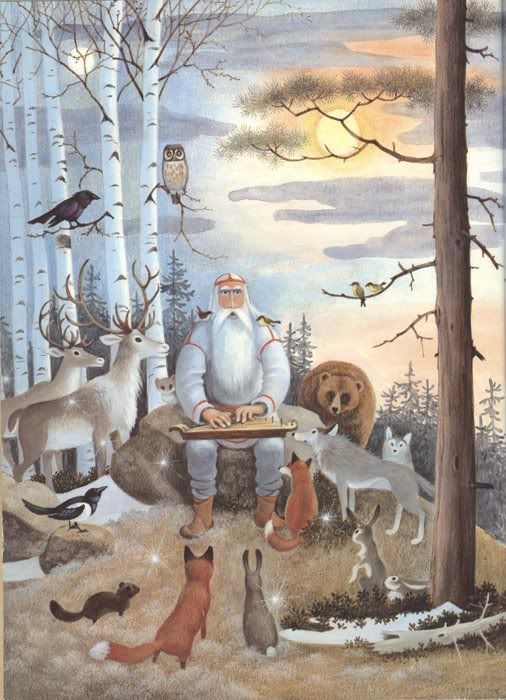
Louhi, the eponymous Witch of North Farm, gets bored one day in this tale taken from Finnish lore, setting out on her skis into the white, snowy world around her home. Eventually taking to the skies, she comes upon Vainamoinen, the Great Singer and Great Knower, playing upon his harp. So beautiful is his song, that all the forest animals gather round, and the sun and moon themselves draw near. Seeing her chance, Louhi steals these celestial bodies, locking them up in her stronghold in Copper Mountain, and leaving the world in darkness. Vainamoinen attempts to retrieve them, but is unsuccessful, leaving the great smith Seppo to use cunning to trick the witch into giving up the imprisoned sun and moon, and restore light to the world...
As its subtitle makes plain, the tale in Louhi, Witch of North Farm: A Story From Finland's Epic Poem 'The Kalevala' is taken from the epic Finnish poem, The Kalevala, recorded and compiled by Elias Lönnrot in the 19th century from various oral traditions. This appears to be the only picture-book ever produced by author Toni de Gerez, a storyteller and children's librarian who lived in Mexico at the time of publication, in 1986. The illustrator, Barbara Cooney, on the other hand, was a prolific and celebrated creator of children's books, twice awarded the Caldecott Medal, for her Chanticleer and the Fox and Ox-Cart Man. One wishes the two had collaborated again, as this retelling is simply wonderful, pairing an engaging, magical narrative with gorgeous illustrations. I found the scene in which Vainamoinen is playing his harp particularly lovely:
Just beautiful! I enjoyed this one immensely, from both a storytelling and illustrative standpoint, although I did wonder why de Gerez chose to refer to the great smith as Seppo, an epithet meaning "smith," rather than by his name, Ilmarinen. After all, she referred to Vainamoinen by his name. Still, that's a minor point, and didn't detract at all from my enjoyment. Highly recommended, both to folklore enthusiasts and readers looking for children's stories from The Kalevala, and to fans of Barbara Cooney's artwork. It could pair very nicely with The Maiden of Northland: A Hero Tale of Finland, another picture-book from The Kalevala, in which Vainamoinen and Ilmarinen vie for the hand of Louhi's daughter.
Finnish folk tale about the seasons. I'm thinking about the archetype of the evil witch in folklore and how Louhi fits into it. It struck me that an old, powerful woman stole the sun and moon and an old man, who we think will be the hero, attempts to get it back but is unsuccessful. The woman relents when she learns there is a plot to imprison her and returns the sun and moon willingly, and then passes it off as if there was no real harm done. My mind is turning over why women and men were chosen for the roles they were and the balance of power between them. It is interesting that in so many stories, the old witch is evil, and yet often immeasurably powerful--so much so that it often takes trickery to defeat her rather than a head-to-head confrontation. I don't have any conclusions about it all, just thinking about it...
CIP: Louhi's plan to steal the sun and moon backfires when the gods learn of her mischievous scheme.
Review: Written in a verse style, yet with flowing lines and easy to understand phrasing, this is a great way to discover part of the Finnish epic tale, Kalevala. The illustrations are lovely acrylics, adding to the authentic voice of the country of origin through its character and place depictions. The conclusion seems a bit forced, however.
PW says: "beautifully illuminated" SLJ says: "Yet, if the artist in the reader is satisfied, the storyteller wishes for more"
I love all the late Barbara Cooney's illustrations. The story line is a bit different which is nice when you are reading to children and so many books have a sameness about them.
As a Finnish-Karelian native this was a terrible read for me. The illustrations lack soul and are far too benign to be of Finnish people. It makes me even angry to see this American misrepresentation of my culture. Jackasses.
They got everything wrong. And turned age-old spiritual tales into something stupid and simple. Hate to see the soulless eyes on the drawings. The pictures do not look like Finnish or Karelian people.
We are not sweet and benign simple cute people - these stories are about strong, dangerous and powerful Shamans and witches. Not cute retired people about to knit a sock.
Maybe they got the Karelian nose shape right but it looks persversly wrong combined with the sweet cute soulless disney eyes.
You shouldnt read this book. I recommend reading books on Finnish culture written by Finnish people!
And never again as an American attempting to write about Finland or Karelia, leave it alone, this angers me and my ancestors.
Requested for the art by Cooney, a Caldecott winner. Thrilled by the discovery of a fascinating tale from a culture I know almost nothing about, poetically told, with an author's note. And, yes, beautifully illustrated. I read this three times within two days just to catch all the detail in how the lines described the story, how the pictures enhanced the text, how the grace was achieved.
The only thing missing is how to pronounce the Finnish names. LOO-hee? :shrug:
What struck me first was how much I liked Barbara Cooney's art. It not only fit the story, it enhanced it. The beginning of the story is just plain fun. What's not to like about a witch who ponders how to spend her day? Who hangs her boot upside down in the rafters? Who mutters and sputters? And isn't it fun to see her stuffing her boots with good sweet grass? And then watch her put on her skis and glide over the meadows of dry heather, until she changes her mind and decides to ski in the sky. Then she hears the beautiful music ...
After this, there are a couple of serious disconnects. But that's okay because this is a folk tale, and I like the art.
2024 The final illustration is typical of Barbara Cooney - wonderful!
My kids used to love to play with the wooden figures that came with the book while I was reading it. I often found them playing out the story by them selves as well. This was a fun mysterious way of thinking and talking about the changing seasons and the length of days that change so dramatically in the North. I still love the illustrations.
I enjoyed this book but I couldn't give it 4 stars because of the difficult Finnish names and the verses were good but didn't flow!
I like the story which is based on a Finnish Folktale. It kind of an explanation to ancient people, where the sun goes in the winter! Nice winter story!