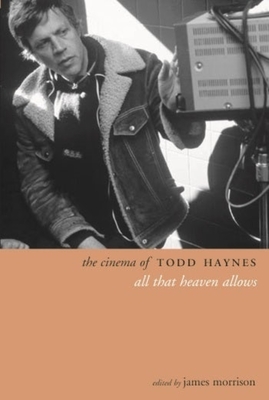
Todd Haynes has emerged from the trenches of independent American film in the 1990s to become one of the twenty-first century's most audacious filmmakers. In a series of smart, informative essays, this book traces his career from its roots in New Queer Cinema to the Oscar-nominated Far from Heaven (2002). Along the way, it covers such landmark films as Poison (1991), Safe (1995), and Velvet Goldmine (1998). Contributors look at these films from a variety of angles, including his debts to the avant-garde and such noted precursors as Rainer Werner Fassbinder; his adventurous uses of melodrama; and his incisive portrayals of contemporary life.
Professor Morrison is a scholar of modern literature and film and the author, editor, or co-author of eleven books. He holds a Ph.D. from SUNY Buffalo and taught at North Carolina State University from 1990 to 2001. His recent works include Buffalo Trace and Auteur Theory and My Son John.
When the subject of Todd Haynes arises in conversation--and I have this funny way of forcing the subject to arise more frequently than one might imagine--I tend to get all crazy and arm-wave-y and hyperbolic. (For example, I say things like the following: "He's the only American filmmaker who's done anything interesting in the past fifty years" and "Todd Haynes is smarter than all of us put together, so you just take back what you said about Velvet Goldmine being a mess because Todd knows what he's doing.")
But I'm going to try to control myself for a minute so that I can write this review without, like, rushing off to watch Safe for the millionth time.
It's obvious that this collection, like all other collections of criticism about a single director, takes auteur theory as its point of departure. What's interesting, though, is that it's criticism about works that are already drenched in theory, that are already engaged with the very concerns that criticism usually attempts to tease out.
This is a director whose short film Dottie Gets Spanked isn't just about a young boy's fascination with spanking--it actually quotes Freud's "A Child is Being Beaten." Far from Heaven isn't just a melodrama that borrows some visual and narrative cues from Douglas Sirk's films; it plays with Sirk and with Fassbinder's takes on Sirkian melodrama, and it's not just indebted to Fassbinder's films but to Fassbinder's essay about Sirk's films. I mean, come on, this isn't Quentin Tarantino-style fanboy pastiche auteurism--Haynes is a different beast entirely.
So what I like about this collection is that it attempts to deal with its subject by pushing beyond the obvious connections to the theories (postmodern, feminist, queer, genre, etc.) that are embedded in the films themselves. I particularly enjoyed Marcia Landy's "Storytelling and Information in Todd Haynes' Films," both essays about queer childhood, and especially Nick Davis' "'The Invention of a People': Velvet Goldmine and the Unburying of Queer Desire," which is going to be the thing that forces me finally, at long last, to read Gilles Deleuze.
I haven't yet read the other collection of essays about Haynes (the Camera Obscura one) so I can't compare the two, but this is a pretty exciting collection for anyone who's into his work, or into contemporary cinema in general.
i read this right after rob white's book on todd haynes, and this is definitely the better of the two. it's much more dense, though—i'm not the most familiar with a lot of film jargon and philosophy, so a lot was lost on me. not much stuck with me very strongly, but i enjoyed almost all of it even if just as i'd enjoy a conversation about the film(s) in question. there was a lot of overlap, so they blur together, but my favorites were the discussion of haynes' portrayal of queer childhood, which functioned for me as a series of "yes! i was thinking that, but not consciously enough to explain!" moments, and the final essay, alexandra juhasz's deeply personal essay on AIDS in haynes' oeuvre and her own experience with the relationship of women to the gay male community, which hit me much closer to home than i expected. the whole book is worth a read, but i found hers by far the most powerful (but also readable)—if you only read one, make it hers.
In anticipation of Todd Haynes next film "I'm not There" due out in September 2007 I have decided to learn everything I can about this illusive director. This is the kind of book I love to tell my students about -it is edited by one person yet has over 10 essays on different Haynes films by 10 different authors. I think this is great because I believe especially when it comes to theory and criticism one person style can rub me the wrong way but if I have the choice of many different authors then I can continue reading through the essays until I find an author who style and deliver matches up with my style. I especially loved the essays on [Safe] which is my ALL time favorite Haynes film.