

What do you think?
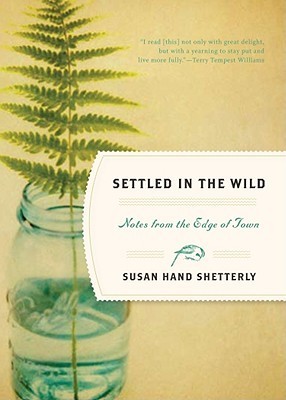
Settled in the Wild: Notes from the Edge of Town
Whether we live in cities, suburbs, or villages, we are encroaching on nature, and it in one way or another perseveres. Naturalist Susan Shetterly looks at how animals, humans, and plants share the land observing her own neighborhood in rural Maine. She tells tales of the locals (humans, yes, but also snowshoe hares, raccoons, bobcats, turtles, salmon, ravens, hummingbirds, cormorants, sandpipers, and spring peepers). She expertly shows us how they all make their way in an ever-changing habitat.
In writing about a displaced garter snake, witnessing the paving of a beloved dirt road, trapping a cricket with her young son, rescuing a fledgling raven, or the town's joy at the return of the alewife migration, Shetterly issues warnings even as she pays tribute to the resilience that abounds.
Like the works of Annie Dillard and Aldo Leopold, Settled in the Wild takes a magnifying glass to the wildness that surrounds us. With keen perception and wit, Shetterly offers us an education in nature, one that should inspire us to preserve it.
In writing about a displaced garter snake, witnessing the paving of a beloved dirt road, trapping a cricket with her young son, rescuing a fledgling raven, or the town's joy at the return of the alewife migration, Shetterly issues warnings even as she pays tribute to the resilience that abounds.
Like the works of Annie Dillard and Aldo Leopold, Settled in the Wild takes a magnifying glass to the wildness that surrounds us. With keen perception and wit, Shetterly offers us an education in nature, one that should inspire us to preserve it.
288 pages, Hardcover
First published January 26, 2010
About the author
Susan Hand Shetterly
14 books43 followersSusan Hand Shetterly, a former wild bird rehabilitator, has written about wildlife and wildlands for over twenty years. She is the author of the essay collection The New Year's Owl and several children's books. She was a contributing writer to the Maine Times and her pieces have appeared in Birder's World, Audubon Magazine, Yankee, and Down East. "
Ratings & Reviews
Friends & Following
Create a free account to discover what your friends think of this book!
Community Reviews
Displaying 1 - 30 of 97 reviews

July 12, 2018
Tons of beautiful imagery of the northern Maine woods. The author came to our Book Club to discuss her book and was very prolific and kind. Wonderful evening. 😊

July 20, 2010
In this spare, elegant, and compassionate little book, Susan Hand Shetterly takes us with her into the wild world at the unsettled edge of a small village in Maine. She and her husband went there in the back-to-the-land movement in the 1970s, "idealistic, dangerously unprepared, and, frankly, arrogant." But when others moved on, they stayed, having brought with them the willingness to do hard physical work, the desire to practice patience, and—perhaps most importantly—"the ability to pay close attention."
It is the paying attention that accounts for so much of the quiet grace of this book, for Shetterly passionately wants us to see and smell and touch and taste what she is paying attention to: the daily small affairs of birds, periwinkles, green crabs, and clams; a porcupine stripping tender young branches from her willow tree in an April night; a rescued raven; a baby snowshoe hare threatened by a bobcat—the wild things that populate her life on the edge of what's left of wildness in this rapidly urbanizing world.
But it is not just the wild things that Shetterly brings to us from the margins: it is the people who live in the village and share the "hard, dangerous gift" of this place. Danny, who doesn't believe in throwing things away. Clarence, who died upside down in the water, weighed down by a trap he'd thrown overboard. Jack Dudley, counting loons, living a sense of place. Settled in the wild, Shetterly is also settled in community, a small community made up of a few utterly unique human individuals, dwelling in a "neighborhood of millions of lives, depending on how and whom you count."
In some important ways, the community itself, long ago settled on the shore of the wild bay, remains an unsettled place. When Shetterly helps to create an association to protect the surrounding wetlands, many of the villagers are threatened and antagonistic. Living in a world of private property, where land is worthwhile only when it can be "developed," they find it hard to believe, as does Shetterly and her conservation colleagues, in the "self-renewing community between wild land and human beings," in the "wild commons."
But at its heart, that's what this book is about: the need that we all have to be a part of the wild commons, to recognize and share the bonds that exist between species, ours and all the others who live in our neighborhoods, inhabit the wild hours of the night, roost in the trees, and hide in the grass and plants in our gardens. It is also about our need to watch and listen and observe for a long time, for a very long time, until, as Shetterly says, we become, "instead of watchers, witnesses, heavy with the gravity of what is revealed to us and what we have chosen to carry of it."
I love this book because it teaches what I take to be the most important thing a human being can do to be at home in the world: to simply watch, and look, and listen—to become witnesses
It is the paying attention that accounts for so much of the quiet grace of this book, for Shetterly passionately wants us to see and smell and touch and taste what she is paying attention to: the daily small affairs of birds, periwinkles, green crabs, and clams; a porcupine stripping tender young branches from her willow tree in an April night; a rescued raven; a baby snowshoe hare threatened by a bobcat—the wild things that populate her life on the edge of what's left of wildness in this rapidly urbanizing world.
But it is not just the wild things that Shetterly brings to us from the margins: it is the people who live in the village and share the "hard, dangerous gift" of this place. Danny, who doesn't believe in throwing things away. Clarence, who died upside down in the water, weighed down by a trap he'd thrown overboard. Jack Dudley, counting loons, living a sense of place. Settled in the wild, Shetterly is also settled in community, a small community made up of a few utterly unique human individuals, dwelling in a "neighborhood of millions of lives, depending on how and whom you count."
In some important ways, the community itself, long ago settled on the shore of the wild bay, remains an unsettled place. When Shetterly helps to create an association to protect the surrounding wetlands, many of the villagers are threatened and antagonistic. Living in a world of private property, where land is worthwhile only when it can be "developed," they find it hard to believe, as does Shetterly and her conservation colleagues, in the "self-renewing community between wild land and human beings," in the "wild commons."
But at its heart, that's what this book is about: the need that we all have to be a part of the wild commons, to recognize and share the bonds that exist between species, ours and all the others who live in our neighborhoods, inhabit the wild hours of the night, roost in the trees, and hide in the grass and plants in our gardens. It is also about our need to watch and listen and observe for a long time, for a very long time, until, as Shetterly says, we become, "instead of watchers, witnesses, heavy with the gravity of what is revealed to us and what we have chosen to carry of it."
I love this book because it teaches what I take to be the most important thing a human being can do to be at home in the world: to simply watch, and look, and listen—to become witnesses
February 26, 2020
Quite honestly, this book was something of a disappointment. At first, I blamed myself for making assumptions about the subject matter. But about halfway through the book, I looked at the subtitle, Notes from the Edge of Town, and realized that there really wasn't any town, or at least anything described by the author that I recognized as a town. The whole reason I was reading this book is that my husband and I are retiring in a couple of years and I would like to move to the edge of town (which town yet to be determined) so that we can have the best of both worlds: wild surroundings but town not too far away. I was hoping this book would offer some insights on how to keep wild areas wild and return areas that have been "tamed" to their wild roots.
The book begins in 1971 with the author and her husband leading the pack of hippie back-to-the-landers, moving to the wilds of coastal Maine. Each short chapter is a vignette of life in the wild, beginning with a cabin with no electricity or running water. The book follows Shetterly's life as she learns about her wild neighbors and becomes the local bird expert, the person others depend on to nurse wounded birds back to health when they find them.
If you like books about living in the wild - and normally I do - you will probably enjoy this one.
The book begins in 1971 with the author and her husband leading the pack of hippie back-to-the-landers, moving to the wilds of coastal Maine. Each short chapter is a vignette of life in the wild, beginning with a cabin with no electricity or running water. The book follows Shetterly's life as she learns about her wild neighbors and becomes the local bird expert, the person others depend on to nurse wounded birds back to health when they find them.
If you like books about living in the wild - and normally I do - you will probably enjoy this one.

May 7, 2010
A beautiful book from another area of the country: this the windy, wild coast of Maine. It was serendipitous to read Laura Bell's "Claiming Ground" immediately before this one. At the beginning of Hand-Shetterly's book, I thought the order would pale the second book against the first. But Bell has her eye on the land; Shetterly is/was a bird rehabilitator, and her eyes are on the marshy waters and its avian residents. We soar and land, and feel the tide surge and retreat. I love the Big Horn territory that Bell claims, and the Maine coasts where Shetterly settled. Reading these two together was sublime.

November 28, 2010
Shetterly is a strong writer but as a whole, this collection doesn't pull together. I prefer my nature essays to teach me about nature (re: Kingsolver or Dillard) rather than just be observant and pretty prose, so that's really where this collection fell short of the mark for me.

June 6, 2018
Ahh! Beautiful writing from a Maine writer, who lives in the Blue Hill area.

July 30, 2018
I fell right into these exquisite essays. They kept me thinking about our surrounding woods and wildlife long after turning the final page.

January 3, 2021
I picked this up at a library sale this fall. Had no idea at the time that it was written by a naturalist living in Maine. Beautiful little book.
August 25, 2018
lovely collection of short essays about living in nature in Maine. While Shetterley's writing is not as lyrical as Annie Dillard's, it comes from a similar place, with the added bonus (for me) of the Maine setting. Gory in places when talking about dead animals - so don't read while you are eating! : )

July 13, 2011
This was such a refreshing book, about rootedness, about the place of nature in our lives, about our re-creation at the contact of nature, our re-education through woods, birds, and animals of all kinds. I enjoyed this book even more than Dillard’s, I find the author here leads you even deeper in contemplation.
I have to add that this book made me ache like no other: at about every page, I wanted just to drop the book, the blog, internet, and every thing, and just go and live out there. So far I have to be happy with my hiking on week-ends, 3 hours or more when possible, and my living in the middle of the woods a few days a year. I did live in the deep countryside for the first 10 years of my life, and am ready to go back, whenever the opportunity presents itself.
I am grateful for our nice backyard where we can observe the birds coming to the feeders or take their bath, the squirrels rushing along their highway (the heavy electric lines), or the skunks following their daily path along the fence, every night at about the same hour.
I love books, and I believe the book of nature is one to keep open to remain human. If you feel the call of the wild, go check if this book is at your library.
Original post:
http://wordsandpeace.wordpress.com/20...
Emma @ words And Peace
I have to add that this book made me ache like no other: at about every page, I wanted just to drop the book, the blog, internet, and every thing, and just go and live out there. So far I have to be happy with my hiking on week-ends, 3 hours or more when possible, and my living in the middle of the woods a few days a year. I did live in the deep countryside for the first 10 years of my life, and am ready to go back, whenever the opportunity presents itself.
I am grateful for our nice backyard where we can observe the birds coming to the feeders or take their bath, the squirrels rushing along their highway (the heavy electric lines), or the skunks following their daily path along the fence, every night at about the same hour.
I love books, and I believe the book of nature is one to keep open to remain human. If you feel the call of the wild, go check if this book is at your library.
Original post:
http://wordsandpeace.wordpress.com/20...
Emma @ words And Peace

Read
March 22, 2010Settled in the Wild: Notes from the Edge of Town by Susan Hand Shetterly is a lovely book. Shetterly chronicles the three decades she has lived in Maine. She moved to a rugged, seafaring part of Maine as a young woman. She and her husband were going “back to the land”. They lived without electricity and plumbing, had two children and experienced life close to nature.
The book is divided into two parts and twenty nine entries. Shetterly details the changes in the land and the changes in the community as development encroaches and climatic and environmental changes force the fishermen from the seas. Some of the pieces are wrenchingly sad, while other offer vivid descriptions of the land and animals surrounding are achingly beautiful. Settled in the Wild is nature writing at its best. Enjoy! --Maeve
From ICPL Staff Picks Blog
The book is divided into two parts and twenty nine entries. Shetterly details the changes in the land and the changes in the community as development encroaches and climatic and environmental changes force the fishermen from the seas. Some of the pieces are wrenchingly sad, while other offer vivid descriptions of the land and animals surrounding are achingly beautiful. Settled in the Wild is nature writing at its best. Enjoy! --Maeve
From ICPL Staff Picks Blog
May 11, 2010
This book was a joy to read and dove tailed with the animal nature exploration kit I just gave my 6 year old grandson. Shetterly describes her experiences in the wild with all the pleasure, sadness and sense of not having to tie everything up in a neat package. Everything can't be known, we can only be observers.
The following passage takes place when Susan is following a coyote's track which had carried off all traces of a dead calf.
"When we had followed the tracks quite far, when we had exited our territory and seemed, eerily, to have entered theirs, without more than a few words between us, we turned around and came back. And that was all."
I am looking forward to exploring Shetterly's numerous childrens books.
The following passage takes place when Susan is following a coyote's track which had carried off all traces of a dead calf.
"When we had followed the tracks quite far, when we had exited our territory and seemed, eerily, to have entered theirs, without more than a few words between us, we turned around and came back. And that was all."
I am looking forward to exploring Shetterly's numerous childrens books.

October 4, 2010
I'm enjoying this book because it awakens my desire to be connected with nature and reminds me of the significance of the people in our lives. Since I live on a farm I'm quite connected with nature but this makes me think of wild nature. I also took opportunity to learn more about the geography of Maine of which I'm not familiar.
The author asks if a person can imprint on a place which creates a standard of comfort by which you measure whatever else is real in the world and whatever else is beautiful. That seems to describe what happened to me and the family farm on which I was raised and ended up returning to.
The author talks of the great people who enter our lives, and just by being themselves, change the way we live in the world.
The author asks if a person can imprint on a place which creates a standard of comfort by which you measure whatever else is real in the world and whatever else is beautiful. That seems to describe what happened to me and the family farm on which I was raised and ended up returning to.
The author talks of the great people who enter our lives, and just by being themselves, change the way we live in the world.

August 26, 2012
Beautiful and unromantic essays on living close to the land. There is wonder in nature, peace that comes from being aware of the now. Shetterly's prose paints clear pictures and vignettes for the reader that feel familiar--yet also new--and exploratory.
Be prepared for as detailed a description of a quiet copse of trees--as the rotting deer carcass by the side of the road.
The circle of life/awareness and acceptance of death as part of life, are themes done very well throughout the book.
Be prepared for as detailed a description of a quiet copse of trees--as the rotting deer carcass by the side of the road.
The circle of life/awareness and acceptance of death as part of life, are themes done very well throughout the book.

April 9, 2017
This is a great book to read amid the digital rattle and hum of 21st living, reminding oneself that other worlds exist beyond the frame of our devices. It's also about the joys and horrors of being solitary, the risks that incur with age and isolation, but primarily this book imbues the reader with a sense of wonder at that which typically does not get noticed without sustained observation and experience. Its harshness is countered by Shetterly's capacity to bring us into her world through beautiful language and compelling narrative.

July 28, 2011
Enjoyed this book, even though it didn't grab me the way so many books about nature do. While I appreciated Shetterley's eye for detail and her ability to take us along with her on her rambles along country roads and down to the seaside, I just didn't enjoy her company that much! I kept getting the feeling that she was just a tad self-righteous and a little too proud of herself for being so concerned about protecting the natural environment and the many creatures who live there.

September 6, 2009
Wonderful essays about the natural world around Shetterly's cabin in rural Maine, as well as the way she and her neighbors relate to the birds, fishes, and other wildlife around them. Just a gorgeous voice, with a poetic eye for detail.
January 13, 2026
Reading for the Stonington Book Club. This was my pick for the club. This is a book of anecdotes/essays of Maine wildlife, Natural history, and notes from the edge of town. I read her book Seaweed Chronicles and really enjoyed it.
The author takes us into the woods and along the shorelines, mudflats, and paths where she lives. She shows us the ways we and animals share the land, especially as our habitat is changing. It starts small in her yard looking out her window to walking in the surrounding forest, going to the seaside, to the lives in her community.
I liked the chapters being short and sweet and so meaningful to me. For instance, when her in-laws came for a visit to their log cabin (no power, wood heat, outhouse) and the mother-in-law shows up in her fur coat and the father-in-law shows up with his bottle of gin. For some unknown reason the skunk under the kitchen floor decides to let go and it stinks up the fur coat and smells the whole house up but the fur coat gets the worst of it! I think that is really funny!
Hatching of the wood frog eggs to polliwogs was another good one. She goes searching for algae for them to feed on and the best place where it grows is in the neighbor's ditch by the road in front of her house. As it turns out there is a secret of the neighbor's prizewinning algae! I don't want to give it away.
Did you know crickets bite? And did you know crabs and whelks eat dead bodies and that we eat crabs and whelks?! And what a great story about the sickle but poor Clarence.
Another story about getting stuck in the mud. That happened in the Mud-lark book I just read. This book had singing Rock of Ages in it though!
I loved reading about the hummers. I didn't realize there were so many varieties of them. They are so colorful and so tiny but so aggressive! And they can die in such fragile ways too. I don't want to give it away.
I loved Wordsworth saying: What dances before the inward eye cannot fail to engage the heart.
The chapter about Chac (Raven) was awesome. What a great story. I would have done the same thing. The ending made me cry! What they had was now. Just loved it.
The calf story was strange and totally weird. And taking food from a bobcat! How brave!
The moaning humpback whale dying was extremely sad for me. They have to feel pain and having a bunch/school of swordfish surrounding it and chasing it into the shallow water must have been so upsetting for the whale. Very sad story.
The Cooper's Hawk are simply beautiful hawks. I love seeing them. Their colors are wonderful. I also found the old dead pine wonderful. We have a few dead trees in the front of our home and see birds including fish hawks who eat their fish and flickers who nest in the dead trees and owls who seat on top of them at night and hoot.
What a bad, bad kingfisher!
The water is a soup with larvae jellyfish, barnacles and krill. You can dip your hands in and cup them and come up with new life. The herring will take the larvae, larger fish will take the herring, and the birds will take the larger fish. Everyone out here except the people swimming is eating everyone else. After people leave from swimming, the rush of living and dying continues even through the night.
Raising the Maine farmed salmon was quite the story. I had no idea how it was done exactly. I should know where my food comes from. I did learn from the story that some of the men on the author's road are just plain crazy, selfish, no regard for the natural resources, and I find totally stupid. They have no regard for animal life and want a free meal. My two cents.
The fire and the owl - how sad. And I want to end with the dove story - so loving.
This is a quick read and a wonderful, inspiring read about a Maine author writing about Maine's natural history. I found it loving and a great learning experience. I highly recommend it - after all it won a book award! Congratulations to the author! Now I'm on to her next book: Notes on the Landscape of Home.
The author takes us into the woods and along the shorelines, mudflats, and paths where she lives. She shows us the ways we and animals share the land, especially as our habitat is changing. It starts small in her yard looking out her window to walking in the surrounding forest, going to the seaside, to the lives in her community.
I liked the chapters being short and sweet and so meaningful to me. For instance, when her in-laws came for a visit to their log cabin (no power, wood heat, outhouse) and the mother-in-law shows up in her fur coat and the father-in-law shows up with his bottle of gin. For some unknown reason the skunk under the kitchen floor decides to let go and it stinks up the fur coat and smells the whole house up but the fur coat gets the worst of it! I think that is really funny!
Hatching of the wood frog eggs to polliwogs was another good one. She goes searching for algae for them to feed on and the best place where it grows is in the neighbor's ditch by the road in front of her house. As it turns out there is a secret of the neighbor's prizewinning algae! I don't want to give it away.
Did you know crickets bite? And did you know crabs and whelks eat dead bodies and that we eat crabs and whelks?! And what a great story about the sickle but poor Clarence.
Another story about getting stuck in the mud. That happened in the Mud-lark book I just read. This book had singing Rock of Ages in it though!
I loved reading about the hummers. I didn't realize there were so many varieties of them. They are so colorful and so tiny but so aggressive! And they can die in such fragile ways too. I don't want to give it away.
I loved Wordsworth saying: What dances before the inward eye cannot fail to engage the heart.
The chapter about Chac (Raven) was awesome. What a great story. I would have done the same thing. The ending made me cry! What they had was now. Just loved it.
The calf story was strange and totally weird. And taking food from a bobcat! How brave!
The moaning humpback whale dying was extremely sad for me. They have to feel pain and having a bunch/school of swordfish surrounding it and chasing it into the shallow water must have been so upsetting for the whale. Very sad story.
The Cooper's Hawk are simply beautiful hawks. I love seeing them. Their colors are wonderful. I also found the old dead pine wonderful. We have a few dead trees in the front of our home and see birds including fish hawks who eat their fish and flickers who nest in the dead trees and owls who seat on top of them at night and hoot.
What a bad, bad kingfisher!
The water is a soup with larvae jellyfish, barnacles and krill. You can dip your hands in and cup them and come up with new life. The herring will take the larvae, larger fish will take the herring, and the birds will take the larger fish. Everyone out here except the people swimming is eating everyone else. After people leave from swimming, the rush of living and dying continues even through the night.
Raising the Maine farmed salmon was quite the story. I had no idea how it was done exactly. I should know where my food comes from. I did learn from the story that some of the men on the author's road are just plain crazy, selfish, no regard for the natural resources, and I find totally stupid. They have no regard for animal life and want a free meal. My two cents.
The fire and the owl - how sad. And I want to end with the dove story - so loving.
This is a quick read and a wonderful, inspiring read about a Maine author writing about Maine's natural history. I found it loving and a great learning experience. I highly recommend it - after all it won a book award! Congratulations to the author! Now I'm on to her next book: Notes on the Landscape of Home.
May 29, 2018
"They are my daffodils, these birds, and Wordsworth taught us that what dances before the inward eye cannot fail to engage the heart." Susan Hand Shetterly has written this and many lovely passages in her book of reflections Settled in the Wild, chronicling observations around her home in the wilds of downeast Maine. This was a book selection for the local library club which meets tomorrow night. I cannot, unfortunately, be there for the discussion due to work commitments, but I wanted nonetheless to read the book. It was a pleasing read, but I think I was not in the mood right now for a book which reminds me of Annie Dillard's Pilgrim at Tinker Creek...minute observations of the natural world, and in this case, clearly one most of of have lost in our lives. That said, I confess easily to saying that I would not like to live in the wild (although I do think I live fairly simply). The move to the "edge of town" in a dwelling with no electricity afforded a rich experience for her children and clearly opened her own heart to deep-seated needs... but it also seems to have cost her marriage along the way. Her picture of the Maine woods and flora and fauna, with the different humans and animals she encounters, are all totally intriguing. I look outdoors from my little house in the middle of a small southern Maine town and just try to stay away from the massive mosquitoes and ticks. Susan has found what makes her heart happy and what she needs to feel connected; we all have our ways of doing that, I reckon.... but do we actively seek it?
June 16, 2018
I picked up this book of short essays because my local library is participating in Read ME, a statewide program presented in partnership with Maine State Library that gets Maine’s adults all reading the same books—by Maine authors and recommended by a Maine author. This year's two books were picked by Paul Doiron. https://mainehumanities.org/read-me/
I thought I would sample a few of the essays, fall asleep and put it down. But even on nights when I was really really tired I would read several of these beautifully written pieces and reluctantly put it down. I just picked it up to finish in the shade on our first warm summer-like day. They are well crafted nature stories, but certainly not all summer breezes, butterflies and wildflowers. Some were about nature's brutality and death with a poetic speculation about the inner lives of wild creatures. The author's home is just down the coast from where I live.
I thought I would sample a few of the essays, fall asleep and put it down. But even on nights when I was really really tired I would read several of these beautifully written pieces and reluctantly put it down. I just picked it up to finish in the shade on our first warm summer-like day. They are well crafted nature stories, but certainly not all summer breezes, butterflies and wildflowers. Some were about nature's brutality and death with a poetic speculation about the inner lives of wild creatures. The author's home is just down the coast from where I live.

June 17, 2018
What a delight! Like Blue Swimmers, Walden, this group of essays is life and becoming one with nature at its finest. With lyrical prose, Susan Hand Shetterly invites us to walk with her in the natural science of woods and marsh, field and stream in the small Downeast town of Surrey, Maine. Abiding peace, the gentle, quiet oneness with nature, feeling the ebb and flow of life are offered within the pages filled with the love of the land and the live that abounds on it.
“This is my neighborhood of millions of lives, depending on how and whom you count. From springtails to moose, from June bugs to people, from viral shrimp to harbor porpoises, it is a small green place by water. It is s tiny, irreplaceable place where we go about the everyday magic of our lives.”
“This is my neighborhood of millions of lives, depending on how and whom you count. From springtails to moose, from June bugs to people, from viral shrimp to harbor porpoises, it is a small green place by water. It is s tiny, irreplaceable place where we go about the everyday magic of our lives.”
August 30, 2018
I'd give this 3.5 stars. This is a quiet book. Lovely and evocative descriptions of place along with observations of nature from the woods and marshes surrounding the author's home.
Of her small town: "We are joined in time in place. Sometimes we attend town functions and someone tells a story of the people who came before us and made community here. We listen and hope that our little group may provoke a story or two, and that our stories will linger, imparting a moment of tragedy or courage, humor or grief or joy, or even a spate of passing foolishness. Our stories say we were here. We made a difference to each other. We cared."
This was one of two book selections for the 2018 Maine State Library's "Read ME" program.
Of her small town: "We are joined in time in place. Sometimes we attend town functions and someone tells a story of the people who came before us and made community here. We listen and hope that our little group may provoke a story or two, and that our stories will linger, imparting a moment of tragedy or courage, humor or grief or joy, or even a spate of passing foolishness. Our stories say we were here. We made a difference to each other. We cared."
This was one of two book selections for the 2018 Maine State Library's "Read ME" program.
August 13, 2024
This was an enjoyable read, sort of a bed & breakfast in book form.
Filled with nature & her experiences in a new lifestyle in the woods of Maine, as a young mother of a boy almost a year old & her husband.
Somewhere, without any reasons shared, they divorced.
I would have appreciated knowing if their move to live where they were, planting & fishing had anything to do with their parting. They had a daughter before they broke up.
The author didn't need to share personal info, but some reasoning for this if it was or was not related to their living in Maine... at least. That she didn't irritated me.
Filled with nature & her experiences in a new lifestyle in the woods of Maine, as a young mother of a boy almost a year old & her husband.
Somewhere, without any reasons shared, they divorced.
I would have appreciated knowing if their move to live where they were, planting & fishing had anything to do with their parting. They had a daughter before they broke up.
The author didn't need to share personal info, but some reasoning for this if it was or was not related to their living in Maine... at least. That she didn't irritated me.
May 3, 2018
The library told me I had to read this book, that it was 'right up my alley' and they were right. My only issue with Susan Hand Shetterly was the book was too short. I loved, LOVED the stories of animals, nature. I enjoy nature and wildlife...the woods, streams, coast. Simple life. I hope Ms. Shetterly continues to write this type of book, everything in it is why I love Maine. Born a Mainer but I have traveled, Maine is still and always will be 'home'.... the woods, animals and nature.

September 5, 2018
"Settled in the Wild, notes from the Edge of Town" by Susan Hand Shetterly was a Maine Book Club read this summer. Although Shetterly's stories were not at all what I expected, her stories based on her life in a small village on the Maine Coast offer readers and inside peek into rural Maine communities and the connection of people to the land and to the natural world they co-habit. Well written and insightful.

November 2, 2018
Our book group is reading this book - generally, I really enjoyed it. From time to time I do enjoy a good nature book, although it takes a little more patience. Susan Hand Shetterly is a lovely writer (I enjoyed her daughter's book, so I was trying to remember Caitlin's descriptions of her mother). I'm generally more interested in the human story, but found Susan's descriptions of her surroundings, and her work, especially with birds, to be quite interesting. Very glad I read it!

May 2, 2018
I really expected to love this book but I just didn't? Sure some of the passages were nice to read but overall I just was left very underwhelmed by this collection and so I decided to move on to other books before completely finishing this one. Maybe someday I will come back to it but I decided that in 2018 I would spend less time reading books I didn't love, or at really like.
June 17, 2018
I bought this little book at my local library (in Southwest Harbor, Maine). It was part of a display of books by Maine authors called “Read ME”. I have tried to read many of these sorts of nature books in the past but with limited success. This one was written so well and told little stories that were worthy of being told. I highly recommend it.

August 31, 2018
A lovely book. Shetterly explores the intersection of wilderness, wildness, and human culture. Her writing is elegant without pretension, and often poignant. My M.A. and Ph.D. studies revolved around the genre of nature writing, and years after that phase of my life I’m pleased to have discovered this author. I would rank this book as one of the genre’s best.
July 28, 2018
At different times in my life I have read nonfiction books about people (usually women) living in nature and writing about their experiences. This is that kind of book. The writing is spare - just enough description to put you into a time and a place. Highly recommend it.
Displaying 1 - 30 of 97 reviews