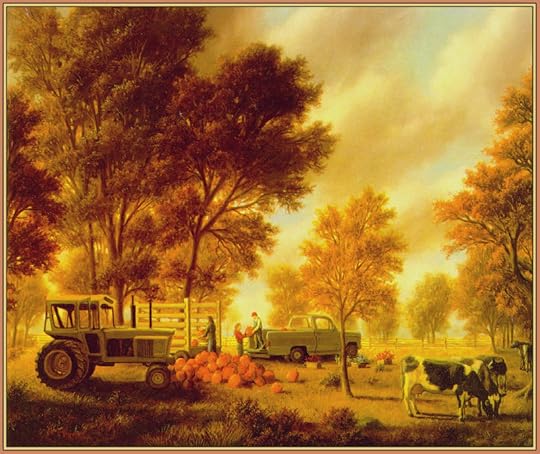
Beautifully warm full-color paintings highlight a tale about Mike and Sarah, who try to help their family farm survive some lean times by raising pumpkins and flowers, but still they need more money. Reprint.
Thomas Locker was one of the major American painters of the past century. In a career that spanned almost 60 years, he had over 75 solo exhibitions. His work ranged from the delicate to the monumental, but all had one thing in common: the beauty of the natural world. He had a deep appreciation for the elusive link between the human spirit and the sublime force of nature.
He spent his entire life in service to his two great passions: painting and nature. Through widespread exhibition of his artwork and publication of his illustrated children’s books, Mr. Locker touched the hearts and minds of countless people.
Mr. Locker’s early paintings were poetic landscapes. Dr. Joshua C. Taylor, former director of the National Collection of Fine Arts for the Smithsonian Institution in Washington, D.C., wrote, "Although Locker’s landscapes are not glimpses of a new Arcadia, the quotation from the past re-emphasizes their cerebral play. They call attention less to Nature than to the complex intermingling of perception and thought in the mind of man. Suddenly, seeing becomes thinking, and thinking a delight to the age."
In 1982, Thomas Locker’s career took on a new and even broader dimension. In an effort to connect with a wider audience and educate younger minds, he began work on his first children’s picture book, Where the River Begins. Today, Mr. Locker’s exceptional paintings and illustrations grace the pages of some 30 different books, several of which he also wrote. These unique books have been honoured with numerous awards, including the prestigious Christopher Award, the John Burroughs Award, and the New York Times Award for best illustration.
Thomas Locker’s landscapes have a quality all their own. His years of experimentation and research into the glazing techniques and paint chemistry of traditional European painting have enabled him to achieve a new vision of the traditional for a non-traditional age.
His books have received many awards, including the John Burroughs Young Reader Award, NCTE Notable Trade Books in the Language Arts, NSTA-CBS Outstanding Science Trade Book for Children, the Christopher Award, and others.
"Somehow we'll find a way to keep the farm going. We always have."
Times are tough for family owned farms, and Mike and Sarah worry that they'll have to sell theirs, and move to the big city where their father can get a job. Turns out . . . they only need to rethink what they've been planting.
Gorgeous artwork by the author makes this one worth checking out.
Thomas Locker's 1988 picture book Family Farm shows with an expressive and detailed but also never tedious, never dragging text an and equally expressive, nicely realistic paintings (and yes, these are not just illustrations but full paintings, stylistically reminding me of the Italian Renaissance and of the Dutch Golden Age) some of the many problems working farms and farming families can and do often experience (how they are dependent on how much money their crops, their milk etc. brings in, that farmers and farmers wives often must get jobs outside of their farm in order to make ends meet, but that this also then can negatively affect the farm and especially if like happens in Family Farm there is also injury to contend with and so on and so on and so on). But yes, Family Farm also shows resourcefulness and imagination, so that Locker's text and his illustrations equally and wonderfully demonstrate how the family, how the mother, father, the grandfather and also siblings Mike and Sarah work together and also figure out a way to augment their meagre resources, that when the price of corn and milk hits rock-bottom, when the father must get an outside job, when the grandfather injures his back, indeed, growing and selling flowers in the summer and pumpkins in the fall, this all helps to make money, this helps to keep the farm running (and that even when Mike and Sarah do not win a ribbon with their heifer at the country fair, at the end of Family Farm there is a new calf to raise and to train for next year's country fair, and that even having to change schools since their old school did not have enough students anymore has not been the issue and the problem Mike and Sarah originally thought it would be).
Now textually speaking, Thomas Locker's words do not pack a lot of verbal excitement and dramatics, but frankly, the combination of Locker's descriptive and understatedly emotional (but also very much educational) text and his absolutely delightful and full full full of farming related detail as well as hugely and gloriously atmospheric paintings, this produces a wonderful picture book which I for one (both my inner child also also adult I) have both hugely enjoyed and also massively appreciated both reading and yes indeed also looking at. And while I encountered Family Farm on Internet Archive, yes, I am now planning on trying to find a physical copy of Family Farm for my bookshelves (because indeed, I really love love love Thomas Locker's paintings and also his understated, his quiet but poignant and delightfully flowing and enlightening farming-themed text, and that my rating for Family Farm is also as such solidly five stars, and is also enthusiastically and warmly recommended).
Special thanks to my friend Manybooks for recommending this beautiful book, sadly, now out of print.
Farm failures have gotten to such a point where Mike and Sarah live that their school is closing, and they’ll be making a three-hour round trip to the Warren school. And their own farm is teetering on the brink of bankruptcy. What sacrifices must they, their parents and grandfather Pop make to keep their farm? And what’s Sarah’s idea to salvage their farm when it looks like their sacrifices won’t be enough?
With American farm bankruptcies at its worst level since the 1980s (remember Farm Aid?), this 1988 gem of a picture book is as relevant as it was at its first release. Lovely old-timey pictures illustrate a story that you could see as a feature on tonight’s TV news. Here’s hoping that Thomas Locker’s picture book is re-released.
Family Farm depicts a working farm family who are struggling to make ends meet. They live on a multi-crop, multi-species farm of the type that has rapidly disappeared from the American countryside. The illustrations are rich, realistic, and pleasing to the eye; and the story has a bit of melancholy mixed with its hope that's not always seen in young children's literature.
The story of a family who lived on a small farm, and some of the hardships, and struggles they faced trying to survive with very little money coming in. The family must find ways to make ends meet, and everyone pitches to do their part.