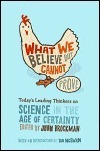
This book has such an interesting premise that I decided to take a chance on it. I was hoping for some soaring flights of speculative thought, and did find some ideas that made me pause and think. The book consists of 109 short contributions, ranging from a single sentence to three pages, with most a page and a half, and it is a mixed bag of profound and pedestrian.
It didn’t start out well for me. The selections are loosely grouped together, and in the first one the writers talk about their belief in life beyond earth. This is such an obvious, easy one that it made me think the participants were going to play it safe, only asserting things that would not cause their colleagues to laugh at them behind their backs. The only memorable quote from that section is by Paul C.W. Davies, “I believe we are not alone because life seems to be a fundamental, and not merely an incidental, property of nature. It is built into the great cosmic scheme at the deepest level and therefore is likely to be pervasive.” (p. 34)
Some of the entries are thoughtful and well reasoned, but many of them seem to be off-the-cuff remarks that were dashed off between more important things. Also, a number of them were simple restatements of the projects their authors were working on: after all, you wouldn’t be working on it unless there were still some unanswered questions to pursue.
There is a good middle section on consciousness: how to define it, how it evolved, how it is connected, and with ideas like the argument that consciousness is not just inside us but an amalgamation of ourselves and the environment in which we live since, after all, language and society are bounding functions when it comes to how we interpret what we perceive.
Daniel Dennett gives a brief recapitulation of one of his most famous ideas, “I believe, but cannot yet prove, that acquiring a human language (an oral or sign language) is a necessary precondition for consciousness – in the strong sense of there being a subject, an I, a ‘something it is like something to be.’ It would follow that nonhuman animals and prelinguistic children...are not really conscious, in this strong sense.” (p. 142)
Of all the entries, the one I thought was the best written was by Irene Pepperberg, who clearly laid out her idea in the first sentence, then proceeded to build a explanation of why it is not proven but how it might still be true, and it is an interesting premise, “I believe, but can’t prove, that human language evolved from a combination of gesture and vocalizations, via the concomitant evolution of mirror neurons, and that birds will provide the best model for language evolution.” (p. 173)
I also found intriguing Donald I. Williamson’s idea that the Cambrian explosion can be explained by hybridization starting around 600 million years ago, in that early forms of multi-cellular life had evolved few mechanisms to prevent cross-fertilization, and so exchanged DNA freely, much like some bacteria do today. The failures disappeared and the successful ones thrived, going on to form the phylla we see today. There are fossils in the Burgess Shale which provide tantalizing support for this idea in their seemingly odd amalgamation of parts, but there is no firm proof.
Kevin Kelly also has an interesting idea regarding DNA variability. We think of our genetic code as having been firmly fixed at conception, but it changes over time. “A few biologists know (even if most of the public doesn’t) that the full sequence of DNA in your cells changes over time, since your chromosomes are shortened each time they divide in growth. Because of a bug in the system, DNA is unable to duplicate itself when it gets to the very tip of its chain, so at each cell division it winds up a few hundred bases short.” (p. 220) From this he speculates that not only does our DNA change during our lifetime, but it is possibly different even in different parts of our bodies.
There is also one entry that I am sure the editor would like to be able to pull back, by none other than alleged pedophile Jeffrey Epstein. He was known for spreading money around scientific circles, and is described here as money manager and science philanthropist. His entry is the silliest of them all, and I am certain his money had something to do with it being accepted for this collection. “I believe that the mechanism for the human perception of time will be discovered...There will be found (in addition to entropy) a cost, or friction, for just moving through time.” (p. 246) That is the kind of thing sophomores say to each other late at night while sharing a joint.
There are also one or more thumbnail essays on faster than light drive, panspermia, free will, true love, evolutionary psychology, a possible fourth law of thermodynamics, animal consciousness, quantum theory, the idea that we are living in what amounts to a draft version of a fully functioning universe, and more.
So, even though this book is uneven in the quality of its essays, it was worth my time. In fact, the best thing I took away from it is new books to add to my reading list. Each author is introduced with a paragraph saying who they are and where they work, and includes the books they have published, some of which definitely sound worthwhile.