

What do you think?
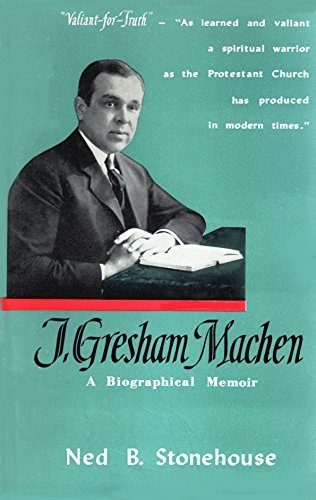
J. Gresham Machen: A Biographical Memoir
A monument to the great leader of the modern evangelical movement and the author of many classical works of apologetics, this definitive biography of J. Gresham Machen by his intimate friend, associate and successor, is based upon a vast amount of letters, memoranda and other documents (filling nearly thirty drawers in the Machen files) in addition to the author's personal reminiscences, and an evaluation of Machen's published writings. An intimate and personal account which leaves no aspect of Machen's full and brilliant life untouched. Ned B. Stonehouse's full-scale portrait is a vivid and inspiring picture of a Christian of apostolic ardor who, at his untimely death in 1937, was called " the first Protestant in the nation." Acknowledged by his critics and admirers alike as the greatest leader of the whole cause of evangelical Christianity in modern times, Machen raised the intellectual acuteness of Protestant orthodoxy to a point where observers such as H. L. Mencken and Walter Lippmann claimed that in the religious debates of the twenties and thirties, the liberals had yet to answer him.
520 pages, Hardcover
First published January 1, 1954
Ratings & Reviews
Friends & Following
Create a free account to discover what your friends think of this book!
Community Reviews
Displaying 1 - 30 of 30 reviews

February 8, 2021
It was perhaps a bit too well-documented toward the beginning, with many quoted letters and details of grandfathers which might have been better abridged, but the latter half was magnificent, with an excellent explanation of the events happening in the Presbyterian Church which led to Machen's ejection and the start of Westminster Seminary. It was very very sad that the PCUSA went the way it did, and it seems to have broken Machen's heart as well.

March 7, 2009
Quite good.
April 5, 2026
Very Good.
Unshaken in his love for our Lord Jesus Christ
Stalwart of the Reformed presbyterian faith
Death of PCUSA and birth of the PCA
Death of Princeton Seminary and Birth of Westminster Seminary
Matt 16:18b
2 Tim 4:1-4
You hardly feel when you begin to drift. It’s like riding in a hot air-balloon. You only realize how far you have gone when you look back to where you were. Be watchful! Stand firm.
Unshaken in his love for our Lord Jesus Christ
Stalwart of the Reformed presbyterian faith
Death of PCUSA and birth of the PCA
Death of Princeton Seminary and Birth of Westminster Seminary
Matt 16:18b
2 Tim 4:1-4
You hardly feel when you begin to drift. It’s like riding in a hot air-balloon. You only realize how far you have gone when you look back to where you were. Be watchful! Stand firm.

June 30, 2026
A very sobering read. Would I have the courage that Machen had to stand for an uncompromising Gospel and system of doctrine against virtually the whole Presbyterian church of his day?
I was also greatly moved getting a glimpse into the love he had for his mother as seen in the incredible correspondence he kept up with her (over 1000 letters written to her over 30 years).
I was also greatly moved getting a glimpse into the love he had for his mother as seen in the incredible correspondence he kept up with her (over 1000 letters written to her over 30 years).

September 30, 2019
Banner of Truth bolsters their impressive array of Christian biographies with this reprint of Ned Stonehouse’s biography of J. Gresham Machen. While I was aware of Machen’s reputation as a stalwart defender of conservative Christianity, I really didn’t know much about his life. Perhaps my not being a Presbyterian had me more out of the loop on Machen’s impressive career, though I had read some of his works with profit before. Don’t worry if your beliefs don’t exactly line up with that of a reformed Presbyterian, because his contribution to the faith extends to all who hold unwaveringly to the veracity of the Bible and a vibrant personal relationship with Christ.
Stonehouse was a colleague of Machen over the last years of Machen’s life when they served together at Westminster Theological Seminary. Without a doubt, Stonehouse is as sympathetic a biographer as you could have and clearly reveres his subject. I realize that can derail some biographies, but I felt I knew Machen so well by the time I finished this volume and Stonehouse proved to be an excellent biographer. If you find the first few chapters on the Gresham and Machen families a little slow, just hang on because I promise the life of Machen proves enjoyable reading.
I’d be tempted to describe Machen as a man born with a silver spoon in his mouth, but there was enough spirituality, particularly in his mother, to have greatly strengthened Machen for his extensive ministry. There was enough money in the family, however, for him to get whatever level of education he wanted and he made the most of it. His time in Germany and the wrestling of his faith was extremely interesting as all the learned names of Germany in that generation popped up in the story. When his faith became more settled, he had as much struggle determining his career path. In both these cases, the sympathetic biographer did an outstanding job opening up these facets of Machen’s life. Since many people wrestle with similar issues, this was powerful spiritual reading.
After he got on his feet at Princeton and was ordained to the ministry, World War I came up. That part of his life story though he was neither a soldier nor an actual chaplain was absolutely riveting. It was so unusual and yet it really helped the reader to understand Machen’s character. As a side note, after proving so adept with both the German and the biblical languages, I was amazed to see that he gave some theological lectures in French before he left France!
His ongoing career and his book writing showed an upward career path with outstanding literary accomplishment. The demise of Princeton’s allegiance to orthodoxy could almost serve as a parable of religious corruption. This same battle has played itself out in so many cases and places. You might find this portion of his life as a blueprint for how to stand when everyone around you wants to run away from God and his word. The ultimate step of creating Westminster showed the thoroughness of his dedication. He wisely saw that orthodoxy in missions was as important as orthodoxy at the academy and he fought valiantly on that front as well. His early death in an unexpected place and way was sad history but interesting biography.
This book holds attention throughout. Perhaps all it lacked was an appendix of all his literary works, but it was thorough without ever falling victim to being boring. The book itself is another of those exquisitely produced hardback editions that we so appreciate from Banner. This book was insightful on how to deal with corruption, spiritual on how one man so well lived the Christian life, and interesting as a biography. I must say that I really enjoyed this book!
I received this book free from the publisher. I was not required to write a positive review. The opinions I have expressed are my own. I am disclosing this in accordance with the Federal Trade Commission’s 16 CFR, Part 255.
Stonehouse was a colleague of Machen over the last years of Machen’s life when they served together at Westminster Theological Seminary. Without a doubt, Stonehouse is as sympathetic a biographer as you could have and clearly reveres his subject. I realize that can derail some biographies, but I felt I knew Machen so well by the time I finished this volume and Stonehouse proved to be an excellent biographer. If you find the first few chapters on the Gresham and Machen families a little slow, just hang on because I promise the life of Machen proves enjoyable reading.
I’d be tempted to describe Machen as a man born with a silver spoon in his mouth, but there was enough spirituality, particularly in his mother, to have greatly strengthened Machen for his extensive ministry. There was enough money in the family, however, for him to get whatever level of education he wanted and he made the most of it. His time in Germany and the wrestling of his faith was extremely interesting as all the learned names of Germany in that generation popped up in the story. When his faith became more settled, he had as much struggle determining his career path. In both these cases, the sympathetic biographer did an outstanding job opening up these facets of Machen’s life. Since many people wrestle with similar issues, this was powerful spiritual reading.
After he got on his feet at Princeton and was ordained to the ministry, World War I came up. That part of his life story though he was neither a soldier nor an actual chaplain was absolutely riveting. It was so unusual and yet it really helped the reader to understand Machen’s character. As a side note, after proving so adept with both the German and the biblical languages, I was amazed to see that he gave some theological lectures in French before he left France!
His ongoing career and his book writing showed an upward career path with outstanding literary accomplishment. The demise of Princeton’s allegiance to orthodoxy could almost serve as a parable of religious corruption. This same battle has played itself out in so many cases and places. You might find this portion of his life as a blueprint for how to stand when everyone around you wants to run away from God and his word. The ultimate step of creating Westminster showed the thoroughness of his dedication. He wisely saw that orthodoxy in missions was as important as orthodoxy at the academy and he fought valiantly on that front as well. His early death in an unexpected place and way was sad history but interesting biography.
This book holds attention throughout. Perhaps all it lacked was an appendix of all his literary works, but it was thorough without ever falling victim to being boring. The book itself is another of those exquisitely produced hardback editions that we so appreciate from Banner. This book was insightful on how to deal with corruption, spiritual on how one man so well lived the Christian life, and interesting as a biography. I must say that I really enjoyed this book!
I received this book free from the publisher. I was not required to write a positive review. The opinions I have expressed are my own. I am disclosing this in accordance with the Federal Trade Commission’s 16 CFR, Part 255.

February 6, 2023
A fantastic biography about a man I knew too little about before reading this book. I recently read a biography about John Murray (someone who worked with Machen during his later years) and was so caught up in that book and the life of Murray that I wanted more in that era. J. Gresham Machen is surely one of the principle Christian figures in the early 20th century and though I knew a vague sketch of his life and his work at Princeton and Westminster, I doubt I could have told you anything else about him. But if you want to more fully understand the life and trajectory of the Christian church in America during the first part of the 20th century, I doubt there is a figure more pivotal to understand than this one. He was at the center of multiple major controversies in the war for the soul of the church and he saw more insightfully than most Christian leaders of that time period. Or perhaps that's incorrect. There were others who may have seen the dangerous drift of the church, but Machen was the one that spoke up and Machen was the one that fought back. He was a man of rare conviction and courage during a time where it was far easier to coast along with the spirit of the age. But I get ahead of myself.
This is a biography of a person, is it not? And if anything, that is probably my one qualm with this book. It is most certainly a biography, but at times it appears that the detailing of the history and issues of the church overtakes the description of the man. That's not all a bad thing, to be sure! As someone who loves biography, history, and especially church history, this book was incredibly interesting. I was always excited to pick it up and continue reading - never a dull moment in this one! But I will say that the biographer chose to veer on the side of chronicling history rather than to attempt to give one a closer look at the man himself.
The first half of the book we do get a little more details on his childhood and early life. I was incredibly fascinated and encouraged to see how Machen's childhood and family were used to influence the man he was to become. His parents were both highly intelligent and encouraged Machen to be independent in study and to search for truth, while also bringing him up in the ways of the Lord. Machen was so impressed with the ideals of intellectual study and the high regard for truth that he had no qualms with spending several years studying theology at some of the most liberal schools in Germany. Some conservative Christians now may shy away from such plans, but Machen was not worried. The truth would prevail, he had no doubt. So why should he not study and sit under some of the finest minds of the day, even if their Christian orthodoxy sometimes left a little to be desired. For Machen knew - the truth will out! (By the by, not recommending that all of us uncritically and without discernment consume philosophical babblings from dangerous sources. God grant us discernment and wisdom that we may separate the wheat from the chaff). Anyway, I am getting a bit in the weeds now, am I not? I also was encouraged to see that Machen did not entirely know what he was to do with his life early on. He was quite indecisive, not sure of the path he was to take. He kept making decisions for "just this year" or "one year more". Encouraging to see God work in Machen's life in spite of his lack of vision! And the chapter on Machen's service in World War I was interesting and thrilling both. I had no idea he was in Europe during that war (as a volunteer for the YMCA, no less!).
I think this is getting to be a bit long, and I haven't even touched the main reason most of us (if we do) know of Machen to this day. He was a professor at Princeton during the final years where Princeton still unashamedly held to the grand old doctrines of the Christian faith and served as a bulwark against the rising tides of Christian liberalism and modern thought. But the church was drifting, and along with it (or perhaps in advance of it!) went many Christian leaders in both the church and university spheres. Machen was a voice in the wilderness, a watchman in the tower. He proclaimed the truth and protested (some thought too strongly) when he saw signs of wavering and pandering in the church. Princeton was eventually lost and so Machen and a handful of others stood against the storm and founded Westminster Theological Seminary. The stories of all of this are well told in this volume and honestly? This book is worth it for those stories alone, of which I knew very little details before reading this book. Even after being at Westminster, there were further battles to fight, further lines to draw in the sand. Machen drew these lines more conservatively than many even in his camp would do and he was not always supported by his fellows. But it was profoundly encouraging to see this man's courage for fighting for the gospel and the authority of Scripture in everyday life. Machen believed that the Word of God is true and that it can be studied and understood, as from a God who wants to communicate with us.
I don't believe this book is perfect. As I said earlier, in the second half in particular, this book gets close to being pure history and losing sight of the man. And written by a man who knew him well and indeed served under him, there is perhaps at times a lack of perspective. Yet even so? We need books like this, written while the iron is hot and written by someone who labored alongside Machen in the trenches. Oh and I forgot one of the things I loved most about this book. All the letters written between Machen and his mother are simply delights. To see their love for one another and the encouragement and devotion they provided to one another throughout their lives! Very heart-warming and indeed a reminder and spur that I ought honour my own parents as Machen is seen to do. All of this being said. This book was most well worth it and if you are at all interested in early 20th century Christianity, this book is a must read.
This is a biography of a person, is it not? And if anything, that is probably my one qualm with this book. It is most certainly a biography, but at times it appears that the detailing of the history and issues of the church overtakes the description of the man. That's not all a bad thing, to be sure! As someone who loves biography, history, and especially church history, this book was incredibly interesting. I was always excited to pick it up and continue reading - never a dull moment in this one! But I will say that the biographer chose to veer on the side of chronicling history rather than to attempt to give one a closer look at the man himself.
The first half of the book we do get a little more details on his childhood and early life. I was incredibly fascinated and encouraged to see how Machen's childhood and family were used to influence the man he was to become. His parents were both highly intelligent and encouraged Machen to be independent in study and to search for truth, while also bringing him up in the ways of the Lord. Machen was so impressed with the ideals of intellectual study and the high regard for truth that he had no qualms with spending several years studying theology at some of the most liberal schools in Germany. Some conservative Christians now may shy away from such plans, but Machen was not worried. The truth would prevail, he had no doubt. So why should he not study and sit under some of the finest minds of the day, even if their Christian orthodoxy sometimes left a little to be desired. For Machen knew - the truth will out! (By the by, not recommending that all of us uncritically and without discernment consume philosophical babblings from dangerous sources. God grant us discernment and wisdom that we may separate the wheat from the chaff). Anyway, I am getting a bit in the weeds now, am I not? I also was encouraged to see that Machen did not entirely know what he was to do with his life early on. He was quite indecisive, not sure of the path he was to take. He kept making decisions for "just this year" or "one year more". Encouraging to see God work in Machen's life in spite of his lack of vision! And the chapter on Machen's service in World War I was interesting and thrilling both. I had no idea he was in Europe during that war (as a volunteer for the YMCA, no less!).
I think this is getting to be a bit long, and I haven't even touched the main reason most of us (if we do) know of Machen to this day. He was a professor at Princeton during the final years where Princeton still unashamedly held to the grand old doctrines of the Christian faith and served as a bulwark against the rising tides of Christian liberalism and modern thought. But the church was drifting, and along with it (or perhaps in advance of it!) went many Christian leaders in both the church and university spheres. Machen was a voice in the wilderness, a watchman in the tower. He proclaimed the truth and protested (some thought too strongly) when he saw signs of wavering and pandering in the church. Princeton was eventually lost and so Machen and a handful of others stood against the storm and founded Westminster Theological Seminary. The stories of all of this are well told in this volume and honestly? This book is worth it for those stories alone, of which I knew very little details before reading this book. Even after being at Westminster, there were further battles to fight, further lines to draw in the sand. Machen drew these lines more conservatively than many even in his camp would do and he was not always supported by his fellows. But it was profoundly encouraging to see this man's courage for fighting for the gospel and the authority of Scripture in everyday life. Machen believed that the Word of God is true and that it can be studied and understood, as from a God who wants to communicate with us.
I don't believe this book is perfect. As I said earlier, in the second half in particular, this book gets close to being pure history and losing sight of the man. And written by a man who knew him well and indeed served under him, there is perhaps at times a lack of perspective. Yet even so? We need books like this, written while the iron is hot and written by someone who labored alongside Machen in the trenches. Oh and I forgot one of the things I loved most about this book. All the letters written between Machen and his mother are simply delights. To see their love for one another and the encouragement and devotion they provided to one another throughout their lives! Very heart-warming and indeed a reminder and spur that I ought honour my own parents as Machen is seen to do. All of this being said. This book was most well worth it and if you are at all interested in early 20th century Christianity, this book is a must read.

November 6, 2024
Summary: A biographical memoir chronicling Machen's evangelical faith and scholarship, first at Princeton and then at Westminster.
J. Gresham Machen was arguably one of the most significant thinkers in twentieth century evangelicalism. He was an exacting scholar and staunch defender of an evangelical understanding of the Westminster Confession of the Presbyterian Church. Following in the steps of the Hodges and Warfield, he sought to defend the stance of Princeton as in its orthodox adherence to a Reformed and Evangelical faith and worked against measures that liberalized the seminary. Ultimately, his ministerial credentials were revoked and he led a group of scholars to form Westminster Theological Seminary, and subsequently, the Orthodox Presbyterian Church.
Ned B. Stonehouse was a student under Machen and one of the founding faculty, along with Machen, of Westminster. This "biographical memoir" has the character of an appreciative, though thorough, account of Machen's life. He extensively cites Machen's writing, including his extensive correspondence, especially with his mother. From this 600 page biography, I simply want to note some aspects of Machen's life that were striking.
A godly family. His parents were devout yet created a culturally rich rather than stultifying environment. When Machen struggled both with intellectual doubts and uncertainties about calling, his father was unstinting in his personal and financial support, expressing confidence in his son's judgement. Equally, his mother stood by him throughout his life, prayed constantly, and eagerly engaged even Machen's scholarly works.
A faith tested in the wilderness. Following his studies at Princeton, he received a fellowship to study at the theological centers in Germany. While he reveled in the scholarship, he also wrestled with his faith in the face of the liberal scholarship he encountered from impressive theologians. Because of this, he delayed ordination and an appointment at Princeton, working as a lecturer while he pressed into the questions his time in Europe had raised, eventually coming back to a full embrace of the faith as expressed in the Westminster Confession. I believe it was this that made him so effective, first as a teacher, and then as an advocate as that liberal faith hit the American church.
A wise mentor. In William Armstrong, a Princeton professor under whom Machen studied and who recruited him. he was blessed with a mentor who patiently walked with Machen through his theological and vocational struggles. Armstrong remained supportive and encouraging while never dismissing Machen's qualms. Likewise, he found ways for Machen to teach without needing to pursue ordination until he was ready.
A balance of grace and truth. Machen is known for being unafraid to challenge institutions that wavered theologically. Yet he was a man of great personal compassion. Stonehouse offers the example of his care for a converted alcoholic, at great personal cost, as well as his liberal generosity in care for others.
A careful scholar. His magnum opus was his work The Virgin Birth of Christ. Along with Christianity and Liberalism, a great work of public scholarship, both works remain in print to this day. Likewise, his New Testament Greek for Beginners served as a standard seminary text for many years. Most of his works are still in print.
A courageous advocate. Machen opposed Princeton's board reorganization, which would (and did) weaken the theological stance of the seminary. Likewise, he challenged the theological drift within Presbyterian missions. It was this that led to revoking his ordination.
Ned Stonehouse's biography of J. Gresham Machen leaves me wondering about our contemporary situation. The American church seems more fragmented than ever and theological orthodoxy less of a concern than ever. A reading of this work at very least ought serve as a reminder of what it means to be faithful in life and doctrine.
____________________
Disclosure of Material Connection: I received a complimentary copy of this book from the publisher for review.
J. Gresham Machen was arguably one of the most significant thinkers in twentieth century evangelicalism. He was an exacting scholar and staunch defender of an evangelical understanding of the Westminster Confession of the Presbyterian Church. Following in the steps of the Hodges and Warfield, he sought to defend the stance of Princeton as in its orthodox adherence to a Reformed and Evangelical faith and worked against measures that liberalized the seminary. Ultimately, his ministerial credentials were revoked and he led a group of scholars to form Westminster Theological Seminary, and subsequently, the Orthodox Presbyterian Church.
Ned B. Stonehouse was a student under Machen and one of the founding faculty, along with Machen, of Westminster. This "biographical memoir" has the character of an appreciative, though thorough, account of Machen's life. He extensively cites Machen's writing, including his extensive correspondence, especially with his mother. From this 600 page biography, I simply want to note some aspects of Machen's life that were striking.
A godly family. His parents were devout yet created a culturally rich rather than stultifying environment. When Machen struggled both with intellectual doubts and uncertainties about calling, his father was unstinting in his personal and financial support, expressing confidence in his son's judgement. Equally, his mother stood by him throughout his life, prayed constantly, and eagerly engaged even Machen's scholarly works.
A faith tested in the wilderness. Following his studies at Princeton, he received a fellowship to study at the theological centers in Germany. While he reveled in the scholarship, he also wrestled with his faith in the face of the liberal scholarship he encountered from impressive theologians. Because of this, he delayed ordination and an appointment at Princeton, working as a lecturer while he pressed into the questions his time in Europe had raised, eventually coming back to a full embrace of the faith as expressed in the Westminster Confession. I believe it was this that made him so effective, first as a teacher, and then as an advocate as that liberal faith hit the American church.
A wise mentor. In William Armstrong, a Princeton professor under whom Machen studied and who recruited him. he was blessed with a mentor who patiently walked with Machen through his theological and vocational struggles. Armstrong remained supportive and encouraging while never dismissing Machen's qualms. Likewise, he found ways for Machen to teach without needing to pursue ordination until he was ready.
A balance of grace and truth. Machen is known for being unafraid to challenge institutions that wavered theologically. Yet he was a man of great personal compassion. Stonehouse offers the example of his care for a converted alcoholic, at great personal cost, as well as his liberal generosity in care for others.
A careful scholar. His magnum opus was his work The Virgin Birth of Christ. Along with Christianity and Liberalism, a great work of public scholarship, both works remain in print to this day. Likewise, his New Testament Greek for Beginners served as a standard seminary text for many years. Most of his works are still in print.
A courageous advocate. Machen opposed Princeton's board reorganization, which would (and did) weaken the theological stance of the seminary. Likewise, he challenged the theological drift within Presbyterian missions. It was this that led to revoking his ordination.
Ned Stonehouse's biography of J. Gresham Machen leaves me wondering about our contemporary situation. The American church seems more fragmented than ever and theological orthodoxy less of a concern than ever. A reading of this work at very least ought serve as a reminder of what it means to be faithful in life and doctrine.
____________________
Disclosure of Material Connection: I received a complimentary copy of this book from the publisher for review.

November 12, 2024
I picked up a biography on J. Gresham Machen to read opposite on one of H. L. Mancken's biography after reading the obituatory Mancken wrote when J. Gresham Machen died and thought the juxtaposition of the two men with similar names in a similar times in a space where they were popular yet fighting against the societal downfall (in their own fields). H. L. against the drab, old ways of literature and journalism (a Hunter S. Thompson-esk of his day). J. Gresham fighting against the "Modernists" (aka liberal Christianity) of his field.
Here's what atheist H. L. had to say about Presbyterianism Calvinist J. Gresham (in part), "It is my belief, as a friendly neutral in all such high and ghostly matters, that the body of doctrine known as Modernism is completely incompatible, not only with anything rationally describable as Christianity, but also with anything deserving to pass as religion in general. Religion, if it is to retain any genuine significance, can never be reduced to a series of sweet attitudes, possible to anyone not actually in jail for felony. It is, on the contrary, a corpus of powerful and profound convictions...Dr. Machen tried to impress that obvious fact upon his fellow adherents...He failed--but he was undoubtedly right.
Enjoying my learning about H. L. Mencken, I was excited to dive into this book. Having some passing knowledge of Machen and his place in Church history, I wasn't going in blind and had some high respect of the man. This book, first published in 1954, about 17 years after the death of Machen by someone who helped start the Westminister Theological Seminary and a respected scholar in his own right - this book was drab and sadly not well done as a biography nor to really drive home the importance of Machen.
Stonehouse puts most of the normal parts of Machen's life one would expect in a biography and the amount of first hand sources just from Machen's letters and his mother's letters are a treasure trove for a biographer, yet the story of Machen's life drags and drags. The organization tends to flip back and forth in timeline and there's almost too much focus on the primary documents to account for smaller parts of Machen's life but misses out on some major parts of his life.
For example, about three quarters into the book a discussion is made about Machen's family and personal wealth, something that could have been discussed much earlier and touched on briefly when discussing Machen's writing career and raising of funds for his seminary. Missing is a discussion of Machen's very interesting political views and even testifying before Congress on behalf of opposing a federal Department of Education. We get too much back and forth between his clear love of his mother in notes and less, albeit some, on the fact that Machen seems to be a sort of atheist or at least a non-holder of orthodox belief when he's in seminary - the author doesn't make that clear.
Firsthand accounts and citations abound but providing a clear picture, especially for one not of the time or of the full understanding of Presbyterianism or even of Modernism vs. Orthodox Christianity has to be sought outside the book. Facts are provided but storytelling does not happen well.
However, through the three month slog through the book I was determined to finish, I did find a deeper appreciation for Machen and his full life. His time during WWI was interesting, his books (but the author doesn't go really into the specifics enough to entice their reading), and his time among other great men of the early 20th century Princeton Christians.
This was really too bad as the ability to tell a really interesting story of an interesting life is clearly there, and some 80 years later these important fights by similar important men are sadly still being fought and we need stories from Church history to inspire and guide us. Men like those that atheist H. L. Mencken could clearly see the need and the true belief of a great man like J. Gresham Machen. Final Grade - D+
Here's what atheist H. L. had to say about Presbyterianism Calvinist J. Gresham (in part), "It is my belief, as a friendly neutral in all such high and ghostly matters, that the body of doctrine known as Modernism is completely incompatible, not only with anything rationally describable as Christianity, but also with anything deserving to pass as religion in general. Religion, if it is to retain any genuine significance, can never be reduced to a series of sweet attitudes, possible to anyone not actually in jail for felony. It is, on the contrary, a corpus of powerful and profound convictions...Dr. Machen tried to impress that obvious fact upon his fellow adherents...He failed--but he was undoubtedly right.
Enjoying my learning about H. L. Mencken, I was excited to dive into this book. Having some passing knowledge of Machen and his place in Church history, I wasn't going in blind and had some high respect of the man. This book, first published in 1954, about 17 years after the death of Machen by someone who helped start the Westminister Theological Seminary and a respected scholar in his own right - this book was drab and sadly not well done as a biography nor to really drive home the importance of Machen.
Stonehouse puts most of the normal parts of Machen's life one would expect in a biography and the amount of first hand sources just from Machen's letters and his mother's letters are a treasure trove for a biographer, yet the story of Machen's life drags and drags. The organization tends to flip back and forth in timeline and there's almost too much focus on the primary documents to account for smaller parts of Machen's life but misses out on some major parts of his life.
For example, about three quarters into the book a discussion is made about Machen's family and personal wealth, something that could have been discussed much earlier and touched on briefly when discussing Machen's writing career and raising of funds for his seminary. Missing is a discussion of Machen's very interesting political views and even testifying before Congress on behalf of opposing a federal Department of Education. We get too much back and forth between his clear love of his mother in notes and less, albeit some, on the fact that Machen seems to be a sort of atheist or at least a non-holder of orthodox belief when he's in seminary - the author doesn't make that clear.
Firsthand accounts and citations abound but providing a clear picture, especially for one not of the time or of the full understanding of Presbyterianism or even of Modernism vs. Orthodox Christianity has to be sought outside the book. Facts are provided but storytelling does not happen well.
However, through the three month slog through the book I was determined to finish, I did find a deeper appreciation for Machen and his full life. His time during WWI was interesting, his books (but the author doesn't go really into the specifics enough to entice their reading), and his time among other great men of the early 20th century Princeton Christians.
This was really too bad as the ability to tell a really interesting story of an interesting life is clearly there, and some 80 years later these important fights by similar important men are sadly still being fought and we need stories from Church history to inspire and guide us. Men like those that atheist H. L. Mencken could clearly see the need and the true belief of a great man like J. Gresham Machen. Final Grade - D+

January 1, 2020
A good book with which to conclude the year. It took me about four months, but I finished more than half of it in a two-week push. This biography is more laudatory in its style and approach than what would generally be favored today; but on the other hand, I think the book would’ve lost something if it hadn’t been written by one who personally loved and was mentored by Machen.
It was really helpful to get a fuller picture of Machen as a churchman and scholar (one who had been much acquainted with theological liberalism), not simply a narrow controversialist. The chapter on Christianity and Liberalism was especially valuable in its assessment of Machen in relation to the emergent Fundamentalism of the day.
Also interesting to compare the personalities of Machen and Vos, after having read Vos’s letters a year ago.
Finally, I must register my amusement as a Hollins University alumna, as JGM preached there in 1917. He wrote to Mother Machen, “They are the only pretty girls [...] whom I had seen for 15 years. Had I enjoyed such advantages before I got too old, my life might have been different! It was really lots of fun. I wish I could preach to that same senior class every Sunday, and join the class-meeting afterwards.” !!!! This especially delights because, as a former attendee of such services as still took place in the college chapel in recent decades, I doubt Machen would *ever* have received an invitation to preach there 100 years later. And I don’t know if he would have had the same reaction to the “girls”...! Still, Hollins women have always had their ways of making an impression, it seems!
It was really helpful to get a fuller picture of Machen as a churchman and scholar (one who had been much acquainted with theological liberalism), not simply a narrow controversialist. The chapter on Christianity and Liberalism was especially valuable in its assessment of Machen in relation to the emergent Fundamentalism of the day.
Also interesting to compare the personalities of Machen and Vos, after having read Vos’s letters a year ago.
Finally, I must register my amusement as a Hollins University alumna, as JGM preached there in 1917. He wrote to Mother Machen, “They are the only pretty girls [...] whom I had seen for 15 years. Had I enjoyed such advantages before I got too old, my life might have been different! It was really lots of fun. I wish I could preach to that same senior class every Sunday, and join the class-meeting afterwards.” !!!! This especially delights because, as a former attendee of such services as still took place in the college chapel in recent decades, I doubt Machen would *ever* have received an invitation to preach there 100 years later. And I don’t know if he would have had the same reaction to the “girls”...! Still, Hollins women have always had their ways of making an impression, it seems!

July 17, 2022
Machen is a fascinating character – he studied under the foremost liberal scholars in Europe, and yet was unmoved in his devotion to the orthodox, reformed faith; the one opportunity he had for marriage was cut off because Machen could not allow himself to marry a Unitarian; he wrote one of the most timeless and relevant books of the 20th century in “Christianity and Liberalism”; and although he has a reputation as a rigid doctrinaire, the pages of this book show him often to be humble, gentle and gracious in his relations with others. When a statement like the inclusivist Auburn Affirmation gains the traction that it did in the 1920s Presbyterian church, it is no wonder that Machen became alarmed and spent the rest of his life fighting for reformed orthodoxy, with little victory and much heartache. His relentless labors no doubt contributed to his premature death in 1937.
The weakness of this book is that author Ned Stonehouse, a former colleague of Machen’s at Westminster seminary, shares far too many excerpts from Machen’s correspondences with his mother. Letters back and forth are reprinted in great volume, and the effect drags down the momentum of the story.
Nevertheless, anyone interested in the influence of modernism on American Presbyterianism, as well as the beginning of Westminster seminary and the Orthodox Presbyterian Church, should find this book useful.
The weakness of this book is that author Ned Stonehouse, a former colleague of Machen’s at Westminster seminary, shares far too many excerpts from Machen’s correspondences with his mother. Letters back and forth are reprinted in great volume, and the effect drags down the momentum of the story.
Nevertheless, anyone interested in the influence of modernism on American Presbyterianism, as well as the beginning of Westminster seminary and the Orthodox Presbyterian Church, should find this book useful.
August 13, 2024
Loved it, but then again, I don't think I've read a biography I didn't like. This was strongly recommended, and I am glad it was.
Just over 500 pages and reads well. There is a lot of correspondence as well particularly those between him and mother. The relationship between was very tight and she no doubt played a big part in who he became in later life. No doubt as to the importance of a nurturing, spirit-led mom.
I found his wartime (WWI) section fascinating. There is something about a first-hand war account as given by a preacher. I felt the same reading the Diary of Kenneth Macrae (Two World Wars) and the Martyn Lloyd Jones biography remarks on WWII.
The biography goes into some of the early problems at Princeton University. The controversy centered around doctrine. The old-school philosophy emphasized strong doctrine and a life that matched, the new philosophy (young people) wanted to emphasize life and doctrine that matched it.
Some detail is given in the books he wrote. Christianity Verses Liberalism and The Virgin Birth of Christ seem to get a lot of attention and rightfully, so they were great books.
During this time Harry Emerson Fosdick was making his rounds and having a lot of influence. This was addressed in the biography.
The book was an easy read and informative and consider it worth reading.
Just over 500 pages and reads well. There is a lot of correspondence as well particularly those between him and mother. The relationship between was very tight and she no doubt played a big part in who he became in later life. No doubt as to the importance of a nurturing, spirit-led mom.
I found his wartime (WWI) section fascinating. There is something about a first-hand war account as given by a preacher. I felt the same reading the Diary of Kenneth Macrae (Two World Wars) and the Martyn Lloyd Jones biography remarks on WWII.
The biography goes into some of the early problems at Princeton University. The controversy centered around doctrine. The old-school philosophy emphasized strong doctrine and a life that matched, the new philosophy (young people) wanted to emphasize life and doctrine that matched it.
Some detail is given in the books he wrote. Christianity Verses Liberalism and The Virgin Birth of Christ seem to get a lot of attention and rightfully, so they were great books.
During this time Harry Emerson Fosdick was making his rounds and having a lot of influence. This was addressed in the biography.
The book was an easy read and informative and consider it worth reading.

December 26, 2019
Spurgeon with the Downgrade, Edwards at Northampton, Machen at Princeton. The man who stands for the Truth, and the Way, and Life will all too often be consumed by the very men they serve.
"To him the issue was much simpler and clear cut: there was only the path of consistent, militant witness and action regardless of consequences--or that of compromise."
Yet Machen was no more the loser than Edwards or Spurgeon. He as the others have left a legacy of faith to countless men who have followed. He was a scholar, a leader of men, a gentleman, a man of whom the world was not worthy. I did appreciate getting to know Dr. Machen, and piecing together many episodes from church history to which he was integral. However, I felt as though I have had a tour around the exterior, glimpses in the windows, but not a warm welcome into the person of J. Gresham Machen.
"To him the issue was much simpler and clear cut: there was only the path of consistent, militant witness and action regardless of consequences--or that of compromise."
Yet Machen was no more the loser than Edwards or Spurgeon. He as the others have left a legacy of faith to countless men who have followed. He was a scholar, a leader of men, a gentleman, a man of whom the world was not worthy. I did appreciate getting to know Dr. Machen, and piecing together many episodes from church history to which he was integral. However, I felt as though I have had a tour around the exterior, glimpses in the windows, but not a warm welcome into the person of J. Gresham Machen.

November 3, 2023
Interesting read but rather stilted prose. During Machen's time studying in Germany, Stonehouse alludes to some type of crisis in his life which bears heavily on his decision whether to enter the ministry or not, but we are never told (frustratingly) what it is that is troubling him. I found my enthusiasm for this book wearing off after about 1/3 way through. I think I would have preferred a more concise (rather than encyclopedic) biography. Reprints of all his letters to his mother and father may have given greater insight into his thinking, but that could have been handled with a sentence or two. I suppose if one really wants to know the man and what made him tick this is a good book to read, but for the average layperson it may be more than one wants to know.

May 24, 2020
A very thorough and detailed biography of an important figure of the early 20th century church--detailed sometimes to the point of tedium, but will be appreciated by those truly interested in his life. The book serves as a good chronicle of the Fundamentalist vs. Modernist controversies of the 1910s and '20s from the viewpoint of one of the most important fundamentalist leaders. You can read my more complete review on my blog:
https://morgantrotter.wordpress.com/2...
https://morgantrotter.wordpress.com/2...

October 12, 2024
I knew some of the broad strokes of Machen's life, but it was interesting to dive in in more detail. A well written biography and an interesting look at a period of church history that saw some seismic changes. I got the feeling the Machen became a little entrenched and embattled by the end of his life, but it was interesting to see what he accomplished as a man who stood by his principles and tried to be faithful in all that did.
September 20, 2019
I read it because I admire the man and want to get a handle on his life.
I did not read it because of its fresh and modern style.
It is not fresh or modern.
Five stars for the subject, though! My little Gresham has a lot to live up to...
I did not read it because of its fresh and modern style.
It is not fresh or modern.
Five stars for the subject, though! My little Gresham has a lot to live up to...

April 21, 2020
Terrific. (I hope to write a full review soon.)

October 22, 2022
The book is exceptionally well written. Hard to get through, but definitely worth the read.
September 25, 2023
Sigh...now I have to buy every Machen book. One of the best biographies I've read. Engaging from top to bottom, thorough, and a great portrait of a wonderful man.

Want to Read
January 25, 2024Per Dr. Bart (1.25.2024)
February 11, 2025
The fascinating story of an incredible man made dull. Should be 300+ pages shorter.
April 1, 2026
Excellent and inspiring.
June 29, 2020
Deserves the label of “a classic”! Stonehouse’s prayer—that these pages with stir up another generation for fidelity and complete abandonment to the truth of Jesus Christ—seem to be answered in Banner’s Reprint in 2020. With all the wit of Machen, regarding Football, Germany, mountain climbing, fundamentalism, and smoking, it is an entertaining read. But only the solid and costly account of contending for the faith could earn these five stars. Machen’s polemics against Modernism may sound different than some of the issues we face today, but in principle they are the same. This book is timelessly relevant because it is patently biblical. Machen points out that subjective interpretations of the Scripture that do not accord with the intended meaning of its historical authors, produce a different religion than Christianity. The true Christ is discovered in the text, not created out of it. This subjectivized interpretation faces us again in hermeneutics.
Machen (and Macartney) knew that unbelief blushes at the world’s mockery. The path to compromise starts with an untested but sincere desire for influence, coupled with an idolatry that believes man can create more influence than God. The battle against German liberalism that almost turned Machen away from the faith, the battle with tolerant Modernism, Princeton, and the PCUSA—it’s all here in this book. The Lord was using this produce Westminster and the OPC. The truth is never popular and every Christian who is involved with seminary education ought to read this book.
Machen (and Macartney) knew that unbelief blushes at the world’s mockery. The path to compromise starts with an untested but sincere desire for influence, coupled with an idolatry that believes man can create more influence than God. The battle against German liberalism that almost turned Machen away from the faith, the battle with tolerant Modernism, Princeton, and the PCUSA—it’s all here in this book. The Lord was using this produce Westminster and the OPC. The truth is never popular and every Christian who is involved with seminary education ought to read this book.

July 7, 2010
This was by far one of the best biographies that I have ever read. The walk through of Machen's beginnings along with the historical background of his family was very enjoyable. At first it sounded like it was just going to be a mushy Victorian age type of book, but once I got farther in the book that all changed. The way Stonehouse describes his heavenly patience with those actively seeking to destroy his name using any and all necessary tactics is truly wonderful.
I also enjoyed the details around his stay in Germany and the friendships that he formed along with his love for the mountains and just a felicity towards German culture. I really enjoyed how he chose to take base duties during his stay in France during WWI. It's almost in his letters to his mother that he is frightened by the sounds of horror happening around him, while at the same time remaining strong in the faith.
His relationship to his mother was very touching and in the end I'm just left with a warm feeling of appreciation for how he served the kingdom and his love for all those that he came in contact with.
I also enjoyed the details around his stay in Germany and the friendships that he formed along with his love for the mountains and just a felicity towards German culture. I really enjoyed how he chose to take base duties during his stay in France during WWI. It's almost in his letters to his mother that he is frightened by the sounds of horror happening around him, while at the same time remaining strong in the faith.
His relationship to his mother was very touching and in the end I'm just left with a warm feeling of appreciation for how he served the kingdom and his love for all those that he came in contact with.

February 5, 2013
A colleague of the famed American theologian of the Old Princeton tradition, Ned B. Stonehouse remembers the life and mind of the founder of Westminster Seminary (East): J. Gresham Machen.
The fondness for the late colleague is detectable slightly in the introduction, but otherwise, with his scholarly acumen, Stonehouse employs objective approach to narrating the theologian.
This is a biography in the utmost modern sense of the term. It details his childhood, his unorthodox upbringing in the upper echelon of society, and concludes powerfully with the theological warfare constantly surrounding the last decade of Machen's life.
There is a lot of learn from the old stalwart of orthodoxy, and as Machen's Warrior children, those influenced by his thought and faithful commitment to the Reformed tradition would do well to read this volume and gain an insight into a man who poured his life and fortune into a cause he defended until his last breath.
The fondness for the late colleague is detectable slightly in the introduction, but otherwise, with his scholarly acumen, Stonehouse employs objective approach to narrating the theologian.
This is a biography in the utmost modern sense of the term. It details his childhood, his unorthodox upbringing in the upper echelon of society, and concludes powerfully with the theological warfare constantly surrounding the last decade of Machen's life.
There is a lot of learn from the old stalwart of orthodoxy, and as Machen's Warrior children, those influenced by his thought and faithful commitment to the Reformed tradition would do well to read this volume and gain an insight into a man who poured his life and fortune into a cause he defended until his last breath.
October 6, 2023
A timely book for anyone involved in educational institution formation, who cares about doctrinal fidelity, and theological vision. A great reference for anyone in controversy along those lines, and for the importance of close friendships with those who share your convictions.

January 18, 2008
I can't believe this book has gone out of print. It is a nicely done biography by a close friend and colleague of Dr. Machen. Better still is D.G. Hart's bio. *Defending the Faith.*
Dr. Machen remains one of the greatest and most misunderstood theologians of the 20th century. Stonehouse's bio. is a good place to begin understanding why.
Dr. Machen remains one of the greatest and most misunderstood theologians of the 20th century. Stonehouse's bio. is a good place to begin understanding why.

January 5, 2010
Look, the man, for all his virtues, was a schismatic. Get over your hero-worship.

January 13, 2012
Excellent biography of a stalwart - though not perfect - defender of the faith: a Mr. Valiant-for-Truth for the 20th Century.
June 7, 2013
Read my review here: http://highplainsparson.wordpress.com...
Displaying 1 - 30 of 30 reviews