A meditation on death and mortality, “The Conqueror Worm” describes a cryptic and ghoulish play that represents the inevitability of death. Despite the fact that his first published works were books of poetry, during his lifetime Edgar Allan Poe was recognized more for his literary criticism and prose than his poetry. However, Poe’s poetic works have since become as well-known as his famous stories, and reflect similar themes of mystery and the macabre. HarperPerennial Classics brings great works of literature to life in digital format, upholding the highest standards in ebook production and celebrating reading in all its forms. Look for more titles in the HarperPerennial Classics collection to build your digital library.
The name Poe brings to mind images of murderers and madmen, premature burials, and mysterious women who return from the dead. His works have been in print since 1827 and include such literary classics as The Tell-Tale Heart, The Raven, and The Fall of the House of Usher. This versatile writer’s oeuvre includes short stories, poetry, a novel, a textbook, a book of scientific theory, and hundreds of essays and book reviews. He is widely acknowledged as the inventor of the modern detective story and an innovator in the science fiction genre, but he made his living as America’s first great literary critic and theoretician. Poe’s reputation today rests primarily on his tales of terror as well as on his haunting lyric poetry.
Just as the bizarre characters in Poe’s stories have captured the public imagination so too has Poe himself. He is seen as a morbid, mysterious figure lurking in the shadows of moonlit cemeteries or crumbling castles. This is the Poe of legend. But much of what we know about Poe is wrong, the product of a biography written by one of his enemies in an attempt to defame the author’s name.
The real Poe was born to traveling actors in Boston on January 19, 1809. Edgar was the second of three children. His other brother William Henry Leonard Poe would also become a poet before his early death, and Poe’s sister Rosalie Poe would grow up to teach penmanship at a Richmond girls’ school. Within three years of Poe’s birth both of his parents had died, and he was taken in by the wealthy tobacco merchant John Allan and his wife Frances Valentine Allan in Richmond, Virginia while Poe’s siblings went to live with other families. Mr. Allan would rear Poe to be a businessman and a Virginia gentleman, but Poe had dreams of being a writer in emulation of his childhood hero the British poet Lord Byron. Early poetic verses found written in a young Poe’s handwriting on the backs of Allan’s ledger sheets reveal how little interest Poe had in the tobacco business.
"It writhes!—it writhes!—with mortal pangs The mimes become its food, And the angels sob at vermin fangs In human gore imbued."
genuinely can't even begin to explain this one, but i loved it nonetheless. i had to pull up the wikipedia for it to figure out what it was really about. this poem is so gothic and dark, it's said to imply that "human life is mad folly ending in hideous death, the universe is controlled by dark forces man cannot understand [...]" (stolen from wikipedia, which explained it far greater than i ever could).
"The Conqueror Worm" is a poem by Edgar Allan Poe about human mortality and the inevitability of death as the poem implies that human life is mad folly ending in hideous death, the universe is controlled by forces man cannot understand, and the only supernatural forces that might help are powerless spectators who can only affirm the tragedy of the scene. [1]
"Lo! 't is a gala night Within the lonesome latter years! An angel throng, bewinged, bedight In veils, and drowned in tears, Sit in a theatre, to see A play of hopes and fears, While the orchestra breathes fitfully The music of the spheres.
Mimes, in the form of God on high, Mutter and mumble low, And hither and thither fly— Mere puppets they, who come and go At bidding of vast formless things That shift the scenery to and fro, Flapping from out their Condor wings Invisible Wo!
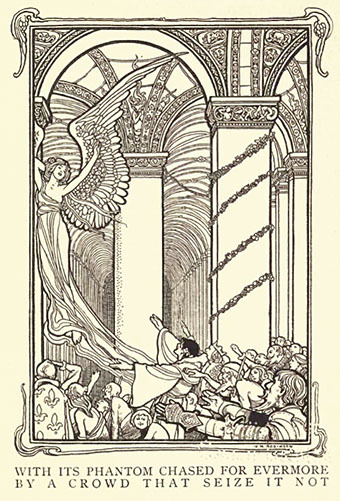
That motley drama—oh, be sure It shall not be forgot! With its Phantom chased for evermore By a crowd that seize it not, Through a circle that ever returneth in To the self-same spot, And much of Madness, and more of Sin, And Horror the soul of the plot.
But see, amid the mimic rout, A crawling shape intrude! A blood-red thing that writhes from out The scenic solitude! It writhes!—it writhes!—with mortal pangs The mimes become its food, And seraphs sob at vermin fangs In human gore imbued.
Out—out are the lights—out all! And, over each quivering form, The curtain, a funeral pall, Comes down with the rush of a storm, While the angels, all pallid and wan, Uprising, unveiling, affirm That the play is the tragedy, 'Man,' And its hero, the Conqueror Worm."
Reference 1.Quinn, Arthur Hobson. Edgar Allan Poe: A Critical Biography. Baltimore: The Johns Hopkins University Press, 1998: 391. ISBN 0-8018-5730-9
I’ll be honest and admit I went into this one somewhat dubious. The Conqueror Worm was a title that left me unsure what I was going to get, and it did not scream out to me. Much to my surprise, I adored this one. It came together well and gave more than expected. It’s not a poem that will work for everyone, but I enjoyed this one a lot more than the title had me expecting. It’s certainly one of Poe’s poems that felt like a hidden gem.
While I appreciate a good man-eating worm--any of the millions in the nonfiction world and the dozens in fiction--the majority of the poem wasn't about the worm. I think the earlier part of the poem was a funeral or something parallel. The language in that part is more Gothic, exclamation point!, words not used in English anymore, and so I didn't get into the rhythm. I like the ending though. Overall though I prefer other Poe poems.
the poem is part if the story ' Ligeia ' written by poe which is wow 😮 😮 😮 there is a whole paragraph in which he was describing her eyelashes ☺️ another one for her nose one for her mouth, another for her intellectual and one for her eyes "I cannot speak of this process in its earthly sense. Her eyes were, I must believe, far larger than the ordinary eyes of our own race. They were even fuller than the fullest of the gazelle eyes of the tribes of the valley of Nourjahad. Yet it was only at intervals—in moments of intense excitement—that this peculiarity became more than slightly noticeable in Ligeia."
and after all of that he is saying that he has failed to describe her 🫠 Poe 's love and obsession with his wife was really indescribable. I just love that 🥰
Very interesting depiction of death by using a worm, as they scavenge remains that provide nutrients to the earth. A pretty grim read that illustrates how life, to Poe, is meaningless and that we as man define ourselves through delusions of grandeur. I enjoy the allegory of “Man” being a play, and have life be a stage for the world to see. My favorite line has to be “While the orchestra breathes fitfully, the music of the spheres” (music is universal!)
This entire review has been hidden because of spoilers.
This is my favorite Poe-em. The terror! The despairing impotence of the mimes and spectators alike... and hauntingly beautiful writing. This poem is best read in the greatest Poe short story: Ligeia, because I could understand why someone would find The Conqueror Worm's themes shallow--- but in the context of Ligeia, the poem retains its beauty and attains newfound meaning.
I did not understand this one as much as The Raven or Annabel Lee, but I definitely enjoyed the flow of the stanzas and I will work on appreciating the meaning of this poem more and more as time goes by.
Poe is back to thinking about death in this one with a clear reference to death in. the title. Somewhat mournful but not as much as you would expect. Nice imagery, but not one of my favourites.